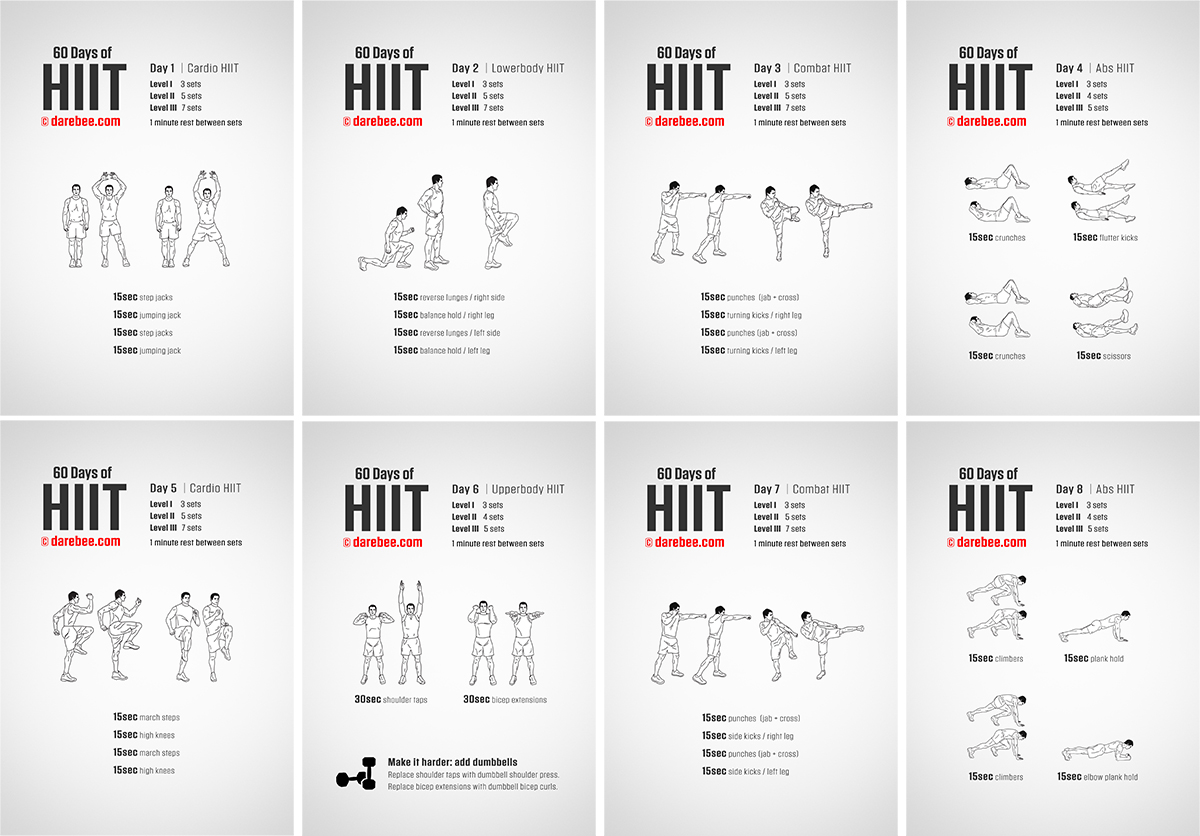
60 Days of HIIT is a two-month, no-equipment interval training program built for maximum return on minimum time. Every workout is one minute of actual work per set: either four 15-second intervals run back to back, or two 30-second blocks on the upper body days. Then a full minute of rest, and you go again. Most days scale to three, five or seven sets; the abs and upper body days scale to three, four or five, because those muscles fatigue on a different clock. There are no push-ups anywhere in the program and nothing to buy - the upper body days offer an optional pair of dumbbells if you own them, and work perfectly well without.
The program runs on a clean eight-day cycle that repeats from the first day to the last: cardio, lower body, combat, abs, cardio again, upper body, combat again, abs again. That gives you a combat session and an abs session every fourth day, cardio twice per cycle, and the lower and upper body days spaced far enough apart to recover between them. Nothing about the rotation ever changes, which means you always know what tomorrow is - and each day type builds its own arc underneath the routine. The combat days grow from single strikes into five-strike combinations. The lower body days climb through a ladder of lunge variations. The abs days upgrade their anchor from crunches to sit-ups halfway through, and the cardio days leave the standing position entirely and start pairing running-in-place work with plank drills before returning to their feet for the finish.
It suits anyone short on time, anyone who wants their conditioning and their midsection trained in the same session, and anyone who would rather work hard for twelve minutes than moderately for an hour. Pick your set count honestly each morning - three sets finished properly beats seven abandoned at set five, and the scaling is there to be used rather than admired. Take the full minute of rest; the intervals only work if you arrive at each one able to attack it. Finish the sixty days and you can start again the next morning at a higher set count, which is the cleanest measure of progress this program offers.

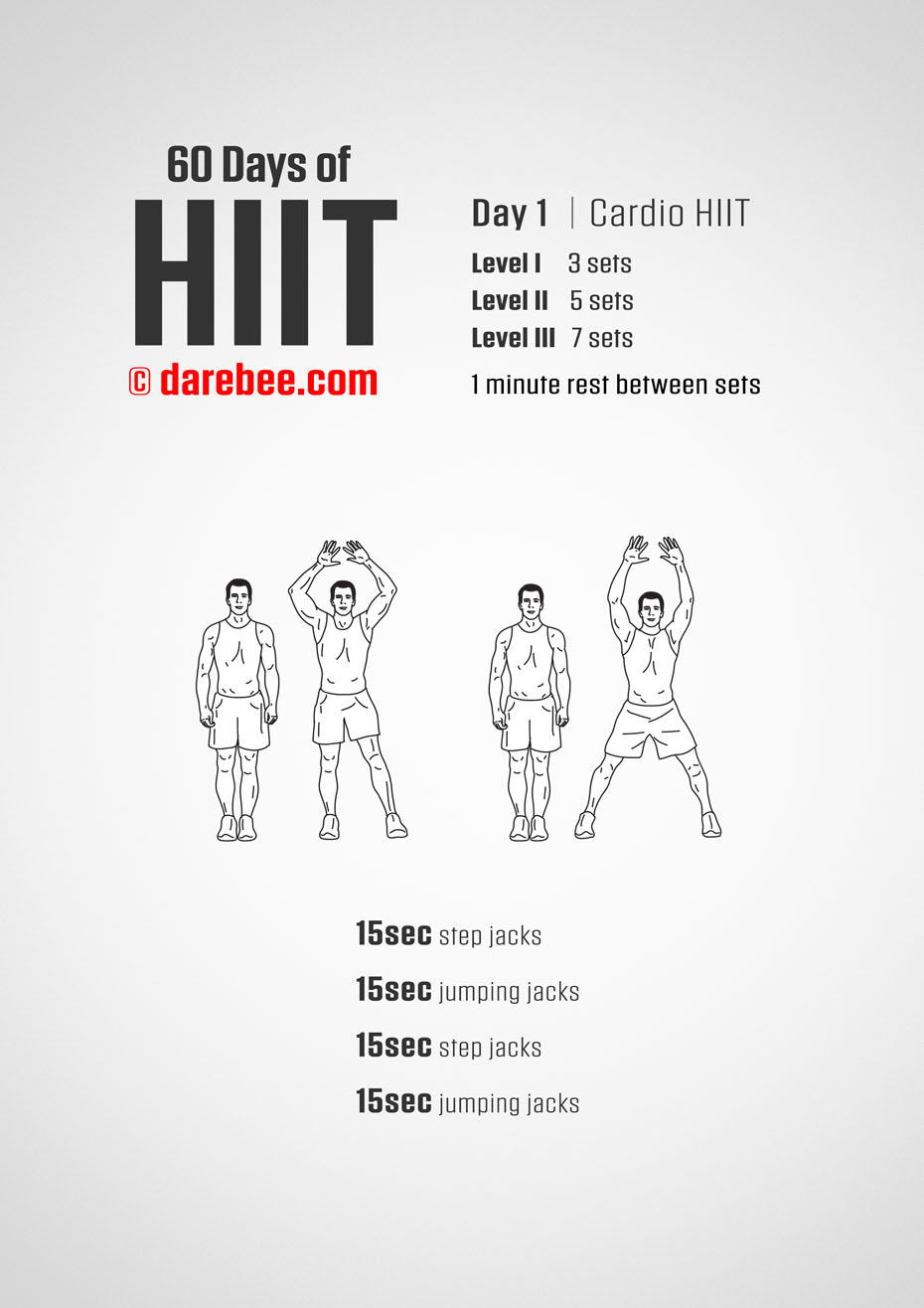
60 Days of HIIT opens with the shortest possible introduction to its own format. Four intervals of 15 seconds run back to back - step jacks, jumping jacks, step jacks, jumping jacks - and then a full minute of rest before the whole thing repeats. Three sets, five, or seven, depending on what you have in the tank today. Two exercises, one minute of actual work per set, and a program that will use this exact shape for the next two months.
The pairing is the entire lesson. A step jack is a jumping jack taken apart: the same overhead arm sweep, the same wide-to-narrow leg pattern, but one foot steps out at a time and neither leaves the floor. The jumping jack puts it back together and adds the hop. Alternating them inside a single set means your heart rate climbs during the jumping intervals and holds during the stepping ones instead of dropping away, which is precisely what interval training is built to do.
On step jacks, step wide enough that your stance genuinely changes and drive both arms all the way overhead rather than stopping at shoulder height. On jumping jacks, land through the whole foot with soft knees and let the arms and legs arrive together. Fifteen seconds is too short to pace yourself, but it is also short enough that three sloppy reps eat a meaningful chunk of the interval.
Day 1 of 60 asks for one thing only: learn the rhythm of fifteen seconds on and no thinking.
Make it Harder: Count your jumping jacks in the first set and refuse to finish any later set with a smaller number.
Make it Easier: Run all four intervals as step jacks and keep the full set count - the format still gets learned, the floor stays intact.

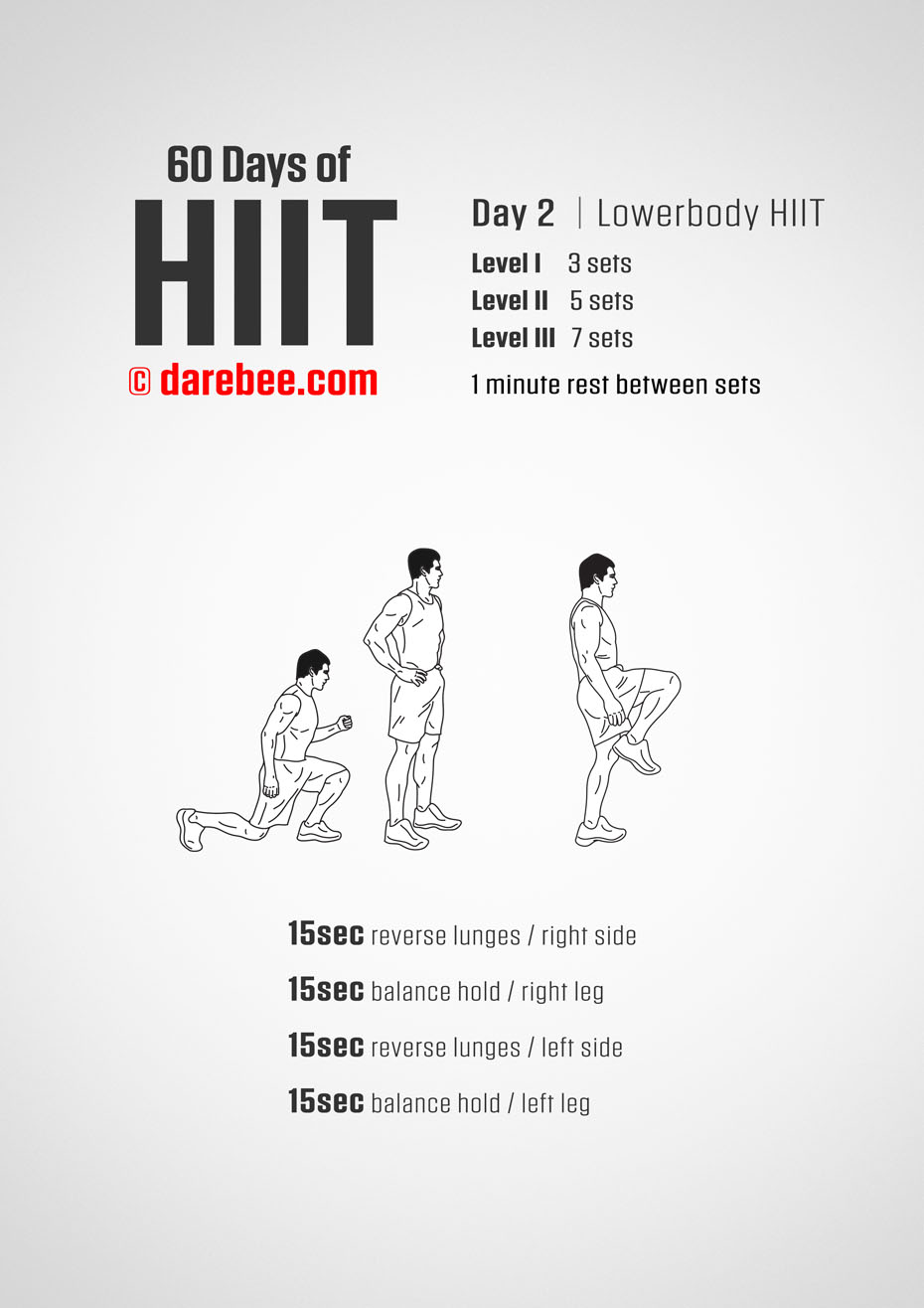
Day 2 takes the interval format and gives it a side. The four 15-second intervals split down the middle: reverse lunges on the right, a balance hold on the right, then reverse lunges on the left and a balance hold on the left, with the standard minute of rest between sets. Three sets, five or seven. Each leg gets 30 seconds of continuous attention before the other one is allowed to take over.
Moving work and still work on the same leg, back to back, is the design here. The reverse lunge is the dynamic half: step back, drop the rear knee toward the floor, drive up through the front heel, repeat for the full fifteen seconds. The balance hold is the still half - stand tall on one leg with the opposite knee drawn up to hip height and the hands gathered at the raised shin, and simply refuse to wobble. Your standing leg has just been working for fifteen seconds, so the hold arrives on a leg that is already asking questions.
Keep the lunges shallow enough that you can keep the tempo honest - the interval rewards clean repeatable reps, not one heroic deep one. In the hold, fix your eyes on something that is not moving, stack your hips level, and stand through the whole foot rather than gripping with your toes. If the ankle starts chattering, that is the exercise working, not failing.
Two days in and your legs learn the program's favourite trick: work one side until it complains, then ask it to stand still.
Make it Harder: Let go of the shin during the balance holds and hold your arms out to the sides instead - nothing to grip, nothing to help you.
Make it Easier: Rest one fingertip on a wall for the balance holds and step back into a shorter lunge.

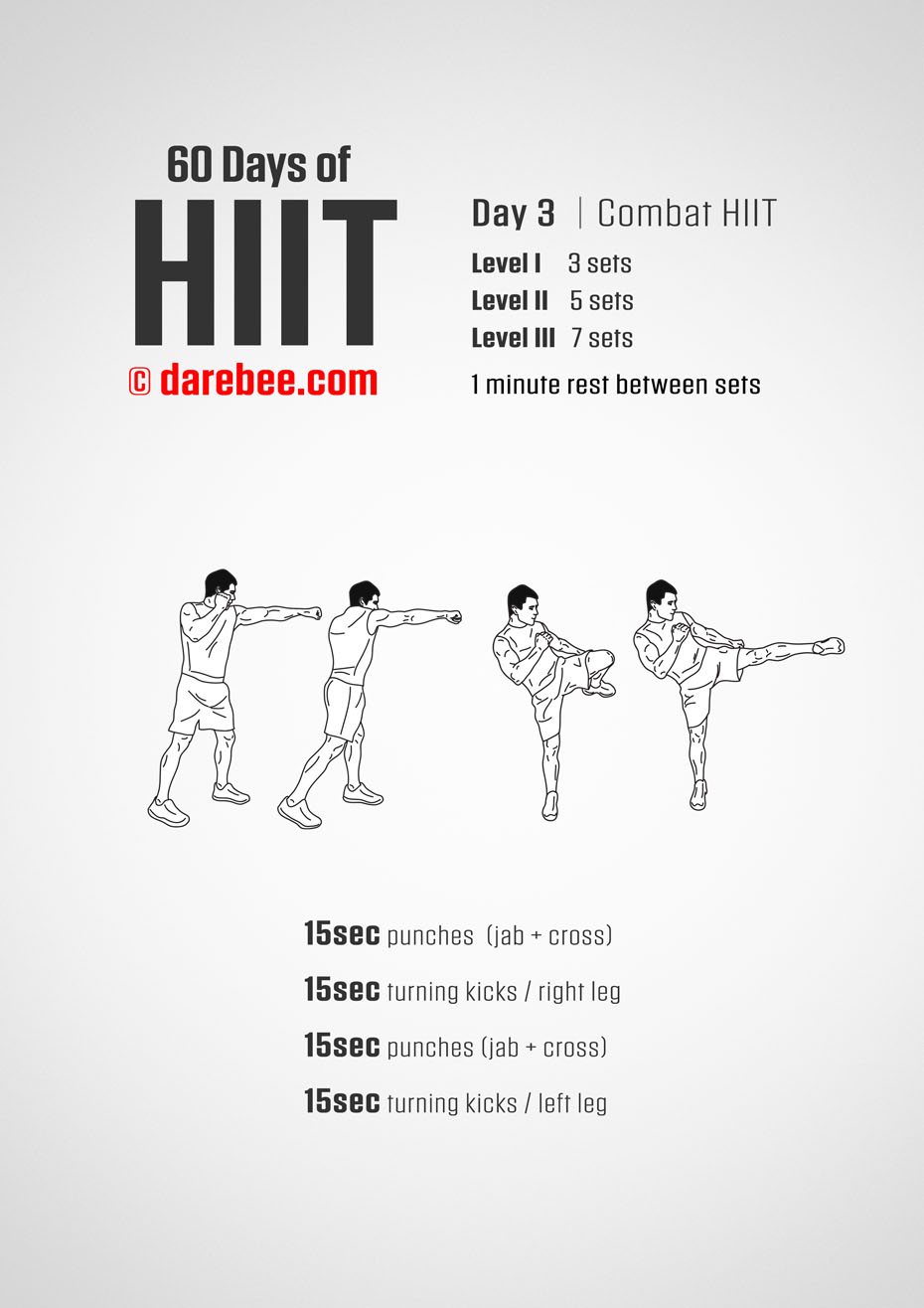
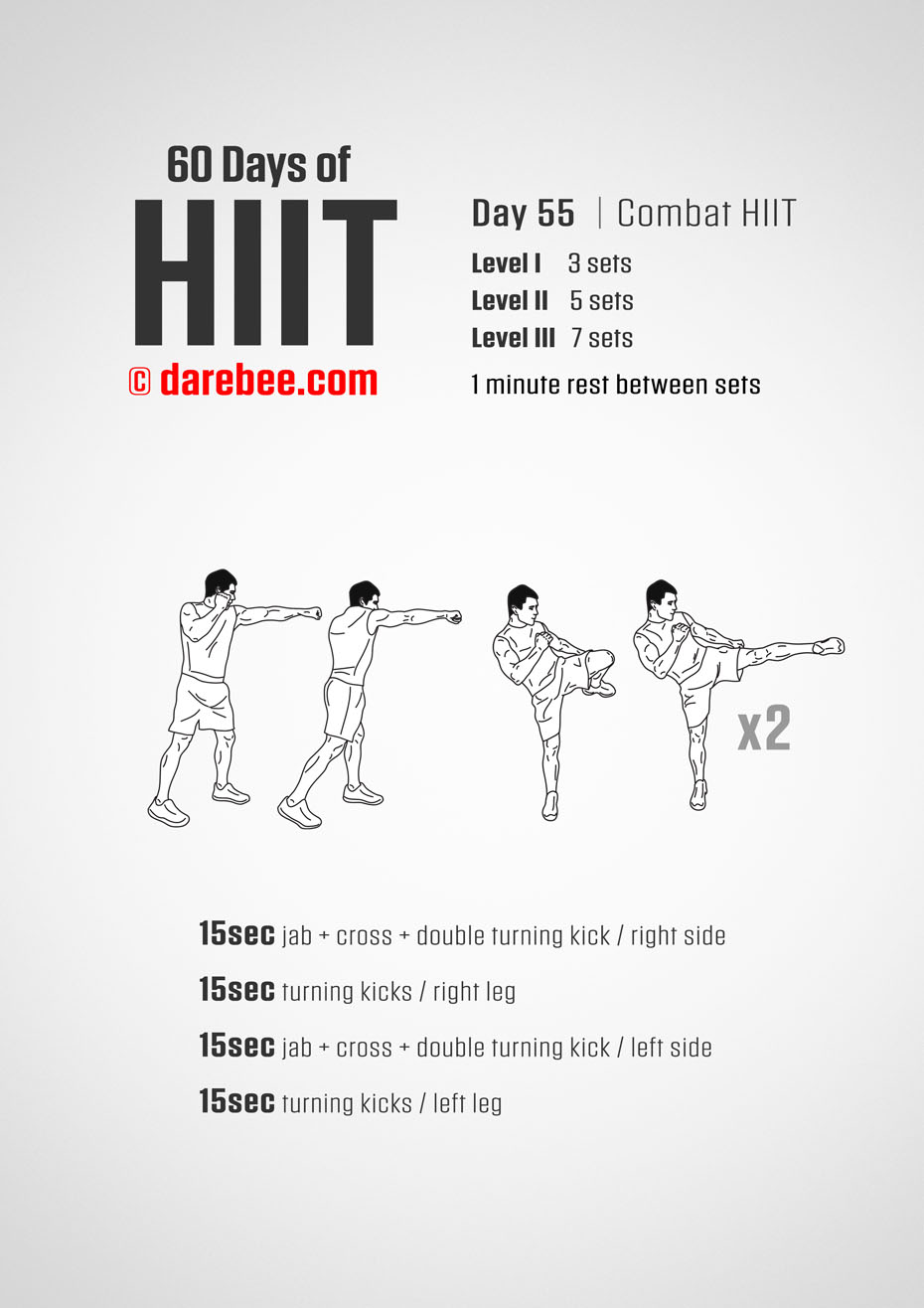
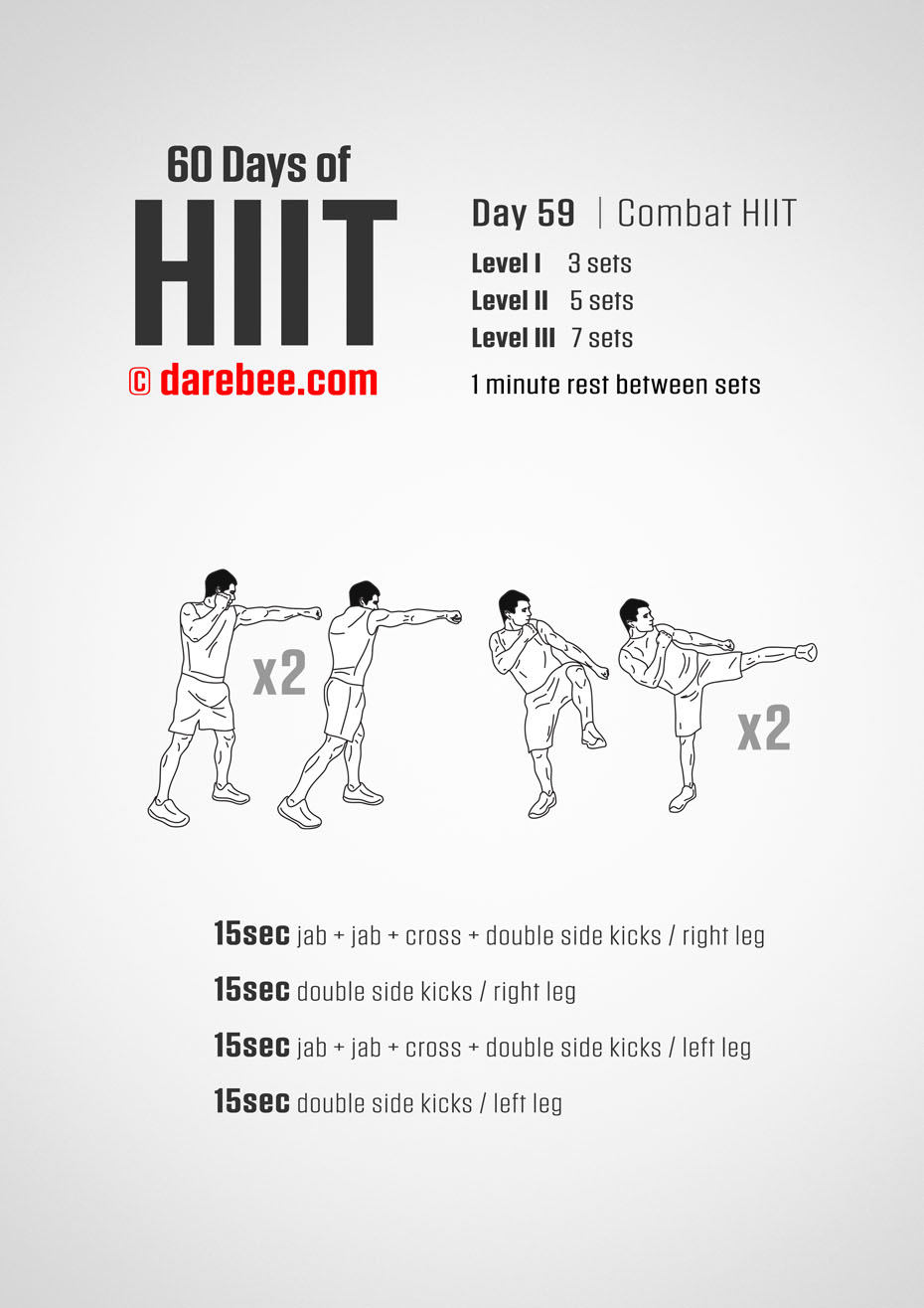
The first combat day arrives on Day 3, and it will keep arriving every fourth day from here. The structure is the familiar one - four 15-second intervals, one minute of rest, three to seven sets - and the content is a punch interval and a kick interval, run twice: punches, turning kicks on the right leg, punches again, turning kicks on the left.
The punches are a jab and cross combination, thrown from a staggered stance with the lead hand and then the rear hand. The turning kick is drawn in two stages: the knee lifts and chambers across the body first, then the leg whips out and the hip rolls over to deliver the kick at waist height. That two-stage picture is not decoration - the chamber is where a turning kick gets its power, and skipping it turns the movement into a swing of the leg. Alternating punches and kicks means the upper body works while the standing leg recovers, and the whole session doubles as balance training you did not sign up for.
Punch from the shoulder, not the arm, and let your rear hip rotate into the cross. Bring the hand straight back to your cheek afterwards - the retraction is half the technique. On kicks, plant the standing foot flat, pivot it as the hip turns, and keep both hands up at your face for the entire interval. Height is not the goal; a controlled waist-high kick beats a wild one every time.
Combat day one: fists up, feet quick, and every fifteen seconds a new job.
Make it Harder: Throw the punch intervals as jab-cross-jab, three strikes to a cycle, without letting your guard drop between them.
Make it Easier: Kick to knee height and keep one hand free to touch a wall while the standing leg finds its footing.

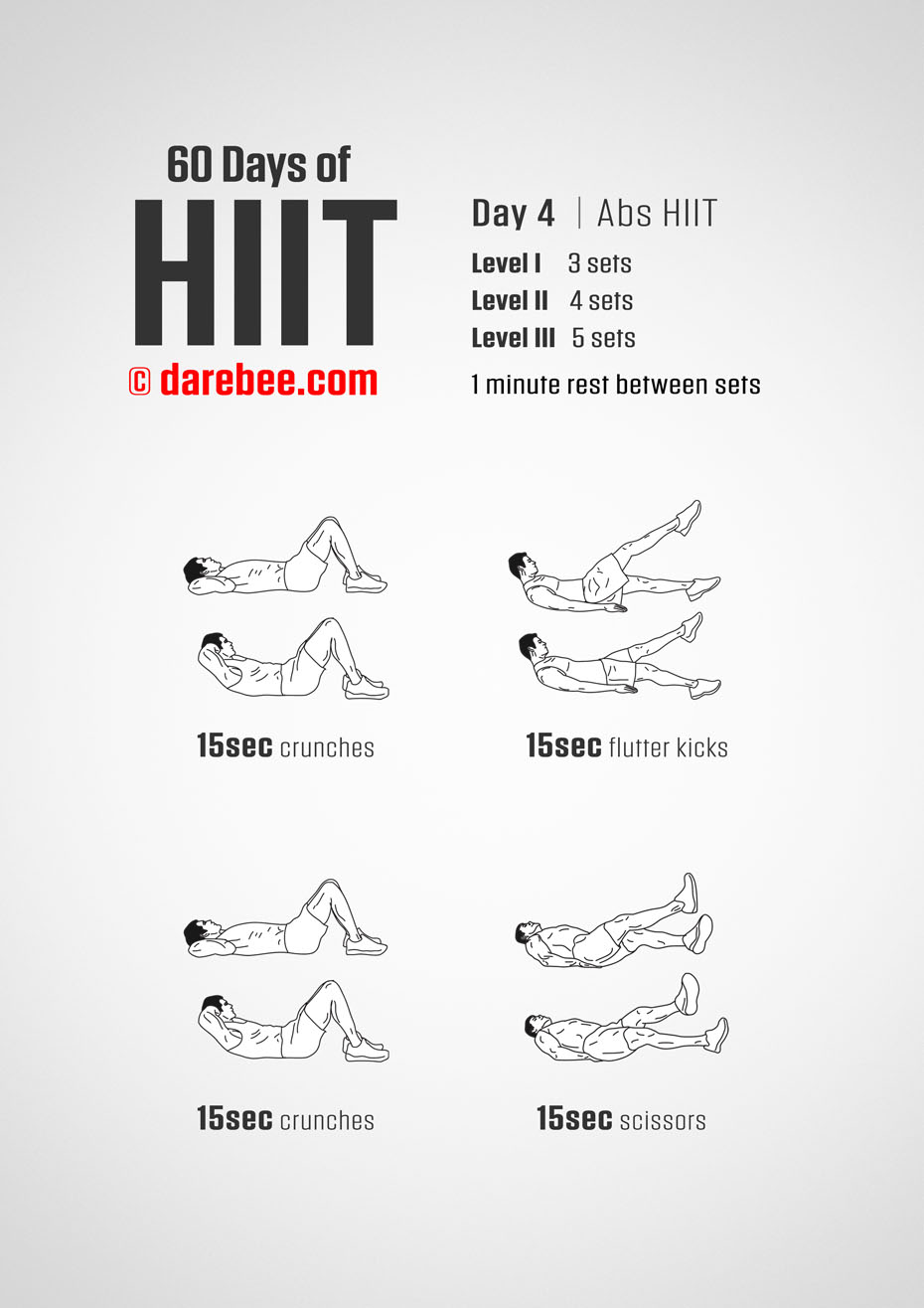
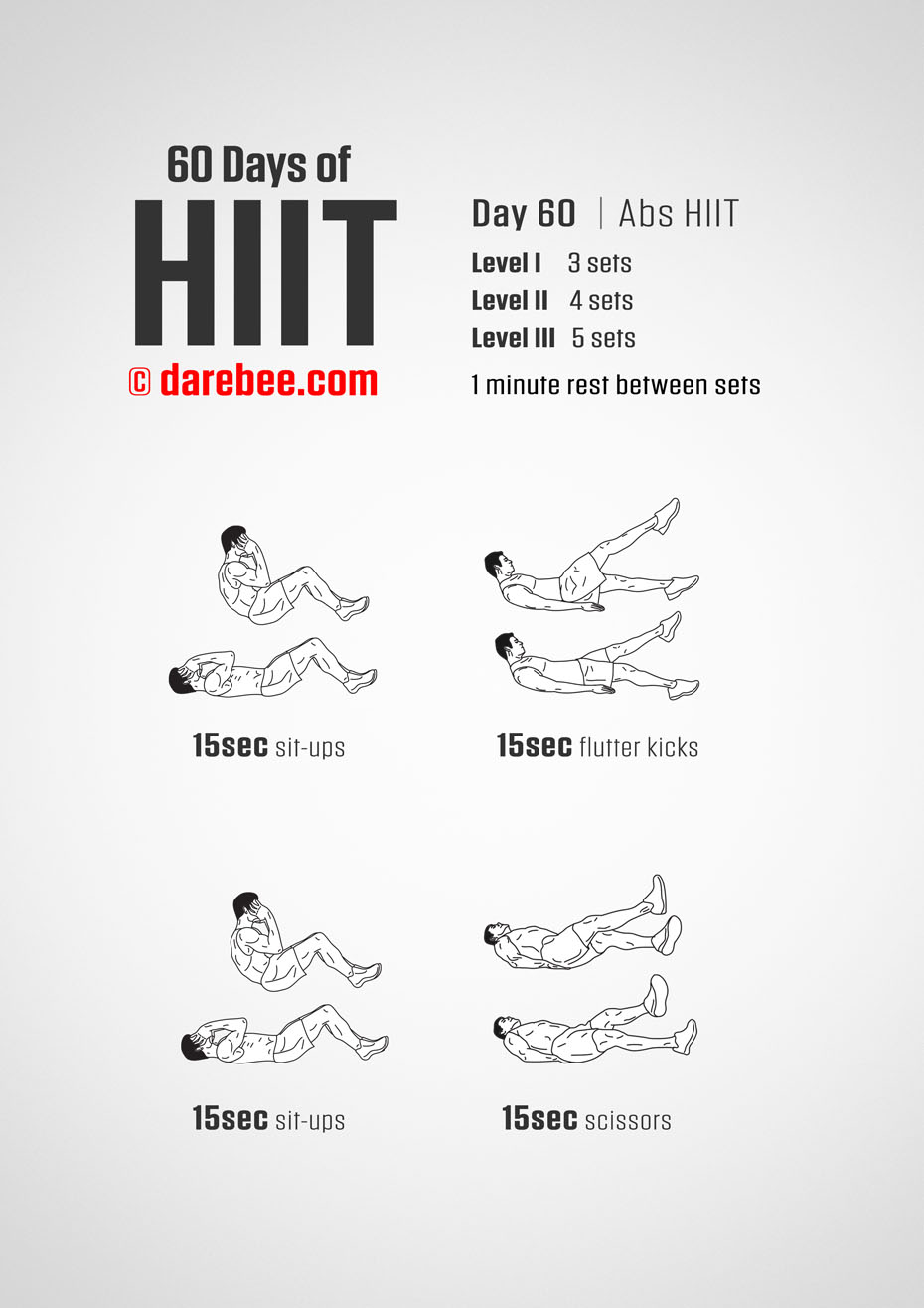
Day 4 is the program's first abs session, and the set counts change to match. Where the cardio and combat days scale to three, five or seven sets, the abs days run three, four or five - the midsection fatigues on a different clock, and the program respects it. The intervals themselves are unchanged: 15 seconds each of crunches, flutter kicks, crunches and scissors, then a minute of rest.
Crunches bookend the session for a reason. They are the direct upper-abdominal contraction, curling the shoulder blades off the floor while the lower back stays put. Between them sit two lower-abdominal intervals that look similar and work differently: flutter kicks alternate straight legs up and down through a small vertical range, while scissors cross one leg over the other horizontally. Vertical, then horizontal, with the same job underneath both - keeping your lower back pressed to the floor while your legs try to pull it off.
In the crunch, lead with your ribs rather than your chin and stop pulling on your neck the moment you notice you are. In flutter kicks and scissors, the lower the legs travel the harder your abs work and the more your lower back wants to arch - find the height where you can keep the small of your back in contact with the floor and stay there for the full fifteen seconds.
Every fourth day belongs to your midsection, and this is where that promise starts getting kept.
Make it Harder: Keep your head and shoulder blades lifted off the floor for the entire flutter kick and scissor intervals.
Make it Easier: Bend your knees to ninety degrees for both leg intervals - shorter levers, same lesson.

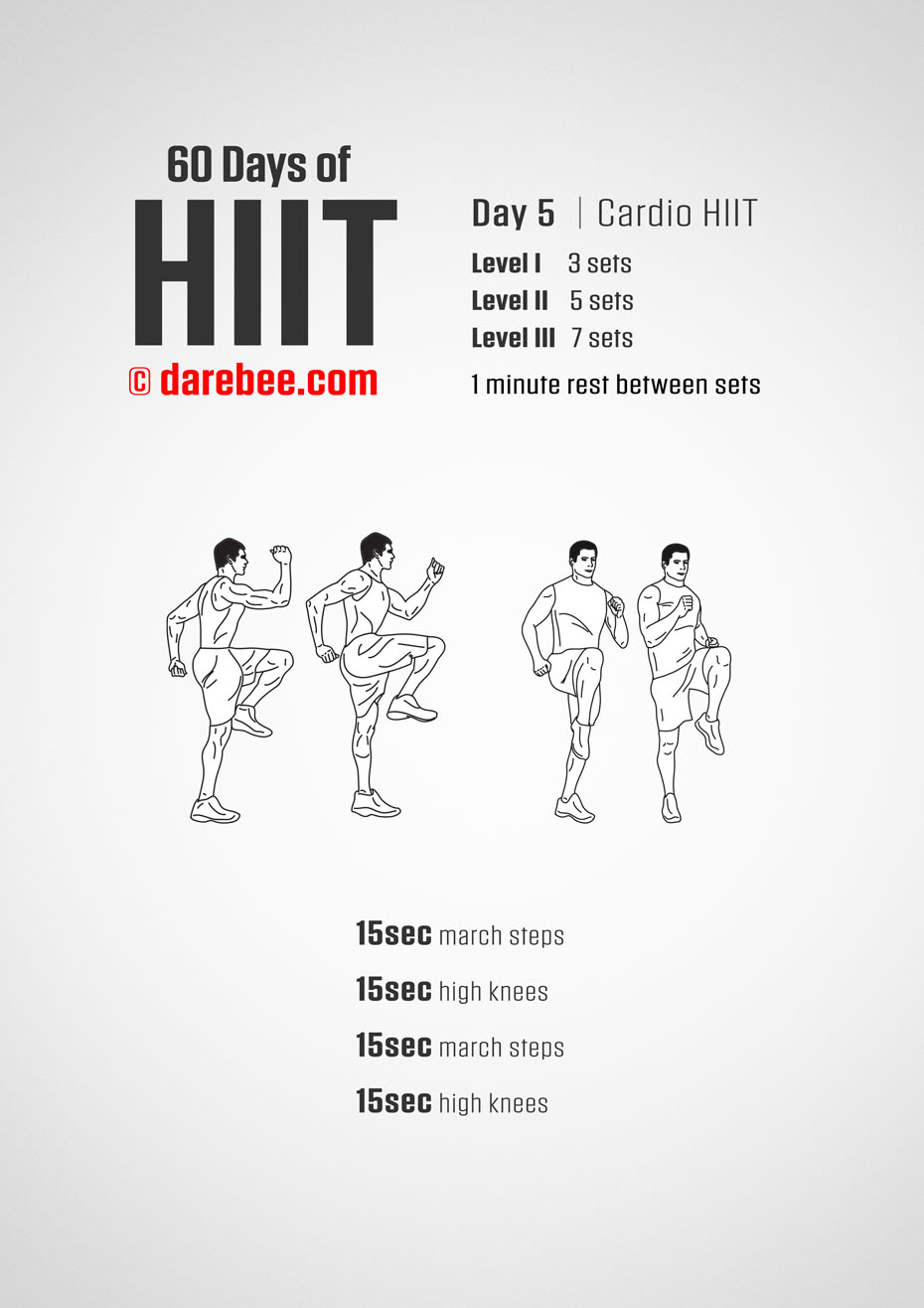
The second cardio day of the cycle keeps the shape and changes the engine. Four 15-second intervals - march steps, high knees, march steps, high knees - one minute of rest, three to seven sets. Both exercises are running in place; the only variable that changes between them is how high the knee gets and how fast it gets there.
That single variable is doing all the work. March steps lift the knee to roughly hip height at a steady walking cadence, arms swinging in opposition. High knees take the same pattern and turn the dial up: the knees drive higher and faster, and the exercise leaves the ground. Running the two in alternation gives you a genuine two-speed session where the slower interval never becomes a rest - your feet keep moving, your heart rate keeps its altitude, and the next fifteen seconds arrives with nowhere to hide.
March with intent rather than shuffling, and use your arms - a driven arm swing lifts the knee for you. On high knees, stay tall through the spine instead of leaning back, land on the balls of your feet, and aim for quick contact with the floor rather than height for its own sake. If your knees start dropping in the last five seconds, that is the interval doing its job.
Same two feet, two entirely different gears - and 60 seconds of work that feels considerably longer.
Make it Harder: Bring your hands to shoulder height and slap your palms with your knees on every high knee rep.
Make it Easier: Run the high knee intervals as a light jog in place with lower knees and keep the marching brisk.

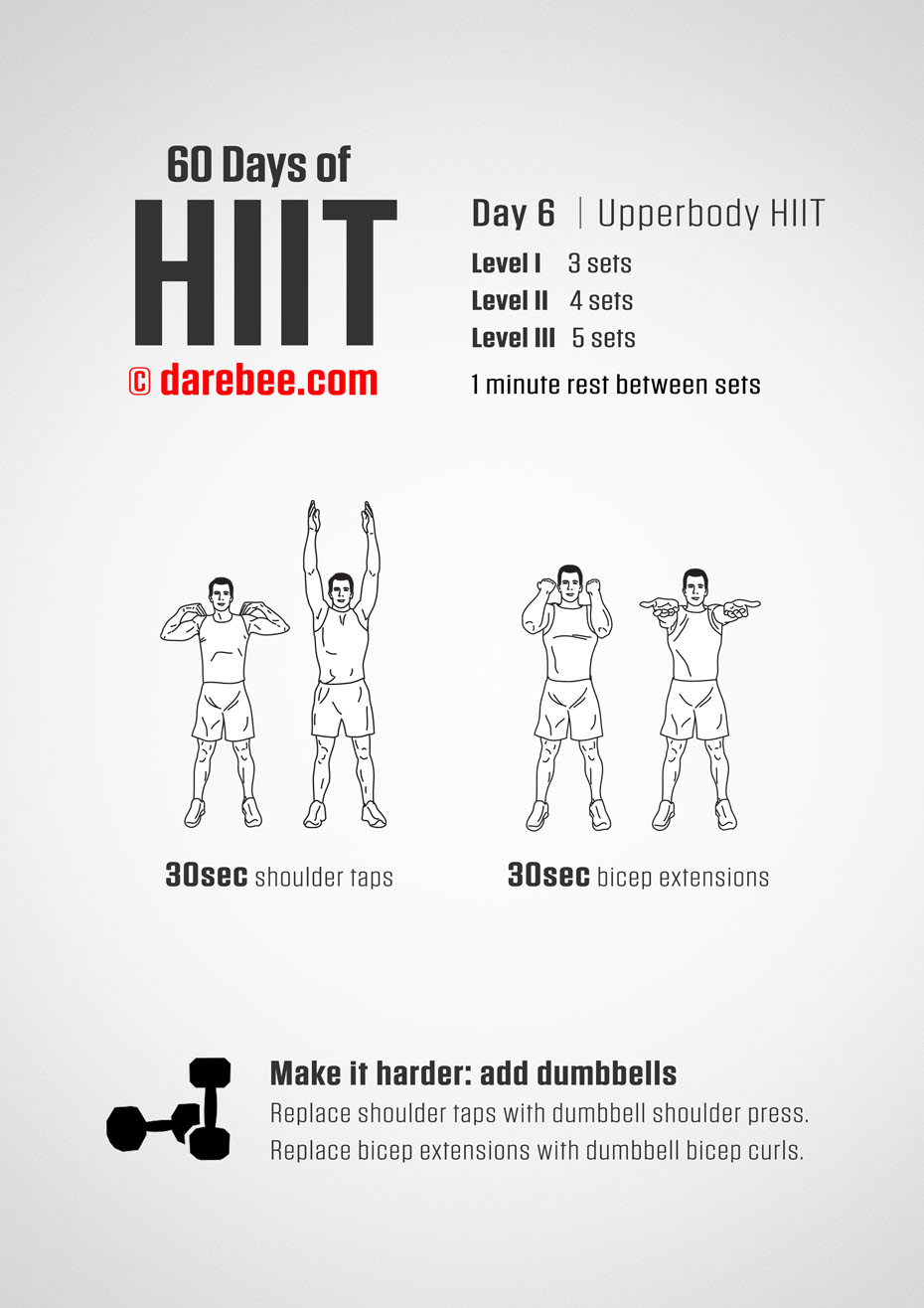
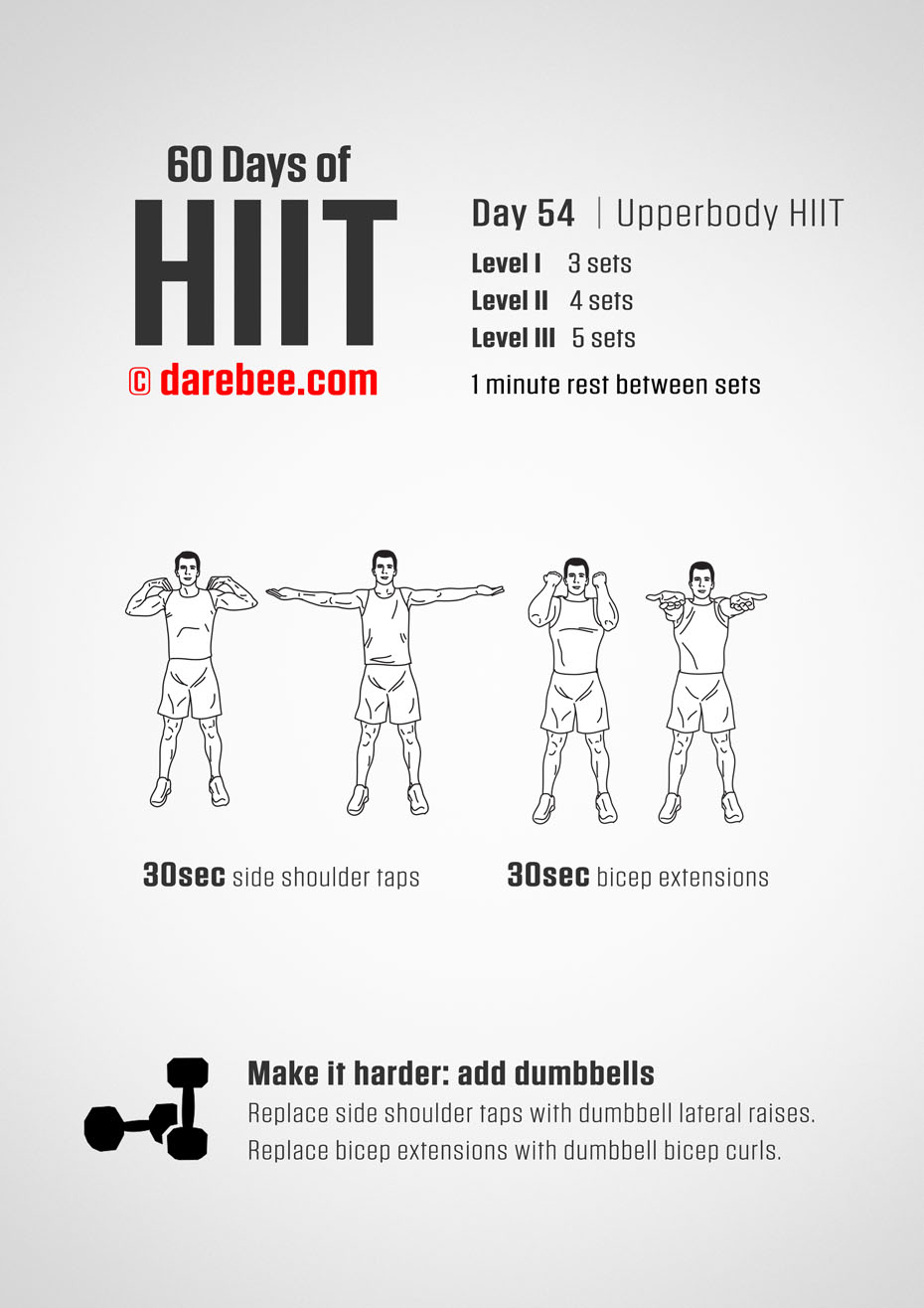
Day 6 changes the clock. The upper body days are the only sessions in the program that drop to two exercises of 30 seconds instead of four of 15, and they run three, four or five sets. Today it is 30 seconds of shoulder taps and 30 seconds of bicep extensions, with the usual minute of rest in between - the same total minute of work, delivered in two longer blocks instead of four short ones.
Both movements are standing and both are self-loaded. Shoulder taps as drawn here are the vertical one: fingertips to the tops of your shoulders, then both arms press all the way overhead to full extension and return. Bicep extensions are the horizontal one: fists start at the shoulders and the arms extend forward until they are straight, with the tension supplied by you rather than by any weight. Thirty seconds is long enough that the shoulders and arms have to keep producing that tension deep into the interval, which is the entire point of stretching these days out.
Press all the way to straight arms overhead on every shoulder tap rep and keep your ribs down rather than arching your lower back to find the last few degrees. On bicep extensions, clench your fists and tense the whole arm through both directions - if you are not supplying resistance, you are just waving. Keep your shoulders away from your ears throughout both.
No weights in sight, and your arms will still be counting down the last ten seconds.
Make it Harder: The card names it outright - pick up a pair of dumbbells and run these as a shoulder press and a set of curls.
Make it Easier: Split each 30-second block into 20 seconds of work and 10 of shaking the arms out, inside the same interval.

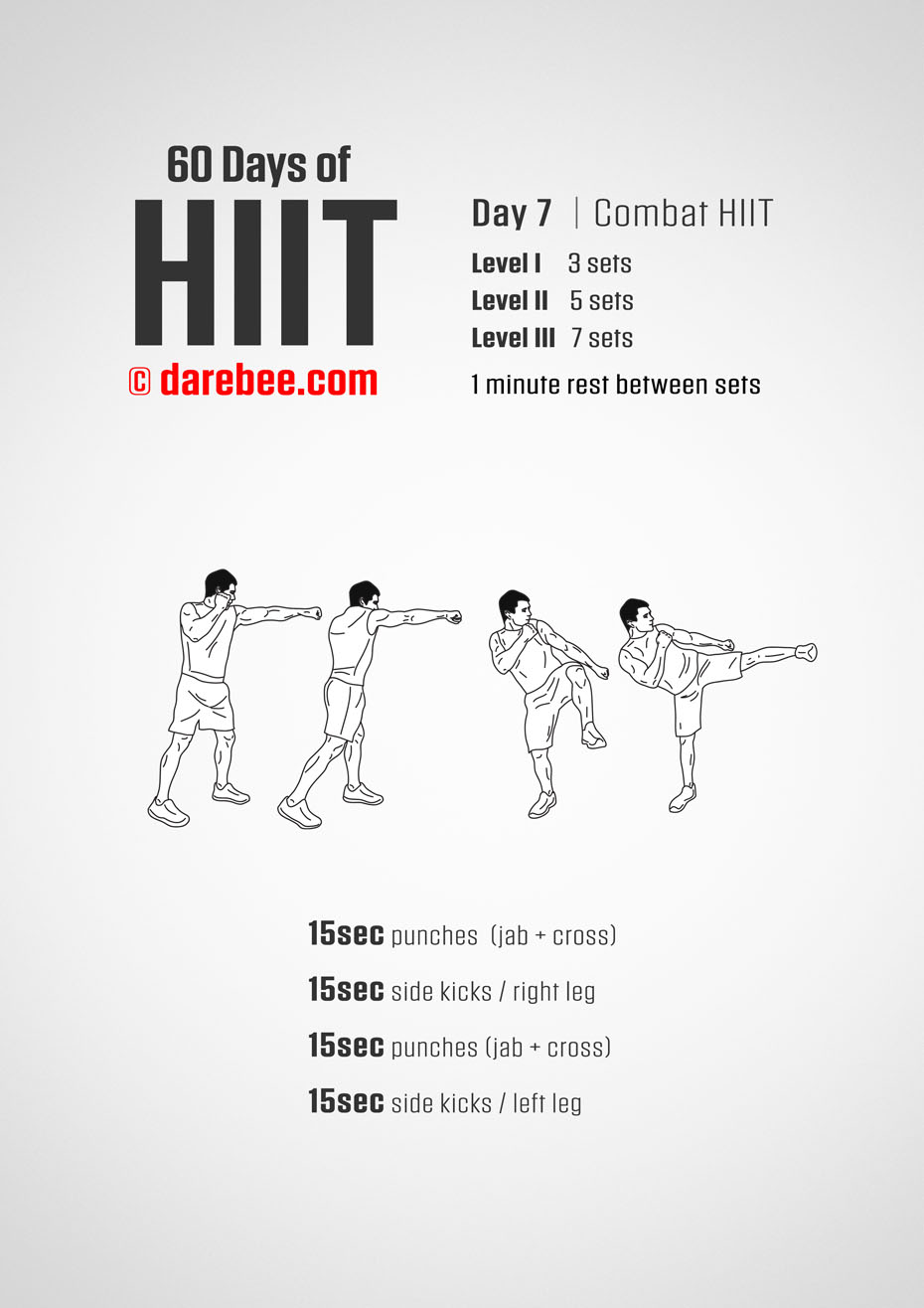
Combat returns on Day 7 with the punch interval intact and a new kick in the second slot. Four 15-second intervals - punches, side kicks on the right leg, punches, side kicks on the left - one minute of rest, three to seven sets. Same structure as Day 3, different weapon.
The difference between a turning kick and a side kick is the direction the hip travels, and the illustration shows it clearly: the knee chambers up and across, then the leg extends out to the side with the hip rolling over and the foot driving through in a straight line rather than whipping in an arc. It is a pushing kick rather than a swinging one, and it demands more from the standing leg because your body has to lean away to counterbalance the extension. Bracketing the kicks with punch intervals gives the standing leg exactly fifteen seconds to remember what it is for.
Chamber the knee first, extend second, and retract the leg under control rather than letting it fall - the way back is part of the kick. Keep your guard up even while your leg is out; the temptation to drop the hands as the kick extends is universal and worth resisting. On the punch intervals, breathe out sharply with each strike and keep your feet light rather than planted.
The second combat session lands, and your kicking leg already has two different jobs to remember.
Make it Harder: Hold the side kick at full extension for a beat before retracting - every rep, both legs.
Make it Easier: Kick low and slow, and reset your stance fully between reps rather than chasing the count.

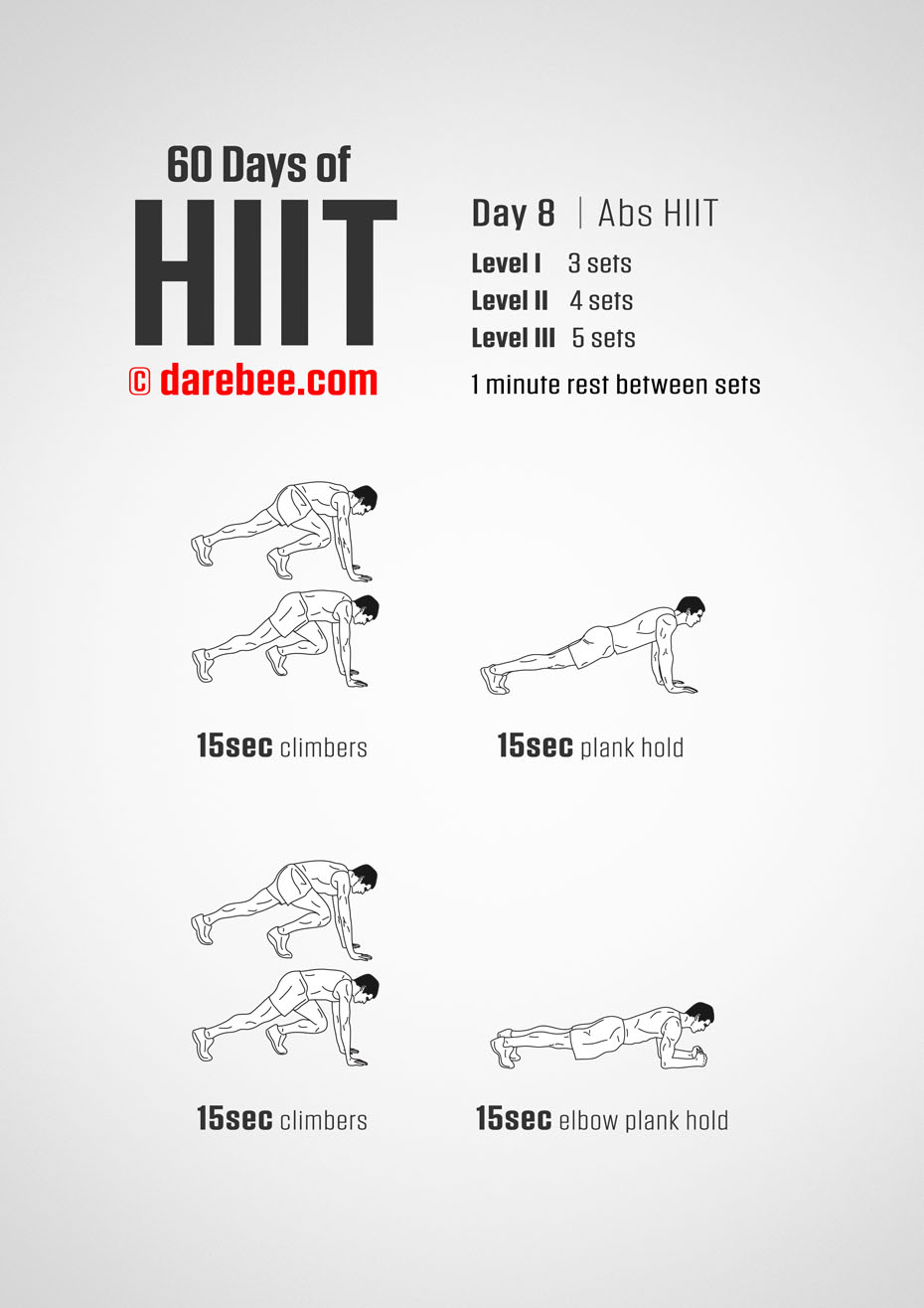
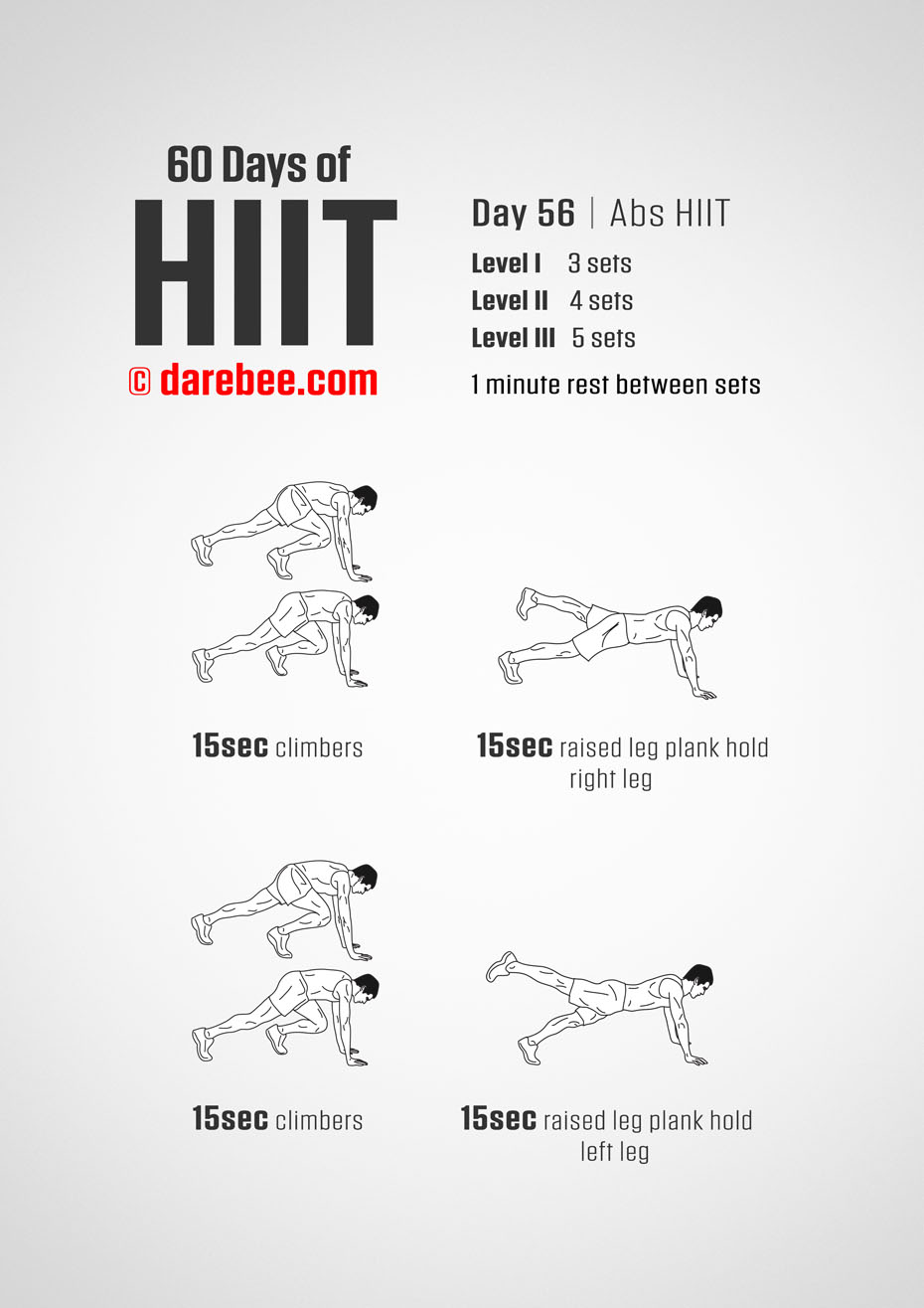
The second abs day of the cycle turns you over. Where Day 4 worked on your back, Day 8 works face down: 15 seconds of climbers, 15 of plank hold, 15 more of climbers, then 15 of elbow plank hold, at three, four or five sets with a minute of rest between them.
Climbers and planks are the same position doing opposite things. In a climber, you hold a high plank on your hands and drive the knees toward your chest one at a time, fast - the core is fighting to keep your hips from bouncing while your legs pump. In the plank hold, everything stops and the core simply resists gravity. Putting the still interval directly after the moving one means you arrive at the hold already breathing hard, which is when a plank stops being easy. The final interval drops you onto your forearms, shortening the lever and shifting more of the load from your shoulders to your midsection.
In climbers, keep your hips level with your shoulders instead of letting them ride up - the range gets shorter as you tire, the height should not change. In both holds, squeeze your glutes, tuck your ribs down and draw a straight line from your heels to the back of your head. On the elbow version, stack your elbows directly under your shoulders and press your forearms into the floor.
Fast, still, fast, still - your midsection gets no say in which one is coming.
Make it Harder: Lift one foot a couple of inches off the floor for the last five seconds of each plank hold, alternating feet between sets.
Make it Easier: Take both plank intervals from your knees and keep the climbers as written.

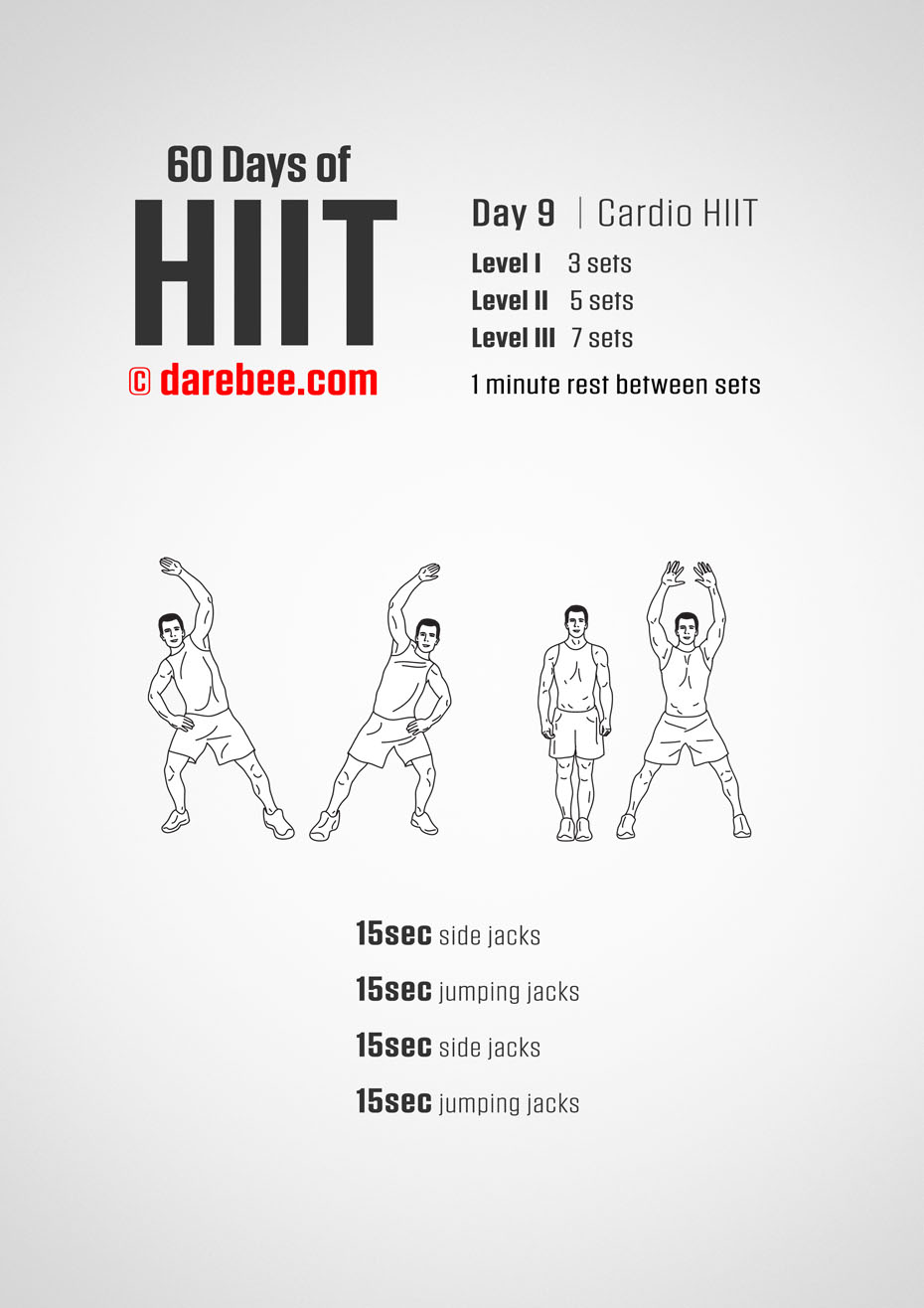
Day 9 opens the second cycle of the program, and the cardio day answers with a new partner for an old favourite. Four 15-second intervals - side jacks, jumping jacks, side jacks, jumping jacks - one minute of rest, three to seven sets. The jumping jack you already know from Day 1; the side jack is new.
The side jack, as drawn, is a standing side bend done from a wide stance: one hand rests on the hip while the other arm sweeps overhead and reaches over, bending the torso sideways, then the movement alternates. It puts the emphasis on the flanks and the obliques and it costs your legs almost nothing, which makes it the perfect counterweight to jumping jacks. You bounce, then you bend; the heart rate stays up while the load shifts from the legs to the sides of your trunk.
In the side jack, lean directly sideways with no forward collapse and no twist - the reach should travel from your hip to your armpit. Keep the wide stance stable and let the overhead arm lengthen the whole flank rather than just tipping your shoulders. On jumping jacks, keep the arms fully overhead: shorter arms mean an easier interval, and that is not what you came for.
Week two starts with your sides getting an invitation they did not receive in week one.
Make it Harder: Pause at the deepest point of each side bend for a full second before coming back up.
Make it Easier: Narrow your stance on the side jacks and reduce the bend to whatever range feels comfortable through the ribs.

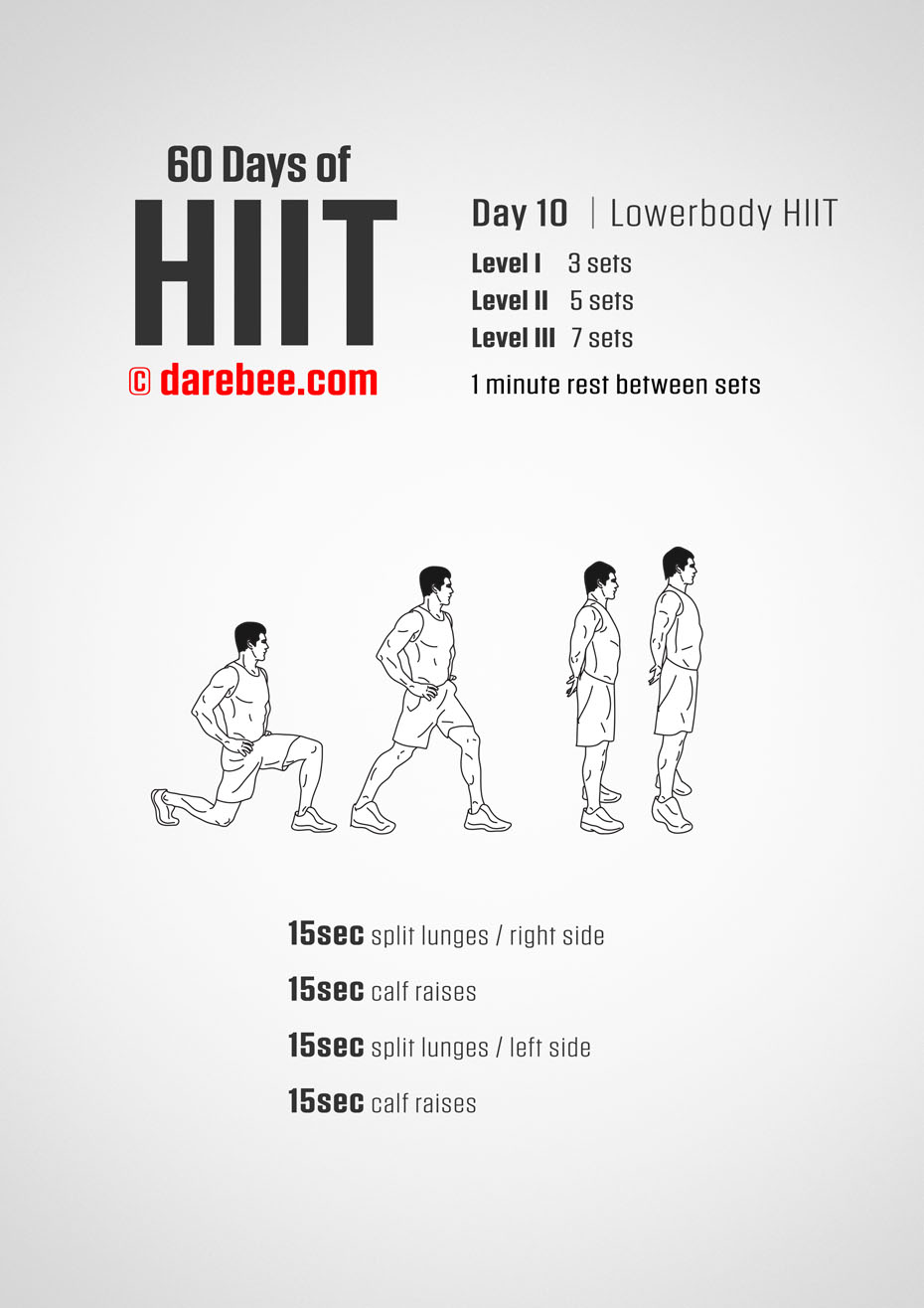
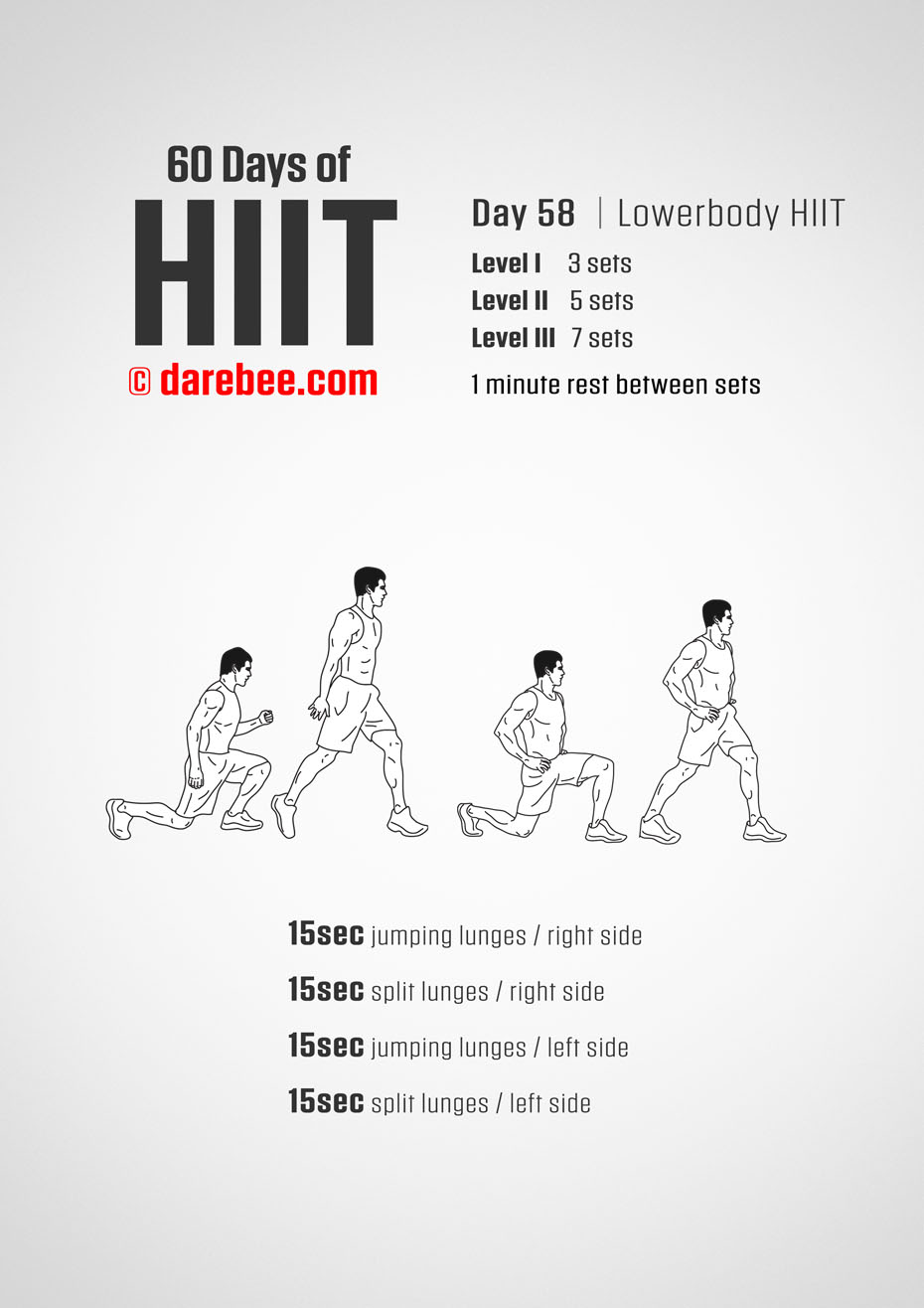
The second lower body day swaps the lunge and keeps the sides. Four 15-second intervals - split lunges on the right, calf raises, split lunges on the left, calf raises - three, five or seven sets with a minute of rest. The calf raise interval runs twice, once after each side, which makes it both an exercise and a breather for the working leg.
A split lunge is different from the reverse lunge of Day 2 in one important way: your feet do not move. You set a staggered stance and stay in it, dropping the rear knee toward the floor and driving back up without ever stepping in or out. That removes the step and leaves nothing but the up and down, which is why fifteen seconds of it burns the front thigh so efficiently. Calf raises then take the whole thing to the ankles - rise onto the balls of both feet, lower under control, repeat - and give the quads a genuine rest without stopping the session.
In the split lunge, keep your torso upright and your front shin close to vertical, and drop straight down rather than drifting forward. On calf raises, rise all the way onto the toes and lower all the way to the floor; the range is small enough already without you shortening it. Steady tempo beats fast partial reps in both.
Feet planted, knees busy - the split lunge gives you nowhere to travel and nothing to hide behind.
Make it Harder: Rise onto the toes of your front foot at the top of every split lunge and turn the whole interval into one continuous chain.
Make it Easier: Shorten your split stance and cut the depth in half - a smaller range done cleanly for fifteen seconds still counts.

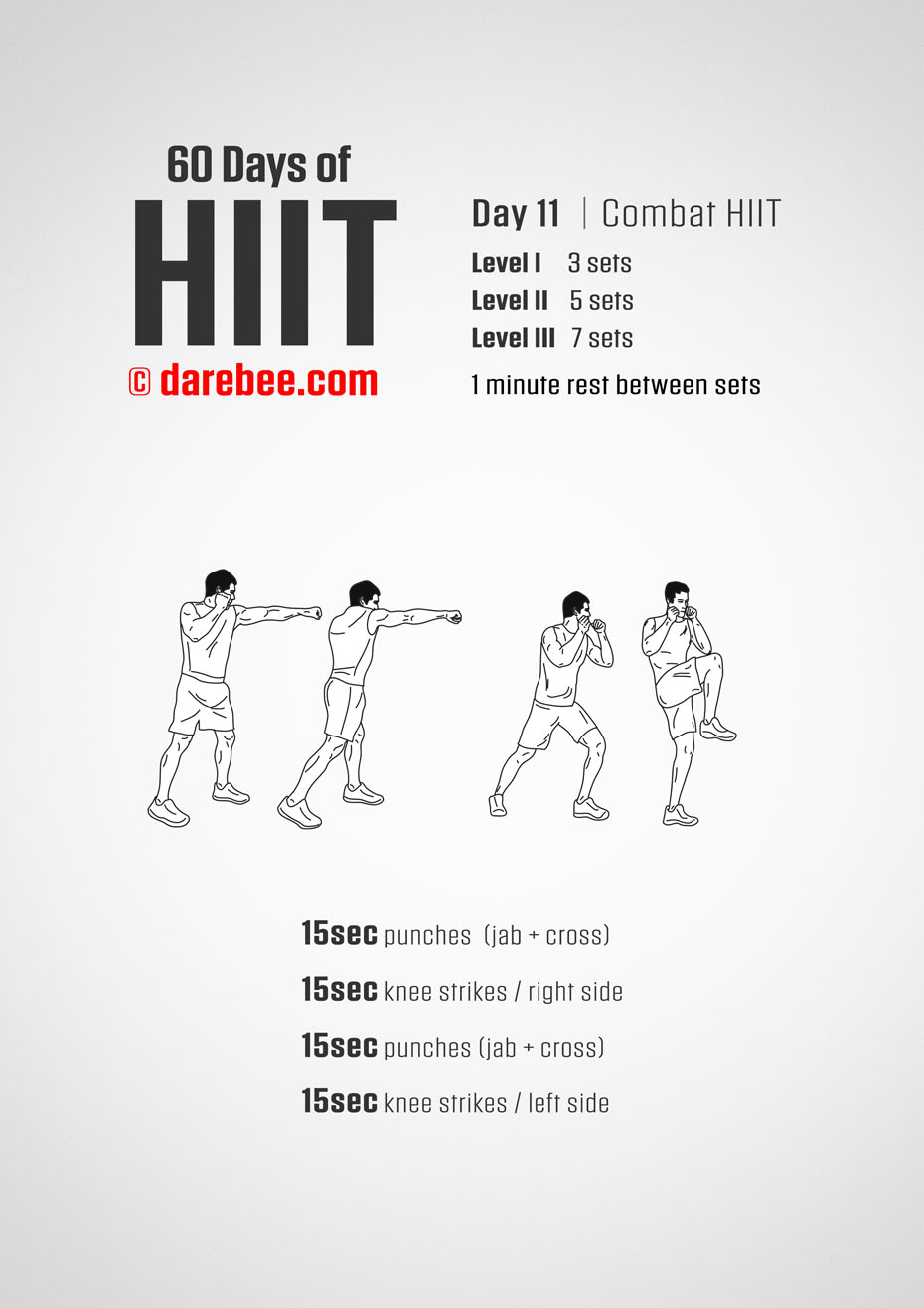
The third combat day completes the striking trilogy. Day 3 gave you a turning kick, Day 7 gave you a side kick, and Day 11 gives you the close-range option: knee strikes. Four 15-second intervals - punches, knee strikes on the right, punches, knee strikes on the left - one minute of rest, three to seven sets.
A knee strike is what happens when the distance closes and there is no room to kick. From a guarded stance, the rear knee drives up and forward while both hands pull down as though hauling an opponent onto the strike. There is no chamber and no extension - the whole movement is one sharp upward drive of the hip and knee, which makes it the fastest strike in the program and the one that hits your hip flexors hardest. Fifteen seconds of continuous knees will tell you exactly how much your midsection has been contributing to the last week and a half.
Drive the knee up rather than forward, and pull your hands down and in as the knee arrives so the two halves meet. Rise onto the ball of the standing foot with each strike to add range and keep your torso from collapsing backwards. Reset your guard between reps rather than leaving your arms low.
Three kicks, three distances - your combat toolkit is now complete enough to start combining.
Make it Harder: Add a small hop on the standing foot with each knee strike so the whole body commits to the strike.
Make it Easier: Take the knee to hip height without the hands pulling down, and let the tempo settle into something you can hold for the full fifteen.

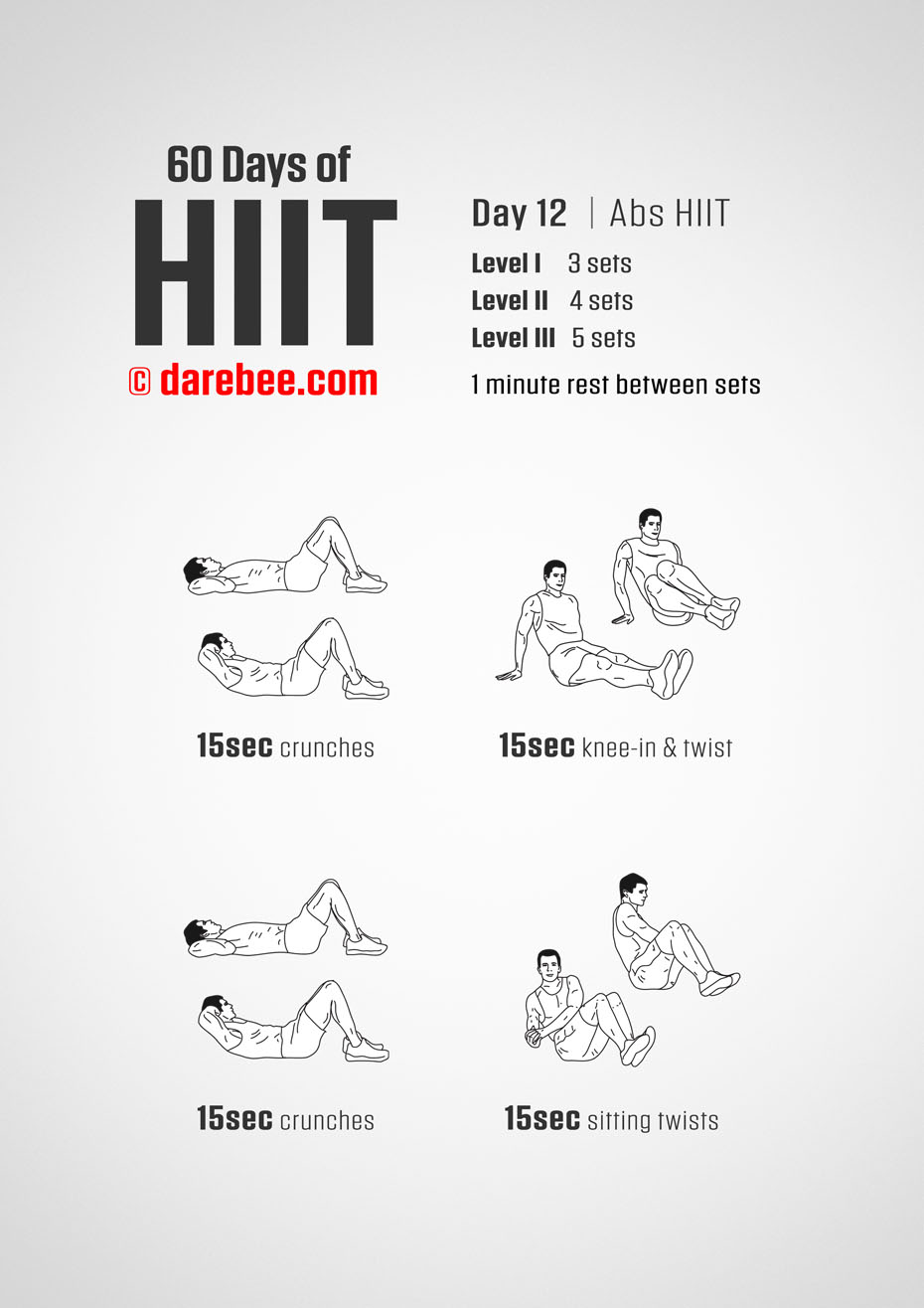
Day 12 keeps the crunch anchor and brings rotation into the abs work for the first time. Four 15-second intervals - crunches, knee-in and twist, crunches, sitting twists - at three, four or five sets with a minute of rest. The two new intervals are both seated, both rotational, and they differ in a way that is easy to miss and worth getting right.
The knee-in and twist starts seated with the legs extended and the torso leaning back on the hands, then draws the knees in toward the chest while the trunk rotates to meet them - a tuck with a turn built into it. The sitting twist keeps the knees bent and the feet hovering, and rotates the torso side to side with the hands moving across the body while the legs stay put. One rotates while the legs move, the other rotates while the legs hold. Between them they cover the obliques from both directions, and the crunch intervals in between keep the front of the abdominal wall in the conversation.
In the knee-in, pull the knees all the way in and let the rotation come from your ribs rather than your arms. In the sitting twist, keep your chest lifted and your feet off the floor for as long as you can hold them there - the moment the heels drop, the exercise becomes half of itself. Breathe out on each rotation.
Front, sides, front, sides - Day 12 finishes the tour of your midsection that Day 4 started.
Make it Harder: Keep your feet off the floor for the entire knee-in and sitting twist intervals, heels never touching down.
Make it Easier: Rest your heels lightly on the floor between rotations and keep the twisting range small.

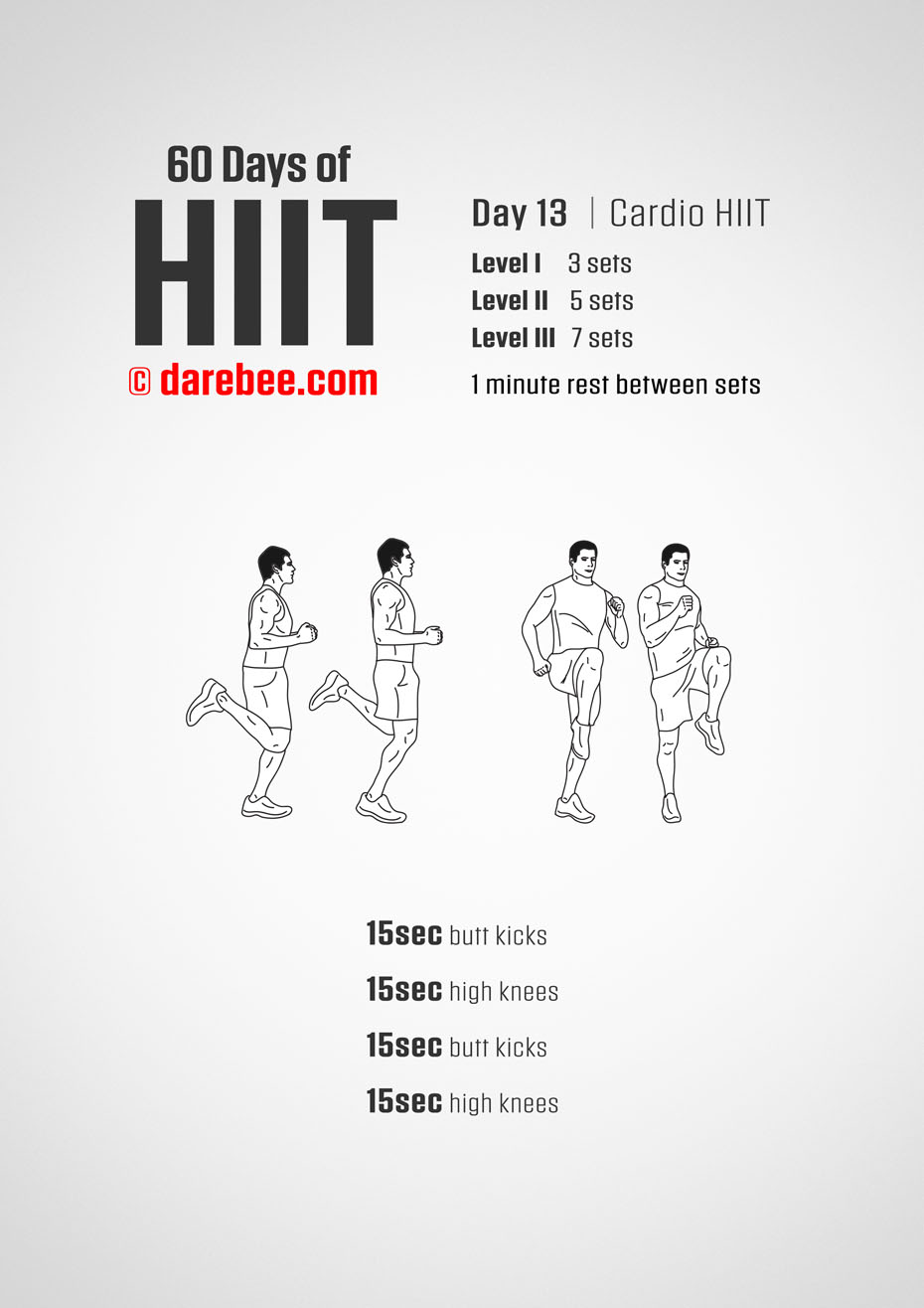
Day 13 runs the running-in-place family in a new pairing. Four 15-second intervals - butt kicks, high knees, butt kicks, high knees - one minute of rest, three to seven sets. Same footwork, opposite direction of travel.
High knees drive the thigh up in front of you; butt kicks flick the heel up behind you toward the glute. Front of the leg and back of the leg, alternating every fifteen seconds. That is not just variety - it means the hamstrings get a fast, light, high-repetition interval sandwiched between two hip flexor efforts, and the two muscle groups end up sharing the session rather than one carrying it. It also keeps your cadence honest: butt kicks are almost impossible to do slowly without them turning into a jog.
On butt kicks, keep your knees pointing at the floor rather than swinging forward, stay tall, and let your heels come all the way up to make contact. On high knees, drive the knees high and the arms hard. In both, quick light contact with the floor beats heavy stomping - your calves and knees will thank you around set four.
Heels up, knees up, and no interval long enough to let either one become comfortable.
Make it Harder: Bring your hands behind you at hip height and touch your heels to your palms on every butt kick.
Make it Easier: Take both intervals at a jog cadence and let the range be whatever your legs will give you today.

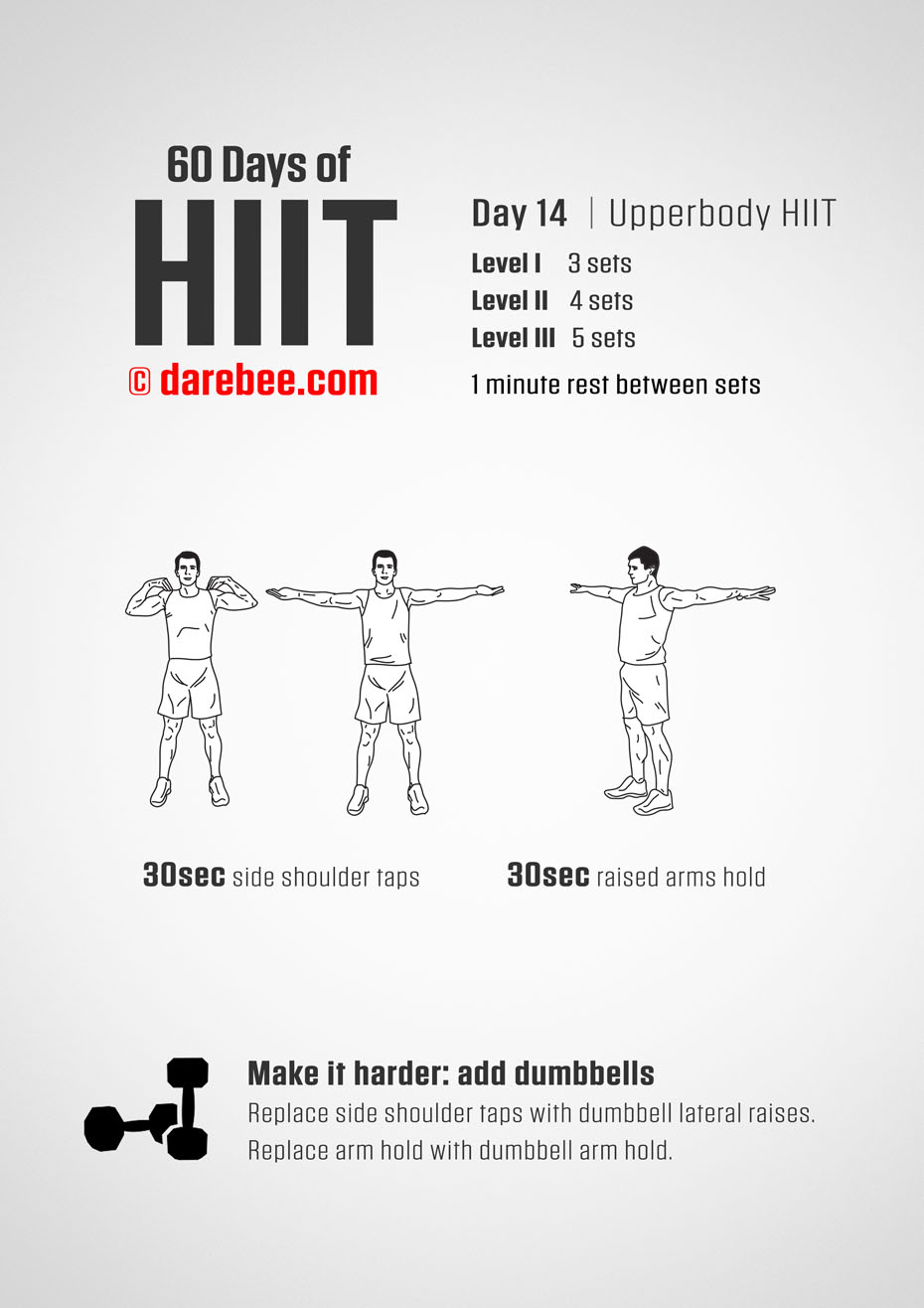
The second upper body day returns to the two-block format: 30 seconds of side shoulder taps and 30 seconds of a raised arms hold, three, four or five sets, one minute of rest. One moving exercise and one that does not move at all - which, over half a minute, is a considerably worse deal than it sounds.
Side shoulder taps are the lateral cousin of Day 6's overhead version: fingertips to the tops of the shoulders, then both arms open straight out to the sides at shoulder height and return. The raised arms hold takes that end position and simply keeps it - arms straight out to the sides, level with the shoulders, for the full 30 seconds. Doing the taps first means the hold arrives on a pair of deltoids that have already been raising and lowering for half a minute, and the last ten seconds of that hold is where the whole session lives.
Open the arms all the way to a straight line through both hands and stop the moment they drift above shoulder height. In the hold, keep your palms facing down, your elbows locked out, and your shoulders pulled away from your ears. When your arms start sinking, raise them back to level rather than accepting the new height - the count only counts at shoulder height.
Thirty seconds of holding your own arms up: the least impressive-looking hard thing in the program.
Make it Harder: Take the dumbbell route the card offers - lateral raises for the taps and a loaded arm hold for the second block.
Make it Easier: Drop your arms to a 45-degree angle for the hold rather than full shoulder height, and keep them there without lowering further.

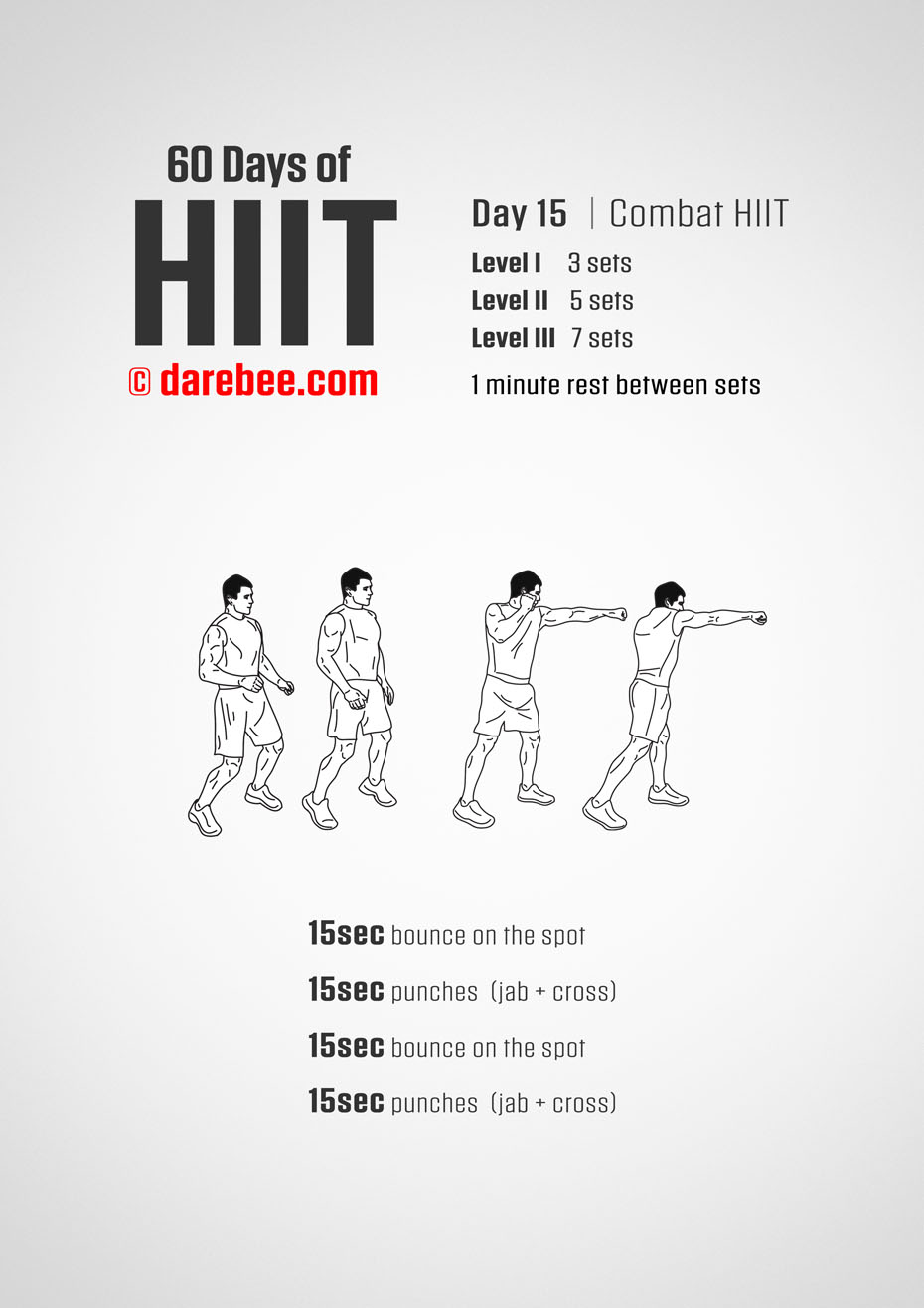
Day 15 is the first combat session without a kick in it, and the first to introduce footwork as an exercise in its own right. Four 15-second intervals - bounce on the spot, punches, bounce on the spot, punches - one minute of rest, three to seven sets.
The bounce is the fighter's stance in motion: a light, continuous shifting of weight from foot to foot with the knees soft and the guard up, staying loose and staying ready. It looks like almost nothing on paper and it is what every striker does between every exchange, because a fighter who stands flat cannot move. Alternating it with punch intervals builds exactly the pattern the sport actually uses - move, strike, move, strike - and turns your calves and ankles into part of the workout rather than passengers.
Bounce on the balls of your feet with small movements, not big hops, and keep the hands at your cheeks the whole time. When the punch interval starts, keep bouncing - the feet should not stop just because the hands have started. Jab and cross from the shoulders, rotating the rear hip into the cross, and let each hand snap straight back to the guard.
Halfway through the second month's opening stretch, and today the program teaches your feet what your fists already know.
Make it Harder: Keep bouncing through all four intervals so your feet never once settle for the whole set.
Make it Easier: Turn the bounce into a slow rocking shift of weight between the feet without leaving the floor.

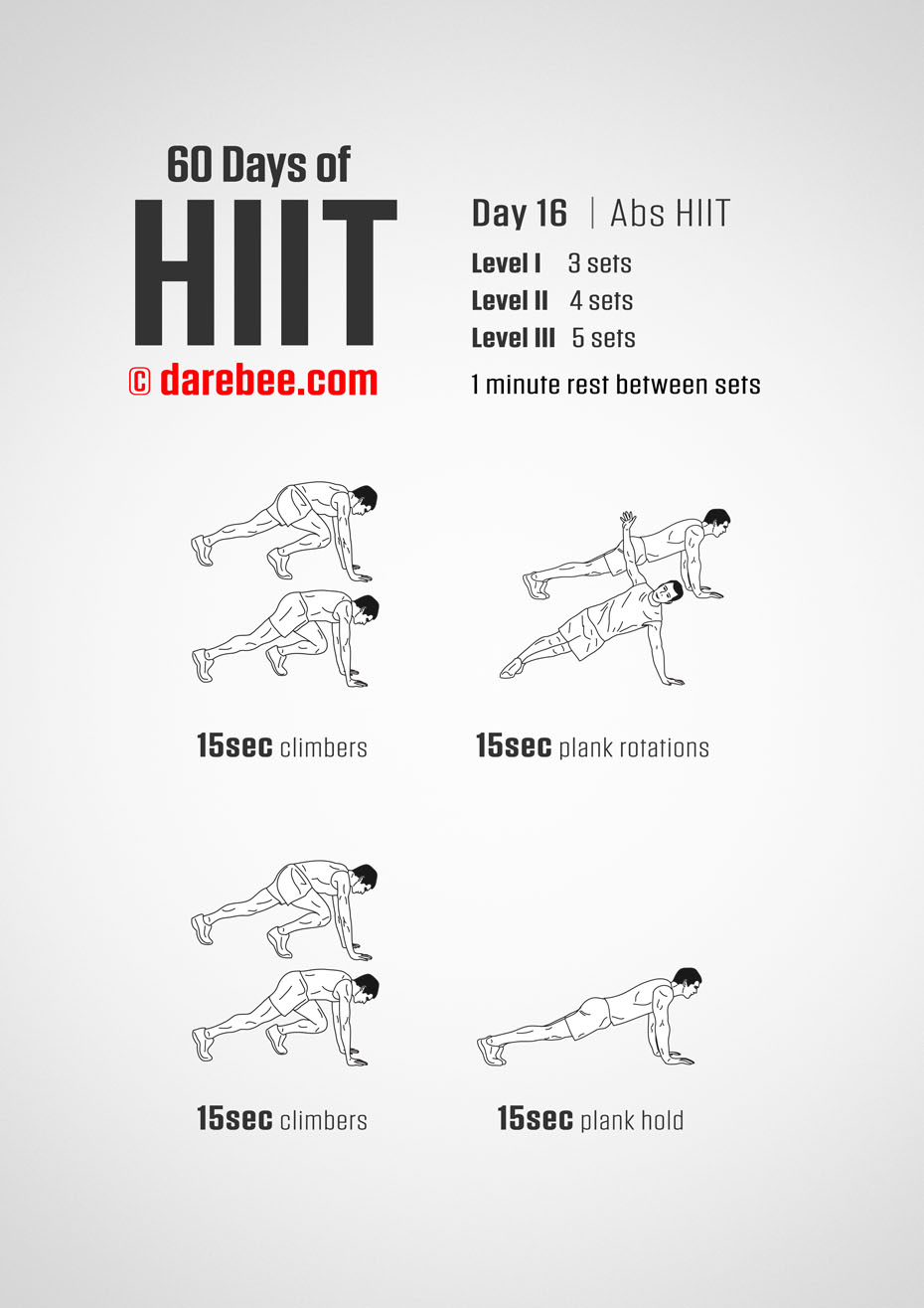
Day 16 keeps climbers in the anchor slot and slides a new plank variation into the second interval. Fifteen seconds each of climbers, plank rotations, climbers and a plank hold, at three, four or five sets with a minute of rest between them.
Plank rotations are the first time the program asks your core to work sideways while you are face down. From a high plank, the illustration shows the body rotating open into a side plank with one arm reaching straight up toward the ceiling, then returning to centre and rotating the other way. That opening movement recruits the obliques and the muscles that stabilise the shoulder, and it exposes any weakness in your trunk immediately - a rotation you cannot control is a rotation that collapses at the hips. Closing the session with a straight plank hold after all that movement is the program's way of checking whether the position survived.
Rotate from your ribs and keep your hips stacked so your body forms a single flat plane at the top of each turn. Press the floor away with your supporting hand rather than sinking into the shoulder. In the plank hold, hips level with the shoulders, glutes on, ribs down, breathing normally throughout.
Face down, face sideways, face down again - the plank position turns out to have more than one door.
Make it Harder: Hold each side plank position for two full seconds at the top of every rotation before returning to centre.
Make it Easier: Rotate from your knees rather than your toes and keep the reaching arm at hip height instead of overhead.

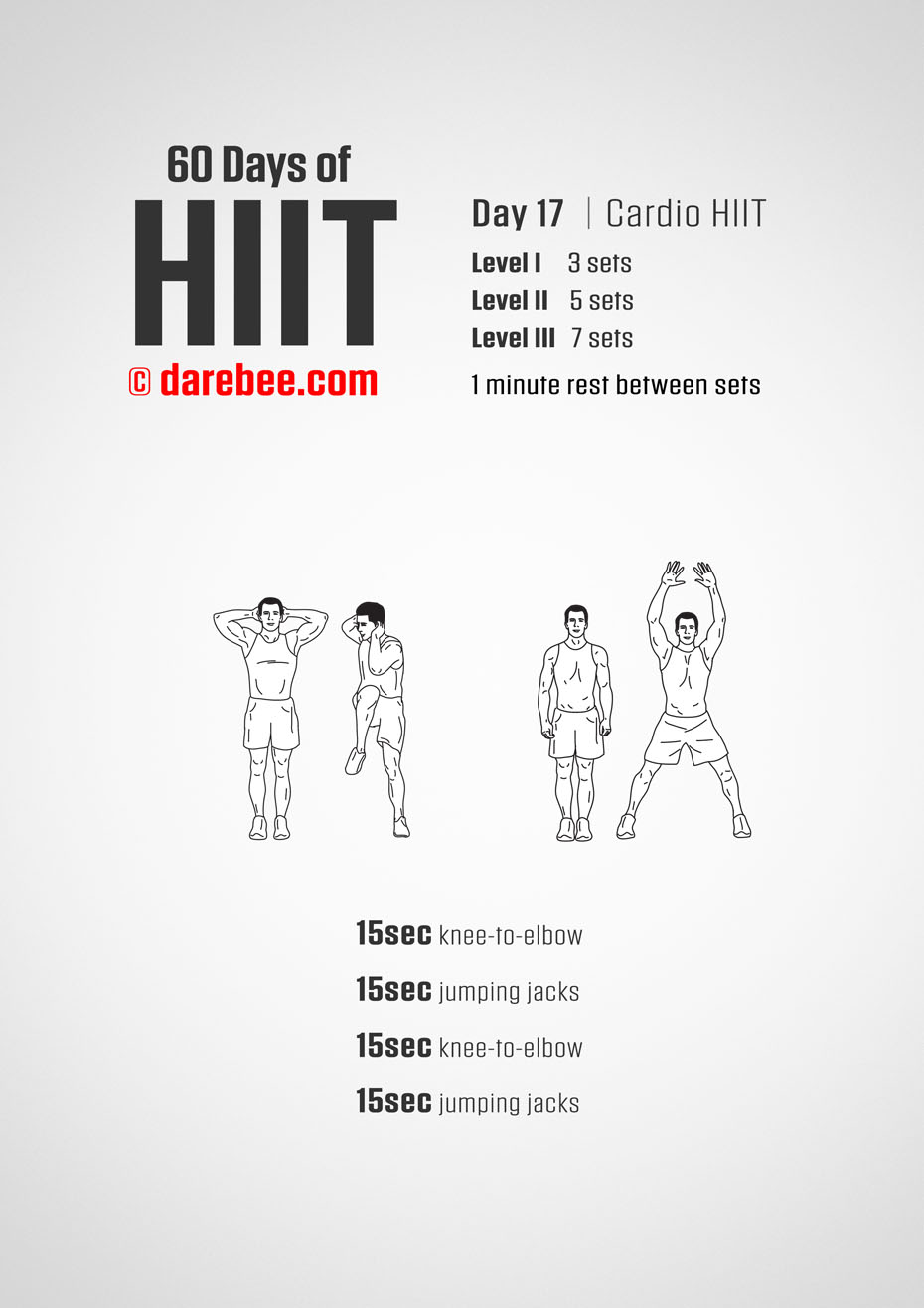
Day 17 puts the midsection into the cardio day. Four 15-second intervals - knee-to-elbow, jumping jacks, knee-to-elbow, jumping jacks - three to seven sets, one minute of rest. It is a cardio session by name, and by rep count it is also an oblique session.
The knee-to-elbow is standing and rotational: hands behind the head with the elbows wide, then one knee drives up and across while the opposite elbow drops down to meet it, alternating sides continuously. Every rep is a standing crunch with a rotation and a balance component attached, and doing it fast for fifteen seconds keeps your heart rate exactly where the jumping jacks left it. The jumping jack intervals then become the recovery - which tells you something about how hard the knee-to-elbow works when you commit to it.
Bring the knee up to meet the elbow rather than diving the elbow down to the knee - the movement should come from your waist rotating, not your spine folding. Keep the elbows wide and the hands light on the back of the head. On jumping jacks, keep the tempo high; this is the interval where you make back the breath you just spent.
A cardio day that quietly takes your obliques along for the ride, one knee at a time.
Make it Harder: Add a small hop under each knee-to-elbow so both feet leave the floor with every rotation.
Make it Easier: March the knee-to-elbow at a walking pace and take the rotation only as far as it comfortably goes.

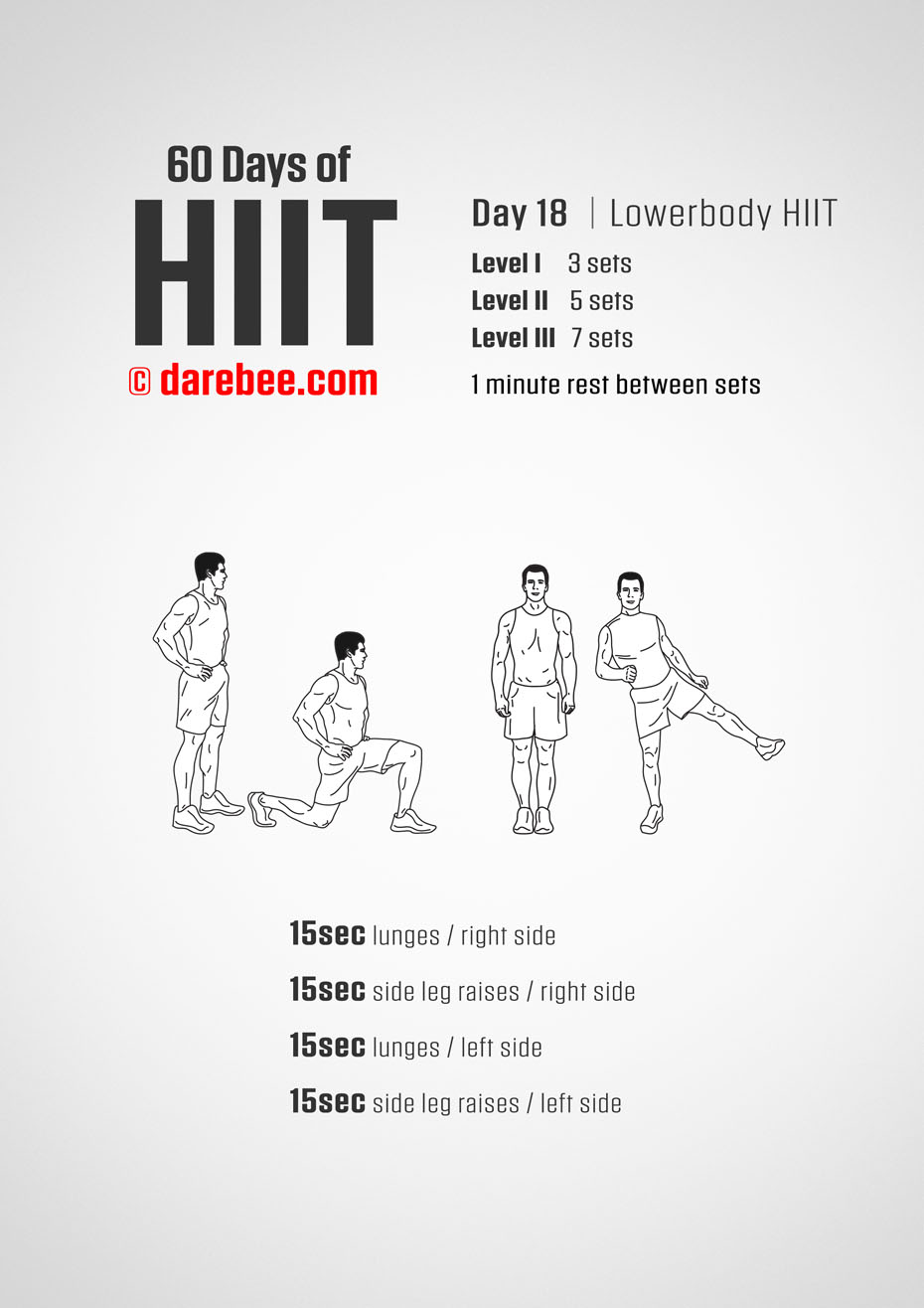
The lower body day arrives with a lunge you have not met yet and a hip exercise to sit beside it. Four 15-second intervals - lunges on the right, side leg raises on the right, lunges on the left, side leg raises on the left - three, five or seven sets, one minute of rest. Both halves of the session stay on one side before switching.
The lunge here is the forward-stepping version: step out, drop the rear knee toward the floor, push back to standing, repeat. Unlike the reverse lunge of Day 2 or the fixed split lunge of Day 10, this one travels forward, which loads the front leg on the way in as well as on the way up. The side leg raise then shifts the work to the outer hip - standing tall, the leg sweeps out to the side and returns under control. It is the smallest movement in the session and the one that keeps your pelvis level every time you take a step in real life.
Step far enough forward that your front knee stays behind your toes, and push back off the front heel rather than the toes. On side leg raises, stay upright and resist the urge to lean away from the lifting leg - the height of the raise matters far less than the hip doing the raising. Keep the toes pointing forward, not up.
Big movement, small movement, same hip - and the small one is the one you will feel tomorrow.
Make it Harder: Keep the raised foot off the floor between reps for the whole side leg raise interval - no touching down until the fifteen seconds are up.
Make it Easier: Hold onto a chair back for the side leg raises and take the lunges to a comfortable depth.

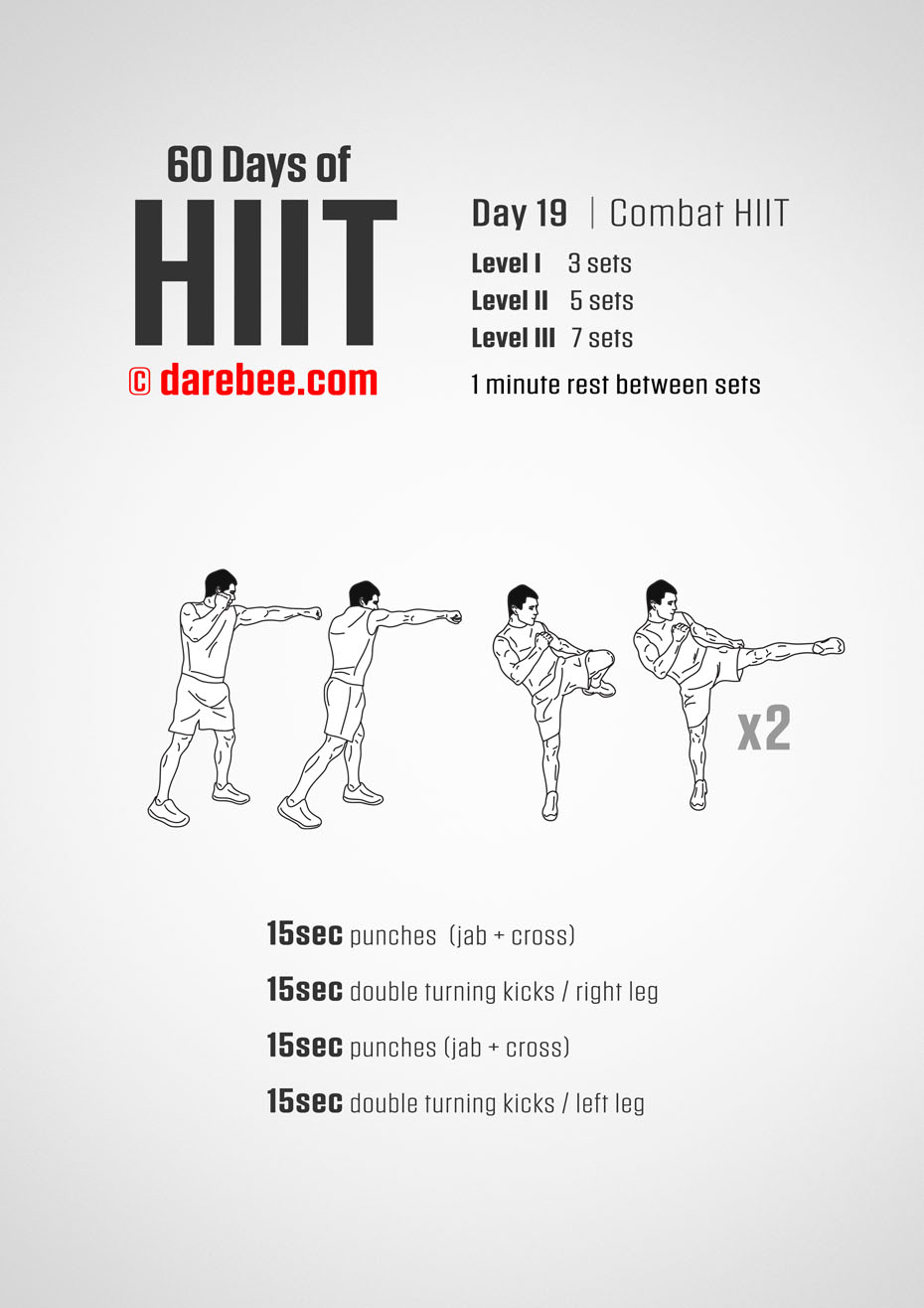
Day 19 is where combat starts compounding. The card carries a small x2 beside the kick illustration, and that marker changes the session: the kicks are now doubled. Four 15-second intervals - punches, double turning kicks on the right leg, punches, double turning kicks on the left - three to seven sets, one minute of rest.
A double turning kick means two kicks from the same leg without the foot returning to the floor between them. You chamber, kick, re-chamber, kick again, and only then set down. That second kick is where the exercise earns its place - the standing leg has to hold you up through a second full hip rotation, and the kicking leg has to reload without any help from the ground. It is the same technique you learned on Day 3, asked for twice in a row, and it roughly doubles the demand on your balance.
Chamber high and re-chamber fully - if the leg drops between kicks you have thrown two singles rather than a double. Keep the standing foot pivoting so your hips can turn freely, and keep both hands at your face throughout. Fewer clean doubles beat more scrappy ones inside the interval.
One leg, two kicks, no floor in between - the combat days just changed gear.
Make it Harder: Make it three kicks per chamber instead of two and keep the same fifteen seconds.
Make it Easier: Touch the foot down between the two kicks and treat the pair as a fast single-single.

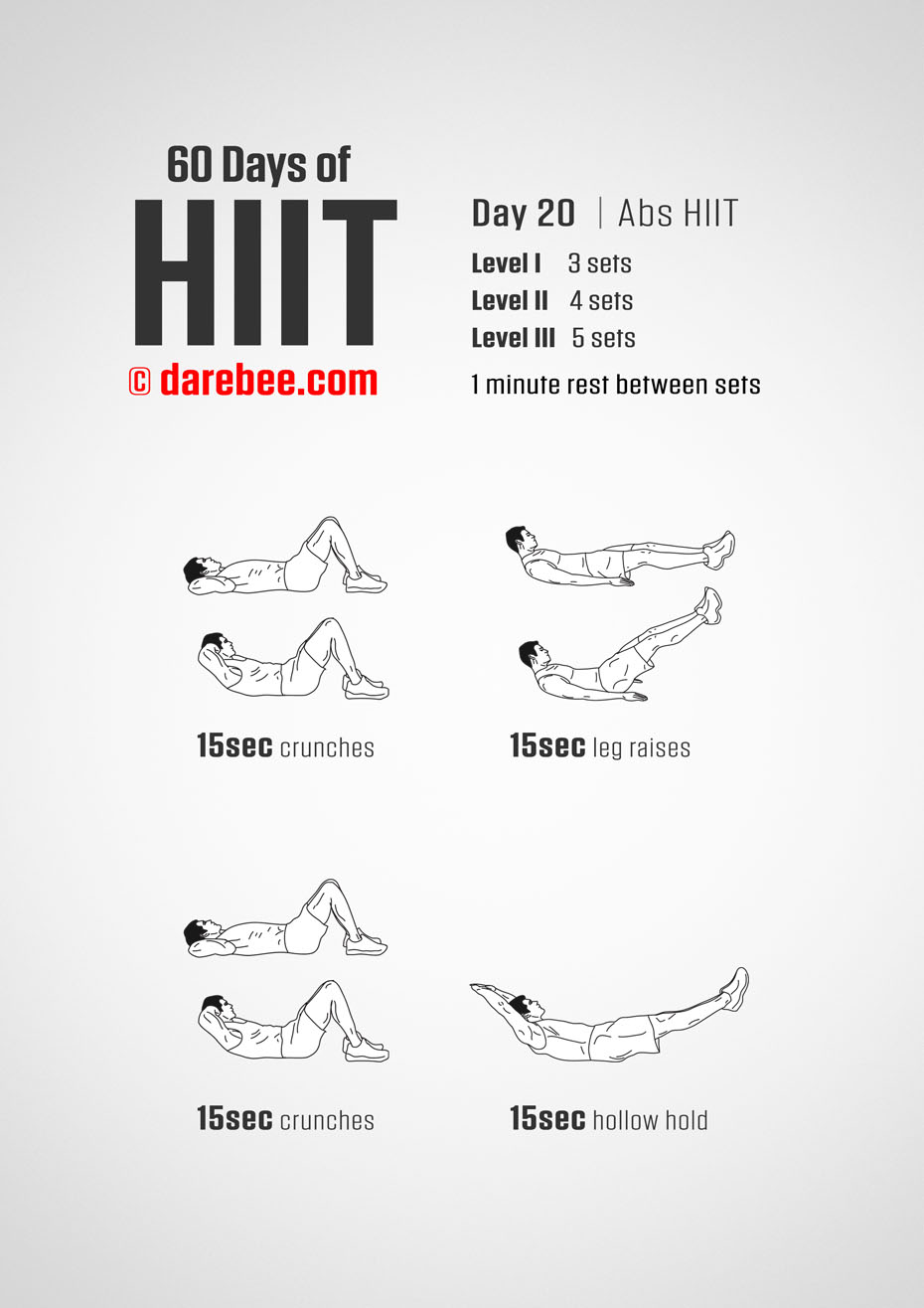
Day 20 introduces the program's first true abdominal hold. Four 15-second intervals - crunches, leg raises, crunches, hollow hold - three, four or five sets with a minute of rest. The first three are movement; the last one stops entirely.
Leg raises take both straight legs from just above the floor to vertical and lower them back down, which loads the lower abdominals through their whole range. The hollow hold then takes the hardest part of that range and parks there: lying on your back with the arms extended overhead, the shoulder blades lifted, and both legs held straight and low so your body forms a shallow curve off the floor. Nothing moves. Everything works. Arriving there straight after a leg raise interval means your abs are already loaded, and fifteen seconds is exactly long enough to find that out.
On leg raises, lower the legs only as far as you can go while keeping your lower back flat, then reverse - the last few inches down are where control matters most. In the hollow hold, press your lower back into the floor first and set your leg height second; if the back arches, raise the legs a little until it does not. Breathe throughout rather than holding your breath.
A third of the way through the program, and your abs get their first taste of holding still under load.
Make it Harder: Take the hollow hold with your arms straight overhead and your hands as far from your feet as you can get them.
Make it Easier: Tuck your knees and bring your arms alongside your hips for the hollow hold - a shorter body is a lighter one.

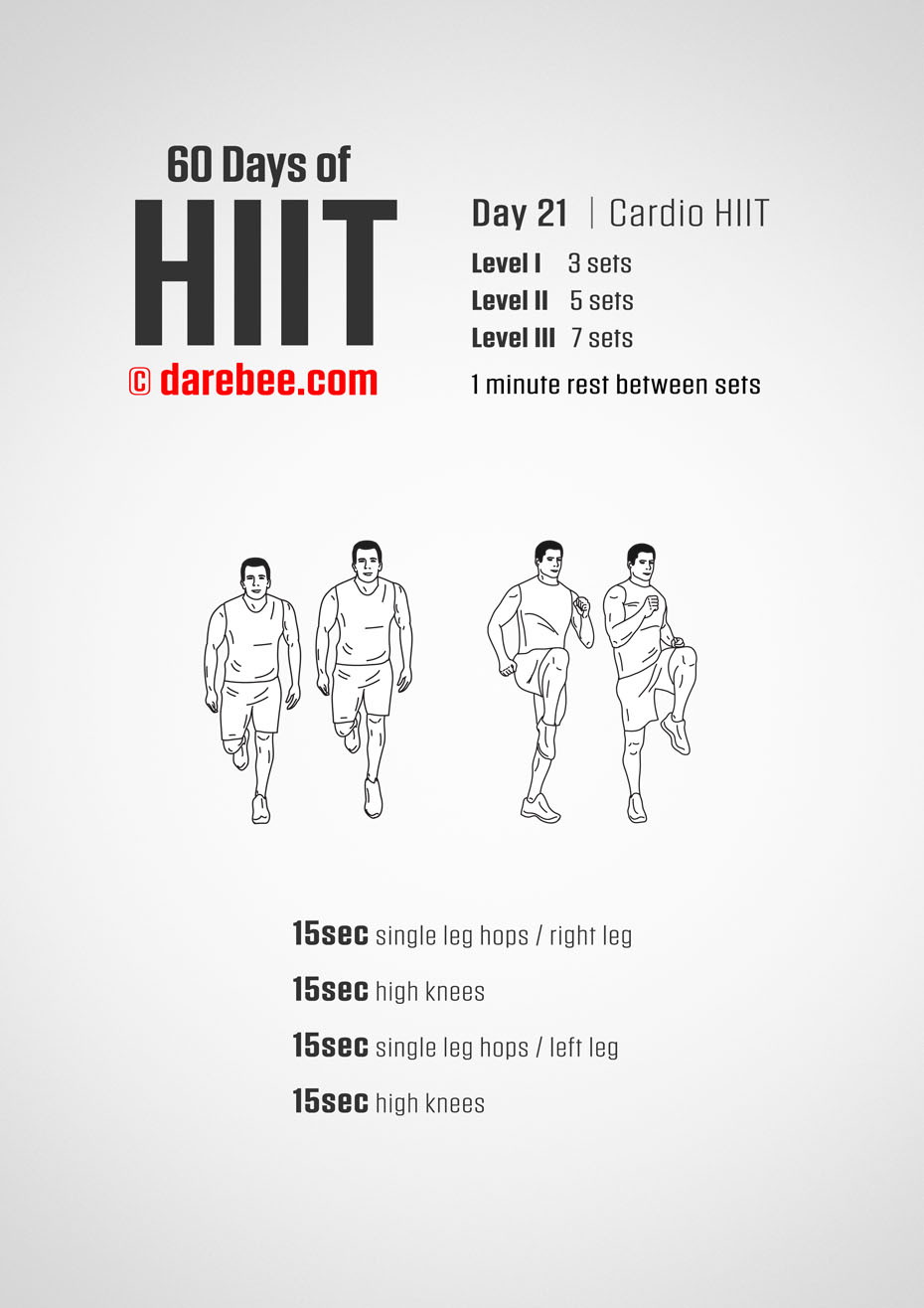
Day 21 gives the cardio session a side for the first time. Four 15-second intervals - single leg hops on the right, high knees, single leg hops on the left, high knees - three to seven sets, one minute of rest. High knees run twice as the shared partner while each leg takes its own turn at the hopping.
Single leg hops are small, continuous hops on one foot, staying on the spot with the other foot held clear of the floor. That is a very different demand from anything the cardio days have asked for so far: instead of sharing the landing between two legs, one ankle, calf and knee absorb every impact for fifteen straight seconds. It builds the elastic strength and single-leg stiffness that running and jumping both depend on, and it exposes any difference between your two sides within about four hops.
Keep the hops low and quick rather than high and heavy, landing on the ball of the foot with a soft knee. Stay tall and use your arms for rhythm. If the ankle starts to wobble, shorten the hop rather than stopping - the interval is short enough to finish.
Three weeks in, and the program starts asking each leg to hold up its end alone.
Make it Harder: Hop forward and back over an imaginary line rather than staying on the spot, still on one foot.
Make it Easier: Take the hops as fast single-leg toe taps with the other foot touching down lightly for balance.

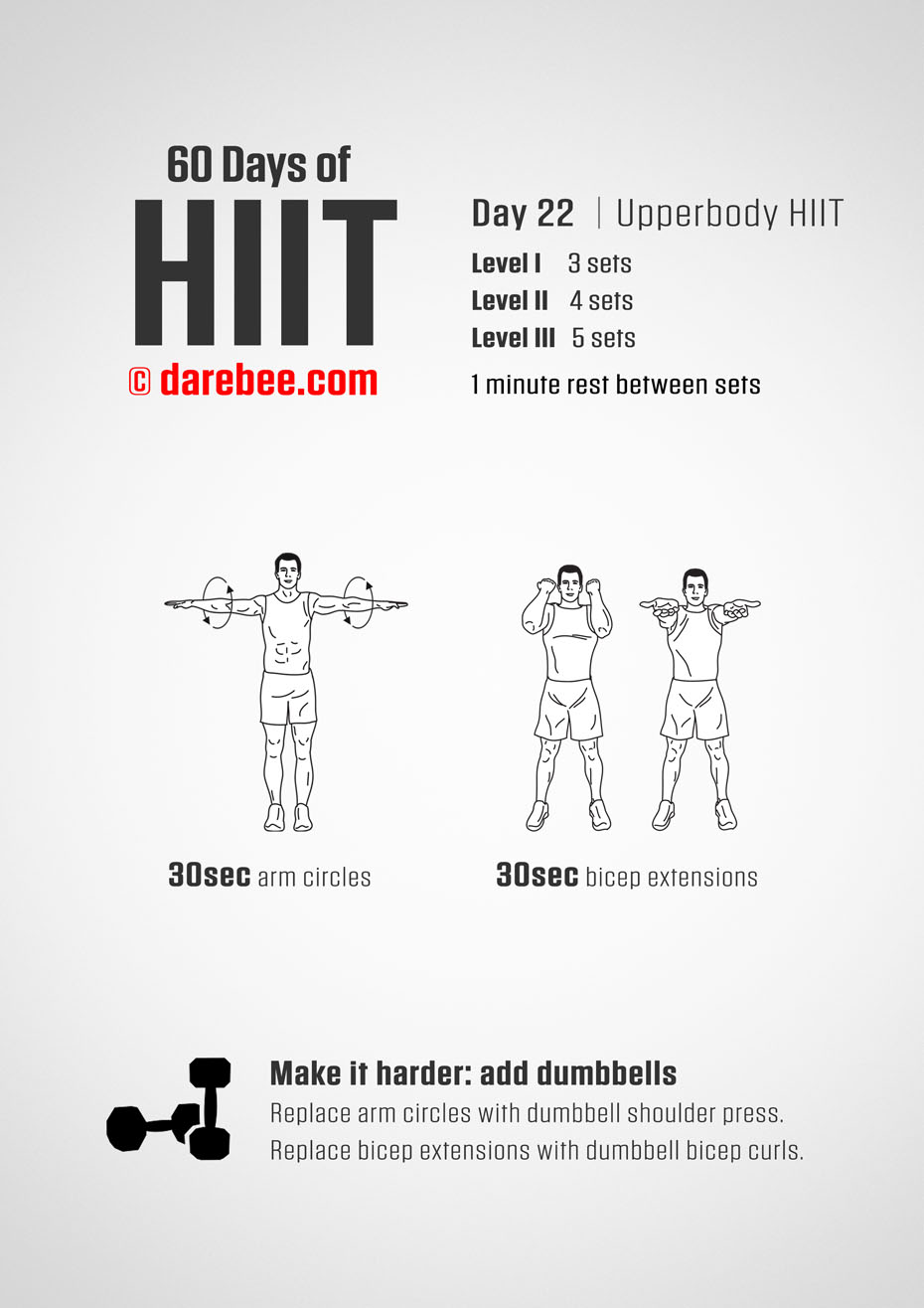
The upper body day comes back around with a new opener. Thirty seconds of arm circles and 30 seconds of bicep extensions, three, four or five sets, one minute of rest. Bicep extensions you already know from Day 6; the arm circles are new and considerably less friendly than they look.
Arm circles hold both arms straight out to the sides at shoulder height and rotate them in small continuous circles for the full half-minute. The circling is almost beside the point - what makes this exercise work is that the arms never come down. Your deltoids are supporting the weight of your own arms at their least advantageous angle for 30 unbroken seconds, and the circles simply guarantee you cannot cheat by locking into a comfortable position. Following it with bicep extensions keeps the arms working while giving the shoulders a slightly different job.
Keep the circles small and the arms genuinely level - the moment they drift downward the exercise gets easier and stops being the exercise. Fully extend through the fingertips. On bicep extensions, supply real tension in both directions and keep the elbows from drifting behind your body.
Small circles, straight arms, thirty seconds: the simplest thing in the program and one of the longest half-minutes in it.
Make it Harder: Reverse the direction of the circles halfway through the interval without ever lowering your arms.
Make it Easier: Bend your elbows slightly for the arm circles - shorter levers make the same half-minute survivable.

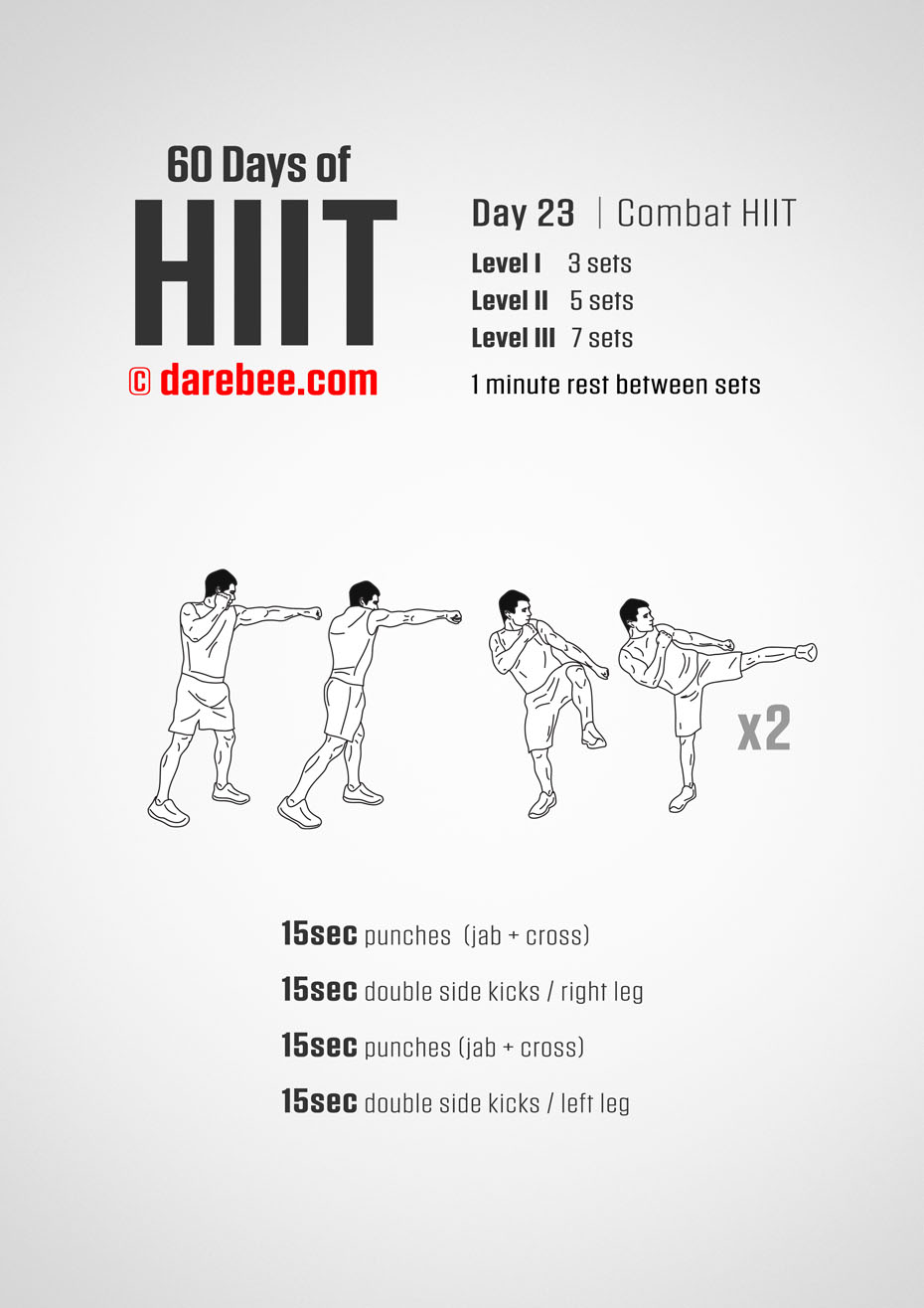
Day 23 applies the doubling to the side kick. The x2 marker sits beside the kick illustration again, and the four 15-second intervals run punches, double side kicks on the right leg, punches, double side kicks on the left, at three to seven sets with a minute of rest.
Doubling a side kick is harder than doubling a turning kick, and the reason is the direction of the lean. A side kick pushes the foot out in a straight line, which means your torso has to angle away to counterbalance it - and holding that angled position while you re-chamber and fire a second time is a genuine test of the standing leg and the whole side of your trunk. The punch intervals in between are not just striking practice at this point; they are the fifteen seconds your balance needs to reset.
Chamber the knee high and across, extend to the side, then pull the foot straight back to the chamber for the second kick without setting it down. Keep the standing foot pivoted so the hip can open, and keep your guard up even as your body angles away. Two controlled doubles are worth more than four kicks that end with you hopping sideways.
Same doubling trick, tougher kick, and a standing leg that finally has an opinion about it.
Make it Harder: Keep the kicking foot off the floor for the entire interval - chamber, kick, kick, re-chamber, and go again without touching down.
Make it Easier: Kick to knee height for both kicks of each pair and let the foot brush the floor in between.

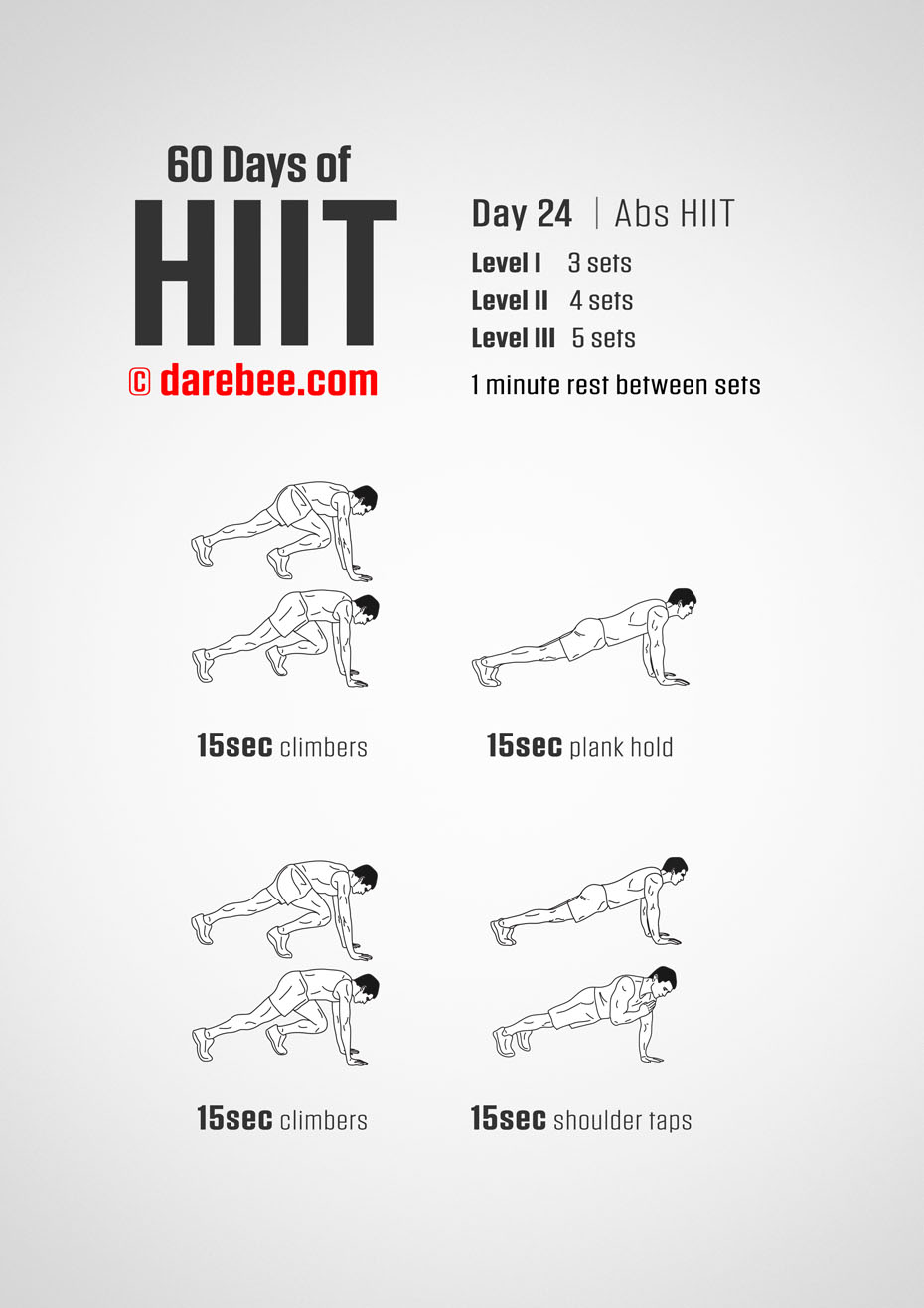
Day 24 keeps the climbers and swaps in a plank variation that moves your hands instead of your feet. Fifteen seconds each of climbers, a plank hold, climbers again, and then shoulder taps - three, four or five sets, one minute of rest.
These shoulder taps are the plank version, not the standing one from the upper body days: from a high plank, one hand lifts off the floor and taps the opposite shoulder, then returns, then the other hand does the same. The moment a hand leaves the ground your base narrows to three points and your hips want to rotate - and stopping that rotation is the entire exercise. It is anti-rotation training disguised as a tapping drill, and it sits perfectly after a plank hold, which spends fifteen seconds teaching you the position that the taps then try to break.
Set your feet wider than usual to give yourself a stable base, and move the hand slowly enough that your hips do not swing. The tap should be deliberate; the point is not touching the shoulder, it is everything below the shoulder staying still. In the plank hold, keep the line from heels to head and resist the sag.
Hands off the floor, hips going nowhere - that gap between the two is where your core does its best work.
Make it Harder: Bring your feet together for the shoulder tap interval and keep the hips from rotating a millimetre.
Make it Easier: Take the shoulder taps from your knees and set your hands slightly wider than your shoulders.

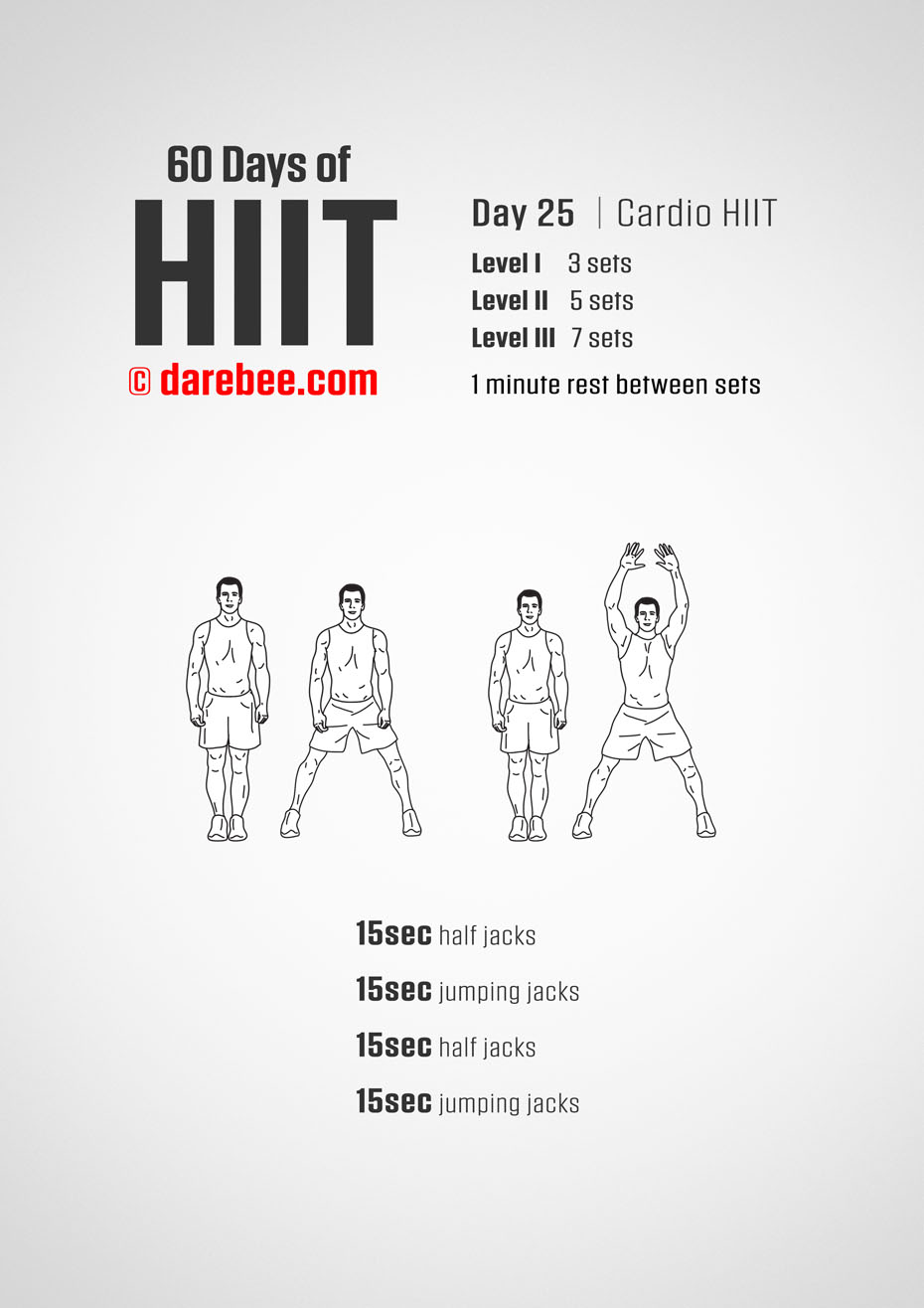
Day 25 runs the jack family against itself. Four 15-second intervals - half jacks, jumping jacks, half jacks, jumping jacks - three to seven sets, one minute of rest. One exercise is the full version, one is its lower-effort twin, and alternating them is the whole session.
A half jack, as drawn, keeps the arms down at the sides while the feet jump wide and back together - the legs do the whole job and the shoulders sit it out. That makes it lower in effort than a full jumping jack without being slower, so your cadence stays high while the arms recover. Then the full jack brings the arms back overhead and the demand jumps again. Same footwork throughout, two different amounts of body in play, and a heart rate that never quite gets to settle.
On half jacks, keep the feet snapping wide and back with real intent - without the arms to keep you honest, this is the interval that quietly turns into a shuffle. On full jacks, take the arms all the way overhead and let hands and feet arrive together. Land softly on both, through the whole foot.
Arms out, arms down, and a session that proves how much of a jumping jack lives above the waist.
Make it Harder: Bring the hands to shoulder height on the half jacks so the arms are held up rather than resting at your sides.
Make it Easier: Step the feet wide and back rather than jumping them, on both intervals.

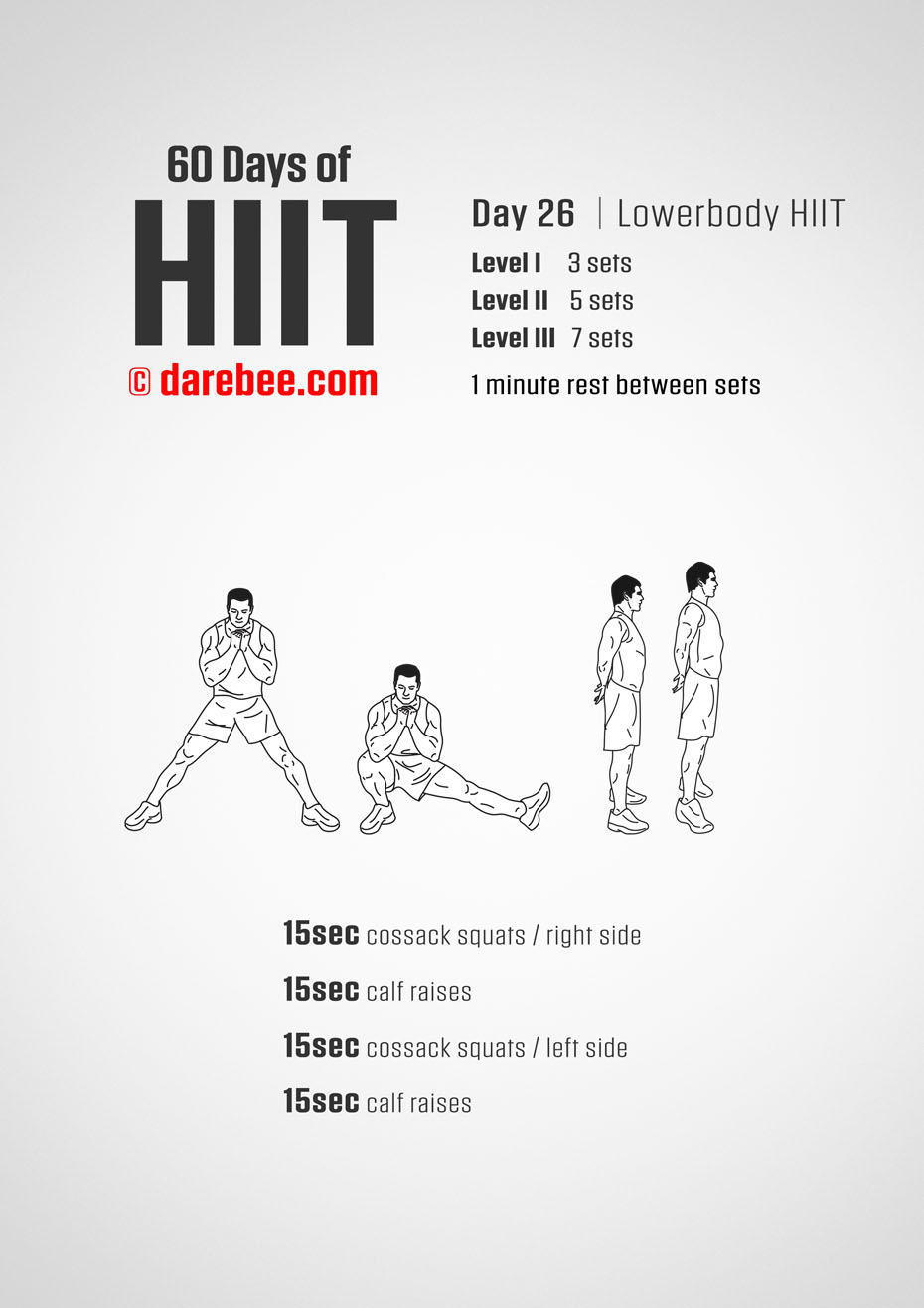
The lower body day pushes into a deeper range than anything the program has asked for so far. Four 15-second intervals - cossack squats on the right, calf raises, cossack squats on the left, calf raises - three, five or seven sets with a minute of rest.
A cossack squat starts from a very wide stance and sinks down onto one leg while the other stays straight with the foot flat and the toes up. It is the widest movement in the program: the bending side gets a deep squat, the straight side gets a serious inner-thigh stretch, and your ankles and hips have to cooperate to keep you upright while it happens. The calf raise intervals then sit between the two sides as an active recovery that still trains something - which is exactly how this program uses the calves throughout.
Keep your chest lifted and sit back rather than pitching forward, and go only as deep as you can while keeping the heel of your bent leg on the floor. Keep the straight leg genuinely straight with the foot flat. On calf raises, full range up and down, no bouncing at the bottom.
The widest stance in the program, and the day your hips find out how much room they actually have.
Make it Harder: Pause for two seconds at the bottom of every cossack squat before rising - depth held is depth earned.
Make it Easier: Take a narrower stance, keep the heel of the straight leg lifted, and go only as deep as your hips allow today.

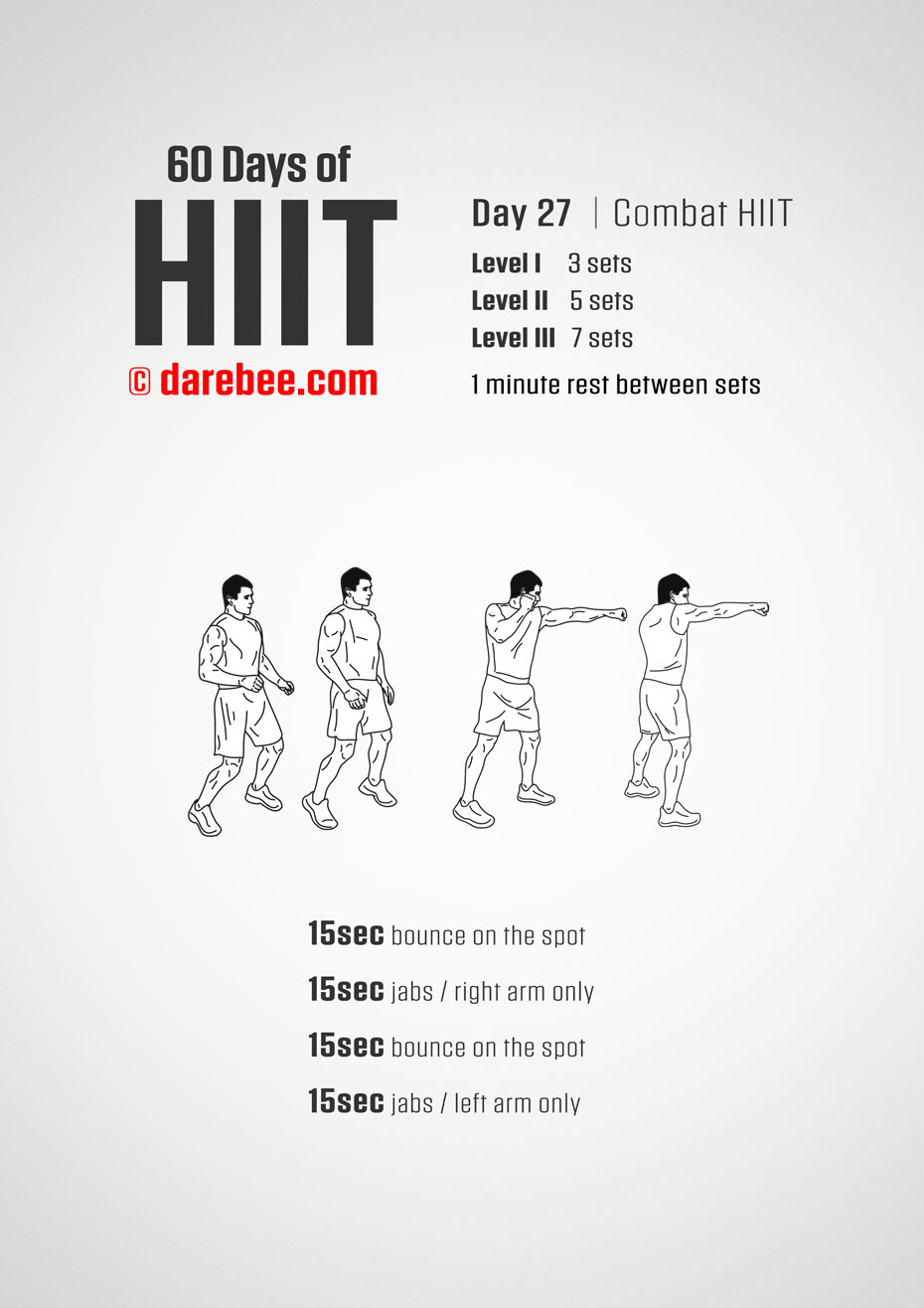
Day 27 strips the combat session down to one hand at a time. Four 15-second intervals - bounce on the spot, jabs with the right arm only, bounce on the spot, jabs with the left arm only - three to seven sets, one minute of rest. It is the first session in the program to isolate a single limb for a full interval.
Throwing jabs with one arm for fifteen unbroken seconds is a different exercise from throwing a jab-cross combination. There is no rest hand and no rhythm to hide in: the same shoulder produces every strike and the same shoulder has to recover on the fly. It builds punching endurance in a way that alternating never can, and it makes any difference between your two arms impossible to ignore. The bounce intervals in between keep the feet alive and give the working shoulder its only recovery.
Snap the jab out and pull it straight back to your cheek - the return is what keeps the shoulder from burning out early. Keep the non-punching hand glued to your face for the entire interval. Rotate the shoulder into each strike rather than reaching with the arm, and keep bouncing lightly while you punch.
One arm, fifteen seconds, nowhere to pass the work along - your shoulders are about to compare notes.
Make it Harder: Add a rear-hand cross after every third jab without breaking the rhythm of the working arm.
Make it Easier: Slow the jab rate and reset your guard fully between strikes rather than chasing volume.

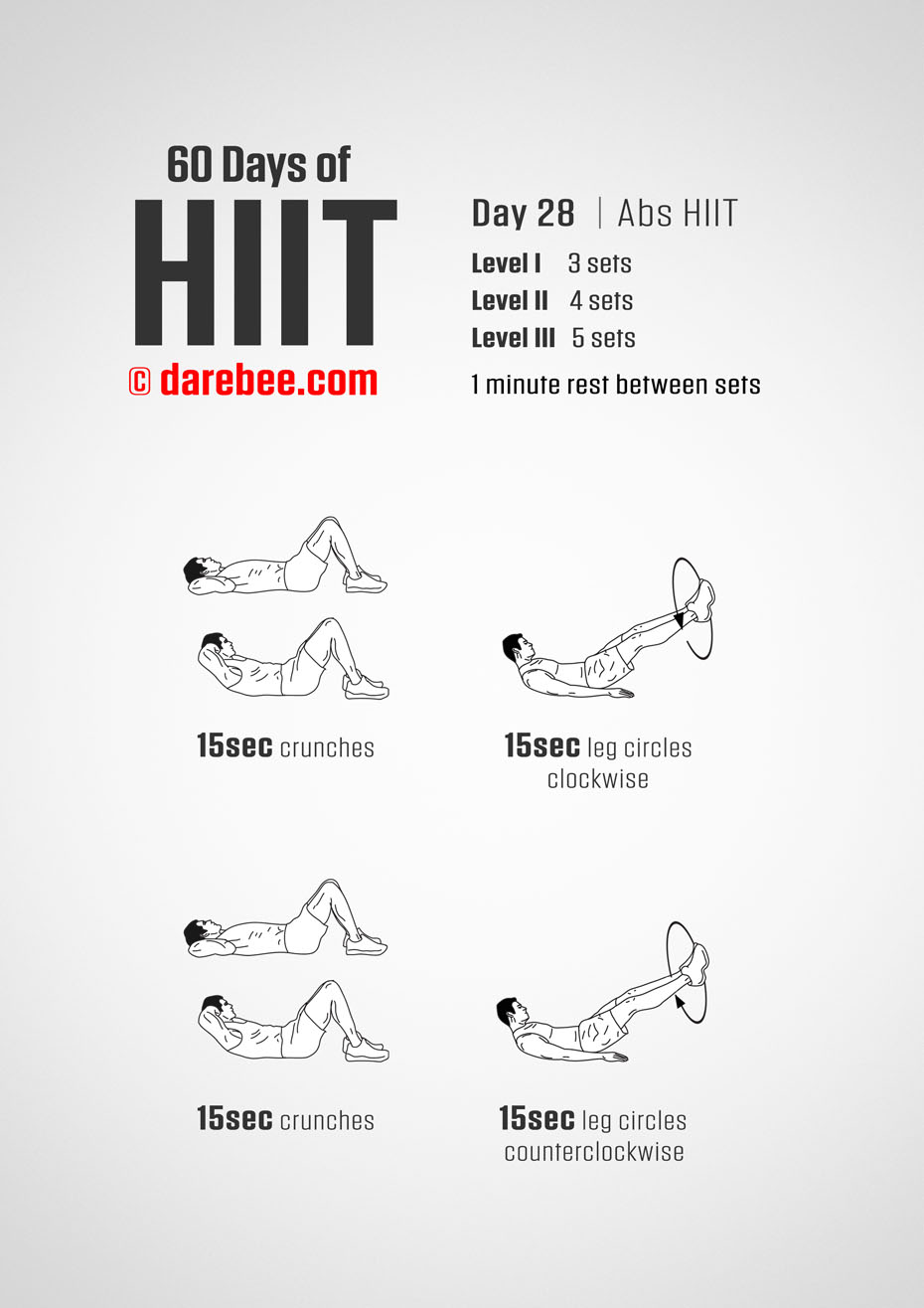
Day 28 rounds off the fourth cycle with an abs session built around a circle. Four 15-second intervals - crunches, leg circles clockwise, crunches, leg circles counterclockwise - three, four or five sets with a minute of rest.
Leg circles lie on your back with both legs held straight and low, and trace a full circle in the air with the feet together - the illustration shows the arrow going one way in the first interval and the other way in the second. Running the same movement in both directions is not a formality: a circle loads the lower abdominals unevenly, and reversing it makes sure both halves of the movement get the same attention. Because the legs never touch down, the abdominal wall is under continuous tension for the whole interval, which makes it closer to a moving hold than to a set of reps.
Keep your lower back pressed to the floor throughout and let the size of the circle be determined by that, not by ambition. Keep the legs together and straight, and move slowly enough that the circle is actually round. Hands flat beside your hips for support.
One circle, both directions, and your lower abs kept honest for every second of it.
Make it Harder: Make the circles as large as you can while keeping your back flat, and take the legs as close to the floor as the bottom of each circle allows.
Make it Easier: Bend your knees and trace smaller circles higher above the floor.

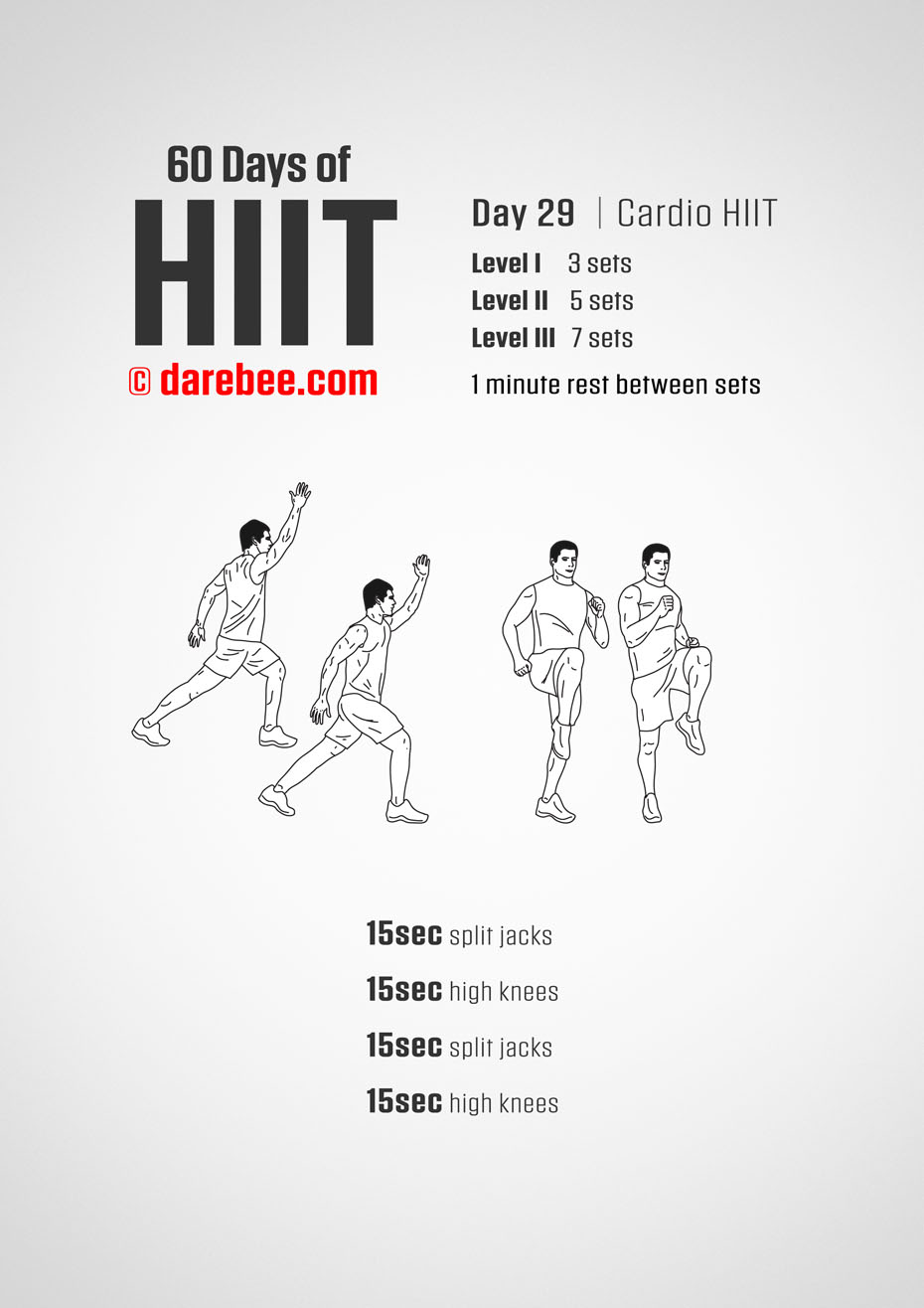
Day 29 brings the last new member of the jack family into the program. Four 15-second intervals - split jacks, high knees, split jacks, high knees - three to seven sets, one minute of rest.
A split jack keeps the arms sweeping overhead like a jumping jack but changes the legs completely: instead of jumping wide and narrow, the feet scissor forward and back, swapping which one leads with every rep. That gives you the cardiovascular cost of a jack with a lunging pattern underneath, so the front of one thigh and the back of the other get loaded on every landing. Alternating it with high knees keeps the session firmly in running-cadence territory while switching the direction the legs travel.
Land softly with both knees soft and your torso upright rather than leaning over the front leg. Take the split wide enough to feel it but not so wide that you cannot swap cleanly. On high knees, drive hard and keep the contact light.
Forward and back instead of side to side - the jack you know, rewired for a different pair of legs.
Make it Harder: Sink deeper into each split so the rear knee drops toward the floor on every landing.
Make it Easier: Step the feet forward and back rather than jumping them, and keep the arm sweep going.

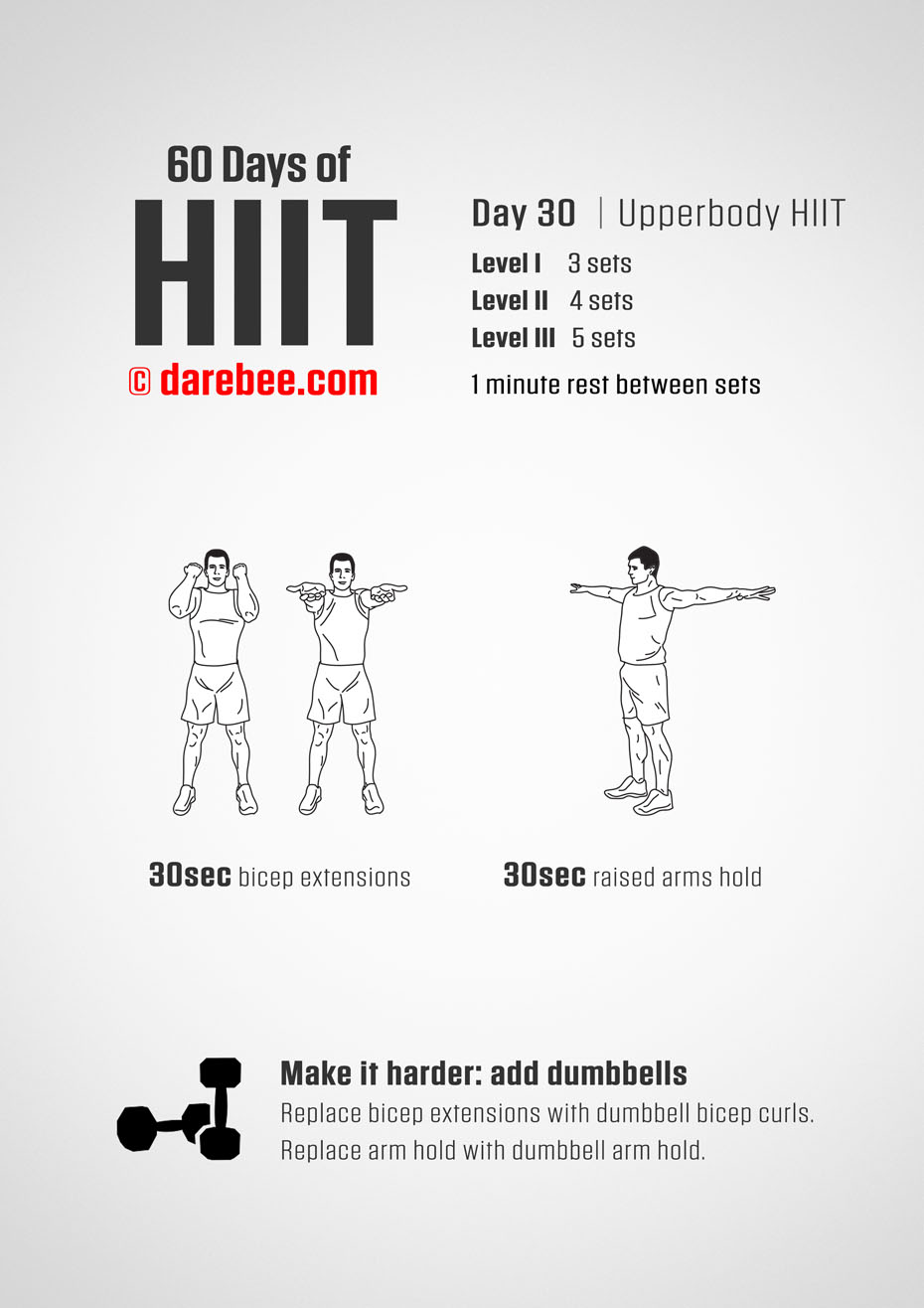
Halfway. Day 30 marks the exact midpoint of the program, and it does it with an upper body session that pairs a moving exercise with a static one: 30 seconds of bicep extensions and 30 seconds of a raised arms hold, three, four or five sets, one minute of rest.
Both exercises are old friends by now - the bicep extension from Day 6 and Day 22, the raised arms hold from Day 14 - but this is the first time they have been put together. The order matters. Bicep extensions work the arms with the elbows moving and the shoulders relatively quiet; the hold then locks the shoulders at their hardest angle with nothing moving at all. Arms first, shoulders second, and the second half of every set becomes a straightforward negotiation between you and gravity.
On bicep extensions, keep the tension deliberate in both directions and the elbows tucked in beside your ribs. In the hold, arms straight out to the sides at shoulder height, palms down, elbows locked, shoulders down. When the arms start to drift, lift them back to level instead of quietly accepting the drop.
Thirty days in, thirty to go - and the program has spent that whole first half proving that a bare pair of arms is resistance enough.
Make it Harder: Add the dumbbells the card suggests and hold them out to the sides for the full thirty seconds.
Make it Easier: Take the hold with your arms out in front of you at shoulder height rather than to the sides.

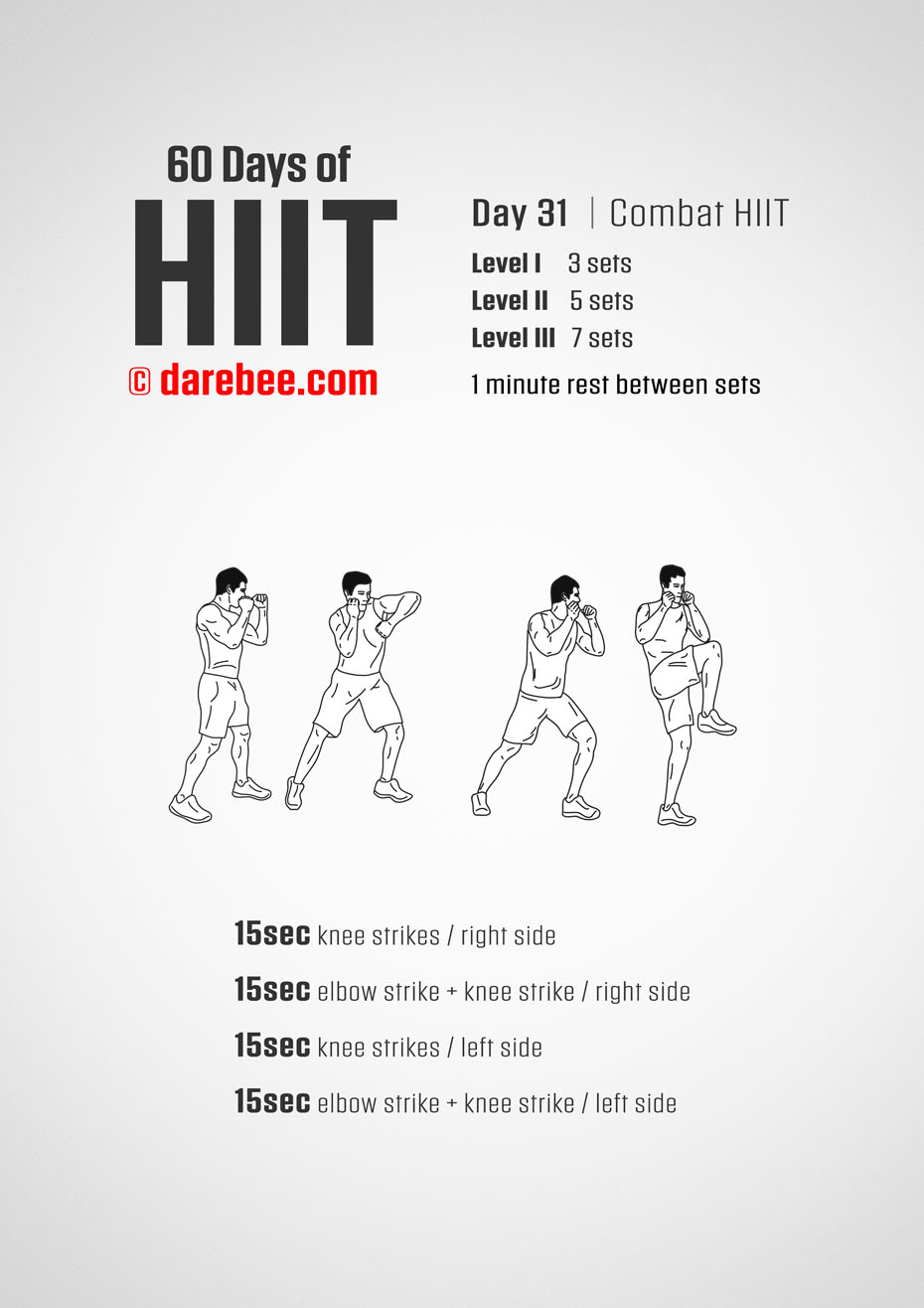
Day 31 drops the punch interval entirely and builds the session out of close-range strikes. Four 15-second intervals - knee strikes on the right, an elbow strike and knee strike combination on the right, knee strikes on the left, then the combination on the left - three to seven sets, one minute of rest.
This is the first combat day to pair a single strike with a combination that contains it. The knee strike interval builds the raw engine; the combination interval then puts an elbow in front of it, so each rep becomes a short horizontal elbow strike across the body followed immediately by the knee driving up from the same side. Upper limb, lower limb, one side, one continuous motion - that is how close-range striking actually chains together, and running both sides means neither gets to be the good one.
Throw the elbow across your body at head height with the fist closed and the shoulder rotating, and let the knee arrive while the elbow is still returning. Pull your hands down as the knee drives up. Stay light on the standing foot and keep the whole sequence tight - close-range strikes travel short distances at speed.
No punches today, no kicks either - just the two shortest weapons you own, back to back.
Make it Harder: Add a second elbow from the other side before the knee, turning every rep into a three-strike chain.
Make it Easier: Run the combination slowly as two separate strikes with a clear pause between the elbow and the knee.

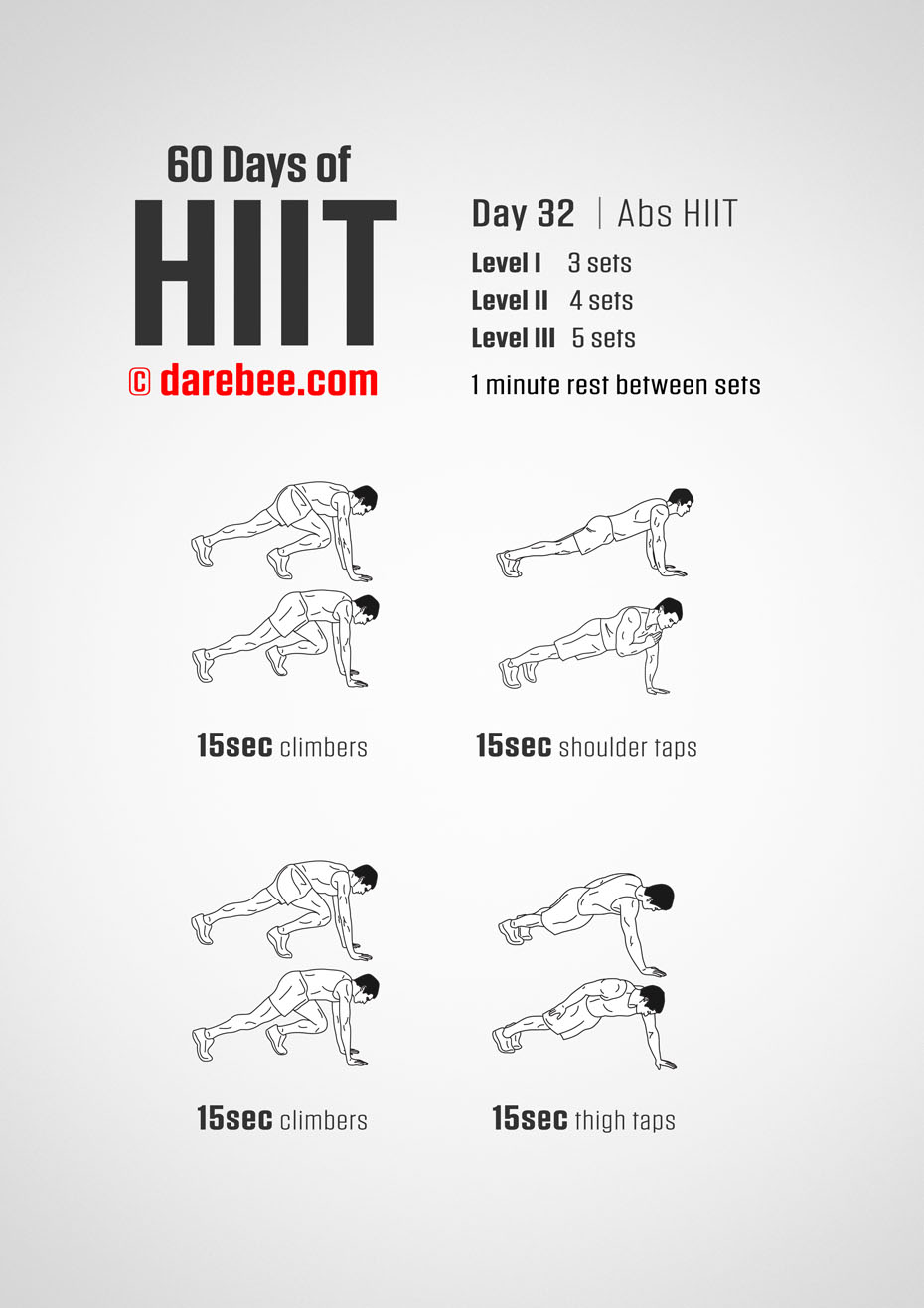
Day 32 keeps the climber anchor and runs two tapping drills against each other. Fifteen seconds each of climbers, shoulder taps, climbers and thigh taps, at three, four or five sets with a minute of rest between them.
Shoulder taps and thigh taps are the same anti-rotation problem addressed at two different distances. In the shoulder tap, the hand comes off the floor and travels a short way across to the opposite shoulder. In the thigh tap it goes the other direction entirely - the hand reaches back down the body to tap the opposite thigh, which is a longer reach, a bigger shift of weight, and a much stronger invitation for your hips to twist. Putting the shorter reach first and the longer one last means the interval that demands the most control arrives when you have the least of it left.
Widen your feet for both tapping intervals and move one hand at a time with deliberate slowness. The success measure is not how many taps you get - it is whether your hips stayed square while you got them. Press the supporting hand firmly into the floor and keep your neck long.
Short reach, long reach, and a set of hips that would dearly like to rotate and is not allowed to.
Make it Harder: Alternate shoulder tap and thigh tap on the same rep cycle for the final interval - up, then down, then swap hands.
Make it Easier: Keep both tapping intervals from the knees with a wide hand position and slow, single taps.

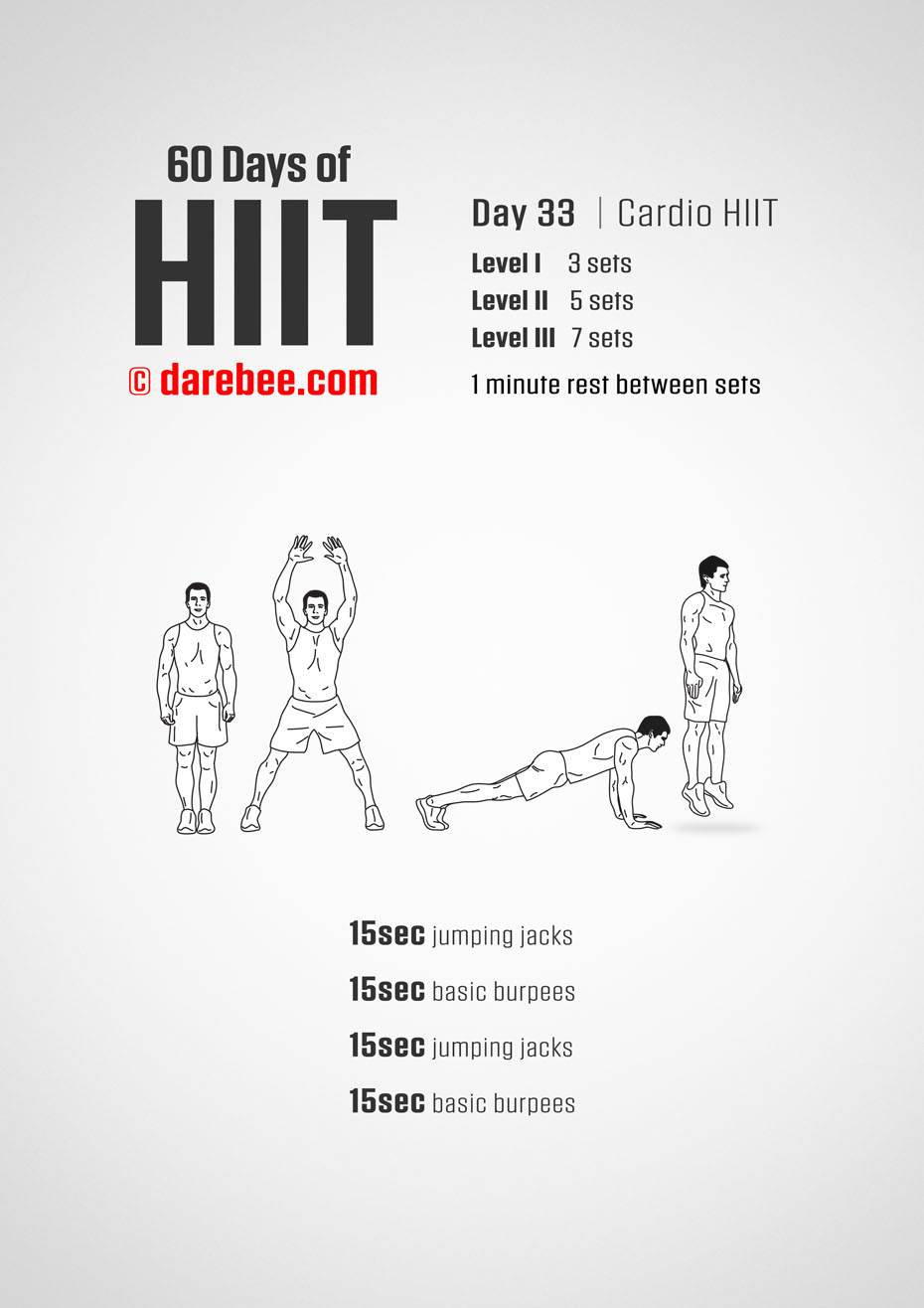
Day 33 changes what a cardio day looks like in this program. For the first 32 days the cardio sessions kept you upright; from here they start putting you on the floor. Four 15-second intervals - jumping jacks, shoulder taps, jumping jacks, shoulder taps - three to seven sets, one minute of rest.
The shoulder taps here are the plank version, and dropping into a plank between two jumping jack intervals is a genuinely different kind of hard. Your heart rate is high from the jacks, your breathing is up, and now you have to hold a stable plank and lift one hand at a time without your hips swinging. Cardiovascular load and postural control at the same moment is a demand the standing sessions never made, and it is why the back half of this program feels different from the front half.
Get down and set up quickly - the fifteen seconds starts whether you are ready or not, so plant the hands, set the feet wide, and go. Tap deliberately and keep the hips square. On the jumping jacks, use the interval to get your breathing back rather than emptying yourself completely.
From here on the cardio days will not let you stay on your feet - and today is where that starts.
Make it Harder: Add a knee drive to the opposite side with each tap so the whole body works through every rep.
Make it Easier: Hold a plank without taps for the second and fourth intervals and simply survive the position.

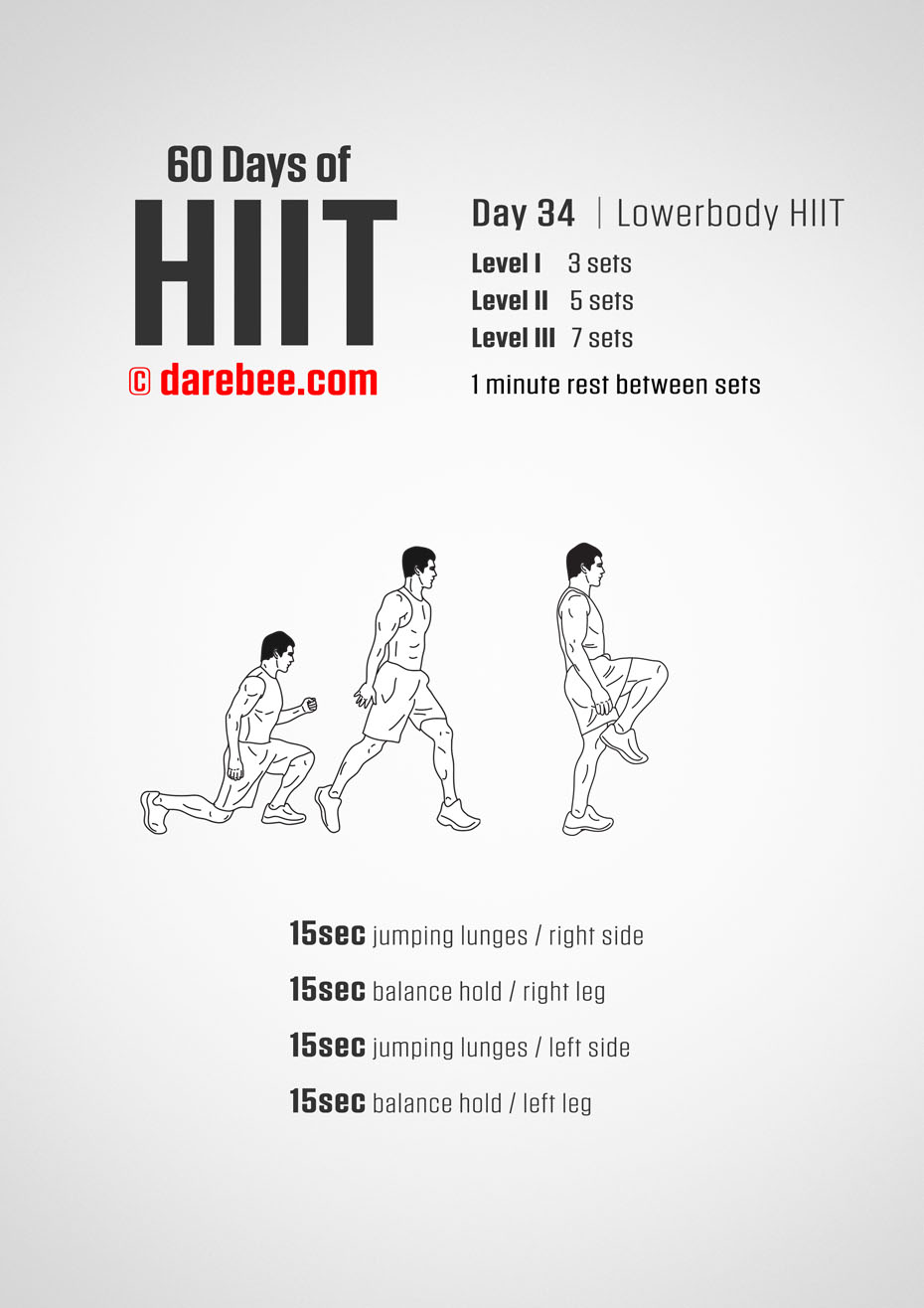
Day 34 introduces the exercise that will anchor every remaining lower body day in the program. Four 15-second intervals - lunge step-ups on the right, a balance hold on the right, lunge step-ups on the left, then the hold on the left - three, five or seven sets, one minute of rest.
A lunge step-up is two movements welded together: drop into a lunge, then drive up through the front leg all the way to standing and continue into a high knee, so the rear leg finishes with its knee lifted to hip height. Down into the lunge, up into the knee drive, back down again. It takes the strength demand of a lunge and adds an explosive finish and a moment of single-leg balance at the top. Pairing it with the balance hold - standing tall on one leg with the opposite knee up at hip height and the hands gathered at the shin - means you spend fifteen seconds passing through that top position and then fifteen more living in it.
Drive up through the whole front foot and let the knee lift come from the hip rather than from a hop. Stay tall throughout - the temptation is to lean forward on the way up. In the hold, plant the standing foot, lift the chest, and let the ankle do its work.
Lunge, rise, balance, repeat - the lower body's signature move for the rest of the program arrives today.
Make it Harder: Rise onto the toes of the standing foot at the top of every step-up before dropping back into the lunge.
Make it Easier: Come to standing without the knee drive and keep a fingertip on a wall for the balance holds.

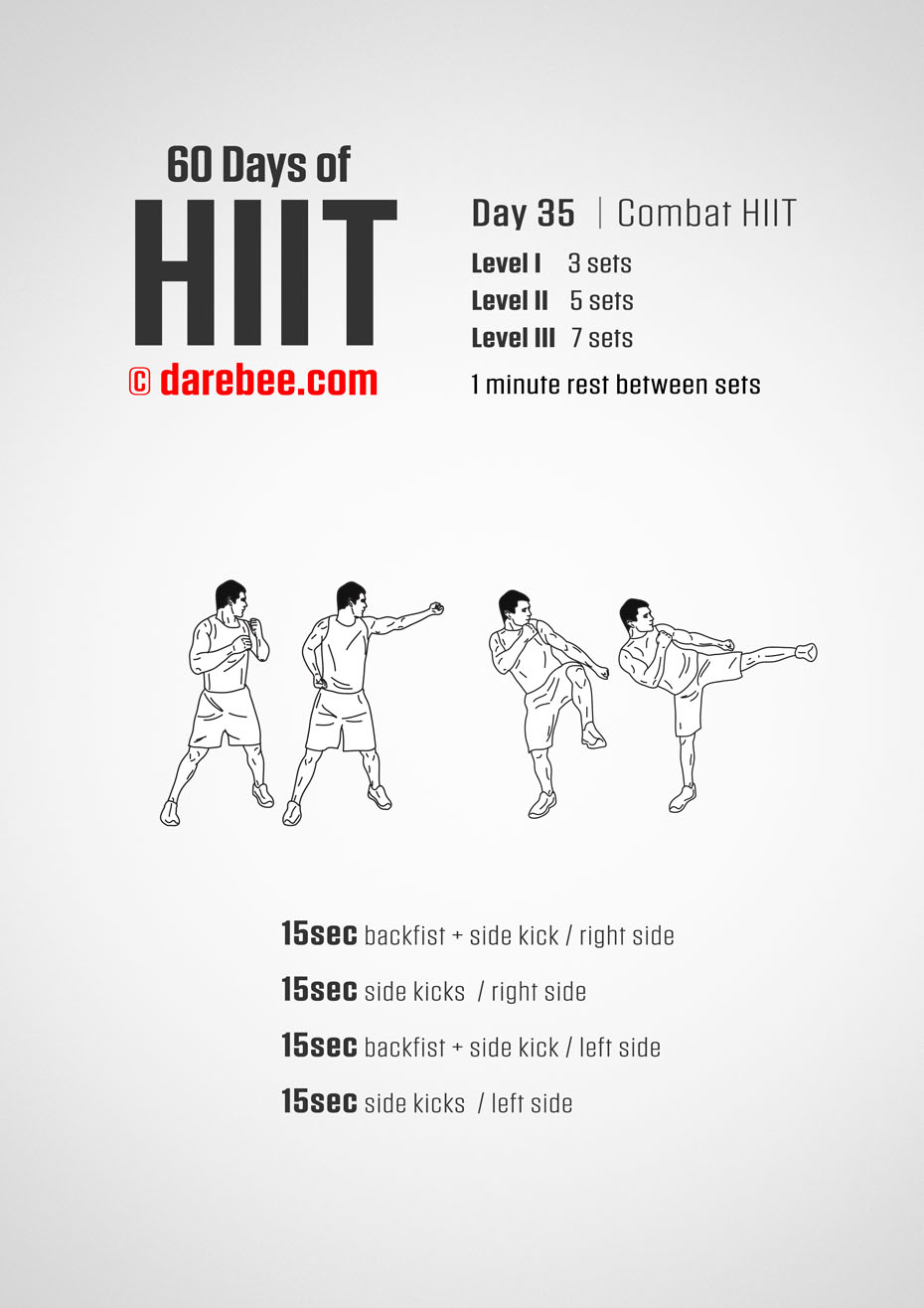
Day 35 opens the combination phase of the combat days. From here the strings get longer, and today's is a hand strike into a kick. Four 15-second intervals - backfist and side kick on the right, side kicks on the right, backfist and side kick on the left, side kicks on the left - three to seven sets, one minute of rest.
A backfist swings the back of the lead hand outward and around toward the target with the elbow leading and then extending - a whipping strike rather than a straight one. Following it immediately with a side kick from the same side gives you a genuine hand-to-foot combination: the backfist opens the line and the kick travels through it. The second interval then strips the hand away and leaves you with side kicks alone, so each side gets the combination and the isolated repetition before the other side takes over.
Let the backfist snap out and back rather than pushing through - the return is what makes it a backfist. Keep your other hand up throughout. On the kicks, chamber, extend, retract, and pivot the standing foot so the hip can open fully.
Hand then foot, and the combat days stop teaching strikes and start teaching sequences.
Make it Harder: Double the backfist before the kick so each rep runs backfist, backfist, side kick.
Make it Easier: Take a beat between the backfist and the kick to reset your stance rather than flowing straight through.

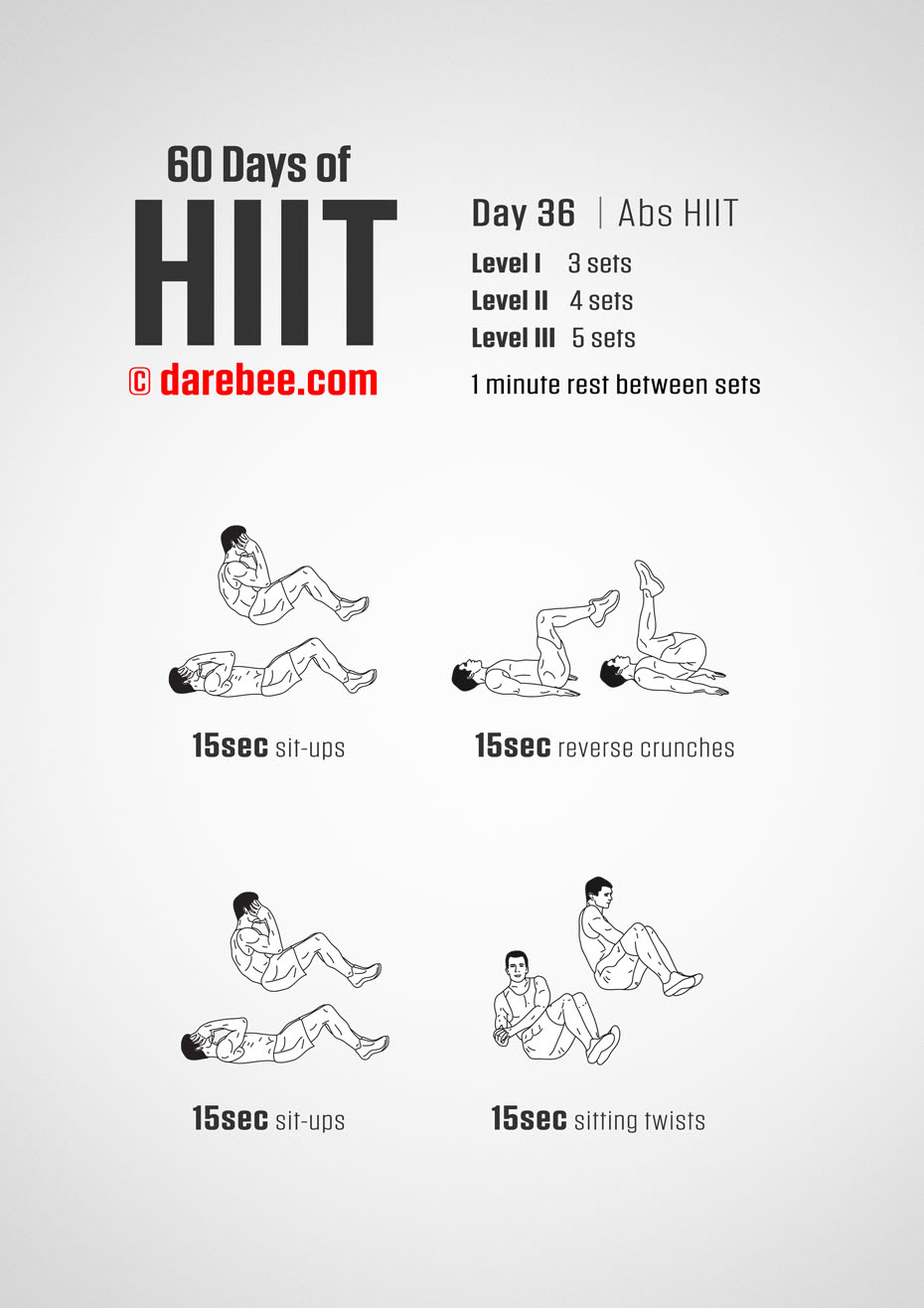
Day 36 upgrades the anchor. For eight abs sessions the supine days have been built on crunches; from today they are built on sit-ups, and that change holds for the rest of the program. Four 15-second intervals - sit-ups, reverse crunches, sit-ups, sitting twists - three, four or five sets with a minute of rest.
A sit-up is a crunch that keeps going: instead of curling the shoulder blades off the floor and stopping, you come all the way up until your torso is upright. It brings the hip flexors into the movement and roughly doubles the range, which is why it arrives now rather than on Day 4. The reverse crunch works from the other end - knees drawn in and hips curling up off the floor - so the session covers the abdominal wall from the top down and the bottom up before the sitting twists finish with rotation.
Come all the way up on the sit-up and lower under control rather than dropping back; the way down is where most of the work goes unclaimed. On reverse crunches, lift the hips with your abs rather than swinging the legs for momentum. Keep the feet hovering through the sitting twists.
Same position on the floor, twice the range - the abs days just grew up.
Make it Harder: Cross your arms over your chest for the sit-ups and take three full seconds to lower back down on every rep.
Make it Easier: Keep the crunches you know for the first and third intervals and leave the rest of the session as written.

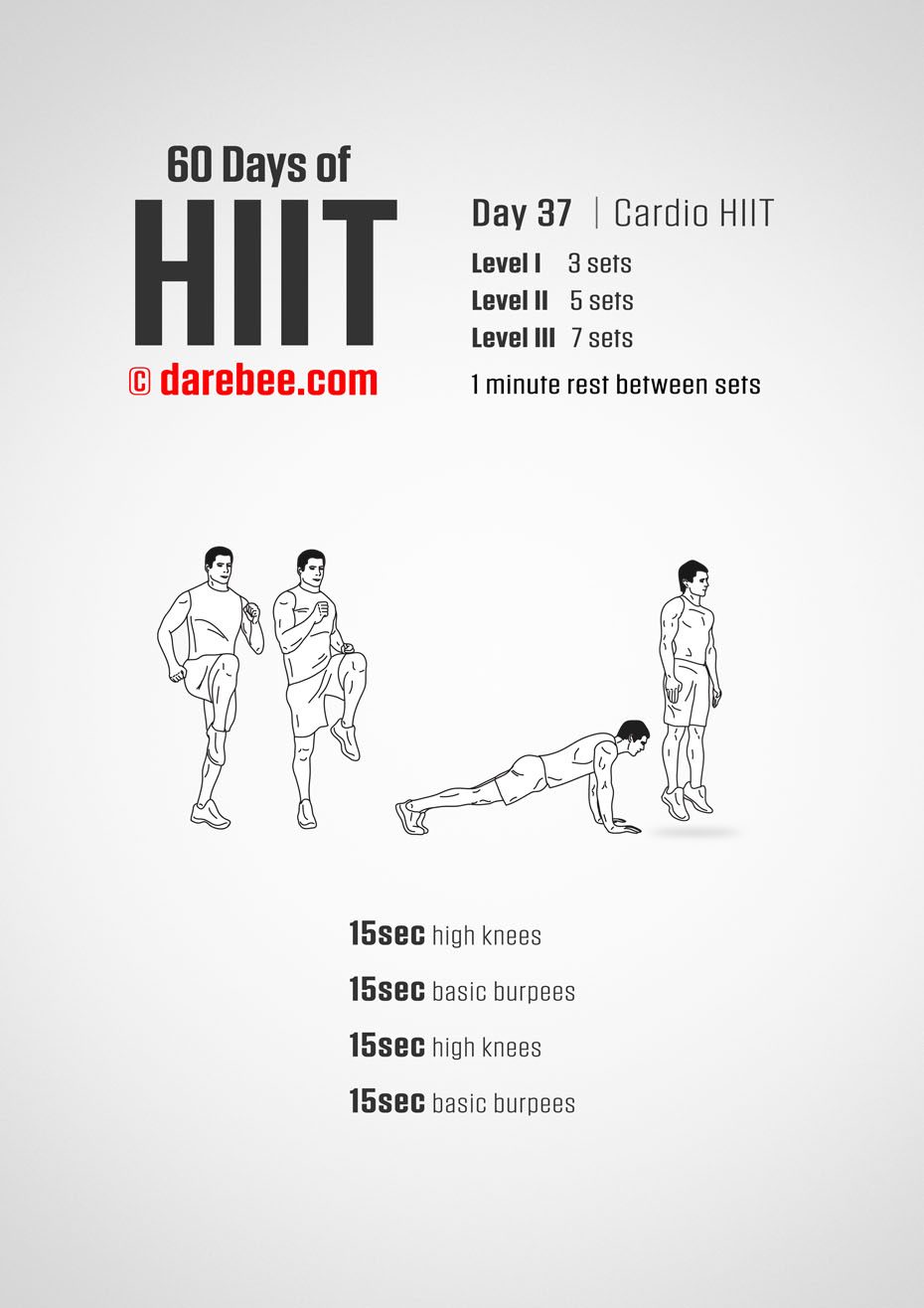
Day 37 pairs a running interval with a floor interval and lets the transition do the damage. Four 15-second intervals - high knees, climber taps, high knees, climber taps - three to seven sets, one minute of rest.
Climber taps are a climber with a reach added. From a high plank, one foot drives up to land outside the same-side hand, and the opposite hand comes off the floor to tap the foot before both return. It combines the hip drive of a climber with the balance demand of a shoulder tap and a hip opening that most people do not visit often. Coming into it straight off fifteen seconds of high knees means your legs are already burning when they are asked to drive forward under your body - and getting up off the floor for the next high knee interval is its own small workout.
Bring the foot all the way up beside the hand rather than settling for halfway, and turn the tap into a deliberate reach rather than a swipe. Keep the hips low and level. On high knees, drive hard and keep the arms working.
Up, down, up, down - and the getting up and down turns out to be part of the exercise.
Make it Harder: Add a hop as you switch feet on the climber taps so both feet leave the floor together.
Make it Easier: Step the foot up beside the hand without the tap and hold each position briefly before switching.

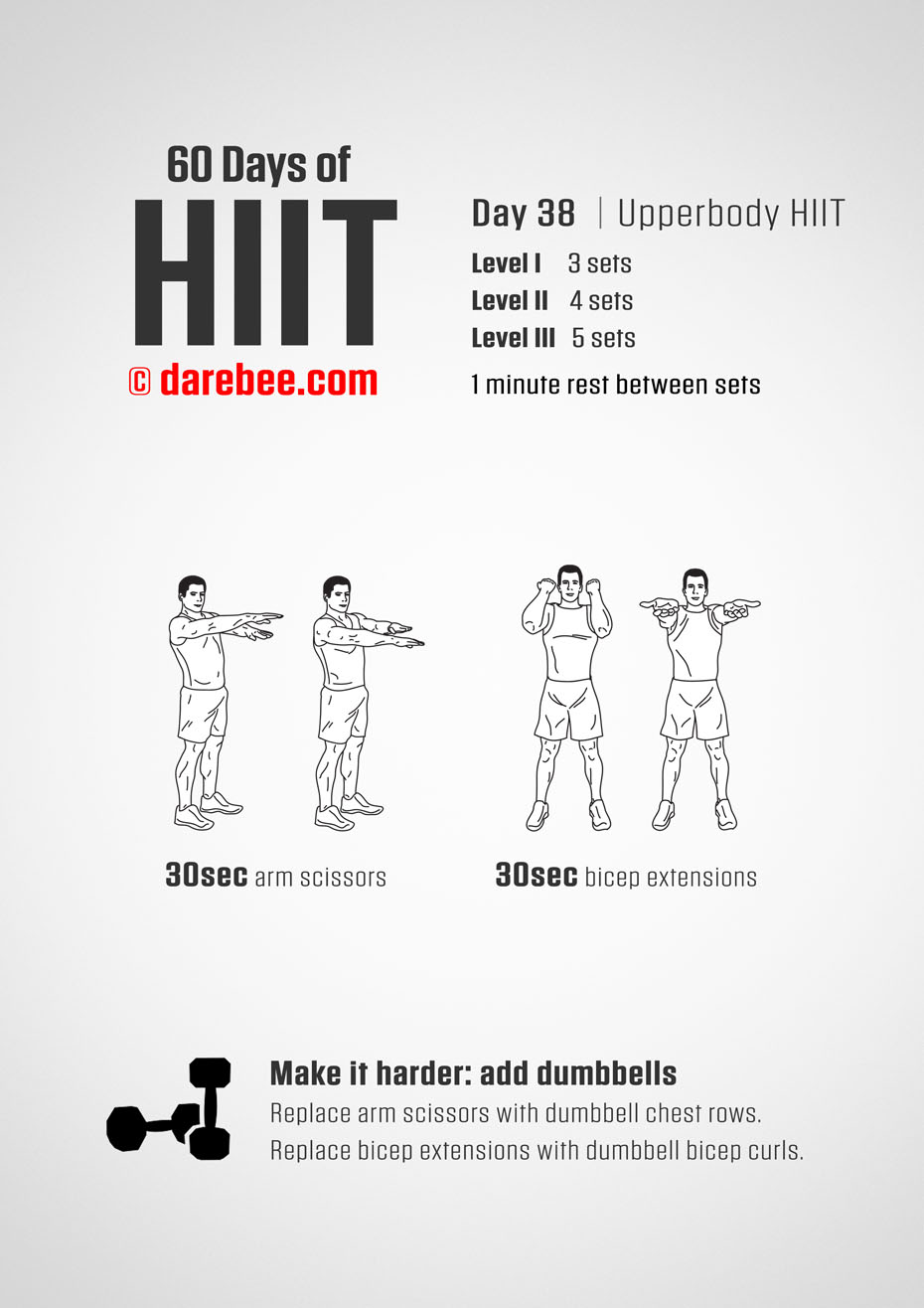
The upper body day returns with a movement that trains the front and back of your shoulders in a single sweep. Thirty seconds of arm scissors and 30 seconds of bicep extensions, three, four or five sets, one minute of rest.
Arm scissors hold both arms straight out in front at shoulder height and cross them over one another, opening and re-crossing continuously with the top arm alternating each time. Like the arm circles of Day 22, the value is less in the movement than in the fact that the arms never lower - but the scissor adds a horizontal pull and push that brings the chest and upper back into it. Thirty unbroken seconds of holding your arms at shoulder height while crossing them is quietly one of the harder things this program asks of an unloaded upper body.
Keep both arms dead level and fully extended, and cross them wide enough that you feel the sweep across your chest. Alternate which arm crosses on top with every rep. On bicep extensions, keep supplying real tension and keep the shoulders relaxed downward.
Arms out front for half a minute, crossing and re-crossing - simple to describe, considerably less simple at second twenty-five.
Make it Harder: Take the dumbbell option on the card and run the scissors as chest rows with the arms kept high.
Make it Easier: Drop your arms to chest height and slow the scissor rate to something you can sustain for the full block.

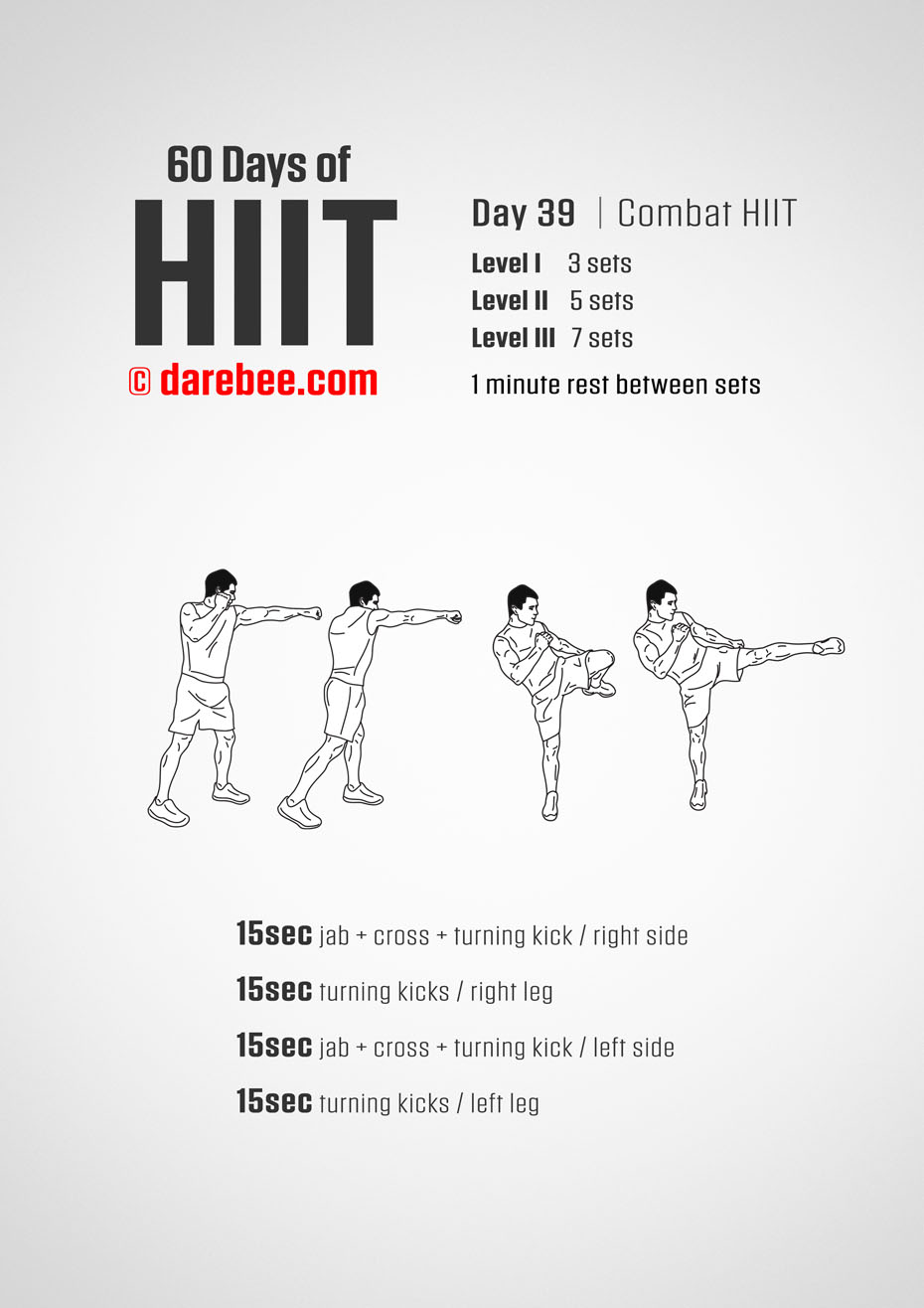
Day 39 lengthens the combination to three strikes. Four 15-second intervals - jab, cross and turning kick on the right, turning kicks on the right, then the same pair on the left - three to seven sets, one minute of rest.
This is the classic striking chain and the one worth learning properly: lead hand, rear hand, then the rear leg swinging through as a turning kick. Each strike sets up the next, and the rotation you generate in the cross is the same rotation that carries the kick. Following the combination with an interval of turning kicks alone means you throw the chain first while you are fresh and then drill the hardest component of it in isolation, on the same side, before switching.
Let the jab lead, the cross rotate the rear hip, and the kick continue that rotation rather than starting a new one. Keep both hands at your face during the kick. On the isolated kick interval, chamber high and retract fully - a kick that falls back to the floor is a kick you have not finished.
Both hands and a leg riding one continuous rotation - this is where the combat days start to look like actual striking.
Make it Harder: Follow the kick with a return cross so each cycle finishes with your hands rather than your foot.
Make it Easier: Drop the cross and run the combination as a jab and turning kick.

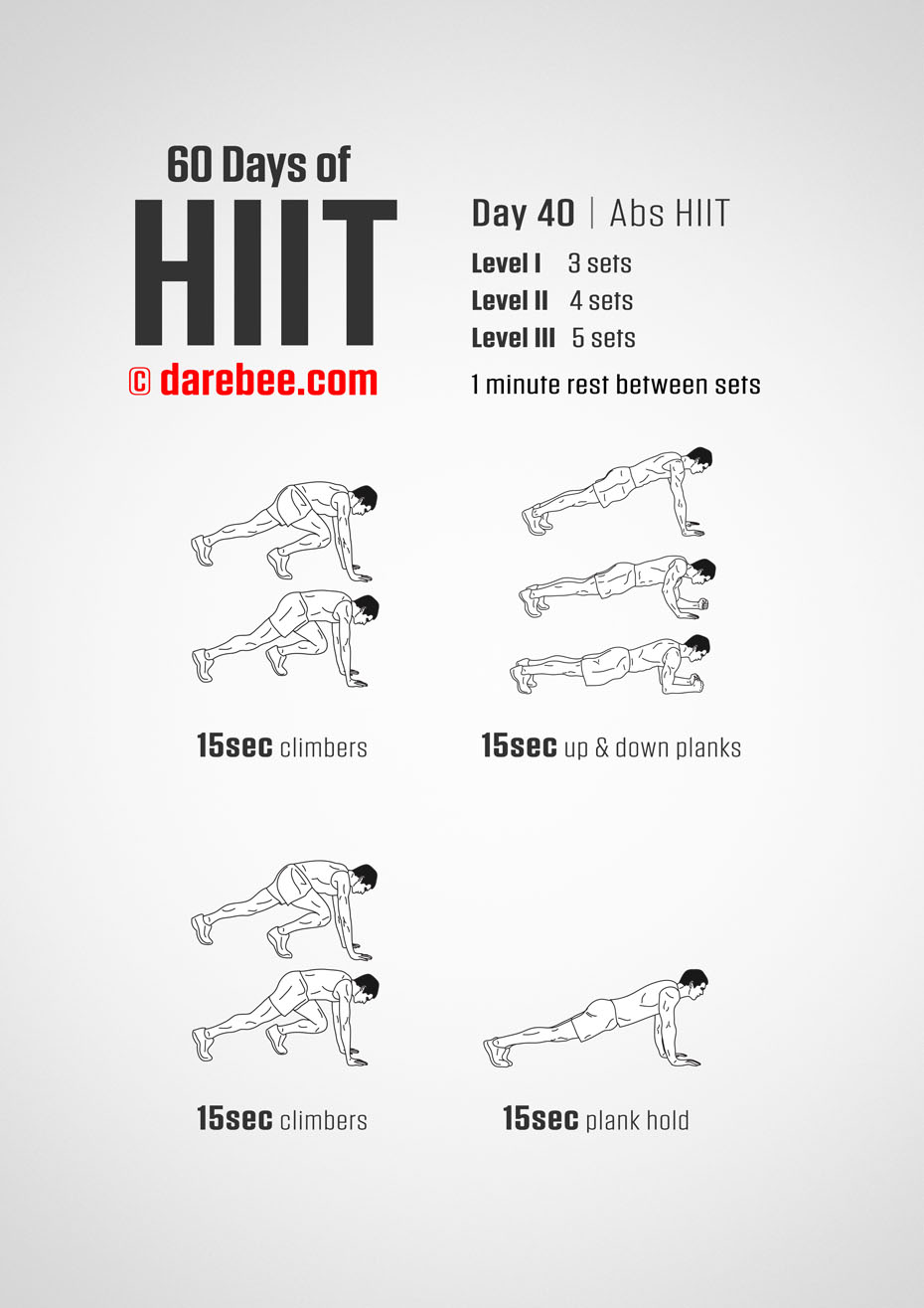
Day 40 brings the plank family its most demanding variation yet. Fifteen seconds each of climbers, up and down planks, climbers and a plank hold, at three, four or five sets with a minute of rest.
An up and down plank travels between the two plank positions you already know: from the high plank on your hands, you lower one forearm to the floor, then the other, arriving in an elbow plank, then press back up one hand at a time. The illustration shows all three stages. Every transition is a moment where your base is uneven and your hips want to rock, and doing it continuously for fifteen seconds makes it as much a shoulder exercise as a core one. Finishing the session with a static plank hold after all that movement gives you the position back in its simplest form, right when holding it is hardest.
Set your feet wide and move deliberately - down, down, up, up - keeping the hips as level as you can through every stage. Alternate which arm leads. In the final hold, everything from your heels to the back of your head stays in one line and your breathing stays even.
Forty days in, and your plank now has to travel as well as hold.
Make it Harder: Lead with the same arm for the whole interval on one set and the other arm on the next - the leading side works considerably harder.
Make it Easier: Take the up and down planks from your knees and keep the climbers and the hold as written.

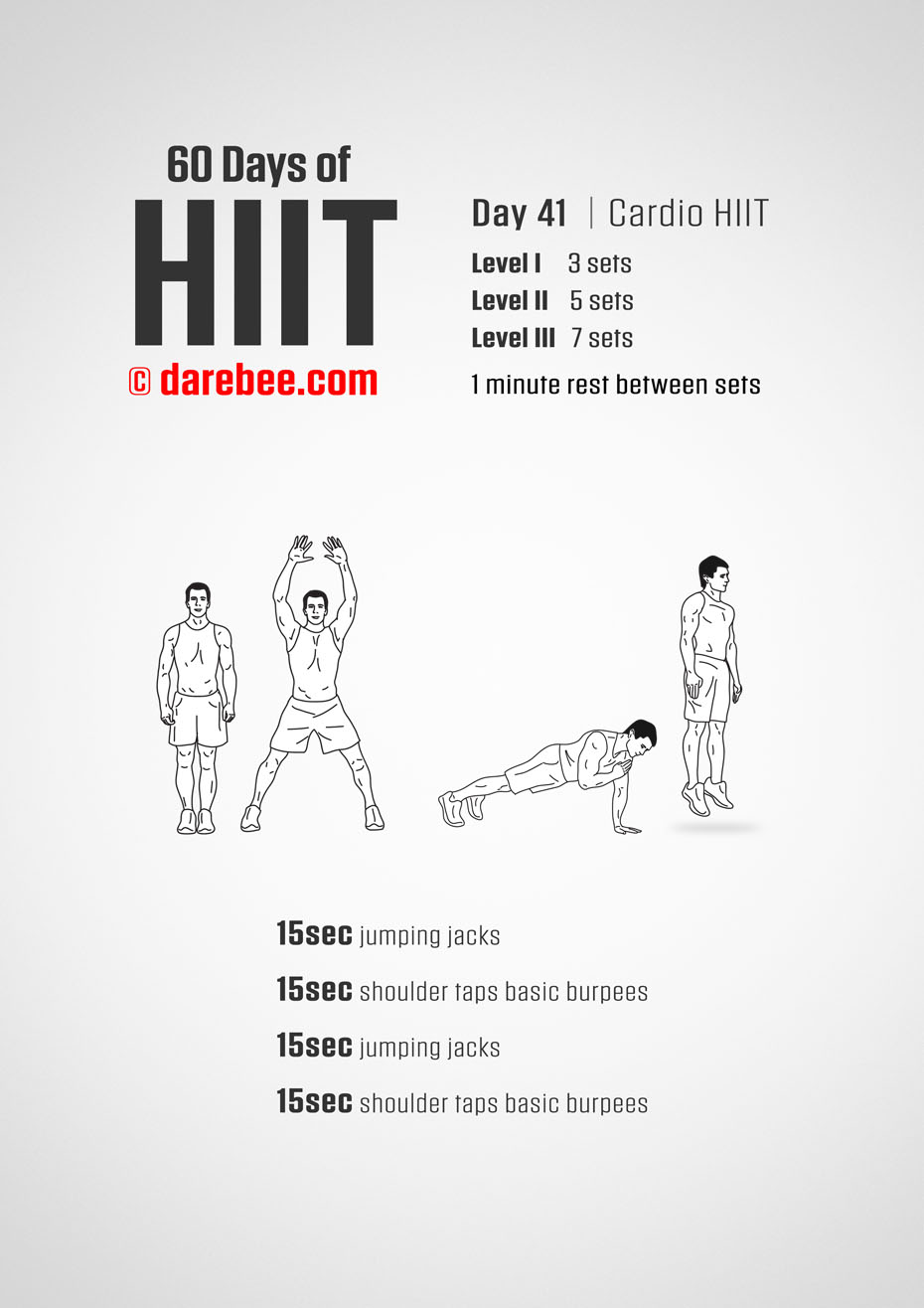
Day 41 keeps the new cardio format and changes what waits for you on the floor. Four 15-second intervals - jumping jacks, plank side crunches, jumping jacks, plank side crunches - three to seven sets, one minute of rest.
A plank side crunch drives one knee up toward the elbow on the same side, travelling around the outside of the body rather than under it, then returns and alternates. Where a climber sends the knee straight forward and works the front of the abdominal wall, this angle sends it out to the side and puts the load squarely on the obliques. It is the same plank base, the same fast tempo, a completely different slice of your midsection - and it arrives with your heart rate already elevated from the jumping jacks.
Keep the hips low and let the knee travel wide rather than tucking underneath you. Turn your head slightly toward the working side and squeeze at the top of each rep instead of just touching and going. On jumping jacks, full range overhead and light landings.
Straight ahead is not the only direction a knee can travel, and your obliques have just been informed.
Make it Harder: Hold the knee at the top of each side crunch for a beat before returning it to the plank.
Make it Easier: Step the knee up to the side slowly, one at a time, without any pace pressure.

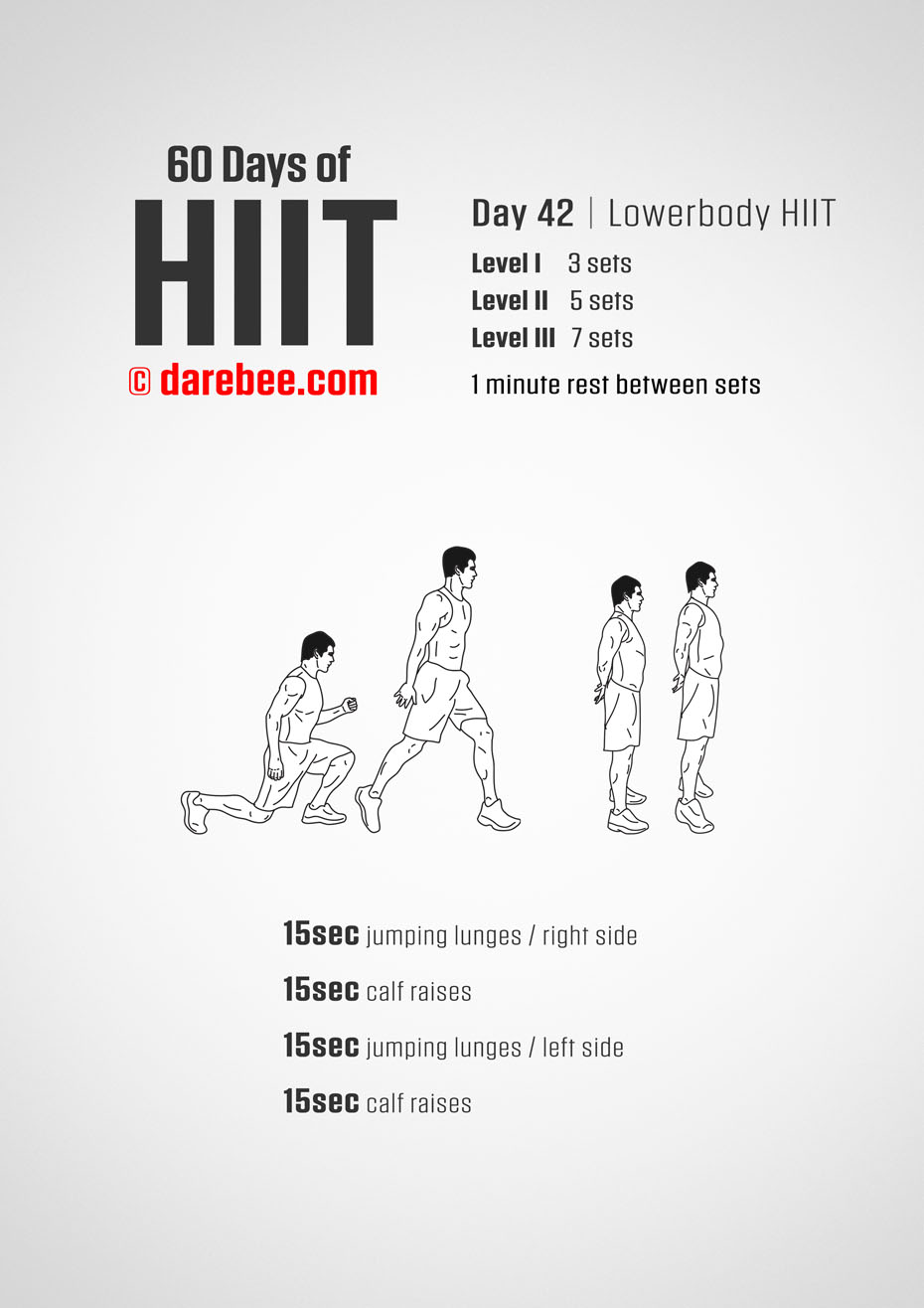
The lower body day rebuilds around the exercise Day 34 introduced. Four 15-second intervals - lunge step-ups on the right, calf raises, lunge step-ups on the left, calf raises - three, five or seven sets, one minute of rest.
The step-up is the same as before: drop into a lunge, drive up through the front leg, finish with the rear knee lifting to hip height, and go straight back down. What changes is the partner. Where Day 34 followed it with a static balance hold, today it is followed by calf raises - so instead of standing still on one leg, you keep moving on two. That makes this the higher-volume version of the session: less balance work, more continuous leg output, and both calves getting fifteen seconds of dedicated attention twice per set.
Keep the step-up tall and the knee lift genuine rather than a token hop, and set the foot down under control rather than crashing into the lunge. On calf raises, full range every rep, and use the interval to breathe rather than to rest - your legs are still working.
Legs alternating, calves filling the gaps - the lower body session with the fewest pauses in it.
Make it Harder: Run the calf raise intervals on one leg at a time, matching the side you have just been working.
Make it Easier: Take the step-ups to a shallower lunge depth and let the knee drive come only as high as it comfortably will.

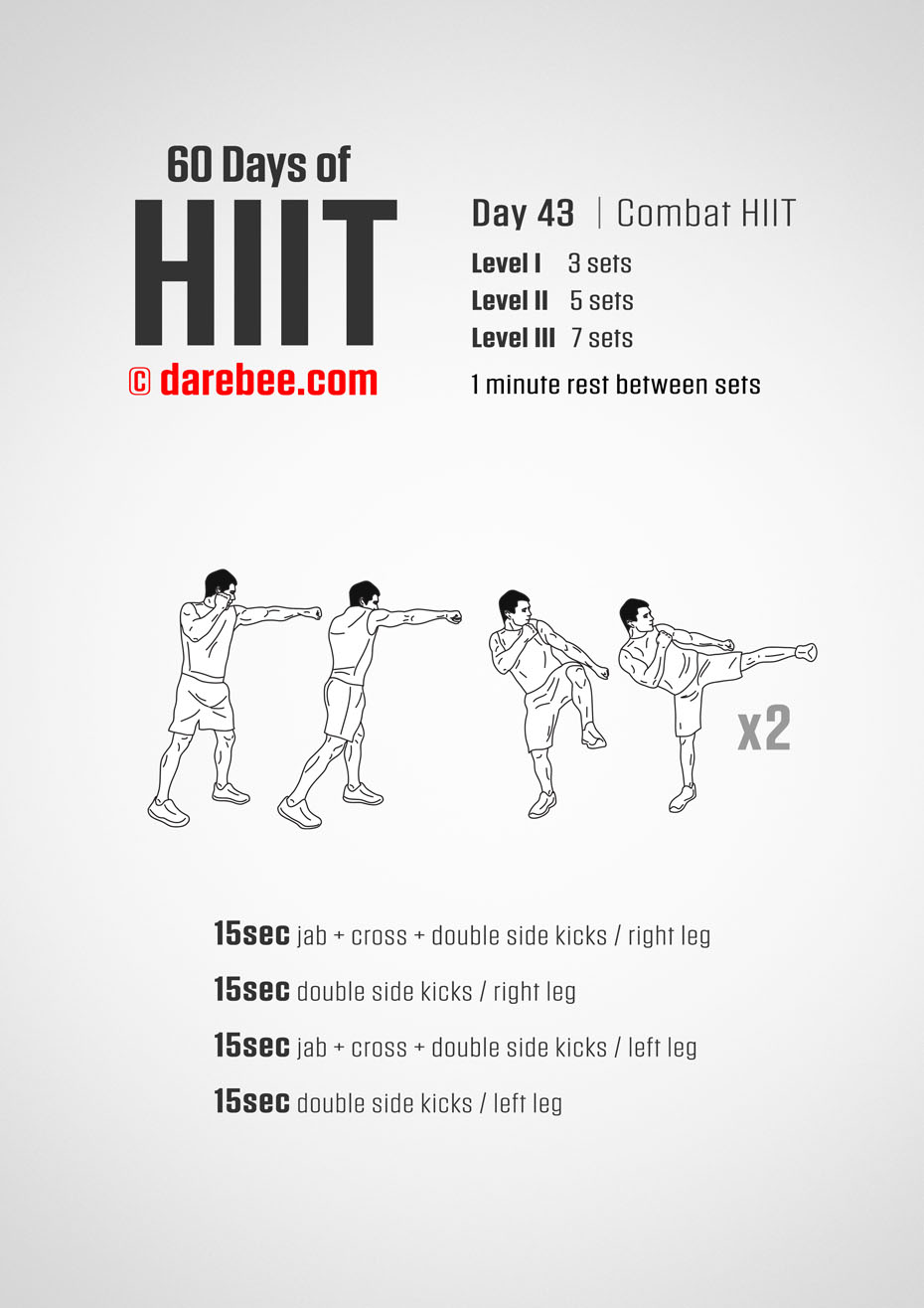
Day 43 puts the punch chain in front of the doubled kick. Four 15-second intervals - jab, cross and double side kicks on the right leg, double side kicks on the right, then the same pair on the left - three to seven sets, one minute of rest. The x2 marker sits beside the kick illustration, as it has since Day 19.
This is the longest string the program has asked for so far: two punches followed by two kicks from the same leg without the foot touching down. Four strikes in one cycle, and the whole thing has to flow. The punches build the rotation, the first kick spends it, and the second kick has to be generated from a standing position that is already leaning away and already tired. Following that with an interval of doubles alone removes the punches and leaves you with nothing but the hardest part.
Throw the punches sharp and short so you arrive at the kick with your balance intact rather than overcommitted. Chamber high, extend to the side, pull the foot back to the chamber and fire again. Guard up, standing foot pivoting, torso angled but controlled.
Four strikes, one cycle, one foot in the air for half of it - the chain is getting long.
Make it Harder: Add a return jab after the second kick so every cycle opens and closes with your hands.
Make it Easier: Run the combination as jab, cross and a single side kick, and keep the doubles for the second interval only.

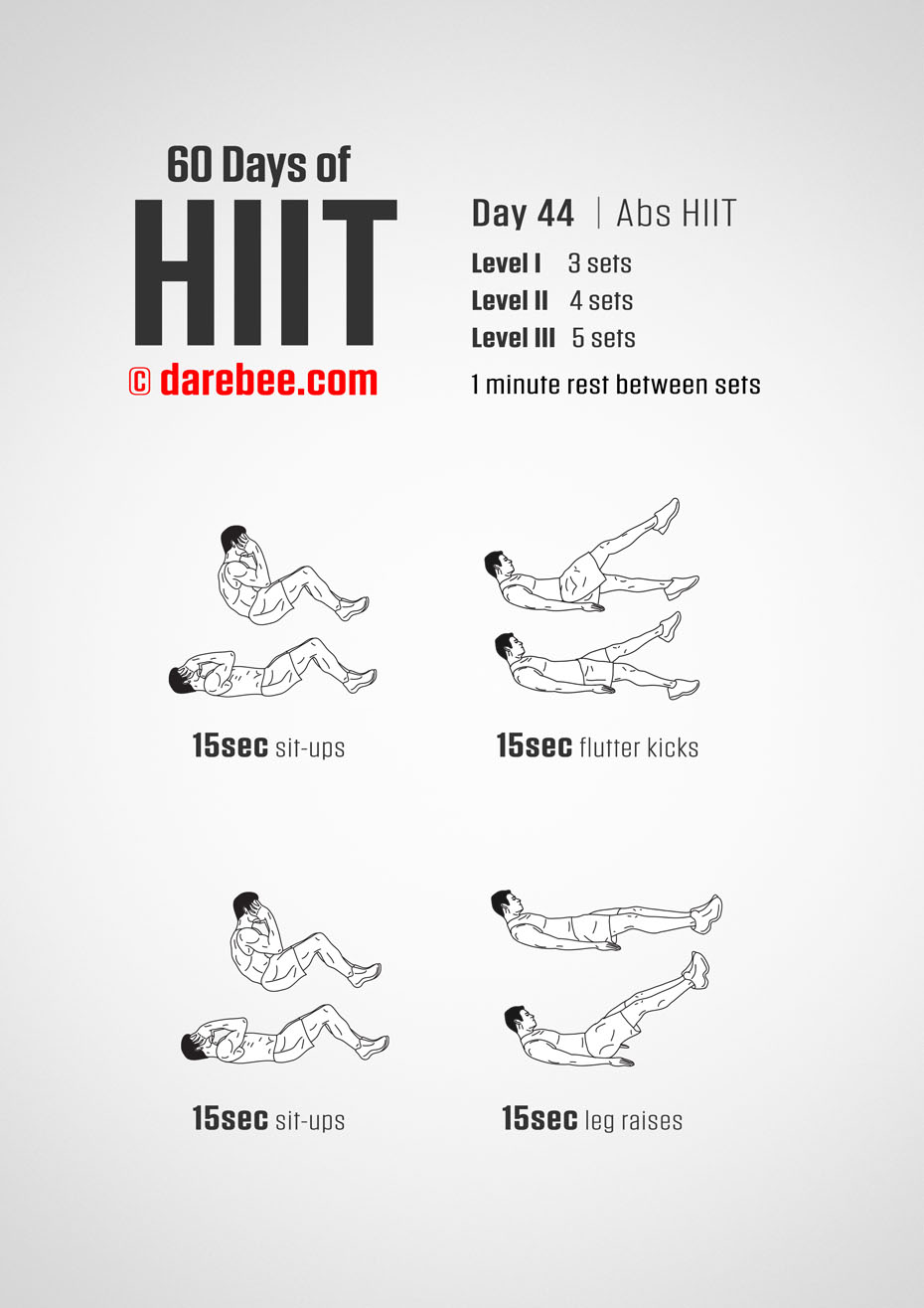
Day 44 runs sit-ups against two leg intervals that look alike and load differently. Fifteen seconds each of sit-ups, flutter kicks, sit-ups and leg raises, at three, four or five sets with a minute of rest.
Flutter kicks and leg raises are the same starting position and the same straight legs, separated by range and rhythm. Flutter kicks alternate the legs through a small fast range, keeping constant low-level tension on the lower abdominals for the whole interval. Leg raises take both legs together through the full arc from just off the floor to vertical, which is a bigger movement with a heavier bottom position. Small and fast, then large and slow, with the full-range sit-up bookending both.
Keep your lower back pressed down for both leg intervals and set your working height accordingly. On leg raises, control the descent - the last few inches before the floor are where the abdominals actually earn the rep. On sit-ups, come all the way up and lower without dropping.
Same legs, same floor, two entirely different bills - and your lower abs pay both.
Make it Harder: Stop the leg raises just above the floor and hold there for a second before the next rep, never letting the heels touch down.
Make it Easier: Slide your hands under your hips for both leg intervals and reduce the range until your back stays flat.

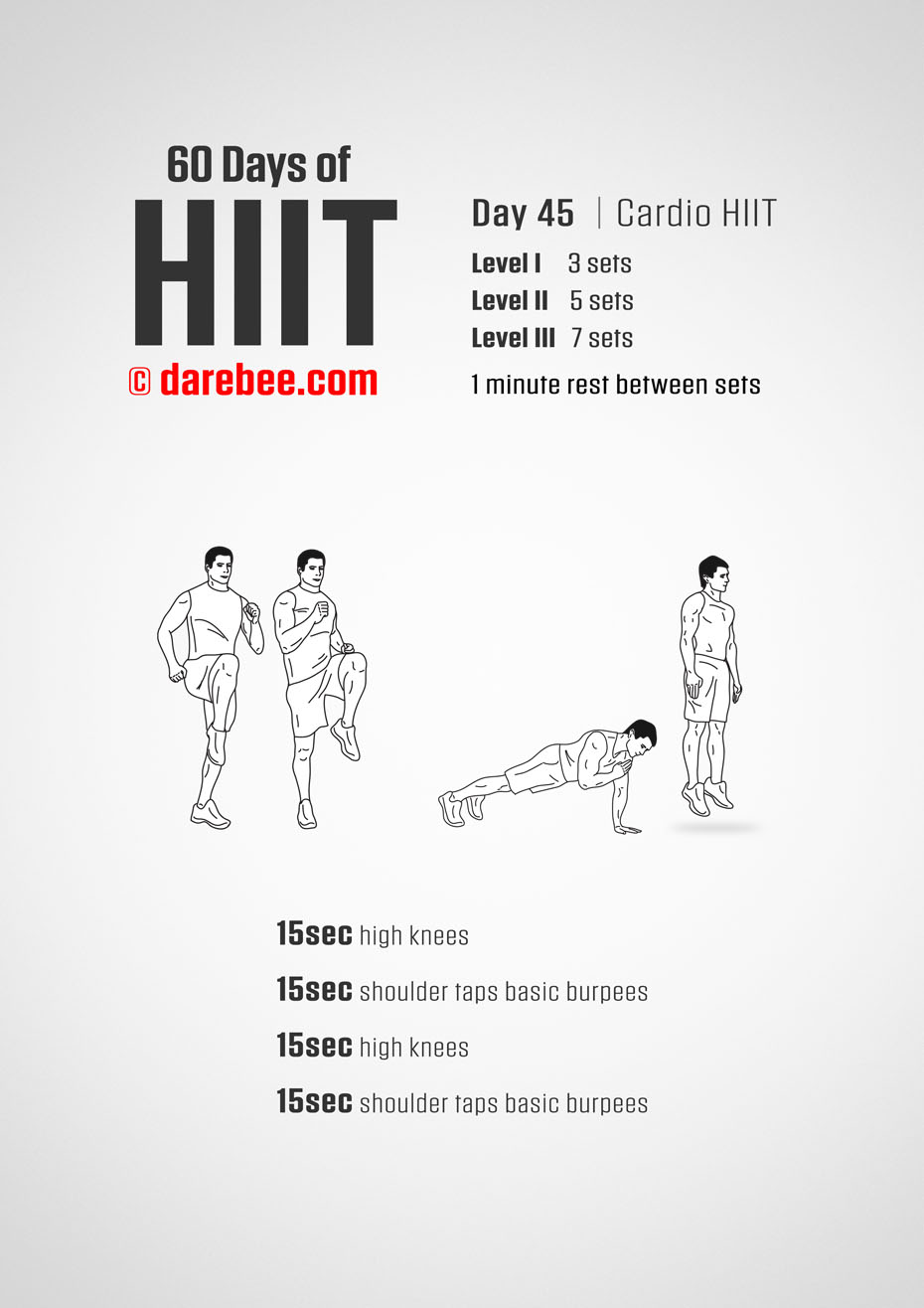
Day 45 pairs the fastest standing exercise in the program with one of the slowest floor ones. Four 15-second intervals - high knees, plank leg raises, high knees, plank leg raises - three to seven sets, one minute of rest.
A plank leg raise holds the high plank position and lifts one straight leg off the floor, then lowers it and alternates. It looks minor and it is anything but: the moment a foot leaves the ground your base drops to three points, your hips want to tilt, and the glute of the lifting leg has to work while the whole core fights to keep everything level. After fifteen seconds of high knees, arriving at an exercise whose entire success criterion is stillness is a genuine change of gear.
Lift the leg from the glute rather than by arching your lower back, and stop when the foot is a hand's width off the floor - height is not the point, control is. Keep the hips square and the plank line intact. On high knees, drive the pace and use the arms.
Legs everywhere for fifteen seconds, then one leg moving and everything else forbidden to.
Make it Harder: Hold each leg at the top for two seconds before lowering, and keep the hips from dipping while you do it.
Make it Easier: Take the plank from your knees and lift one lower leg at a time rather than the whole leg.

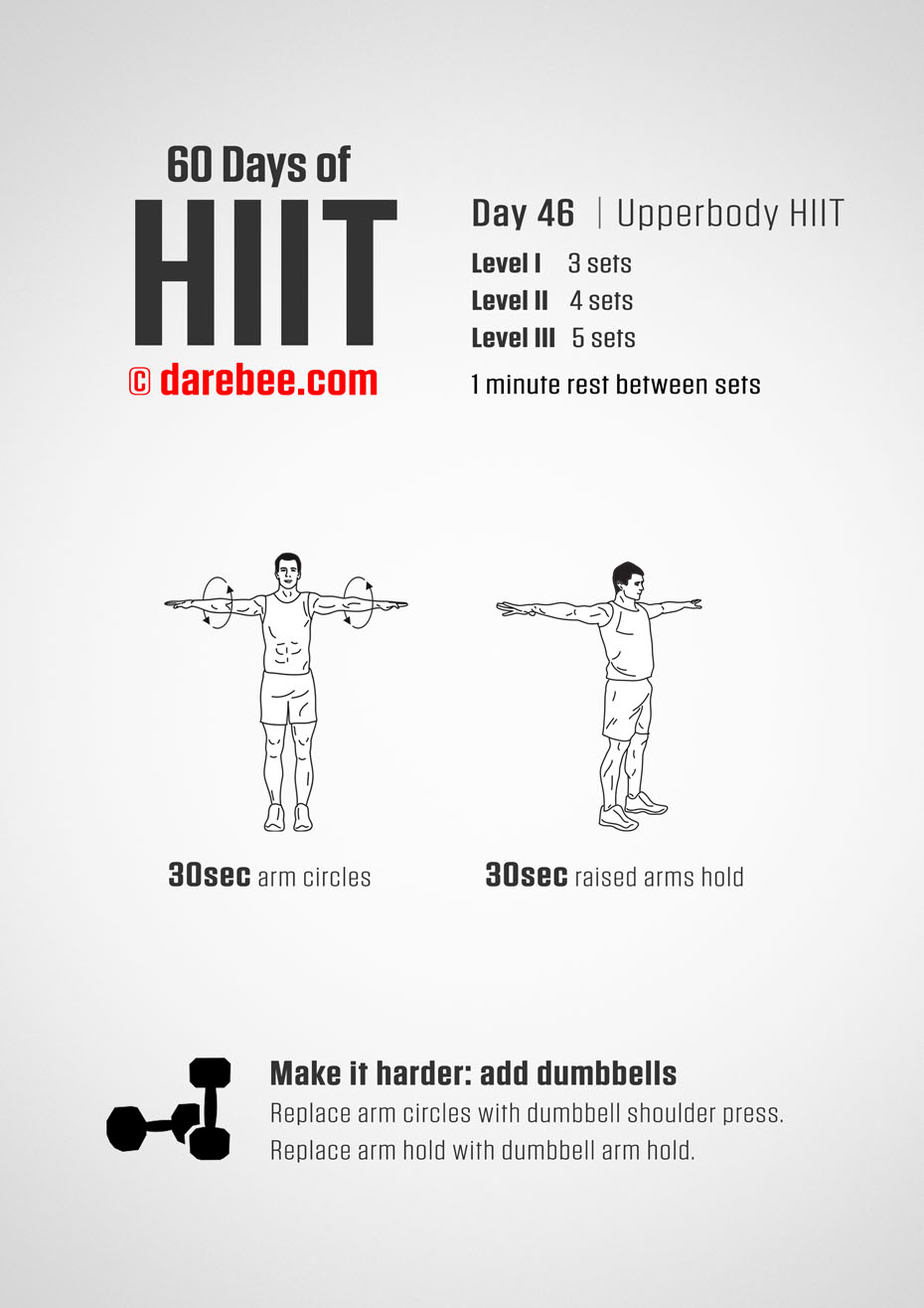
The upper body day comes back with a familiar pairing arranged in a new order. Thirty seconds of arm circles and 30 seconds of a raised arms hold, three, four or five sets, one minute of rest. Both exercises keep your arms out to the sides at shoulder height for their entire block - which means a full minute per set with the arms never once coming down.
That is the design and it is a deliberate one. The arm circles keep the shoulders moving through small continuous rotations while supporting the arms' weight; the hold then removes even the movement and leaves nothing but the support. There is no phase of this session where the deltoids get any relief inside the working minute, which makes it the most concentrated shoulder session in the program and the reason the rest period matters more here than almost anywhere else.
Keep the circles small, the arms level and the fingers extended. Move straight from the last circle into the hold without lowering. In the hold, palms down, elbows locked, shoulders pulled away from your ears, and eyes on something that will not move.
Sixty seconds of arms up and nothing to hold but your own - and yes, they will shake.
Make it Harder: Turn your palms to face forward for the hold and keep them there for the full thirty seconds.
Make it Easier: Lower your arms for a two-second shake between the two blocks rather than running straight through.

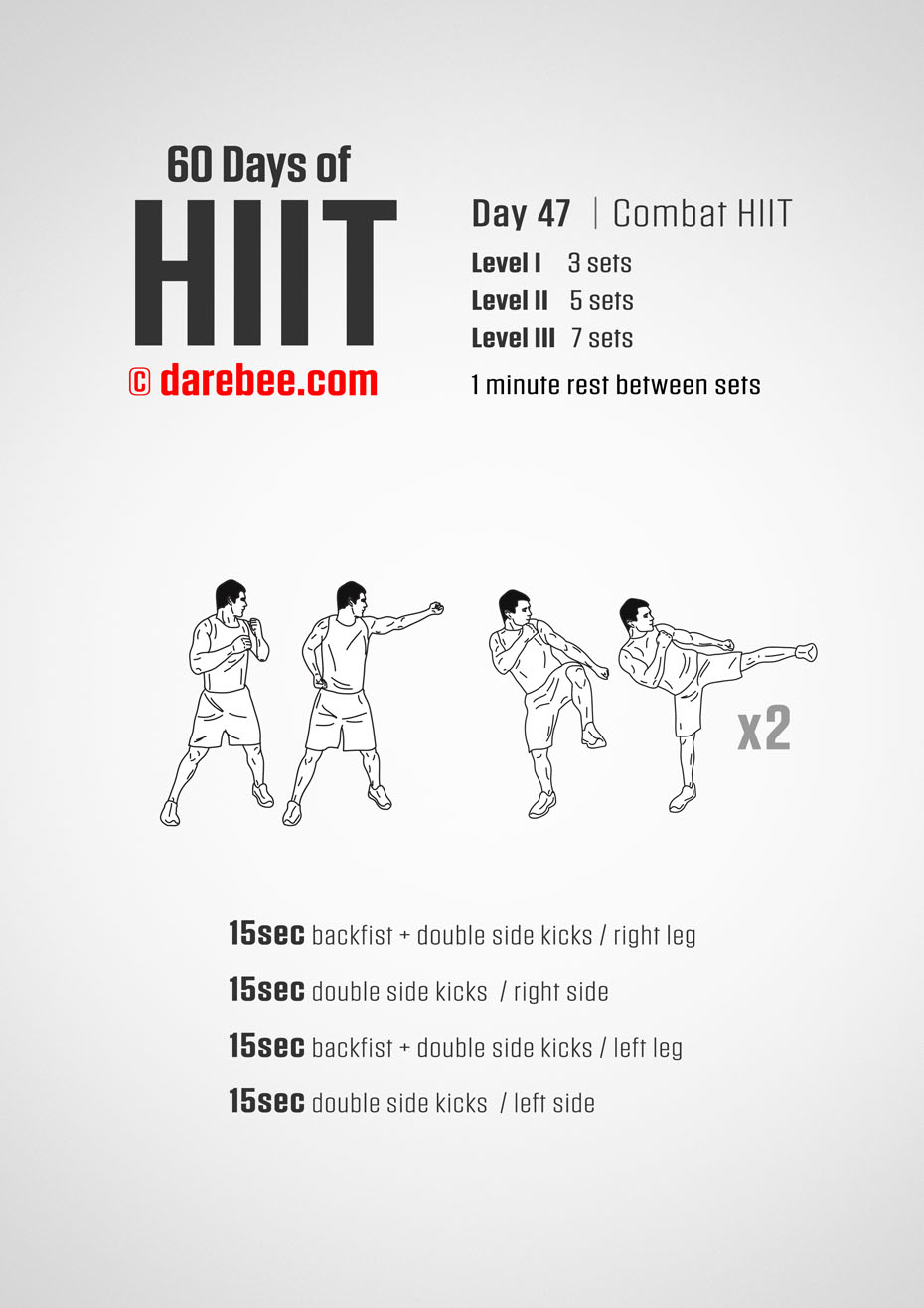
Day 47 keeps the doubled side kick and puts a hand strike in front of it. Four 15-second intervals - backfist and double side kicks on the right, double side kicks on the right, backfist and double side kicks on the left, double side kicks on the left - three to seven sets, one minute of rest.
Where Day 35 paired a backfist with a single side kick and Day 43 opened with a jab and cross, today's combination is shorter at the top and heavier at the bottom: one whipping hand strike and then two kicks from the same leg without the foot setting down. That puts almost all of the cycle's weight onto one standing leg, and the backfist becomes what it should be - a fast opener rather than a rest.
Snap the backfist out and back with the elbow leading and let the hand return to guard before the knee chambers. Kick, re-chamber fully, kick again, then set down. Pivot the standing foot, keep the torso angled but controlled, and let the second kick be as long as the first even when it does not want to be.
One strike, two kicks, one leg holding you up for the whole thing - the balance tax has never been higher.
Make it Harder: Throw a backfist between the two kicks as well, so the hand works on both ends of the cycle.
Make it Easier: Set the foot down between the two kicks and treat the backfist as a separate strike before the pair.

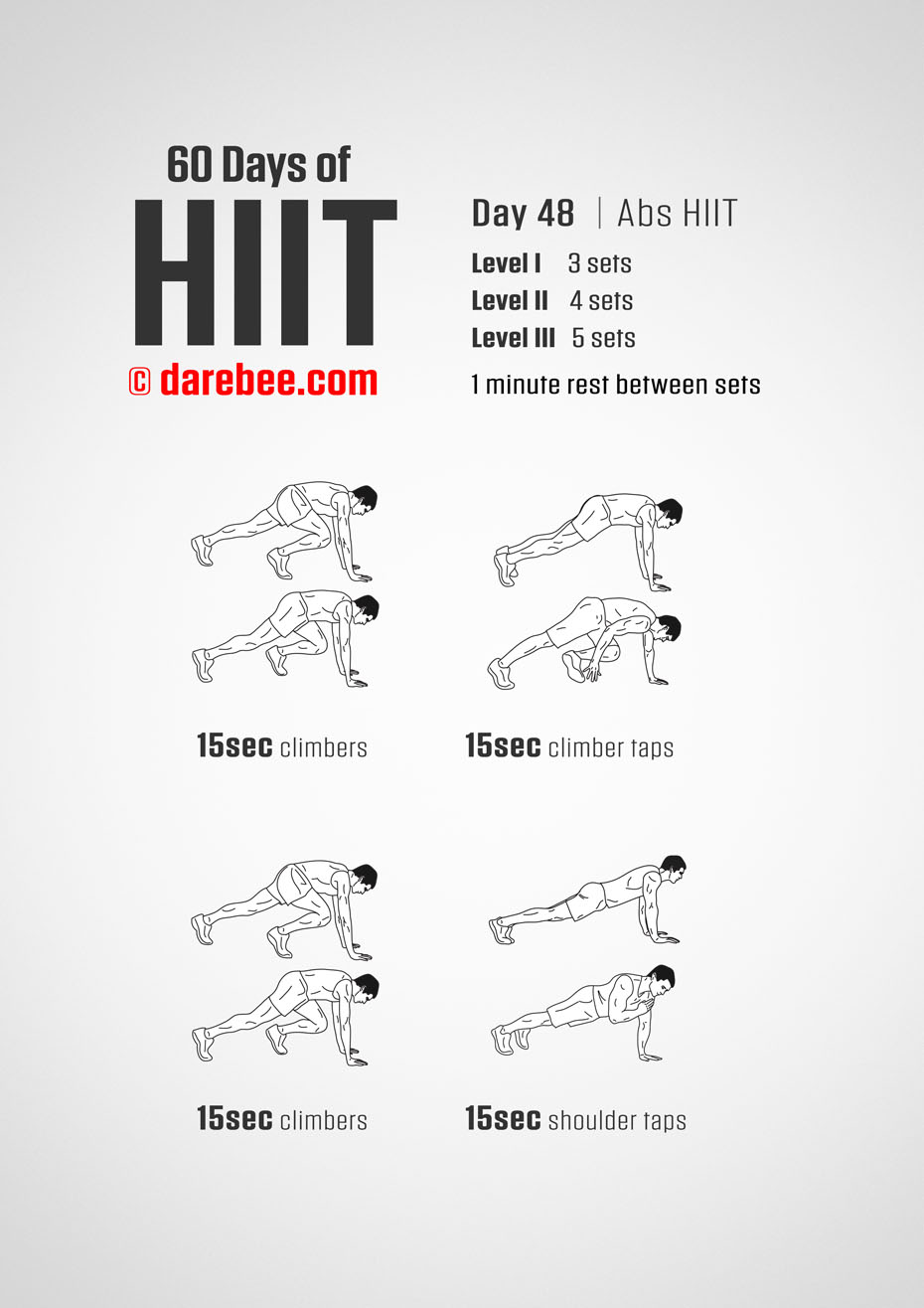
Day 48 stacks three of the program's plank drills onto its most repeated exercise. Fifteen seconds each of climbers, climber taps, climbers and shoulder taps, at three, four or five sets with a minute of rest.
Every interval today is spent in the high plank, which makes this the most position-specific abs session in the program. The three exercises then divide the work between them: climbers drive the knees forward for speed and hip flexion, climber taps add a cross-body reach at the bottom of that drive, and shoulder taps remove the legs from the equation and make it purely about resisting rotation. Fast, fast with a reach, then slow and still - three different demands from a single set of hands on the floor.
Keep your hips level in all four intervals; the plank line is the thread running through the whole session. Bring the foot right up beside the hand on climber taps and make the tap deliberate. On shoulder taps, widen your feet and slow down enough that the hips stay square.
Four intervals, one position, and shoulders that will be glad to see the minute of rest.
Make it Harder: Keep the hips low and the knees tucked in as far as they will go on every climber rep - no half distances.
Make it Easier: Take the two tapping intervals from your knees and keep the climbers on your toes.

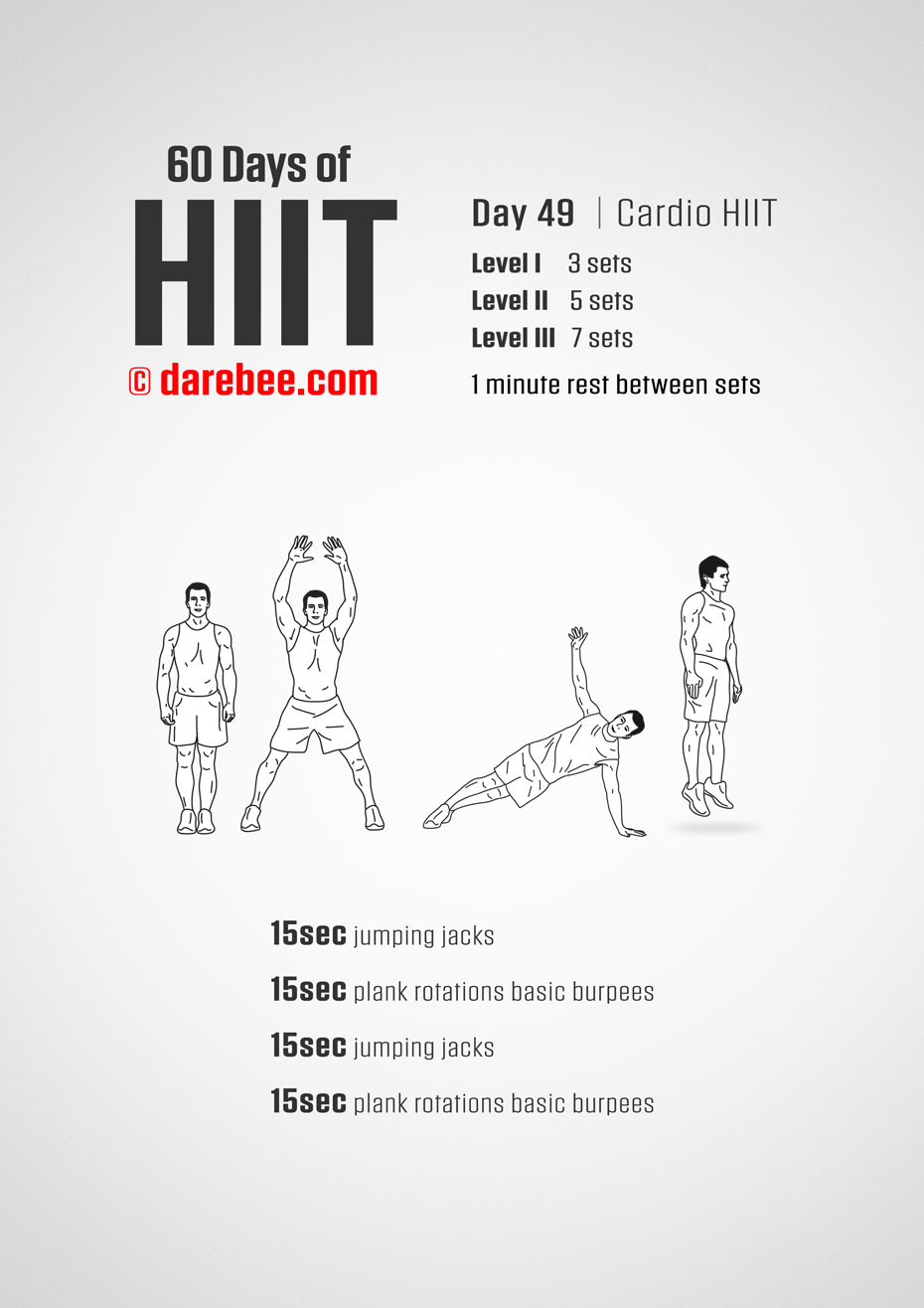
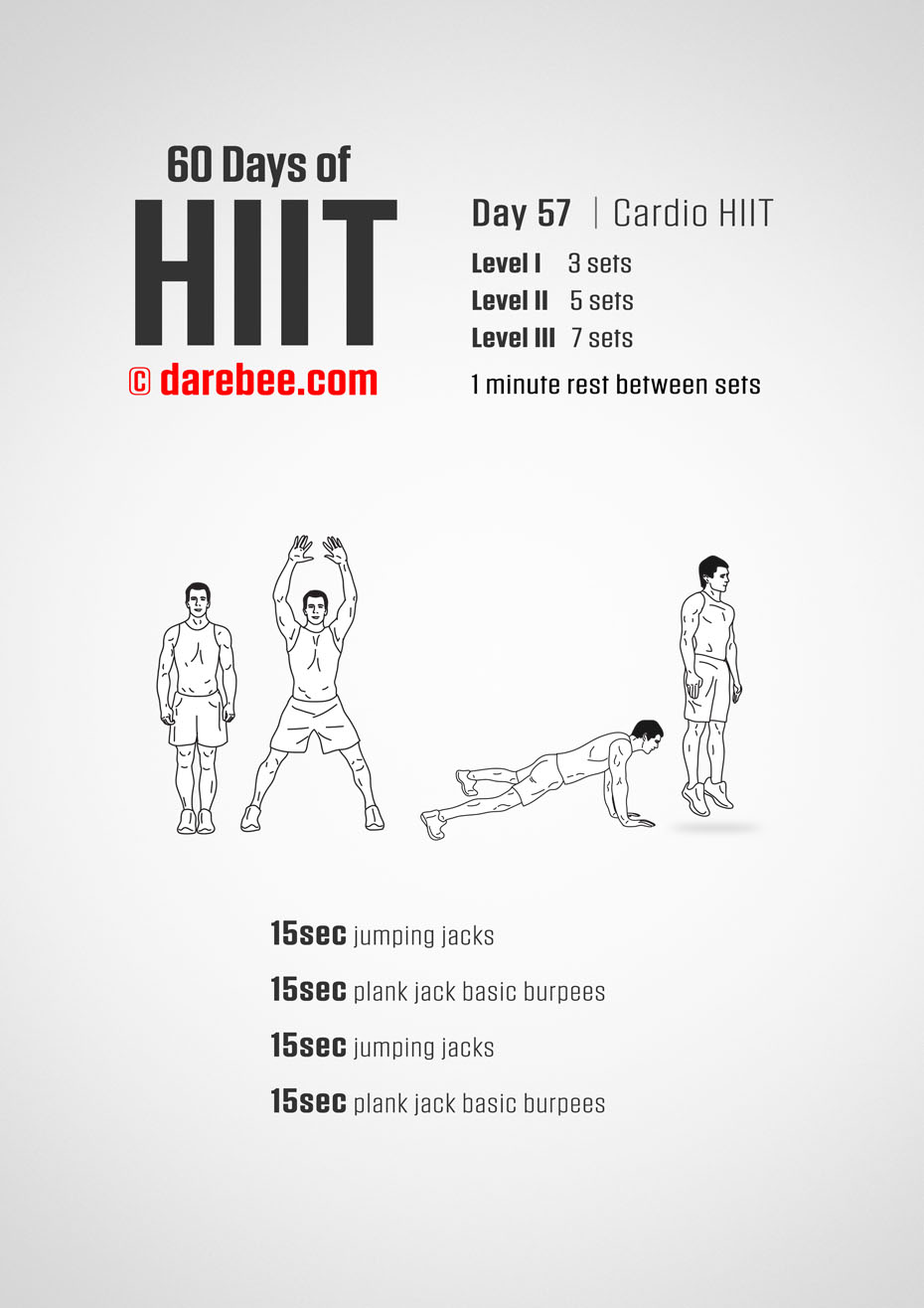
Day 49 gives the jumping jack a floor-based twin. Four 15-second intervals - jumping jacks, plank jacks, jumping jacks, plank jacks - three to seven sets, one minute of rest.
A plank jack is exactly what it sounds like: from a high plank, both feet jump wide and back together while everything above the waist stays completely still. It is the same leg pattern as a jumping jack rotated ninety degrees, and it turns out to be far harder in this orientation, because your core has to stop your hips from bouncing every time your feet land. Alternating the standing and floor versions inside one set is the cleanest illustration of what the back half of this program has been doing - taking a familiar cardio movement and making you hold a plank while you do it.
Keep your hips low and steady on the plank jacks and let the feet do all the travelling - if your backside is rising with each jump, slow the tempo. Land on the balls of your feet. On the standing jacks, arms all the way overhead and a light landing through the whole foot.
The same jack, two orientations - and gravity is a very different opponent from down there.
Make it Harder: Take the plank jacks on your forearms rather than your hands and keep the same tempo.
Make it Easier: Step the feet out and in one at a time on the plank jacks instead of jumping them.

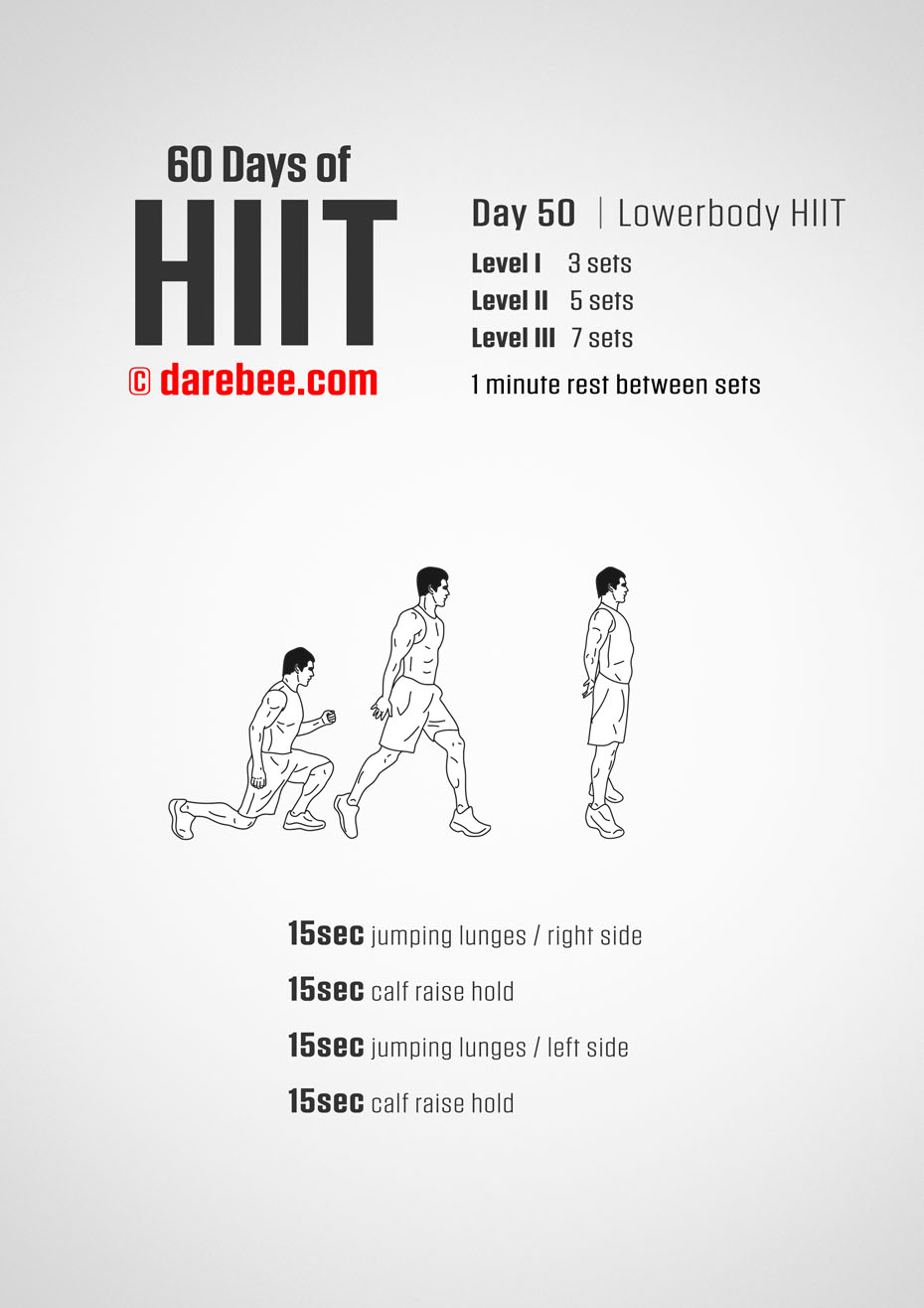
Day 50 pairs the step-up with a calf exercise that does not move. Four 15-second intervals - lunge step-ups on the right, a calf raise hold, lunge step-ups on the left, another calf raise hold - three, five or seven sets, one minute of rest.
The calf raise hold is the static version of the exercise you have been doing since Day 10: rise onto the balls of both feet and stay there, heels off the floor, for the full fifteen seconds. That changes what the calves are being asked for. Repetitions build range and endurance; a hold builds the sustained tension the ankle actually uses when you balance, run or land. Coming after a lunge step-up interval, the hold also asks a leg that has just been driving explosively to hold a fine, still position - which is exactly the pairing Day 34 set up with the balance hold, moved down to the ankle.
Rise as high as you can and stay at that height rather than sinking gradually - the count only counts at the top. Keep your knees straight and your weight over the balls of both feet. On the step-ups, tall torso, full knee drive, controlled descent.
Fifty days down, and your calves finally get an interval where nothing happens except effort.
Make it Harder: Take the calf raise hold on one leg at a time, matching the side you have just worked.
Make it Easier: Touch a wall for balance during the calf raise holds and lower your heels briefly if the calves cramp.

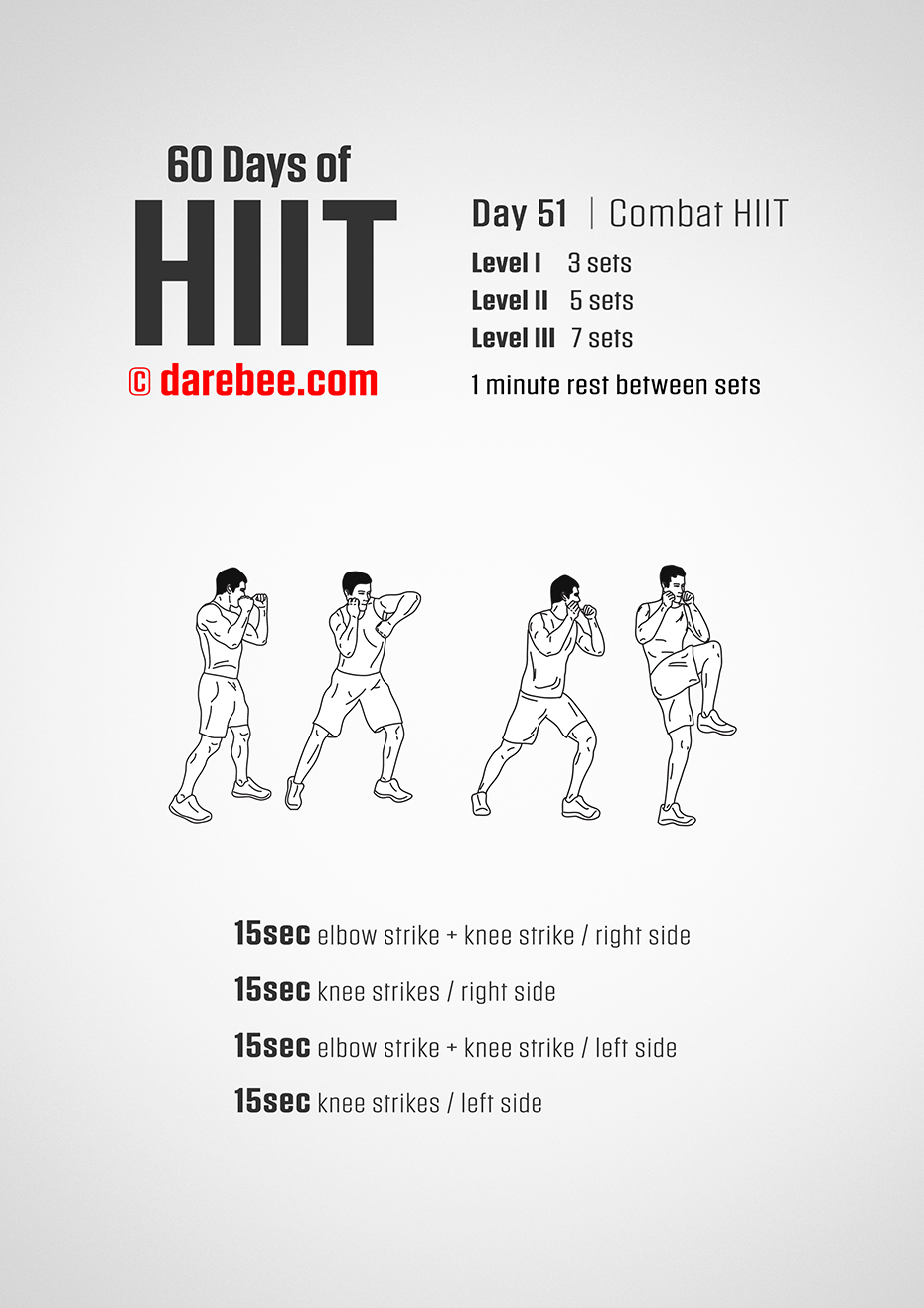
Day 51 runs Day 31's session in reverse order, and the reversal is the point. Four 15-second intervals - elbow strike and knee strike on the right, knee strikes on the right, then the same pair on the left - three to seven sets, one minute of rest.
Three weeks ago you built the knee strike first and added the elbow afterwards. Today the combination comes first, while you are fresh, and the isolated knee strikes follow it. That means the fifteen seconds of continuous knees now arrive on a hip flexor that has already been driving through a combination, which is a considerably steeper ask than the same interval was on Day 31. Same two strikes, same two sides, and a harder order of operations.
Elbow across the body at head height, then the knee driving up from the same side while your hands pull down to meet it. On the isolated interval, keep the knees quick and high and rise onto the ball of the standing foot with each one. Guard resets between every rep, both intervals.
The same two strikes you met on Day 31 - stacked in the order that costs you more.
Make it Harder: Alternate sides within the combination interval so the elbow comes from one side and the knee from the other.
Make it Easier: Take the isolated knee strike interval at half pace and put your full effort into the combination.

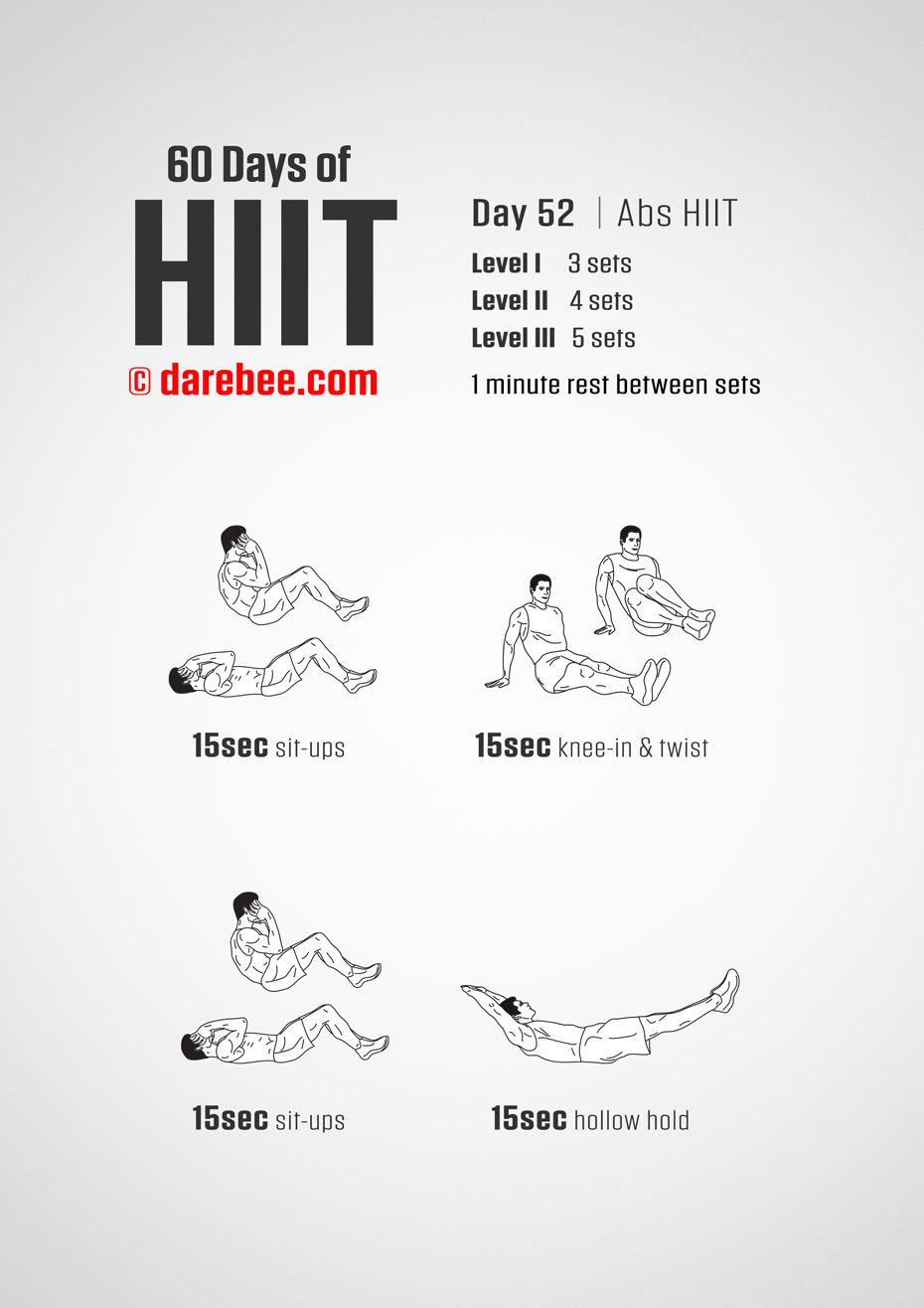
Day 52 brings the hollow hold back with the sit-up now anchoring the session. Fifteen seconds each of sit-ups, knee-in and twist, sit-ups and a hollow hold, at three, four or five sets with a minute of rest.
Look at what the session covers. The sit-up takes the trunk through its full range of flexion. The knee-in and twist adds rotation from a seated position, drawing the knees in while the torso turns to meet them. The hollow hold then removes movement entirely - flat on your back, shoulder blades and legs both lifted, the body held in a shallow curve with nothing touching down but your lower back. Flexion, rotation, and a static hold, in that order, with the hold arriving last because that is when it is hardest to keep.
Come all the way up and all the way down on the sit-ups. Draw the knees fully in on the knee-in and let the rotation come from the ribs. In the hollow hold, press the lower back into the floor first and adjust your leg height until it stays there - and keep breathing.
Sixty seconds of abdominal work that ends with everything switched on and nothing moving.
Make it Harder: Reach your arms past your ears in the hollow hold and rock gently for the full fifteen seconds without losing the shape.
Make it Easier: Hold the hollow position with your knees bent and your hands resting on your thighs.

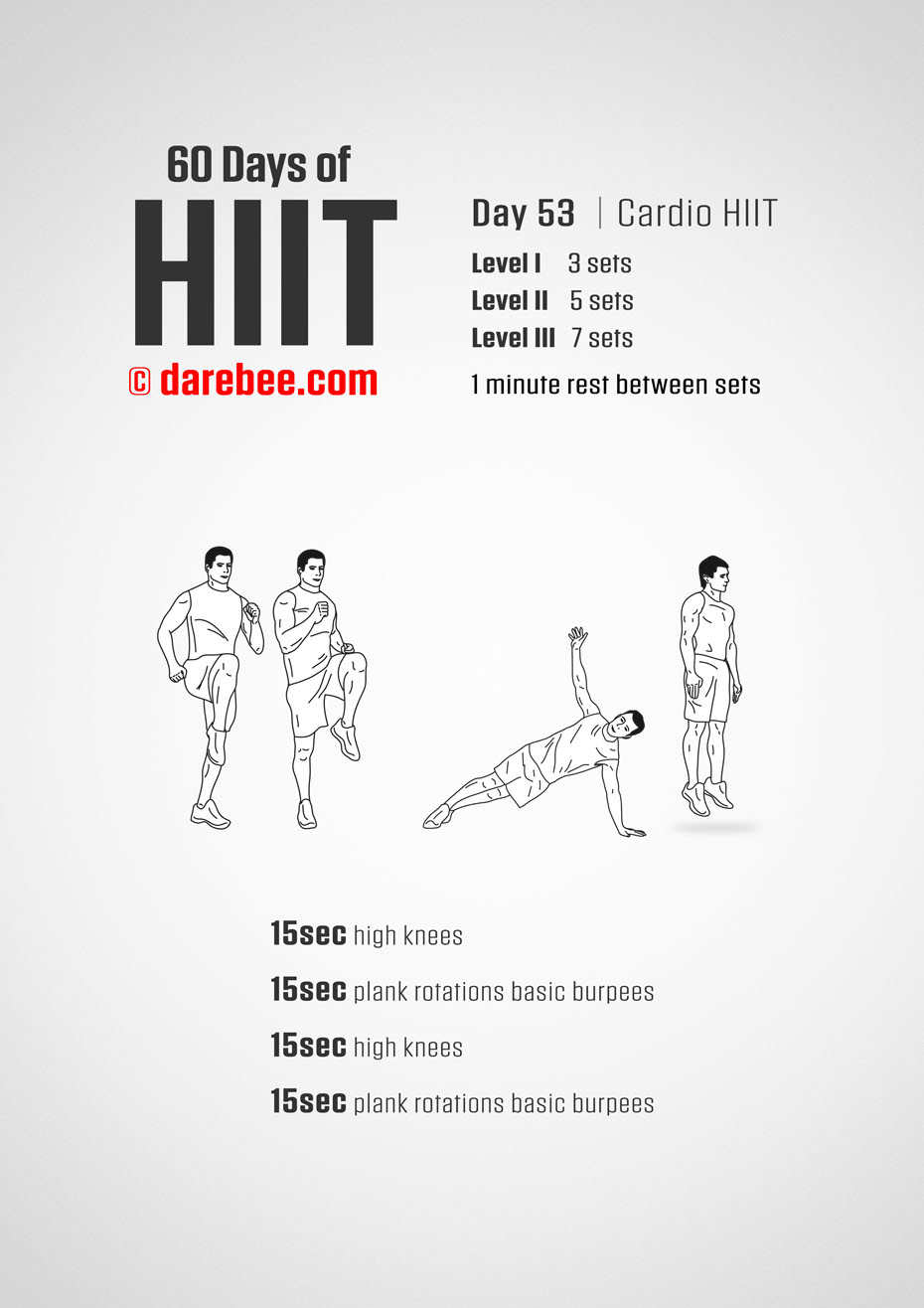
Day 53 is the last of the cardio days to send you to the floor, and it picks the rotation drill to do it with. Four 15-second intervals - high knees, plank rotations, high knees, plank rotations - three to seven sets, one minute of rest.
You met plank rotations on Day 16 as part of an abs session. Here they do a different job: opening the body into a side plank with one arm reaching to the ceiling, then rotating through centre and opening the other way, all while your heart rate is still high from running in place. Rotating under fatigue is where the obliques and the shoulder stabilisers get properly tested, and doing it with your breathing already elevated is a fair simulation of every sport that ever asked you to change direction while tired.
Stack your hips as you open so the body forms one flat plane, and press the supporting hand into the floor rather than collapsing into that shoulder. Control the return through centre instead of dropping. On high knees, keep the cadence high - the interval is short and the rotation will feel slower if you have earned it.
Fast on your feet, then slow and wide on the floor - the last time this program asks for that particular swap.
Make it Harder: Lift the top leg as you rotate open so the side plank is supported on one hand and one foot.
Make it Easier: Rotate from your knees and take the reaching arm only as high as your shoulder allows.

The last upper body session of the program pairs its two most-used movements. Thirty seconds of side shoulder taps and 30 seconds of bicep extensions, three, four or five sets, one minute of rest.
Side shoulder taps have appeared once before, on Day 14, and bicep extensions have appeared on almost every upper body day since Day 6 - which makes this final session a summary rather than an introduction. Fingertips to the shoulders and then the arms opening straight out to the sides works the deltoids through their whole lateral range; the bicep extensions then close the program's upper body arc with the same self-supplied tension it opened with. Seven sessions, six exercises, no equipment, and the arms are demonstrably stronger for it.
Open the arms to a full straight line and keep them at shoulder height rather than letting them drift up toward the ears. On the extensions, clench the fists and drive the tension through both directions - after seven upper body days you should be able to make thirty seconds of this genuinely hard without a single gram of weight.
The last thirty seconds of upper body work in the program, and it still comes down to how much tension you are willing to supply.
Make it Harder: Finish each set by holding your arms straight out to the sides for a further ten seconds before the rest period starts.
Make it Easier: Take the side shoulder taps at half tempo with a clear pause at the top of every rep.

Day 55 puts the punch pair in front of a doubled turning kick. Four 15-second intervals - jab, cross and double turning kick on the right, turning kicks on the right, then the same pair on the left - three to seven sets, one minute of rest, with the x2 marker beside the kick illustration.
The combination on Day 39 finished with a single turning kick; today it finishes with two from the same leg without the foot returning to the floor. That small change alters the rhythm of the whole cycle - the punches have to be crisp and quick because the leg work at the end is now twice as long, and the rotation you build has to carry through two full hip turns rather than one. The isolated kick interval that follows gives each leg its own volume block.
Jab, rotate the hip into the cross, and let that rotation feed straight into the first kick. Re-chamber fully before the second - the difference between a double kick and a kick with a wobble is entirely in the re-chamber. Hands up for all of it, standing foot pivoting freely.
Both fists and a doubled kick inside one breath - the longest combination of the program is now one day away.
Make it Harder: Make the second kick a head-height turning kick while the first stays at waist height.
Make it Easier: Run the combination with a single turning kick and keep the doubles out of it entirely.

The final abs session of the program pairs climbers with a hold that has a side to it. Fifteen seconds each of climbers, a raised leg plank hold on the right, climbers again, and a raised leg plank hold on the left - three, four or five sets with a minute of rest.
A raised leg plank hold is the still cousin of the plank leg raise from Day 45: instead of lifting and lowering, one straight leg comes off the floor and stays there for the entire fifteen seconds. Three points of contact, one working glute, and a core that must keep the hips square for the whole hold rather than just for a moment. Splitting it by side means each leg gets its own dedicated interval, and running it after climbers means you arrive at the hold already breathing hard - which is precisely when hips start to tilt.
Lift the leg only as high as you can while keeping both hips level, and hold that height rather than letting the leg drift down through the interval. Press the floor away with both hands, keep the neck long, and breathe. On the climbers, keep the hips low and the knees driving.
Fifteen abs sessions, one last plank, and one leg in the air to prove the position holds.
Make it Harder: Lift the opposite arm as well as the leg, holding the plank on one hand and one foot for as long as you can inside the interval.
Make it Easier: Keep the toes of the raised leg brushing the floor and simply unweight the leg for the fifteen seconds.

Day 57 brings the cardio days back onto their feet for the finish. Four 15-second intervals - jumping jacks, squat jacks, jumping jacks, squat jacks - three to seven sets, one minute of rest. After six sessions of dropping to the floor, the last cardio day of the program stays fully upright.
A squat jack is the jack pattern taken down into a squat: the feet jump wide and the hips sink as the arms come overhead, then the feet jump back together and the body rises. It is the most leg-intensive cardio interval in the program, and it comes on the day your legs have the most training behind them. Alternating it with standard jumping jacks means the quads and glutes get loaded hard for fifteen seconds and then get a fifteen-second interval to keep moving without the depth.
Sit the hips back as the feet land wide and keep your chest up rather than folding forward. Drive out of the bottom through your heels. On the jumping jacks, keep the arms fully overhead and the landings light - after eight weeks there is no excuse for a half-range jack.
The cardio days end where they began, on your feet - only now with a squat underneath them.
Make it Harder: Add a small jump out of the bottom of every squat jack so the movement leaves the floor twice per rep.
Make it Easier: Take the squat jacks to a quarter depth and keep the tempo rather than chasing range.

The last lower body day of the program puts two lunge variations back to back with no rest between them. Four 15-second intervals - lunge step-ups on the right, split lunges on the right, lunge step-ups on the left, split lunges on the left - three, five or seven sets, one minute of rest.
This is thirty unbroken seconds per leg, and both exercises load the same front thigh. The step-up is the explosive one, driving up to a knee lift and dropping back down; the split lunge that follows removes the travel and the rise entirely, keeping the feet planted and grinding straight up and down in the stance. Dynamic then static-footed, both on the same side, and the second interval arrives on a leg that has already been driving for fifteen seconds. It is the hardest lower body session in the program and it is placed exactly where you can handle it.
Stay tall in both and keep the front shin close to vertical. On the step-ups, full knee drive and controlled descent. On the split lunges, drop straight down and push straight up - and when the thigh starts burning around second ten, shorten the range rather than breaking the tempo.
Day 2 gave each leg two exercises with a break between them; Day 58 gives it two with none.
Make it Harder: Pause for a full second at the bottom of every split lunge before driving back up.
Make it Easier: Cut the depth on the split lunges and let the step-ups finish at standing without the knee drive.

The last combat session runs the longest combination in the program. Four 15-second intervals - jab, jab, cross and double side kicks on the right leg, double side kicks on the right, then the same pair on the left - three to seven sets, one minute of rest. There are two x2 markers on the card, one beside the punches and one beside the kicks, and both are already spelled out in the sequence: the jab is doubled and so is the kick.
Five strikes in a single cycle. Two jabs to establish and disguise the range, a cross to turn the hips, and then two side kicks from the same leg without the foot touching down. Everything the combat days have built since Day 3 is in this one sequence - the punch mechanics from the early sessions, the doubling that arrived on Day 19, and the long chains that started on Day 35. Fifteen seconds is enough for a handful of full cycles, and that is the right number.
Keep the two jabs quick and light so the cross still has something to rotate into. Chamber high, kick, re-chamber, kick again. Guard up throughout, standing foot pivoting, and let the final kick be as long as the first - which after fifteen seconds is entirely a decision rather than a matter of ability.
Fifteen combat sessions, five strikes in a breath, and the last one is the longest.
Make it Harder: Close every cycle with a returning backfist after the second kick, making it six strikes from a single sequence.
Make it Easier: Cut the sequence to one jab and one kick and keep the second interval exactly as written.

The program closes with an abs session that deliberately echoes its fourth day. Fifteen seconds each of sit-ups, flutter kicks, sit-ups and scissors - three, four or five sets with a minute of rest. Day 4 ran crunches, flutter kicks, crunches and scissors; Day 60 runs the same session with the sit-up in the anchor slot.
That single substitution is the whole story of the program in one line. The partner exercises have not changed - the same small vertical flutter and the same horizontal scissor, both keeping the lower abdominals under continuous tension while your lower back stays pinned to the floor. What has changed is you, and the sit-up is the proof: full range where you started with a partial one, at the end of a session where every interval is a movement you have practised fifteen abs days over. Nothing new, everything harder, and no equipment involved from the first day to the last.
Come all the way up on every sit-up and lower under control. Keep the legs low on flutter kicks and scissors and the small of your back in contact with the floor throughout. Same standards as Day 4, applied to a considerably stronger midsection.
Sixty days, 240 intervals a set, and a final session that measures the distance by asking for the same thing you started with.
Make it Harder: Hold the top of every sit-up for a beat with your hands reaching past your knees before lowering.
Make it Easier: Take the sit-ups with your arms crossed over your chest and your feet tucked under something solid.