
Lifting a weight to make your muscles adapt to the resistance it presents them with and therefore grow stronger is such an intuitive thing to do when you do it that it is hard to imagine that you may need help to start. Yet, most of those of us who started lifting dumbbells have had a guide to begin with: a friend, a sibling, someone at the gym, a trainer even or a coach.
Well, first of all let’s establish straightaway that lifting dumbbells is the perfect exercise for home training. It requires very compact equipment and barely any space, which makes it the ideal go-to type of exercise for strength training at home. Second, the relative simplicity of dumbbell lifting exercises make them perfect for days when we want to focus on training our body with a type of exercise that doesn’t also provide us a heavy cognitive load.
But what if you start from a blank page? What if you want to start lifting dumbbells at home, are a complete novice and want to know which are the nest dumbbells for you and the best weight to pick? How you go about answering these questions depends on your age, weight, fitness goals and how you intend to use the dumbbells.
But let’s start with the absolute basics: what type of dumbbell should you choose? You can go for black, cast in metal with a raw feel to it or you can go for ones covered in rubber that feel softer to the touch and are more modern or, you could even go for the many variety of candy-colored dumbbells that are all the rage at the moment or splash out on a shiny, all-chrome set. There are quite a lot of options at the moment so it’s a good question to start with.
Attached to this question is also the additional query of whether you should just get a couple of dumbbells or maybe a couple of different weight sets or should you opt for the adjustable ones where you get to pick what weight to put on the metal handle you will be using to lift them with?
To help you with the answer consider that whichever type you go for, in the short-term is excellent. It gives you a set of dumbbell weights to lift and that solves the problem. Long-term, however, a set of slightly different criteria play a part.
In no particular order they are:
- Durability – You want the dumbbell weights you use to look their best for as long as possible. Rubber covered ones can become damaged a lot more easily and not look their best. Even metal ones can rust if not looked after, but that can be fixed a lot more easily.
- Aesthetic – Ultimately, you want the dumbbells you have to always make you feel good. Feeling good about the dumbbells you lift is important because the way you feel about them, impacts on your willingness to use them regularly to exercise.
- Goals – If you're training for strength and want to build muscle mass your choice of dumbbells will always be towards the heavier end of the scale. If you're building functional power and speed you want dumbbells that are heavy enough to challenge your muscles but light enough to use in large-range-of-motion activities such as throwing punches or doing T-jumps. This will also dictate perhaps the type of dumbbells you choose as some are easier and more comfortable to use this way than others, irrespective of the weight you're lifting.
Now, whether you go for fixed dumbbell weights or choose to buy an adjustable set will depend on your own personal needs. But again there is a short set of criteria you can apply to help you decide:
- Flexibility - As you get stronger you will need to, at some point, increase the weight you lift for, at least, some of the exercises. You can, of course, always purchase a heavier set of dumbbells as you progress, but being able to change the weight, at will, makes things a lot easier.
- Goals – You may want to train for speed and power versus strength and size, in which case a fixed weight set of dumbbells in a weight range you can comfortably swing about would make a lot more sense than an entire adjustable weight barbells kit.
All this should help you make the right choices when you’re starting out but before you even consider which type of dumbbells to go for, there is an even more basic question you need to ask yourself before you start.
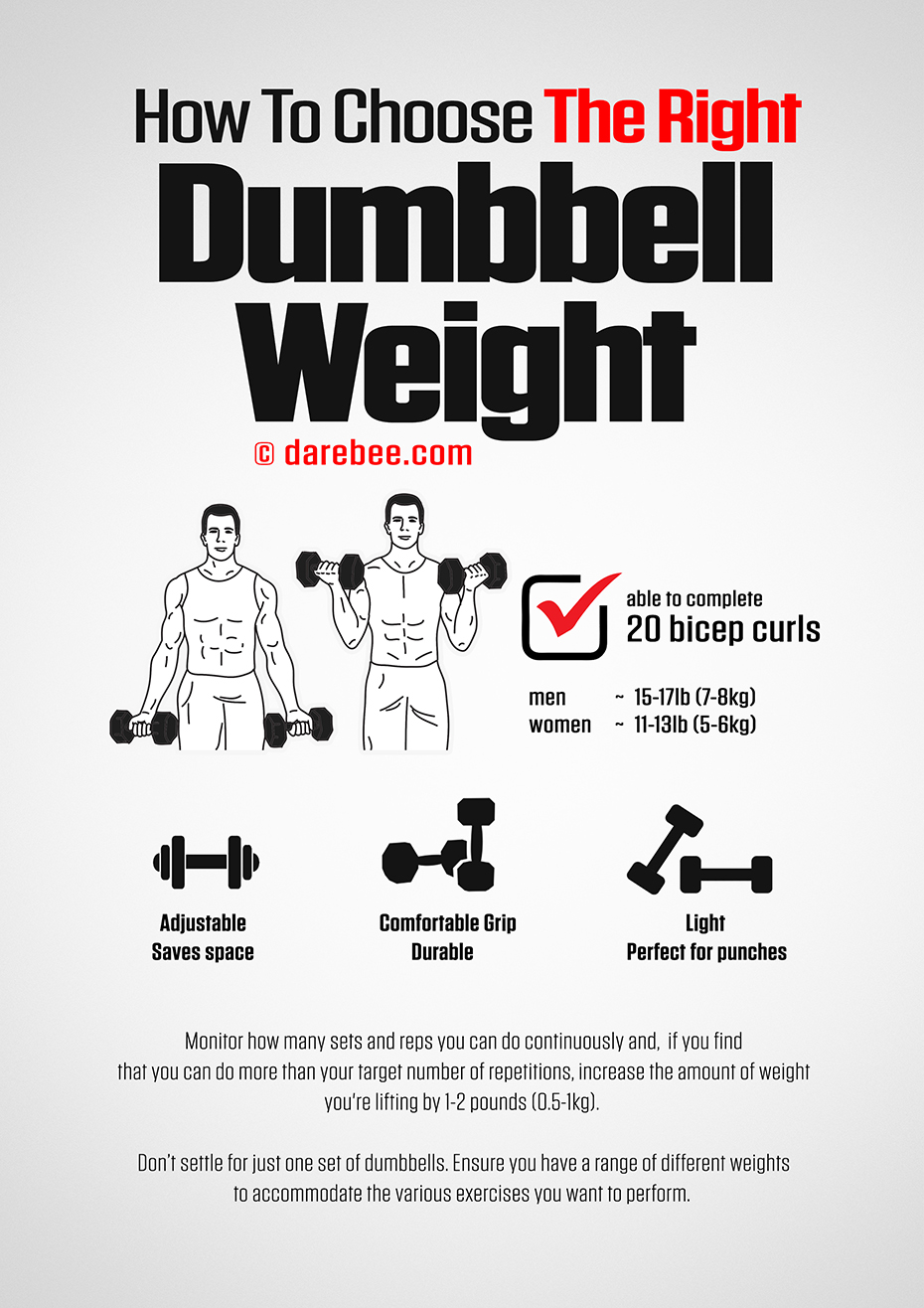
How Much Should I Lift When Training With Dumbbells?
This is a critically important question. Dumbbells are a steady load that is external to the body. They can bring about great adaptations to the muscles increasing their strength, power and endurance precisely because of that. However, because the load is external to the body it presents a very-near constant load to joints and tendons. As a result it can lead to injury much faster than say, doing bodyweight exercises.
To avoid these you need to focus on two things: First, technique. It’s important you use proper technique when lifting weights. So if you were to do, for instance, bicep curls with your dumbbells it’s super-important to maintain great form and actually lift with the bicep and shoulder muscles, primarily and not use your entire body to ‘swing’ the dumbbell up to your shoulder as you perform the curl.
The second thing to focus on is the weight you lift. For dumbbells and general dumbbell lifting exercises that target the biceps, triceps and shoulders the rule of thumb is to use a set of two 5 – 10 lbs weights (approx. 2 – 5 kgs) for women and 10 – 20 lbs weights (approx. 5 – 10kgs) for men.
If you have made that choice and storage is an issue, then volume can always be substituted for weight[1] when it comes to progressing your dumbbell strength training at home. If you started out with 20 lbs dumbbells and you have outgrown them, you could, for instance, do 20 consecutive curls with 20 lbs dumbbell weights instead of doing ten with higher weight dumbbells which you haven’t got. Scientific analysis[2] of the results shows that in terms of strength attained and size of the muscles this is a good substitute that delivers virtually identical results to lifting heavier with fewer repetitions.
This is of particular importance as research has shown that men and women may respond differently to resistance training, particularly with age.[3]
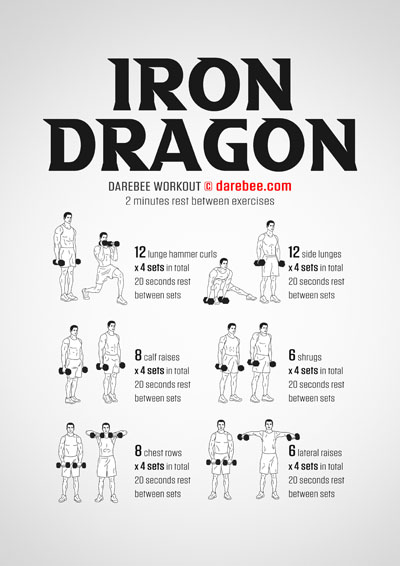
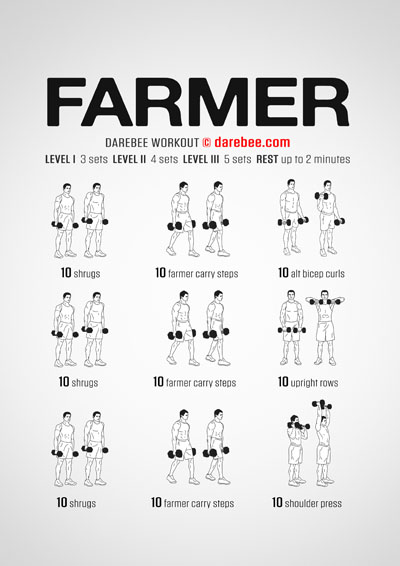
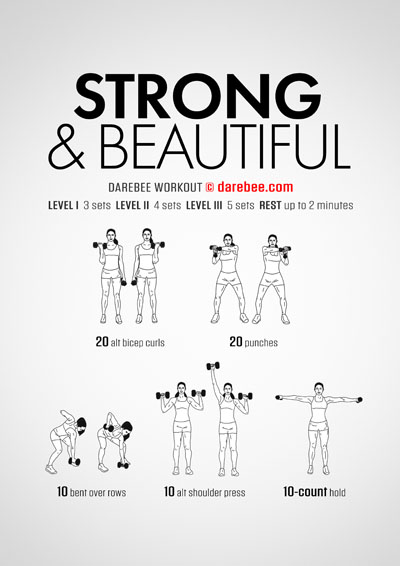
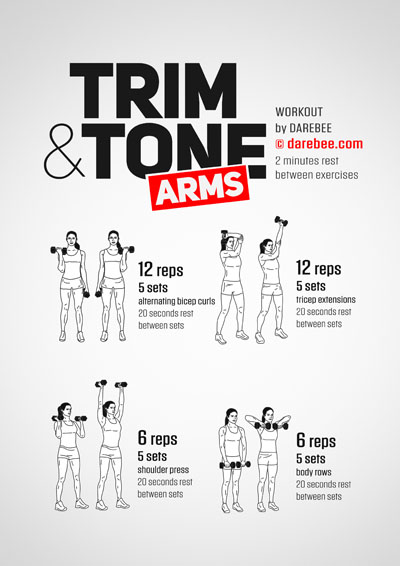
Workouts to Try
Summary
Training with dumbbells at home is a great way to get stronger, improve cardiovascular health[4] and reduce resting blood pressure.[5] It has additional psychological, mental and physical mobility benefits that address issues of quality of life for adults at every stage of life. Provided proper technique is observed when lifting dumbbells and there is consistency in the training schedule, over time, the benefits accumulate to help increase our healthspan[6].
Research
1. Schoenfeld BJ, Grgic J, Van Every DW, Plotkin DL. Loading Recommendations for Muscle Strength, Hypertrophy, and Local Endurance: A Re-Examination of the Repetition Continuum . Sports (Basel). 2021 Feb 22;9(2):32. doi: 10.3390/sports9020032. PMID: 33671664; PMCID: PMC7927075.2. Nicholson VP, McKean MR, Slater GJ, Kerr A, Burkett BJ. Low-Load Very High-Repetition Resistance Training Attenuates Bone Loss at the Lumbar Spine in Active Post-menopausal Women . Calcif Tissue Int. 2015 Jun;96(6):490-9. doi: 10.1007/s00223-015-9976-6. Epub 2015 Mar 14. PMID: 25772806.
3. Jones MD, Wewege MA, Hackett DA, Keogh JWL, Hagstrom AD. Sex Differences in Adaptations in Muscle Strength and Size Following Resistance Training in Older Adults: A Systematic Review and Meta-analysis . Sports Med. 2021 Mar;51(3):503-517. doi: 10.1007/s40279-020-01388-4. PMID: 33332016.
4. Najib M. Yaacob, Nor A. Yaacob, Ab A. Ismail, Noor A.A. Che Soh, Mohamed S. Ismail, Hamid J.J. Mohamed, Suhaily M. Hairon, Dumbbells and ankle-wrist weight training leads to changes in body composition and anthropometric parameters with potential cardiovascular disease risk reduction , Journal of Taibah University Medical Sciences, Volume 11, Issue 5, 2016. Pages 439-447, ISSN 1658-3612.
5. Westcott WL. Resistance training is medicine: effects of strength training on health . Curr Sports Med Rep. 2012 Jul-Aug;11(4):209-16. doi: 10.1249/JSR.0b013e31825dabb8. PMID: 22777332.
6. Gorzelitz J, Trabert B, Katki HA, et al. Independent and joint associations of weightlifting and aerobic activity with all-cause, cardiovascular disease and cancer mortality in the Prostate , Lung, Colorectal and Ovarian Cancer Screening Trial British Journal of Sports Medicine 2022;56:1277-1283.