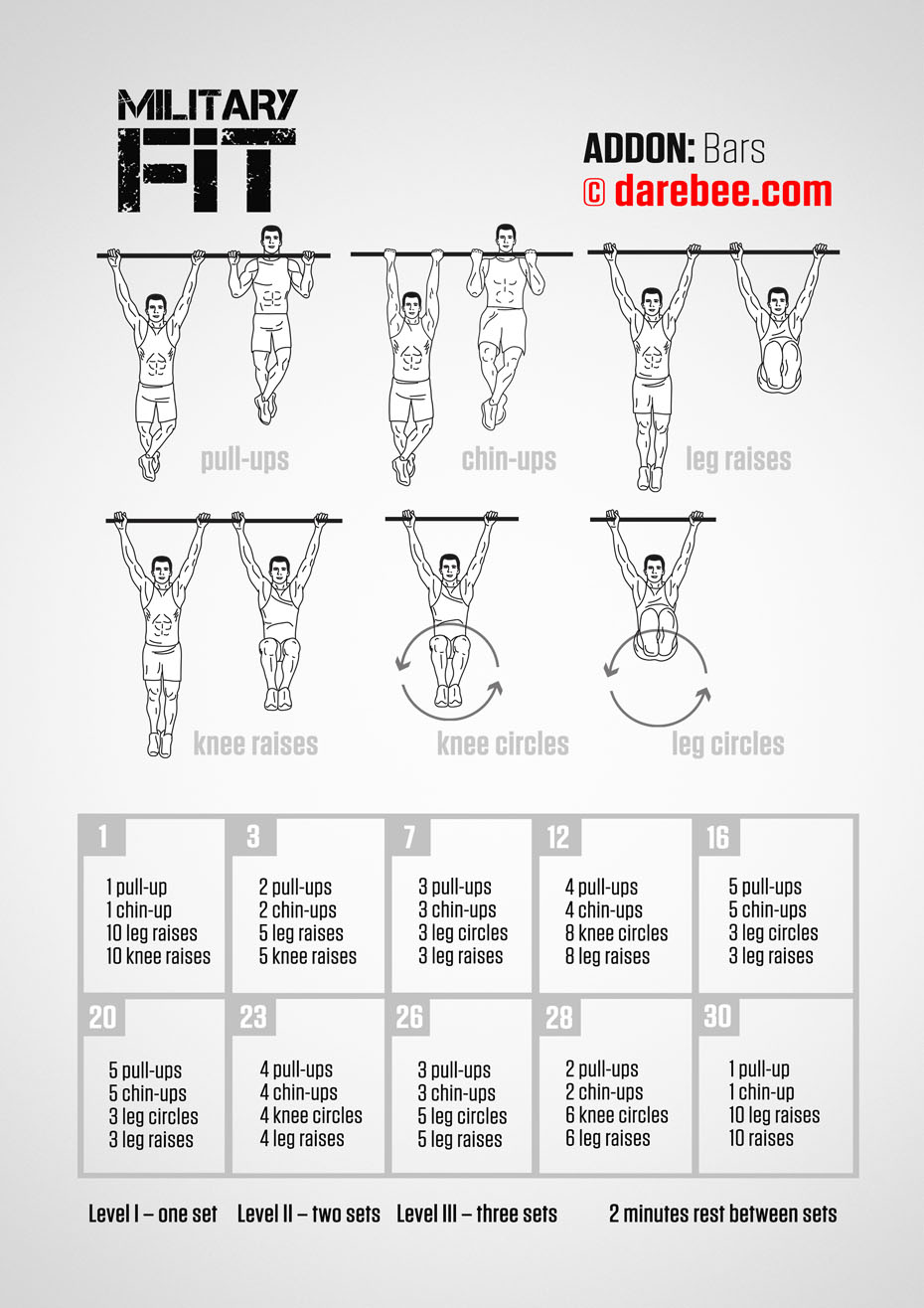
The Bars sheet is an optional extra that runs alongside the program rather than after it. Six movements are drawn at the top: pull-ups with the palms facing away, chin-ups with them facing you, hanging leg raises with straight legs, hanging knee raises, hanging knee circles and hanging leg circles. Below them are ten numbered boxes, and those numbers are days: 1, 3, 7, 12, 16, 20, 23, 26, 28 and 30. Each box is the bar work for that day, added onto the session already on the card. Level I runs three sets, Level II four, Level III five, with two minutes of rest between them.
Read the ten boxes in order and the shape is a pyramid. The pulling starts at one pull-up and one chin-up, climbs through two, three and four, peaks at five on days 16 and 20, then walks back down the same steps to finish at one on day 30. The hanging work moves the other way, opening and closing with the highest counts and thinning out through the middle so that the pulling can take the load at the peak. That is a deliberate arc: build the pull first, and let the hanging core work carry the ends of the program.
Hang from a full stretch with the shoulders active rather than loose, and pull until your chin clears the bar without kicking. Chin-ups with the palms toward you bring the biceps in and are usually the easier of the two. For leg raises, keep the legs straight and lift with the abs rather than swinging, and lower slowly. Knee raises do the same with the knees bent, which shortens the lever. Knee circles and leg circles draw a full circle in the air with the hips, alternating direction between sets, and the slower the circle the harder the trunk has to work to stop the body swinging.
Ten days out of thirty, one bar, and a pyramid that starts and finishes at a single pull-up.
Make it Harder: Take a three-count on the way down for every pull-up and chin-up in the box.
Make it Easier: Set a chair under the bar and use a foot to help through the pulling reps, keeping the lowering slow and unassisted.