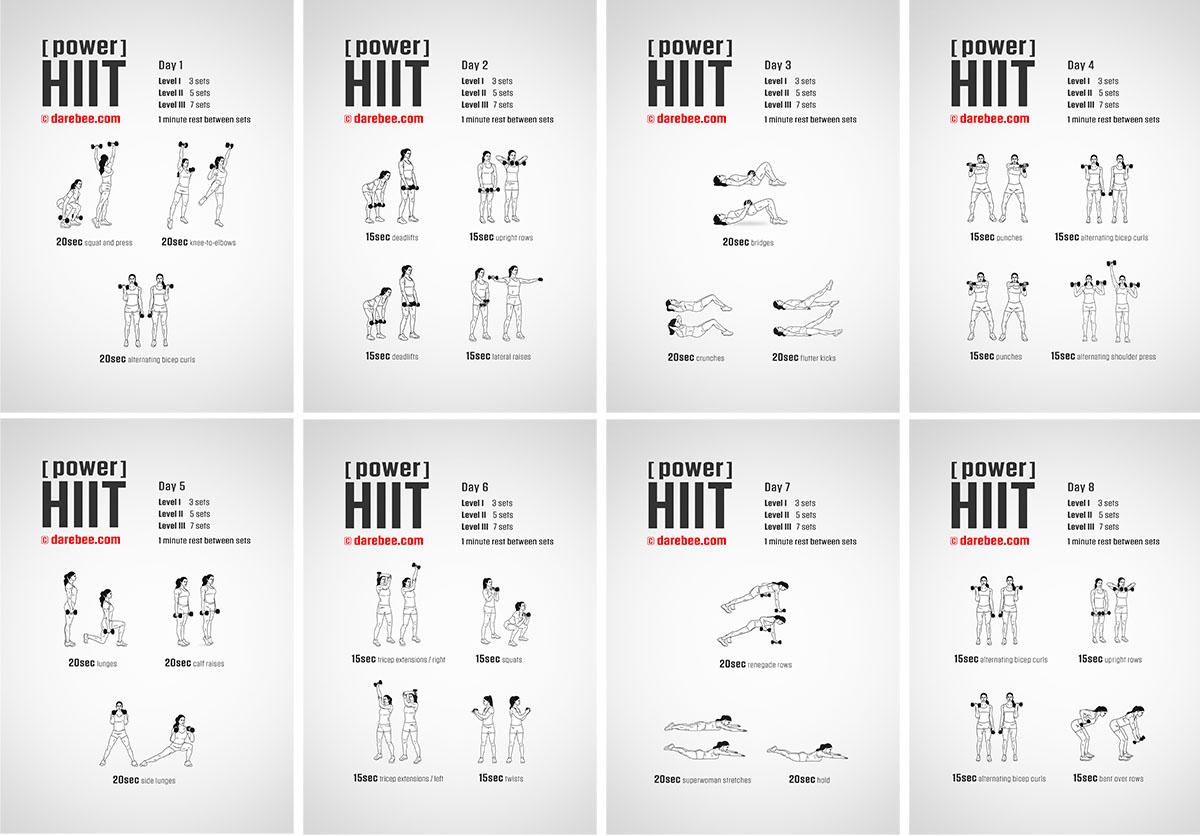
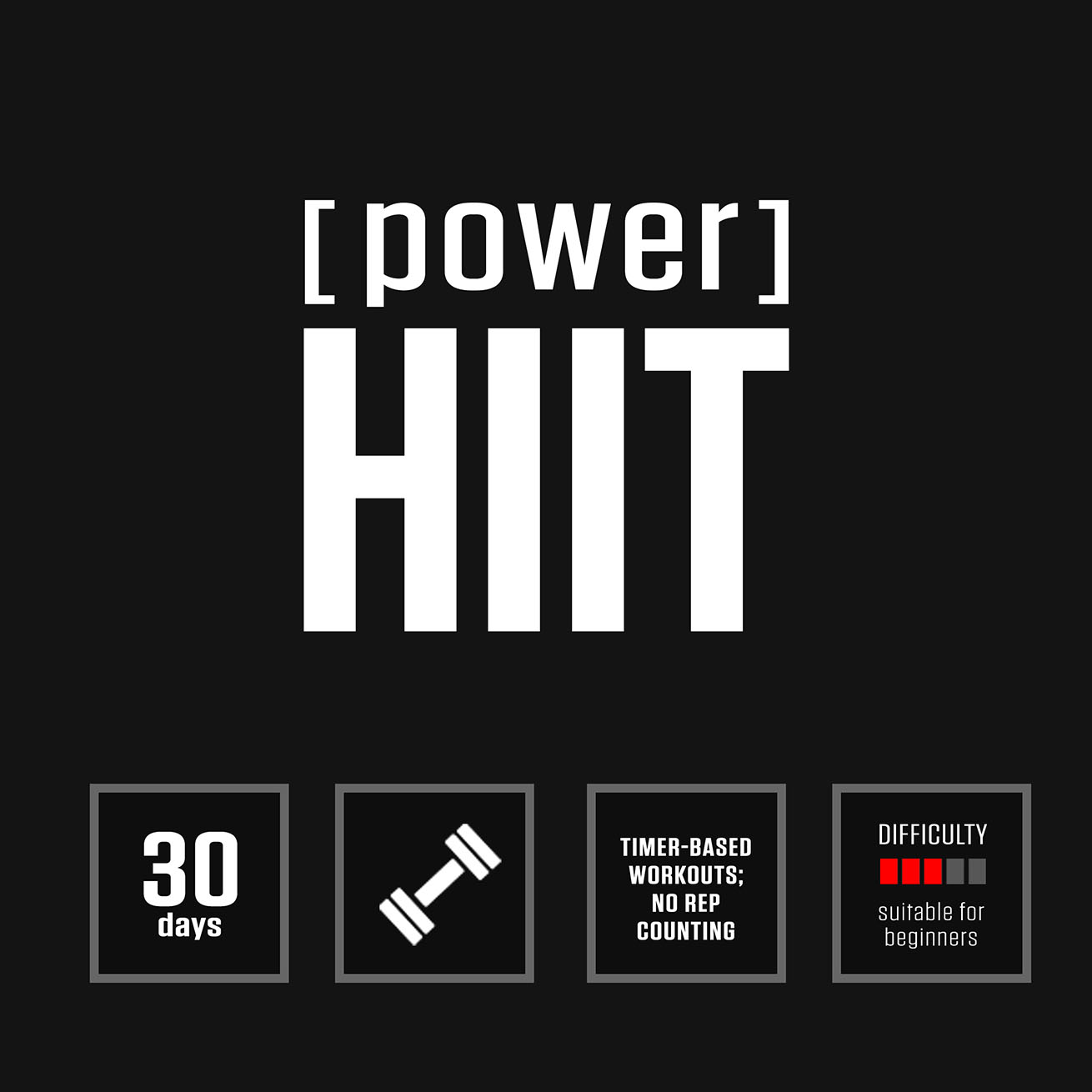
Power HIIT is a 30-day dumbbell-based high intensity interval training program designed for high burn, streamline and tone. It is built for anyone looking to trim up, lower their body fat percentage and add muscle definition at the same time, using nothing but a pair of dumbbells and a timer. Every workout is scalable to one of three difficulty levels - I, II or III at 3, 5 or 7 sets - so the same month of training fits a first-timer and a seasoned athlete alike.
There is no rep counting anywhere in the program: every exercise runs on the clock. Days alternate between two formats - three 20-second exercises or four 15-second ones - so each set is exactly sixty seconds of work followed by a minute of rest, and each session takes minutes, not hours. Standing dumbbell days for the arms, shoulders and legs alternate with floor sessions for the core and back, compound days weld everything together, and isometric holds appear throughout to turn fatigue into strength. The dumbbells load every movement, from punches and presses to bridges with the weight resting on your hips.
The program is suitable for all genders, ages and fitness levels; the recommended dumbbell weight is 1kg+ (2lb+). Pick the level you can finish on Day 1 and hold it for the month - then, when Day 30's final set is done, you will know exactly which level to claim the next time through. Short, sharp and honest: set the timer and see it through.

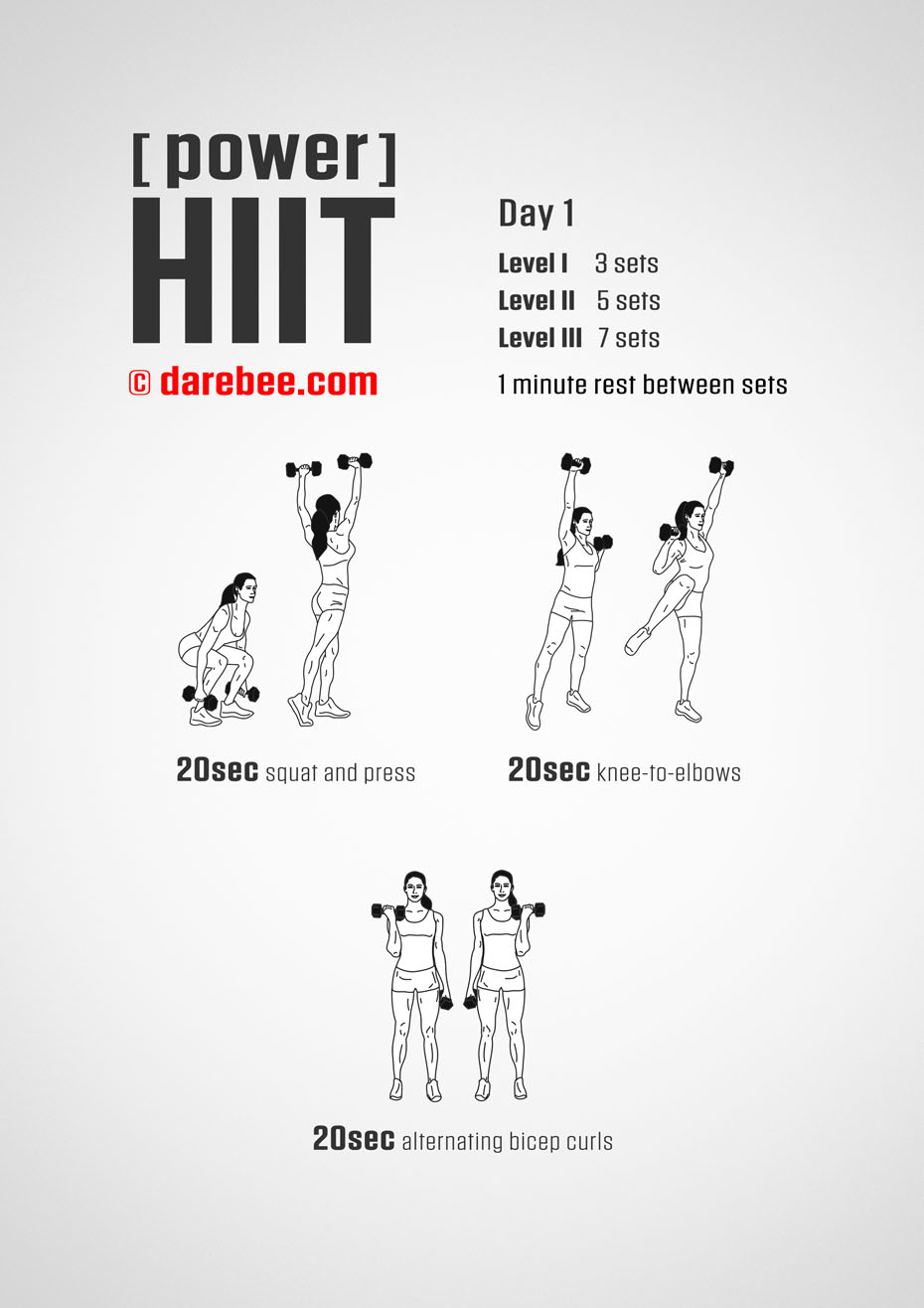
Power HIIT introduces itself with a full body day and a stopwatch. Three exercises - 20 seconds of squat and press, 20 seconds of knee-to-elbows, 20 seconds of alternating bicep curls - performed back to back, then one minute of rest before the next set. You choose your dose: 3 sets at Level I, 5 at Level II, 7 at Level III. There is no rep counting anywhere in this program; the timer decides when you start and stop, and your job is to fill every one of those seconds with clean, fast work.
The order is a deliberate descent through the body's gears. The squat and press is the biggest movement here - legs drive out of the squat, shoulders finish the job overhead - and it goes first while you are freshest. Knee-to-elbows keep the heart rate climbing while shifting the load to the core: the dumbbells go up, and each knee rises to meet a pulling elbow. The alternating curls then close the minute with focused arm work while your lungs catch up. Sixty seconds of work, sixty of rest - an honest one-to-one ratio that makes the intensity sustainable across every level.
In the squat and press, hit proper depth before you drive up, and finish each press with the dumbbells fully overhead rather than drifting forward. On knee-to-elbows, pull the elbow down to the rising knee with intent - the crunch in the middle is the exercise. Curl with control in both directions; speed matters in HIIT, but a swung curl is a wasted one.
Day 1 is also your fitting room - pick the level you can finish, and own it for the month.
Make it Harder: Go up a dumbbell size for the squat and press only - the biggest movement can take the heaviest load.
Make it Easier: Do the knee-to-elbows without dumbbells and keep the other two exercises weighted as written.

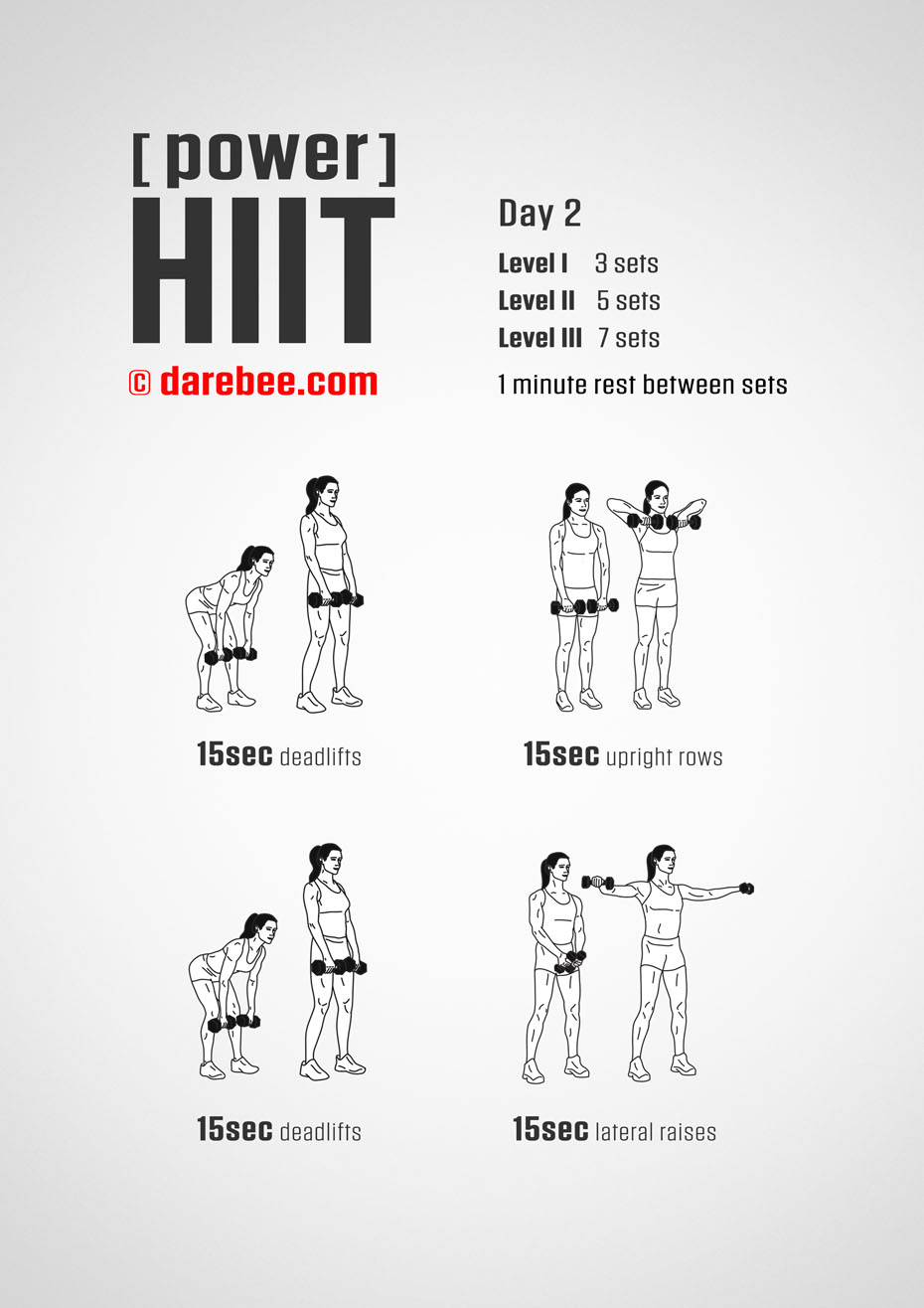
Day 2 shortens the intervals and adds a station. Four exercises at 15 seconds each - deadlifts, upright rows, deadlifts again, lateral raises - for 3, 5 or 7 sets by level, with the standard minute of rest between sets. The work-per-set is the same sixty seconds as yesterday, but chopped finer: shorter bursts, faster transitions, and no time to settle into any single movement.
Notice that the deadlifts appear twice, sandwiching the upright rows. That is the day's engine: the biggest pull in the program returns for a second helping while the muscles are already warm, and the two shoulder movements slot between and after to keep the hips from monopolizing the session. Deadlifts train the entire back side - hamstrings, glutes, lower back - while upright rows pull the dumbbells to collarbone height and lateral raises float them out to the sides. Hinge, pull, hinge, raise: the posterior chain does the heavy lifting and the shoulders do the finishing.
Deadlift with a flat back and soft knees, pushing your hips back rather than folding your spine forward - fifteen fast seconds is not a license for a round back. On upright rows, lead with the elbows and stop at chest height. Keep the lateral raises smooth and level; the dumbbells rise to shoulder height and no higher, however loud the timer gets.
Two visits to the deadlift in one day - the back of your body just found out what this program thinks of it.
Make it Harder: Treat every 15-second window as a rep race against your previous set - match or beat the count each time.
Make it Easier: Take the rest to 90 seconds between sets and keep everything else as written.

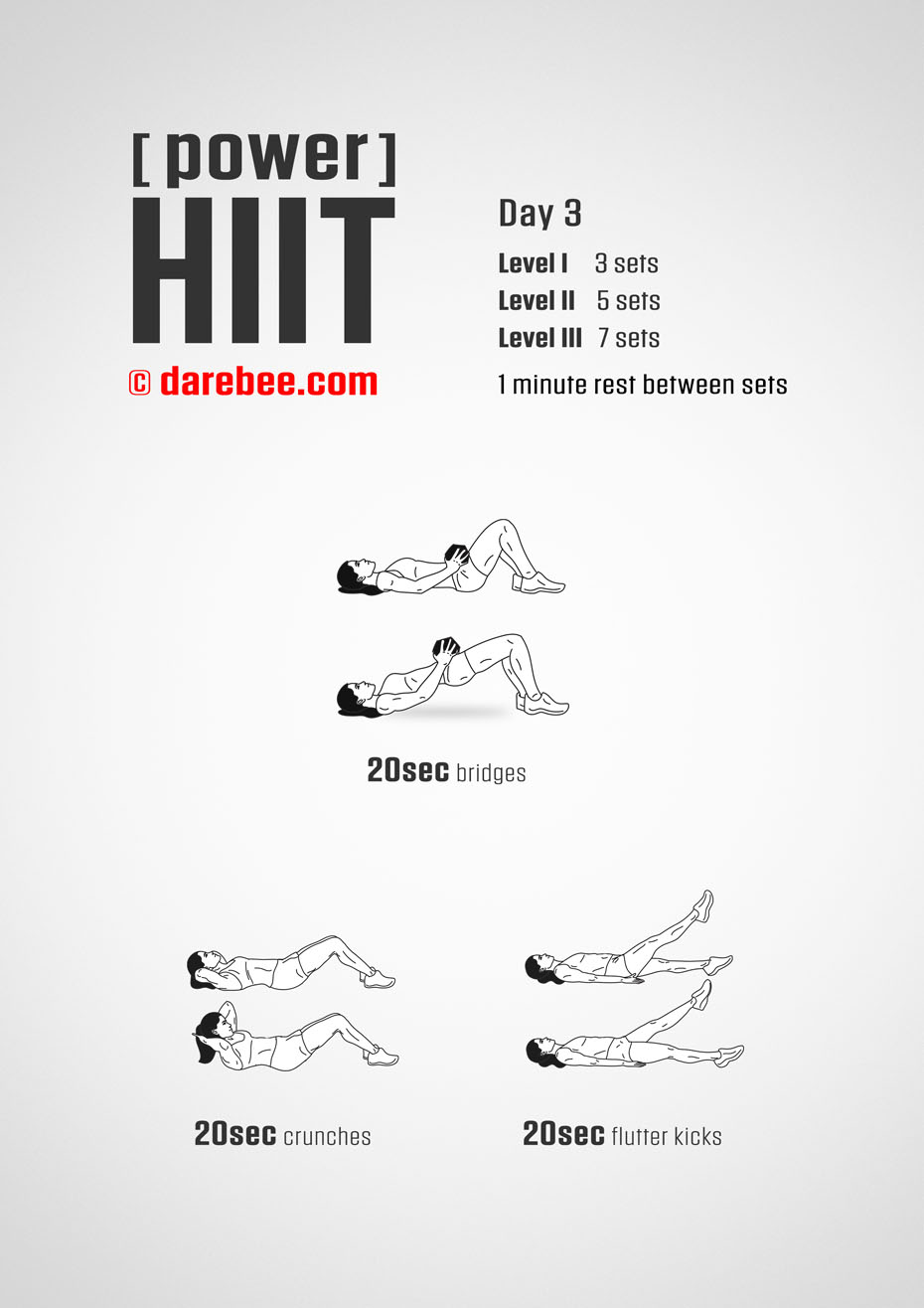
Day 3 takes the program to the floor. Three exercises, 20 seconds each: bridges with a dumbbell resting on your hips, crunches, and flutter kicks - 3, 5 or 7 sets by level, one minute between sets. It is the first session where a dumbbell becomes a passenger instead of a handle: the weight sits across your hip bones during the bridges, held steady with both hands, turning a familiar glute exercise into loaded hip work.
The trio splits the trunk neatly in three. Bridges fire the glutes and hamstrings against the added load - drive the hips up, squeeze at the top, lower under control, repeat until the timer stops you. Crunches then handle the upper abs with a short, deliberate curl of the shoulders off the floor, and flutter kicks finish with the lower abs and hip flexors, both legs hovering and scissoring for the full 20 seconds. Between the weighted bridges and the unweighted ab work, the session covers the entire midsection without a single standing rep.
In the bridge, push through your heels to full hip extension - the dumbbell should rise on a straight line from knees to shoulders, not on an arched lower back. Curl your crunches with the abs, not with a yank of the neck. During flutter kicks, keep your lower back pressed into the floor; if it starts to peel up, the kicks are dropping too low.
The first floor day of the program - proof that lying down and resting are not the same thing.
Make it Harder: Keep your heels off the floor between crunches so the abs never fully unload.
Make it Easier: Bend your knees to 90 degrees for the flutter kicks and do the bridges without the dumbbell.

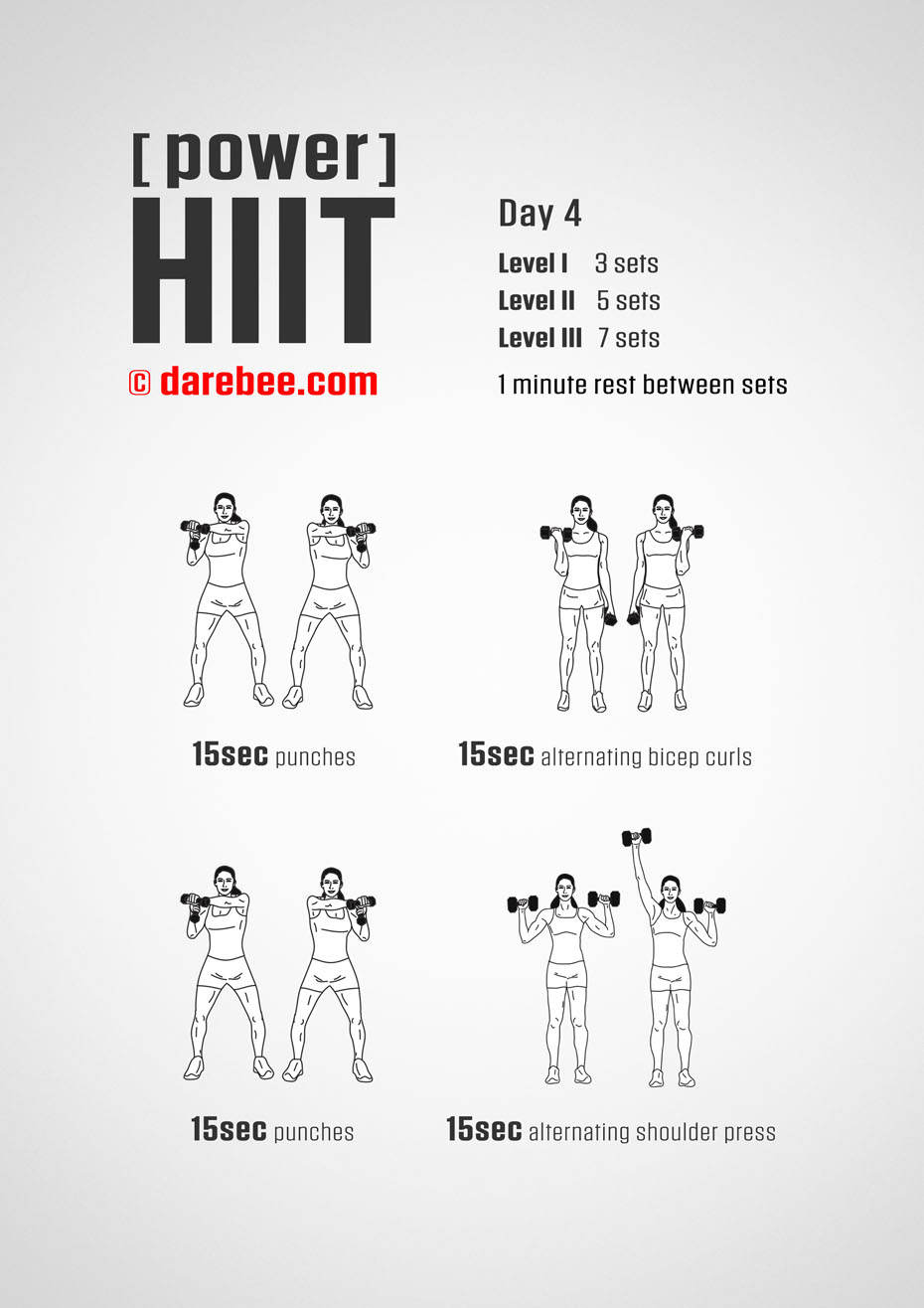
Day 4 is an arm day with a fight in it. Four rounds of 15 seconds - punches, alternating bicep curls, punches again, alternating shoulder press - for 3, 5 or 7 sets with a minute of rest between them. The punches carry dumbbells, which changes everything: what looks like shadowboxing becomes weighted resistance work for the shoulders, chest and arms, thrown from a solid stance at pace.
The doubled punches are the day's cardio spine. Fifteen seconds of fast weighted punching spikes the heart rate; the curls that follow slow the tempo and load the biceps; then the punches return on tired shoulders, and the alternating press finishes overhead one arm at a time. It is a boxing round dressed as a dumbbell session - alternating between speed work and strength work so neither the lungs nor the arms ever get a full break within the set.
Punch from the shoulder with a slight rotation, extending fully without locking the elbows, and keep your guard-hand dumbbell at your chest between punches. Curl without swinging - the fifteen seconds reward crisp reps, not wild ones. On the alternating press, drive each dumbbell to full lockout overhead while the other waits at shoulder height, and resist leaning away from the working arm.
Two rounds of punches per set - by the last one, the lightest dumbbells you own will have gained weight.
Make it Harder: Throw the punches as genuine full-speed strikes - maximum velocity on every extension, not a rhythmic push.
Make it Easier: Drop the dumbbells for both punch intervals and keep the curls and presses weighted.

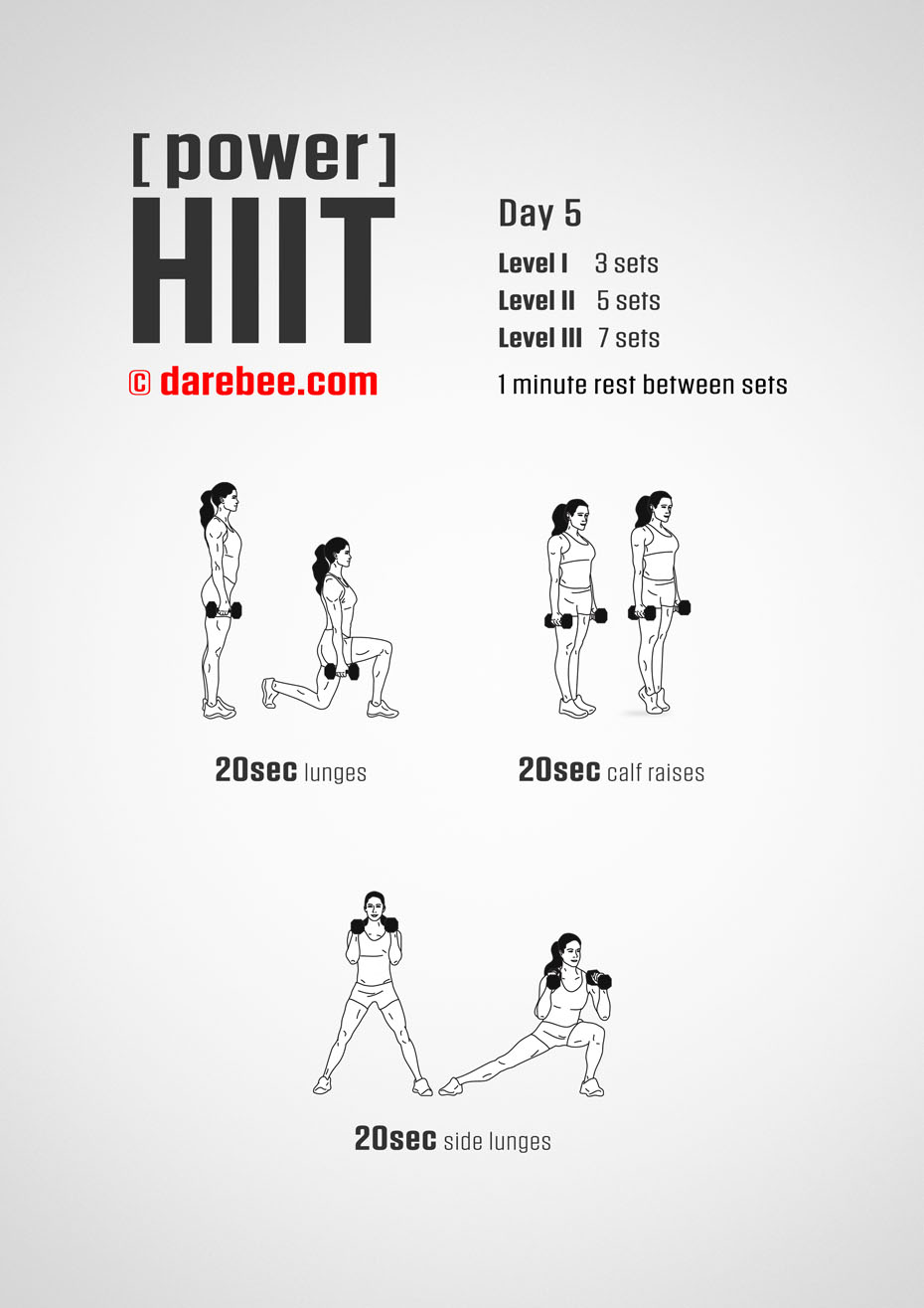
Day 5 hands the program to your legs. Three exercises at 20 seconds each - lunges, calf raises, side lunges - at 3, 5 or 7 sets by level, one minute of rest between sets. The dumbbells hang at your sides for the lunges and calf raises and ride at your shoulders for the side lunges, adding load to three different directions of lower body work: forward, upward, and sideways.
Each exercise claims its own territory. Lunges take the quads and glutes through a full stride, one leg at a time, alternating as the timer runs. Calf raises isolate the muscles that will quietly carry every other leg exercise in this program - up onto the balls of the feet, down with control, as many quality reps as 20 seconds allows. Side lunges then push the workload literally sideways, loading one bent leg while the other stays extended, waking up the inner thighs and glutes that straight-ahead lunging never quite reaches.
Step your lunges long enough that the front knee stays over the ankle, and drop the back knee toward the floor rather than tipping the torso forward. On calf raises, use the full range - all the way up, all the way down - because half reps at speed are just bouncing. In the side lunge, sit back into the bent leg with your chest up, and keep the extended leg's foot flat on the floor.
Three directions of lunge and lift - your legs now know this is not an arms-only program.
Make it Harder: Add a pulse at the bottom of every lunge and side lunge - down, half up, down again, then stand.
Make it Easier: Hold one dumbbell instead of two for the side lunges, hugged at your chest, and alternate sides at your own pace.

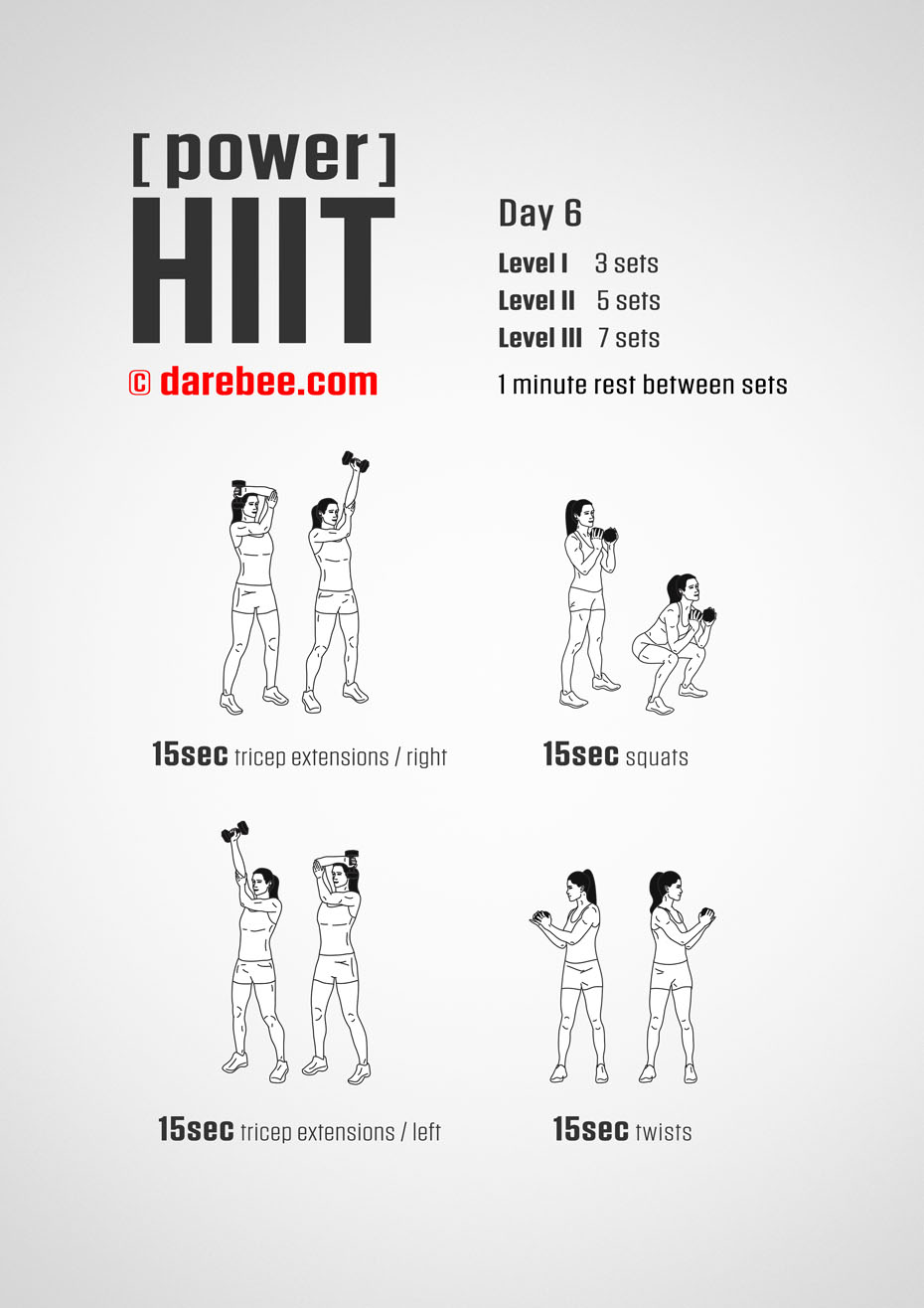
Day 6 splits an exercise in half and puts a squat between the pieces. The four 15-second intervals run: tricep extensions with the right arm, squats, tricep extensions with the left arm, then twists - 3, 5 or 7 sets by level, one minute between sets. The dumbbells change roles as the set goes on: one overhead for the extensions, a pair held at your chest for the squats, and a single dumbbell clasped in both hands for the twists.
Working the triceps one arm at a time is the day's quiet genius - each arm gets its own dedicated 15 seconds with a squat break in the middle, so the second arm works just as fresh as the first. The squats keep the legs and lungs involved so the session never becomes a standing-still arm day, and the twists close each set by rotating the trunk against the dumbbell's resistance, pulling the obliques into a program that has so far worked the body mostly front-on.
In the extensions, keep the working arm's elbow pointed at the ceiling and close to your head - only the forearm moves, lowering the dumbbell behind you and pressing back up. Squat to proper depth with your chest tall and the dumbbells steady at your collarbones. Twist from the waist with your hips facing forward, shifting the dumbbell side to side at chest height - the rotation should live in your trunk, not your arms.
One arm, then legs, then the other arm - nobody gets to coast through Day 6.
Make it Harder: Squat an honest count deeper and slower - fewer squats per interval, each one worth more.
Make it Easier: Swap the twist dumbbell for your lightest one and spend the saved effort on a faster, fuller rotation.

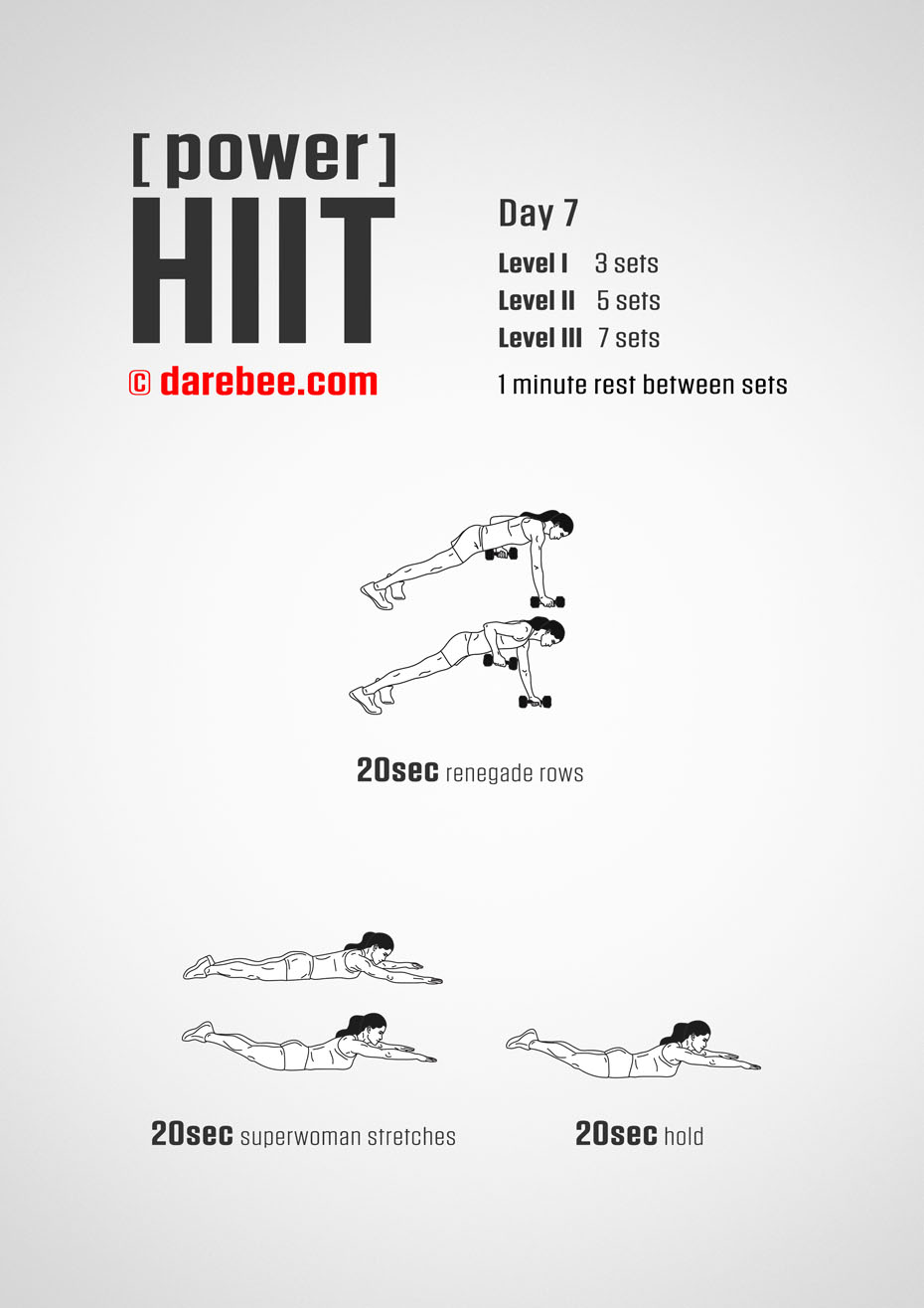
Day 7 closes the first week face-down. Three intervals of 20 seconds: renegade rows in a plank on the dumbbells, superwoman stretches lying prone, and a hold at the top of that same superwoman position - 3, 5 or 7 sets, one minute between them. It is the first appearance of both the plank family and the isometric hold in this program, and they both report to the same department: your back.
The renegade row is the hardest exercise Power HIIT has shown you yet - a plank held on two dumbbell handles while one arm at a time rows its dumbbell to the ribs, forcing the core to fight the tilt every single rep. The superwoman stretches then flip you over the other way: lying on your front, arms and legs lift together, working the entire back line from shoulders to glutes. And the final 20 seconds simply freeze that lifted position - no reps left to hide behind, just the lower back and rear shoulders holding everything off the floor while the timer takes its time.
In the rows, set your feet wide and keep your hips level - the goal is a torso so still that only the rowing arm knows work is happening. Lift into each superwoman rep with arms and legs together, reaching long rather than jerking high. In the hold, find a height you can keep for the full count and breathe normally; a shaking, held-breath arch helps nobody.
One week in, and the program just checked whether your back half has been paying attention.
Make it Harder: Slow each renegade row to a deliberate pull and lower - fewer rows, zero hip wobble.
Make it Easier: Do the renegade rows from your knees, and lift just your chest and arms in the superwoman work, leaving your legs down.

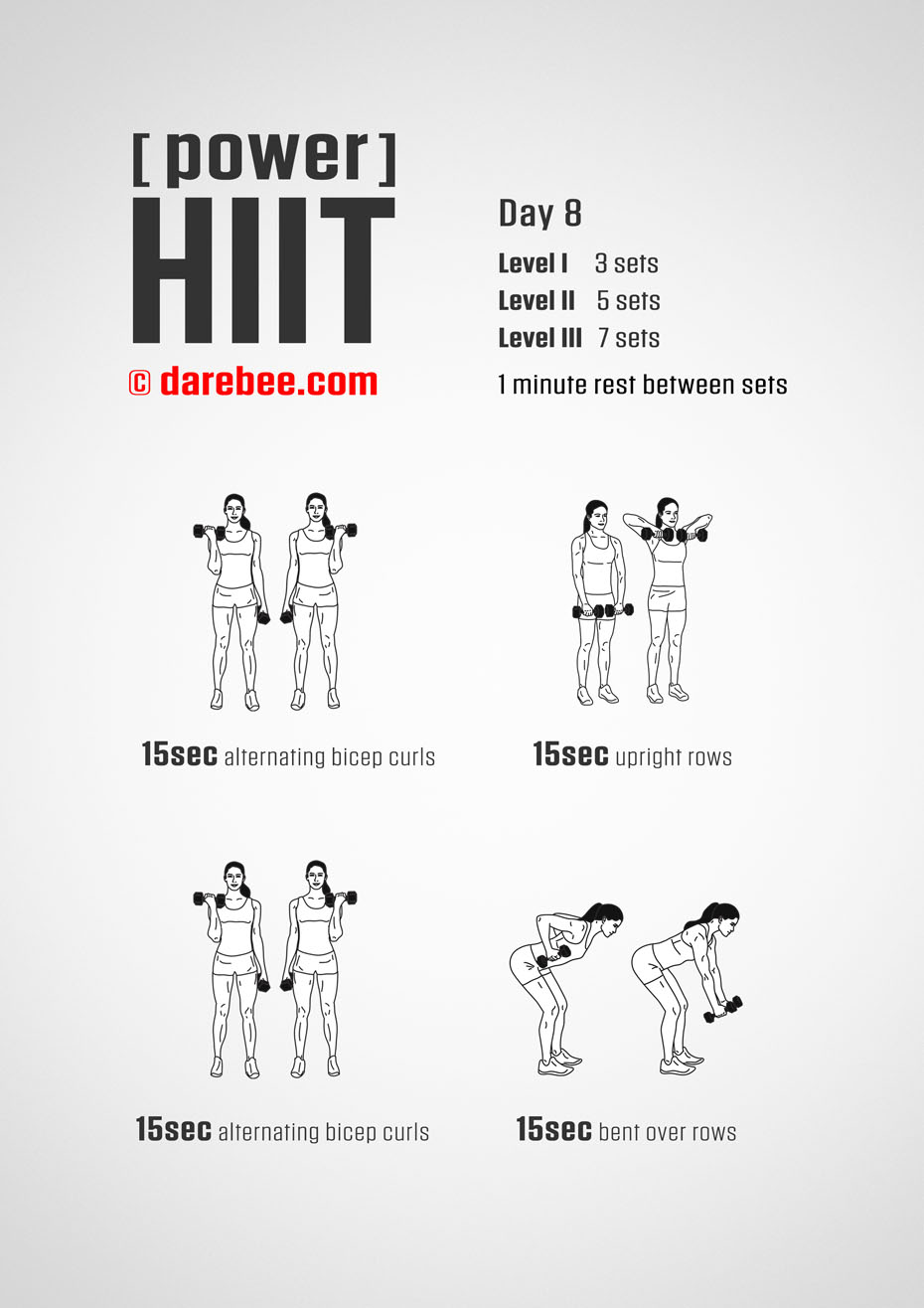
Day 8 is a pull day from top to bottom. Four intervals of 15 seconds - alternating bicep curls, upright rows, alternating bicep curls again, bent over rows - at 3, 5 or 7 sets by level, one minute of rest between sets. Every exercise here drags the dumbbells toward you from a different angle; nothing gets pushed away all day.
The curls are the returning anchor, appearing twice per set with a different row after each visit. Upright rows pull the dumbbells up the front of your body to chest height, working the shoulders and traps; bent over rows hinge you forward and pull the weight to your ribs, hitting the lats and mid-back. Between the two rows and the double dose of curls, the session builds the pulling musculature that mirrors all the punching and pressing of the earlier days - the balance sheet of a well-designed week.
Alternate the curls cleanly - one dumbbell rising as the other lowers, elbows pinned to your sides. Lead the upright rows with your elbows and keep the dumbbells close to your body on the way up. For the bent over rows, hinge to a flat back, let the arms hang, then row both dumbbells to your lower ribs and squeeze the shoulder blades together before lowering.
Four pulls, zero pushes - consider this the answer to every punch you have thrown so far.
Make it Harder: Hold the top of every bent over row for a full second squeeze before lowering.
Make it Easier: Perform the bent over rows one arm at a time with your free hand braced on your thigh for support.

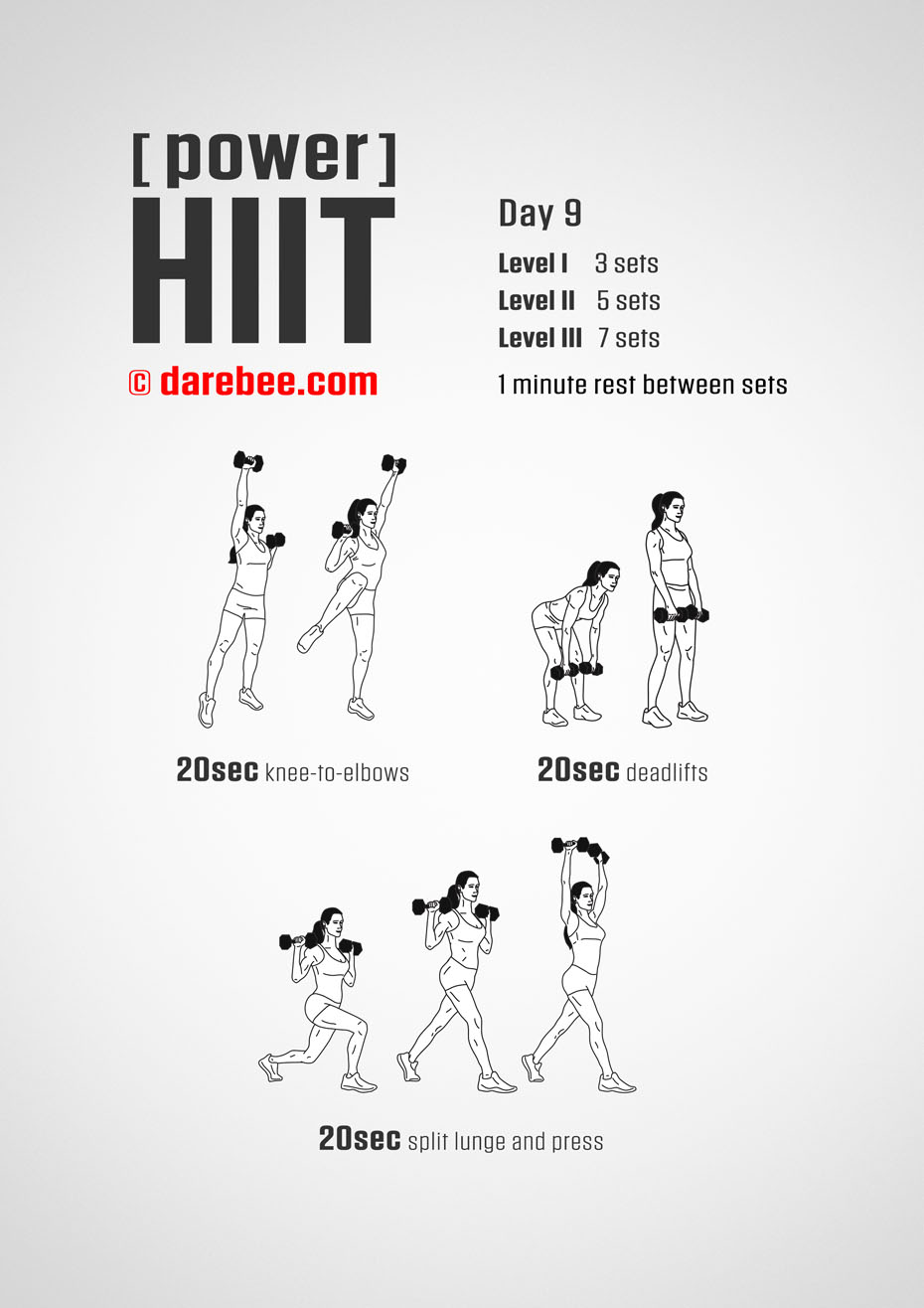
Day 9 stacks three compound movements into sixty seconds of work. The 20-second intervals run: knee-to-elbows, deadlifts, and split lunge and press - 3, 5 or 7 sets by level, a minute of rest between sets. Every exercise here uses more than one joint and more than one region; there is not a single isolation movement on the card.
The session is Day 1's opener grown up. Knee-to-elbows return from that first day to spike the heart rate, dumbbells overhead and knees driving up to meet pulling elbows. Deadlifts bring back Day 2's hinge for the hamstrings and glutes. The new arrival is the split lunge and press - a lunge that rises into a full overhead press as the feet switch, welding the lower and upper body into one continuous movement. It is the most coordination Power HIIT has asked of you yet, and it lands exactly when a week of practice has prepared you for it.
Keep the knee-to-elbows sharp - the dumbbell pulls down as the knee rises, meeting in the middle with intent. Deadlift with the flat back you built on Day 2. In the split lunge and press, drop into a stable lunge, then drive up and press the dumbbells overhead as your feet come through - find a rhythm where the press crowns each stride rather than fighting it.
Three exercises, every one of them a whole-body sentence - Day 9 speaks fluent compound.
Make it Harder: Sink the back knee to a hover in every split lunge before you drive up into the press.
Make it Easier: Split the lunge and press into alternating halves - lunge without the press, then press without the lunge - switching every few reps.

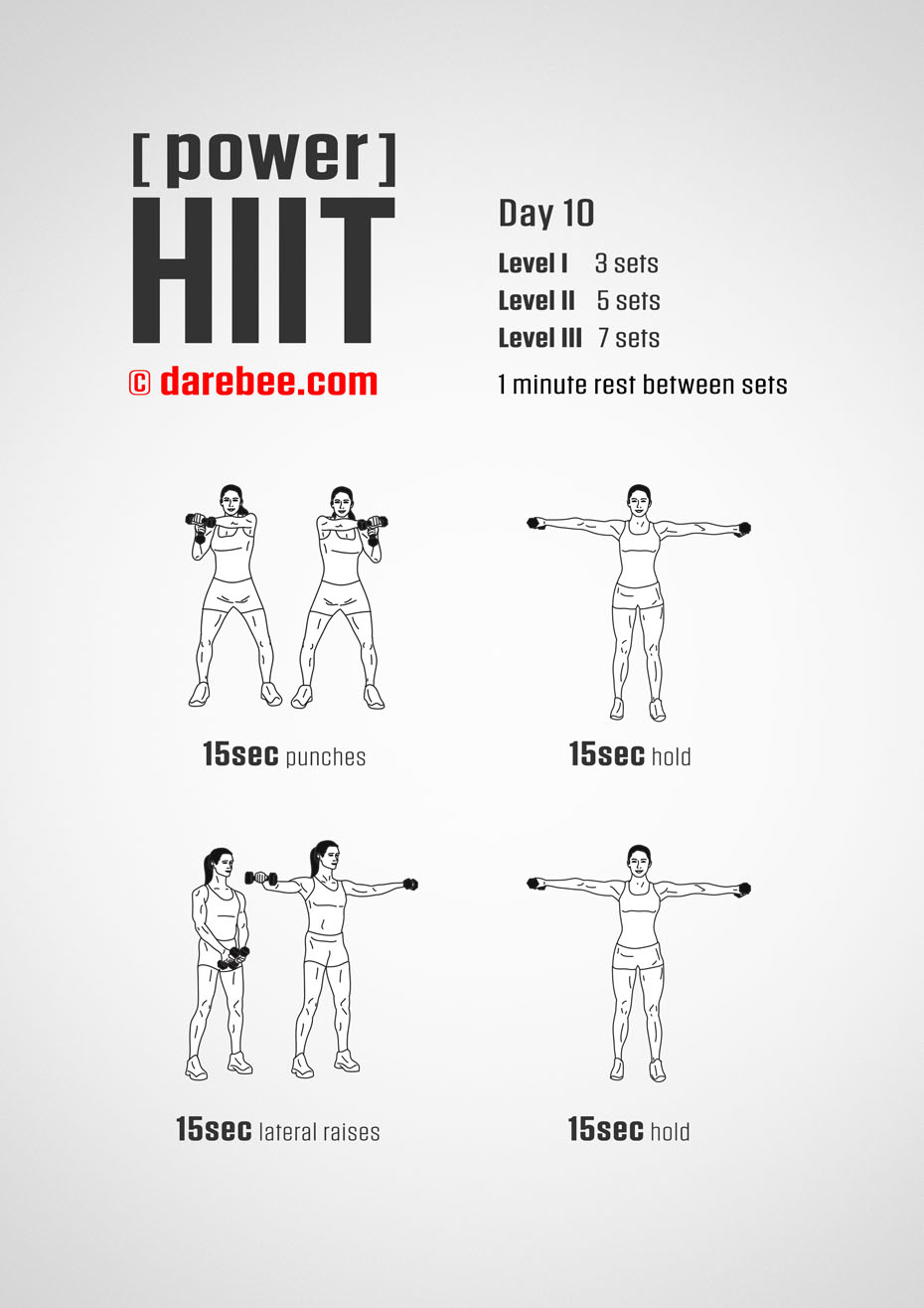
Day 10 introduces the program's cruelest trick: stopping. The four 15-second intervals alternate work and stillness - punches, a hold with both arms extended straight out to the sides, lateral raises, and the same hold again - at 3, 5 or 7 sets with a minute between sets. The dumbbells never touch the floor mid-set; they either move fast or stay frozen at shoulder height.
The pairing is deliberately unfair to your shoulders. Punches flood the delts with fast, weighted work, and then the first hold arrives - arms out in a T, dumbbells level, nothing moving except the burn spreading through the shoulders. Lateral raises then repeat the exact arc of that hold as a dynamic exercise, lifting and lowering through the same position you just suffered in, and the final hold parks you back in the T to finish. Work then hold, work then hold: fifteen seconds of stillness after effort is far longer than any clock admits.
Punch fast and full, guard hand at your chest. In the holds, set the dumbbells exactly at shoulder height with a slight bend in the elbows, and defend that height - the moment the arms sag, lift them back; the count only counts at altitude. Keep the lateral raises smooth and symmetrical, rising to shoulder level and lowering with control rather than dropping.
Half of this workout is refusing to move - your shoulders will remember which half was worse.
Make it Harder: Turn your palms to face the ceiling during both holds - same position, meaner leverage.
Make it Easier: Do both holds empty-handed with your arms in position - build the endurance first, add the dumbbells next round.

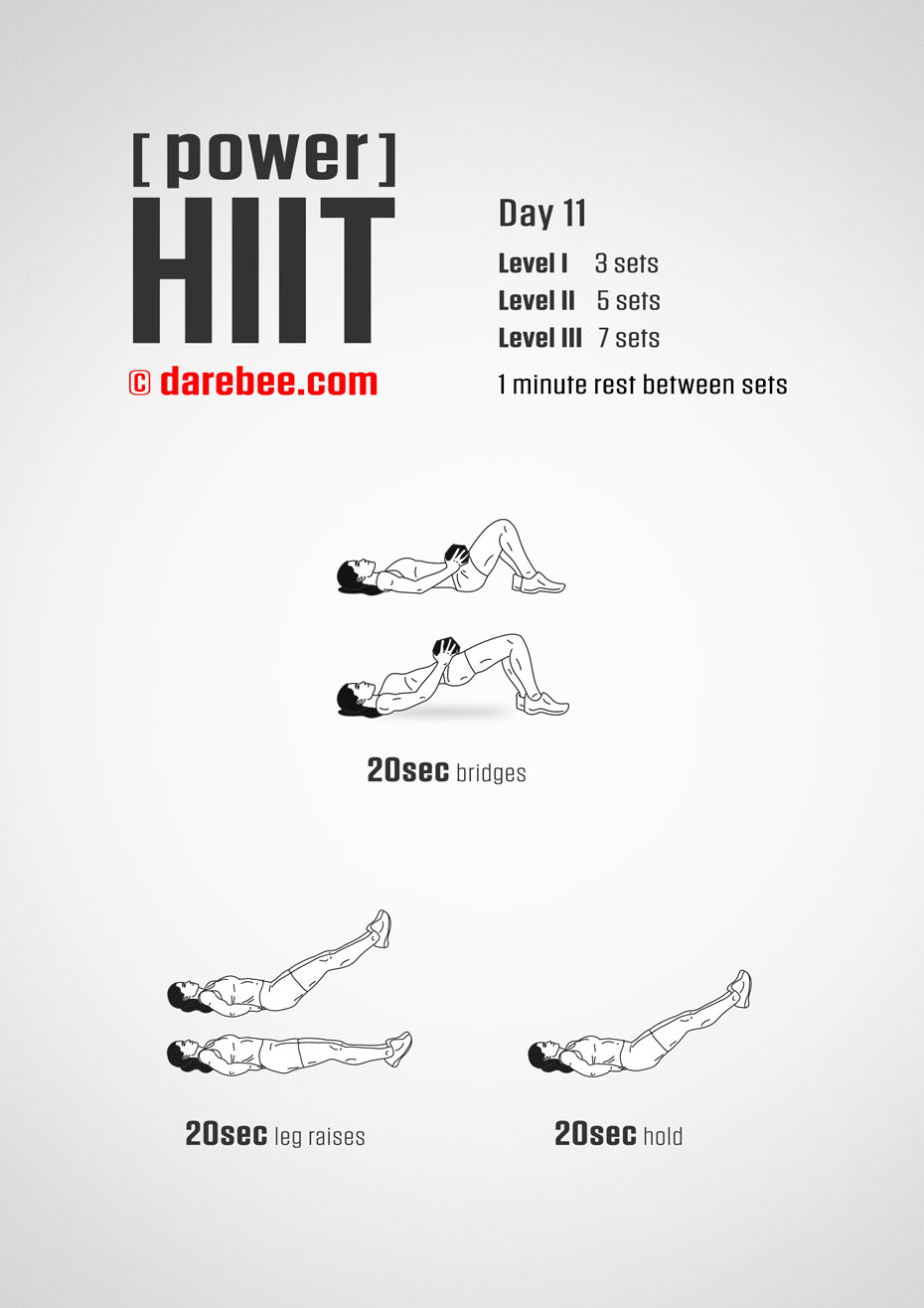
Day 11 returns to the floor with a lower target. Three intervals of 20 seconds - bridges with a dumbbell resting on your hips, straight leg raises, and a hold with both legs hovering just off the floor - at 3, 5 or 7 sets by level, one minute of rest between sets. The bridges you know from Day 3; the other two-thirds of this session belong entirely to your lower abs.
The sequencing borrows the work-then-freeze logic the program has been quietly teaching. Leg raises lift both legs toward vertical and lower them slowly without touching down, loading the abs hardest in the last few degrees of the descent - and the final interval simply moves into that low zone and stays, legs hovering above the floor while the midsection holds the line. Coming straight after the weighted hip work of the bridges, the pair gives the front and back of your trunk equal billing in a single sixty-second set.
Drive the bridges to full hip extension with the dumbbell steady - the weight rises because your glutes push it, not because your back arches. During leg raises, keep your lower back pressed into the floor and shorten the range the moment it tries to lift. In the hold, pick a hover height you can defend for the full 20 seconds and keep breathing; the count stops mattering the second your heels touch down.
The first half of the set lifts your hips, the second half refuses to lower your legs - Day 11 plays both ends of stubborn.
Make it Harder: Lower the hover an inch closer to the floor for the hold - the longer the lever, the louder the abs.
Make it Easier: Keep your legs higher during the hold - the closer to vertical, the lighter they weigh.

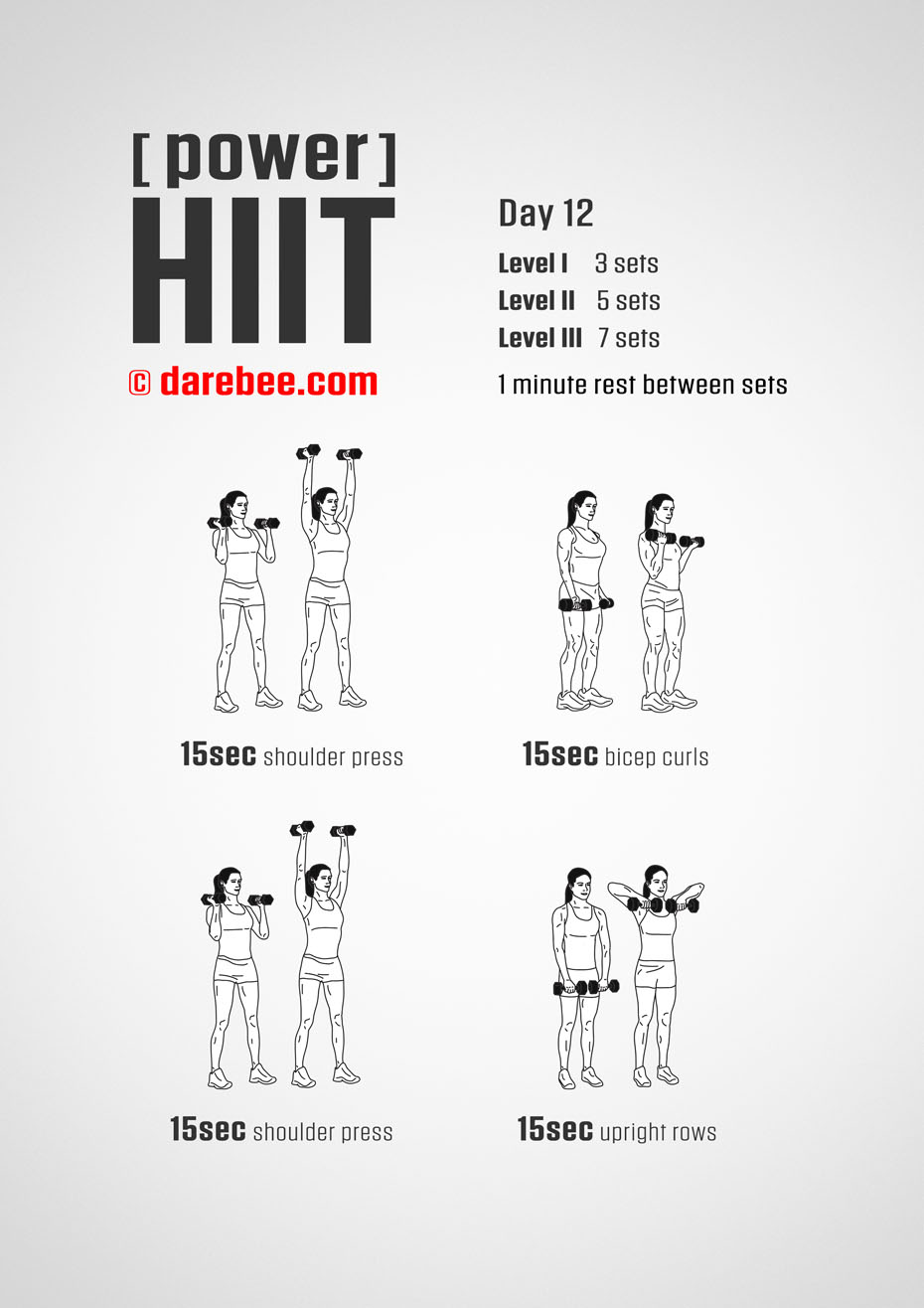
Day 12 gives the shoulder press the anchor role. Four intervals of 15 seconds - shoulder press, bicep curls, shoulder press again, upright rows - at 3, 5 or 7 sets with the standard minute between sets. Two overhead pushes bracket the arm work: the press opens the set, the curls and rows fill the middle and end, and everything happens above the waist.
Doubling the press follows the pattern the even days have been building since the deadlifts of Day 2: the day's main movement returns mid-set on warmed muscle, and the second visit is always more honest than the first. The curls work one arm at a time between the two press intervals, and the upright rows close by pulling the dumbbells up the path the presses just pushed - up and down the same column of the body, four different ways.
Press to full lockout overhead with the dumbbells finishing over your shoulders, not out in front. Curl each dumbbell with the elbow pinned and the wrist neutral, one side rising as the other lowers. On the upright rows, elbows lead, dumbbells stay close, and chest height is the ceiling - the pull ends where the shoulders start complaining, not above it.
One column of the body, worked up and down for sixty seconds at a time - Day 12 is vertical from start to finish.
Make it Harder: Press with zero leg drive - knees locked out of the conversation, shoulders doing all the talking.
Make it Easier: Swap to your lightest dumbbells for the second press interval and keep the first at full weight.

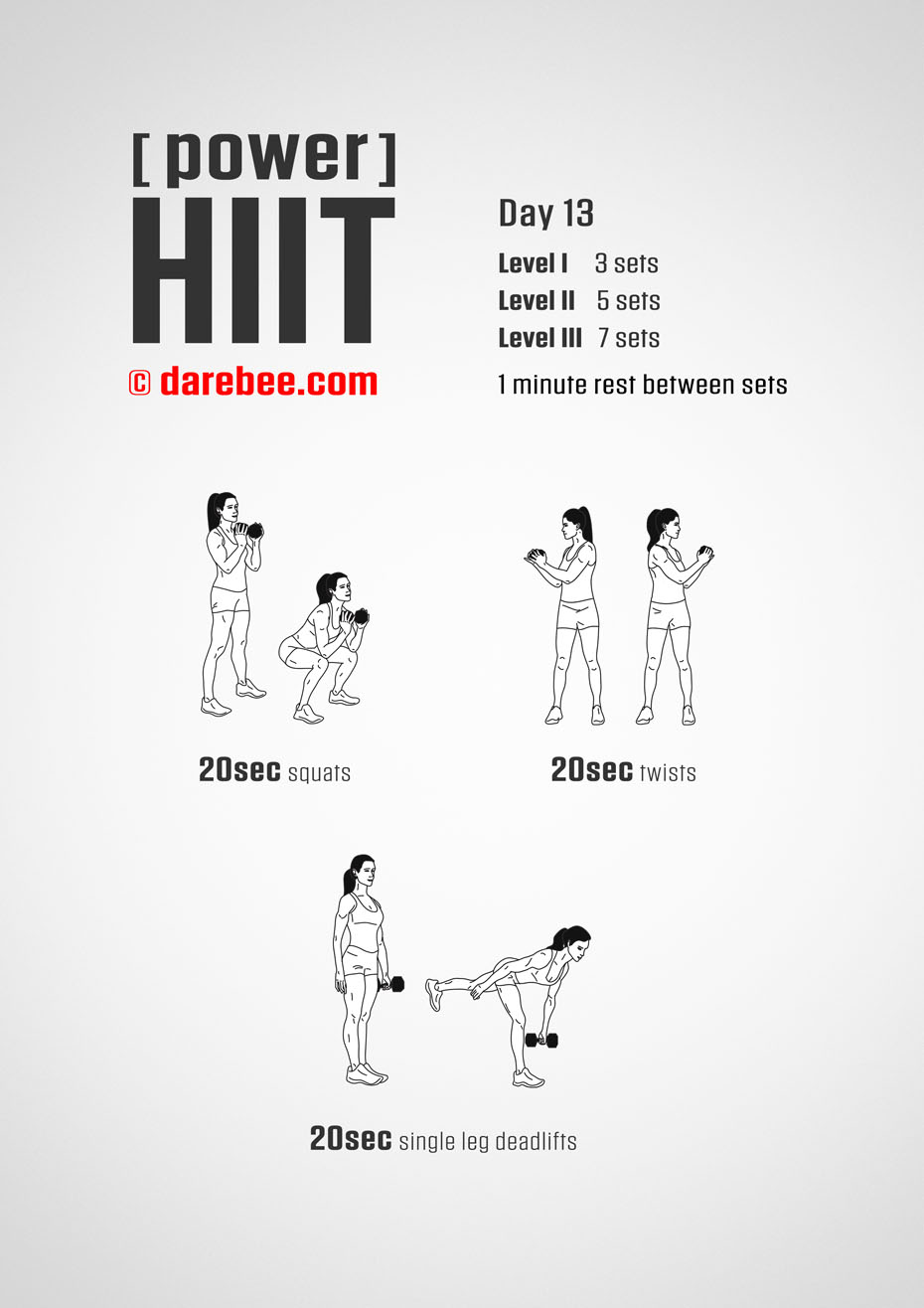
Day 13 makes balance the fourth exercise. Three 20-second intervals - squats with the dumbbells held at your chest, twists with a single dumbbell clasped in both hands, and single leg deadlifts - at 3, 5 or 7 sets, a minute of rest between. Two feet, then a rotating trunk, then one foot: each interval takes away a little more stability than the last.
The single leg deadlift is the program's first true balance exercise, and it earns its place at the end of the set. Standing on one leg, you hinge forward as the free leg extends behind you, the dumbbell lowering toward the floor - hamstrings and glutes doing the strength work while the ankle and hips negotiate the wobble. The squats before it build the fatigue, and the weighted twists in the middle work the obliques while giving your legs their only breather of the set.
Squat to depth with the dumbbells steady at your collarbones and your heels planted. Twist from the waist, shifting the dumbbell side to side at chest height while the hips hold their ground. In the single leg deadlift, hinge until your torso and raised leg form one line, keep the standing knee soft, and switch legs at halfway - a small wobble is the exercise working, a hop is a rep to redo.
By the last interval you are lifting on one leg and liking it - Day 13 trains the steadiness the mirror never shows.
Make it Harder: Take every squat below parallel - full depth at full weight, all twenty seconds.
Make it Easier: Keep the back toes resting on the floor as a kickstand through the single leg deadlifts.

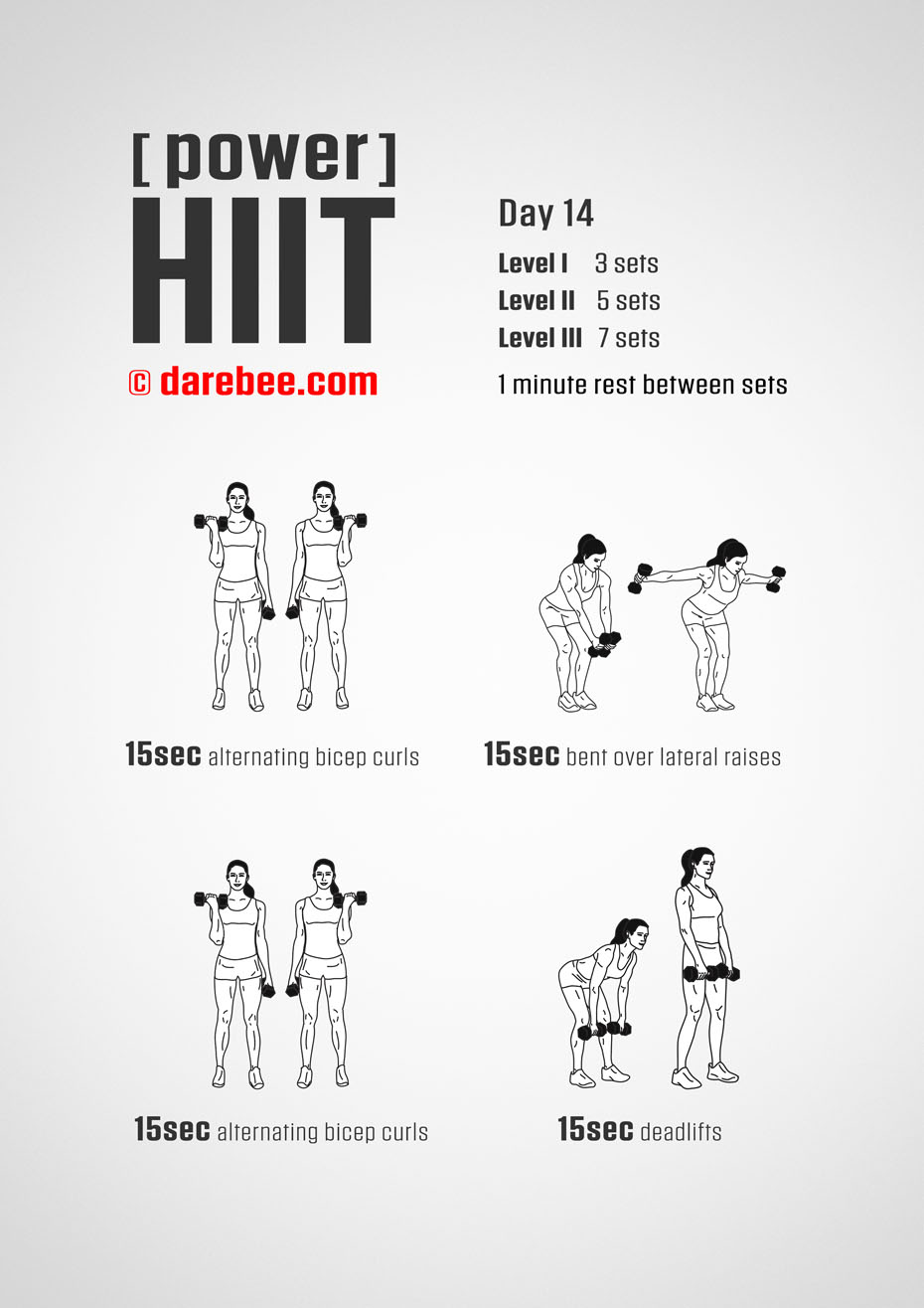
Day 14 sends the pull day to a new angle. Four 15-second intervals - alternating bicep curls, bent over lateral raises, alternating bicep curls again, deadlifts - at 3, 5 or 7 sets, one minute between sets. The curls anchor the set in their usual doubled role; the news is the bent over lateral raise, which folds you forward and asks the back of your shoulders to do something dumbbells rarely ask.
Rear delts are the muscles that pull your shoulders back into good posture, and they only work when you meet them at their angle: hinged forward, arms hanging, dumbbells sweeping out to the sides like slow wings. Fifteen seconds is exactly long enough to find them. The deadlifts that close each set share the same hinge position, so the day quietly teaches one shape twice - once for small muscles with light sweeps, once for big ones with a full pull.
In the bent over raises, hinge to a flat back, keep a soft bend in the elbows and raise the dumbbells out until they reach shoulder line - no higher, no swinging. The curls keep their standard: elbows pinned, one arm at a time, both directions controlled. Deadlift exactly as the raises positioned you - hips back, spine long, the dumbbells tracking down the front of your legs.
Half of this day happens bent over at the hips - your posture will cash the cheque later.
Make it Harder: Hinge deeper for the raises - torso parallel to the floor turns a sweep into a fight.
Make it Easier: Raise the dumbbells to halfway height in the bent over raises and keep every rep smooth.

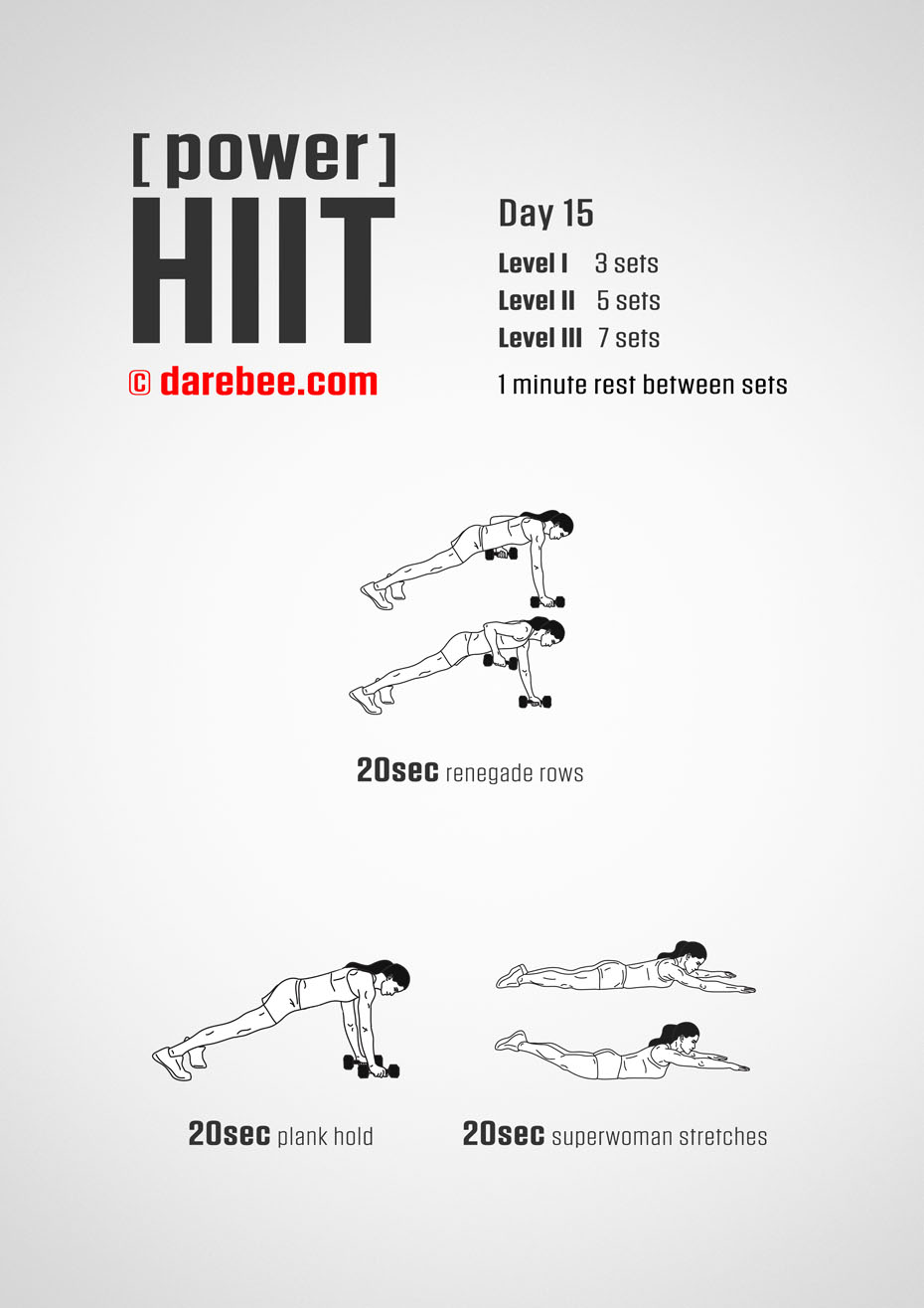
Day 15 rebuilds Day 7 with a longer stay in the plank. The three 20-second intervals: renegade rows, a plank hold on the dumbbell handles, and superwoman stretches - 3, 5 or 7 sets by level, a minute between sets. The rows and the prone back work return unchanged; the middle interval is new, and it consists of doing absolutely nothing without falling over.
Holding a plank on two dumbbell handles is harder than holding one on the floor - the grip works, the wrists balance, and the whole trunk manages a narrower, taller base. Placing it directly after the renegade rows is the design: the rows pre-fatigue exactly the muscles the hold then has to rely on, so 20 static seconds arrive feeling like forty. The superwoman stretches then flip you over and let the back of the body move again, sweeping arms and legs up together to close the set.
Row with level hips and a wide stance, one dumbbell at a time to the ribs. In the plank hold, stack your shoulders over the handles, squeeze the grip, and hold one straight line from head to heels - no sagging middle, no hiked hips, just quiet effort. Lift into each superwoman rep with everything at once and lower with the same patience.
A week after the first prone day, the plank stops being a position and starts being an exercise - Day 15 makes the difference obvious.
Make it Harder: Walk your feet together for the plank hold - the narrower the base, the busier the core.
Make it Easier: Take the plank hold from your knees and keep your hands on the dumbbells.

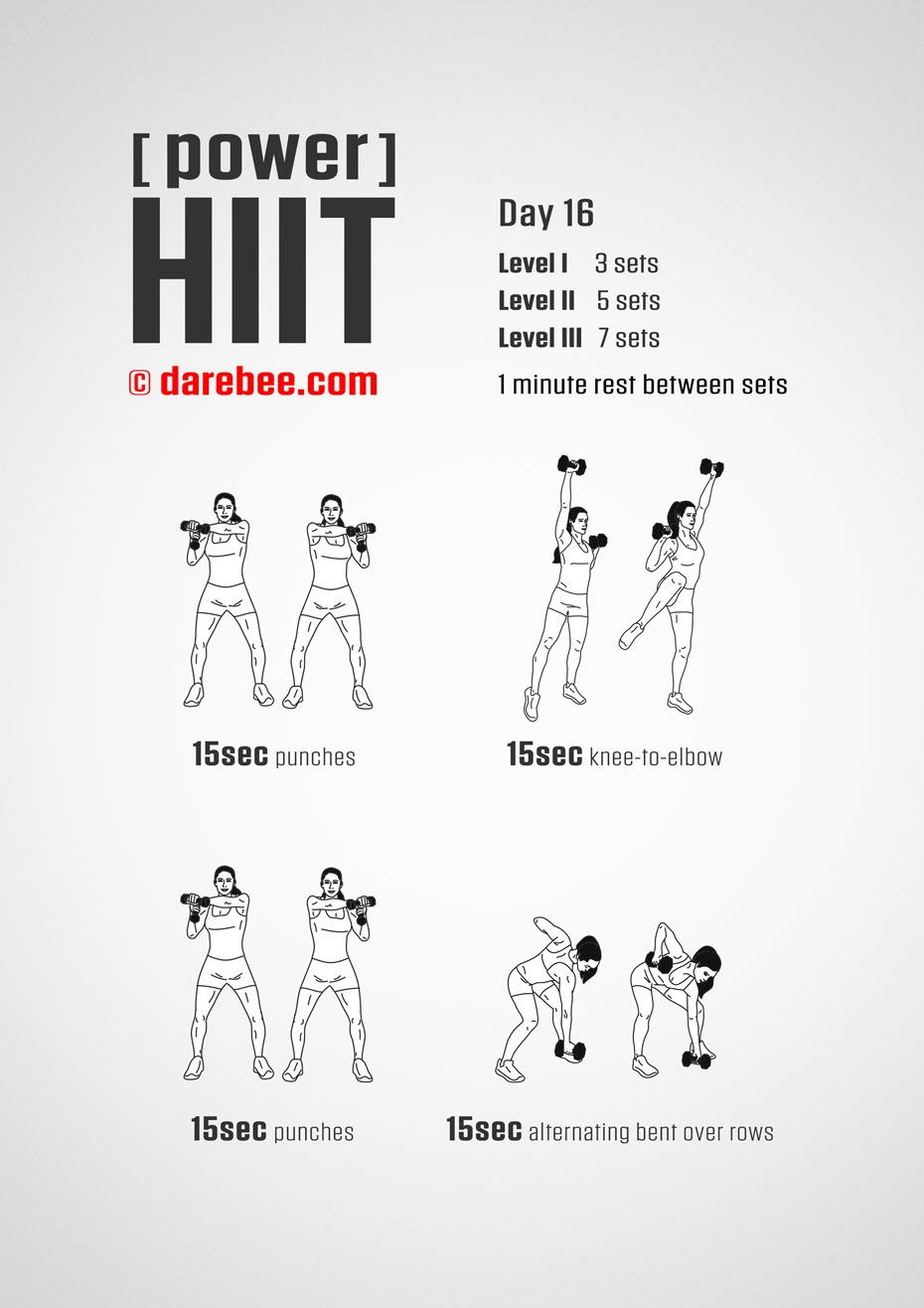
Day 16 mixes its speeds. Four 15-second intervals - punches, knee to elbow, punches again, alternating bent over rows - at 3, 5 or 7 sets with a minute of rest between them. The doubled punches keep the tempo high, the knee to elbow work keeps the core involved, and the rows finish each set hinged over and pulling one arm at a time.
This is the even-day template at its most cardio: two fast intervals, two strength ones, alternating so the heart rate never quite settles. The knee to elbow exercise returns from the odd days with its dumbbells overhead and its knees driving up to meet pulling elbows - a standing crunch at speed. The alternating bent over rows then trade speed for position: hinged, braced, one dumbbell rowing to the ribs while the other waits at arm's length.
Punch fast, extend fully, keep the resting dumbbell at your chin. Drive each knee up with genuine height and pull the elbow down to meet it - the collision point is the rep. In the rows, hold the hinge steady while the arms alternate; the torso should not rotate more than a few degrees as the dumbbells trade places.
Fast, core, fast, pull - Day 16 changes gears every fifteen seconds and expects you to keep up.
Make it Harder: Drive every knee above hip height in the knee to elbow work - no shallow reps hiding in the count.
Make it Easier: Ease the hinge in the rows - a taller torso takes the load off the lower back while the arms still work.

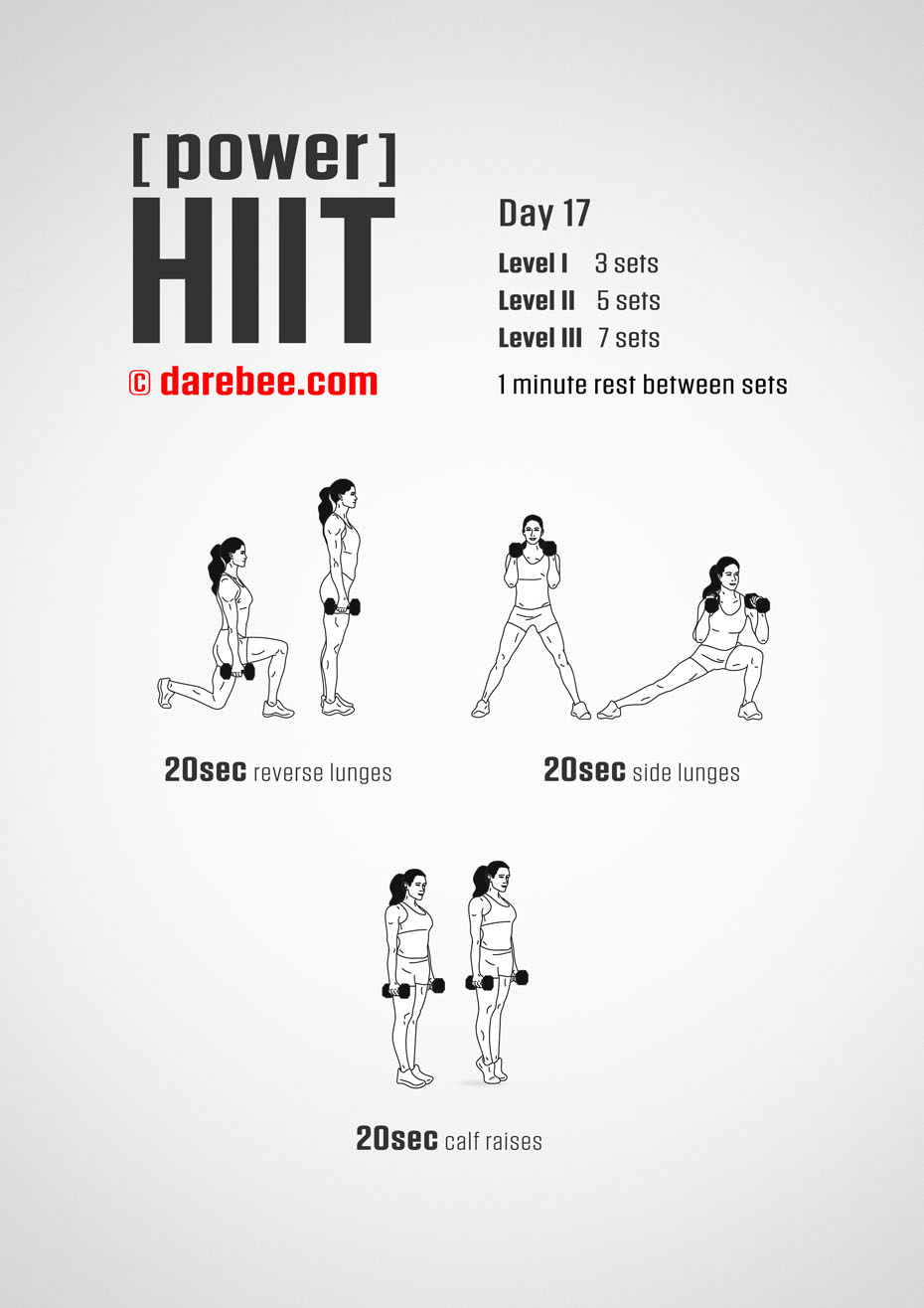
Day 17 is leg day with a change of direction. Three 20-second intervals - reverse lunges, side lunges, calf raises - at 3, 5 or 7 sets, one minute between sets. The dumbbells hang at your sides for the reverse lunges and calf raises and sit at your shoulders for the side lunges, and the session never asks your feet to stay still.
The reverse lunge is the new arrival: stepping backward instead of forward keeps the front shin vertical and the knee happier, while the quads and glutes of the stationary leg do the honest work. The side lunges then load the frontal plane - inner thighs, outer hips - and the calf raises close the set with the smallest muscles of the day doing their quiet, essential job. Backward, sideways, upward: three directions in sixty seconds.
Step back far enough that the front knee stays over the ankle, lower the back knee toward the floor, and drive up through the front heel. In the side lunge, sit into the bent leg with your chest tall and both feet flat. Calf raises get full range or they get nothing - all the way up onto the balls of your feet, all the way down.
Three directions of travel and not a single step forward - Day 17 trains the legs for everywhere else they go.
Make it Harder: Bring the dumbbells up to your shoulders for both lunge exercises - same legs, higher centre of gravity, harder balance.
Make it Easier: Alternate sets - one with dumbbells, one without - and keep every rep at full depth.

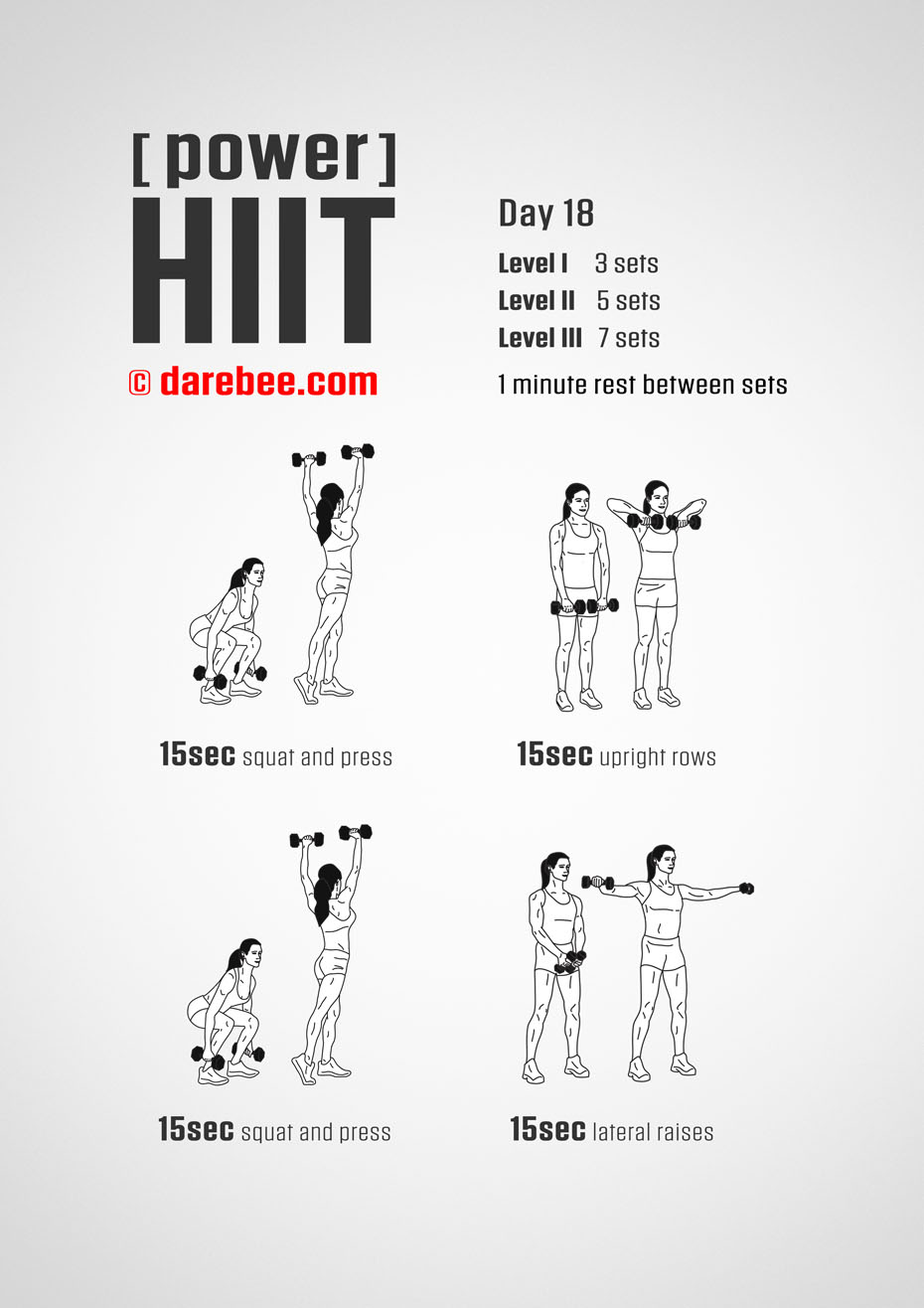
Day 18 doubles the biggest movement of Day 1. Four 15-second intervals - squat and press, upright rows, squat and press again, lateral raises - at 3, 5 or 7 sets, a minute between sets. The compound that opened the program now anchors an entire even day, with two shoulder exercises filling the gaps between its visits.
The squat and press is the most expensive exercise in this program - legs, hips, core and shoulders all pay into every rep - and meeting it twice per set is the point. The upright rows after the first visit keep the dumbbells moving on tired shoulders; the lateral raises after the second ask those same shoulders for precision when they would rather have mercy. It is Day 2's doubled-anchor structure applied to the day the whole body works.
Squat to depth before the drive - the press should ride the momentum of your legs, finishing locked out overhead. Keep the upright rows close to your body, elbows leading to chest height. On the lateral raises, resist the fatigue shrug: shoulders down, arms rising level to shoulder height, every rep the same shape as the first.
The program's biggest lift just became a chorus - twice a set, every set, until the timer says otherwise.
Make it Harder: Add a beat at the bottom of every squat before you drive up into the press.
Make it Easier: Press out of every second squat only - squat every rep, press when your shoulders allow.

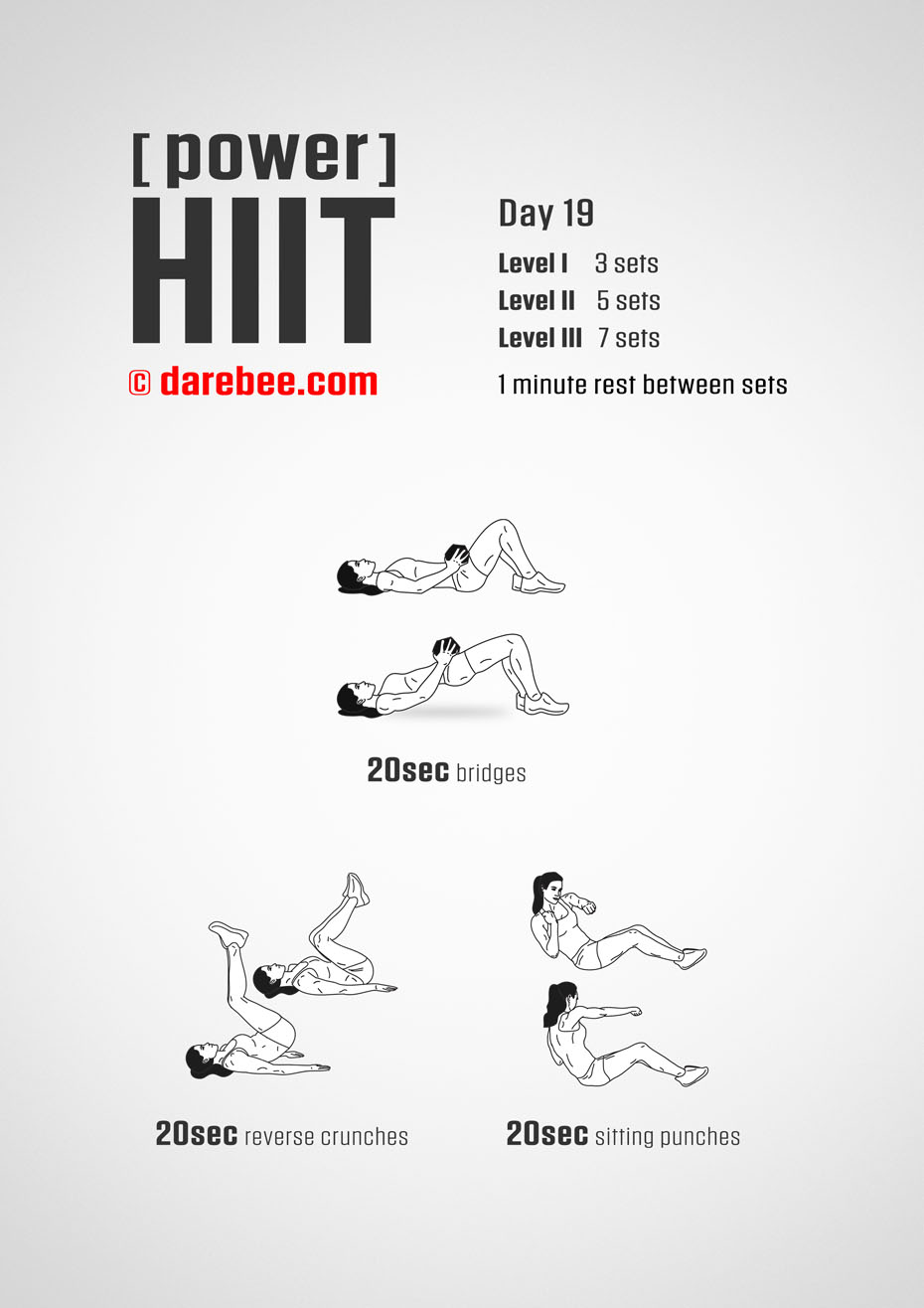
Day 19 is the floor session with a fight at the end. Three 20-second intervals - bridges with the dumbbell on your hips, reverse crunches, and sitting punches - at 3, 5 or 7 sets, a minute of rest between. The bridges anchor the floor days as always; the pair behind them works the abs from two directions, one curling, one rotating.
Reverse crunches flip the usual crunch on its head: instead of lifting your shoulders toward your hips, you curl your hips toward your shoulders, knees sweeping up and over until the tailbone leaves the floor - lower abs doing the lifting, not momentum. The sitting punches then prop you into a lean-back sit and let your fists fly, empty-handed and fast, while the abs hold the recline against every rotation. The dumbbell works the bridges; your bodyweight handles the rest.
Bridge to full extension with the weight steady across your hip bones. In the reverse crunch, curl the hips up under control and lower them without letting the feet crash down - the slow return is half the exercise. Sit back into the punches until the abs engage, rotate slightly with each strike, and keep the pace up for the whole 20 seconds.
The set ends with you leaning back and punching the air - Day 19 knows exactly how that will feel by round five.
Make it Harder: Recline further in the sitting punches - the lower the lean, the harder the abs hold it.
Make it Easier: Rest your heels on the floor throughout the sitting punches and keep the punches sharp.

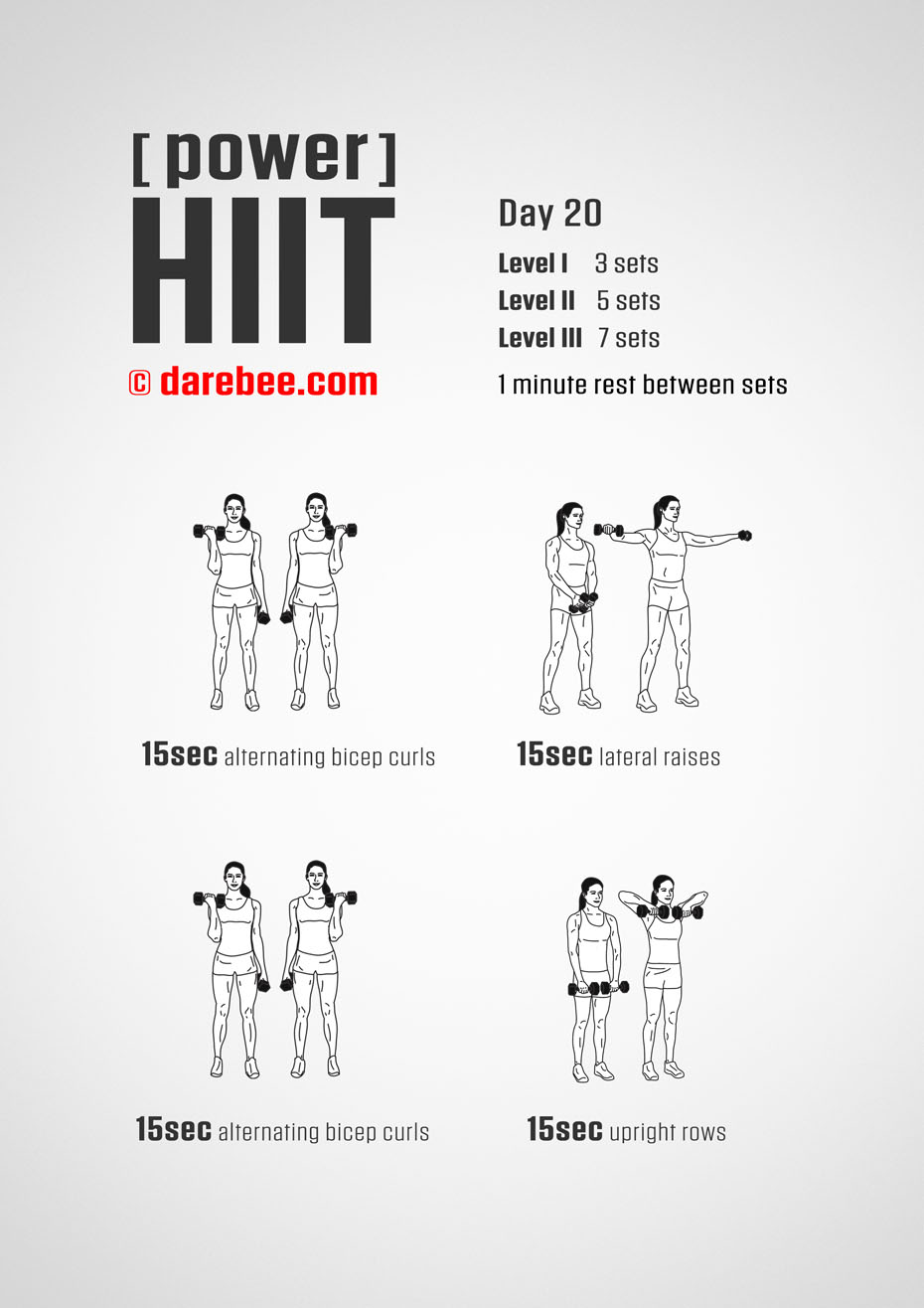
Day 20 is a pump day, pure and simple. Four 15-second intervals - alternating bicep curls, lateral raises, alternating bicep curls again, upright rows - for 3, 5 or 7 sets with a minute between sets. Nothing below the waist works today except your patience: the dumbbells stay in hand from the first curl to the last row, and the arms and shoulders trade the load between them.
The design is a tour of the three pulls the program keeps returning to - curls for the biceps, raises for the side delts, rows for the traps and shoulders - with the curls appearing twice as the day's anchor. Fifteen-second intervals suit these movements perfectly: long enough to accumulate real work, short enough that light dumbbells stay honest at speed. By the second half of each set the exercises stop feeling separate and start feeling like one continuous negotiation with gravity.
Alternate the curls with elbows pinned and zero swing. Lateral raises rise level to shoulder height and lower under control - the descent is where the shape is built. Upright rows finish each set with elbows leading and the dumbbells travelling close to your body; if the weights start drifting forward, the shoulders have clocked out and the momentum has clocked in.
Sixty seconds of arms, sixty of rest, repeat - Day 20 is the simplest deal this program offers, and one of the harder ones to keep.
Make it Harder: Curl both dumbbells together instead of alternating - twice the load in the air for the same fifteen seconds.
Make it Easier: When form frays mid-interval, park the dumbbells at your sides for three breaths and rejoin - an honest pause beats sloppy reps.

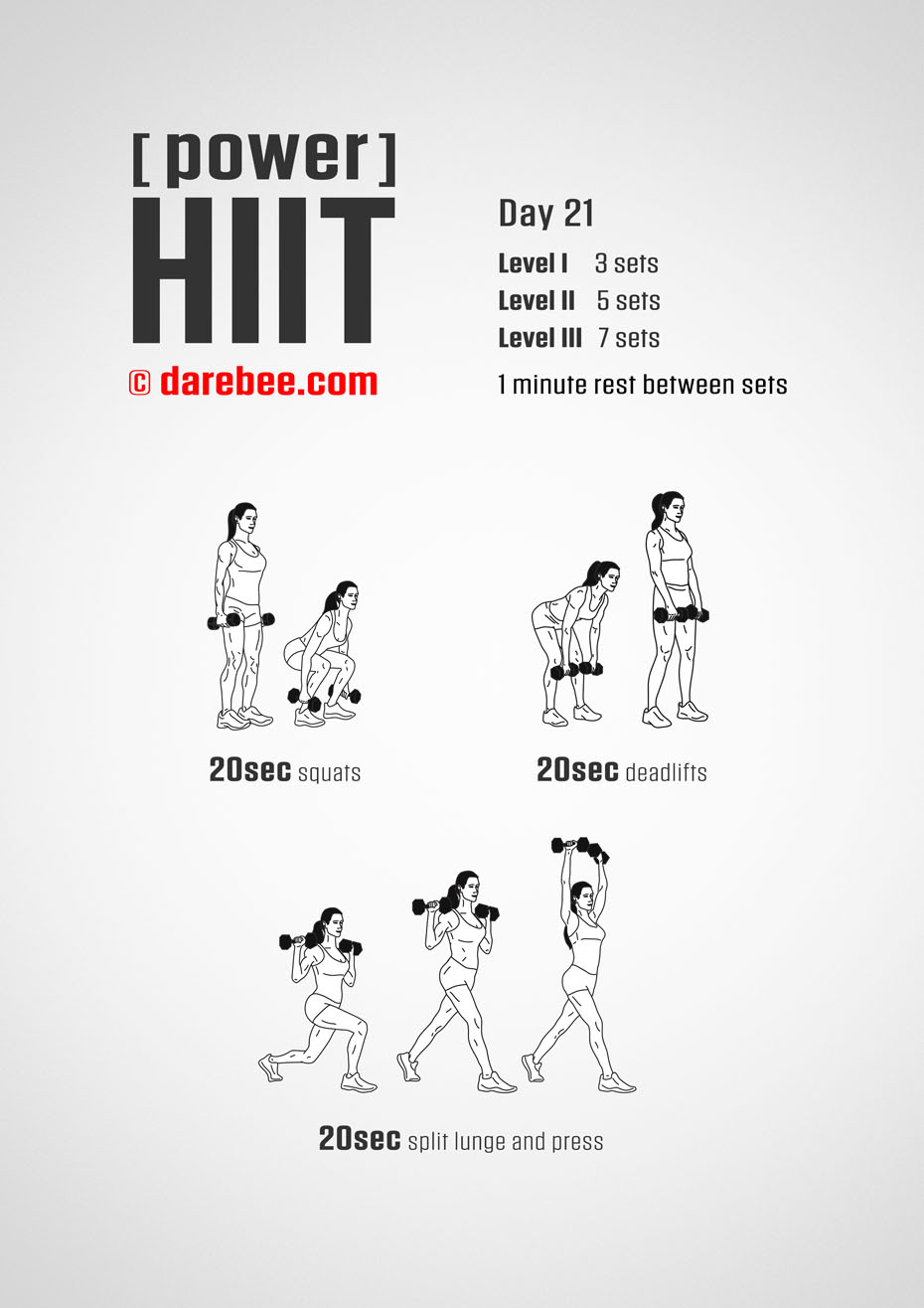
Day 21 runs the compound gauntlet. Three 20-second intervals - squats, deadlifts, split lunge and press - at 3, 5 or 7 sets, a minute of rest between sets. Three weeks in, the program hands you its three biggest lower body movements in a row and steps back to watch.
It is Day 9's blueprint with heavier intent: the squat replaces the knee-to-elbows, so all three intervals are now strength movements and the cardio comes from the sheer size of the muscles working. Squats load both legs, deadlifts load the back of them, and the split lunge and press splits the stance and sends the dumbbells overhead as the feet switch - the same coordination test as before, now arriving on legs that have already squatted and hinged for forty seconds.
Squat with your chest tall and the dumbbells hanging heavy at your sides. Deadlift with the hinge you have been practising since Day 2 - hips back, spine flat, the weights tracking your legs. In the split lunge and press, land each stride stable before the press crowns it; when the rhythm comes, ride it, and when it wobbles, slow down and rebuild it mid-interval.
Squat, hinge, lunge, press - the whole lower body syllabus in one set, on legs that have earned the right to complain.
Make it Harder: Touch the dumbbells to the floor on every deadlift rep - full range at full pace.
Make it Easier: Keep the same lead foot through each split lunge and press interval, switching legs between sets instead.

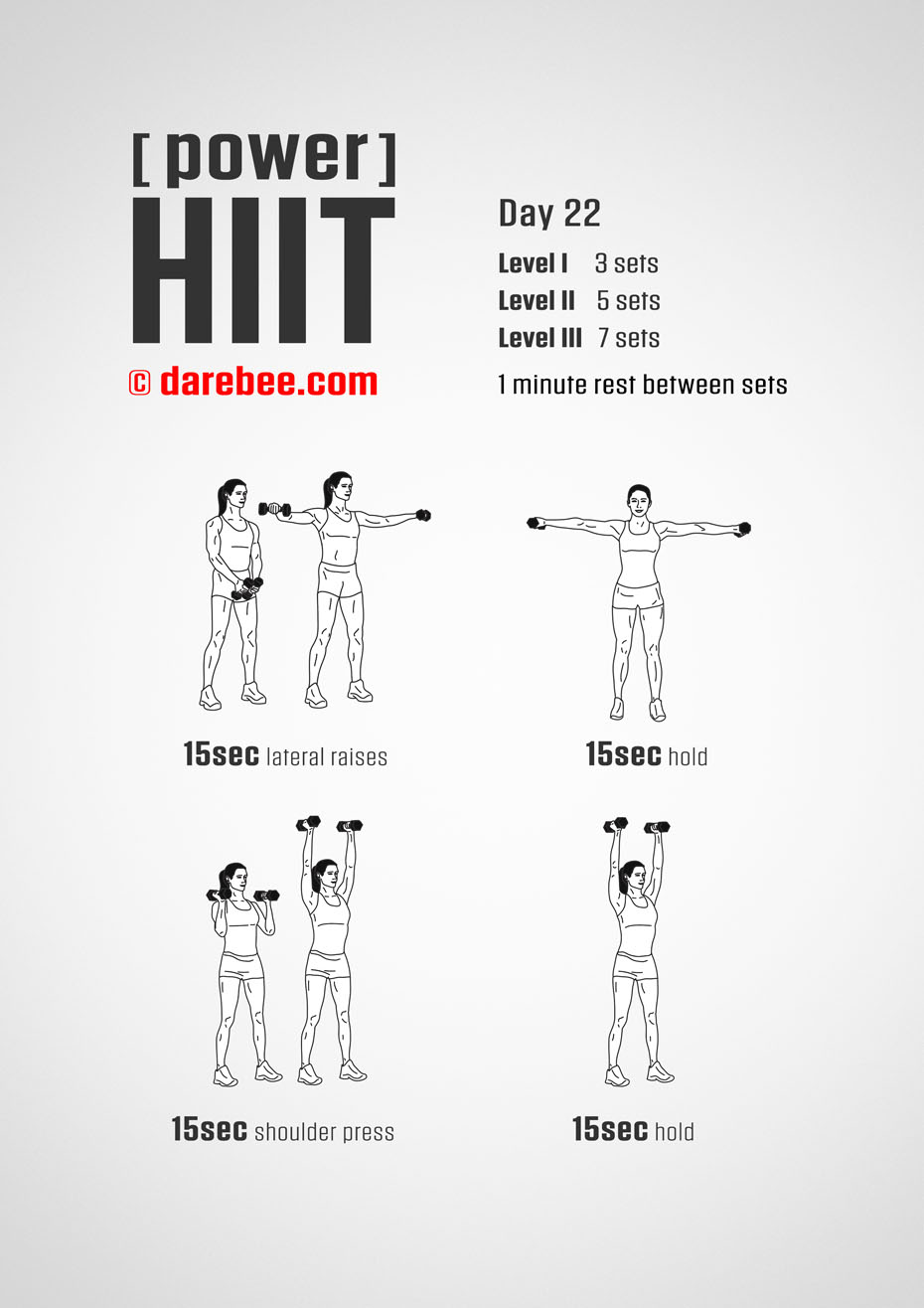
Day 22 brings back the freeze. The four 15-second intervals alternate movement and stillness - lateral raises, a hold with the arms extended out in a T, shoulder press, and a hold with the dumbbells locked out overhead - at 3, 5 or 7 sets with a minute between sets. It is Day 10's cruel format promoted upward: this time the second hold happens at full extension above your head.
The pairings are precise. The lateral raises carve the exact arc the T hold then freezes, and the shoulder presses end where the overhead hold begins - each dynamic exercise builds the fatigue its static partner exploits. The overhead hold is the day's summit: arms locked out, dumbbells stacked over shoulders over hips, everything from grip to core keeping the weight quiet at altitude for fifteen seconds that read much longer from underneath.
Raise level, hold level - the T position lives exactly at shoulder height, elbows softly bent, and sagging arms get lifted back into place. Press to full lockout each rep. In the overhead hold, reach tall, keep your ribs down and your ears clear of your shoulders, and breathe like it is easy even when it is not.
Half this day is spent perfectly still with the weights at their highest - Day 22 measures strength in seconds, not reps.
Make it Harder: Actively press upward against nothing during the overhead hold - push the ceiling for all fifteen seconds.
Make it Easier: Bend the elbows to a goalpost for the overhead hold, dumbbells at head height, and keep the T hold as written.

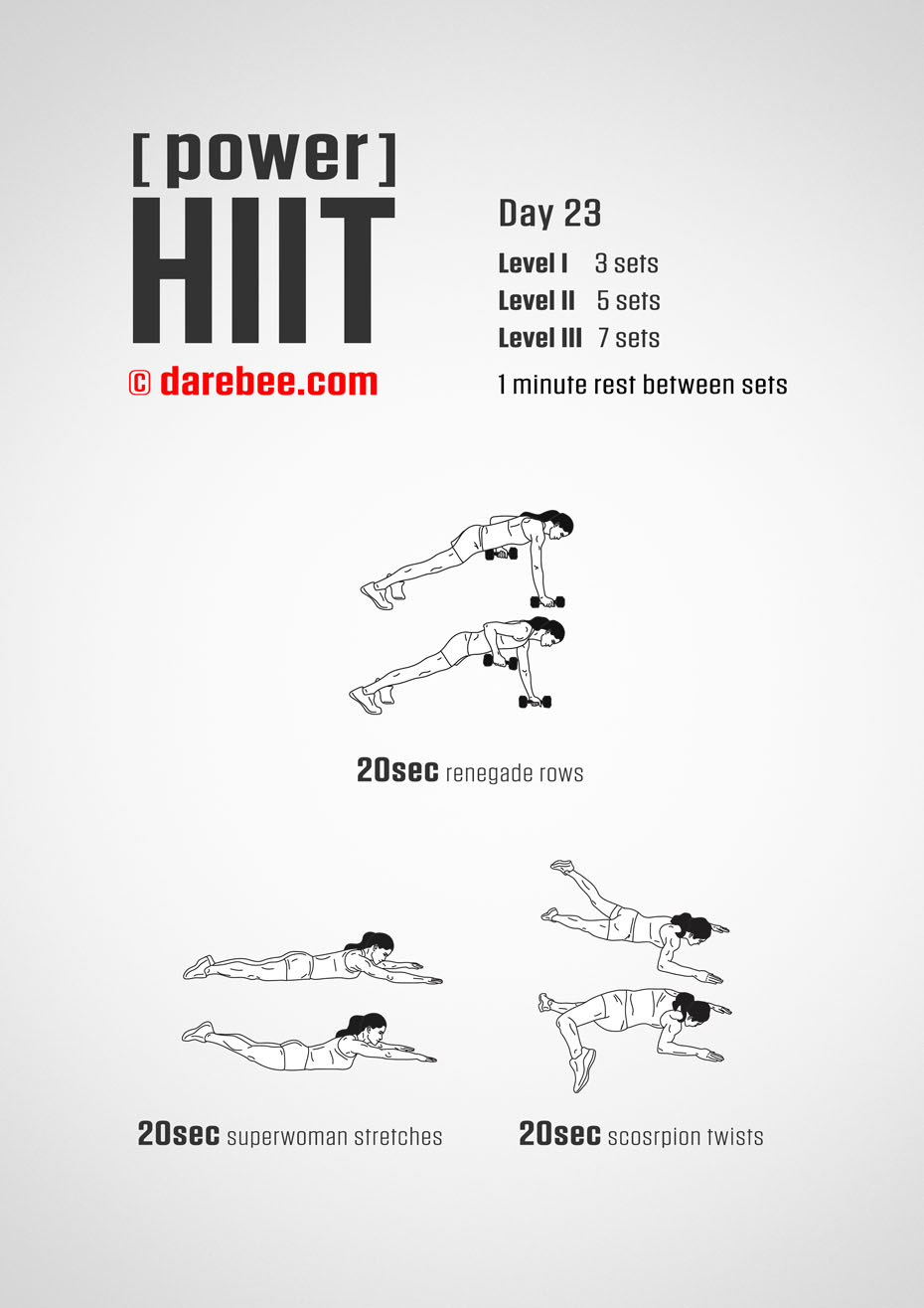
Day 23 is the prone day's final form. Three 20-second intervals - renegade rows, superwoman stretches, scorpion twists - at 3, 5 or 7 sets, one minute between sets. The rows and the superwoman work carry over from Days 7 and 15; the scorpion twists are new, and they rotate a session that has so far only moved straight up and down.
The scorpion twist starts face down with arms wide, then lifts one leg and sweeps it across the body toward the opposite side, the hips rolling as the chest tries to stay square. It is a mobility exercise wearing a strength day's clothes - the lower back, glutes and obliques all negotiate the crossover - and after two prone exercises that only lift, twenty seconds of controlled rotation is exactly what the spine has been owed. Rows for the mid-back, superwoman for the whole line, scorpions for the twist: the back's full range in one set.
Keep the renegade rows plank-solid and the hips level. Sweep into each superwoman rep with arms and legs rising together. In the scorpion twist, move slowly - lift the leg, cross it over until the foot reaches toward the floor on the far side, and return with the same control; the shoulders stay grounded as long as they can, and the stretch across the trunk is the sign it is working.
Three prone days taught your back to lift - the last one teaches it to turn.
Make it Harder: Lift the crossing leg higher before it travels in every scorpion twist - a taller arc is a longer twist.
Make it Easier: Shrink the crossover - sweep the leg only to hip width and grow the range set by set.

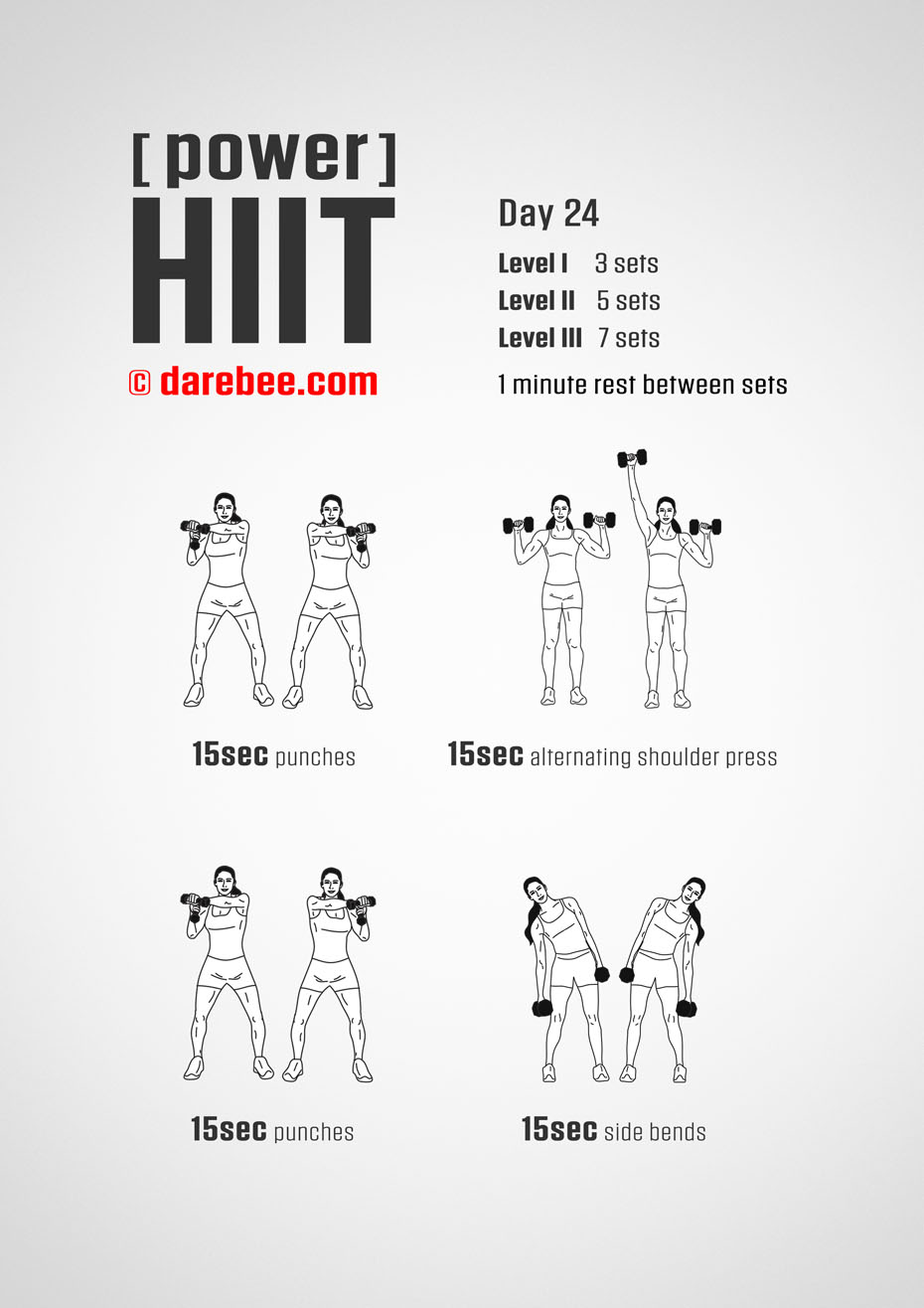
Day 24 keeps the punches and changes everything around them. Four 15-second intervals - punches, alternating shoulder press, punches again, side bends - at 3, 5 or 7 sets, a minute of rest between. The doubled punches do their usual cardio duty; the press works overhead one arm at a time; and the side bends close each set by taking the dumbbells somewhere the program has never gone - sideways along your own waist.
The side bend is simple and specific: dumbbells hanging at your sides, you lean directly sideways, one weight sliding down the outside of your thigh, then pull yourself back upright with the opposite obliques. No twist, no lean forward - just the lateral line of the trunk lengthening and contracting under load. Sandwiched behind two rounds of punches and a set of presses, it gives the day's shoulder-heavy work a waist-deep finish.
Punch with full extension and a tight guard. In the alternating press, drive each dumbbell to lockout while the other holds at the shoulder, torso tall and untilted. Side bends travel in one plane only - imagine sliding between two panes of glass - and the pull back to vertical is the rep, not the drop into the lean.
Punches, presses, and a lean to each side - Day 24 finishes by drawing the waistline it has been promising all month.
Make it Harder: Reach the dumbbell below knee height on every side bend - deeper lean, longer pull back up.
Make it Easier: Use one dumbbell for the side bends, held on the working side, and swap hands halfway through the interval.

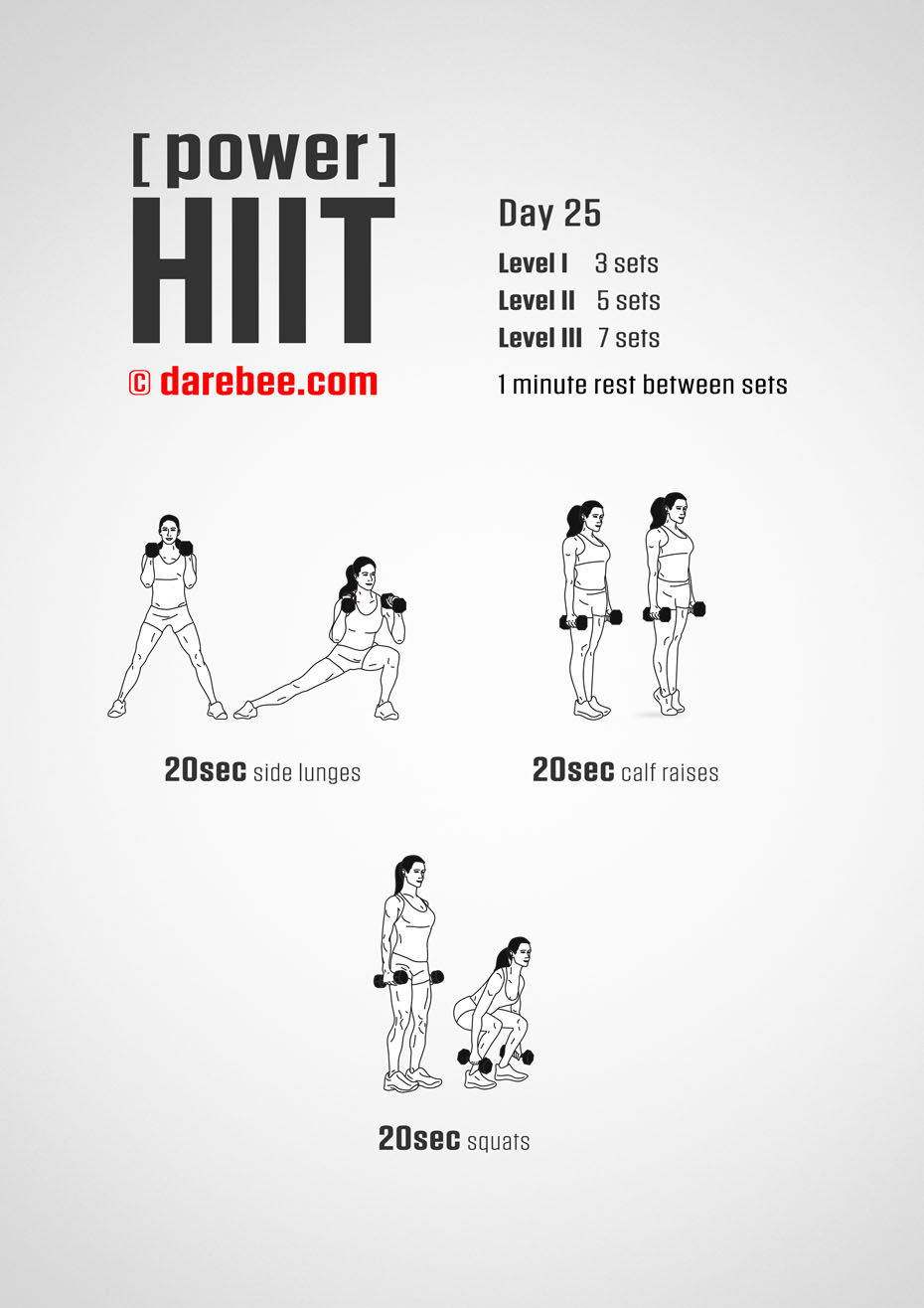
Day 25 is the last dedicated leg day, and it wastes no time. Three 20-second intervals - side lunges, calf raises, squats - at 3, 5 or 7 sets by level, one minute of rest between sets. Every exercise is a returning veteran; the only new thing here is how well you do them now compared to week one.
The order runs wide to narrow: side lunges load one leg at a time with the dumbbells racked at your shoulders, calf raises shrink the movement to the ankles, and squats finish with both legs sharing the biggest load of the set. It is a farewell tour of the program's lower body vocabulary - frontal plane, full range, and the compound that underwrites everything - packed into sixty seconds a set and repeated until your level says stop.
Side lunges sit back into the bent leg, chest proud, extended foot flat. Calf raises still owe you full range at any speed - the top of every rep is on the balls of your feet or it is not a rep. Squat to depth with the dumbbells hanging heavy and your heels welded down; by now the shape should feel like home.
The last leg day changes nothing and expects everything - the exercises are old friends, so treat them like it.
Make it Harder: Make the squats continuous - no pause at the top, just twenty unbroken seconds of moving.
Make it Easier: Trim every interval to 15 seconds for the day and keep the load and form as written.

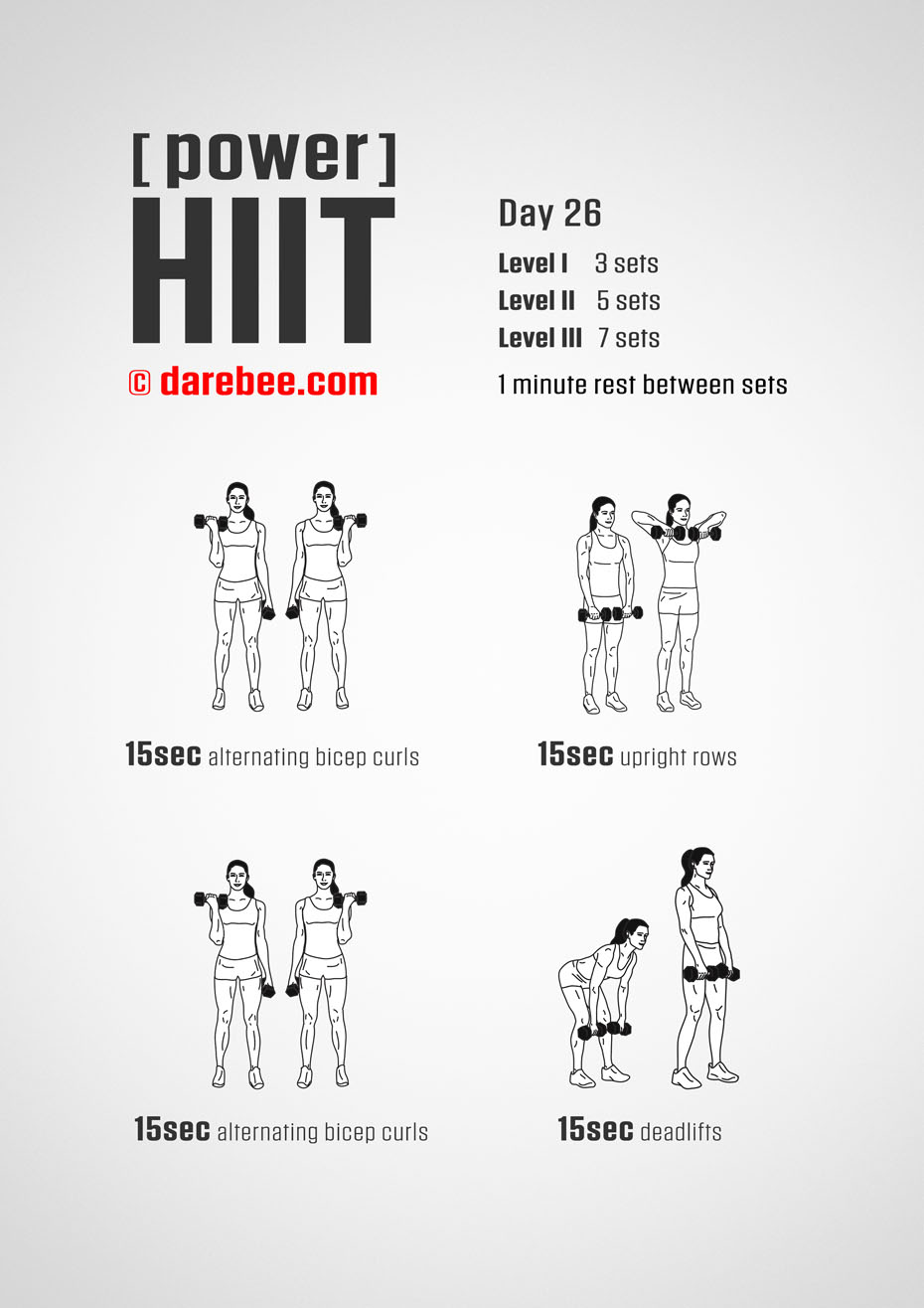
Day 26 rewires Day 8. Four 15-second intervals - alternating bicep curls, upright rows, alternating bicep curls again, deadlifts - at 3, 5 or 7 sets, a minute between sets. Three-quarters of the session is the pull day you know; the closing interval swaps the bent over rows for deadlifts, trading an upper body pull for the biggest hinge in the book.
That single swap changes the shape of the set. Where Day 8 stayed above the waist, this version ends every sixty-second round with the hamstrings and glutes taking over from arms that have already curled twice and rowed once - a handover from small muscles to big ones just as fatigue arrives. The curls keep their doubled anchor role, the upright rows keep the shoulders honest, and the deadlifts make the last fifteen seconds the heaviest of the day.
Curls stay strict - alternating, elbows pinned, no half reps as the sets stack up. Upright rows to chest height with the elbows leading. Then reset completely for the deadlifts: feet planted, hips back, spine long, and pull like the first rep of the day even though it is the last.
Arms first, hinge last - Day 26 saves its biggest pull for the moment you would rather it did not.
Make it Harder: Start every interval instantly - dumbbells moving within the first second, no transition seconds donated to rest.
Make it Easier: Run two pairs if you have them - lighter dumbbells for the curls, your standard pair for the rows and deadlifts.

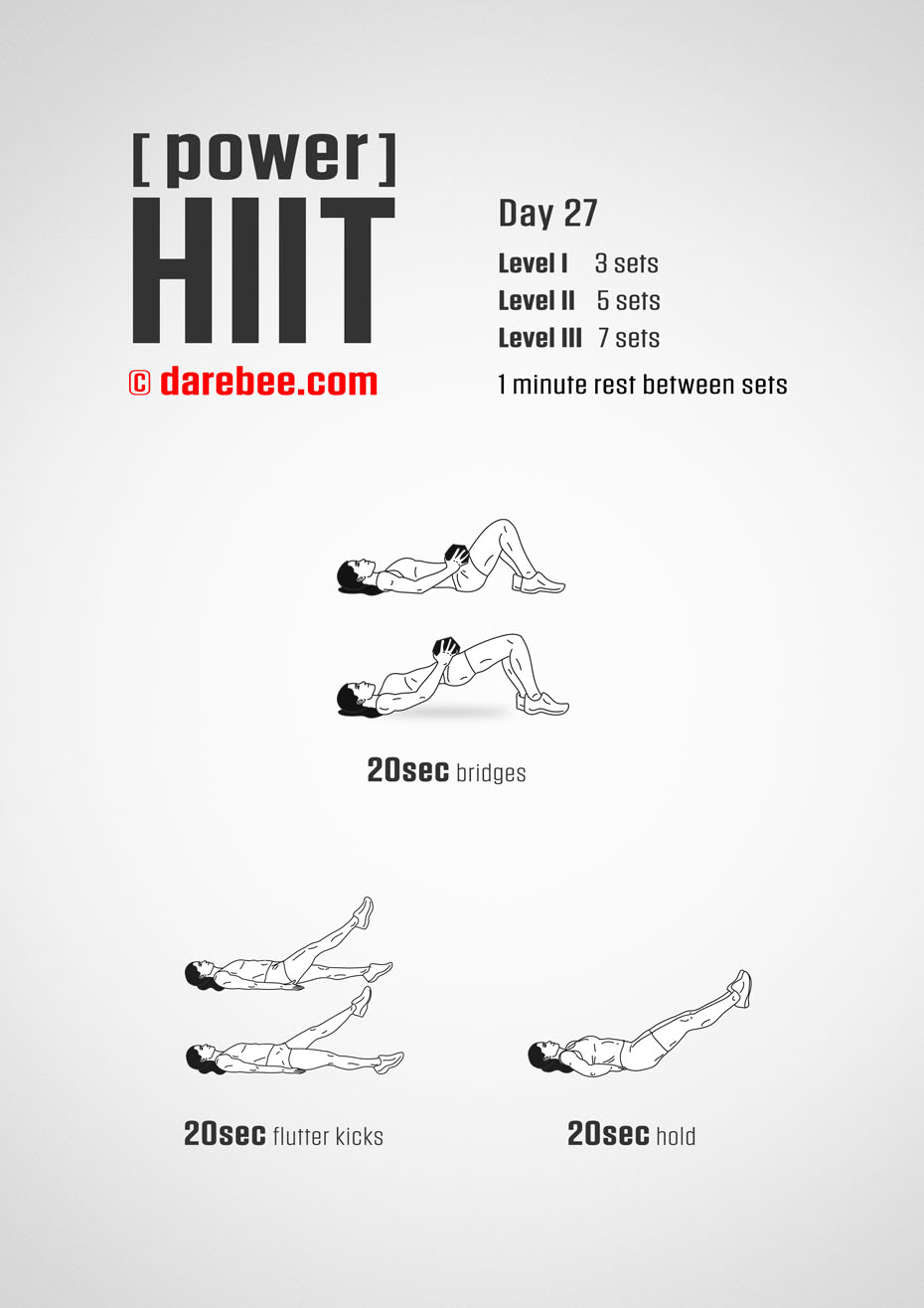
The last floor day keeps only the essentials. Three 20-second intervals - bridges with the dumbbell on your hips, flutter kicks, and a hold with both legs hovering off the floor - at 3, 5 or 7 sets, one minute between sets. Weighted hips, moving legs, frozen legs: the floor-day formula distilled to its three purest ingredients.
Everything here is a returning exercise meeting the strongest version of you. The bridges have anchored every floor session since Day 3. The flutter kicks scissor through the same low zone they did that first week - only now the hold that follows them parks your legs in exactly that airspace and asks them to stay. Kicking through a position and then holding it is the program's oldest one-two, and it lands hardest here, on the last day it gets to use it.
Bridge to full extension every rep, the dumbbell rising level. Flutter with your lower back glued down and the kicks small and fast. In the hold, find the hover and defend it - legs together, breath steady - and when the timer releases you, lower your heels like you meant to all along.
Four floor days built this finale - twenty seconds of stillness at the end is the program asking whether you were listening.
Make it Harder: Point your toes and reach the legs long during the hold - a longer lever is a heavier pair of legs.
Make it Easier: Slide your hands under your hips for the flutter kicks and the hold - a small tilt that spares the lower back.

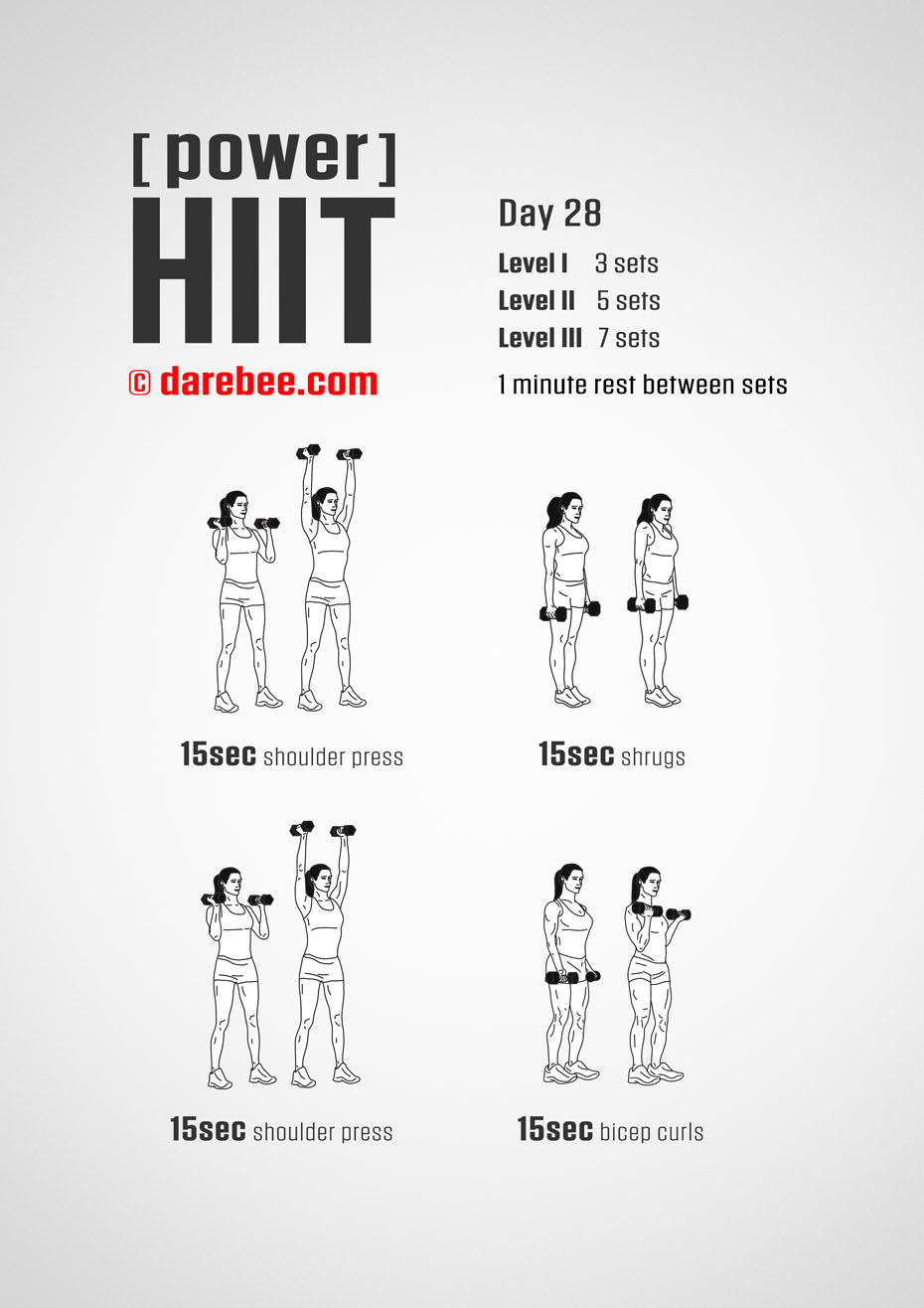
Day 28 presses twice and shrugs once. The four 15-second intervals - shoulder press, shrugs, shoulder press again, bicep curls - run at 3, 5 or 7 sets with a minute between sets. The press anchors its second day of the program, and even now, three days from the finish, Power HIIT has one more new exercise to hand over: the shrug.
Shrugs are the simplest movement on any card - dumbbells hanging, shoulders rising straight up toward the ears, then lowering - and their late arrival is no accident: they load the traps, muscles that have assisted every row and press for four weeks and finally get fifteen seconds with their name on it. Between the two press intervals and the closing curls, the day works the shoulder girdle from underneath, above and in front.
Press to lockout, lower to the shoulders, repeat without shortening the range as the sets climb. Shrug straight up and straight down - no rolling, no bending elbows, just the traps lifting the load as high as it goes. Curl one arm at a time to finish, as strict at the end of the set as at its start.
A brand new exercise this deep into the program - Day 28 is proof that even the traps get their turn before the credits.
Make it Harder: Turn the final press of each set into a hold - lock the dumbbells out and keep them there until the interval ends.
Make it Easier: Alternate arms on both press intervals - one dumbbell working at a time, the same path at half the load.

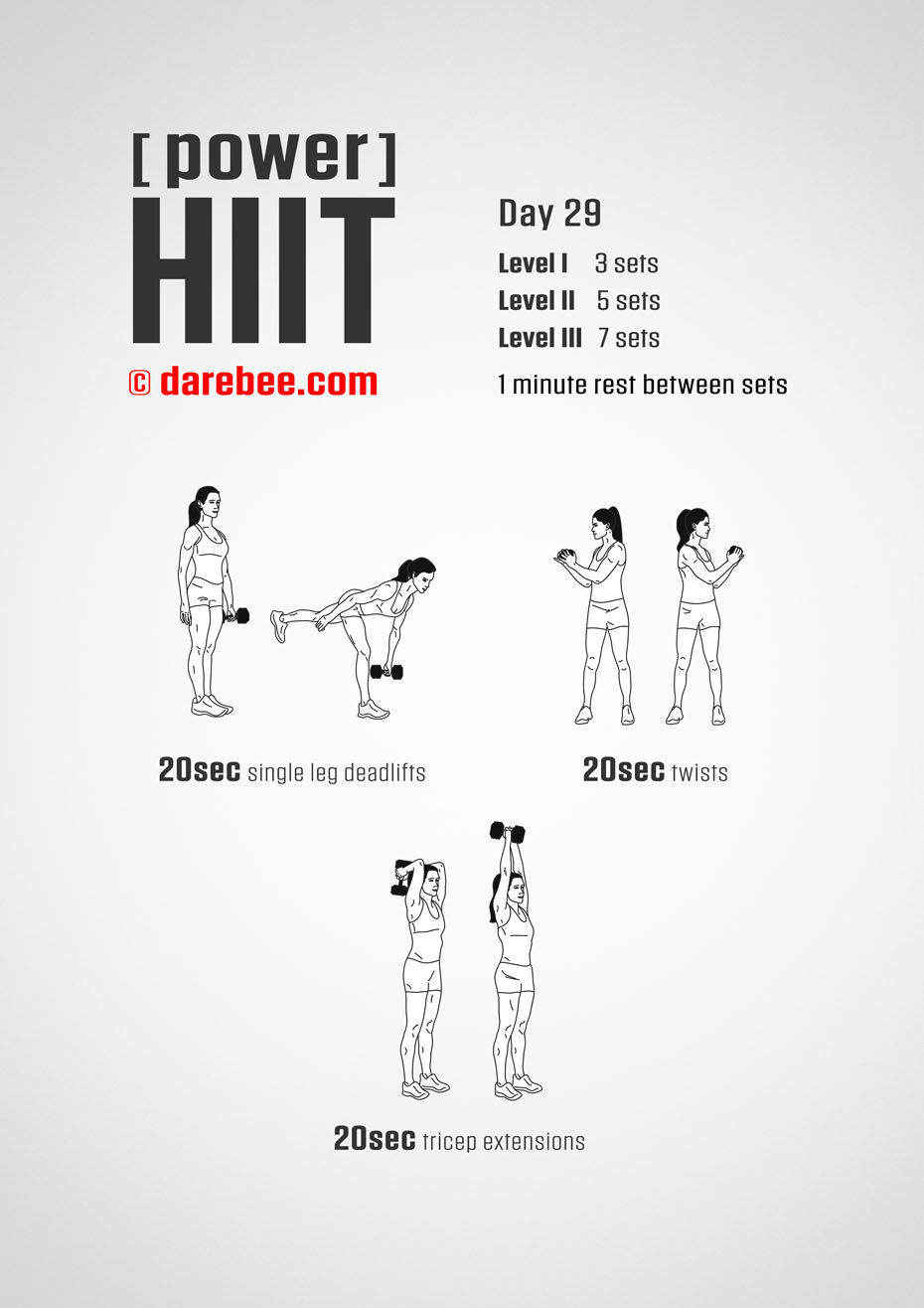
The last odd day balances, twists and reaches. Three 20-second intervals - single leg deadlifts, twists with the dumbbell clasped in both hands, and tricep extensions with both hands on one dumbbell overhead - at 3, 5 or 7 sets, one minute of rest between sets. One foot, one waist, one weight overhead: Day 29 revisits three of the program's subtler skills in a single set.
The single leg deadlifts return from Day 13 with two more weeks of practice in the bank - the wobble should be smaller and the hinge deeper. The twists keep the obliques in play mid-set, and the tricep extensions arrive in a new configuration: both hands wrapped around a single dumbbell, lowering it behind your head and pressing it back up, both arms sharing the work Day 6 assigned to one at a time. Balance, rotation, extension - a quieter kind of hard than the compound days, and no less honest.
Hinge into each single leg deadlift until torso and raised leg make one line, and change legs at halfway. Twist from the waist with the hips square. In the extensions, keep both elbows close to your head and pointing at the ceiling - only the forearms move, the dumbbell tracing the same short arc behind your skull every rep.
One leg, one twist, one dumbbell overhead - the program's penultimate day is a quiet exam in everything that does not show up in a mirror.
Make it Harder: Slow the lowering of every extension to a 3-count and press back up at speed.
Make it Easier: Shorten the extension range - lower the dumbbell only to the crown of your head and press from there.

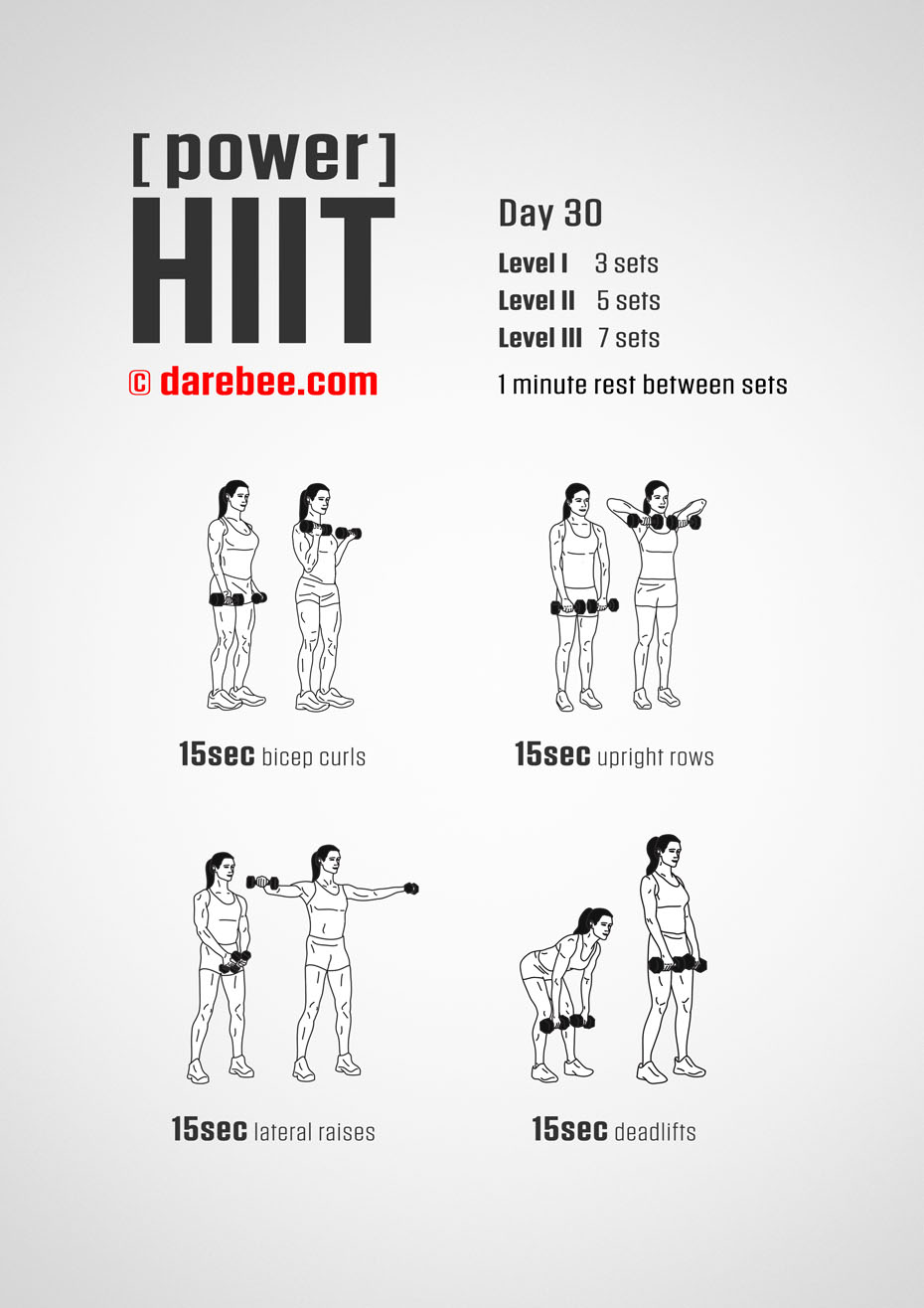
Day 30 breaks its own pattern to say goodbye. Four 15-second intervals - bicep curls, upright rows, lateral raises, deadlifts - at 3, 5 or 7 sets with the last minute-long rests of the program. For the first time on an even day, no exercise repeats: four different movements, one visit each, a greatest-hits set played straight through.
Every exercise here is one of the program's most-travelled roads. The curls that have anchored half the even days open the set one arm at a time; the upright rows and lateral raises cover the two shoulder paths you have worn smooth over thirty days; and the deadlifts - the very first exercise of the very first even day - close both the set and the program with the biggest hinge you own. No new skills, no surprises: just sixty seconds of everything this month built, done as well as you have ever done it.
Hold the standard on all four: curls strict, rows led by the elbows to chest height, raises level and controlled, deadlifts flat-backed and full. Fatigue has no vote today - the last set of the last day should be the one you would put on a poster.
Thirty days, one timer, and a final set with no repeats - finish it clean, write down your level, and know exactly what to beat next time.
Make it Harder: Run the whole final day one level up from where you started the program - the difference is the month's work, measured.
Make it Easier: Drop one level below your usual for today and pour the surplus into speed and form - a fast, immaculate finish.