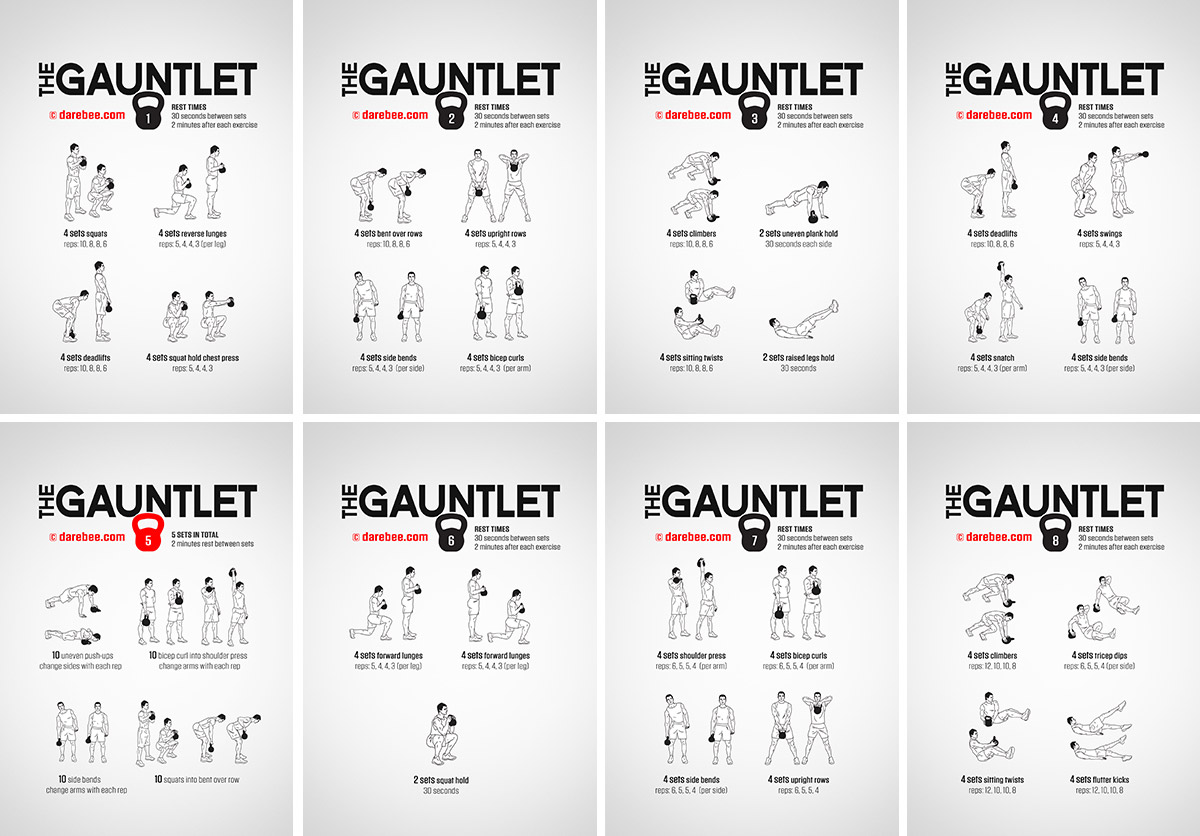
A kettlebell does not sit quietly in your hand the way a dumbbell does - it swings, it pulls, it wants to move - and The Gauntlet is thirty days of learning to be stronger than it is. This is a classic strength program built around a single bell: squats, deadlifts, rows, presses, swings and snatches for the legs, back, arms and shoulders, with climbers, twists and holds on the floor to tie the trunk to all of it. It builds muscle and raw power the old-fashioned way, one exercise at a time, with real rest between them and counts that keep climbing as the days go by.
Four days out of every five are strength days, marked by a black bell on the card. You work through each exercise on its own, finishing all of its sets before the next lift begins, so the muscle gets your full attention and the bell gets your best form. Every fifth day the bell turns red and the rules change: the same movements are chained into combinations and run as a circuit, and strength turns into endurance, coordination and athleticism. The two kinds of day feed each other - the black days build the engine, the red days teach it to move - and every exercise is introduced properly on the day it first appears, so nothing on any card will catch you unprepared.
One bell does everything here, so choose it for the hardest single-arm lifts on the cards: a weight you can press overhead with one arm for 8 to 10 clean reps and still control at the bottom of a swing. If you can press it 15 times without thinking it is too light; if you cannot press it 5 times with a straight back it is too heavy for now. Thirty days later you will squat, hinge, press, swing and snatch that bell with a confidence that carries into everything else you train, and the program is built to be repeated - come back with a heavier bell and it becomes a new challenge every time. As long as it challenges you, it is working.

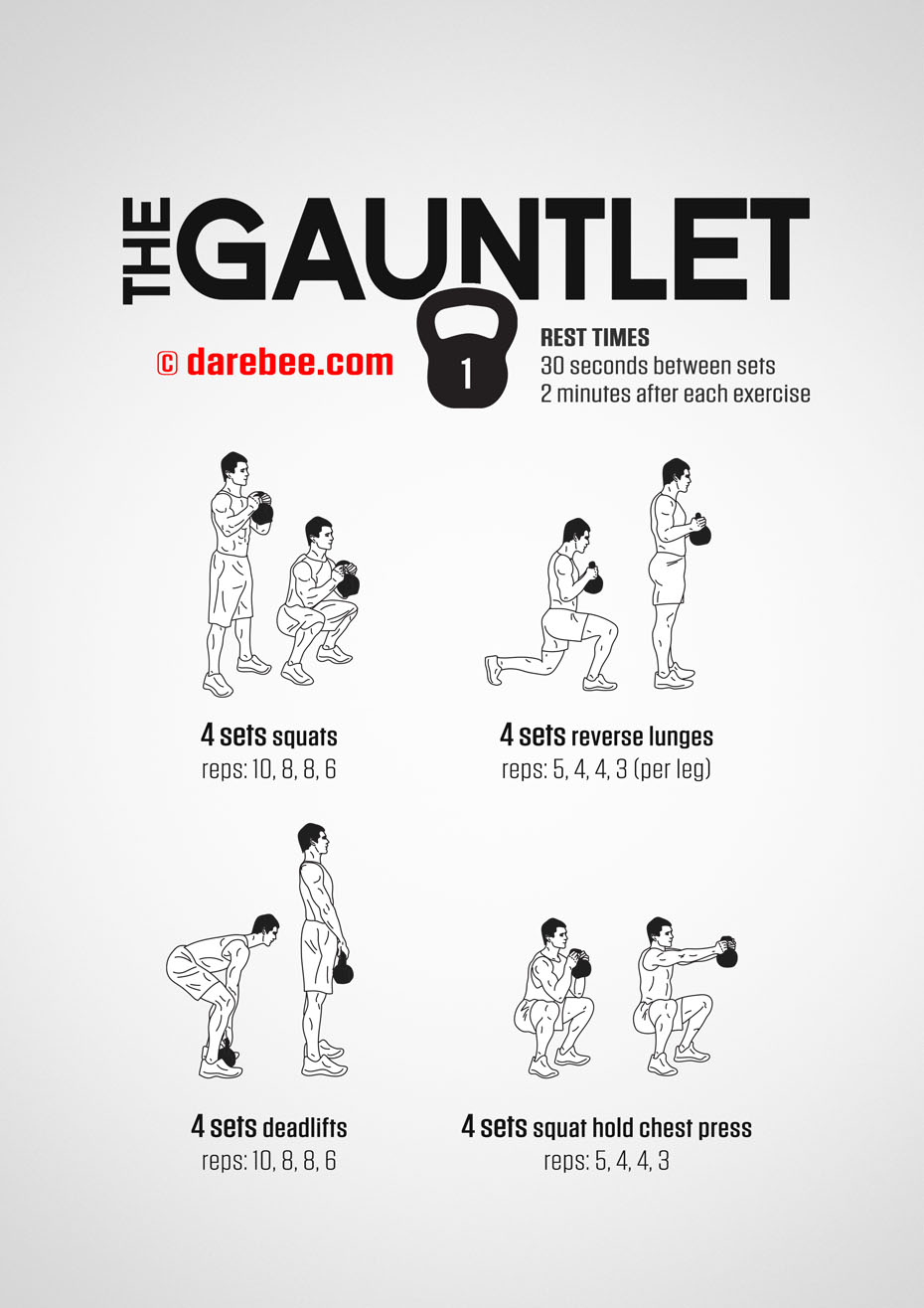
The Gauntlet opens on the legs and lays out its rules on the first card. One kettlebell is all the equipment you need, and this is straight sets training: you finish every set of one exercise before the next one begins - 4 sets of squats, then 4 sets of reverse lunges, 4 of deadlifts and 4 of squat hold chest presses - with 30 seconds of rest between sets and 2 minutes of rest once an exercise is done. The reps come down as the sets go on: 10, 8, 8 and 6 for the squats and deadlifts, 5, 4, 4 and 3 for the presses. The lunge count is per leg, so 5 reps means 5 on each leg inside the set.
The descending numbers are the design, not a concession. The first set is the biggest because you are freshest; each set after it asks for slightly less while the muscles carry the fatigue of the one before, so the last set of 6 should feel as demanding as the first set of 10. The four exercises cover the leg in a circle: the goblet squat, bell held at the chest by the horns, loads quads and glutes; the reverse lunge works each leg on its own; the deadlift hinges at the hip to bring in hamstrings and lower back; and the squat hold chest press parks you in the bottom of a squat while your arms press the bell forward, so the legs work as stabilisers while the chest and shoulders take the movement.
Squat: hold the bell close to the chest, elbows in, sit down between the heels and keep the chest up. Reverse lunge: step back, lower the rear knee to a hover, drive up through the front heel, bell staying at the chest. Deadlift: bell between the feet, hinge at the hips with a flat back, stand tall and squeeze the glutes at the top, then lower it by hinging again rather than rounding. Squat hold chest press: sink into the squat and stay there, press the bell straight out until the arms are extended, pull it back to the chest - the squat does not rise between reps.
Thirty days of kettlebell work begin with the biggest muscles you own, and they begin with the rules you will use on every card after this one.
Make it Harder: Shorten the rest between sets to 15 seconds on the squats and the deadlifts.
Make it Easier: Do the squat hold chest presses standing tall instead of in a squat, keeping the reps as written.

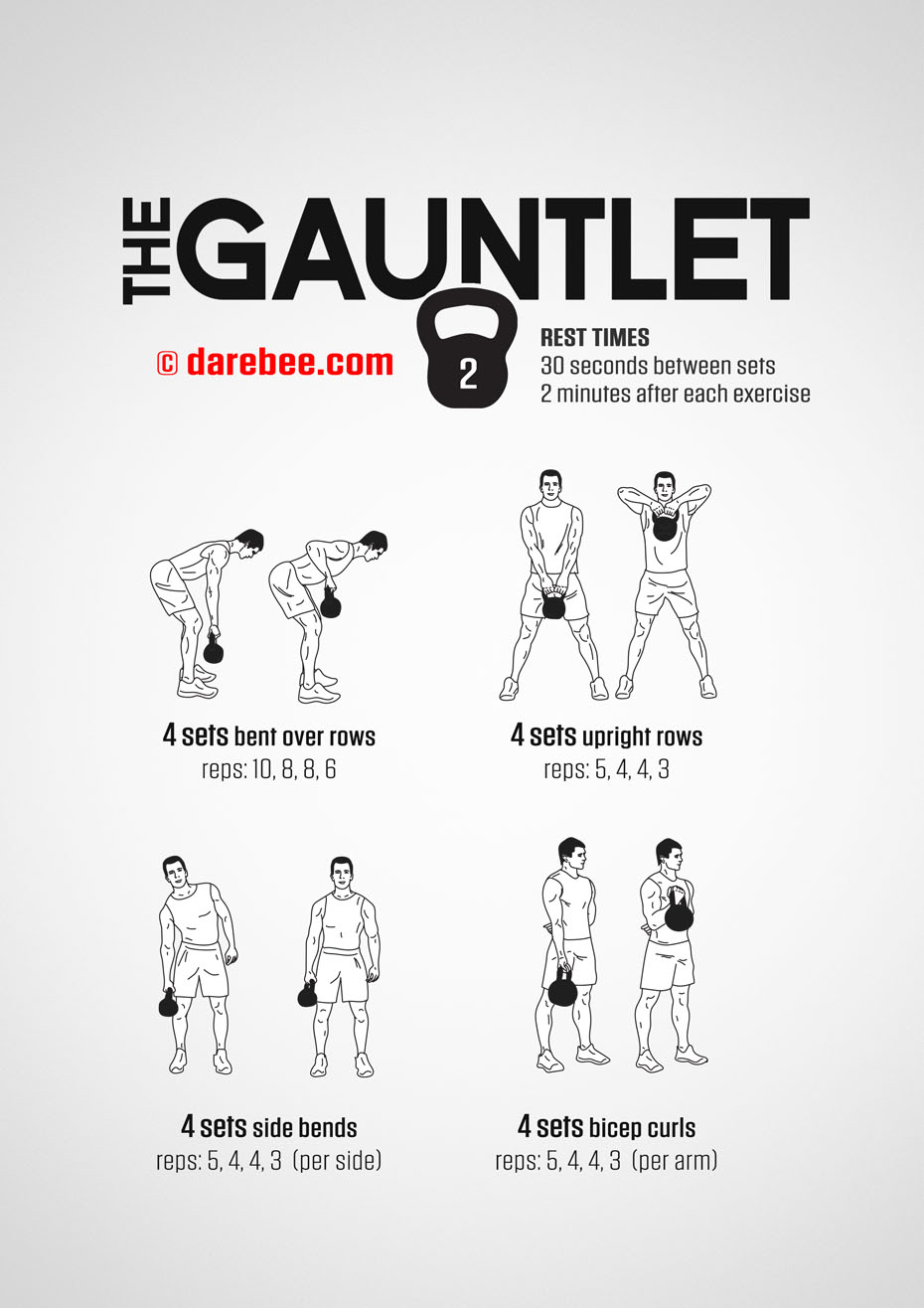
Day 2 moves the bell to the upper body. Same straight sets format, same rest: 4 sets of bent over rows at 10, 8, 8, 6, 4 sets of upright rows at 5, 4, 4, 3, then side bends and bicep curls at 5, 4, 4, 3 per side and per arm. Two exercises are two-handed and pull; two are one-handed and ask each side of your body to work alone.
The rows pull at two angles. The bent over row, hinged at the hips with the bell hanging under the chest, drives the elbows back and up to work the lats and mid-back; the upright row, standing tall in a wide stance and pulling the bell to chin height with the elbows leading, hits the shoulders and upper traps instead. The single-arm pair changes the job: side bends load the obliques on one side at a time while the free hand rests behind your back, and bicep curls isolate the arm holding the bell. Per-side counts mean every printed rep happens twice - once left, once right - inside every set, so 5 per arm is 10 curls before you rest.
Bent over row: flat back, hinge until the torso is close to parallel with the floor, pull the bell to the lower ribs and lower it under control. Upright row: keep the bell close to the body, elbows higher than the wrists at the top, no shrugging. Side bend: slide the bell down the outside of the leg by bending sideways at the waist - no forward lean, no twist - and pull yourself back upright with the opposite side. Bicep curl: elbow pinned to the ribs, curl to the shoulder, lower slowly; the free hand stays behind the back so the body cannot help.
One bell and four angles of pull - the arms and back now know what the next four weeks are going to feel like.
Make it Harder: Do the side bends with the bell held overhead, arm locked out, instead of hanging at your side.
Make it Easier: Do the bicep curls with both hands on the handle and keep the counts as printed.

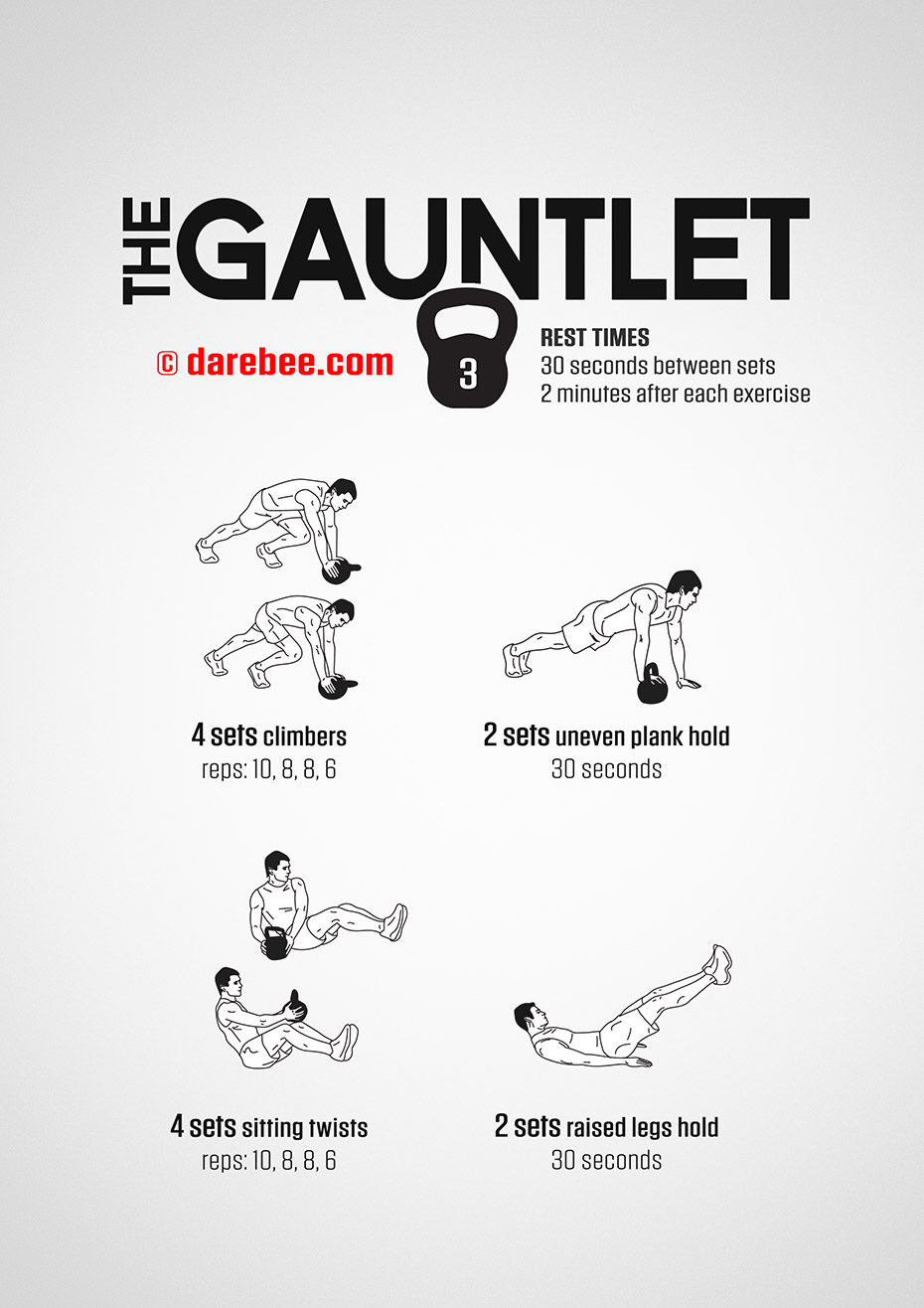
Day 3 takes the bell to the floor and works everything between the hips and the ribs. Two exercises run in the familiar 4 sets of 10, 8, 8, 6: climbers and sitting twists. Two are holds - an uneven plank and a raised legs hold - at 2 sets of 30 seconds each. The rest rules stay the same: 30 seconds between sets, 2 minutes once an exercise is done. Rep counts here are totals, so 10 climbers is 5 knees per side and 10 twists is 5 to each side.
The bell changes familiar core exercises in specific ways. Climbers with both hands on the handle put your base on a narrow, unsteady platform, so the shoulders and trunk have to hold you still while the knees drive in. The uneven plank hold puts one hand on the bell and the other on the floor, tilting the shoulders and forcing the core to fight the rotation for 30 seconds - do one set with each hand on the bell. Sitting twists hand the bell to your grip: feet off the floor, torso leaned back, the weight crossing side to side while the abs stop you toppling. The raised legs hold is the one bell-free position - lying on your back with straight legs lifted and held, the lower abs working against gravity alone.
Climbers: hands on the handle, shoulders stacked over the bell, drive one knee toward the chest and switch without letting the hips rise. Uneven plank: body in one line, the bell hand pressed down firmly, hips level - if one hip drifts higher, correct it. Sitting twists: heels off the floor, chest lifted, move the bell across the body by turning the shoulders, not just the arms. Raised legs hold: lower back pressed into the floor, legs straight and together, lifted to the height you can keep still for the full 30 seconds.
The bell spends today on the floor and your core spends it refusing to let anything tip over.
Make it Harder: Hold each knee in at the chest for a 1-count on every climber rep before switching.
Make it Easier: Do the climbers with both hands flat on the floor and the bell set to one side.

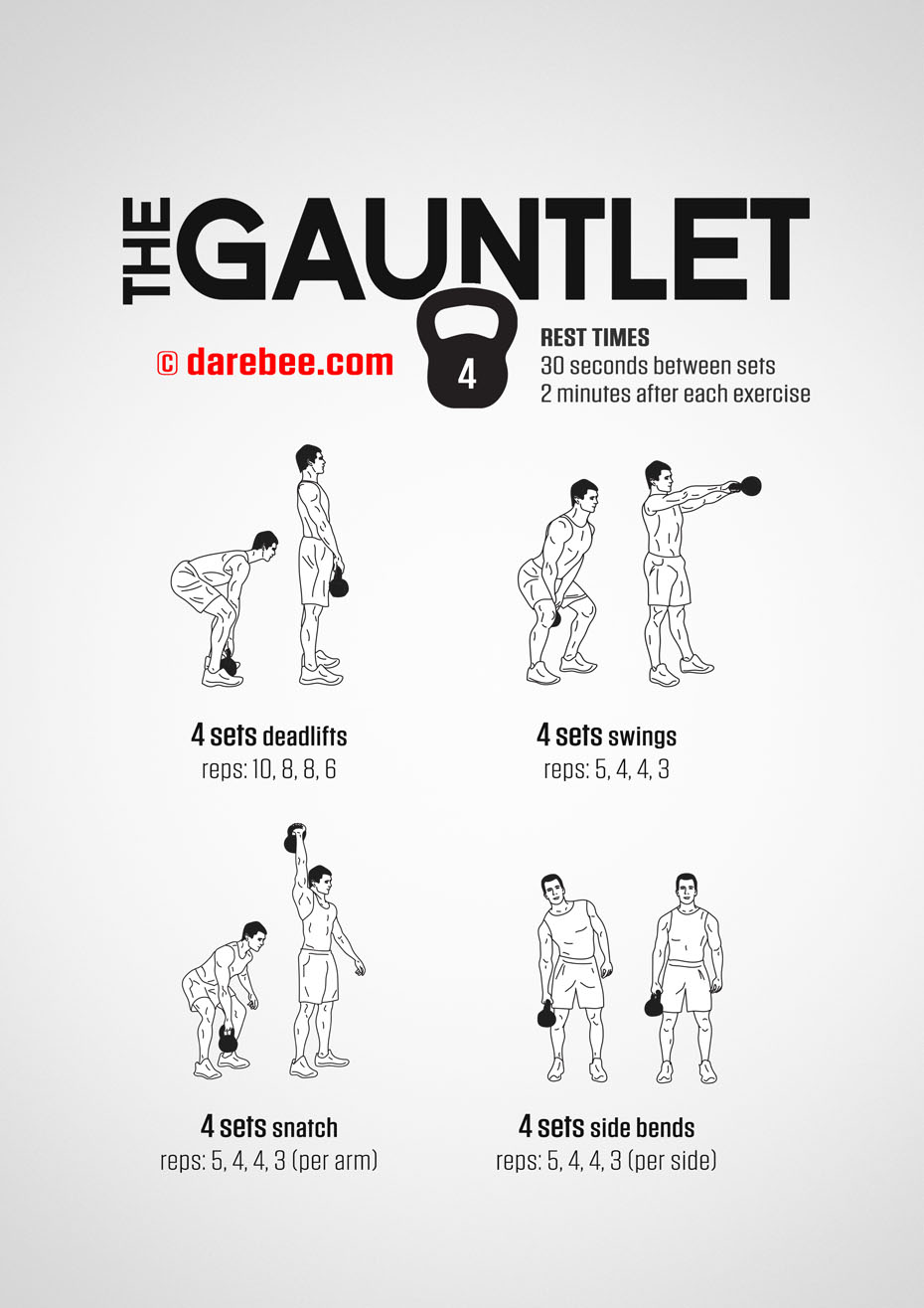
Day 4 is where the bell starts to move fast. Deadlifts open at 10, 8, 8, 6, and then two new exercises arrive: the kettlebell swing at 5, 4, 4, 3 and the snatch at 5, 4, 4, 3 per arm. Side bends at 5, 4, 4, 3 per side close the session. Straight sets, 30 seconds between sets, 2 minutes between exercises.
The order teaches the swing by way of the deadlift. Both are hip hinges; the deadlift is the slow version, and doing it first drills the flat back and the hip drive that the swing then performs at speed - hiking the bell back between the legs and snapping the hips forward so the bell floats up to shoulder height with the arms relaxed, the power coming from the glutes rather than the shoulders. The snatch takes the same hinge one step further: one arm, the same hip snap, and the bell travels in a single pull all the way to a locked-out arm overhead. It is the most technical lift in the program, which is why it arrives on modest numbers. Side bends afterwards give the trunk a quieter finish after three exercises driven by the hips.
Deadlift: hinge, flat back, stand and squeeze. Swing: hike the bell back, drive the hips, let the arms follow the bell to shoulder height and guide it back down into the next hinge - no squatting, no lifting with the shoulders. Snatch: hike the bell back, drive the hips hard, and as the bell rises keep it close to the body, punching the hand through at the top so the bell rolls gently onto the back of the forearm rather than flipping over and slapping the wrist; lower it by bringing it back through the same path. Side bends: bend sideways only, and come back with the opposite side.
Deadlift, swing, snatch - one hinge learned at three speeds, and the fastest one ends overhead.
Make it Harder: Turn every swing into a dead-stop swing: set the bell down between reps and re-hike it each time.
Make it Easier: Replace the snatch with one-arm swings to shoulder height at the same counts.

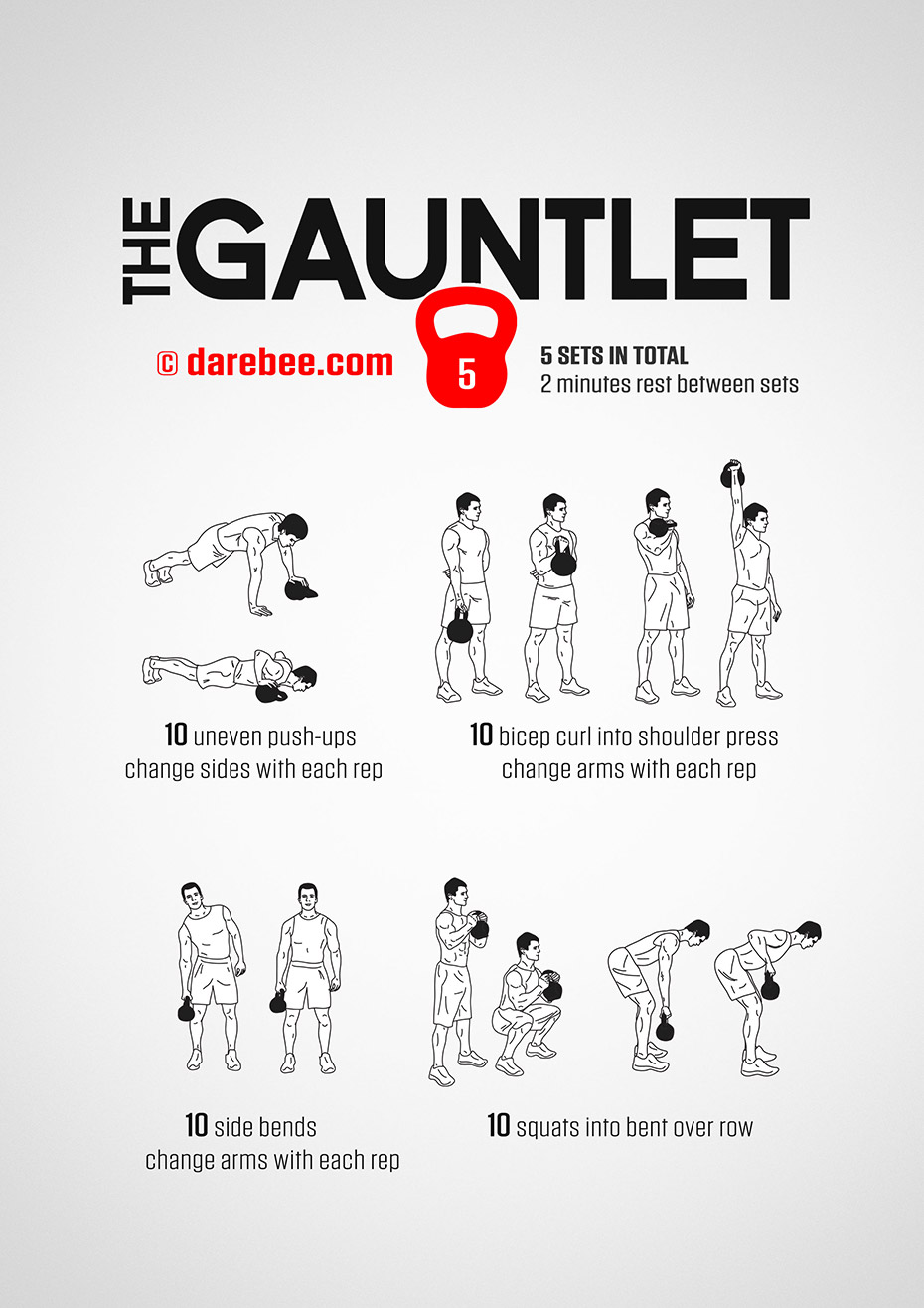
The red bell on the card means the rules change. Day 5 is a functional fitness day: instead of finishing one exercise at a time, you run all four in sequence - 10 uneven push-ups, 10 bicep curls into shoulder presses, 10 side bends and 10 squats into bent over rows - and that pass is one set. Rest 2 minutes, then repeat until you have done 5 sets in total. "Change sides with each rep" means the reps alternate: 10 uneven push-ups is 5 with the bell under each hand, done left, right, left, right. The squats into rows are two-handed and do not alternate.
Every fifth day switches the goal to movement rather than muscle. The combinations are what make the day different: a bicep curl that flows into a shoulder press turns two isolated lifts into one chain that runs to overhead; a squat that becomes a bent over row asks the legs and the back to trade the bell without a pause. Uneven push-ups put one hand up on the bell so each rep is lopsided and the chest, shoulder and core have to balance the difference. Side bends, alternating hands every rep, keep the trunk switching sides. With nothing done for more than 10 reps and every exercise touching several muscle groups, the session builds coordination and stamina, and the 2-minute rests are what let you keep the quality high for all 5 rounds.
Uneven push-up: one hand on the handle, one on the floor, body straight, chest down to bell height, then swap hands for the next rep. Curl into press: curl the bell to the shoulder, rotate the hand so the bell settles on the back of the forearm, press to lockout, reverse the path and change arms. Side bend: bell in one hand, bend and return, pass the bell to the other hand. Squat into row: goblet squat with the bell at the chest, stand, let the bell hang, hinge and row it to the ribs, stand tall again - that is one rep.
Five rounds of chained movement and a bell that never stops changing hands - this is the other half of The Gauntlet.
Make it Harder: Keep hold of the bell for the entire set - no setting it down between exercises until the round is done.
Make it Easier: Run 4 sets in total instead of 5.

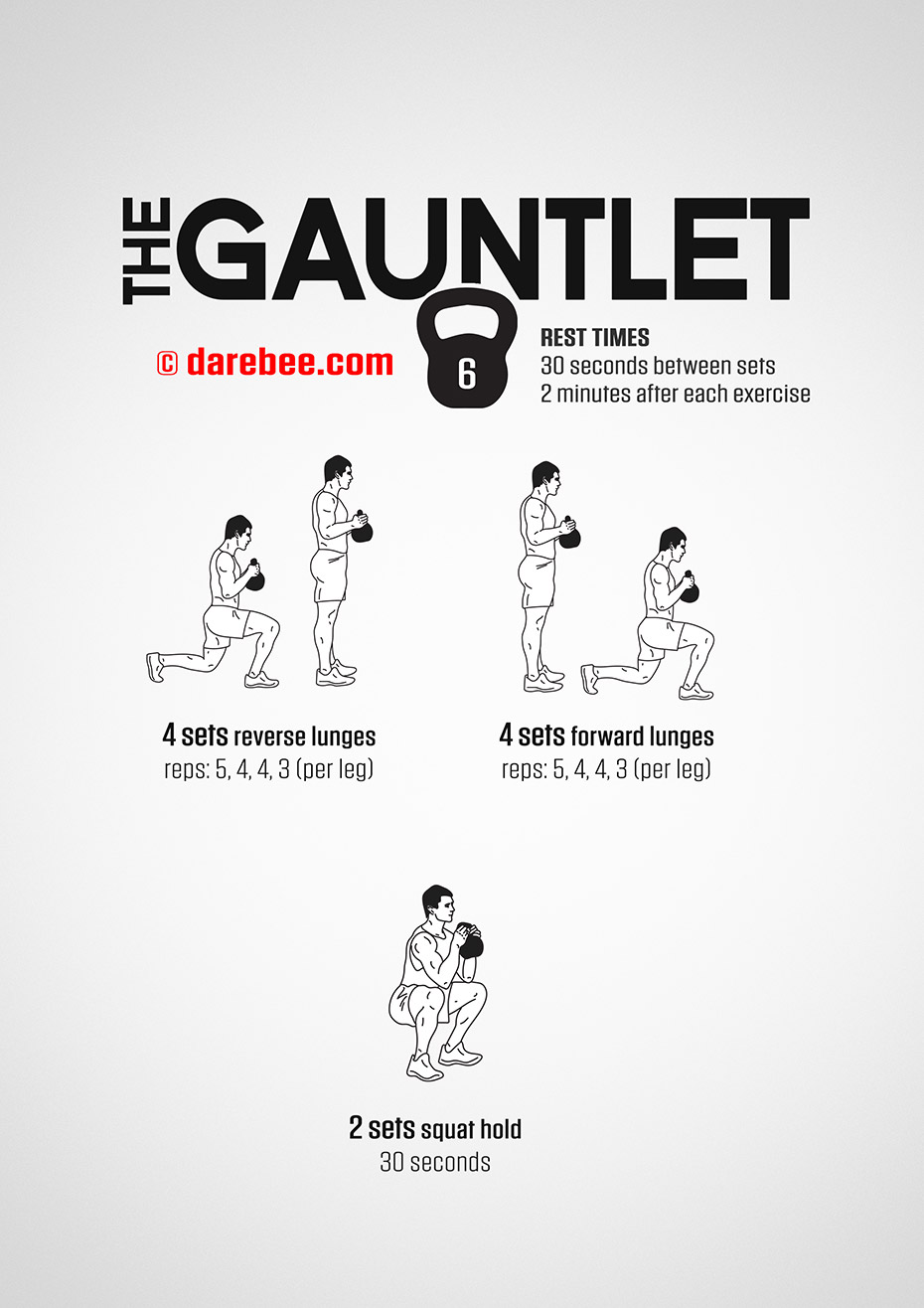
Day 6 is a three-exercise leg session built almost entirely on one leg at a time. Straight sets: 4 sets of reverse lunges and 4 sets of forward lunges, both at 5, 4, 4, 3 per leg, followed by 2 sets of a 30-second squat hold with the bell at the chest. Rest 30 seconds between sets and 2 minutes between exercises, as on every black-bell day.
The two lunges look alike and load differently. Stepping back keeps the front shin vertical and puts the work into the front leg's glute and quad in a controlled, balanced way; stepping forward means the front leg has to absorb your weight and then push you back to standing, which asks more of the quad and more of your balance. Doing the reverse version first warms the pattern before the forward version tests it. The squat hold at the end is a different kind of work: nothing moves, the bell sits at the chest, and the legs simply stay at depth while the clock runs - 30 seconds of tension the joints barely register.
Reverse lunge: step back, rear knee to a hover, front heel down, drive up. Forward lunge: step long enough that the front knee stays over the ankle, lower the rear knee toward the floor, and push back through the front foot to the start; keep the bell tight to the chest so it does not pull you forward. Squat hold: sit to the depth you can keep for the full count, chest up, elbows inside the knees, weight in the heels, and breathe.
Two lunges and a hold - by the end you will know exactly which of your legs is the stronger one.
Make it Harder: Pulse twice in the bottom position of each forward lunge before pushing back up.
Make it Easier: Do the lunges without the bell and keep the squat hold as written.

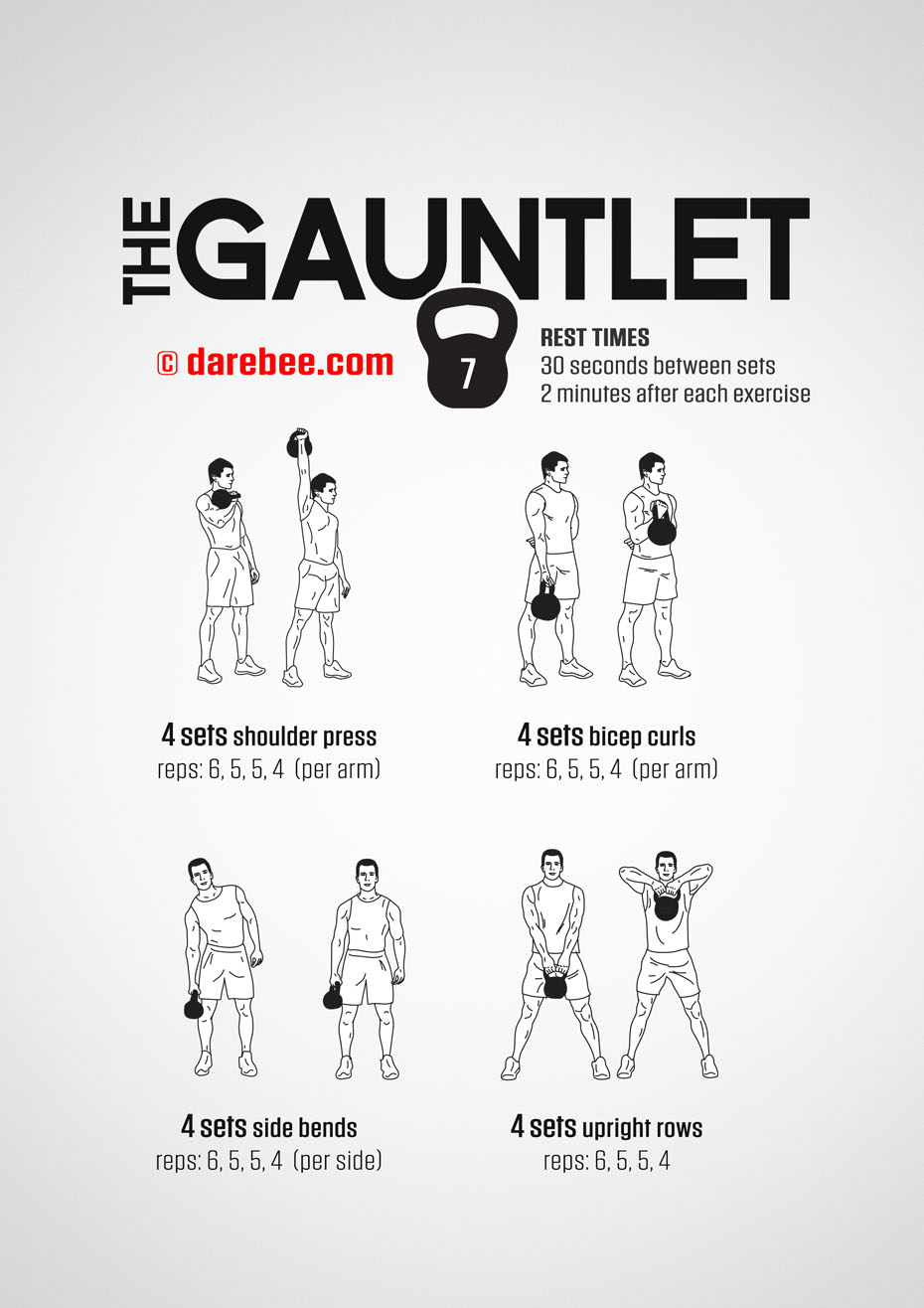
Day 7 is the arms and shoulders, one exercise at a time and one arm at a time. Four exercises in straight sets, all at 6, 5, 5, 4: the shoulder press and bicep curls per arm, side bends per side, upright rows two-handed. That is one rep up across the board on the counts the curls, bends and rows used on Day 2. Rest 30 seconds between sets, 2 minutes after each exercise.
The shoulder press is new. The bell sits racked at the shoulder - handle in the palm, the ball resting on the back of the forearm - and gets pressed straight up to a locked-out arm, then lowered back to the rack. Every other movement today is pulling or bending: the curl works the front of the arm, the side bend the flank, the upright row the shoulders and upper back. Pressing first means the shoulders take their most demanding job fresh, and the two-handed upright rows arrive last, when the single-arm work has already tired each side evenly.
Shoulder press: brace the trunk, press without leaning away, finish with the bicep beside the ear, lower under control; free hand behind the back. Bicep curl: elbow still, full range, slow on the way down. Side bend: sideways only. Upright row: bell close to the body, elbows lead, top of the pull at chin height with the shoulders down.
The bell went overhead by press rather than by pull today - the shoulders have joined the program properly.
Make it Harder: Press the bell bottoms-up - handle gripped with the ball balanced above your fist - on every shoulder press rep.
Make it Easier: Press the bell with both hands on the horns, a two-handed press, and keep the counts as printed.

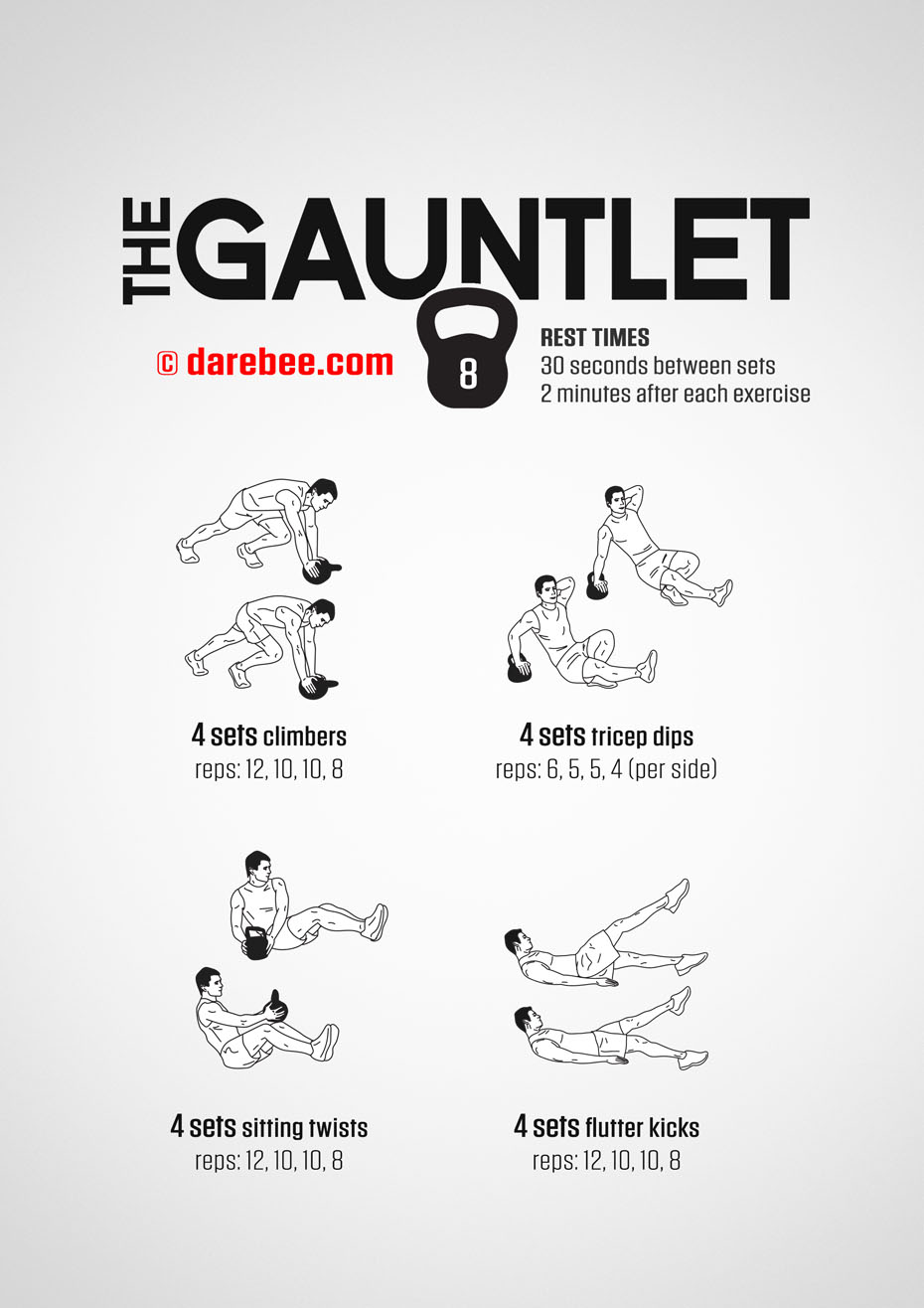
Day 8 is the second core session and it trades both holds for reps. Climbers and sitting twists return at 12, 10, 10, 8 - two reps higher than Day 3 on every set - and two exercises are new: tricep dips at 6, 5, 5, 4 per side, and flutter kicks at 12, 10, 10, 8. Straight sets, 30 seconds between sets, 2 minutes between exercises. Climbers, twists and kicks are totals; the dips are the only per-side count.
The tricep dip on a kettlebell is its own animal: sitting on the floor with the knees bent, one hand pressing on the handle beside your hip and the other hand behind your head, you push the hips up and straighten the arm, then bend it to lower back down. One arm does the lifting, the trunk stops you twisting, and the bell gives the hand something narrow to balance on. Flutter kicks replace the raised legs hold with a moving version - legs straight and hovering, alternating small kicks up and down, counted as totals - which keeps the lower abs under tension without a clock. Together with climbers on the handle and twists with the bell, the session hits the abdominal wall from four directions.
Climbers: shoulders over the handle, hips low, quick knees. Tricep dips: fingers wrapped over the handle, elbow pointing back, hips lifted enough that the arm takes the load, lower until the elbow bends to about 90 degrees. Sitting twists: heels up, chest up, bell across the body. Flutter kicks: lower back down, legs long, small kicks - a few centimetres of travel is plenty, and the legs never touch the floor until the set is done.
Four exercises, no holds, and two reps more on everything the floor already knew - the core's numbers are on their way up.
Make it Harder: Straighten the legs on the tricep dips so your legs stop helping the arm.
Make it Easier: Put the working hand flat on the floor for the tricep dips instead of on the bell.

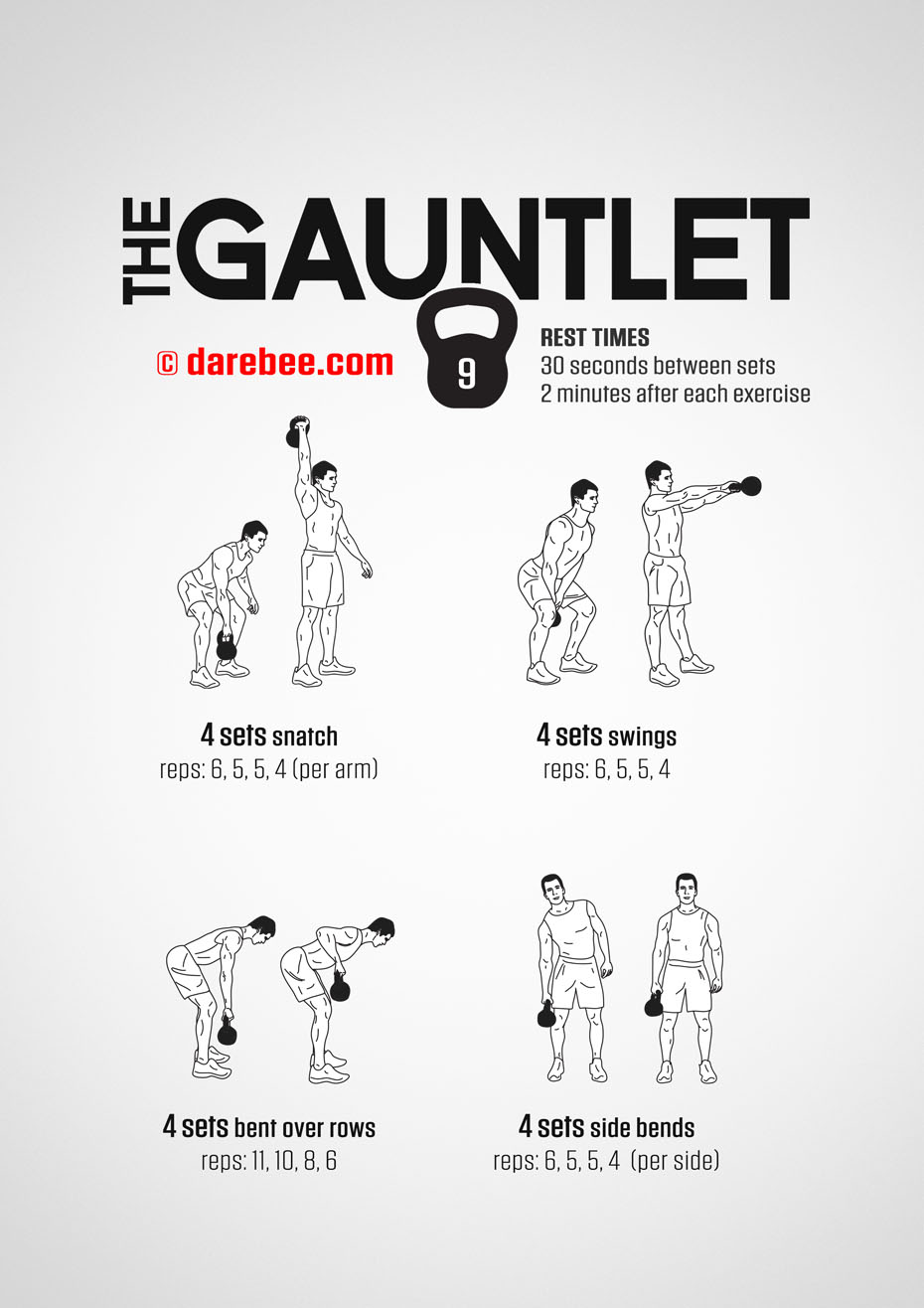
Day 9 turns Day 4 upside down. The snatch leads at 6, 5, 5, 4 per arm, the swings follow at 6, 5, 5, 4, then bent over rows take the deadlift's place at 11, 10, 8, 6 and side bends close at 6, 5, 5, 4 per side. Straight sets, the usual rest. Every power number is one rep up on Day 4, and the rows open on 11, one more than they managed on Day 2.
Putting the snatch first is deliberate: it is the most demanding lift technically, and it wants your freshest attention and your cleanest hip drive. The swings follow as the easier cousin, keeping the hinge rhythm going while the arms recover after the overhead work. Rows and side bends bring the day down the way Day 4 did, only heavier - 11, 10, 8, 6 is the most volume the back has been asked for in one exercise so far, and it lands after the hinge has already been worked at speed.
Snatch: hike, hip snap, hand punches through at the top, bell settles on the forearm - if it slaps the wrist, the punch came late. Swings: hips, not arms; bell to shoulder height and no higher. Bent over rows: torso still, elbows to the ceiling, bell to the lower ribs. Side bends: straight down the leg and back up, no lean.
The snatch leads, the swing follows, and the hinge you learned five days ago is now the engine of the session.
Make it Harder: Lower every snatch to the shoulder rack first and then swing it down - a two-stage descent on every rep.
Make it Easier: Run the snatch at 4, 4, 3, 3 per arm; everything else stays as printed.

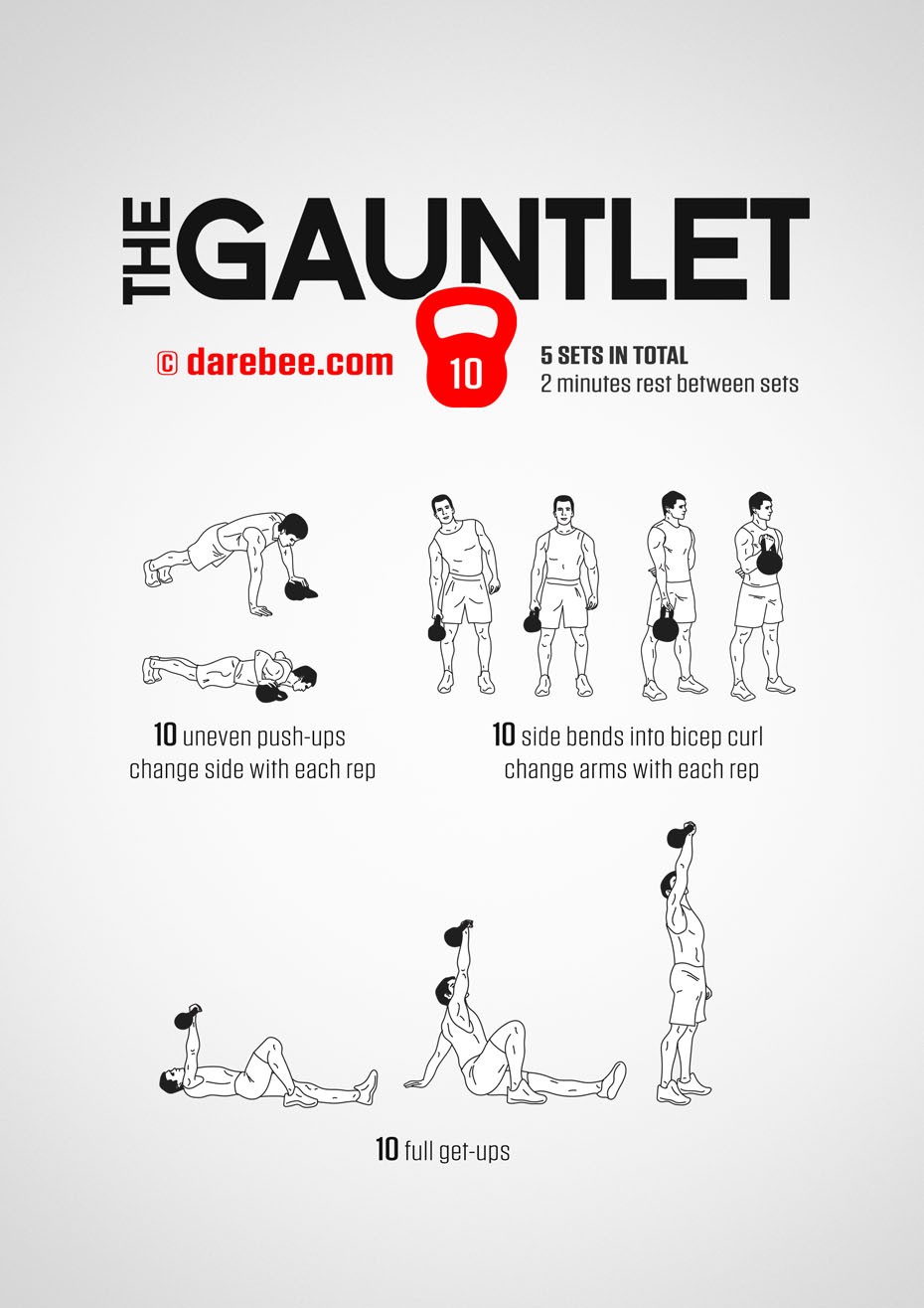
The second red-bell day arrives with the program's biggest single movement. Three exercises, 5 sets in total, 2 minutes rest between sets: 10 uneven push-ups alternating sides each rep, 10 side bends into bicep curls alternating arms each rep, and 10 full get-ups - 5 with the bell in one hand, then 5 with the other. One pass through all three is a set.
The get-up is the reason this day has only three exercises. Lying on your back with the bell locked out over one shoulder, you roll up onto the elbow, then the hand, sweep the leg under into a kneeling position and stand up - all with the arm straight and the bell overhead - and then reverse every step back to the floor. One rep asks the shoulder to stabilise, the core to rotate and brace, the hips to drive and the eyes to stay on the bell the entire time. Ten of them, five times over, is a session in itself. The push-ups and the side bend-curl chain in front of it warm the shoulders and grip for the get-up, and the 2-minute rest is there because the get-up spends focus as fast as it spends strength.
Uneven push-up: bell under one hand, floor under the other, chest down, swap hands each rep. Side bend into curl: bend toward the bell, come upright, curl it to the shoulder, lower and pass it to the other hand. Get-up: press the bell up and keep the arm vertical throughout; move deliberately through each stage - elbow, hand, hip, knee, stand - and go back down in the same order, watching the bell the whole way. The bell never dips and the wrist never bends.
Ten get-ups per round, fifty for the day - the bell goes floor to standing and back more times than you will want to count.
Make it Harder: Go through every get-up at half speed, with no stage faster than a 3-count.
Make it Easier: Do half get-ups - up onto the hand and back down - instead of standing all the way.

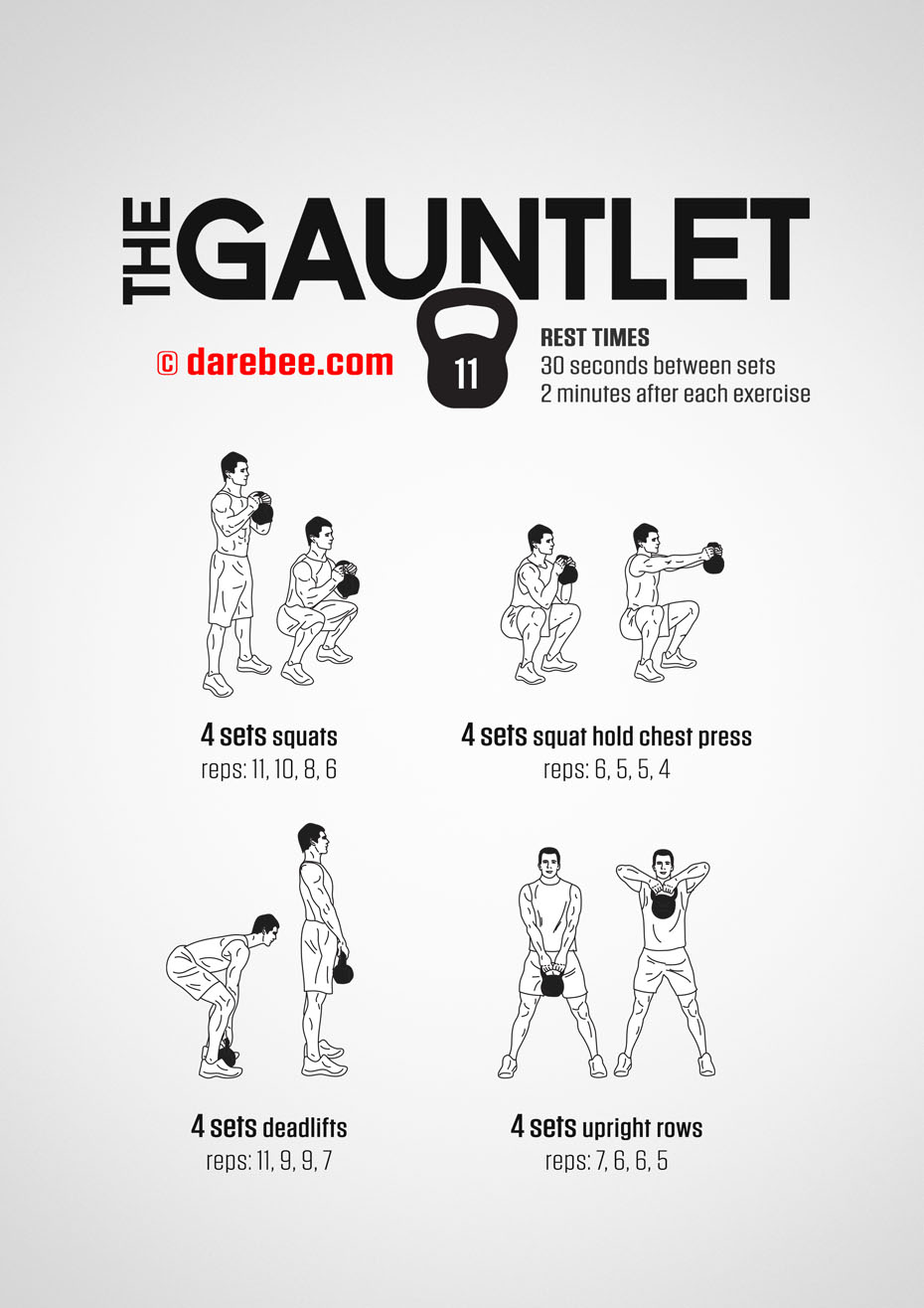
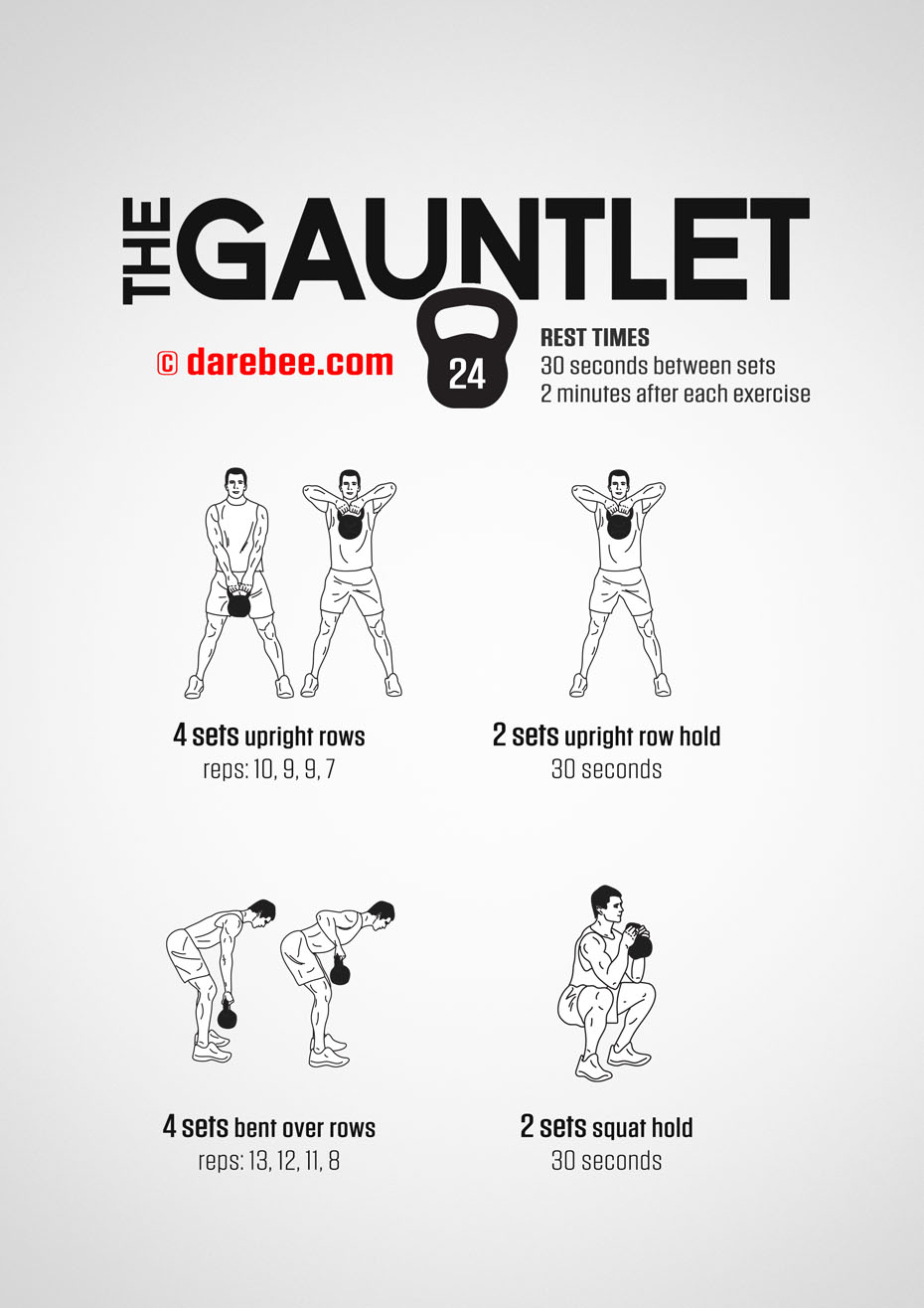
Day 11 reruns Day 1's legs with the reverse lunge swapped for upright rows and every count nudged up. Straight sets: squats at 11, 10, 8, 6, squat hold chest presses at 6, 5, 5, 4, deadlifts at 11, 9, 9, 7, upright rows at 7, 6, 6, 5. Same rest - 30 seconds between sets, 2 minutes between exercises.
Compare the numbers with Day 1 and you can see how this program moves: the squat's opening set went up to 11, the deadlift's closing set up to 7, and the presses gained a rep on every set. Nothing dramatic, all of it real - the same movements, a slightly heavier day. Putting the chest press directly after the squats means the legs go into the held squat already tired, so the position is harder to keep than it was ten days ago. The upright rows at the end are an upper body finisher on a leg day: the shoulders and traps get their work while the legs get their first real rest since the session began.
Squats: goblet, chest up, hips between the heels. Squat hold chest press: stay at depth, arms extend fully, bell back to the chest, squat held throughout. Deadlifts: flat back, hinge, stand and squeeze - and with 11 in the first set, set the bell down with the same hinge you picked it up with. Upright rows: bell close, elbows high, shoulders down.
Every count on this card is a step above the last time you saw it - the second block of the program has started climbing.
Make it Harder: Add a fifth set of 6 reps to the squats.
Make it Easier: Keep the sets and reps but stand up out of the squat between chest press reps.

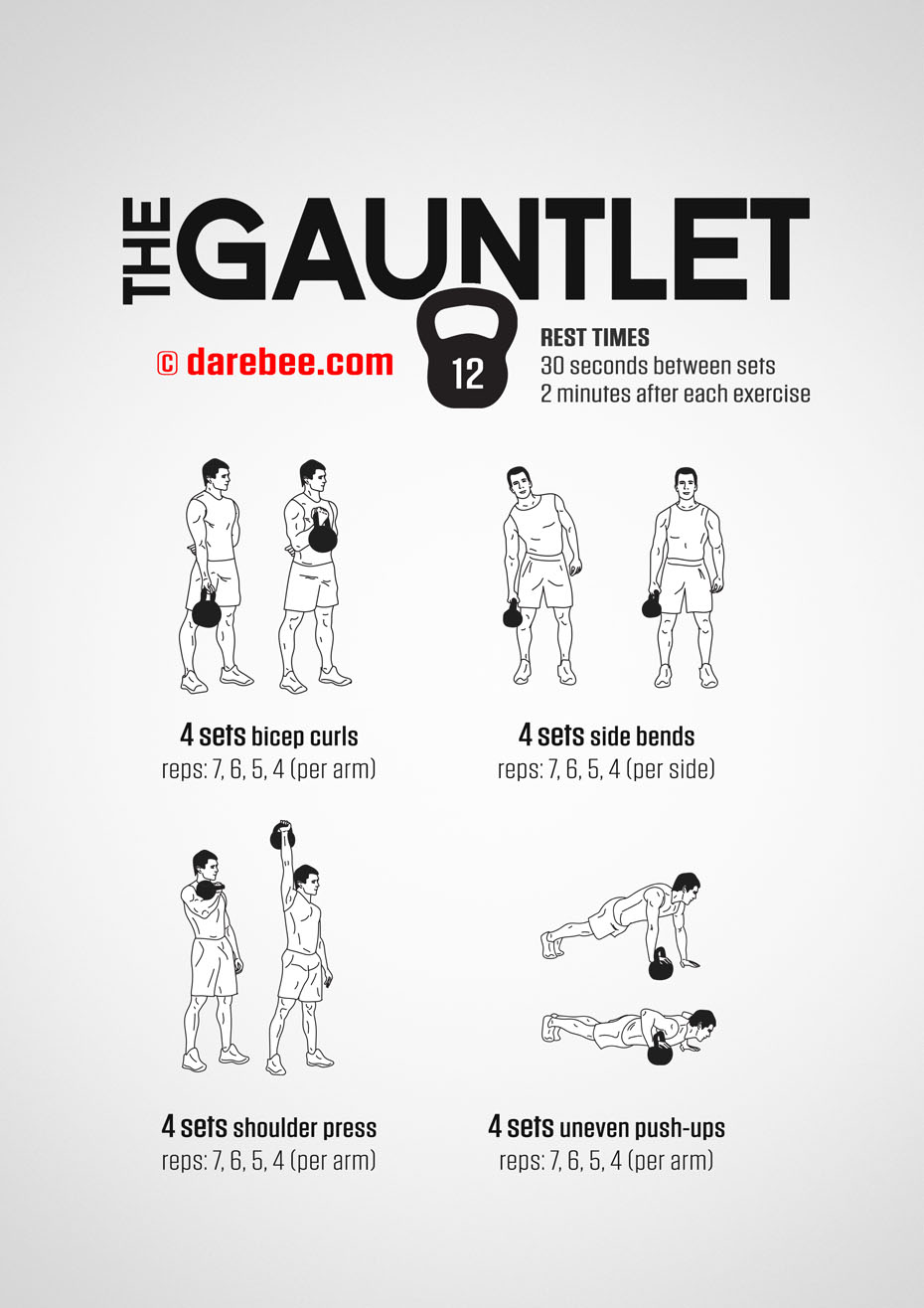
Day 12 gives the upper body one rep scheme for everything - 7, 6, 5, 4 - and runs it per arm or per side on all four exercises: bicep curls, side bends, shoulder press and uneven push-ups. Straight sets, 30 seconds between sets, 2 minutes between exercises. The push-ups are new to the black-bell days, and here "per arm" means all the reps with the bell under one hand, then all the reps with it under the other, inside each set.
The uneven push-up changes character when it stops alternating. On the red days it swaps every rep and the imbalance keeps shifting; here the same side takes 7 lopsided reps in a row, and the shoulder above the bell has to stabilise on a raised, narrow, slightly wobbly base for the entire set. That is a stability challenge stacked on top of a pushing exercise. Around it the session is Day 7's arm work re-dealt: curl, bend and press, each now at 7 on the first set, one more than five days ago. Pushing arrives last on purpose - by then the shoulders have pressed and the arms have curled, and the push-up asks them to work together.
Bicep curls: elbow fixed, slow lowering. Side bends: bend and return, no twist. Shoulder press: rack, press, lockout, lower - no lean. Uneven push-ups: bell hand on the handle with the wrist straight, floor hand level with it, elbows tucked at about 45 degrees, chest down to bell height and back up in one line.
Seven, six, five, four on every exercise - the upper body now has a rhythm, and it repeats on both sides.
Make it Harder: Do the shoulder presses seated on the floor with the legs extended in front of you - no leg drive, no lean.
Make it Easier: Do the uneven push-ups with your knees on the floor.

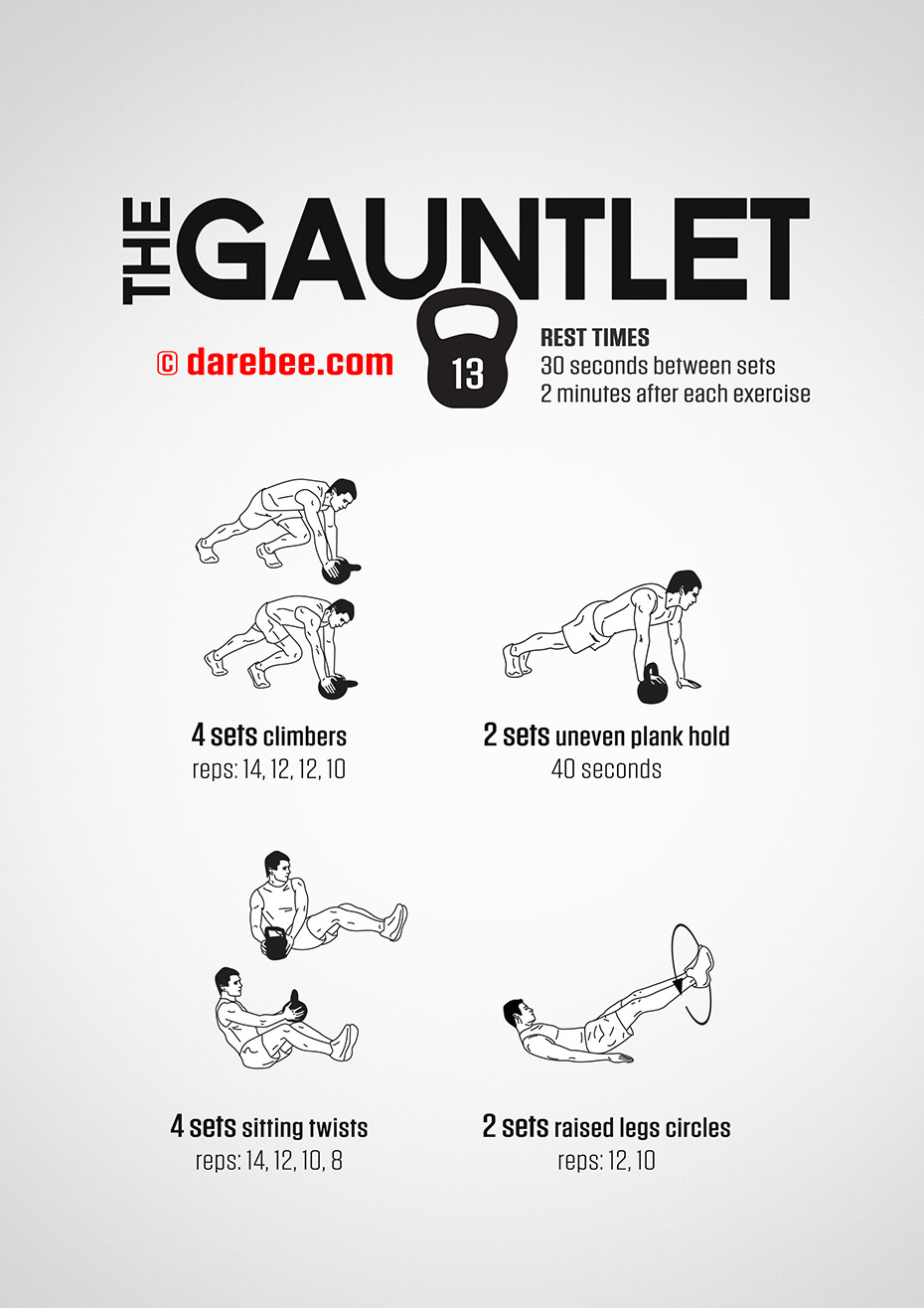
Day 13 returns to the floor with longer holds and bigger counts. Climbers at 14, 12, 12, 10 and sitting twists at 14, 12, 10, 8 in 4 straight sets; the uneven plank hold is back at 2 sets of 40 seconds, ten seconds longer than on Day 3; and the raised legs hold has become raised legs circles at 2 sets of 12 and 10. Rest 30 seconds between sets, 2 minutes between exercises. Circles are counted as totals - reverse the direction halfway through each set, so 12 circles is 6 one way and 6 the other.
The circles are what make this session different. Lying on your back with straight legs raised together, you draw a circle in the air with your feet - the lower abs and hip flexors work through the loop and hardest at the bottom of it, where the legs are closest to the floor. Switching direction halfway means both sides of the trunk do the stabilising in turn. The plank hold's extra ten seconds is a bigger ask than it reads because the position is lopsided: the shoulder above the bell holds you still against a tilt for the full 40. Climbers and twists keep climbing in the background - 14 opening reps where Day 3 started with 10.
Climbers: hands on the handle, shoulders over it, knees driving, hips quiet. Uneven plank: swap the bell hand between sets, body in one line, hips level. Sitting twists: heels up, the bell crossing the body with the shoulders. Leg circles: lower back on the floor, legs together and straight, circles no larger than you can control, and the feet never touch down until the set ends.
Ten more seconds on the plank and a new shape for the legs to trace - the floor days are quietly getting harder each time you visit.
Make it Harder: Make the leg circles bigger, taking the feet lower toward the floor on every loop.
Make it Easier: Keep the circles small - a plate rather than a wheel.

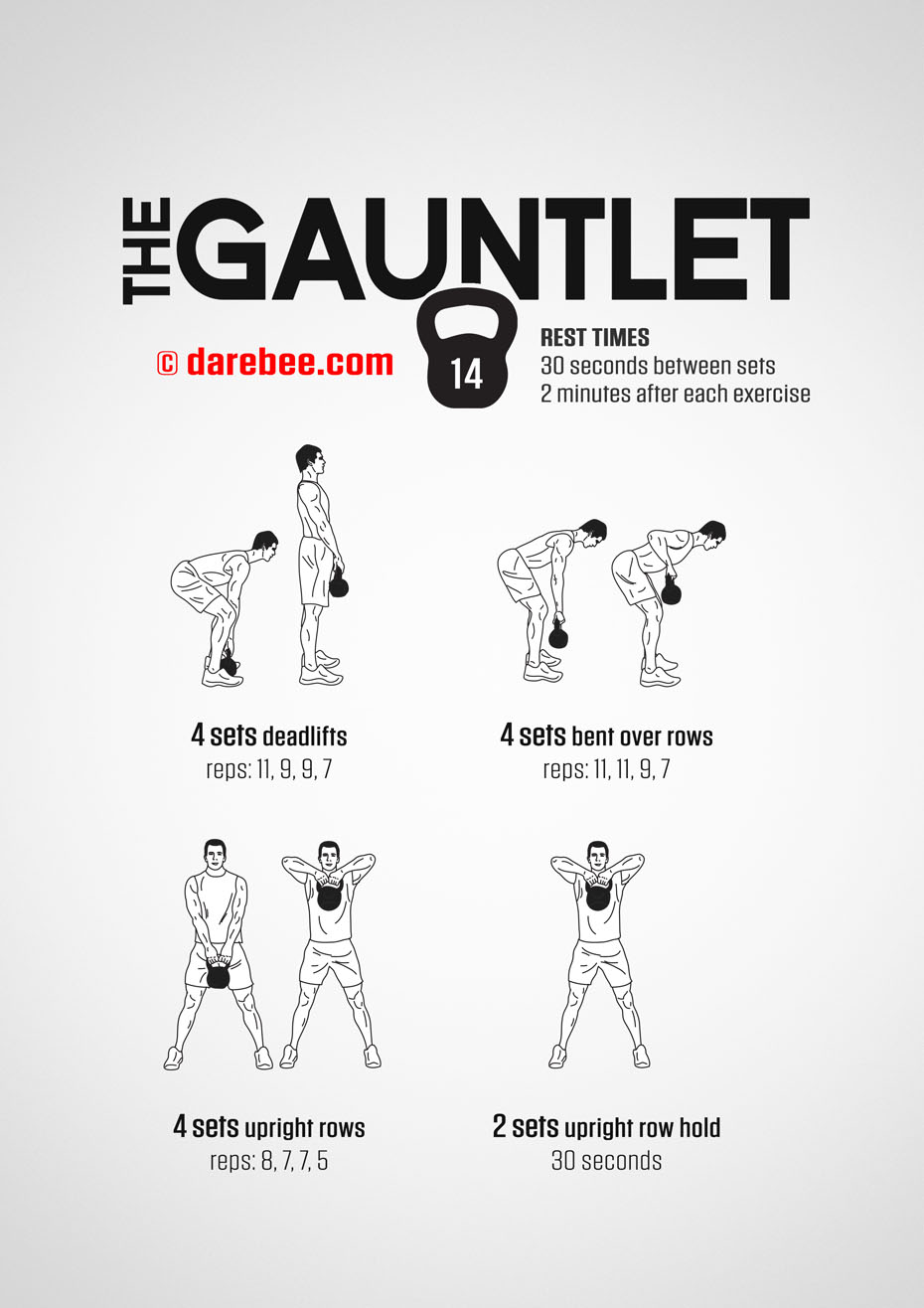
Day 14 is a back day - the first time the fourth slot in the cycle sets the fast lifts aside. Deadlifts at 11, 9, 9, 7, bent over rows at 11, 11, 9, 7, upright rows at 8, 7, 7, 5, all in straight sets, and then something new: an upright row hold, 2 sets of 30 seconds with the bell held at chin height and the elbows high. Rest 30 seconds between sets and 2 minutes between exercises.
Three pulls and a hold trace the back from the bottom up. The deadlift loads the lower back, glutes and hamstrings through the hinge; the bent over row puts the mid-back to work while the lower back holds the hinge still; the upright row moves up to the shoulders and traps. The hold then keeps you at the top of that last movement, bell at the chin, and asks the shoulders to stay there for 30 seconds - an isometric finish that follows the reps the way the squat hold followed the lunges on Day 6. The row counts have grown too: 11, 11, 9, 7 keeps the second set as big as the first, which Day 9's 11, 10, 8, 6 did not.
Deadlifts: hinge, flat back, stand tall. Bent over rows: the torso stays fixed, the elbows do the moving. Upright rows: elbows lead the bell up the front of the body, top at the chin, shoulders down. Upright row hold: find the top position - elbows above the wrists, bell under the chin - and stay; if the elbows start sinking the hold is over, so pick a height you can defend for the full 30.
No swings and no snatches - today the back does its pulling slowly and then holds the last pull still.
Make it Harder: Stand on one leg for both upright row holds, swapping legs between the sets.
Make it Easier: Take the bent over rows to 9, 9, 7, 7; the rest of the card stays as printed.

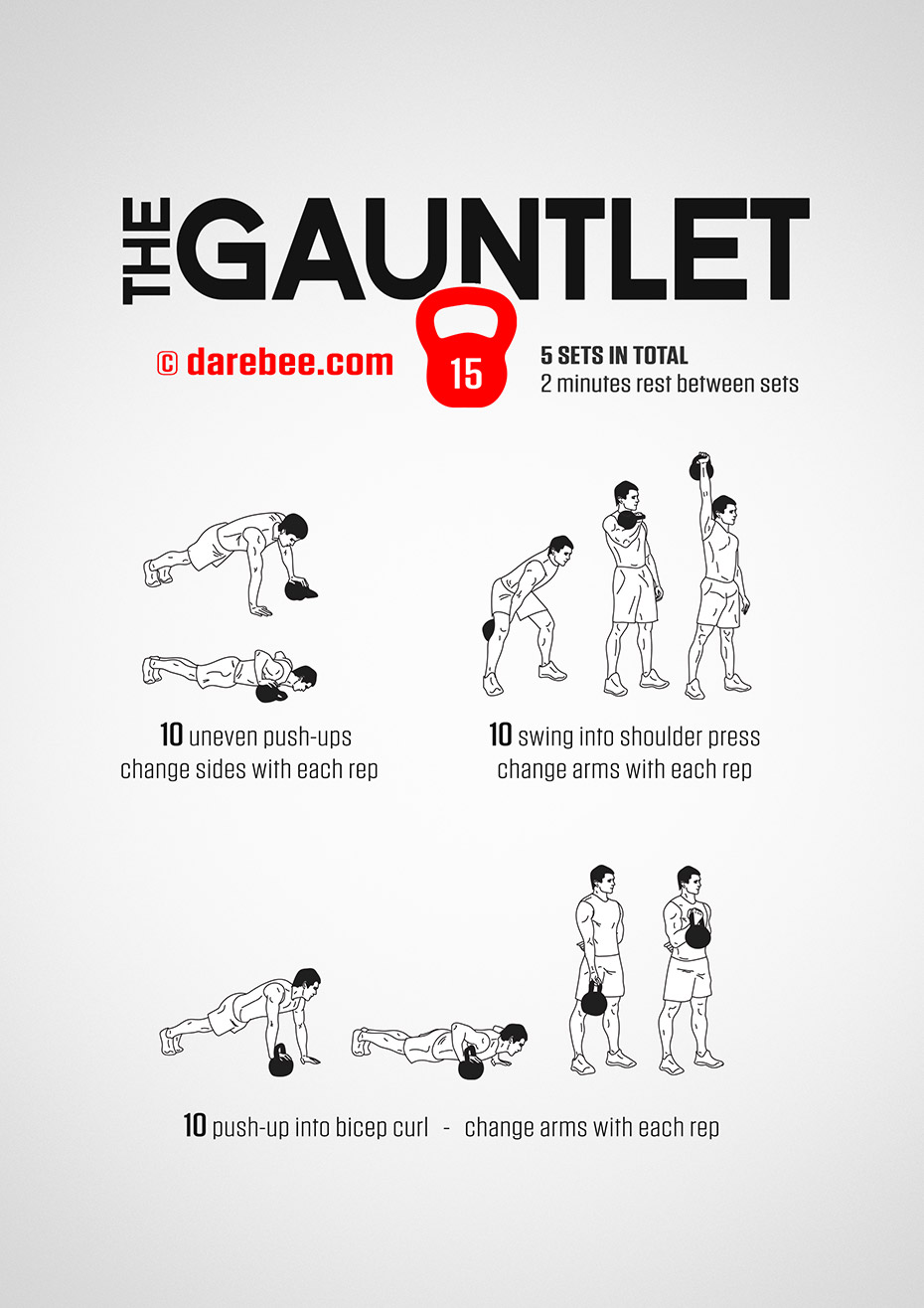
Halfway through, and the red bell comes back with two chains it has not used before. Three exercises, 5 sets in total, 2 minutes rest between sets: 10 uneven push-ups alternating sides, 10 swings into shoulder presses alternating arms, and 10 push-ups into bicep curls alternating arms. Ten reps of everything, all totals, every rep on a new side.
Both new combinations link a hinge or a floor movement to a standing one, which is what the functional days are for. The swing into press starts as a one-arm swing, but instead of letting the bell float to shoulder height and fall, you pull it in to the rack at the shoulder, press it overhead, lower it to the rack and swing it back down - hip drive feeding straight into a press. The push-up into curl starts on the floor with one hand on the bell, does one uneven push-up, then has you stand up, curl the bell with that same arm and get back down for the next rep on the other side. It is as much a test of getting up and down as of the arms. Five rounds of this build the kind of stamina that turns strength into something you can use.
Uneven push-up: swap hands each rep, chest to the bell. Swing into press: hinge, hip snap, catch the bell at the shoulder with the elbow tucked and the wrist straight, press to lockout, lower to the shoulder, swing down and change hands on the next hinge. Push-up into curl: push-up with a straight body, stand with the bell by hinging rather than rounding, curl to the shoulder with the elbow pinned, lower, then set the bell down and get back into the plank for the other side.
Day 15 is the middle of the program, and it is spent on the floor, standing up and overhead - sometimes all inside a single rep.
Make it Harder: Add a second press to each swing into press before the bell comes back down.
Make it Easier: Take the swing into press as a one-arm swing to the rack only, no press, and keep the counts at 10.

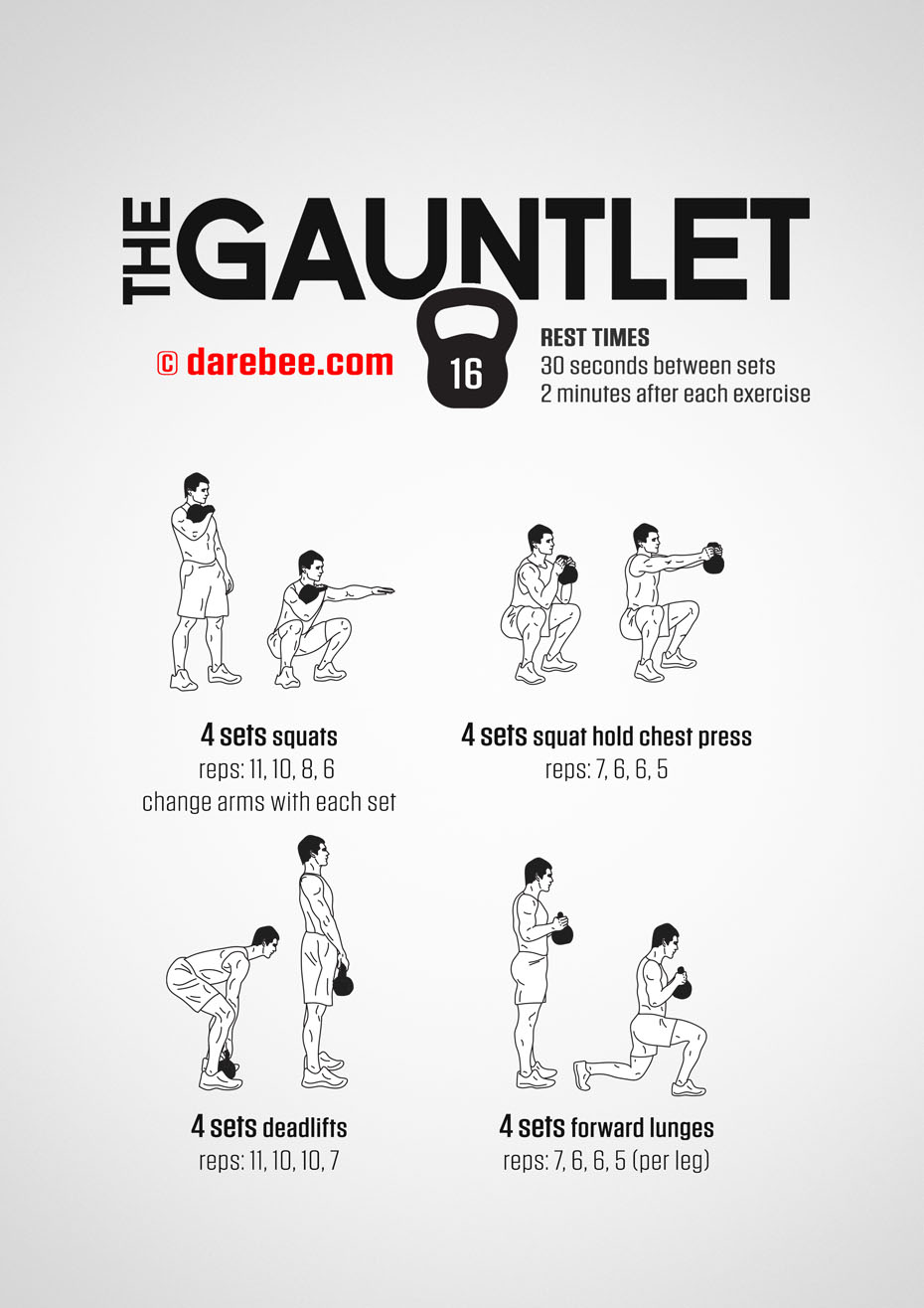
Day 16 changes how you hold the bell for the squat. Instead of goblet position, the bell is racked on one shoulder - handle in the palm, ball resting on the back of the forearm - and you squat with the free arm reaching forward for balance; the card says change arms with each set, so sets 1 and 3 go on one shoulder and sets 2 and 4 on the other. Squats at 11, 10, 8, 6, squat hold chest presses at 7, 6, 6, 5, deadlifts at 11, 10, 10, 7 and forward lunges at 7, 6, 6, 5 per leg. Straight sets, 30 seconds between sets, 2 minutes between exercises.
The racked squat is not harder because the bell got heavier - it is harder because the load moved to one side. The trunk has to stop you tipping toward the bell, the shoulder holding it works through the descent, and the reaching arm is a counterweight rather than a rest. Alternating shoulders every set keeps both sides honest across the four sets. The rest of the day is the leg session you know, at its biggest numbers yet: the chest presses open on 7 where Day 1 opened on 5, the deadlift's middle sets are up to 10, and the forward lunges arrive at 7 per leg where Day 6 started them at 5.
Racked squat: elbow tucked to the ribs, wrist straight, the bell resting on the forearm rather than gripped for dear life; sit down between the heels, reach the free arm out at shoulder height, keep the chest square rather than turned toward the bell. Squat hold chest press: stay down, press out, pull back. Deadlifts: hinge and stand. Forward lunges: long step, rear knee to a hover, push back to standing through the front heel, bell at the chest.
One shoulder at a time, the squat just became a core exercise as well as a leg one.
Make it Harder: Reach the free arm straight overhead instead of forward on every racked squat.
Make it Easier: Do sets 3 and 4 of the squats in goblet position and keep the counts as printed.

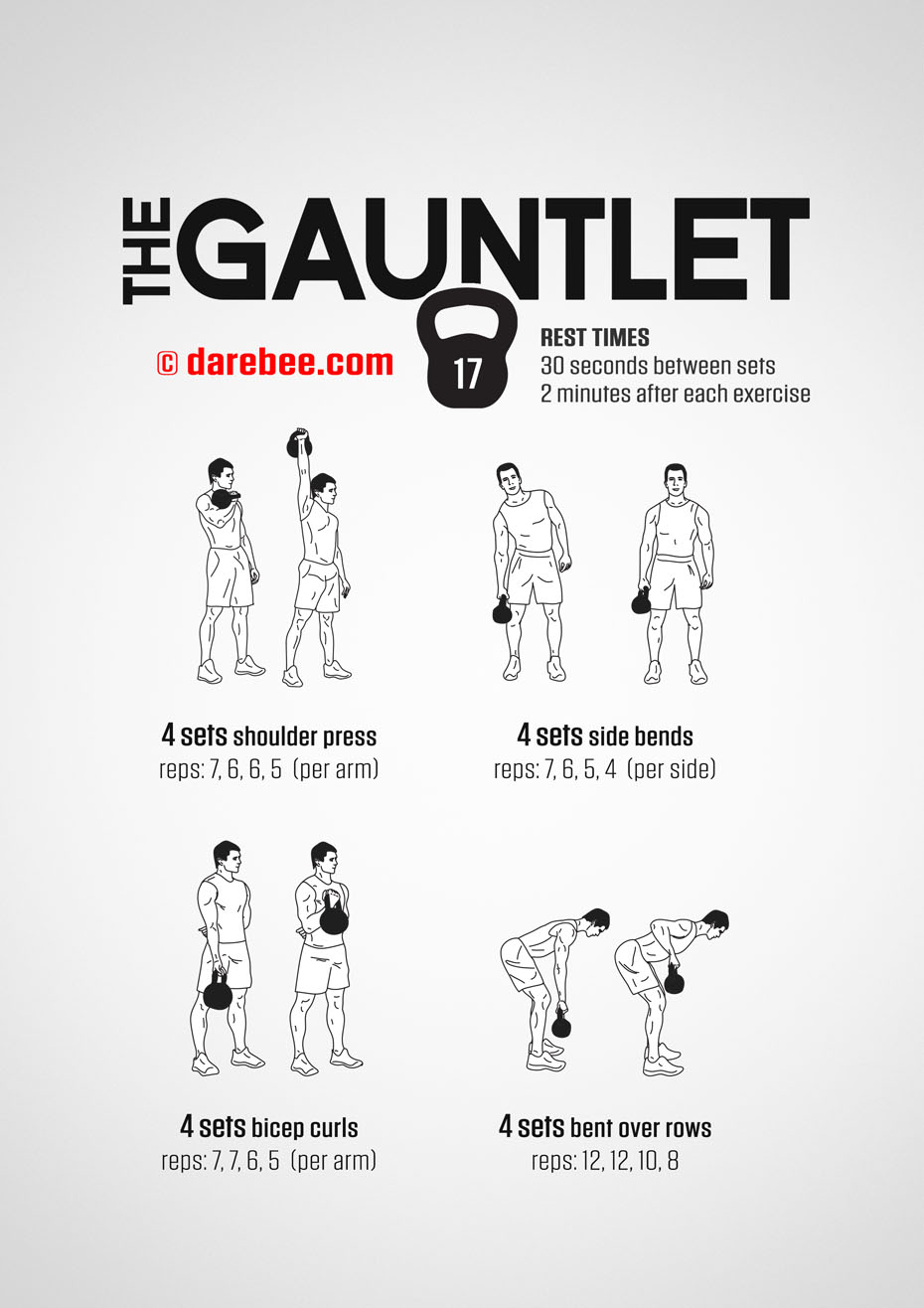
Day 17 is the arm session with the press moved to the front. Shoulder press at 7, 6, 6, 5 per arm, side bends at 7, 6, 5, 4 per side, bicep curls at 7, 7, 6, 5 per arm, and bent over rows at 12, 12, 10, 8 to finish. Straight sets, 30 seconds between sets, 2 minutes between exercises. The press and the curls have both crept up since Day 12; the rows open on 12, one more than on Day 14.
Pressing first is the same logic Day 7 used: the overhead lift gets fresh shoulders and full focus. What is different is the ending - the bent over row, two-handed and at 12, 12, 10, 8, is the biggest pulling volume in the program so far, and it lands after three single-arm exercises have tired each side in turn. That order means the row is pulling with a back that is already warm and arms that are already worked, which is where the mid-back has to do the job without the biceps taking over.
Shoulder press: bell racked, press without leaning, lock out beside the ear. Side bends: down the leg and back. Bicep curls: elbow pinned, slow on the way down. Bent over rows: hinge deep, back flat, drive the elbows back rather than curling the bell up - if the biceps are doing the work by rep 10, the elbows have drifted forward.
The press leads, the row finishes on twelve, and everything between them is one arm at a time.
Make it Harder: Row one-handed, full count on each arm, with the free hand resting on the knee.
Make it Easier: Rest a full 60 seconds between sets of the bent over rows.

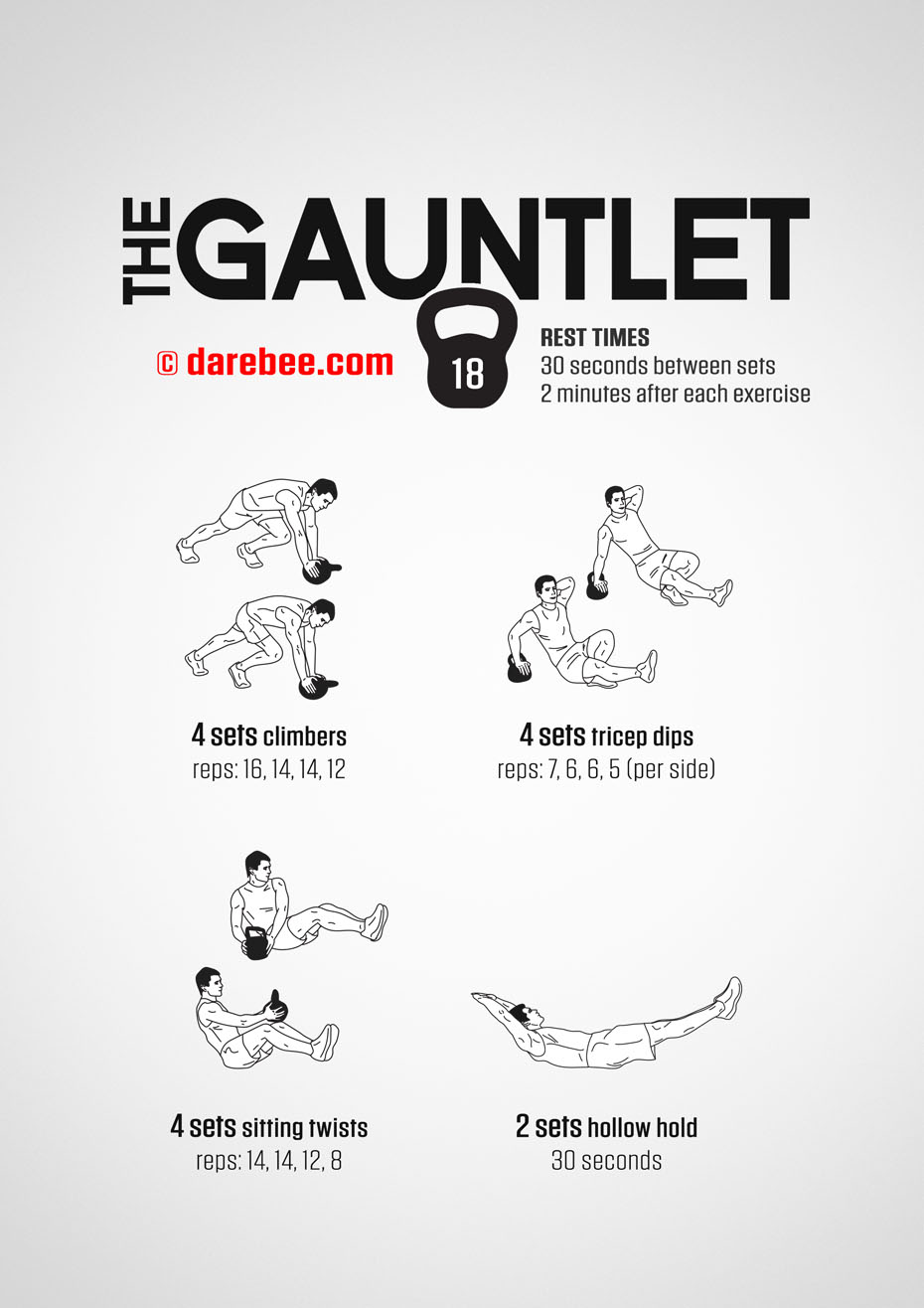
Day 18 pairs the core's two rep exercises with a dip and a hold. Climbers at 16, 14, 14, 12, tricep dips at 7, 6, 6, 5 per side and sitting twists at 14, 14, 12, 8, all in 4 straight sets, then a hollow hold at 2 sets of 30 seconds. Rest 30 seconds between sets, 2 minutes between exercises. The hollow hold is bell-free.
The hollow hold is the raised legs hold with the top half added. Lying on your back, you lift the shoulders off the floor with the arms extended overhead and the legs raised straight, so the body curves into a shallow dish and the lower back presses into the floor. Everything between the shoulders and the feet is off the ground and the abs are holding all of it. It is the strongest bracing position in the program and it arrives as a finisher, after the climbers and the dips have already used the trunk. The dips are up a rep on Day 8, the climbers up four on their first set, and the twists keep their second set at 14 - the reps keep growing without any change to the exercises.
Climbers: hands on the handle, quick knees, hips down. Tricep dips: one hand on the bell, the other behind the head, hips lifted, elbow bending to 90 degrees and straightening fully. Sitting twists: heels up, bell across. Hollow hold: lower back glued down, arms by the ears, legs together, and find the height for the legs and shoulders that you can keep still for 30 seconds - lower is harder.
Shoulders up, legs up, back flat - the hollow hold is the shape the core has been building toward since Day 3.
Make it Harder: Rock gently back and forth in the hollow hold without changing the shape of the position.
Make it Easier: Hold the hollow position with the arms by your sides instead of overhead.

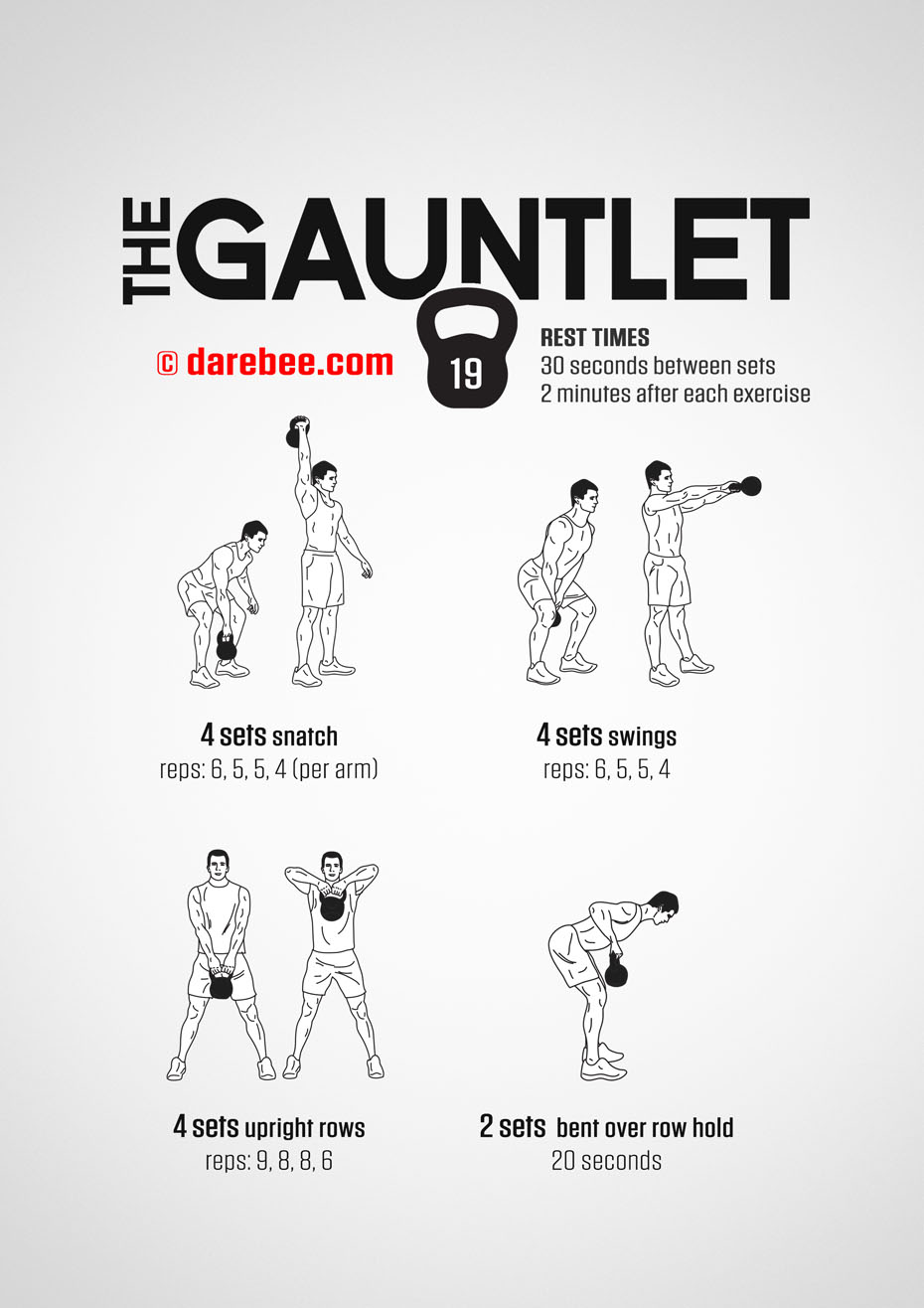
Day 19 brings the fast lifts back at the same counts as Day 9 and changes what comes after them. Snatch at 6, 5, 5, 4 per arm, swings at 6, 5, 5, 4, upright rows at 9, 8, 8, 6, and a new hold: the bent over row hold, 2 sets of 20 seconds with the bell pulled to the ribs in the hinge position. Straight sets, 30 seconds between sets, 2 minutes between exercises.
The snatch and swing numbers did not move, and that is deliberate. With the fast lifts, progression is partly about quality: a snatch at 6, 5, 5, 4 ten days after you first did those counts should travel a cleaner path, catch softer on the forearm and cost less breath. The upright rows carry the growth instead, opening on 9 where Day 14 opened on 8. The hold is the new idea: the bent over row's top position, held. Bell at the lower ribs, elbows back, torso hinged and still, 20 seconds - the lats and mid-back get the static work the upright row hold gave the shoulders on Day 14, and the lower back has to keep the hinge for the same 20.
Snatch: hip drive, close path, punch through at the top. Swings: bell to shoulder height on the hips alone. Upright rows: elbows high, bell close, shoulders down. Bent over row hold: hinge to a flat back, row the bell to the ribs and freeze there; the elbows stay behind the body and the back stays flat - if the bell starts drifting down, that is the end of the hold.
Same counts on the snatch and the swing, a cleaner path through both - and a hold that keeps the row where the back works hardest.
Make it Harder: Hold each upright row at the chin for a 2-count before lowering.
Make it Easier: Do one bent over row hold instead of two.

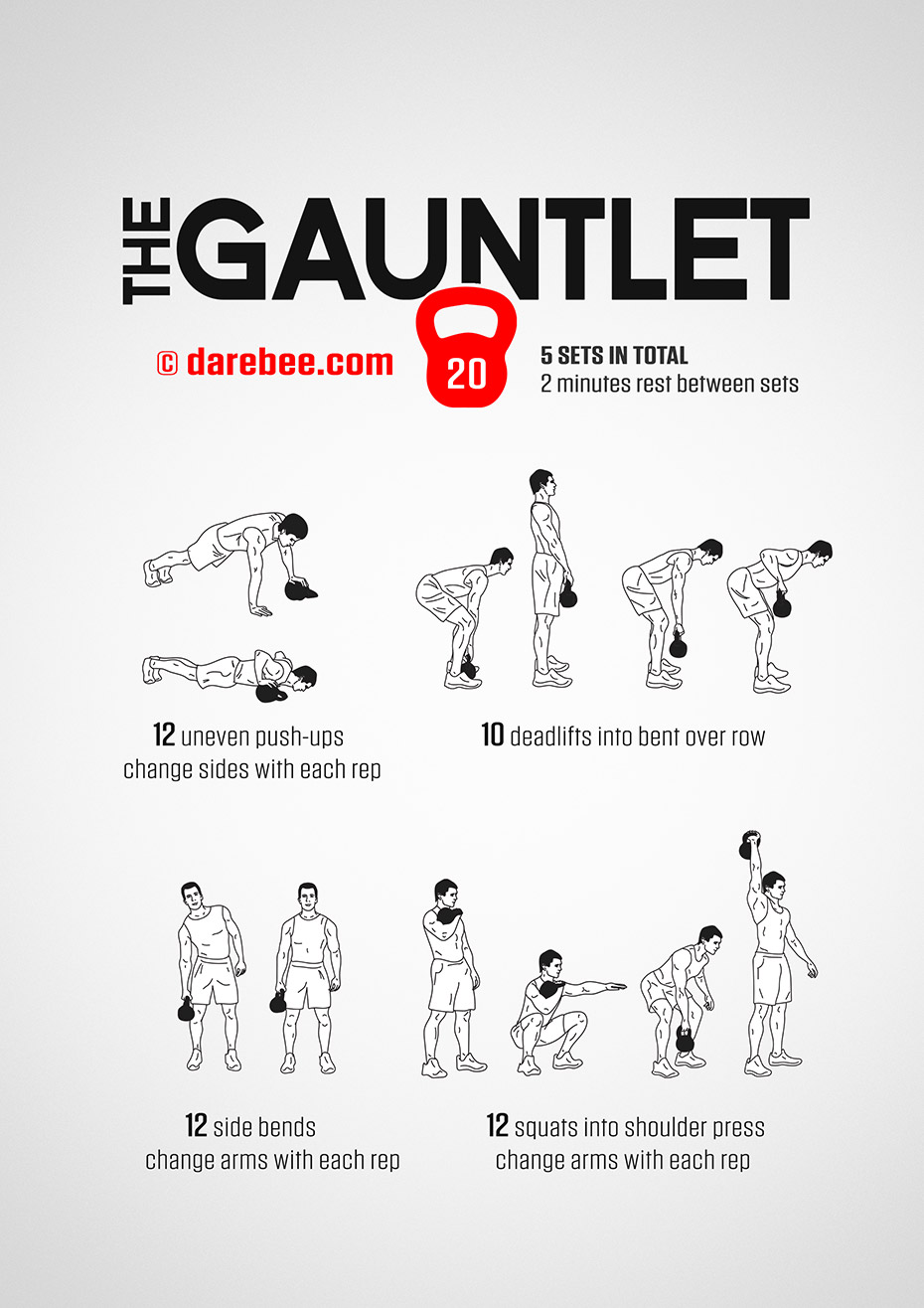
Day 20 is the fourth red-bell day and the first one where the counts go up. 12 uneven push-ups alternating sides, 10 deadlifts into bent over rows, 12 side bends alternating arms, and 12 squats into shoulder presses alternating arms - one pass is a set, 5 sets in total, 2 minutes rest between sets. Three of the four exercises have climbed to 12; the two-handed deadlift-row chain stays at 10.
Two chains are new. The deadlift into bent over row picks the bell up with a full hinge and stands tall, then hinges again to row it to the ribs, lowers it and stands - one rep, lower back holding the hinge at both ends. The squat into shoulder press racks the bell on one shoulder, squats with the free arm reaching forward - the Day 16 squat - and presses the bell overhead as you stand, lowering it to the rack before the next rep on the other arm. Both take a leg or hinge movement and hand the bell straight to the upper body without a break, which is exactly the coordination this day exists to train. Push-ups and side bends at 12 apiece hold the two ends of the circuit, and five rounds of the four make this the longest red day yet.
Uneven push-ups: swap hands each rep. Deadlift into row: flat back throughout, stand fully at the top of the deadlift, hinge again before you row. Side bends: bend, return, pass. Squat into press: rack the bell, sit down, reach the free arm, drive up and keep driving - the press starts as the legs finish - lock out, lower to the rack, and re-rack on the other shoulder for the next rep.
Twelve is the new ten on the red bell - the functional days have started growing alongside the strength days.
Make it Harder: Take the deadlift into bent over row to 12 as well, matching the other three exercises.
Make it Easier: Do sets 4 and 5 at 10 reps on everything.

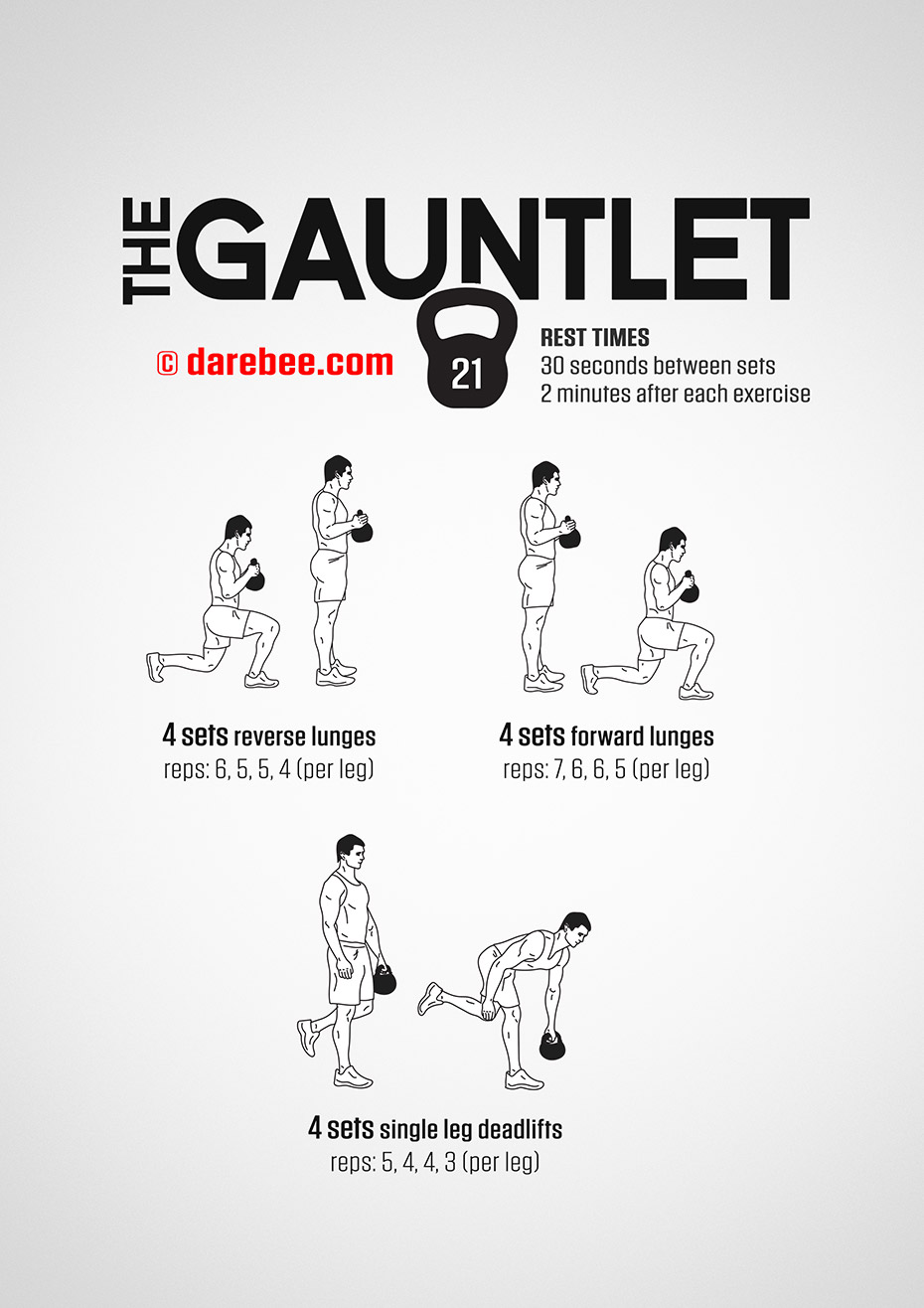
Day 21 is the second three-exercise leg day, and all of it is done one leg at a time. Reverse lunges at 6, 5, 5, 4 per leg, forward lunges at 7, 6, 6, 5 per leg, and a new exercise, the single leg deadlift, at 5, 4, 4, 3 per leg. Straight sets, 30 seconds between sets, 2 minutes between exercises. Both lunges are up on Day 6 - the reverse by one rep per set, the forward by two.
The single leg deadlift is the deadlift's balance test. Standing on one leg with the bell in the hand opposite it, you hinge at the hip so the torso tips forward and the free leg rises behind you until both are roughly parallel to the floor, then squeeze the standing glute to bring yourself back up. Hamstring and glute do the lifting, the hip does the balancing, and the bell hanging on the opposite side pulls the trunk into a twist it has to refuse. Swap both the leg and the hand when you change sides. The lunges before it are the same work in a more forgiving form - two feet on the floor at all times - so by the time the deadlift arrives, each leg has already done its share and the balance comes into it tired.
Reverse lunge: step back, knee to a hover, drive up through the front heel. Forward lunge: long step, rear knee down, push back to standing. Single leg deadlift: soft knee on the standing leg, hips square to the floor, the free leg and the torso moving as one unit like a seesaw; go only as far as the flat back allows and let the bell hang straight down under the shoulder. If you wobble, reset rather than muscle through - the balance is part of the exercise.
Three exercises and not one rep where both legs share the load evenly - balance is on the card today whether it is printed or not.
Make it Harder: Press the bell overhead and keep it locked out there for every reverse lunge.
Make it Easier: Let the toe of the free leg touch down between single leg deadlift reps.

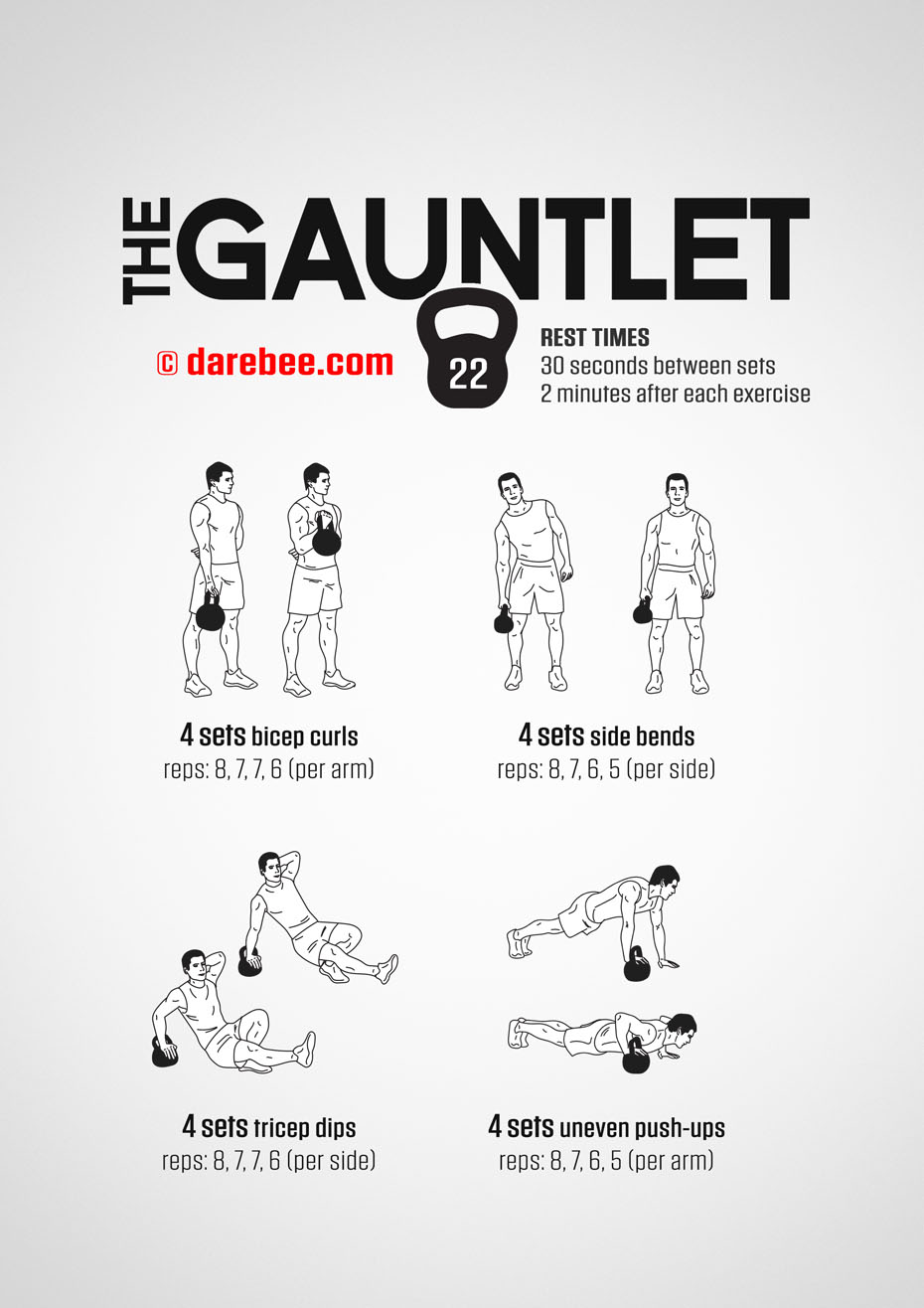
Day 22 opens the counts on 8 for everything. Bicep curls at 8, 7, 7, 6 per arm, side bends at 8, 7, 6, 5 per side, tricep dips at 8, 7, 7, 6 per side, and uneven push-ups at 8, 7, 6, 5 per arm. Straight sets, 30 seconds between sets, 2 minutes between exercises. There is no press today; the dips, moved over from the core days, take its place.
The pairing is built around the arm from both sides. Bicep curls work the front; tricep dips, pushing the body up on one hand with the other behind the head, work the back; uneven push-ups then ask the triceps and chest to do it again with the body moving rather than the bell. Side bends sit between curls and dips to give the arms a set of rest while the trunk works. Every count here is one rep higher on its first set than the last time the exercise appeared - curls and dips on 8 where Days 17 and 18 had them on 7, push-ups on 8 where Day 12 opened on 7 - and every exercise is one side at a time, so the printed number doubles inside each set.
Bicep curls: elbow fixed, slow lowering. Side bends: down the leg and up. Tricep dips: fingers over the handle, elbow pointing back, hips lifted, lower to 90 degrees. Uneven push-ups: bell hand and floor hand level, chest to bell height, body in one line, all 8 on one side before the swap.
Eights across the board, one arm at a time - the upper body's counts have caught up with its ambitions.
Make it Harder: Put both hands on the handle for the push-ups - a close-grip push-up on the bell.
Make it Easier: Cut the tricep dips to 6, 5, 5, 4 per side - Day 8's counts - with nothing else changed.

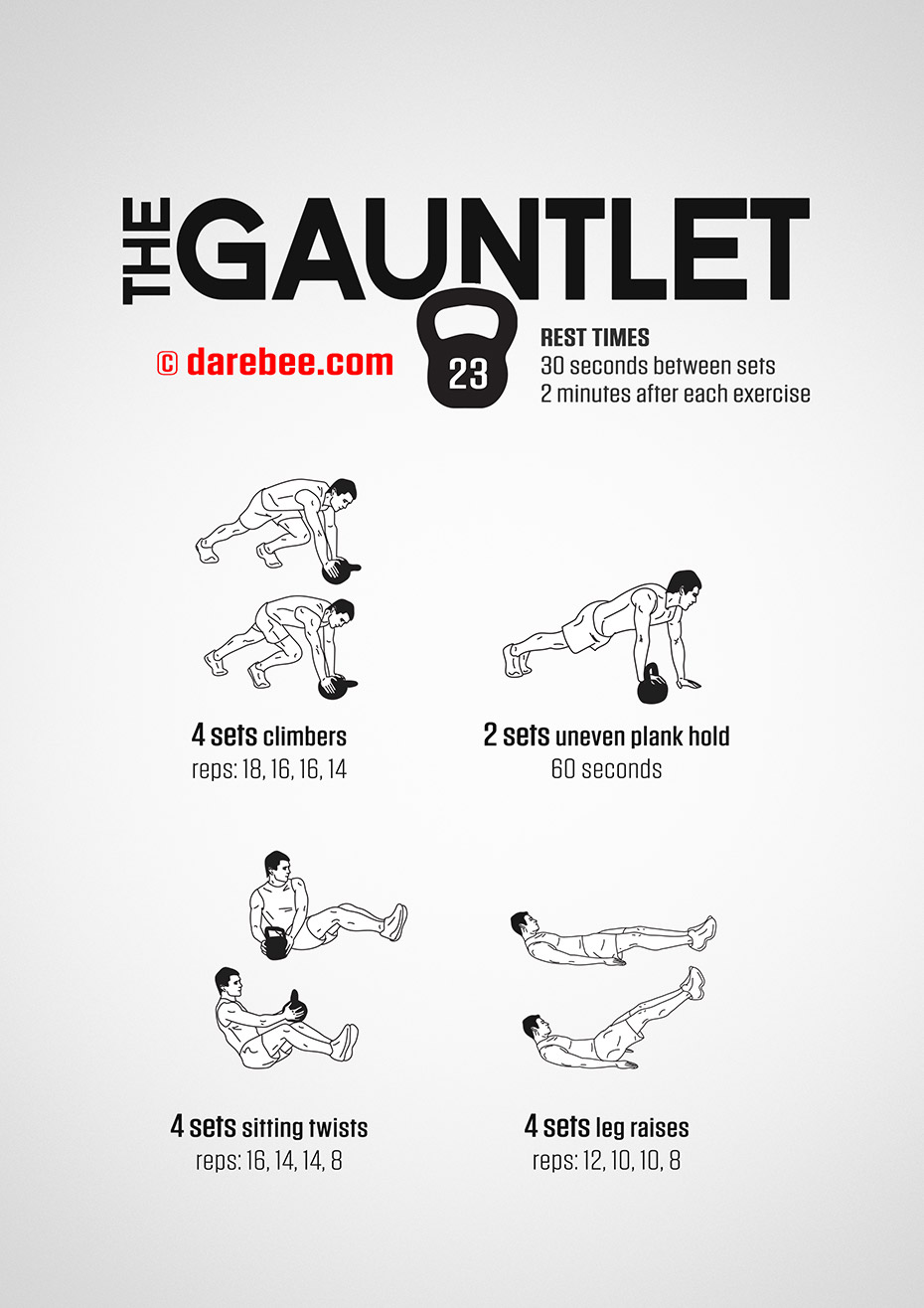
Day 23 puts a full minute on the plank. Climbers at 18, 16, 16, 14, sitting twists at 16, 14, 14, 8 and a new exercise, leg raises, at 12, 10, 10, 8, all in 4 straight sets; the uneven plank hold is 2 sets of 60 seconds - double what it was on Day 3. Rest 30 seconds between sets, 2 minutes between exercises. Leg raises are totals and need no bell.
The leg raise is the movement the raised legs hold, the flutter kicks and the circles have all been circling. Lying on your back with straight legs, you lift them from a hover to somewhere past 45 degrees and lower them back to the hover without touching down - the lower abs control both halves, and the hardest part is the last few inches on the way down. The sitting twists finish on 8, a steep fall on the fourth set that keeps the final set short and clean after three big ones. And the minute-long uneven plank is a milestone: 60 seconds on a lopsided base, twice, one hand on the bell each time. The climbers' 18 opening reps are the most the card has asked for on any exercise so far.
Climbers: shoulders over the handle, hips low, quick feet. Uneven plank: body in one line, bell hand pressed down, swap hands for set two, and breathe - a minute is long enough to forget to. Sitting twists: heels up, chest lifted, bell across. Leg raises: lower back flat on the floor, legs together, up under control, down slower, heels stopping a hand's width above the floor.
Sixty seconds on the plank and eighteen climbers to open - the plank has doubled since Day 3 and the climbers are not far behind.
Make it Harder: Hold the bell straight above your chest in both hands for all the leg raises.
Make it Easier: Do the uneven plank holds on your knees, reps unchanged.

Day 24 is the second back day, two pulls and two holds. Upright rows at 10, 9, 9, 7 followed by the upright row hold at 2 sets of 30 seconds, then bent over rows at 13, 12, 11, 8 followed by a squat hold at 2 sets of 30 seconds. Straight sets, 30 seconds between sets, 2 minutes between exercises. No deadlifts today - the rows carry the back on their own.
The design is pull, then hold the pull. Upright rows work the shoulders and traps through the rep, and the hold that follows keeps them at the top position for 30 seconds while the arms are already fatigued; the bent over rows work the mid-back through 13, 12, 11, 8 - the biggest row set in the program so far - and the squat hold after them gives the lower back the same treatment, holding the bell at the chest in a deep squat while the spine stays upright. Doing the holds immediately after their matching movement means they are done on tired muscle, which is where 30 seconds starts to feel long.
Upright rows: bell close, elbows high, shoulders down. Upright row hold: elbows above the wrists, bell at the chin, defend the height for the full count. Bent over rows: hinge, flat back, elbows to the ceiling. Squat hold: sit to depth, chest up, elbows inside the knees, breathe.
Pull, hold, pull, hold - the back gets four exercises today and only two of them move.
Make it Harder: Press the bell out at arm's length in front of you and hold it there through the squat hold.
Make it Easier: Hold the upright row hold with the bell at chest height rather than at the chin.

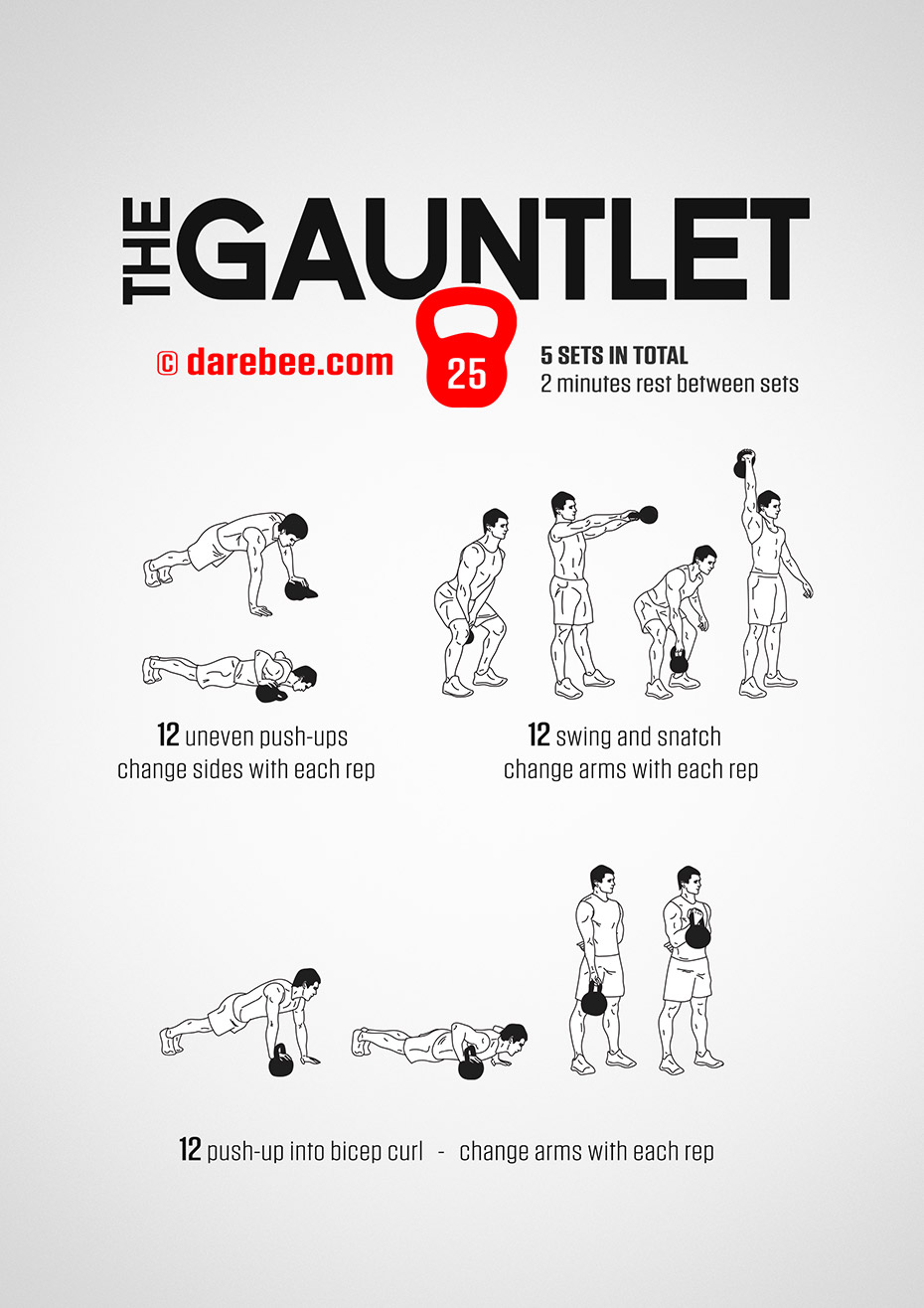
The fifth red-bell day runs three chains at 12. 12 uneven push-ups alternating sides, 12 swings and snatches alternating arms, and 12 push-ups into bicep curls alternating arms - one pass is a set, 5 sets in total, 2 minutes rest between sets. The swing and snatch is the day's new combination and the last new chain until the final card.
The swing and snatch joins the two hip-drive lifts into one rep. Hinge, one-arm swing to shoulder height, back down between the legs, and then straight into a snatch that finishes overhead - two hip snaps, the first to shoulder height and the second all the way up, before the bell comes down and changes hands. Twelve of those per round is thirty swings and thirty snatches per arm by the end of the day. The push-up into curl returns from Day 15, up two reps, and the uneven push-ups open the round as they always do. Where Day 20 chained slow lifts to slow lifts, this one chains fast to fast, and the 2-minute rest is the only reason the last round looks like the first.
Uneven push-ups: swap hands, chest to the bell. Swing and snatch: hip drive on both parts, arm relaxed on the swing, bell kept close on the snatch, hand punching through to a soft catch on the forearm, then lower it back through the swing path before the next hinge. Push-up into curl: uneven push-up, stand by hinging with a flat back, curl with the bell arm, lower, set it down and get back into the plank for the other side.
A swing that becomes a snatch, a push-up that becomes a curl - twelve of each, five times, and the bell barely stops moving.
Make it Harder: Cut the rest between sets to 90 seconds.
Make it Easier: Set the bell down between the swing and the snatch and reset your stance before each part.

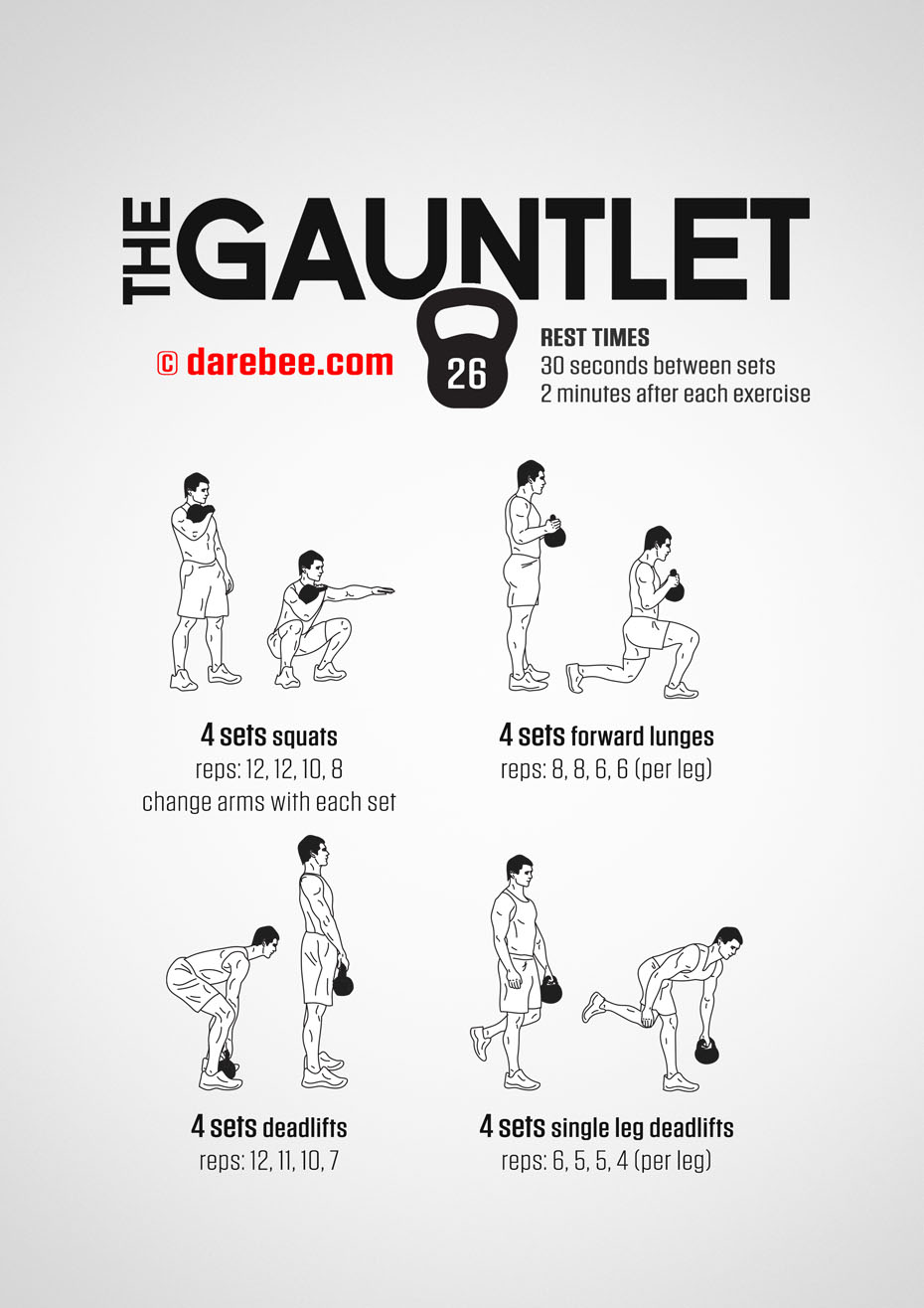
Day 26 is the last leg day and its biggest. Racked squats at 12, 12, 10, 8, changing shoulders each set, forward lunges at 8, 8, 6, 6 per leg, deadlifts at 12, 11, 10, 7 and single leg deadlifts at 6, 5, 5, 4 per leg. Straight sets, 30 seconds between sets, 2 minutes between exercises. Two deadlifts on one card for the first time.
Every count here is the top of its own arc. The squat opens on 12 where Day 1 opened on 10 and Day 16 on 11, and holds that 12 for a second set; the forward lunge reaches 8 per leg, three above its Day 6 debut; the deadlift starts on 12 and the single leg deadlift on 6, one above Day 21. The two-handed and one-legged deadlifts back to back are the interesting pairing - the first loads the hinge with both feet planted, the second takes one foot away and hands the same movement to your balance. The racked squat, on one shoulder with the free arm out, keeps the legs and the trunk working together rather than in turn.
Racked squats: elbow in, wrist straight, chest square, free arm level; sets 1 and 3 on one shoulder, 2 and 4 on the other. Forward lunges: long step, rear knee to a hover, push back. Deadlifts: flat back, hinge, stand and squeeze. Single leg deadlifts: bell in the hand opposite the standing leg, free leg and torso in one line, swap leg and hand together.
Twelve squats, twelve deadlifts and one leg holding the balance - the legs finish their block with every count at its highest.
Make it Harder: Rack the bell on one shoulder for the forward lunges too, swapping shoulders each set.
Make it Easier: Do the single leg deadlifts with both hands on the handle, bell hanging between them.

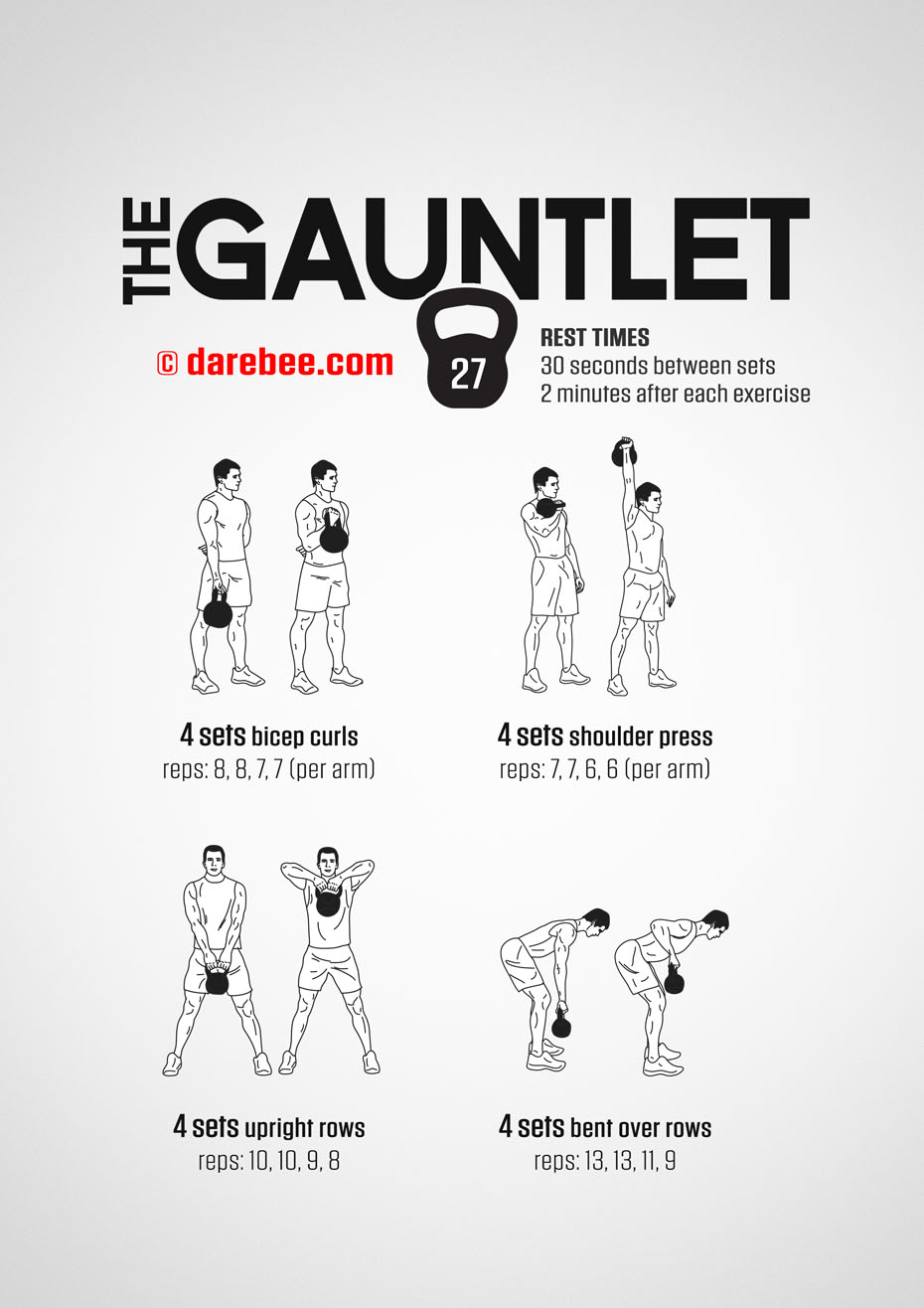
Day 27 closes the upper body block with the flattest rep schemes in the program. Bicep curls at 8, 8, 7, 7 per arm, shoulder press at 7, 7, 6, 6 per arm, upright rows at 10, 10, 9, 8 and bent over rows at 13, 13, 11, 9. Straight sets, 30 seconds between sets, 2 minutes between exercises. No exercise on the card loses more than 2 reps between one set and the next.
That flatness is the story. On Day 2 the numbers ran 10, 8, 8, 6, shedding 4 reps between the first set and the last; today the rows go 13, 13, 11, 9 and the curls barely move. Holding the count across the first two sets means there is no easy set - the second one asks for everything the first did. Two arm exercises lead, one arm at a time, and two rows finish two-handed, so the session moves from isolation to the big pulls the way Day 17 did, only heavier on every line.
Bicep curls: elbow pinned, full range, slow on the way down. Shoulder press: rack, brace, press without leaning, lock out beside the ear. Upright rows: elbows lead, bell close, shoulders down. Bent over rows: hinge, flat back, elbows back - and on set two, the same 13 as set one, with the same form.
Eight, eight, seven, seven - the sets have stopped falling away, and that is the clearest sign the arms have grown.
Make it Harder: Finish each set of bicep curls with 5 partial reps in the top half of the curl.
Make it Easier: Take 2 reps off the final set of every exercise.

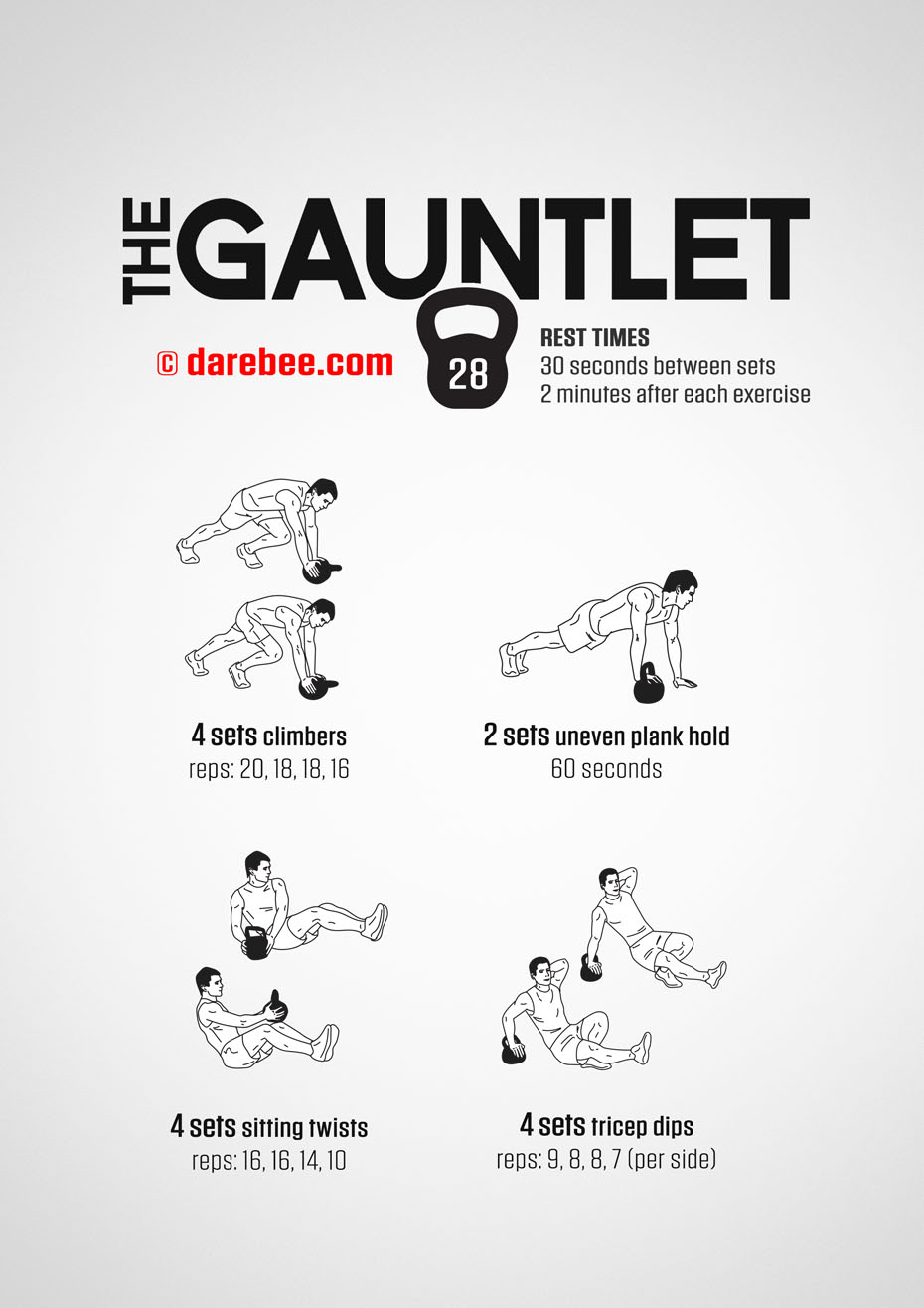
Day 28 is the final floor session and the climbers reach 20. Climbers at 20, 18, 18, 16, sitting twists at 16, 16, 14, 10 and tricep dips at 9, 8, 8, 7 per side in 4 straight sets, with the uneven plank hold at 2 sets of 60 seconds. Rest 30 seconds between sets, 2 minutes between exercises.
Twenty climbers on the bell is where a count that started at 10 on Day 3 ends up: every core day added two reps to the first set, and the plank grew alongside it - 30 seconds, 40, 60, 60. The tricep dips take the fourth slot, up a rep on Day 22 on every set, and the sitting twists finish on 10, the highest final set they have had. This is the core block's summary card: the two exercises that appeared on every floor day at their peak, the hold at its longest, and the arm exercise that lives on the floor at its heaviest.
Climbers: hands on the handle, shoulders stacked, knees fast, hips still - and with 20 in the first set, do not let the hips creep up as the count climbs. Uneven plank: swap the bell hand between sets, body in one line, breathe. Sitting twists: heels up, chest up, the bell crossing the body. Tricep dips: hand on the handle, elbow back, hips high, full extension at the top.
Ten climbers became twenty and thirty seconds became sixty - the floor days have finished what they started.
Make it Harder: Do the sitting twists with the bell held out at arm's length.
Make it Easier: Rest the heels on the floor for the sitting twists.

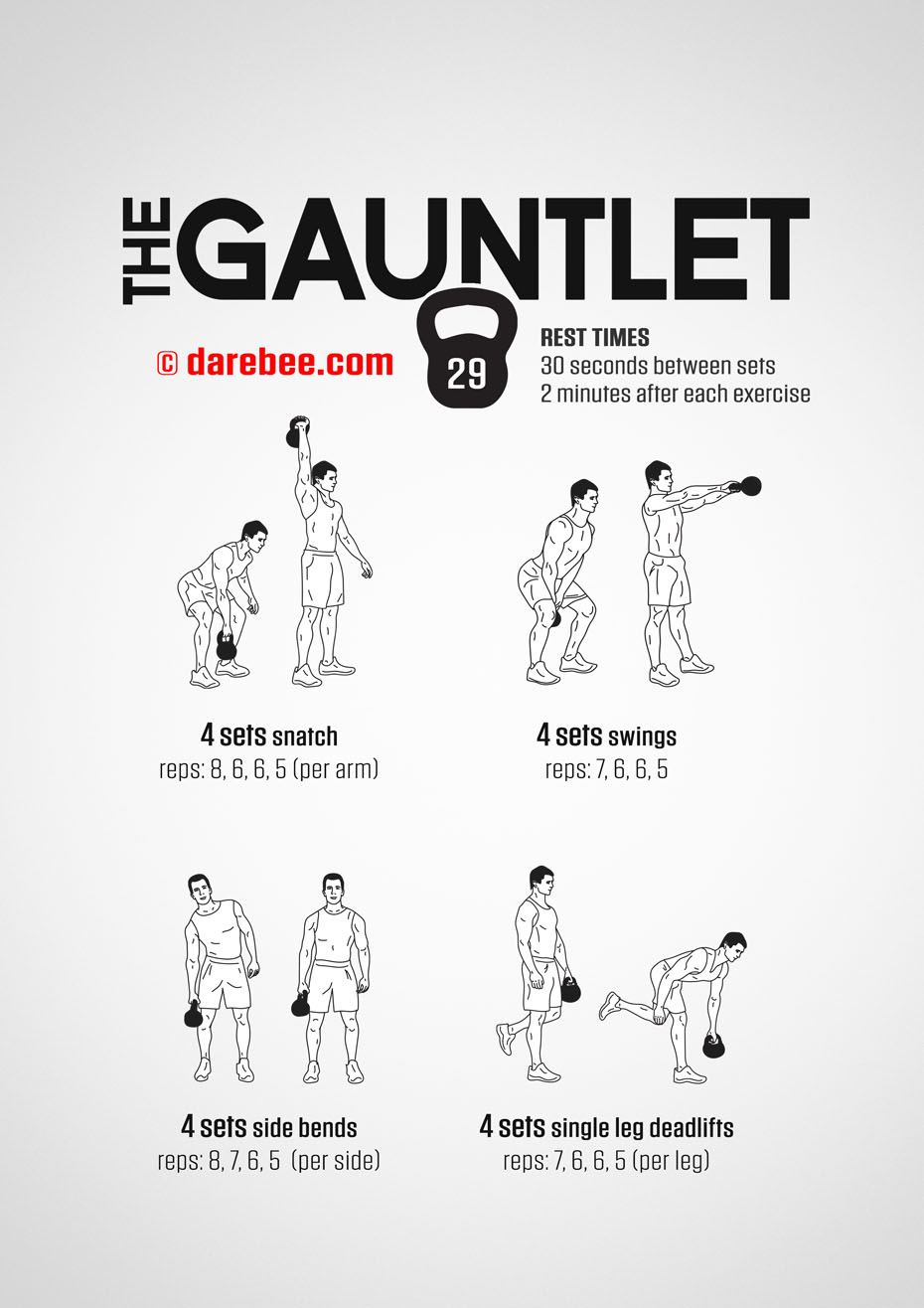
Day 29 is the last black-bell day and the fast lifts get their biggest counts. Snatch at 8, 6, 6, 5 per arm, swings at 7, 6, 6, 5, side bends at 8, 7, 6, 5 per side and single leg deadlifts at 7, 6, 6, 5 per leg. Straight sets, 30 seconds between sets, 2 minutes between exercises. The snatch opens on 8 after three cards at 5 and 6; the swings finally move past 6, twenty days after they first got there.
The snatch has been held back on purpose. It arrived on Day 4 at 5, 4, 4, 3, sat at 6, 5, 5, 4 on Days 9 and 19, and only now opens on 8 per arm - 16 snatches in the first set alone, on a hip drive that has been practiced on every power day and every deadlift in between. The single leg deadlift, on a power day for the first time, is the quiet counterpart: the same hinge the swing does at speed, done slowly on one leg. Side bends at 8 per side sit between them and give the shoulders a set of rest before the balance work.
Snatch: hike, drive, keep it close, punch through, soft catch - and with 8 reps in the first set, keep every one of them at the same height. Swings: hips only, shoulder height, arms loose. Side bends: sideways only. Single leg deadlifts: opposite hand to the standing leg, hips square, free leg and torso in one line, the standing glute pulling you back up.
Eight snatches per arm to open - the lift the program held back the longest gets the last word on the black bell.
Make it Harder: Do the swings one-handed, passing the bell between hands at the peak of each swing.
Make it Easier: Swing the bell to hip height instead of shoulder height.

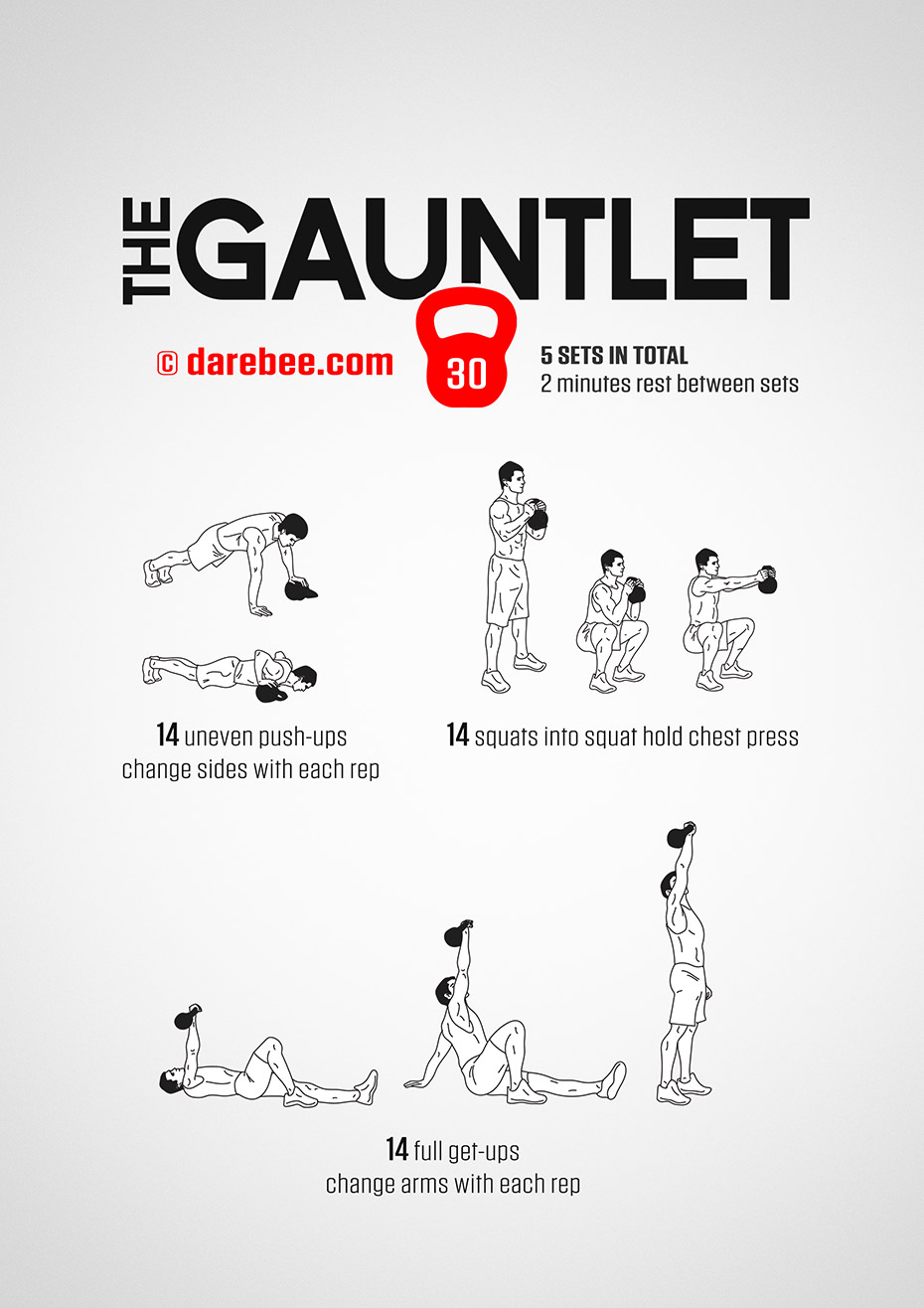
The Gauntlet ends on a red bell and three exercises at 14. 14 uneven push-ups alternating sides, 14 squats into squat hold chest presses, and 14 full get-ups alternating arms each rep - one pass is a set, 5 sets in total, 2 minutes rest between sets. That is 70 get-ups by the time you finish.
The get-up is back for the finale, bigger than its Day 10 debut and now alternating arms rep by rep, so no shoulder gets a run of reps to settle into - each side has to be ready every other time. The squat into squat hold chest press is the day's new chain and it combines two exercises the program has used since Day 1: goblet squat down, press the bell straight out at the bottom, pull it back, stand. Fourteen of those with the legs held at depth for every press is a leg finisher on its own. The push-ups open the round as they have on every red day, two reps above Day 25. Three exercises, five rounds, and every one of them is something an earlier card taught you.
Uneven push-ups: swap hands each rep, chest to the bell. Squat into chest press: bell at the chest, sit down between the heels, press out until the arms are straight, pull it back, drive up - the press happens at the bottom, not on the way up. Get-ups: bell locked out, arm vertical, eyes on the bell; elbow, hand, hip, knee, stand, and the same stages in reverse; change hands on the floor, not in the air.
Seventy get-ups, seventy squats with a press at the bottom of each, and then the bell finally stops - The Gauntlet is run.
Make it Harder: Run a sixth round.
Make it Easier: Take 3 minutes of rest between sets instead of 2.