30 Days of HIIT Advanced is a 30-day, no-equipment, high intensity interval training program built for one purpose: burning fat, fast. Every workout is measured in seconds rather than reps - the clock decides when you start and when you stop, and your only job is to fit as much honest work as you physically can into every work interval. Three levels run through the entire month: Level I is 3 sets, Level II is 5, Level III is 7, so the same 30 days scale from challenging to brutal depending on how much you take on. Most days give you 2 minutes of rest between sets; the days marked non stop give you none at all.
The month runs on five kinds of day, and learning their personalities is half the journey. Cardio HIIT days chain standing cardio with plank work and slip a connective exercise - a push-up, a jump squat, a pair of side-to-side lunges - between every interval so your heart rate never gets a foothold. Power HIIT days lean on squats, push-ups and kicks to keep muscle in the mix while the fat burns. Full Circuit days are the non-stop ones: sprint intervals chased by active recovery, looped without a single break. Single-exercise days strip everything down to burpees or high knees against the clock, and HIIT the Plank days alternate flat-out effort with dead-still holds - two opposite skills sharing one set of lungs.
The progression hides in the clock. The first three weeks run mostly on 20-second work intervals; the final week stretches them to 30, and several late workouts are exact upgrades of early ones - same exercises, half again more time under load - so you can feel precisely how far you have come. There are no rest days: thirty days, thirty workouts, with the single-exercise days quietly doing double duty as the lighter sessions. Go as fast as you honestly can in every interval, drop a level before you drop your form, and expect the program to feel very different in week four than it did in week one. That difference is the result.

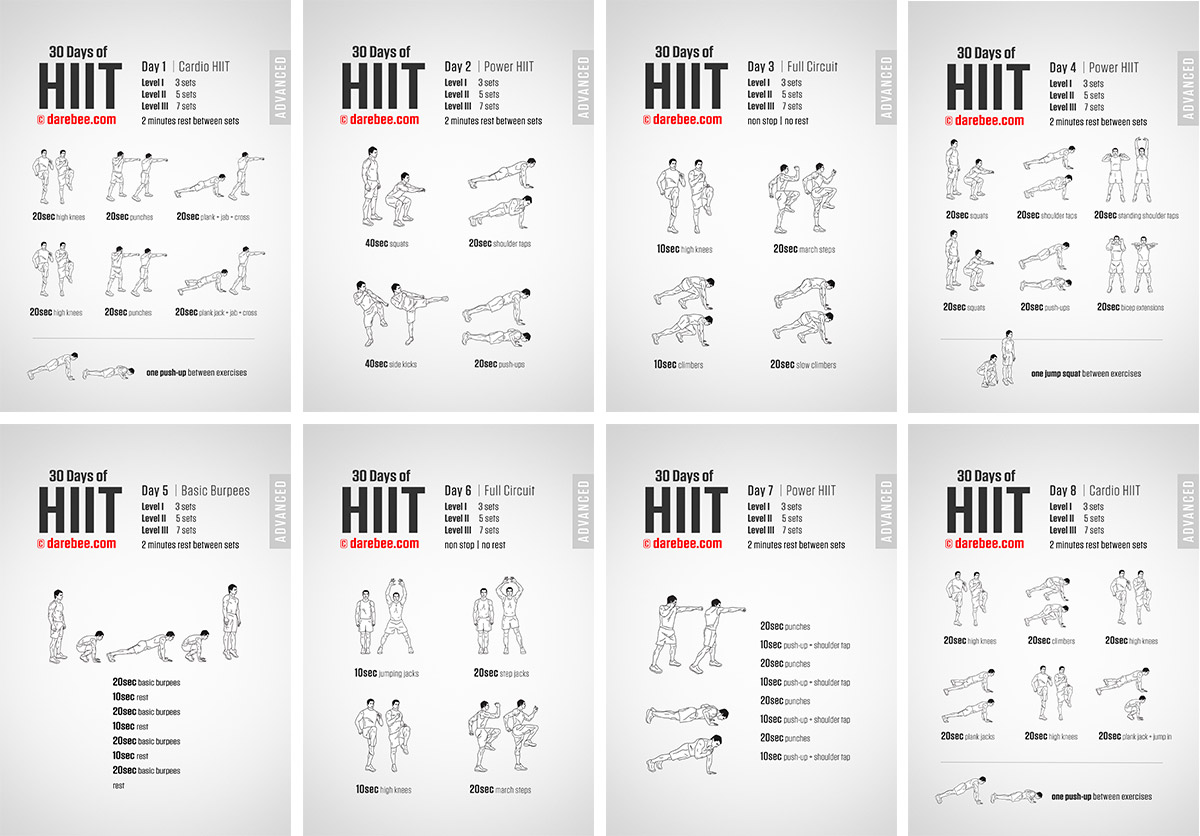
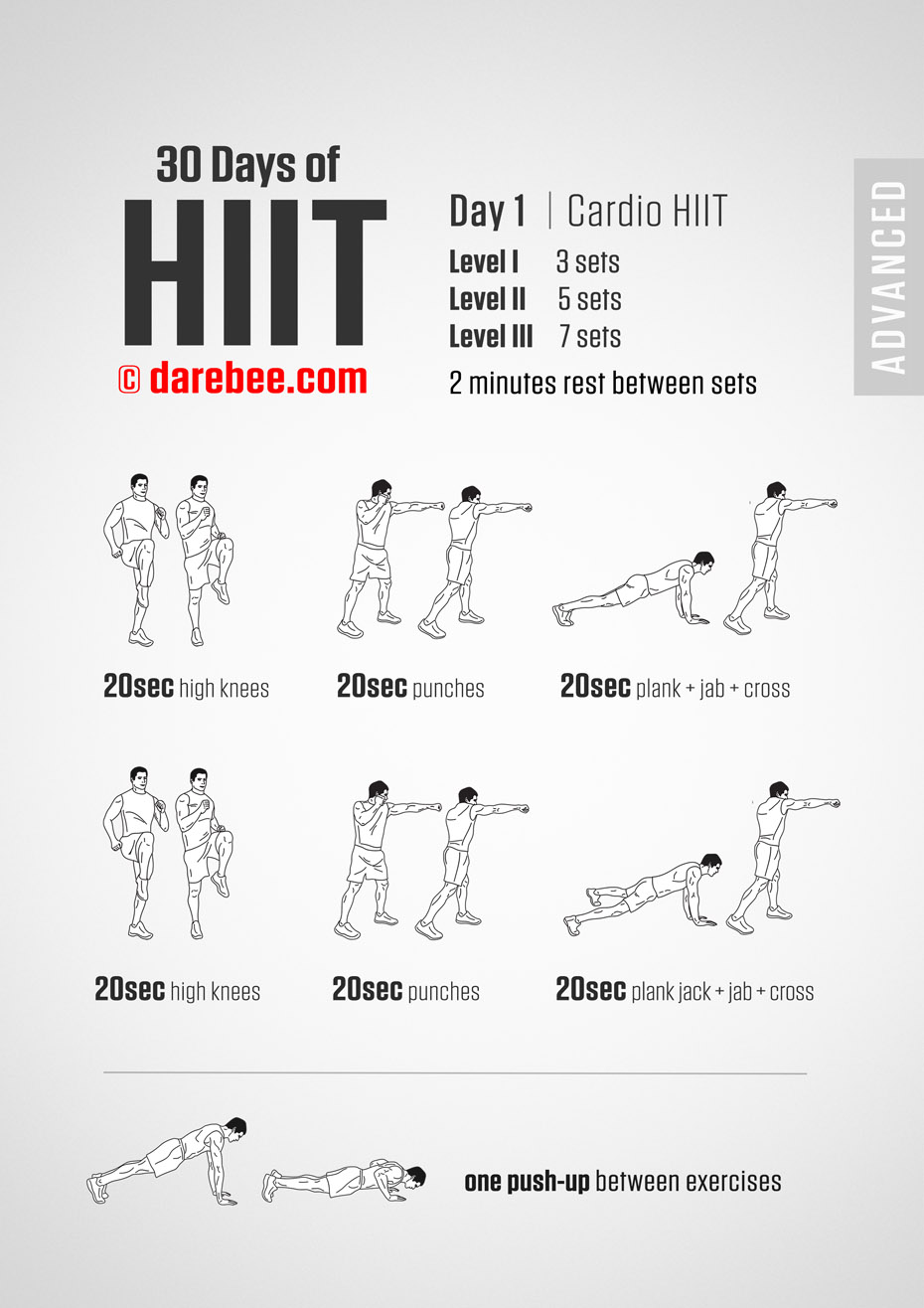
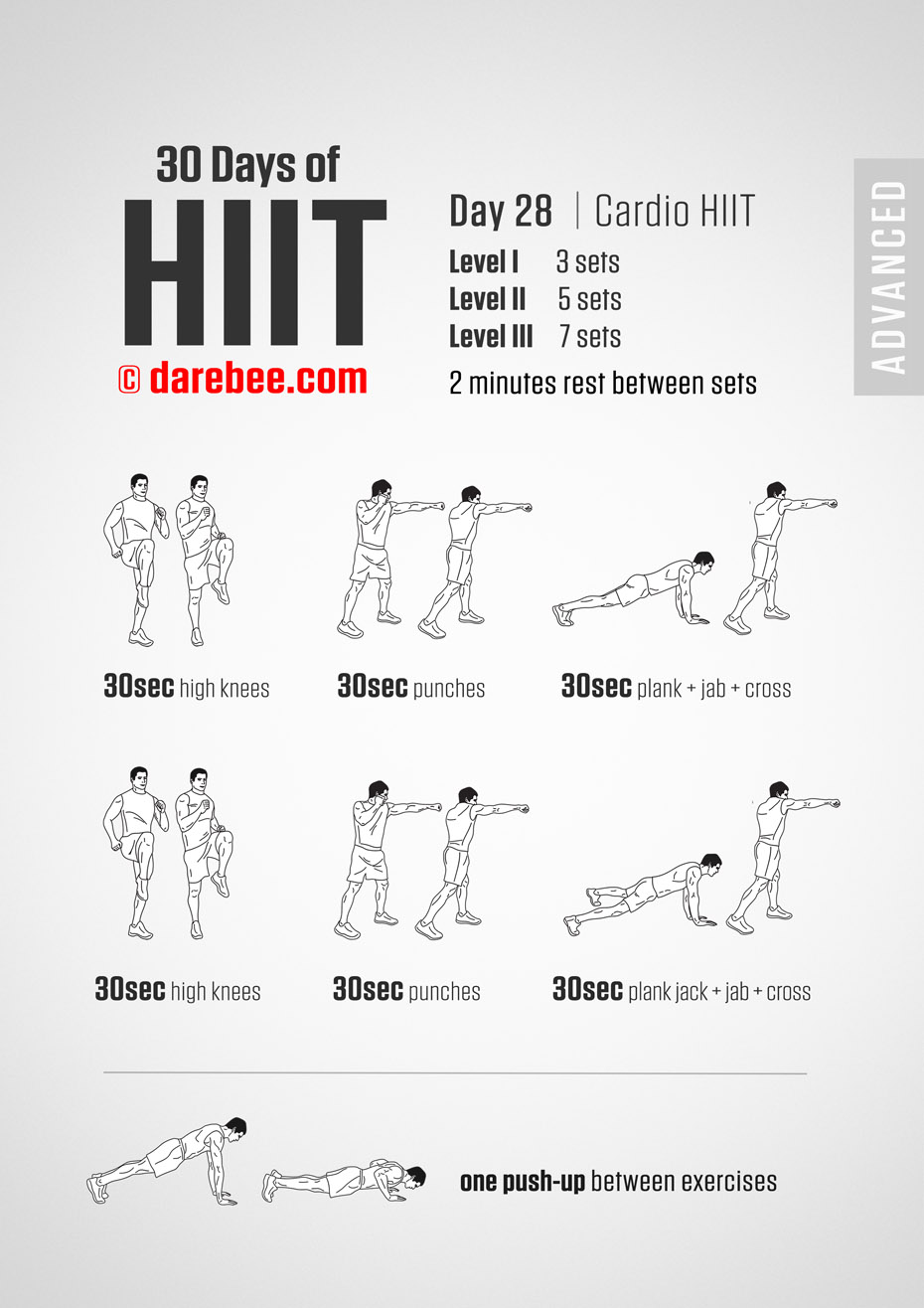
The program opens flat out. Day 1 is six 20-second intervals run as one continuous set: high knees, punches and a plank + jab + cross combination, then the same row again with the plank combo upgraded to a plank jack + jab + cross. Between every exercise you owe one push-up - a two-second toll that keeps the transitions honest. Run it at 3, 5 or 7 sets depending on your level, with 2 minutes of rest between sets, because inside a set there is no rest at all.
The card alternates planes on purpose. High knees and punches keep you upright with the heart rate climbing; the plank combinations drop you to the floor and make the shoulders and core pay for the trip, throwing a jab and a cross from a moving plank. The second row's upgrade - a plank jack slipped underneath the punches - is the program showing you, six intervals in, exactly how it likes to progress: same slot, slightly bigger ask. And the connective push-up is sneakier than it looks: six exercises means five tolls per set, and by the fifth set those push-ups are a session of their own.
Drive the knees to hip height and pump the arms on the high knees - the drawing is a run on the spot, not a march. Keep a guard up and rotate from the hips when you punch. In the plank combinations, set the feet wide for balance, punch from the shoulder without letting the hips swing, and keep the plank jacks small with the spine long throughout.
Day 1 doesn't ease you in - it quotes you the price of the next 30 days and asks if you're good for it.
Make it Harder: Count your punches in the first plank combo interval and refuse to finish any later set below that number.
Make it Easier: Drop the jab + cross from both plank combinations and hold a strong, motionless plank for those 20 seconds instead.

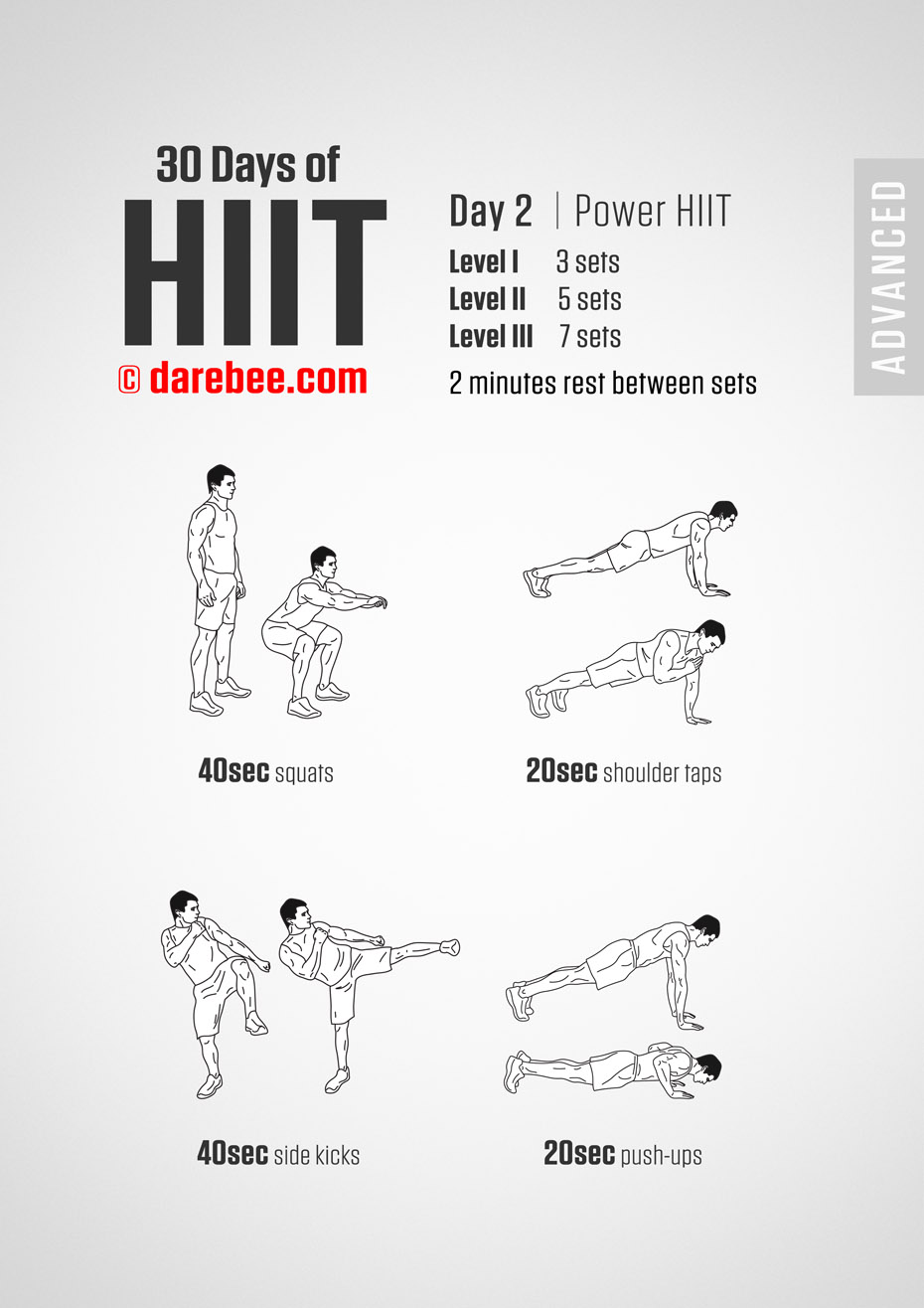
Day 2 introduces the Power HIIT format: longer intervals, heavier movements. The pattern is 40 seconds of squats, 20 seconds of shoulder taps, 40 seconds of side kicks and 20 seconds of push-ups - one long leg grind, one short floor challenge, twice over. Take it at your level's 3, 5 or 7 sets with 2 minutes between them, and treat the 40-second intervals with respect: they are twice as long as anything Day 1 asked of you.
The arithmetic favours the legs deliberately. Big muscle groups burn the most fuel, so they get the long intervals - squats first, then side kicks, which sneak balance and hip mobility into what looks like a cardio slot. The upper body gets short, sharp visits instead: shoulder taps in a plank, where the real work is keeping the hips level while one hand leaves the floor, and push-ups arriving last, on shoulders the taps have already softened up.
Squat to at least parallel with the heels heavy - speed never excuses depth. In the shoulder taps, imagine headlights on your hips that must not swing side to side. Chamber the side kicks - knee up, kick out, knee back - rather than swinging the leg, and keep the push-ups full range from the first rep to the last.
Forty seconds is where 'as fast as you can' meets 'as well as you can' - Day 2 grades you on both at once.
Make it Harder: Land every side kick above waist height, every rep, both legs.
Make it Easier: Kick at knee height and take the push-ups from your knees.

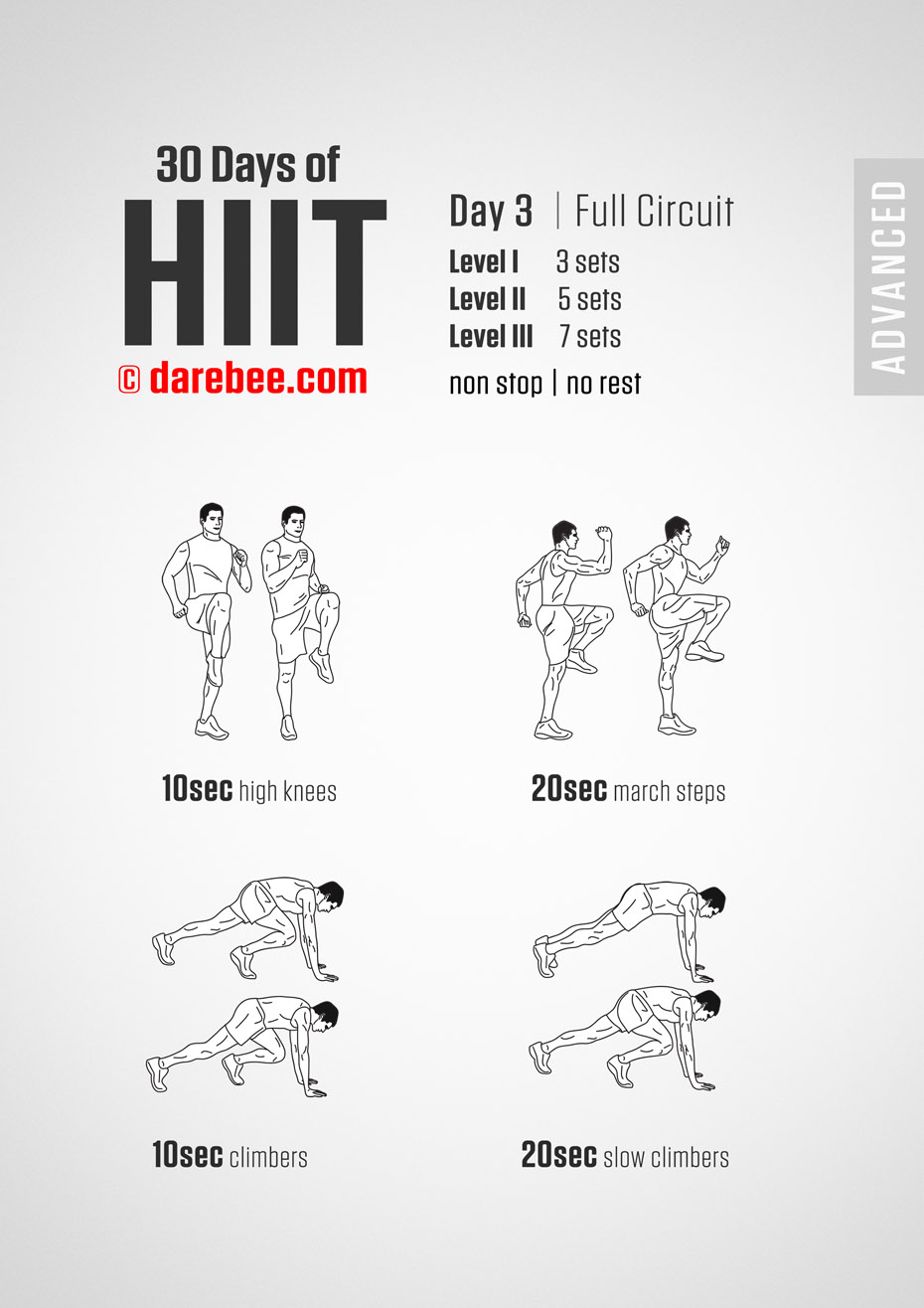
Day 3 is the program's first non-stop day, and the rules change: no rest between exercises, no rest between sets, no rest anywhere. The circuit is 10 seconds of high knees, 20 seconds of march steps, 10 seconds of climbers, 20 seconds of slow climbers - and then it repeats, immediately, for as many loops as your level demands: 3, 5 or 7.
The design runs on gears, not breaks. Each pair puts a sprint next to its own slower cousin: high knees cool into march steps, fast climbers into slow climbers, so recovery happens inside movement rather than instead of it. Ten seconds is short enough that you can genuinely empty the tank, and the 20-second cruise is exactly long enough to make the next sprint possible - provided you actually cruise, and don't stall.
In the 10-second bursts, chase turnover - the knees and feet should blur. March steps stay tall: chest up, arms driving, knees deliberate. Keep the hands planted under the shoulders at both climber speeds, and make the slow climbers long and controlled - a full knee drive on each side, not a lazy shuffle.
The first non-stop day teaches the one skill every circuit in this program demands: changing gears without ever touching neutral.
Make it Harder: Hold the march step knees at hip height so the recovery interval never goes fully passive.
Make it Easier: Step the fast climbers through, one foot at a time, instead of running them.

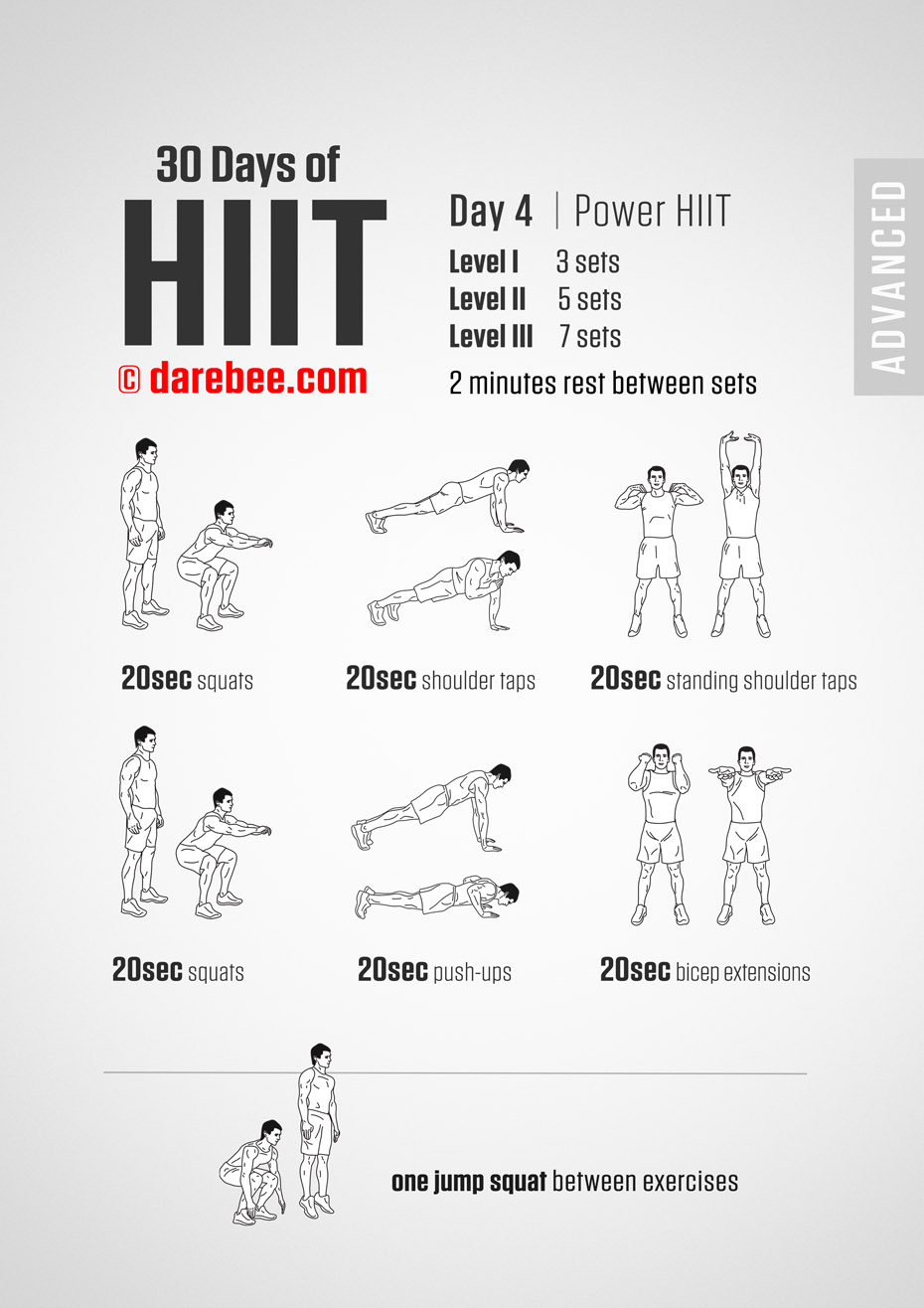
Day 4 stacks six 20-second intervals: squats, shoulder taps, standing shoulder taps, squats again, push-ups and bicep extensions - with one jump squat owed between every exercise. Level rules as always: 3, 5 or 7 sets, 2 minutes of rest between sets, everything inside a set continuous.
Two of today's exercises share a name and almost nothing else, which is Darebee poster shorthand at work. The first shoulder taps happen in a plank - hand to opposite shoulder, hips fighting rotation the whole time. The standing version brings the fingertips to the shoulders and then drives both arms to full extension overhead, turning the same words into a shoulder press with no bar. Bicep extensions close the set with self-resistance: you supply the tension and your own arms curl against it. Between all of it, the jump squats accumulate quietly - five per set, every set.
Keep both squat intervals identical in depth; the second one, on tired legs, is the one that counts. Plank taps: hips level, feet wide. Standing taps: touch the shoulders, then reach for the ceiling with intent - a full extension, not a flick. In bicep extensions, clench the fists and make the muscle fight in both directions.
Two exercises answer to one name today and neither apologises - by the end, your shoulders can tell them apart blindfolded.
Make it Harder: Make the connective jump squat a double - two between every exercise.
Make it Easier: Swap the connective jump squat for a plain bodyweight squat.

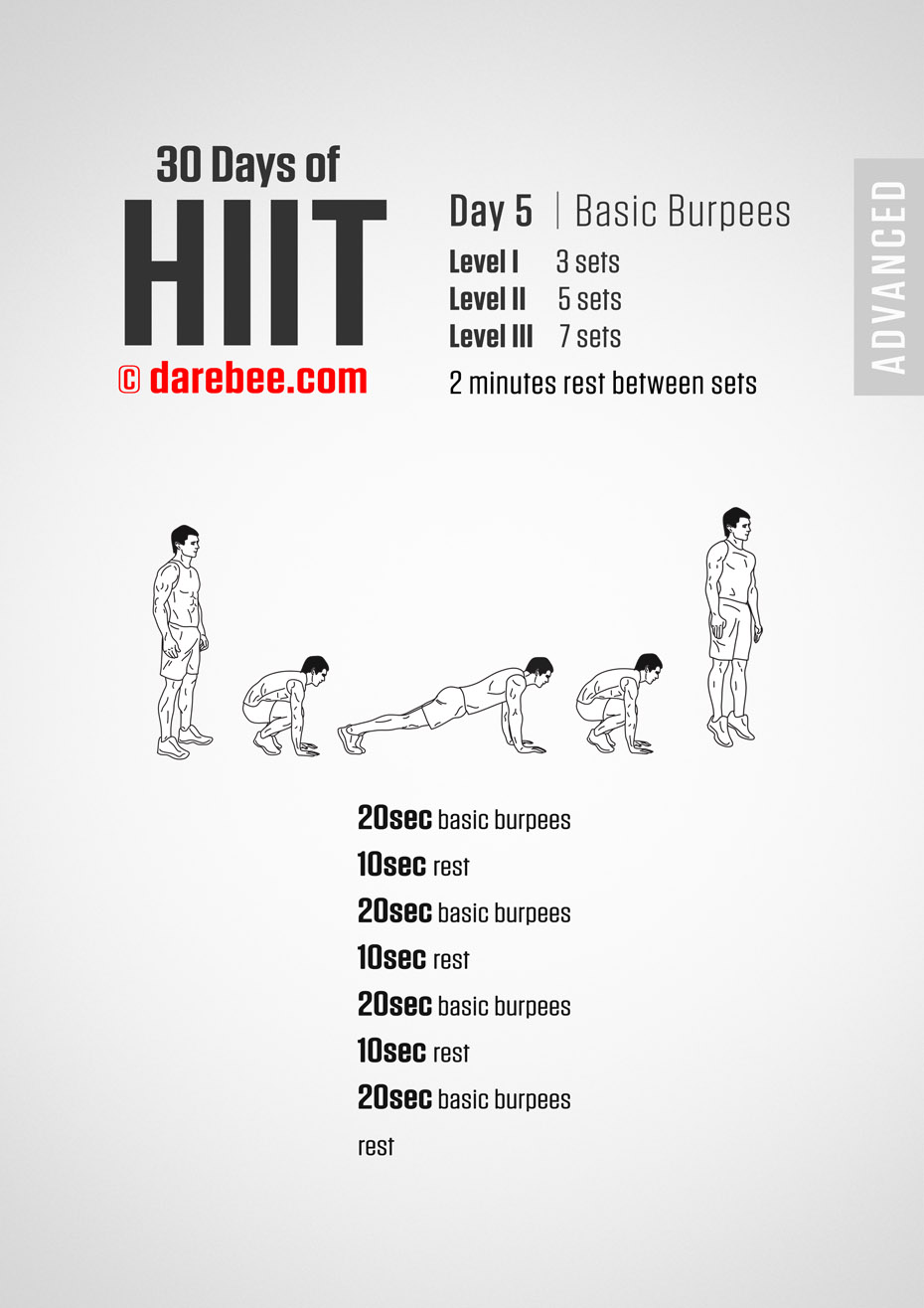
One exercise, one clock. Day 5 runs basic burpees in a 20 seconds on, 10 seconds off ladder - four work intervals per set - at your level's 3, 5 or 7 sets with 2 minutes of rest between sets. The card could not be simpler to read, which is exactly how it gets you.
The burpee is the whole gym in one movement - squat, plank, squat, stand - and the basic version is chosen deliberately: no push-up, no jump, nothing to slow the cycle down, because on this day speed itself is the load. The 10-second breathers are calibrated to be almost enough; they take the edge off without ever letting the heart rate leave the working zone, which is where a HIIT day earns its keep.
Crouch with the hands flat, jump the feet back to a straight-line plank, jump them back in and stand all the way up - hips fully open at the top of every rep. Find a rhythm early and defend it: a steady four-count cycle beats a frantic sprint that collapses in interval three.
One movement and a stopwatch, nowhere to hide - Day 5 is HIIT with everything unnecessary stripped away.
Make it Harder: Add a push-up at the bottom of every burpee.
Make it Easier: Step the feet back and in instead of jumping them.

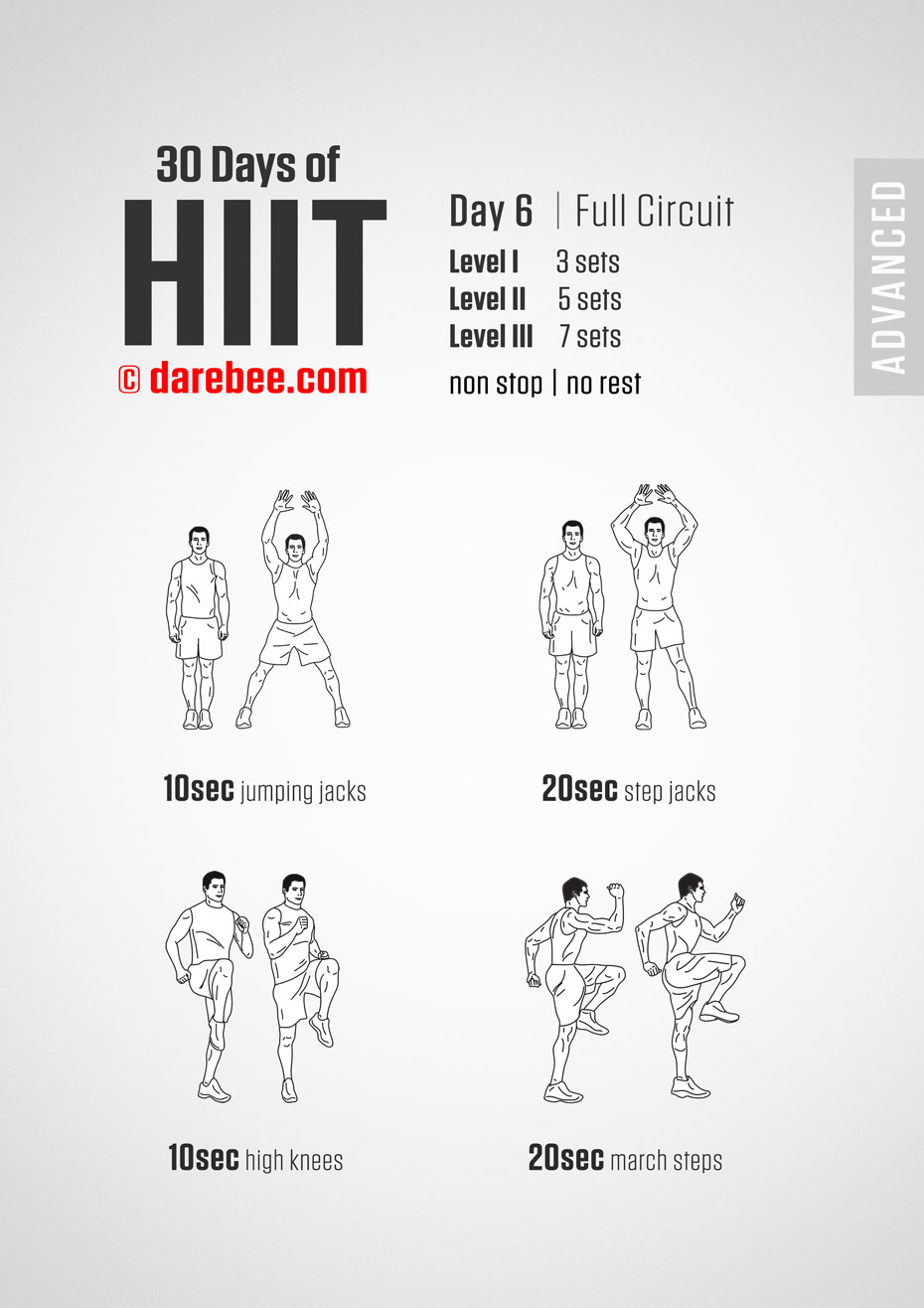
Day 6 is a non-stop circuit built entirely upright: 10 seconds of jumping jacks, 20 of step jacks, 10 of high knees, 20 of march steps - looped without a break for 3, 5 or 7 rounds depending on level. Nothing touches the floor, and nothing lets you stop.
Both pairs follow Day 3's gear-change logic - a sprint feeding into its own low-impact twin. Jumping jacks cool into step jacks, which trace the same overhead arc with one foot always grounded; high knees settle into march steps. The circuit also alternates planes, side-to-side then straight ahead, so no single movement pattern gets to dominate and no single muscle group gets to check out.
Full extension on the jumping jacks - hands meet overhead, feet land wide - then keep exactly the same reach in the step version, just at walking impact. Sprint the high knees outright. In the march steps, drive the arms and keep the torso proud; the moment they turn into a stroll, the circuit stops being a workout.
Day 6 looks like the friendliest card in the program - run it honestly and it will fix that impression by the second loop.
Make it Harder: Turn every 10-second burst into a flat sprint - more than one rep per second, no exceptions.
Make it Easier: Run step jacks in both jack slots.

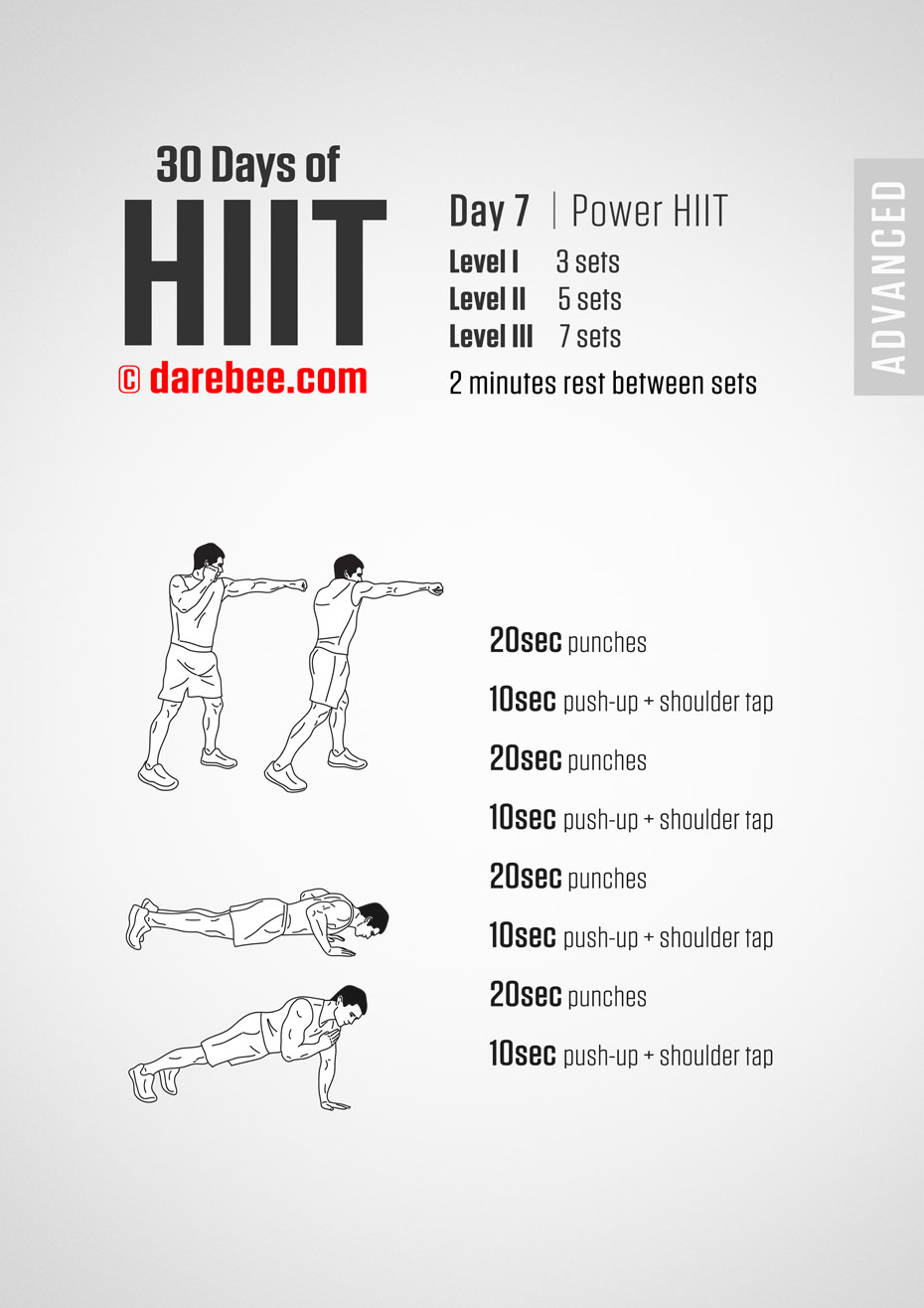
Day 7 alternates 20 seconds of punches with 10 seconds of push-up + shoulder taps, four times through per set - at 3, 5 or 7 sets by level, with 2 minutes between sets. The pattern is boxing rhythm applied to a workout: work the hands, then drop and pay for it.
The pairing is a slow ambush. Punches feel like the easy half - until a few hundred of them have the shoulders burning from the inside, at which point the 10-second combination intervals collect: a full push-up, then a hand to the opposite shoulder with the hips locked level. Ten seconds only fits three or four of those cycles, but they land on pre-fatigued shoulders every single time, which is the entire point of the order.
Punch with a guard: fists return to the chin, shoulders stay down, hips do the rotating. In the combination, finish the push-up completely before the tap - chest down, arms locked out, then touch. Wide feet in the plank buy stability; a sagging or piking hip line sells it.
The punches soften the target and the push-ups finish the job - Day 7 is a one-two combination wearing a timer.
Make it Harder: Take two shoulder taps - one each side - after every push-up.
Make it Easier: Shadow-box the punch intervals at half pace and treat them as moving recovery.

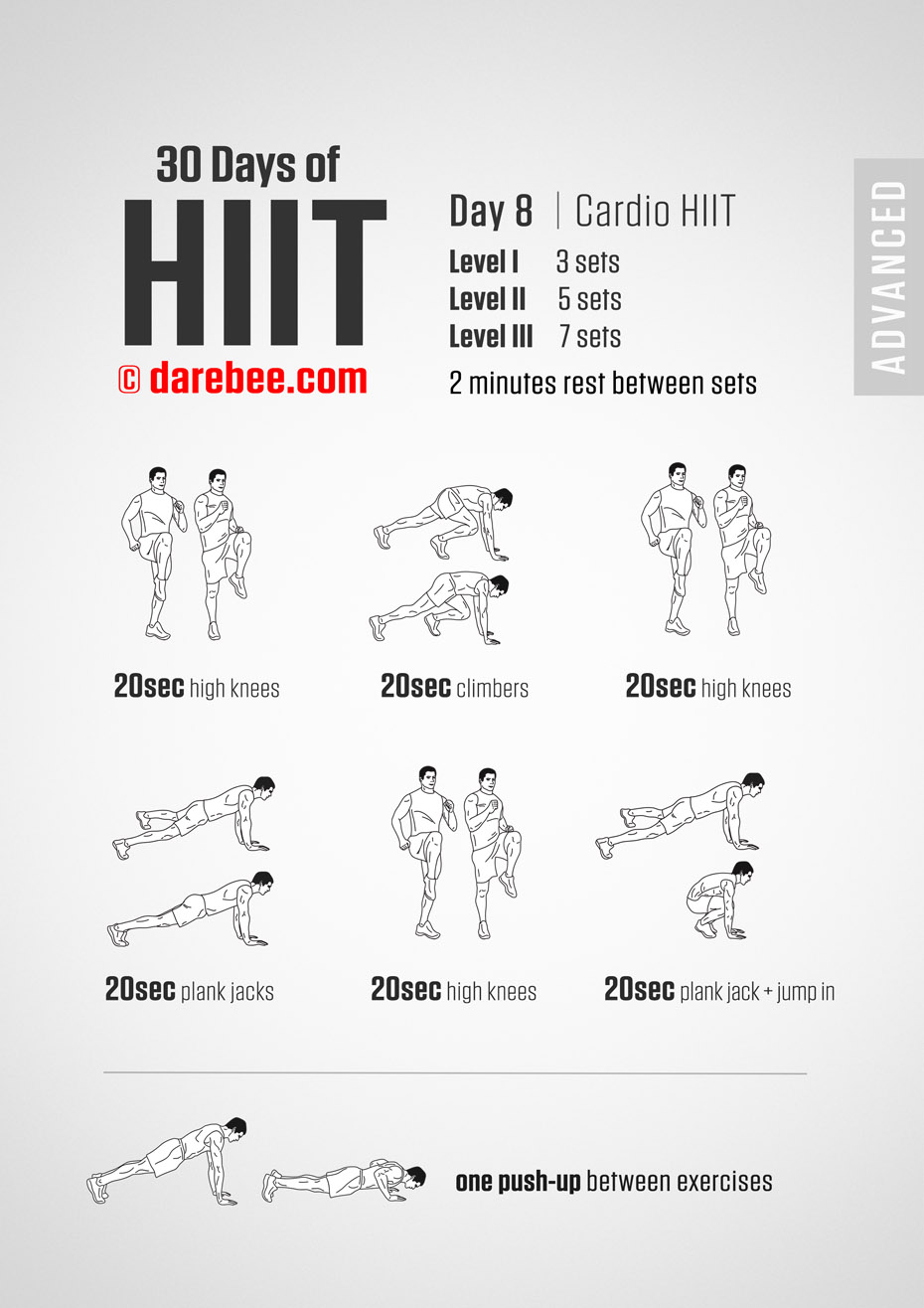
Day 8 threads high knees through the entire session: six 20-second intervals alternating high knees with floor work - climbers, then plank jacks, then plank jack + jump ins - with one push-up owed at every changeover. Level sets as standard: 3, 5 or 7, with 2 minutes between.
The standing intervals never change; the floor ones climb. Climbers are running turned horizontal, plank jacks add a jump to the plank, and the plank jack + jump in stacks a full crouch on top - a three-step staircase built into a single card. Keeping the high knees identical in every other slot is deliberate: they are your fixed measuring stick, and how much those 20 seconds hurt by interval five tells you exactly what the floor work is costing.
In climbers, drive the knees straight forward and keep the hips low - height is wasted effort. Plank jacks jump small and land soft, feet just past shoulder width. In the jump-in version, snap the feet from the jack straight into a crouch beneath the hips and back out again without settling anywhere.
Day 8 sends you to the floor three different ways and raises the rent on every visit.
Make it Harder: Run the plank jack + jump ins as one continuous chain - no pause in the plank, none in the crouch.
Make it Easier: Step the plank jacks out and in one foot at a time.

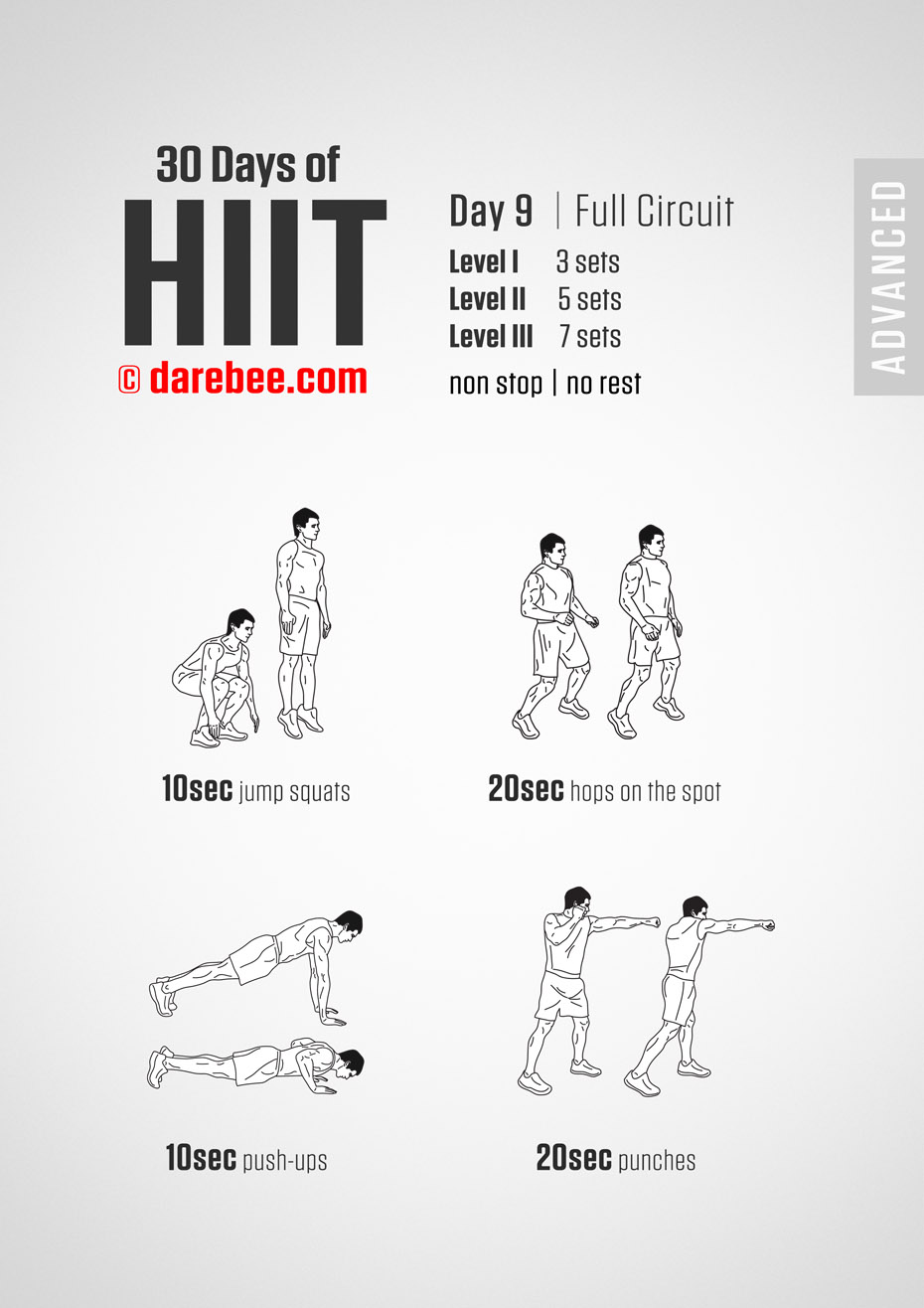
Day 9 is a non-stop circuit with the program's first plyometrics: 10 seconds of jump squats, 20 of hops on the spot, 10 of push-ups, 20 of punches - looped for 3, 5 or 7 unbroken rounds by level.
The pairs manage explosiveness the smart way. Jump squats are the lower body at maximum output; the hops that follow keep the same springs loaded at a fraction of the cost, so the legs stay elastic without redlining. Push-ups then borrow 10 seconds of that reprieve for the upper body, and punches flush the arms while the legs quietly recover underneath - by the time the loop restarts, the jump squats are possible again. Barely.
Land every jump squat soft and balanced - knees tracking over the toes, heels kissing down - and sink to at least parallel before leaving the ground. Hop on the balls of the feet with a quick, quiet bounce. Keep push-ups honest at speed: chest low, body in one line. Punch to full extension and snap back.
Jump, hop, press, punch - Day 9 keeps the whole body on the clock and the meter never stops running.
Make it Harder: Rebound each jump squat straight out of its landing - no reset step between reps.
Make it Easier: Swap the jump squats for regular squats and keep the hops low.

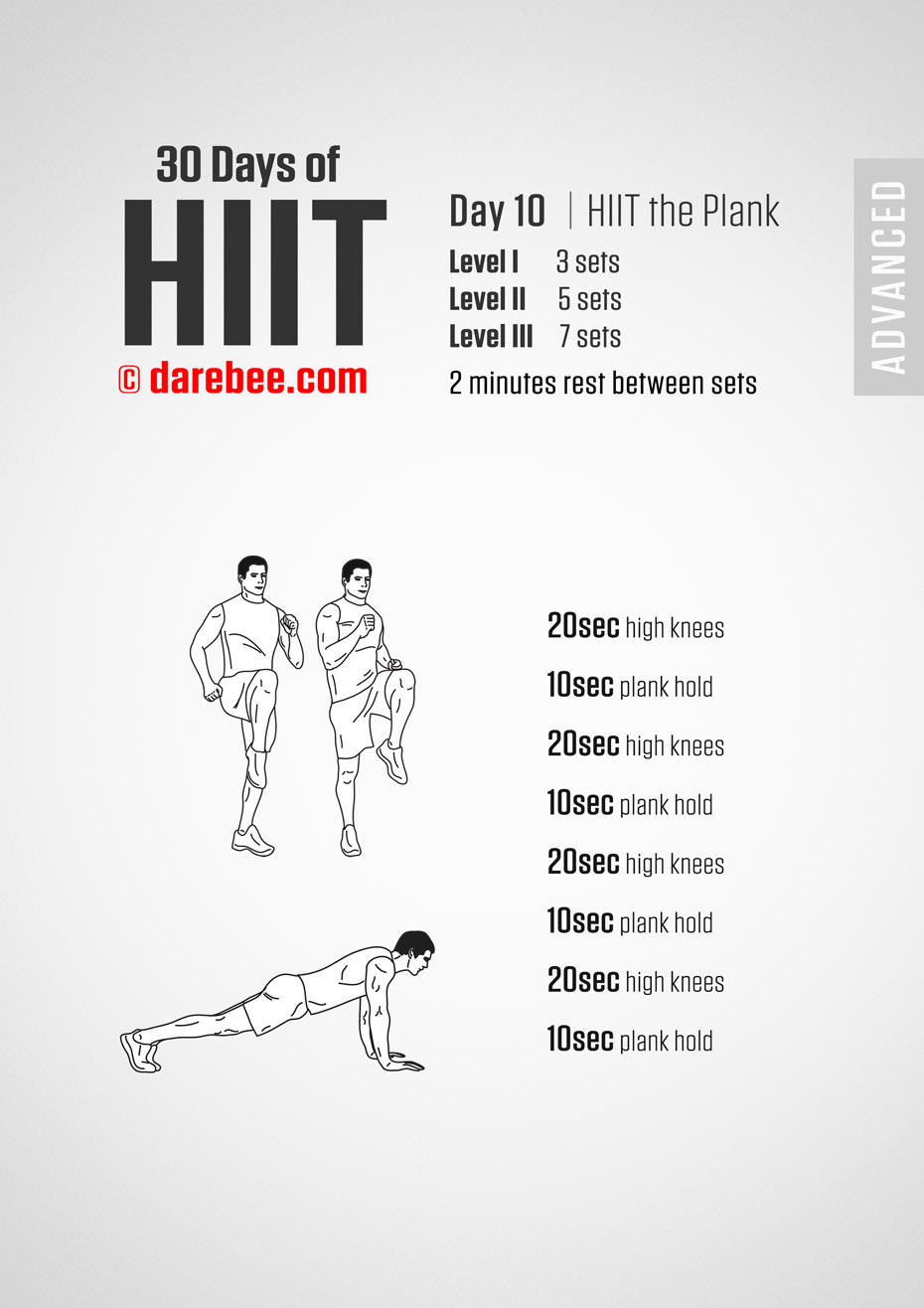
Day 10 introduces the plank days: 20 seconds of high knees, 10 seconds of plank hold, alternating four times per set, at 3, 5 or 7 sets with 2 minutes between. Half of this workout is furious motion. The other half is refusing to move at all.
That contrast is the entire design. Sprinting spikes the heart rate; the plank then demands total stillness on top of that spike - a straight-armed hold, drawn high on the hands, where the challenge is not the position but the composure. Breathing hard and holding steady are usually opposite skills. This card trains them as one, ten seconds at a time, and those ten seconds get longer every time the high knees get faster.
Give the high knees everything - they buy their own rest. Then take the plank seriously as a position: hands under the shoulders, arms locked, one clean line from head to heels, no sag and no pike, breathing loud and staying put. The plank is not a break. It is the second exercise.
Twenty seconds of chaos, ten of stillness - Day 10 grades you on how quickly you can find your composure.
Make it Harder: Hold every plank with your feet together.
Make it Easier: Take the planks from your knees.

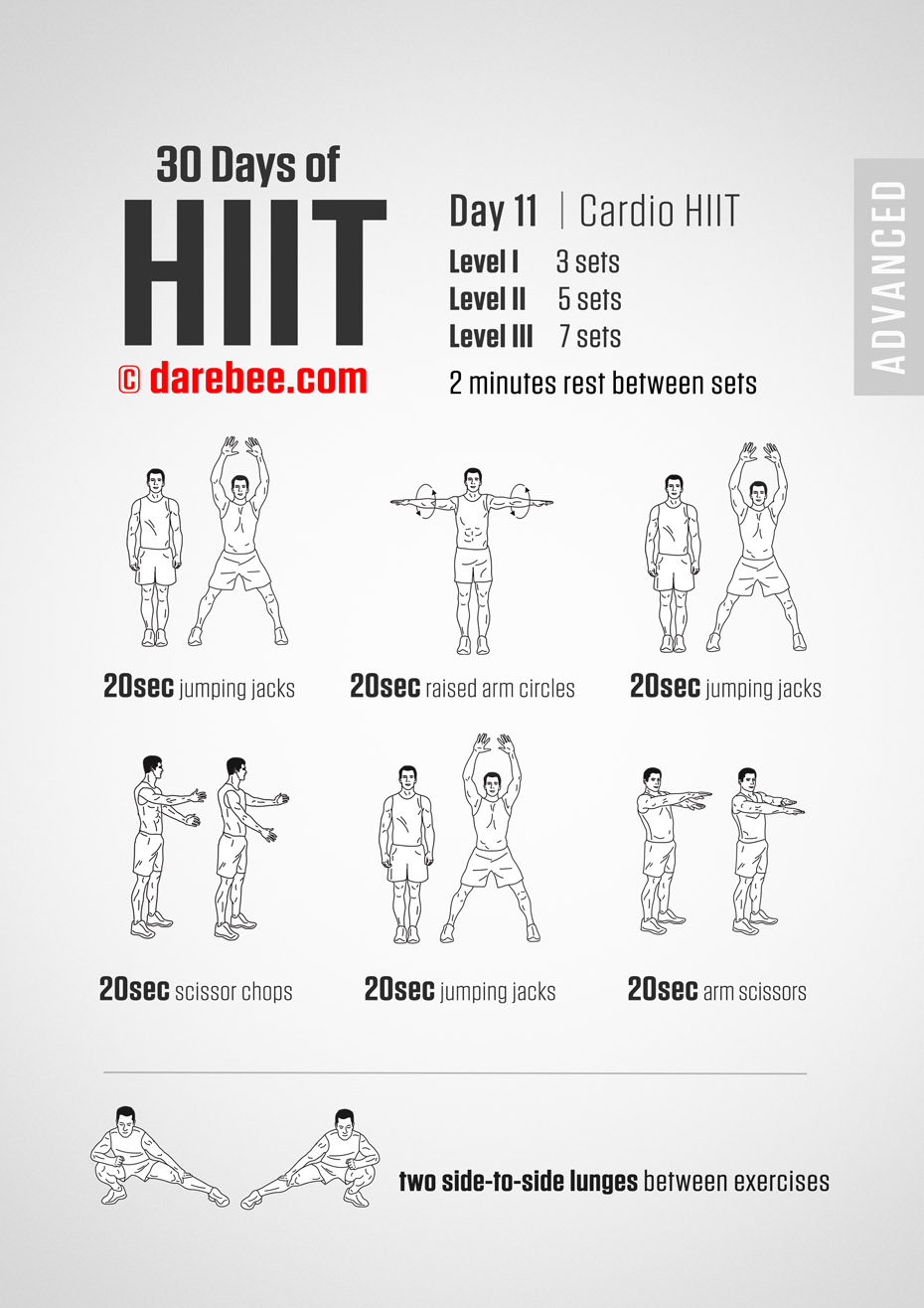
Day 11 never touches the floor. Six 20-second intervals - jumping jacks alternating with raised arm circles, scissor chops and arm scissors - with two side-to-side lunges owed between every exercise. Standard levels apply: 3, 5 or 7 sets, 2 minutes between.
This is a shoulder endurance session in a cardio costume. Every second slot parks the arms at shoulder height and keeps them there: circles rotate them, scissor chops sweep them wide and across in big horizontal arcs, arm scissors cross them straight out front - three different movements, one shared tax of never lowering the arms. The jumping jacks in between are almost a relief, and the side-to-side lunges quietly bill the legs so the arms don't feel singled out.
Arms dead level in all three arm exercises - the moment they droop, the exercise turns into an easier one. Keep the circles tight and continuous, the chops wide and deliberate with alternating cross-overs, the scissors crisp with straight elbows. Sit deep into each side-to-side lunge; the bent leg does the work, the straight leg gets the stretch.
Day 11 keeps your arms at shoulder height for a whole workout - by the final set, that single clause is the entire workout.
Make it Harder: Keep both arms perfectly straight and level through circles, chops and scissors - no elbow bend, no matter what the fatigue suggests.
Make it Easier: Take one side-to-side lunge between exercises instead of two.

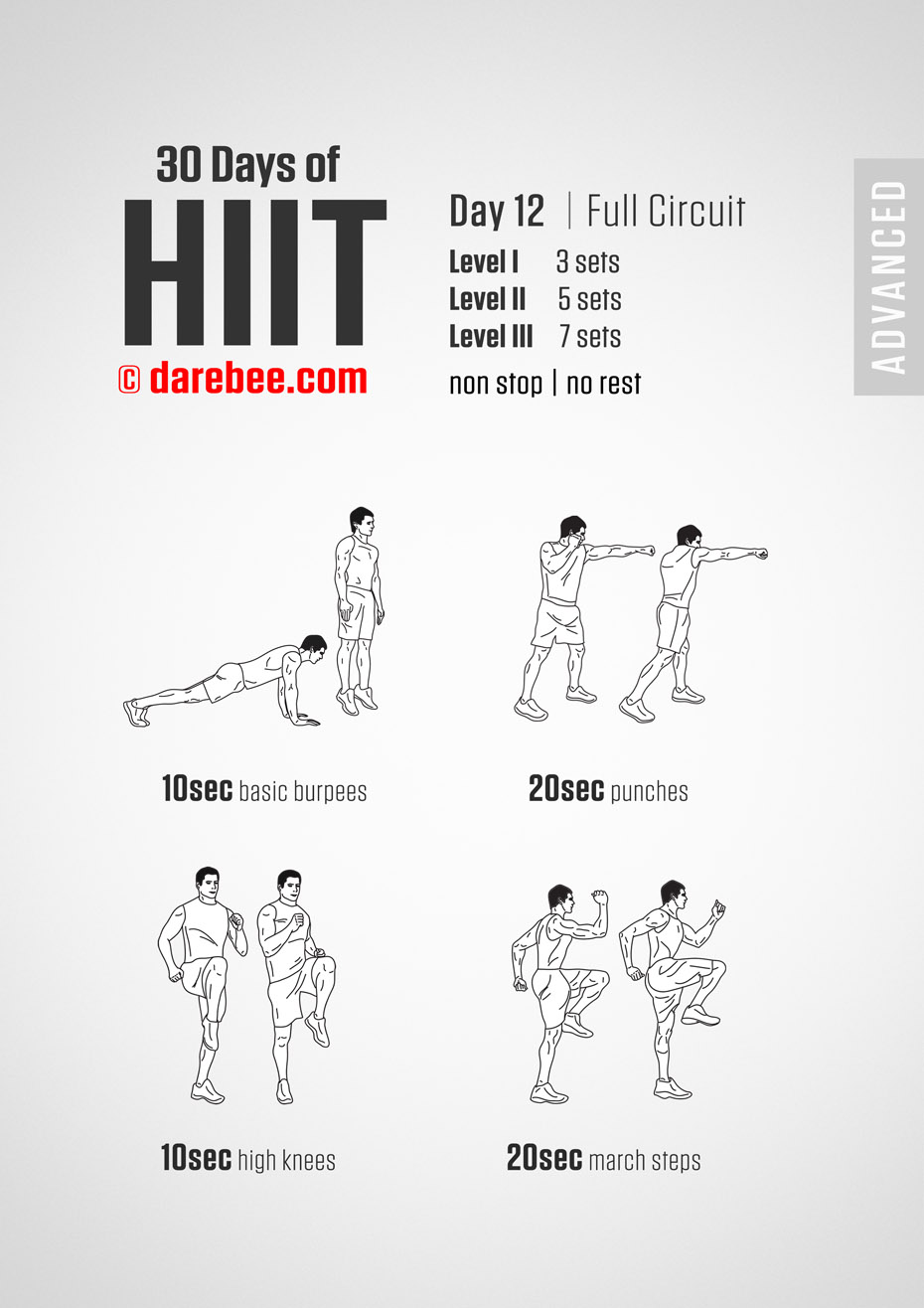
Day 12 puts burpees inside a non-stop circuit for the first time: 10 seconds of basic burpees, 20 of punches, 10 of high knees, 20 of march steps, looped without a break for your level's 3, 5 or 7 rounds.
The clock is doing something clever here. Ten seconds of burpees is only three or four reps - a completely manageable number - but on a non-stop day they are never the last three or four; the circuit swings back around, again and again, and each visit starts from a slightly higher heart rate than the one before. The punches and march steps between them are standing recovery in disguise, keeping the arms and legs busy while the engine claws back what the burpees took.
Make each burpee complete even at speed: flat hands, straight-line plank, feet all the way back in, hips open at the top. Punch with structure rather than flailing - guard up, rotation from the hips. And when the march steps arrive, use them: breathe deep and deliberate, because the next burpee window is ten seconds closer than it feels.
Three or four burpees at a time sounds like mercy - the non-stop loop is how the program repossesses it.
Make it Harder: Set a hard floor of four burpees in every 10-second window.
Make it Easier: Cut the stand-up from the burpees: squat, kick back, return, go again.

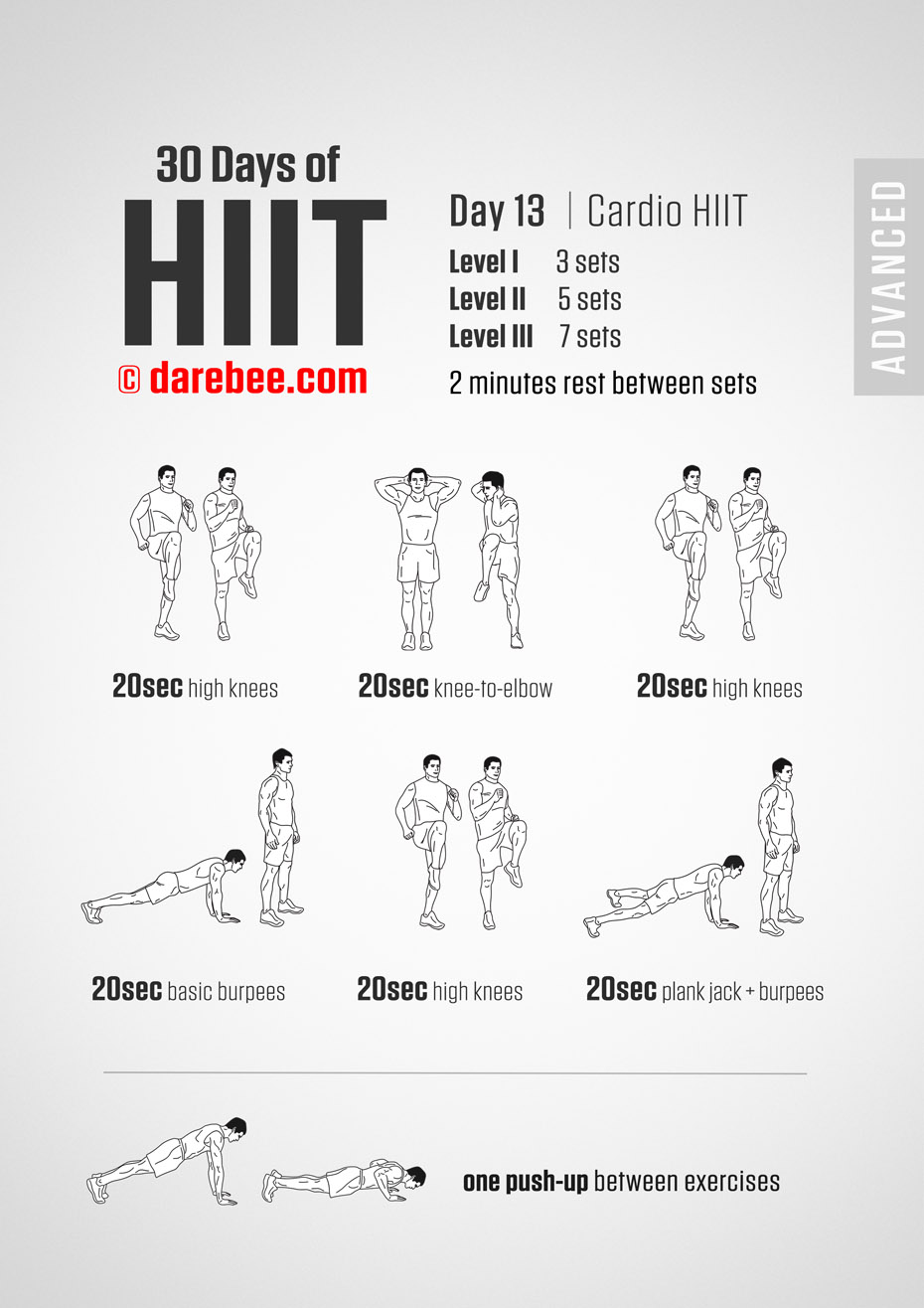
Day 13 runs high knees in every odd slot and escalates everything in between: 20 seconds each of high knees, knee-to-elbow, high knees, basic burpees, high knees, plank jack + burpees - one push-up owed between exercises, 3, 5 or 7 sets by level, 2 minutes between sets.
It is Day 8's architecture with tougher tenants. The unchanging high knees still act as the measuring stick, but the alternating slots now climb from a standing cross-body crunch - knee driving up to meet the opposite elbow - through basic burpees to the plank jack + burpee, a compound that splices a jack into the bottom of every rep. Each slot demands more than the last while the recovery between them stays exactly the same size, which is a polite way of saying it shrinks.
In knee-to-elbow, keep the hands behind the head and bring the knee up to the elbow rather than folding the elbow down - stay tall through the crunch. Burpees keep their full shape at speed. In the plank jack + burpee, hit the jack crisply at the bottom - feet out, feet in - before jumping back to the crouch; blurring it into a shuffle wastes the exercise.
The high knees never change and everything between them gets meaner - that is Day 13 in a single sentence.
Make it Harder: Add a jump at the top of every plank jack + burpee.
Make it Easier: Run basic burpees in both burpee slots.

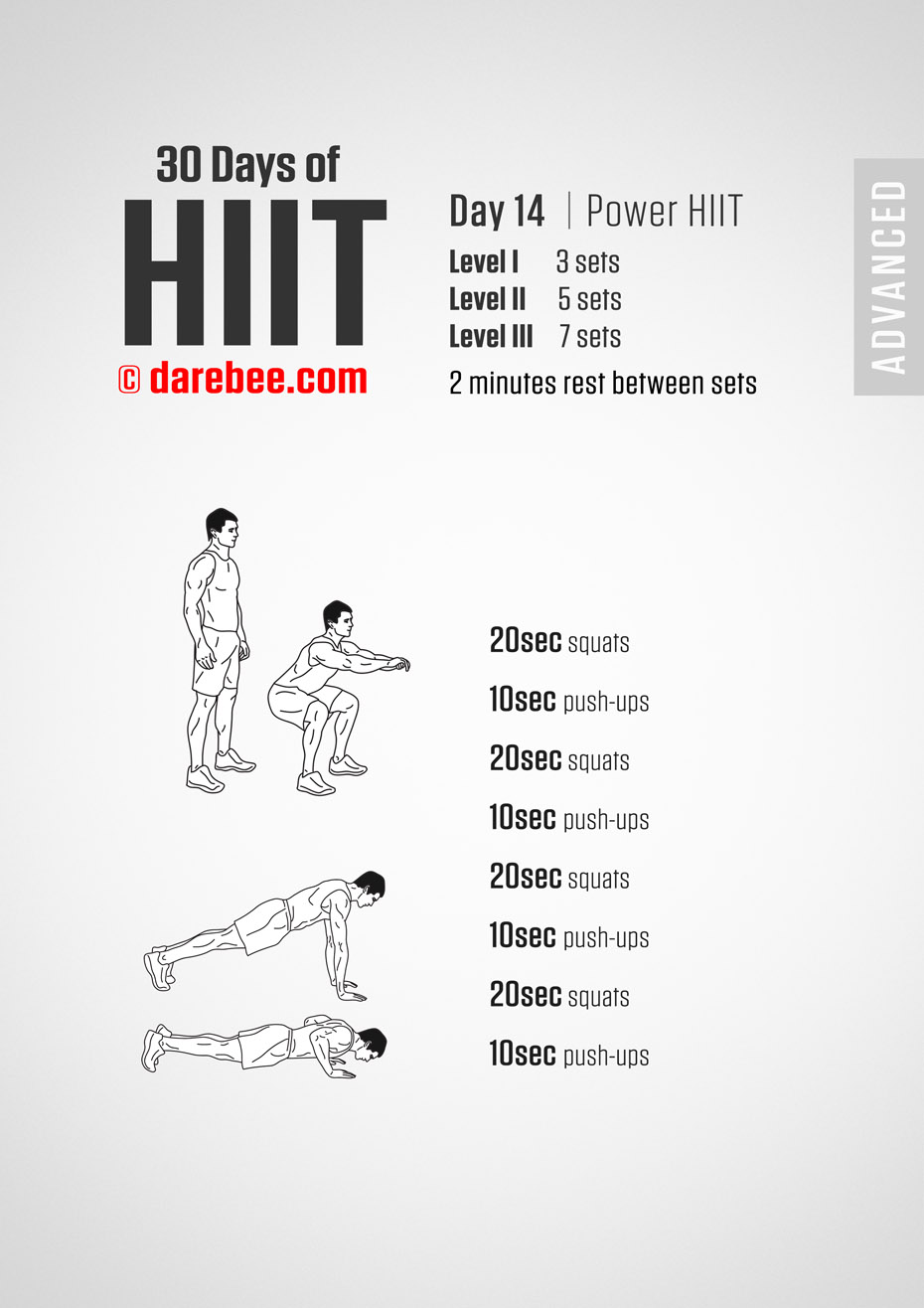
Day 14 is Power HIIT with no decoration: 20 seconds of squats, 10 seconds of push-ups, alternating four times per set - 3, 5 or 7 sets by level, 2 minutes between. Two exercises, one clock, zero fine print.
The split follows the program's standing logic - legs take the long intervals because big muscles are expensive to run, the upper body takes short sharp ones - but compressing it into a two-exercise cycle changes the texture. There is no third movement to hide behind: every half-minute block is squat fatigue feeding directly into push-up fatigue and straight back again, four cycles per set, and by the last cycle both exercises are negotiating with the same empty tank.
Squats: heels heavy, chest up, at least to parallel, arms reaching forward for counterbalance exactly as drawn. Push-ups: hands under the shoulders, elbows tracking back, chest to a fist's height from the floor. Ten seconds is four to six honest reps - honest being the operative word.
Squats and push-ups until the timer says otherwise - the best workouts often have the shortest job descriptions.
Make it Harder: Take every squat below parallel.
Make it Easier: Swap every second push-up interval for a plank hold.

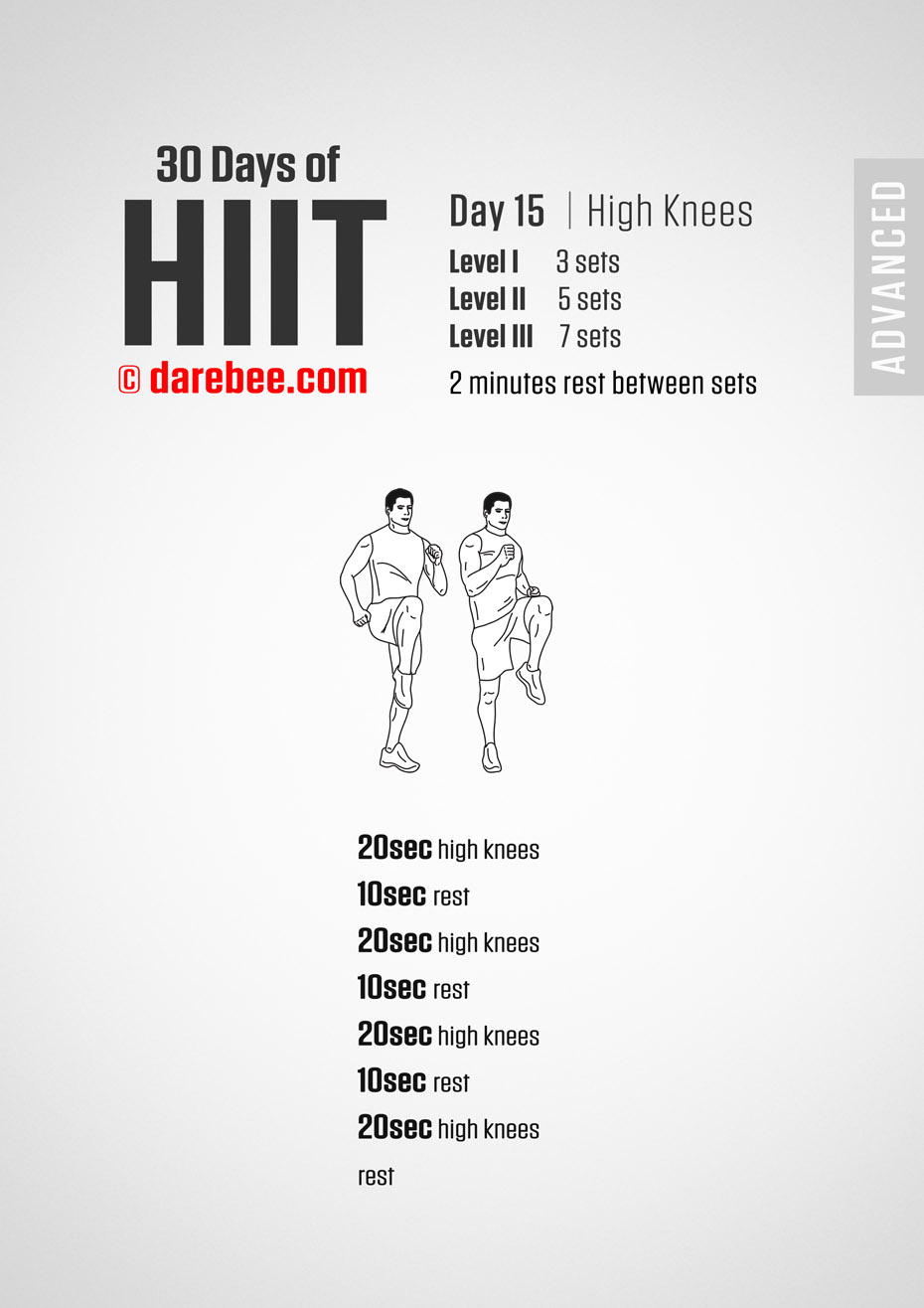
The halfway marker is a single exercise. Day 15 runs high knees in a 20 seconds on, 10 seconds off ladder - four work intervals per set, 3, 5 or 7 sets by level, 2 minutes between. No combinations, no floor, no variety: just you and your top speed, examined.
High knees are the program's most-used movement, and today explains why: they are pure engine work, scalable to any effort level, with nowhere for technique to hide a slow pace. Fifteen days in, this is deliberately a checkpoint - the same legs that ran Day 1's intervals now get a clean, uncluttered read on what has changed. Pacing is the hidden skill: the athlete who sprints interval one and jogs interval four learns less than the one who makes all four match.
Knees to hip height, on the balls of the feet, arms pumping in rhythm - the arms set the tempo and the legs follow. Land light. Use the 10-second windows for breath, not posture collapse: hands stay off the knees, chest stays up, and the next interval starts on time.
Half the program behind you and one question in front: how fast are you when there is nothing else to think about?
Make it Harder: Apply the no-fade rule: the fourth interval of every set must match the first for speed.
Make it Easier: Jog the intervals - lower knees, steady rhythm, full time on the clock.

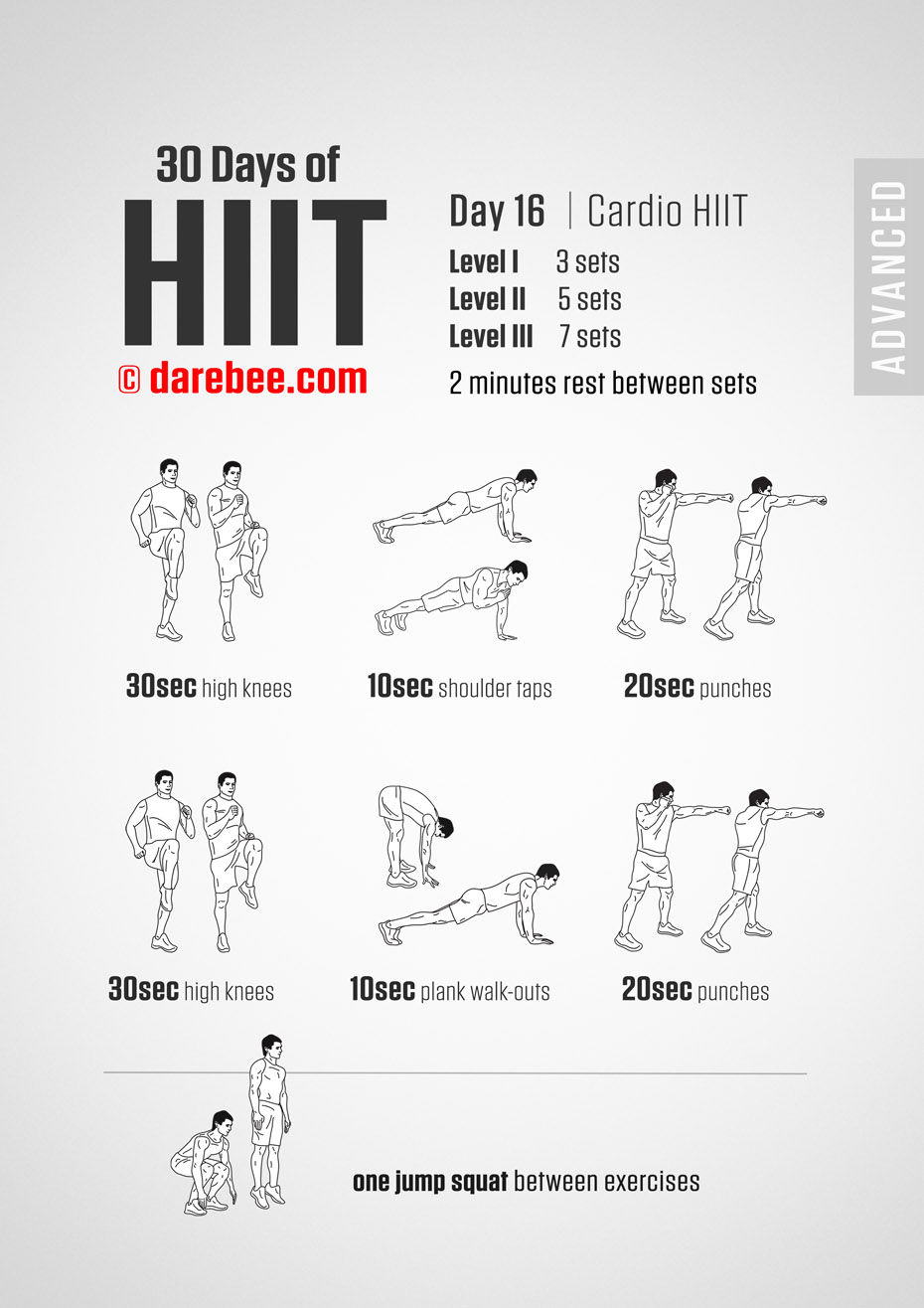
Day 16 smuggles week four into week three. The pattern per set: 30 seconds of high knees, 10 of shoulder taps, 20 of punches, 30 more seconds of high knees, 10 of plank walk-outs, 20 of punches - with one jump squat between every exercise, at 3, 5 or 7 sets by level and 2 minutes between sets.
Those 30-second high knee intervals are the first of their kind in the program - half again longer than anything before them, and a deliberate preview of the final week's clock. The 10-second floor visits work as pivots: quick plank shoulder taps the first time through, then plank walk-outs - fold at the hips, walk the hands out to a full plank, walk them back and stand - which stretch the whole back line while the heart pounds. The punches on either side keep the hands busy and the recovery honest.
Settle into the 30-second high knees a notch below your 20-second pace - they should still hurt, just for longer. In the walk-outs, keep the feet planted and take the hands all the way out to a full plank before returning; the drawing folds deep, so let the hamstrings have their say. Punches stay sharp, and the connective jump squat stays real: full crouch, full jump.
Consider Day 16 a postcard from week four - the 30-second intervals arriving early to introduce themselves.
Make it Harder: Keep the legs dead straight on every plank walk-out.
Make it Easier: Walk the hands out only halfway before walking back.

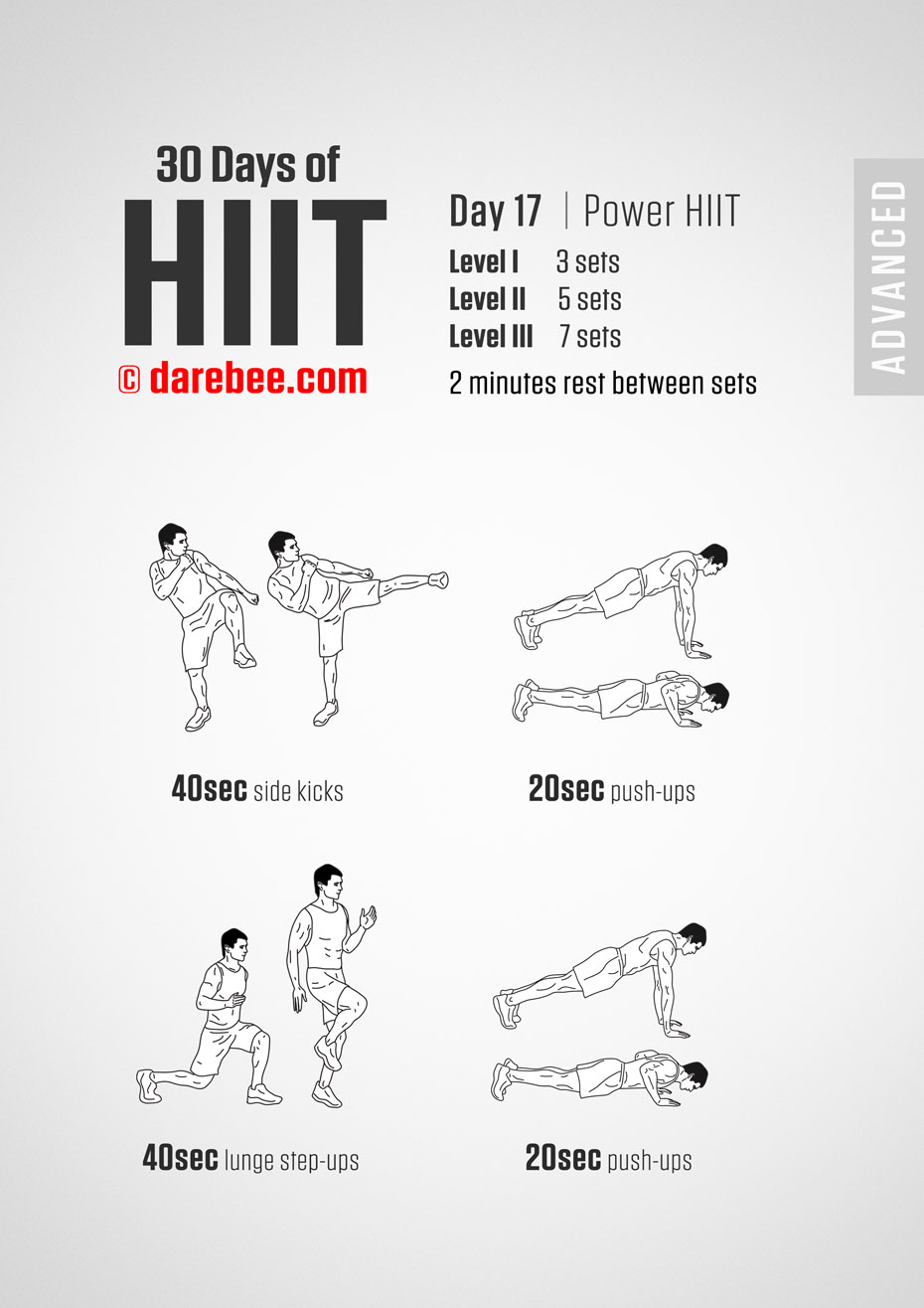
Day 17 reruns the 40/20 Power format with new legs: 40 seconds of side kicks, 20 of push-ups, 40 of lunge step-ups, 20 more of push-ups - at 3, 5 or 7 sets with 2 minutes between.
Both long intervals are single-leg work, which doubles their price. Side kicks return from Day 2, chambering and firing one leg while the other balances everything; lunge step-ups are new - drop into a lunge, then drive up off the front leg into a knee raise, a movement that is half strength, half spring. Forty seconds means roughly twenty seconds per leg of each, and the push-ups in between arrive on a body that never quite got its balance back.
Kicks: knee up, extend, re-chamber - the fold matters as much as the strike, and both sides get equal time. In lunge step-ups, the front heel drives the whole ascent; bring the back knee through to hip height with intent. Push-ups keep full range even as the totals climb - the program is watching the second interval, not the first.
Forty seconds on one leg at a time, twice over - Day 17 is leg day travelling under a HIIT passport.
Make it Harder: Add a hop at the top of every lunge step-up knee drive.
Make it Easier: Step through the lunges at walking pace and leave out the knee drive.

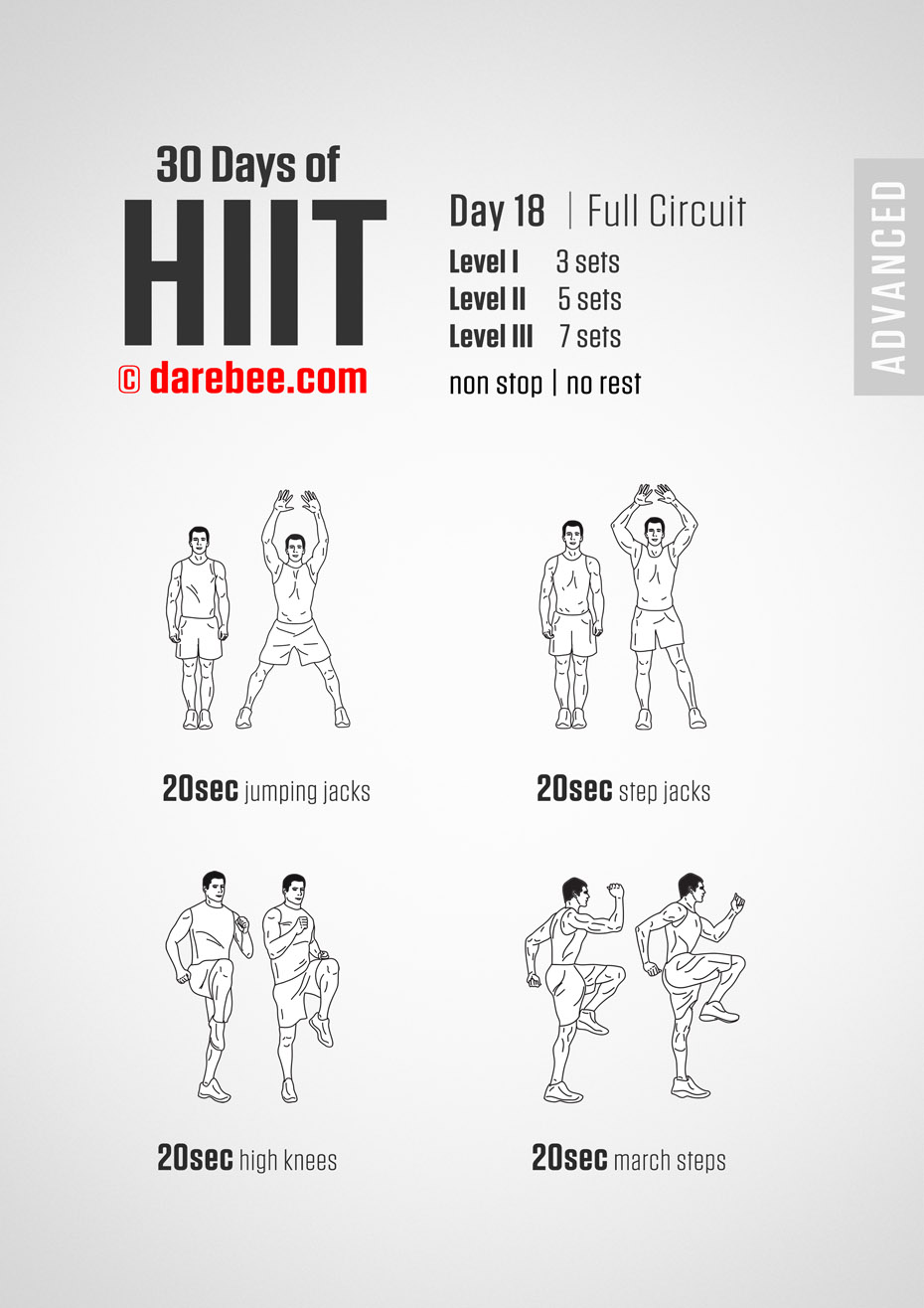
Day 18 is Day 6's circuit with the deal removed: jumping jacks, step jacks, high knees and march steps, all at 20 seconds now, looped non-stop for 3, 5 or 7 rounds. The short sprints are gone - every interval is the same length, and none of them is short.
Doubling the 10-second bursts to 20 changes the circuit's character completely. On Day 6 the sprints were over before they registered; here the jumping jacks and high knees run long enough to demand pacing, while the step jacks and march steps - the supposed recovery - stay exactly as long as the work. The circuit has stopped alternating between hard and easy and started alternating between hard and slightly-less-hard, which is week three's whole personality.
Hold full range on the jacks deep into each interval - reach tall, land wide. Keep the high knees a genuine run. And make the recovery intervals earn their name: big arm drive on the march steps, complete overhead arcs on the step jacks, breathing deep and deliberate throughout.
Same four exercises as Day 6 with the sprints grown to match the cruises - the circuit no longer offers discounts.
Make it Harder: Change exercises mid-stride - no micro-pause at any changeover.
Make it Easier: Trim every interval to 15 seconds and keep the loop unbroken.

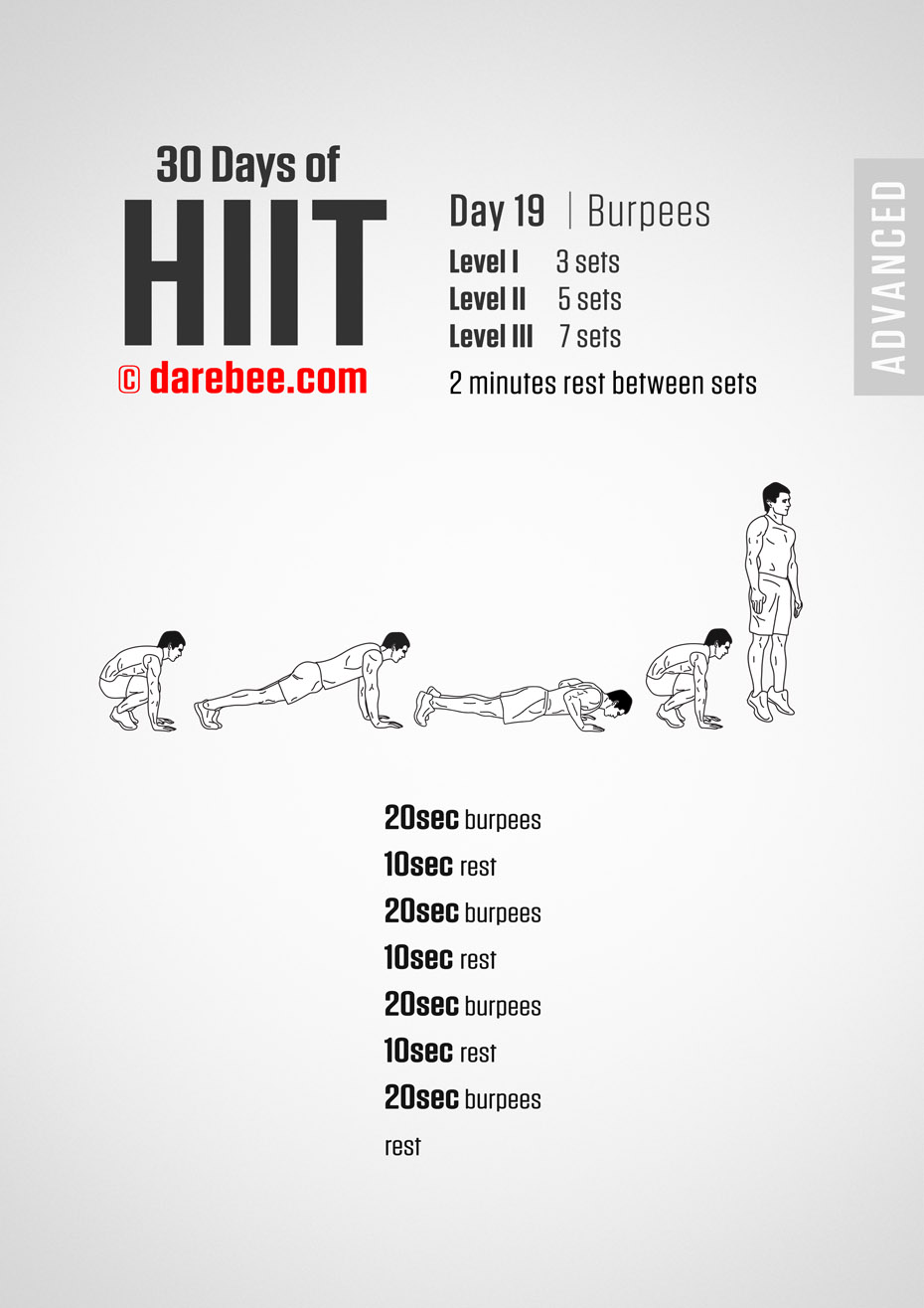
Day 19 looks like Day 5 from across the room - burpees, 20 seconds on, 10 off, four intervals per set at your level's 3, 5 or 7 sets - but the drawing tells the real story: these burpees carry a push-up in the middle. Squat, kick back, chest to the floor, back in, stand. The clock stayed. The rep grew.
That single addition rewrites the day's economics. A basic burpee cycles in about two seconds flat; putting a full push-up at the bottom nearly doubles the work per rep and drags the chest, arms and shoulders into what used to be a legs-and-lungs affair. Fewer reps will fit in each window and that is expected - the program is trading rep count for rep cost, the same exchange it has been teaching since the intervals started growing.
Keep the push-up real inside the rep: plank first, chest all the way down, full press back up before the feet jump in - a nodding head over bending elbows does not count. Everything else follows Day 5's standards: flat hands, straight plank line, complete stand at the top. Rhythm over panic, always.
Two weeks ago this clock carried basic burpees - today every rep touches its chest to the floor, and that difference is the fortnight, measured.
Make it Harder: Jump the feet back into a tight, braced plank and snap them straight back in - no lazy kick-backs.
Make it Easier: Take one full breath at the top of every rep before dropping into the next.

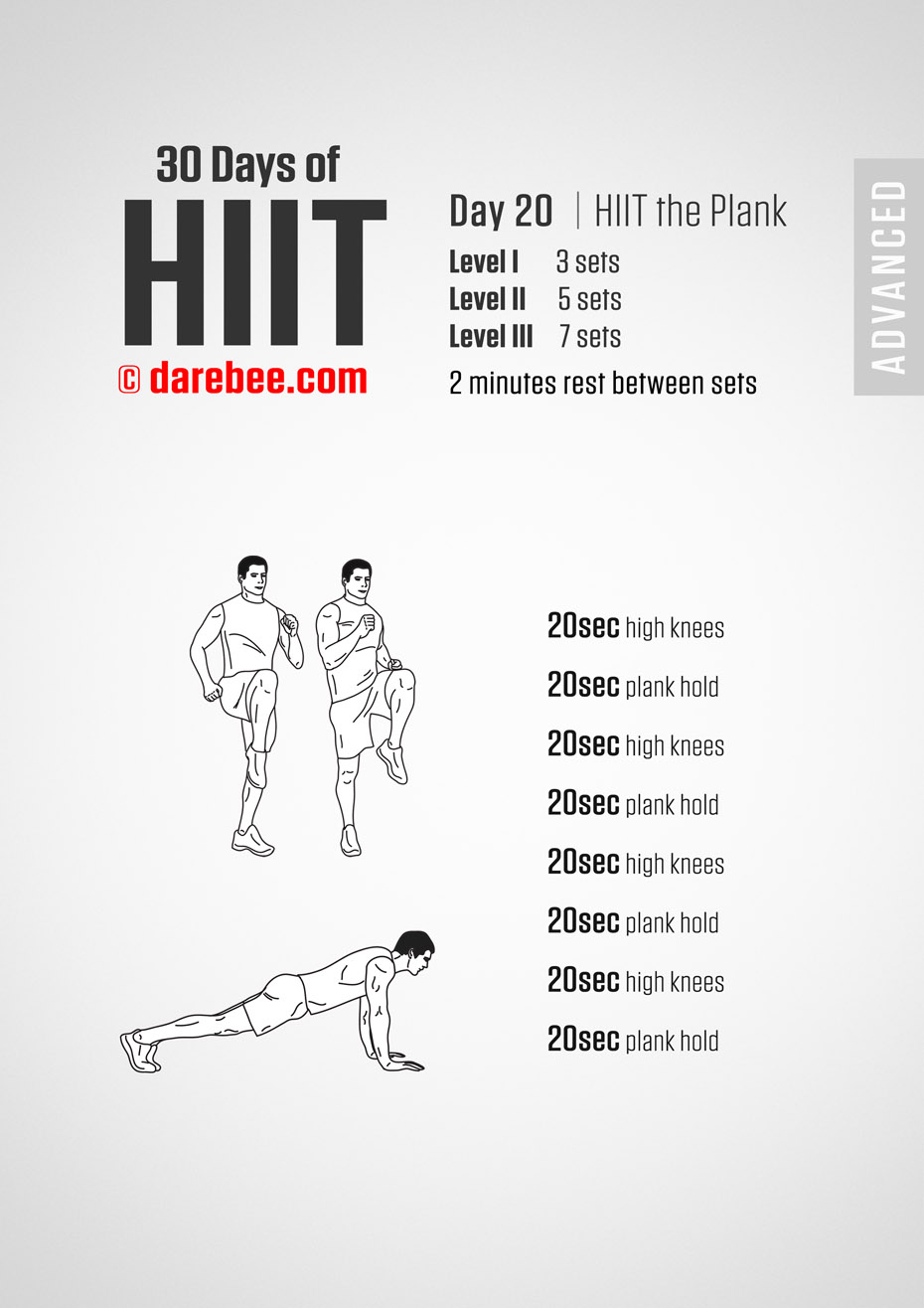
Day 20 doubles the stillness. The plank day returns as 20 seconds of high knees against 20 seconds of plank hold, four of each per set - even odds now, where Day 10 gave the plank only ten seconds - at 3, 5 or 7 sets with 2 minutes between.
Progressing a plank by length rather than variation is the cleanest test there is: the position is identical to Day 10's - straight arms, body in one line - only now it must survive twice as long on the same racing heart rate. The even 20/20 split also does something psychological: half of every set is now spent choosing not to move, and choosing it while the lungs argue is precisely the composure this day type exists to build.
Sprint the high knees exactly as if the plank were not coming. Then build the plank the same way every time: hands under the shoulders, arms locked, glutes and core braced, one line from head to heels. Pick a spot on the floor, breathe long and loud, and let the 20 seconds pass through you rather than fighting each one individually.
Day 10 let you off the plank in ten seconds - Day 20 doubles the sentence and calls it progress, because it is.
Make it Harder: Turn every second plank hold into a side plank, alternating sides.
Make it Easier: Set the feet wide apart in every plank.

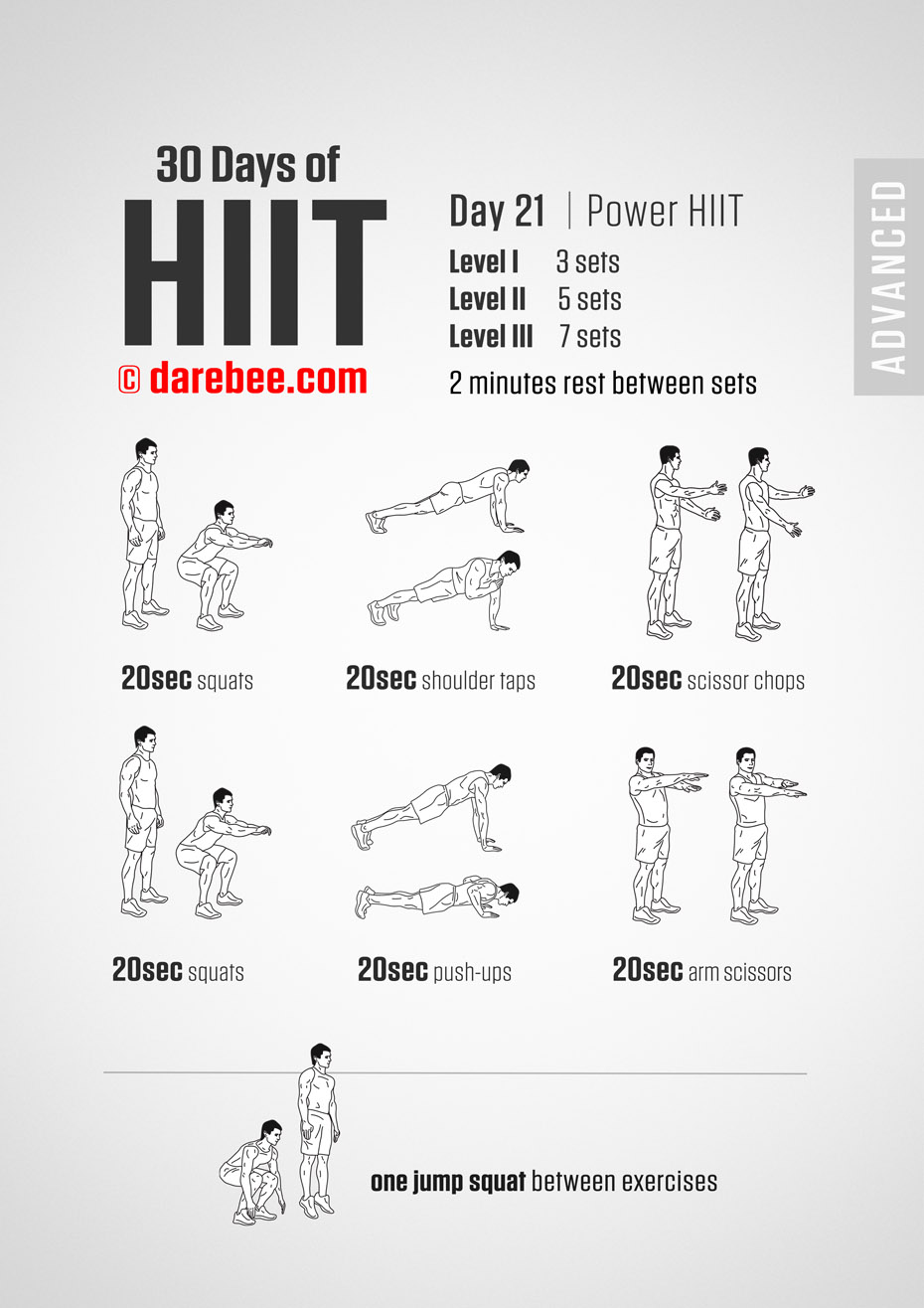
Day 21 merges the program's two upper-body threads into one Power session: 20-second intervals of squats, shoulder taps, scissor chops, squats again, push-ups and arm scissors, with a jump squat owed between every exercise - 3, 5 or 7 sets, 2 minutes between.
The card is a deliberate hybrid: Day 4's strength grid supplies the squats, the plank shoulder taps and the push-ups, while Day 11's endurance work supplies the scissor chops and arm scissors that park the arms at shoulder height and leave them there. Alternating between the two threads means the shoulders never get a clean break - they stabilise a plank one interval and hold a level sweep the next - while the twin squat intervals and the connective jump squats keep the legs paying their share throughout.
Squat depth stays constant across both intervals. Plank taps: hips square, no rocking. Chops sweep wide and cross with intent; scissors stay straight-armed and level - both live or die on the arms refusing to sink. Push-ups run full range, and every connective jump squat gets a real crouch and a real jump.
Strength work and shoulder endurance take turns all session - Day 21 is two earlier workouts agreeing to split the bill.
Make it Harder: Replace both 20-second squat intervals with jump squats.
Make it Easier: Squat to a chair and stand back up - full reps at a guaranteed, friendlier depth.

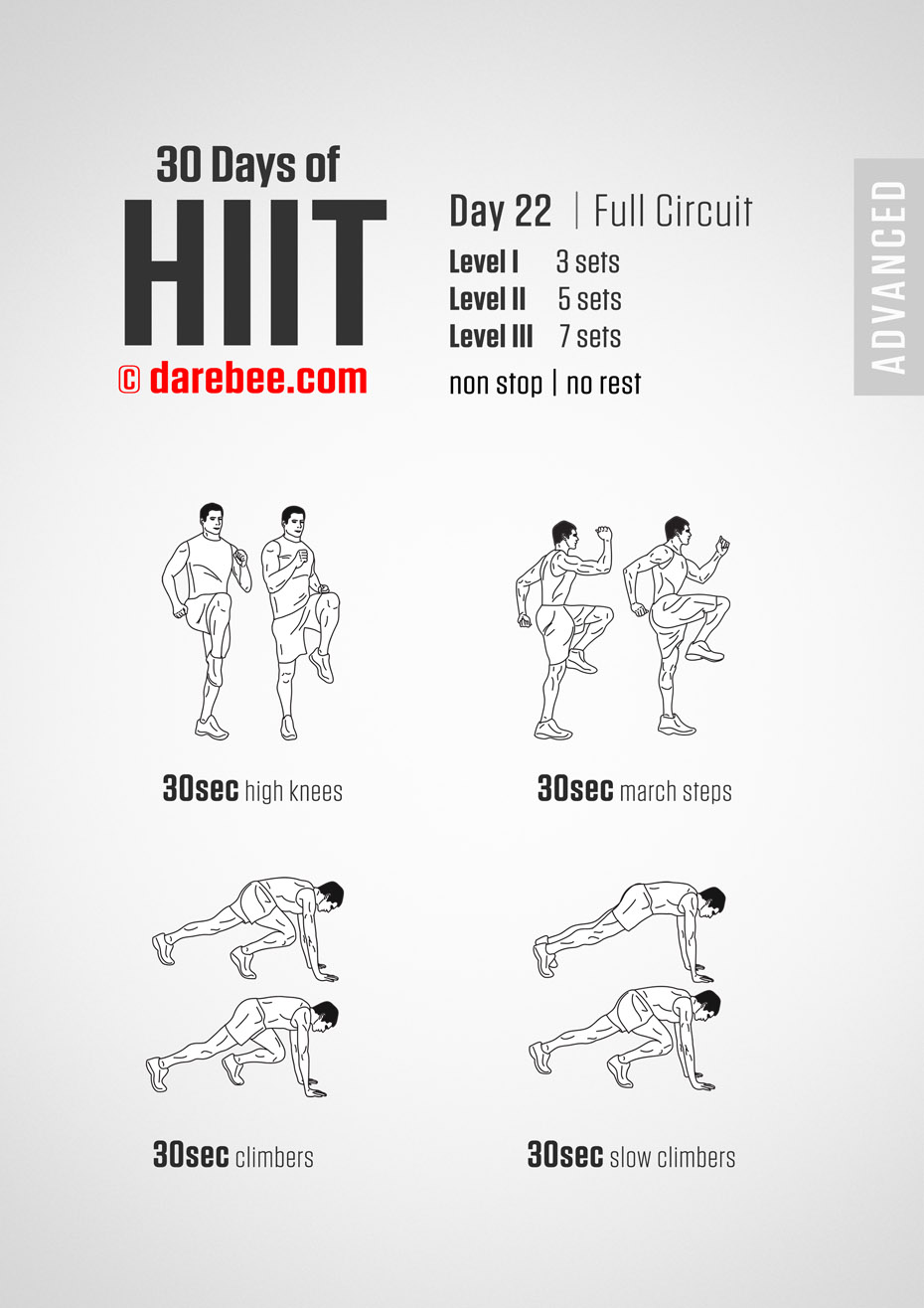
Week four opens by upgrading the oldest circuit in the book. Day 22 is Day 3's exact lineup - high knees, march steps, climbers, slow climbers - with every interval now at 30 seconds, looped non-stop for 3, 5 or 7 rounds. No rest between exercises, none between loops, and no more short sprints to hide inside.
The 10/20 gear-change structure is gone; in its place sit four equal 30-second gears that blur the line between sprint and cruise. Thirty seconds of climbers cannot be attacked the way ten could - it has to be paced, sustained, survived - and the march steps and slow climbers that used to be recovery now run long enough to become work in their own right. Two minutes per loop, entirely unbroken: this is the endurance version of a circuit you first met as a sprint drill.
Open each 30-second interval at a pace you can defend to its end - the final ten seconds are where the interval actually lives. March steps stay tall and driven. Keep the hips low through both climber speeds, and make the slow climbers full and deliberate: long knee drives, no shrinking range as the loops stack up.
On Day 3 this circuit dealt in ten-second problems - now every problem runs thirty seconds and the only answer is still 'keep moving'.
Make it Harder: Drive the knees all the way to the chest on every fast climber.
Make it Easier: Return to Day 3's clock - 10-second sprints, 20-second cruises - and keep the loops non-stop.

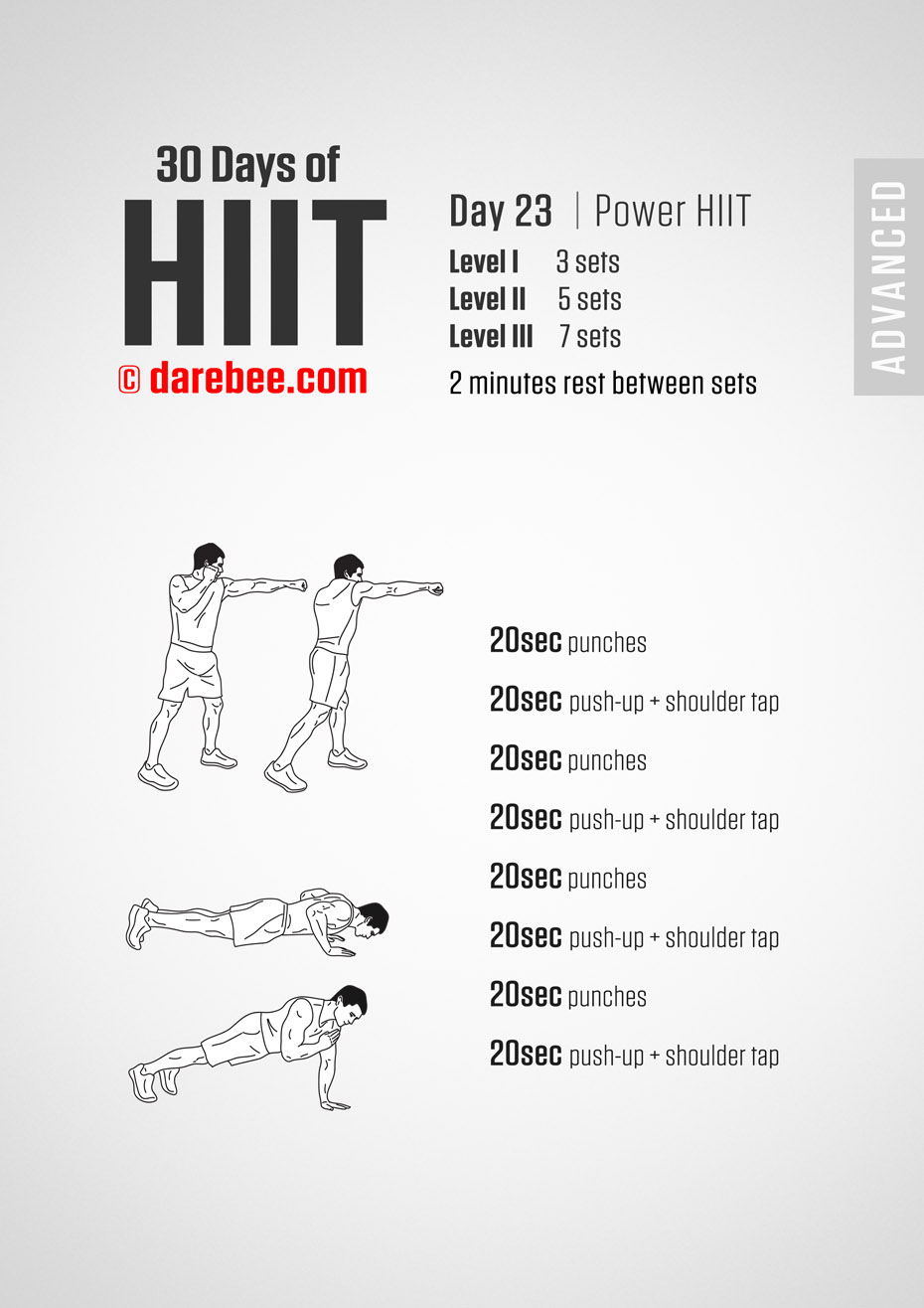
Day 23 is Day 7 with the hard half doubled: 20 seconds of punches alternating with 20 seconds of push-up + shoulder taps, four of each per set, at 3, 5 or 7 sets with 2 minutes between. The punches kept their old length. The combinations did not.
Growing only one half of a pairing is surgical progression - the program looked back at Day 7 and decided the push-up + shoulder tap intervals were the point. At 20 seconds each they now fit six or seven full cycles instead of three, which quietly multiplies the session's pressing volume while the punch intervals change role: no longer the main event, they are the breathing space between floor visits, and they still keep the shoulders warm enough that nothing ever feels fresh.
The combination standard holds at double length: complete push-up, locked-out arms, then the tap with the hips level - in second twenty just as in second one. Feet wide in the plank. Punch with shape between rounds: guard up, full extension, rotation from the hips, using the interval to breathe without ever stopping.
The punches didn't change; the push-up intervals doubled - which tells you exactly which half of Day 7 the program considered the point.
Make it Harder: Lower every push-up to a two-inch hover above the floor before the tap.
Make it Easier: Alternate the combination intervals: one with the push-up, the next with plank shoulder taps only.

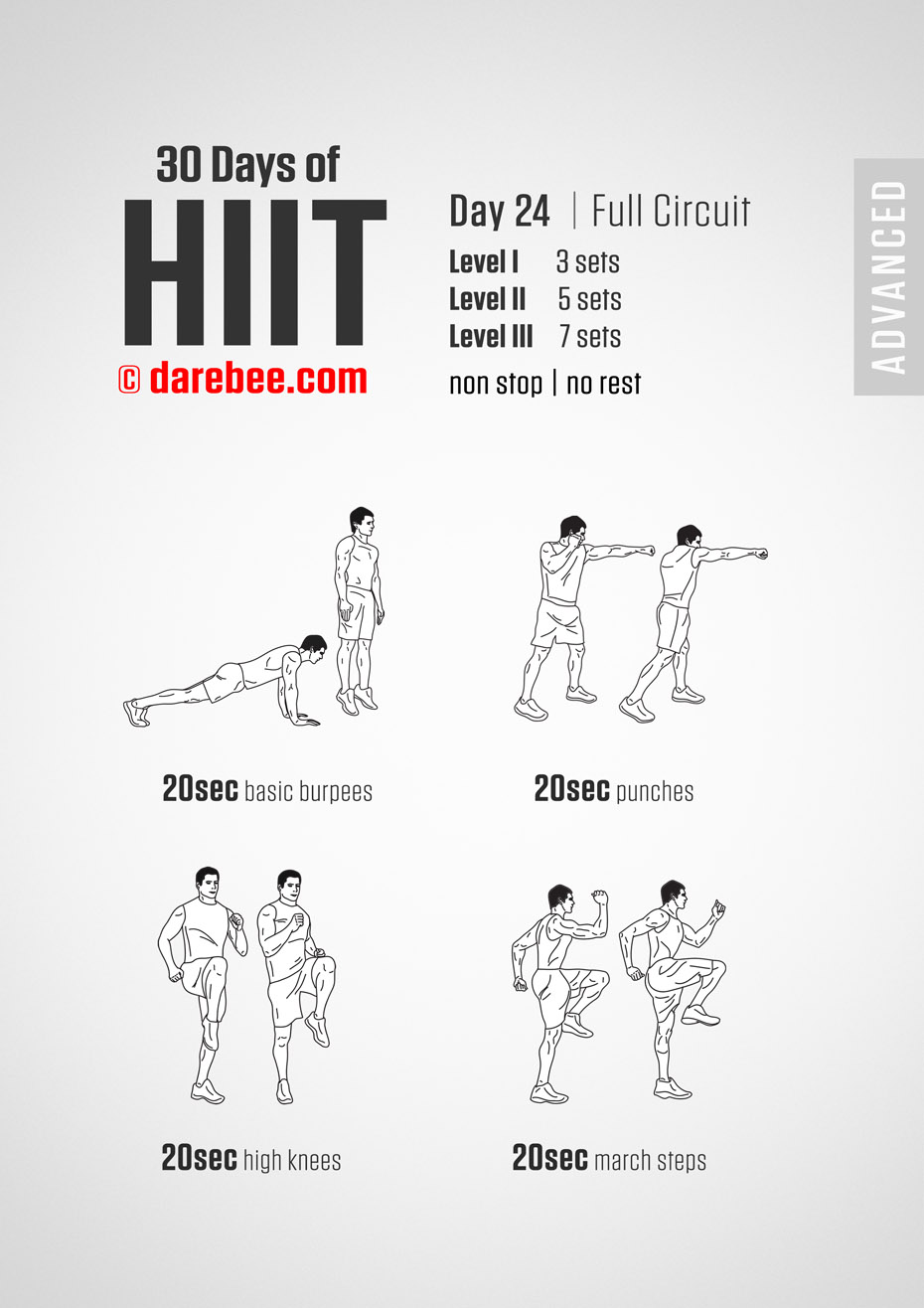
Day 24 doubles Day 12's sprints inside the same no-rest loop: 20 seconds each of basic burpees, punches, high knees and march steps, run continuously for 3, 5 or 7 rounds. What were 10-second visits from the burpees and high knees are now full 20-second stays.
The growth lands exactly where it hurts. Twenty seconds of burpees is six or seven reps, every loop, with nothing but moving recovery on either side - and the high knees, once a quick burst, now run long enough to compete with the burpees for the legs' attention. The punches and march steps stayed at 20, which means the circuit's work-to-recovery balance just tipped from one-hard-in-three to every-other - and on a non-stop day, that tip is everything.
Burpees keep full shape or the reps don't count: plank line, feet fully in, complete stand. Guarded, rotating punches. Genuine running form on the high knees. And breathe on purpose during the march steps - the next burpee window is the whole reason those 20 seconds exist.
Day 12's ten-second sprints doubled overnight, and the no-rest rule didn't move an inch.
Make it Harder: Move up a level - if you planned five loops, run seven.
Make it Easier: Allow yourself ten seconds between loops.

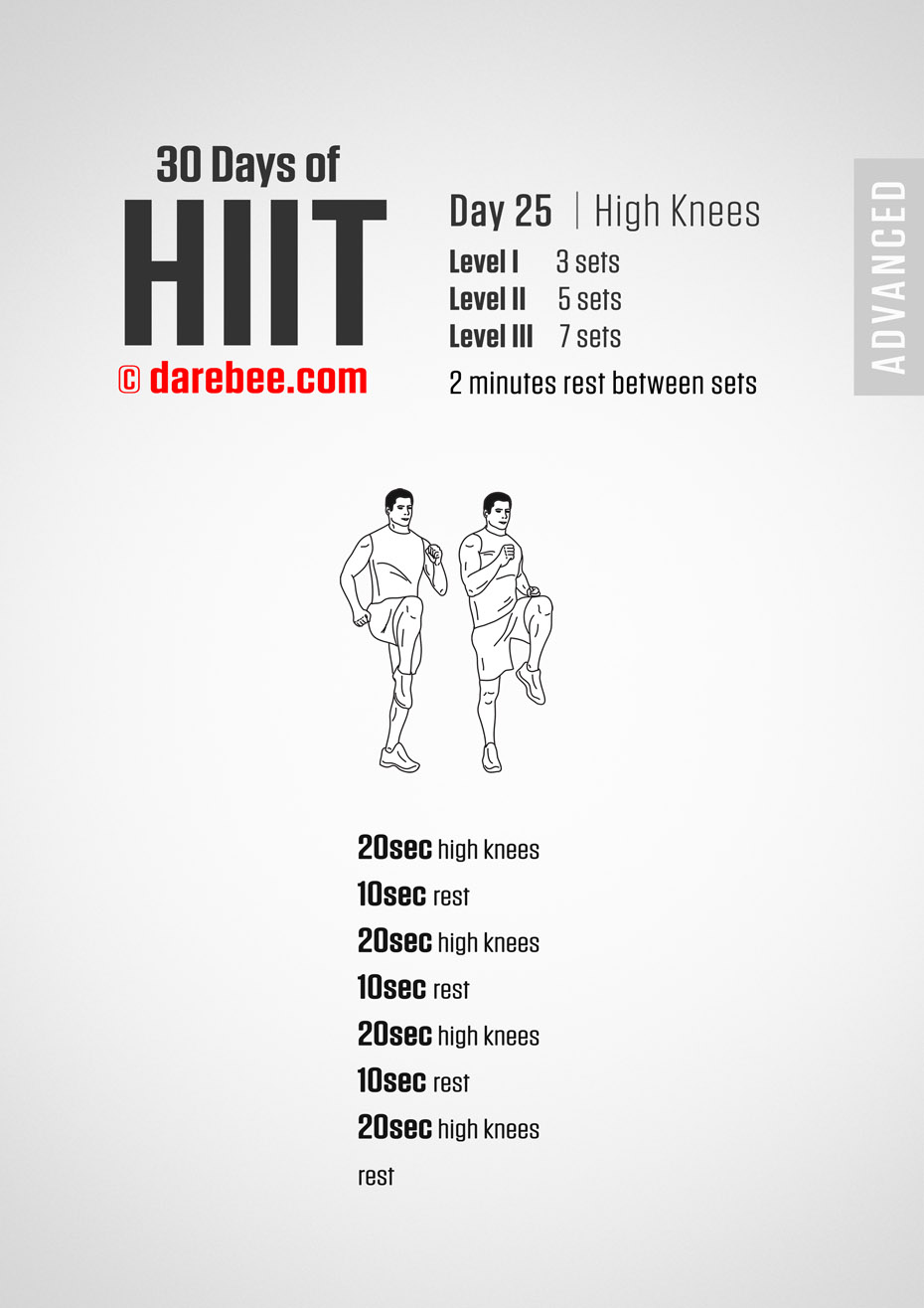
Day 25 is Day 15, unchanged on purpose: high knees, 20 seconds on, 10 off, four intervals per set at your level's 3, 5 or 7 sets with 2 minutes between. Not a second of the card is different - which is exactly what makes it worth running.
Ten days sit between the two versions, and those ten days contained doubled plank holds, push-up burpees, 30-second circuits and a steady diet of growing intervals - so this identical workout is now a measuring instrument. Count steps per interval if you like numbers; if you don't, simply notice where the burn arrives and how the fourth interval feels compared with its Day 15 twin. A repeated test is the only kind that measures the athlete instead of the workout.
The standards repeat along with the card: knees at hip height, balls of the feet, arms setting the tempo, light landings. Spend the 10-second windows breathing tall rather than folding over. Aim for four intervals of one speed - the same discipline as before, hopefully at a pace that isn't.
Nothing about this card has changed since Day 15 - whatever feels different today is yours, and you earned it in the ten days between.
Make it Harder: Cut each 10-second rest to five and work the difference.
Make it Easier: Run three work intervals per set instead of four.

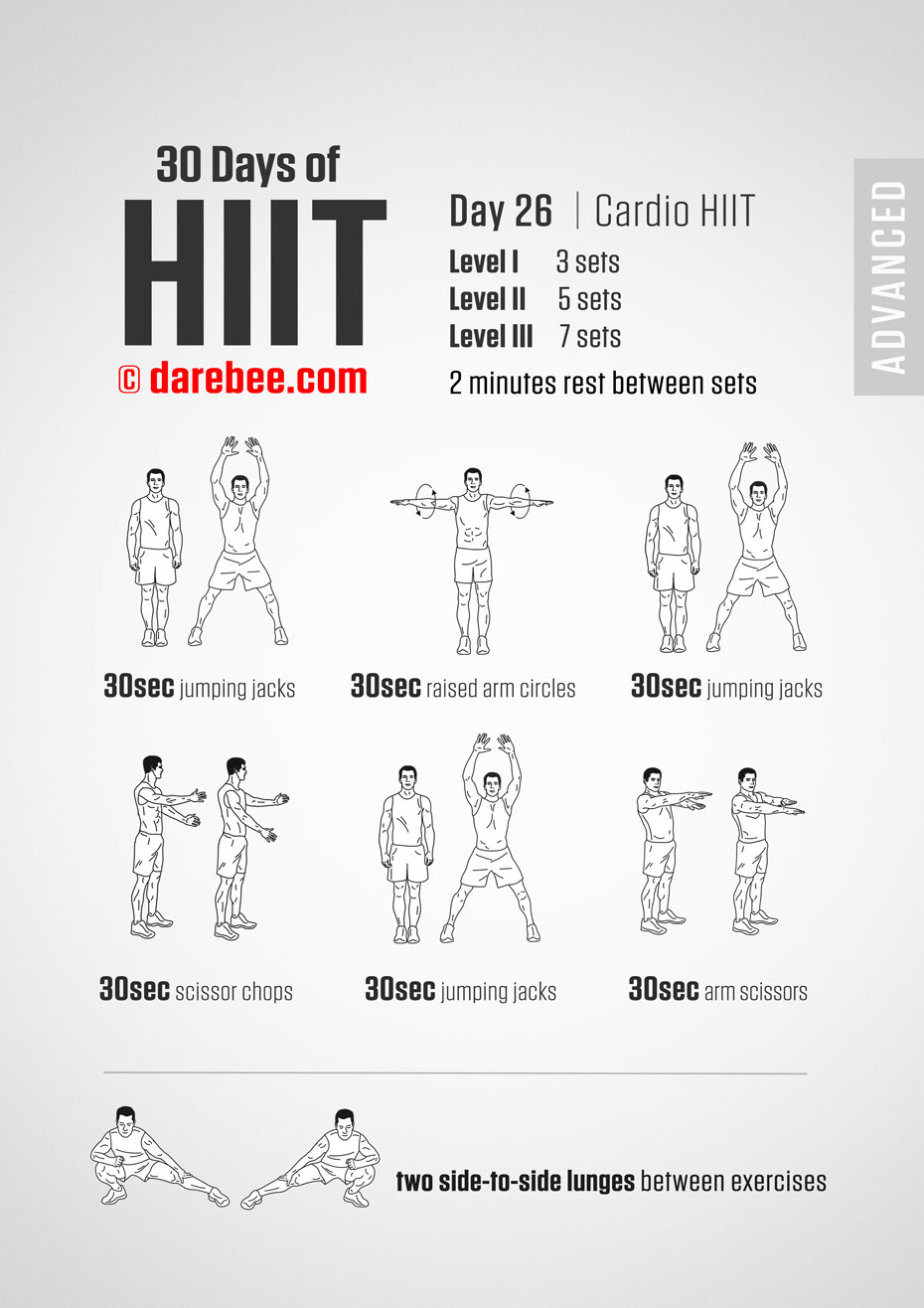
Day 26 stretches Day 11 by half: jumping jacks alternating with raised arm circles, scissor chops and arm scissors, every interval now 30 seconds, still with two side-to-side lunges between exercises - 3, 5 or 7 sets, 2 minutes between.
The shoulder-height tax returns at week four rates. Thirty seconds of arm circles, chops or scissors is an endurance hold with movement layered on top, and stacking three such intervals per set - separated only by jumping jacks that also demand overhead reach - means the deltoids work essentially the entire set. Day 11 trained your arms for exactly this without saying so; today is where that invoice gets settled, and the lunges between exercises make sure the legs stay in the conversation.
The single rule multiplies with the time: arms level, always. If they start drooping at second twenty of a 30-second interval, slow the movement rather than lowering the height - the height is the exercise. Full spread on the jacks, deep honest sits in the side-to-side lunges, and long exhales throughout; shoulder endurance is half breathing.
Half again more time at shoulder height than Day 11 demanded - your arms have been training for this appointment for two weeks.
Make it Harder: Finish every jumping jack at full stretch - feet wide, hands meeting overhead - with zero shrinkage across the set.
Make it Easier: Shrink the jacks whenever form frays - half the arm arc, half the jump - and keep the arm intervals untouched.

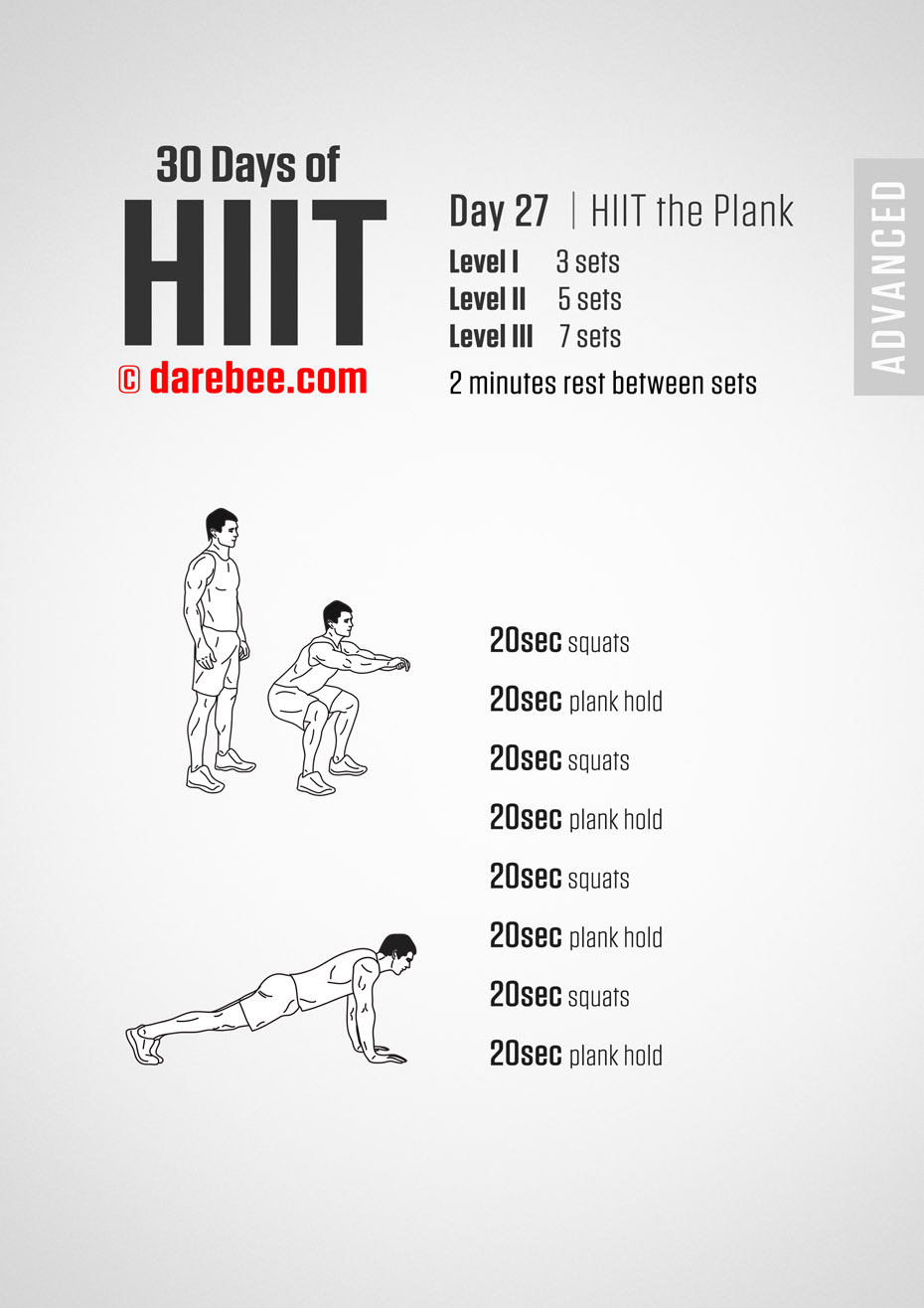
The final plank day changes the partner: 20 seconds of squats alternating with 20 seconds of plank hold, four of each per set, at 3, 5 or 7 sets with 2 minutes between. Where Days 10 and 20 paired the plank with sprinting, Day 27 pairs it with strength.
Swapping high knees for squats trades a lungs problem for a legs one - and hands the plank a new kind of interference to hold against. Twenty seconds of fast squats floods the thighs and glutes; dropping straight into a rigid hold means bracing the trunk while the biggest muscles in the body are still burning, and standing back out of the plank into more squats closes the circle. The heart rate stays high throughout, but today it is strength keeping it there rather than speed.
Squat fast without squatting shallow - parallel or below, heels planted, chest proud. Then build each plank deliberately: hands stacked under the shoulders, whole body switched on, one line held against the leg fatigue trying to sag it. Move between the two positions briskly; the transition is part of the interval.
The plank days end with the legs on fire beneath the stillness - holding steady was never meant to get easier, only more interesting.
Make it Harder: Extend the final plank hold of every set to failure.
Make it Easier: Take the plank holds on your forearms.

Day 28 is Day 1 with a bigger clock. The exact opening-day card - high knees, punches, plank + jab + cross, then the row again with plank jack + jab + cross - now runs every interval at 30 seconds, one push-up still owed between exercises, at 3, 5 or 7 sets with 2 minutes between.
Bookending a program with the same workout at half again the duration is the fairest possible exam: nothing new to learn, no technique excuses, purely a question of what four weeks built. The plank combinations are where the difference shows most - 30 seconds of punching from a plank is a long tenancy for the shoulders and core, and the second row still slips the plank jack underneath, exactly as it did back when 20 seconds felt like plenty.
Day 1's standards apply at Day 28's length: hip-height knees, guarded rotating punches, wide stable feet in the plank combinations with the hips dead quiet while the hands work. Small, crisp plank jacks. And give the connective push-ups the same respect at set five as at set one - they have been counting all month.
This is the workout that opened the program, wearing a heavier clock - how differently it treats you now is the month's report card.
Make it Harder: Enforce the plank rule: if you fall out of a plank combination, the clock pauses until you are back in it.
Make it Easier: Run the second-row plank jack combinations as the first row's plain plank combos.

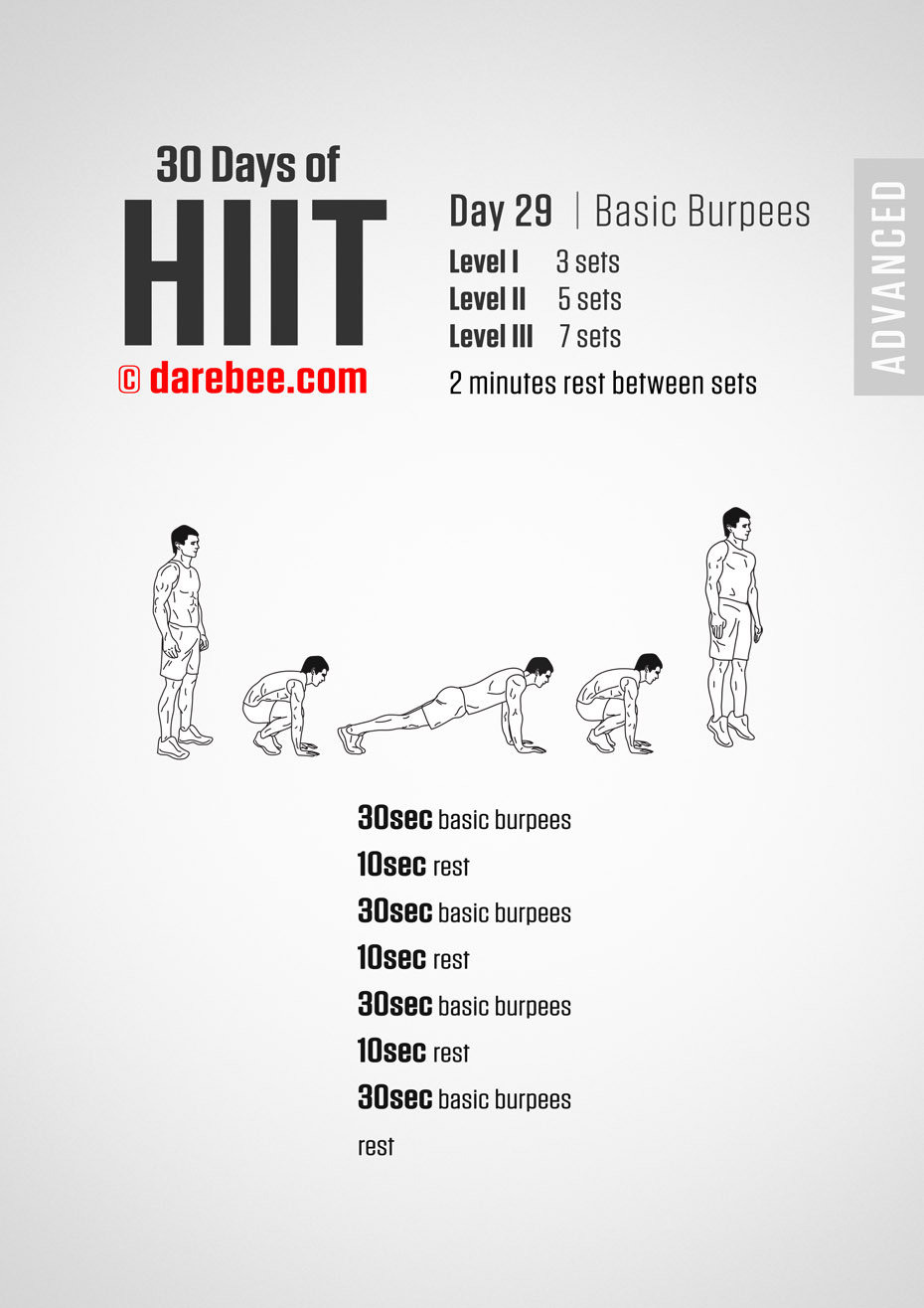
The penultimate day is the plainest kind of brutal: basic burpees, 30 seconds on, 10 off, four intervals per set, at 3, 5 or 7 sets with 2 minutes between. It is Day 5's workout with every work window grown by half and every rest window left exactly where it was.
The basic burpee returns - no push-up this time - because at 30 seconds the interval itself is the difficulty: ten to twelve reps per window instead of six or seven, on rests that no longer come close to covering the debt. This is the program's last word on its own method: it never made the movement fancier when making the clock longer would do, and a 30/10 burpee ladder in week four is that philosophy at full volume.
Pace the windows like the long intervals they are - open at a rhythm the final ten seconds can survive. Full reps only: plank line at the back, feet all the way in, hips open at the top. And guard the 10-second rests jealously: stand tall, take two big breaths, go again.
Half again more burpee per interval than Day 5 - the program saved its simplest cruelty for second-to-last.
Make it Harder: Jump the feet in wide, outside the hands - a deeper crouch and a faster stand-up.
Make it Easier: Cap each interval at eight solid burpees and use whatever time remains to breathe.

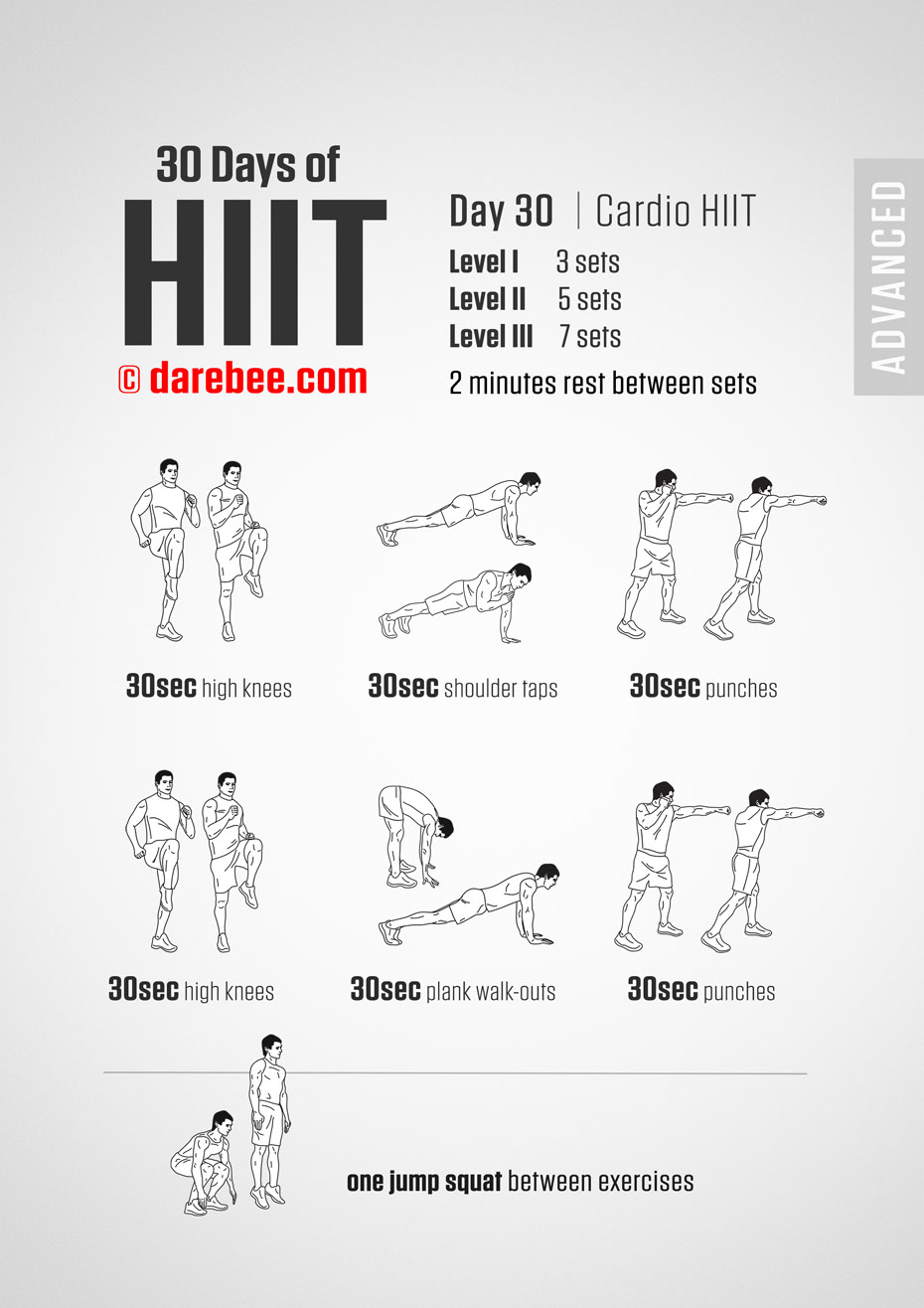
The final day runs everything at week four's full rate: 30 seconds each of high knees, shoulder taps, punches, high knees again, plank walk-outs and punches, with one jump squat between every exercise - 3, 5 or 7 sets, 2 minutes between, one last time.
It is Day 16's card with the training wheels removed: back then, only the high knees ran at 30 seconds; today every interval does, floor work included. Thirty seconds of plank shoulder taps is a genuine core test, thirty of walk-outs a full-body circuit hiding inside one exercise - and the session deliberately samples the whole month: the sprint work, the plank work, the boxing, the connective jump squats. Everything the program taught, on one card, at its highest dose.
Finish the way the month taught you: knees at hip height with no fading, hips level through every tap, walk-outs long and controlled with a real fold at the hips, punches sharp to the last bell. Land the connective jump squats soft. And whatever level you started this program on, notice which level you are finishing it on.
Thirty days ago, twenty seconds felt long - today you close the program holding thirty-second intervals like you own them, because now you do.
Make it Harder: Treat your last set as a benchmark: count every rep of every interval and write the numbers down for round two.
Make it Easier: Finish at Level I - three sets at full honest speed is a proper finish line.