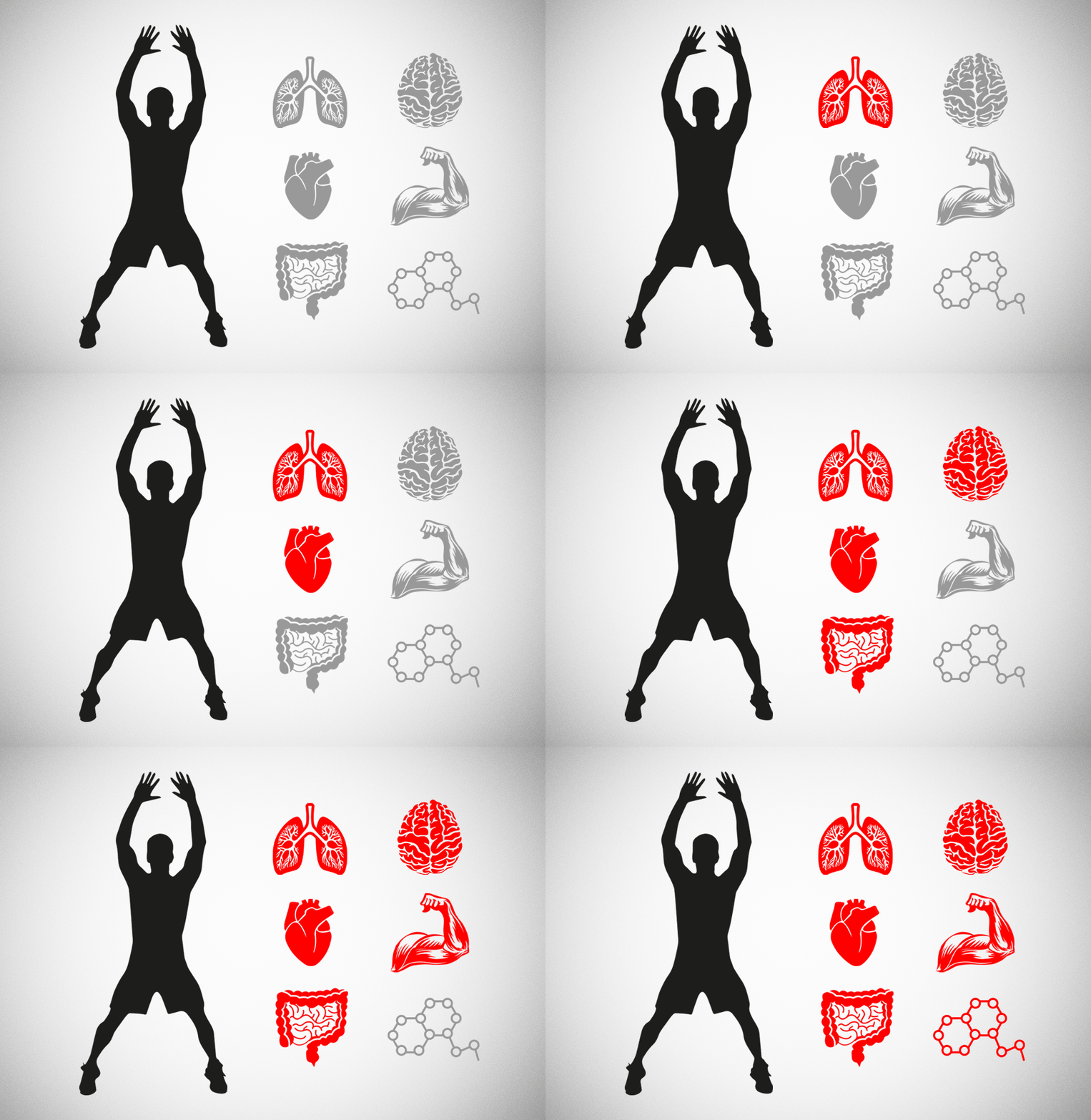
Physical exercise is not simple. Sure, any of us can do something physical at any time but working out in order to achieve a specific goal is way different. This is because exercise affects the body at many different, frequently overlapping levels. Isolating them in order to study their effects helps us understand how each effect is linked to physical exercise but it doesn’t help us a lot in practice because we need to consider them all together.
By understanding the different components that kick in when we exercise and how they are connected we can make better decisions in how to exercise and why.
In this in-depth look at the effects of physical exercise on the human body we will learn about:
- Aerobic stress
- Metabolic stress
- Mechanical load
- Neuromuscular adaptations
- The microbiome contribution
- Neurochemical changes at cellular level
- The body’s energy management system
Aerobic Stress
As the name suggests aerobic stress is the load experienced by the lungs during prolonged physical activity. The definition is expanded a little to also include the transfer of oxygen in the bloodstream to the brain and muscles, during exercise and the capability of the body to absorb oxygen with each breath and exhale carbon dioxide.[1] In the general definition of aerobic stress studies usually include the point of transition to anaerobic exercise (referred to as Anaerobic Threshold or AT for short).
Oxygen transportation in the body is critical for the correct function of the muscles and the health of the brain that controls the central nervous system. We know, for instance, that while breathing in through the nose or mouth when exercising makes no difference to the amount of oxygen intake, it does affect the centers of the brain that are activated as a result.
All exercise increases the volume of air we use and the amount of oxygen the body requires. In turn, the heartbeat also goes up during exercise. The heart and lungs are connected through what is known as the pulmonary loop.[2] This is where the right side of the heart picks up the oxygen-poor blood from the body and moves it to the lungs for cleaning and re-oxygenating. This way the body receives the oxygen-rich blood it needs in order to power the muscles and function properly.
This is where VO2 Max comes in. Sports science tells us that VO2 Max stands for the maximum amount of oxygen you can utilize during strenuous exercise.[3] It is usually measured in millilitres per kilogram per minute (ml/kg/min). It has a score out of a possible 100 with the highest ever recorded accurately being 96 ml/kg/min.
Our VO2 Max level is hugely important because it is a key indicator of cardiovascular and aerobic fitness. The higher it is, the greater endurance we have and the longer we can go on exercising at high intensity without being fatigued and needing to go into an anaerobic phase.
Unsurprisingly, a meta-analysis of over 300 studies and articles[4] showed that one of the best ways to improve VO2 Max is to engage in High Intensity Interval Training (HIIT). HIIT workouts induce a high level of aerobic stress but provide relief via the included break at the end of each interval so that the body can recover before it reaches its anaerobic phase of working. As a result HIIT helps improve cardiovascular health,[5] improve endurance and extend the individual VO2 Max threshold.
An additional benefit of aerobic stress is an improvement in the body’s oxygen transportation capacity mechanisms. This includes an optimization in how red blood cells[6] transport oxygen in the body during periods of high intensity exercise.
Breathing techniques can help improve your workout and breathing itself can be practiced when we exercise to help produce a better overall performance. Because breathing correctly is such a critically important component of fitness we even have a breathing workout to help you practise even when you are not actively working out.
Metabolic Stress
When we exercise long enough for the energy stored in our body to dip the process through which the body supplies the muscles with oxygen and nutrients and gets rid of the by-products of muscle cell activation slows down. Muscle cells then begin to accumulate metabolites such as lactate, phosphate inorganic (Pi) and ions of hydrogen (H+)]. This is the process known as metabolic stress.
Metabolic stress plays a key role in muscle growth and strength training.[7] Studies show that metabolic stress can help reduce fat accumulation in the cells of adults who are overweight[8]. A 2011 study showed that a good VO2 Max condition makes it harder for metabolic stress to occur.[9] This is one of the reasons people who are generally fit show slower progress in strength building and muscle growth than people who are generally unfit.
HIIT training, again, is emerging as a good means of inducing metabolic stress that leads to muscle adaptations in the body. As the body becomes stronger it also becomes more ‘hardened’ to metabolic stress which can have some surprisingly beneficial side-effects on brain health and intelligence.[10] The latter, in particular, is supported by the findings of exercise science on training intensity and brain health.
We should note here that it is possible to induce metabolic stress without also inducing aerobic stress by, for example, lifting light but slowly and for much longer. Aerobic stress, however, is usually also accompanied by metabolic stress.
Mechanical Load
The tension experienced by the muscles during contraction, when they exercise, constitutes the mechanical load[11] they experience. That load will change with variables such as length of time of training. The weight being lifted (if we use resistance training), fatigue (i.e. metabolic stress) and the amount of mechanical damage the muscles sustain under the mechanical load they experience.
Studies show that the magnitude of the mechanical load muscles experience during exercise is important in maintaining bone health. Bone health, in turn, is key to maintaining brain health.
The mechanical load that is experienced by the muscles during physical exercise is determined by the force-velocity relationship.[12] In the simplest language possible this means that the mechanical load that muscles experience when they contract is a function of the force being applied (i.e. weights being lifted, or the foot hitting the ground or the fist hitting a punch bag, etc) and the velocity at which the muscle is being asked to contract. The relationship between force and velocity is an inverse one. So, for instance, if you were lifting a 200kg load your muscles would contract slowly no matter how hard you tried to lift it, while if you were to lift a 2kg load you really need to actively work really hard to slow your lifting because your muscles can contract very quickly indeed.
It is wrong to think however that the only force being applied is what you are lifting or pushing. Metabolic stress and mechanical damage play a role here too. Metabolic stress fatigues the muscles because of the accumulation of metabolites. Mechanical damage is physiological damage that happens to muscle fibers as they are being exercised when fatigued or under large mechanical load. This damage de-strengthens them as damaged muscle fibers cannot fully engage in the physical activity they are recruited to perform.
A classic example that illustrates this is push-ups. Most people can do ten push-ups, ten times, with ten minute intervals between each time. Very few people however can do 100 push-ups in one go, without any break. The total number of push-ups performed is the same in both instances, but the mechanical load experienced by the muscles is different.
The example also shows the relationship that exists between mechanical load and metabolic stress. Mechanical damage that is caused to muscles due to mechanical load also increases metabolic stress[13] that increases the fatigue that is experienced which then further de-strengthens the muscles which then experience greater mechanical load. “To Failure” workouts use this exact principle to deliver faster strength gains.
Neuromuscular Adaptations
Through physical exercise, of course, we all try to build strength. Part of this strength-building process is putting on a little more muscle which is good for our overall health.[14] But the true strength gains come from being able to engage the muscle we already have as well as the muscle we build and for that we need our brain to be able to tell our body to do it. For our body to actually be able to listen to that command from the brain we need nerves that carry the message from the brain to the muscles.
This innervation is what the neuromuscular adaptations of exercise are all about. Sports science calls the grouping of muscle fibers that are innervated by a neuron a motor unit. The number of motor units we can engage in the execution of a physical task determines how strong, fast or agile we are.
In practise this all means that every time we exercise we don’t just train our muscles to do a specific task, we also train our brain that has to develop new neural connections to better guide those muscles in the execution of that task. These neuromuscular adaptations[15] are what makes specific exercises easier, over time.
Studies show that there are different neuromuscular adaptations that take place when we train for strength, speed or endurance.[16] It is these that determine the rate at which motor units engage and discharge (i.e. are recruited in the performance of a particular physical activity and the rate and duration at which they fire).
The need to make these neuromuscular adaptations happen is also why getting fit and becoming skilled in a particular physical exercise takes so long (approx. 4-6 weeks) and needs an exercise program that is appropriately designed to elicit the adaptations required for that particular physical task or sport[17].
The Microbiome Contribution
We can’t adequately cover how the body and brain perform during exercise without talking about the microbiome. This is also the link we need to keep in mind when we talk about nutrition and exercise.
A 2017 study[18] showed that physical exercise produces specific changes in the consistency of our microbiome and that, in turn, benefits our health. Other studies,[19] show that the neuromuscular and physical adaptations that are induced in the body, through exercise, also depend on the microbiome, its consistency, production of specific hormones and its ability to process the food we ingest.
The role the microbiome plays in exercise and nutrition is complex and multi-faceted. It appears that the microbiome plays a central role in the way we use the food we eat as fuel that powers our muscles.[20] This, in turn, affects physical performance based on our individual diet. At the same time, in a complex web of interactions, the physical activity we engage in changes the consistency of the microbiome in our gut which means that it then changes our dietary needs.
On top of all that, two new studies published in 2019 show that our physical strength, speed and endurance are linked to the health of our microbiome[21] which also affects the way the body maintains strength and muscle mass as we age.[22]
Microbiome science is still very new. It is only now that we are getting the scientific evidence that helps us see how the production of specific chemicals in the gut helps in the activation of muscles during physical exercise.[23]
The picture that is emerging from what we already know is that each microbiome is unique. Gut health, physical capabilities and even ageing are linked to nutrition in a combination that is unique for each individual. This means that general guidelines on health, fitness, diet and nutrition are just that: general. They become the starter kit that should be used to refine the training-eating-resting formula that each individual needs in order to maintain optimum physical and mental health as the human body ages.
Neurochemical Changes At Cellular Level
The link between exercise, nutrition and muscle memory is found in the chemical factories deep within the muscle that are responsible for producing the chemicals needed to power muscles during physical activity. These cell engines are responsible from how muscles contract[24] during physical activity to how the heart muscle[25] handles the extra load during exercise to even how muscles handle growth and repair after exercise.[26]
The changes that muscles undergo at a cellular level as a result of physical exercise are linked to their ability to resist metabolic stress and continue to function at a high level of performance beyond their normal range.[27]
A 2017 study showed, amongst other things, that the length of time it takes for muscles to experience change at a cellular level is approximately six weeks of regular exercise.[28] Unsurprisingly, High Intensity Interval Training (HIIT) is emerging as the type of exercise that accelerates changes made to muscles at a cellular level.[29]
Once made these cellular changes remain even if de-strengthening due to inaction takes place. This is the reason why people who have trained in the past but have had a period of inactivity find it easier to build-up their strength again, once they get back to training. This is also the reason physical exercise reverses biological ageing in the body.[30]
The Body’s Energy Management System
The paradox associated with exercise is that rather than depleting the body’s energy it seems to lead to fewer experiences of fatigue and an overall feeling of wellbeing and having more energy.[31] The mechanism through which this is achieved is not yet understood and most of the current studies have only managed to add scientific data that verifies the anecdotal accounts we had, without explaining why this happens.
Most of the studies in this area are already more than ten years old[32] which means that it is not actively looked at just now, though they have established that exercise leads to better energy management throughout the day and has a positive effect on dietary habits.[33] A meta-analysis[34] of 16 studies involving 678 participants, carried out in 2013, showed conclusively that regular high-intensity exercise leads to reduced feeling of fatigue and an increased sense of being more energetic.
In addition to HIIT aerobic exercise has also been shown, by studies, to help combat persistent fatigue in adults. A randomized, controlled study in 2008 showed that over a six week period, adults suffering from chronic fatigue reported significant improvement.[35]
While sports science doesn’t help us a lot here, physics does. The human body is an open system that is in a constant state of energy exchange with its environment. Depending on where we are we are either using calories to heat our body up or calories to cool our body down. In addition, we take in calories in the form of food and snacks and lose calories in the processes our body uses to keep us alive and the exercise we do.
This approach isn’t exactly new. Past studies have used it to help explain weightloss and diets and nutrition.[36] We are going to use it to better explain the use of energy in exercise and why the body activates adaptations that change its physiology when it experiences aerobic or metabolic stress and mechanical loads.
Consider that the long-term survival of the human body (a task for which it has evolved over tens of thousands of years) demands that it reaches, each time, a balance with its environment whereby the amount of energy it needs in order to perform specific tasks is minimized. The reason for the minimization is that in order to ensure survival the human body is automatically tasked with optimizing processes so that it uses as little energy as possible when it performs them.
Energy Expenditure, Physical Adaptations And Physics
A body that uses a lot of energy for its most basic tasks significantly reduces its chance of long-term survival. This simple concept is at the heart of optimization theory in evolution[37]. There is quite some complexity to this argument because evolution is messy and driven by a multitude of factors. The core of it is, however, that physical adaptations take place because of environmental pressures that force the body to respond so it can lower its energy requirements.
As an example consider how when you start to walk fast your body’s energy expenditure goes up and it keeps on going up as you increase walking speed. At the point where you are going fast enough for your body to transition from walking really fast to jogging, the body’s energy expenditure in the activity drops. This happens again and again as we increase jogging speed and transition from jogging to running.
This demonstrates how each time the body transitions from one form of locomotion to another it is using its biomechanical structure to decrease the amount of energy required in the activity. Everything we have discussed to this point, all the adaptations the body engages in when it is exposed to physical stress, are energy-intensive processes that take place in order to allow it to deal with the physical stress it is presented with in an easier manner.[38]
If, for instance, you sprint 100m every day for a month, your body will undergo muscle fiber, neural and cellular changes that are designed to make the energy load required for you, when you sprint, easier. This will also make you faster because you will find sprinting easier.
Great technique in sports and physical activities is also about optimization of energy when performing a specific physical task. This is achieved by moving the body in ways that allow it to better preserve the transfer of kinetic energy from one part to another. A smoother transfer of energy also means that the body moves in a more optimized, less energy-intensive way.
A detailed, scientific study of the way mammals adapted to the transition from land to water showed that they underwent evolutionary adaptations that led them to expand the same amount of energy when moving at speed in water as their land-based counterparts did when sprinting on land.[39]
This is important because it shows that there is an upper limit to energy optimization adaptations. In plain terms there is only so much muscle we can put on and maintain speed and energy efficiency gains. There is only so much coordination and neural adaptations we can achieve in order to perform complex movements in the most energy efficient way possible.
The fact that there is such a limit also helps explain why we cannot keep fitness gains we have made if we stop exercising. In essence the stressors we apply through exercise are seen by the body as environmental ones. It adapts in order to survive. Its adaptations lower the energy requirement cost. When those environmental stressors go away (i.e. we stop exercising in such intensity) the body adapts again to further lower its energy costs so we lose muscle mass as our muscles shrink. We lose VO2 Max capacity as our lungs no longer have to work so hard since we no longer run, for example.
This makes fitness a journey of constant evolution. Two detailed studies[40] that examine human neurobiological and physiological processes through the application of the laws of thermodynamics[41] essentially lay out a compelling argument for the body’s dynamic nature, based upon the principles of energy conservation and entropy.
These are complex subjects. What is worth taking away from the approach however is that our body is always in a process of ‘becoming’ instead of just ‘being’. It takes effort and energy to get us there and effort and energy to maintain the gains we have made.
Summary
Fitness is complex because the human body is not a static object. Because of their microbiome, every person is unique. Exercise affects gut bacteria (microbiome) and the brain as well as the body. Getting fit requires the body to undergo physical and cellular adaptations in direct response to perceived environmental pressures; these pressures are what we call exercise and they take the form of aerobic or metabolic stress and mechanical loads. The body’s adaptation response takes, on average, six weeks to fully manifest itself. Every fitness gain that is made needs to be maintained through extra work (i.e. exercise). The moment that work stops the fitness gain begins to degrade until it is lost. Because the body constantly adapts the fitness gains made through specific exercises decline over time unless variations are thrown in which continue to challenge the body.
Research
- Bove AA. Pulmonary Aspects of Exercise and Sports. Methodist Debakey Cardiovasc J. 2016;12(2):93-97. doi:10.14797/mdcj-12-2-93
- Forfia PR, Vaidya A, Wiegers SE. Pulmonary heart disease: The heart-lung interaction and its impact on patient phenotypes. Pulm Circ. 2013;3(1):5-19. doi:10.4103/2045-8932.109910
- Shete AN, Bute SS, Deshmukh PR. A Study of VO2 Max and Body Fat Percentage in Female Athletes. J Clin Diagn Res. 2014;8(12):BC01-BC3. doi:10.7860/JCDR/2014/10896.5329
- Bacon AP, Carter RE, Ogle EA, Joyner MJ. VO2max trainability and high intensity interval training in humans: a meta-analysis. PLoS One. 2013;8(9):e73182. Published 2013 Sep 16. doi:10.1371/journal.pone.0073182
- Bove AA. Pulmonary Aspects of Exercise and Sports. Methodist Debakey Cardiovasc J. 2016;12(2):93-97. doi:10.14797/mdcj-12-2-93
- Mairbäurl H. Red blood cells in sports: effects of exercise and training on oxygen supply by red blood cells. Front Physiol. 2013;4:332. Published 2013 Nov 12. doi:10.3389/fphys.2013.00332
- de Freitas MC, Gerosa-Neto J, Zanchi NE, Lira FS, Rossi FE. Role of metabolic stress for enhancing muscle adaptations: Practical applications. World J Methodol. 2017;7(2):46-54. Published 2017 Jun 26. doi:10.5662/wjm.v7.i2.46
- Collao Nicolas, Farup Jean, De Lisio Michael. Role of Metabolic Stress and Exercise in Regulating Fibro/Adipogenic Progenitors. Frontiers in Cell and Developmental Biology. Vol. 8, 2020. Doi: 10.3389/fcell.2020.00009. ISSN: 2296-634X.
- Lori D.Calvert, Sally J.Singh, Michael D.Morgan, Michael C.Steiner. Exercise induced skeletal muscle metabolic stress is reduced after pulmonary rehabilitation in COPD. https://doi.org/10.1016/j.rmed.2010.10.012.
- Leo Pruimboom, Charles L. Raison, Frits A. J. Muskiet, "Physical Activity Protects the Human Brain against Metabolic Stress Induced by a Postprandial and Chronic Inflammation", Behavioural Neurology, vol. 2015, Article ID 569869, 11 pages, 2015.
- Ebben, William & Fauth, McKenzie & Kaufmann, Clare & Petushek, Erich. (2009). Magnitude and Rate of Mechanical Loading of a Variety of Exercise Modes. Journal of strength and conditioning research / National Strength & Conditioning Association. 24. 213-7. 10.1519/JSC.0b013e3181c27da3.
- Sugi H, Ohno T. Physiological Significance of the Force-Velocity Relation in Skeletal Muscle and Muscle Fibers. Int J Mol Sci. 2019;20(12):3075. Published 2019 Jun 24. doi:10.3390/ijms20123075
- de Freitas MC, Gerosa-Neto J, Zanchi NE, Lira FS, Rossi FE. Role of metabolic stress for enhancing muscle adaptations: Practical applications. World J Methodol. 2017;7(2):46-54. Published 2017 Jun 26. doi:10.5662/wjm.v7.i2.46
- McLeod M, Breen L, Hamilton DL, Philp A. Live strong and prosper: the importance of skeletal muscle strength for healthy ageing. Biogerontology. 2016;17(3):497-510. doi:10.1007/s10522-015-9631-7
- Gabriel, David & Kamen, Gary & Frost, Gail. (2014). Neural adaptations to resistive exercise: mechanisms and recommendations for training practices. Sport Medicine. 36.
- Vila-Chã C, Falla D, Correia MV, Farina D. Adjustments in motor unit properties during fatiguing contractions after training. Med Sci Sports Exerc. 2012 Apr;44(4):616-24. doi: 10.1249/MSS.0b013e318235d81d. PMID: 21904248.
- Souza EO, Ugrinowitsch C, Tricoli V, et al. Early adaptations to six weeks of non-periodized and periodized strength training regimens in recreational males. J Sports Sci Med. 2014;13(3):604-609. Published 2014 Sep 1.
- Monda V, Villano I, Messina A, et al. Exercise Modifies the Gut Microbiota with Positive Health Effects. Oxid Med Cell Longev. 2017;2017:3831972. doi:10.1155/2017/3831972
- Mach N, Fuster-Botella D. Endurance exercise and gut microbiota: A review. J Sport Health Sci. 2017;6(2):179-197. doi:10.1016/j.jshs.2016.05.001
- Hughes RL. A Review of the Role of the Gut Microbiome in Personalized Sports Nutrition. Front Nutr. 2020;6:191. Published 2020 Jan 10. doi:10.3389/fnut.2019.00191
- Lustgarten MS. The Role of the Gut Microbiome on Skeletal Muscle Mass and Physical Function: 2019 Update. Front Physiol. 2019;10:1435. Published 2019 Nov 26. doi:10.3389/fphys.2019.01435
- Ticinesi A, Nouvenne A, Cerundolo N, et al. Gut Microbiota, Muscle Mass and Function in Aging: A Focus on Physical Frailty and Sarcopenia. Nutrients. 2019;11(7):1633. Published 2019 Jul 17. doi:10.3390/nu11071633
- Okamoto, Takuya & Morino, Katsutaro & Ugi, Satoshi & Nakagawa, Fumiyuki & Lemecha, Mengistu & Ida, Shogo & Ohashi, Natsuko & Sato, Daisuke & Fujita, Yukihiro & Maegawa, Hiroshi. (2019). Microbiome potentiates endurance exercise through intestinal acetate production. American Journal of Physiology-Endocrinology and Metabolism. 316. 10.1152/ajpendo.00510.2018.
- Jayne Alexandra Barbour, Nigel Turner, "Mitochondrial Stress Signaling Promotes Cellular Adaptations", International Journal of Cell Biology, vol. 2014, Article ID 156020, 12 pages, 2014.
- Vega RB, Konhilas JP, Kelly DP, Leinwand LA. Molecular Mechanisms Underlying Cardiac Adaptation to Exercise. Cell Metab. 2017;25(5):1012-1026. doi:10.1016/j.cmet.2017.04.025
- Møller, A.B. & Lønbro, Simon & Farup, Jean & Voss, T.S. & Wang, J. & Højris, I. & Mikkelsen, Ulla & Jessen, Niels. (2019). Molecular and cellular adaptations to exercise training in skeletal muscle from cancer patients treated with chemotherapy. Journal of Cancer Research and Clinical Oncology. 145. 1449-1460. 10.1007/s00432-019-02911-5.
- Schoenfeld, Brad. (2013). Potential Mechanisms for a Role of Metabolic Stress in Hypertrophic Adaptations to Resistance Training. Sports medicine (Auckland, N.Z.). 43. 10.1007/s40279-013-0017-1.
- Prestes, Jonato & Tibana, Ramires & da Cunha Nascimento, Dahan & Rocha, Pollyanna & Camarço, Nathalia & Sousa, Nuno & Willardson, Jeffrey. (2017). Strength And Muscular Adaptations Following 6 Weeks Of Rest-Pause Versus Traditional Multiple-Sets Resistance Training In Trained Subjects. The Journal of Strength and Conditioning Research. 33 Suppl 1. 10.1519/JSC.0000000000001923.
- MacInnis MJ, Gibala MJ. Physiological adaptations to interval training and the role of exercise intensity. J Physiol. 2017;595(9):2915-2930. doi:10.1113/JP273196
- Jesus R. Huertas, Rafael A. Casuso, Pablo Hernansanz Agustín, Sara Cogliati, "Stay Fit, Stay Young: Mitochondria in Movement: The Role of Exercise in the New Mitochondrial Paradigm", Oxidative Medicine and Cellular Longevity, vol. 2019, Article ID 7058350, 18 pages, 2019.
- Puetz, Timothy. (2006). Physical Activity and Feelings of Energy and Fatigue. Sports medicine (Auckland, N.Z.). 36. 767-80. 10.2165/00007256-200636090-00004.
- Puetz TW, O'Connor PJ, Dishman RK. Effects of chronic exercise on feelings of energy and fatigue: a quantitative synthesis. Psychol Bull. 2006 Nov;132(6):866-76. doi: 10.1037/0033-2909.132.6.866. PMID: 17073524.
- Paravidino VB, Mediano MFF, Silva ICM, et al. Effect of physical exercise on spontaneous physical activity energy expenditure and energy intake in overweight adults (the EFECT study): a study protocol for a randomized controlled trial. Trials. 2018;19(1):167. Published 2018 Mar 7. doi:10.1186/s13063-018-2445-6
- Bryan D. Loy, Patrick J. O'Connor & Rodney K. Dishman (2013) The effect of a single bout of exercise on energy and fatigue states: a systematic review and meta-analysis, Fatigue: Biomedicine, Health & Behavior, 1:4, 223-242, DOI: 10.1080/21641846.2013.843266
- Puetz, T., Flowers, S., & O’Connor, P. (2008). A Randomized Controlled Trial of the Effect of Aerobic Exercise Training on Feelings of Energy and Fatigue in Sedentary Young Adults with Persistent Fatigue. Psychotherapy and Psychosomatics, 77(3), 167-174. doi:10.2307/48511083
- Fine EJ, Feinman RD. Thermodynamics of weight loss diets. Nutr Metab (Lond). 2004;1(1):15. Published 2004 Dec 8. doi:10.1186/1743-7075-1-15
- Smith, J. (1978). Optimization Theory in Evolution. Annual Review of Ecology, Evolution, and Systematics, 9, 31-56.
- Parker, Geoff & Smith, J.M.. (1990). Optimality in evolutionary biology. Nature. 348. 27-33. 10.1038/348027a0.
- Williams TM. The evolution of cost efficient swimming in marine mammals: limits to energetic optimization. Philos Trans R Soc Lond B Biol Sci. 1999;354(1380):193-201. doi:10.1098/rstb.1999.0371
- Mady, Carlos & Ferreira, Maurício & Yanagihara, Jurandir & Saldiva, Paulo & De Oliveira Junior, Silvio. (2011). Second Law of Thermodynamics and Human Body. Engenharia Térmica. 10. 88. 10.5380/reterm.v10i1-2.61968.
- Batato M. Energétique du corps humain [Energetics of the human body]. Schweiz Z Sportmed. 1990 Nov;38(3):133-41. French. PMID: 2255884.