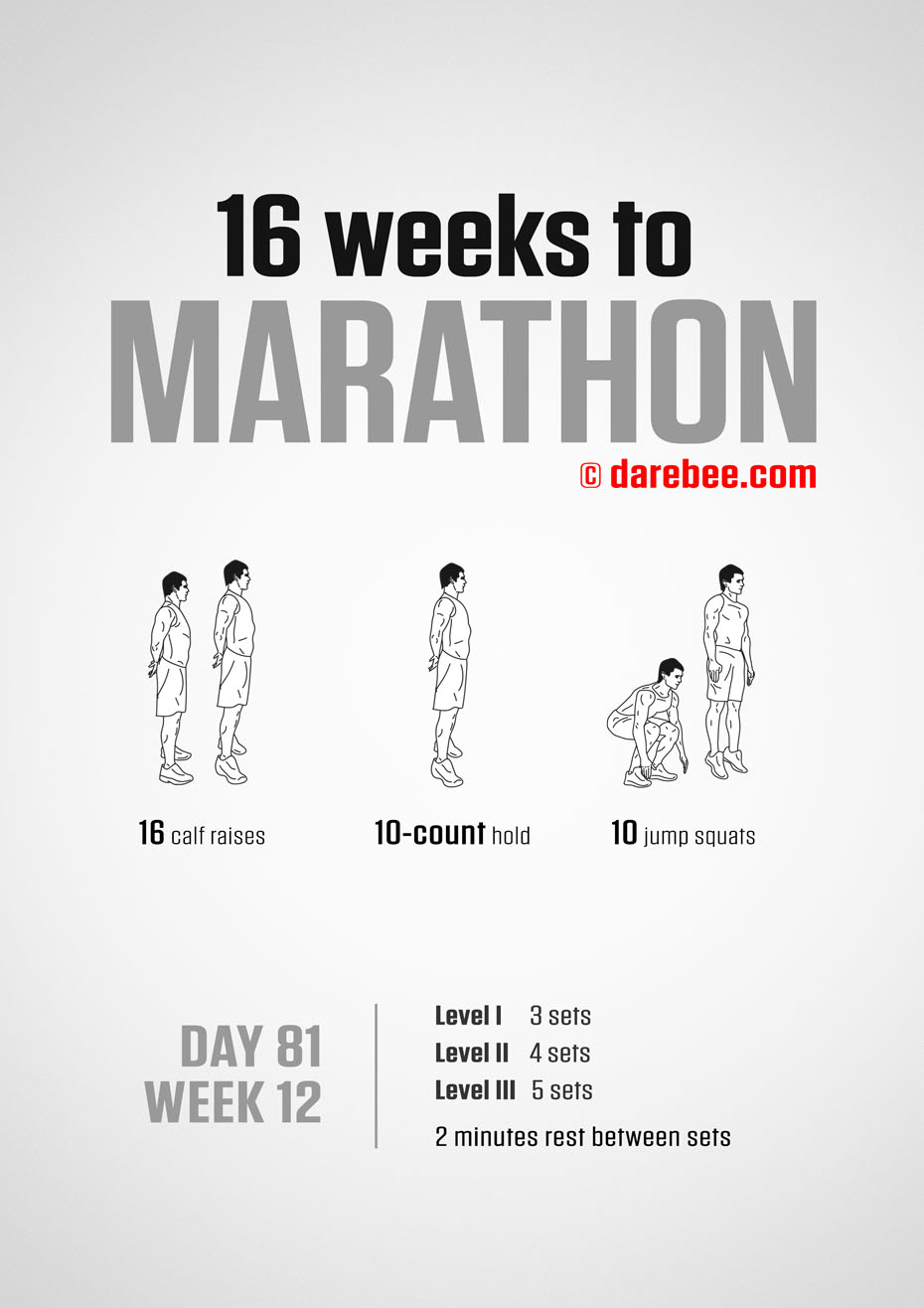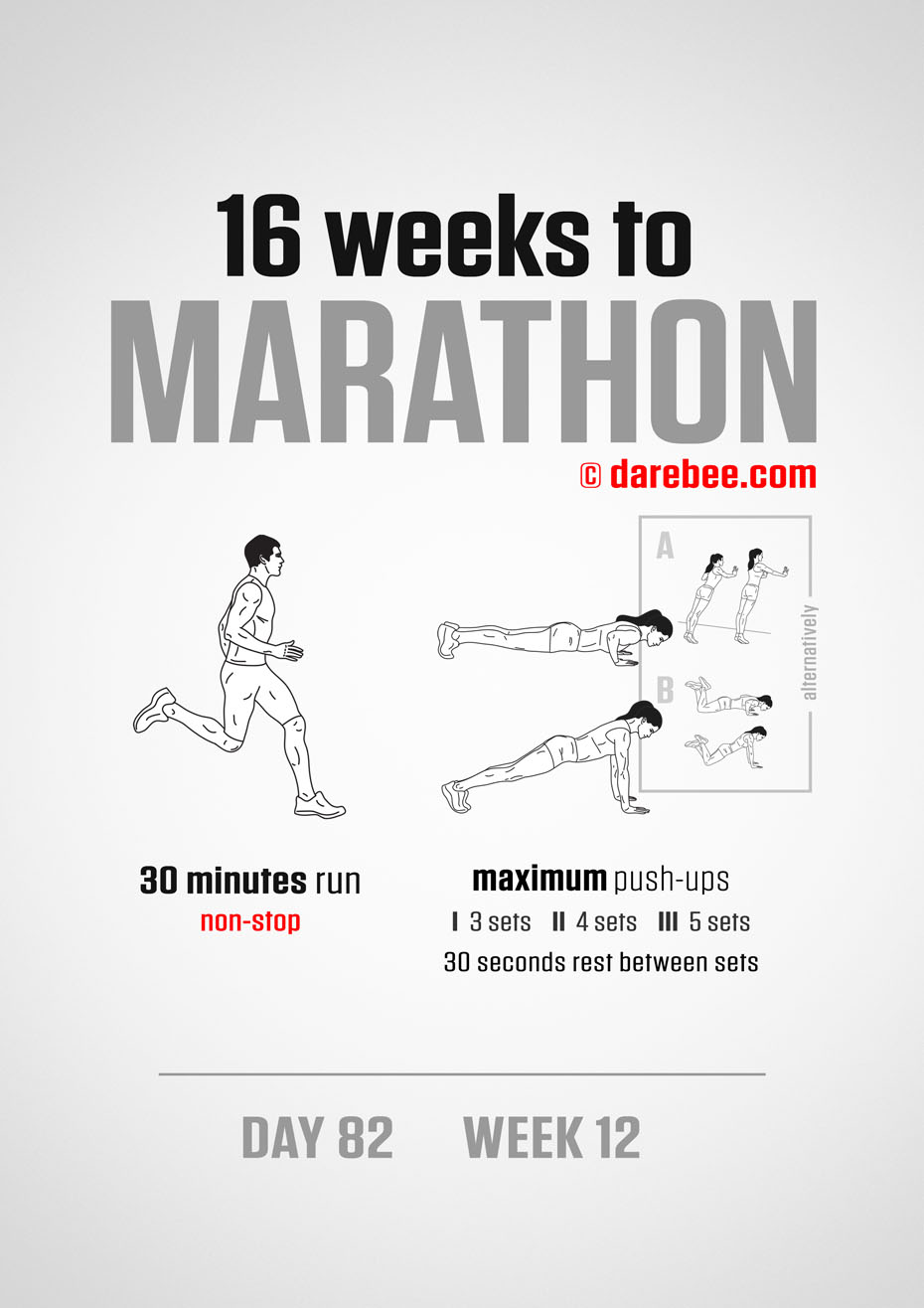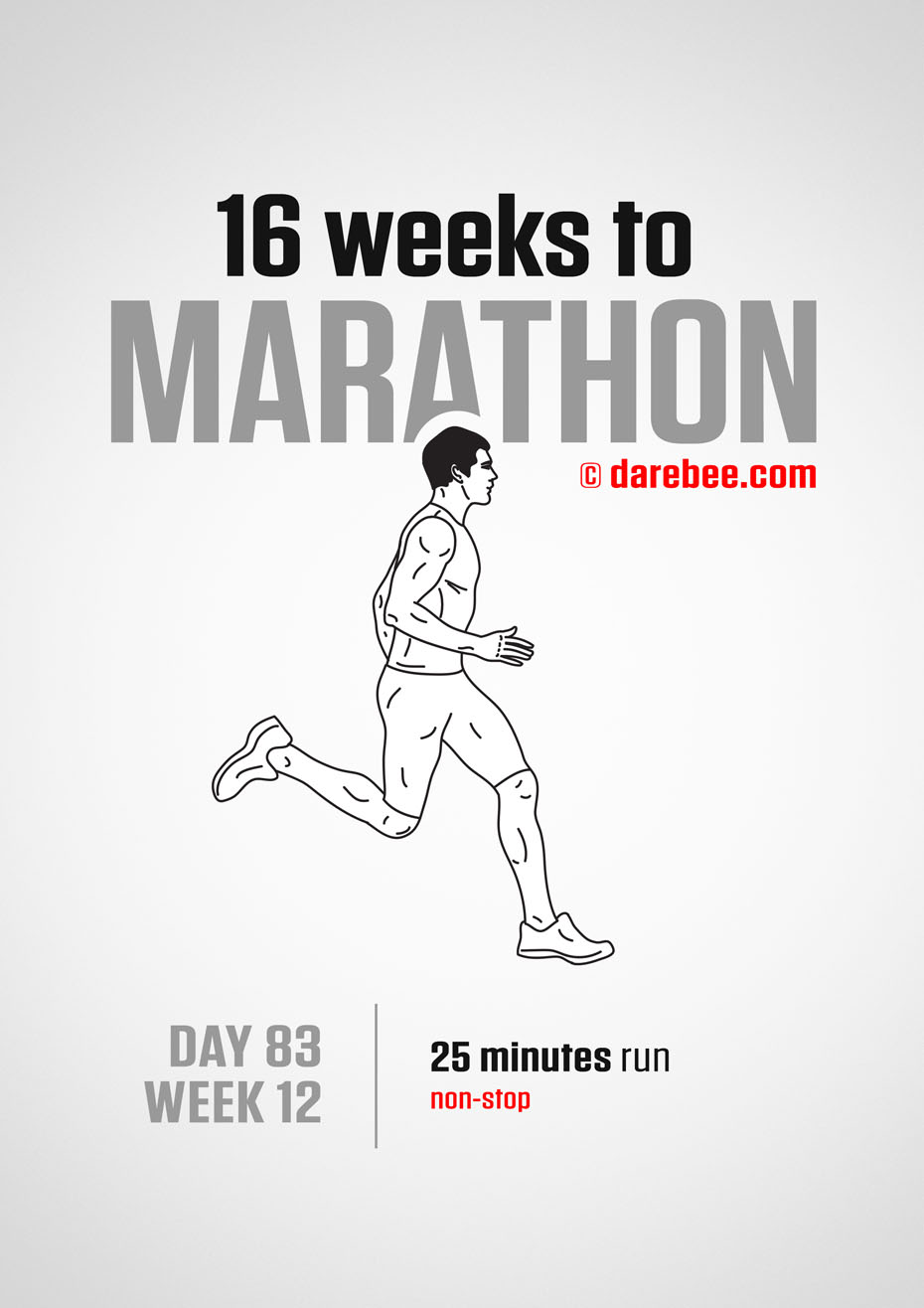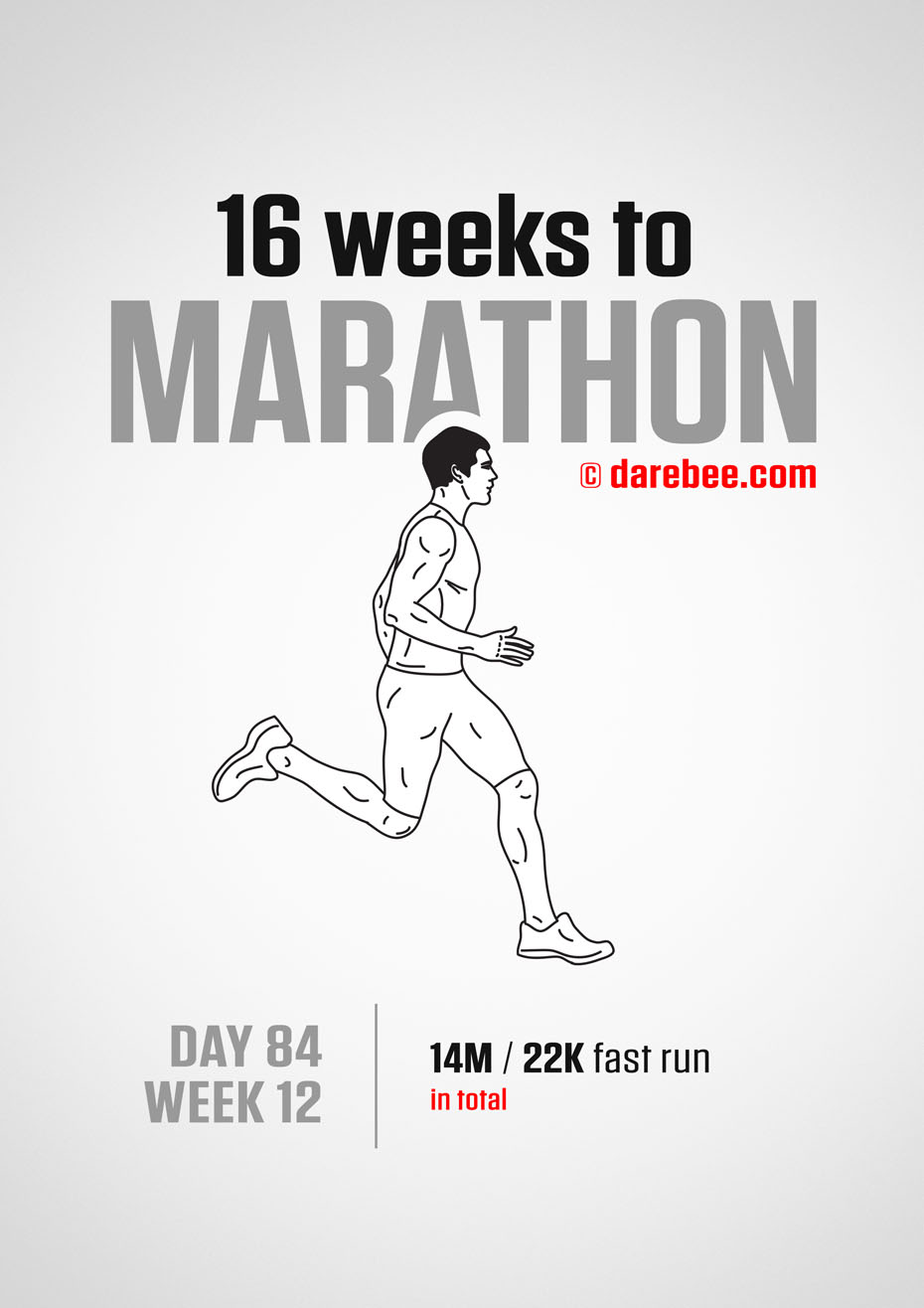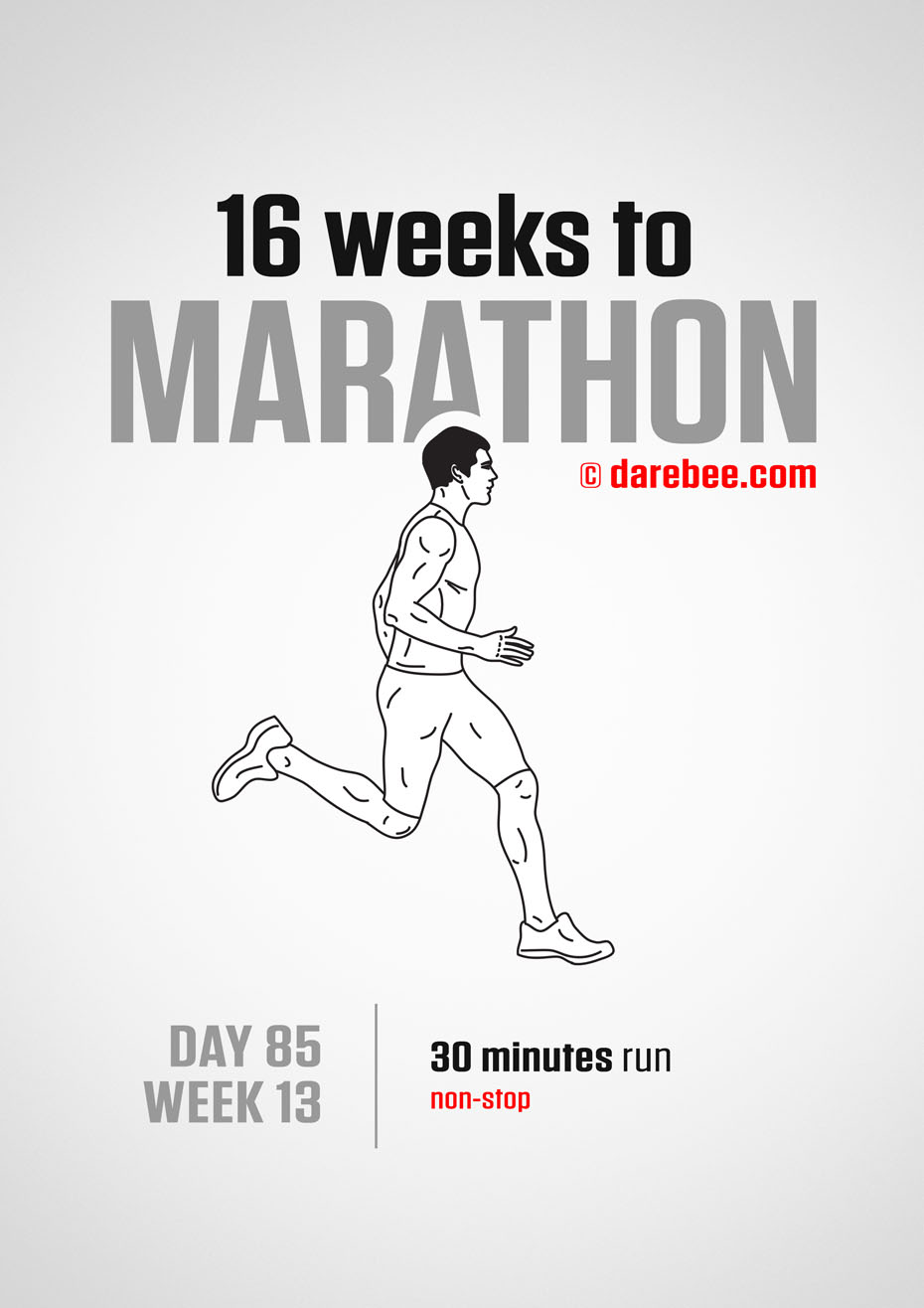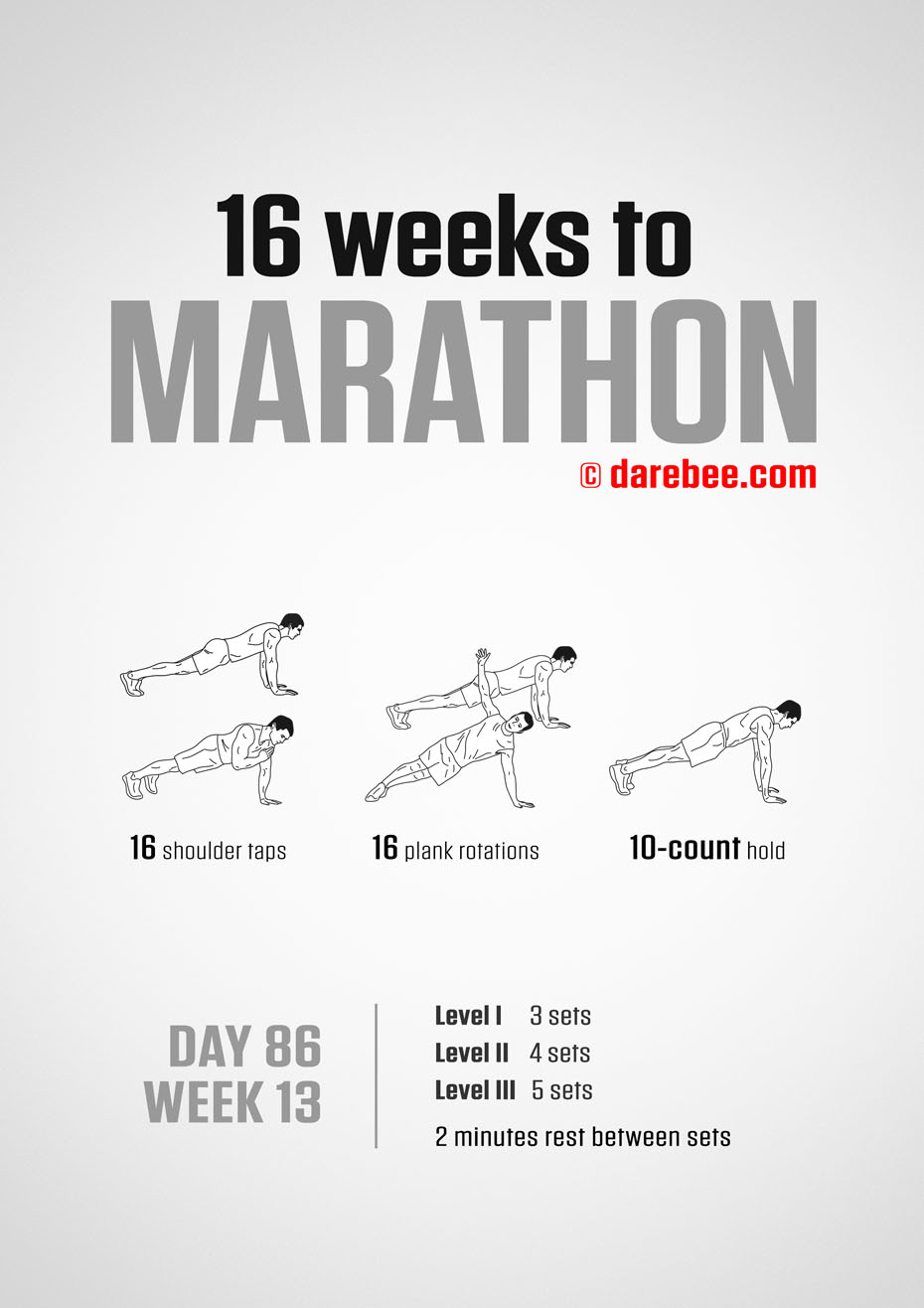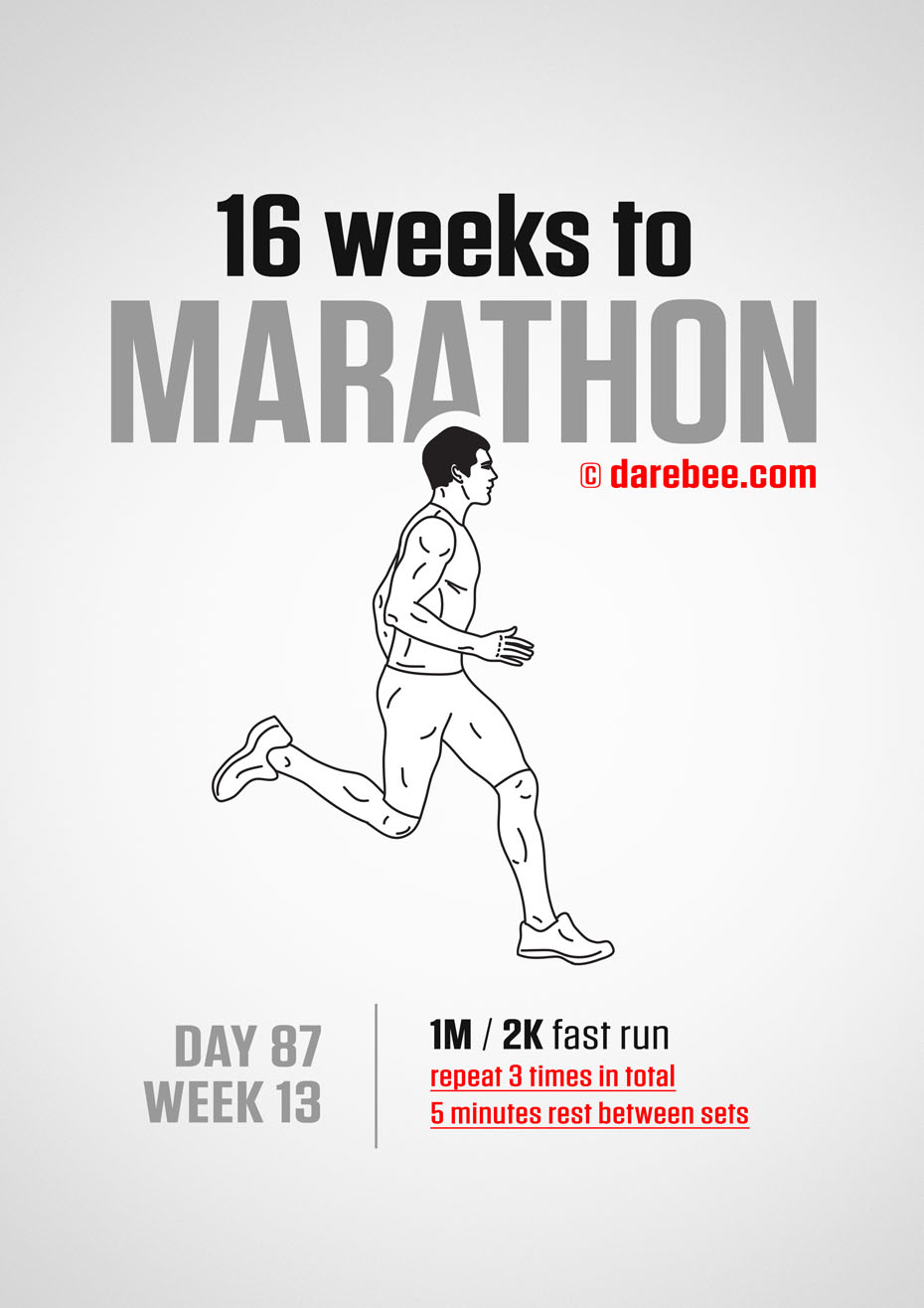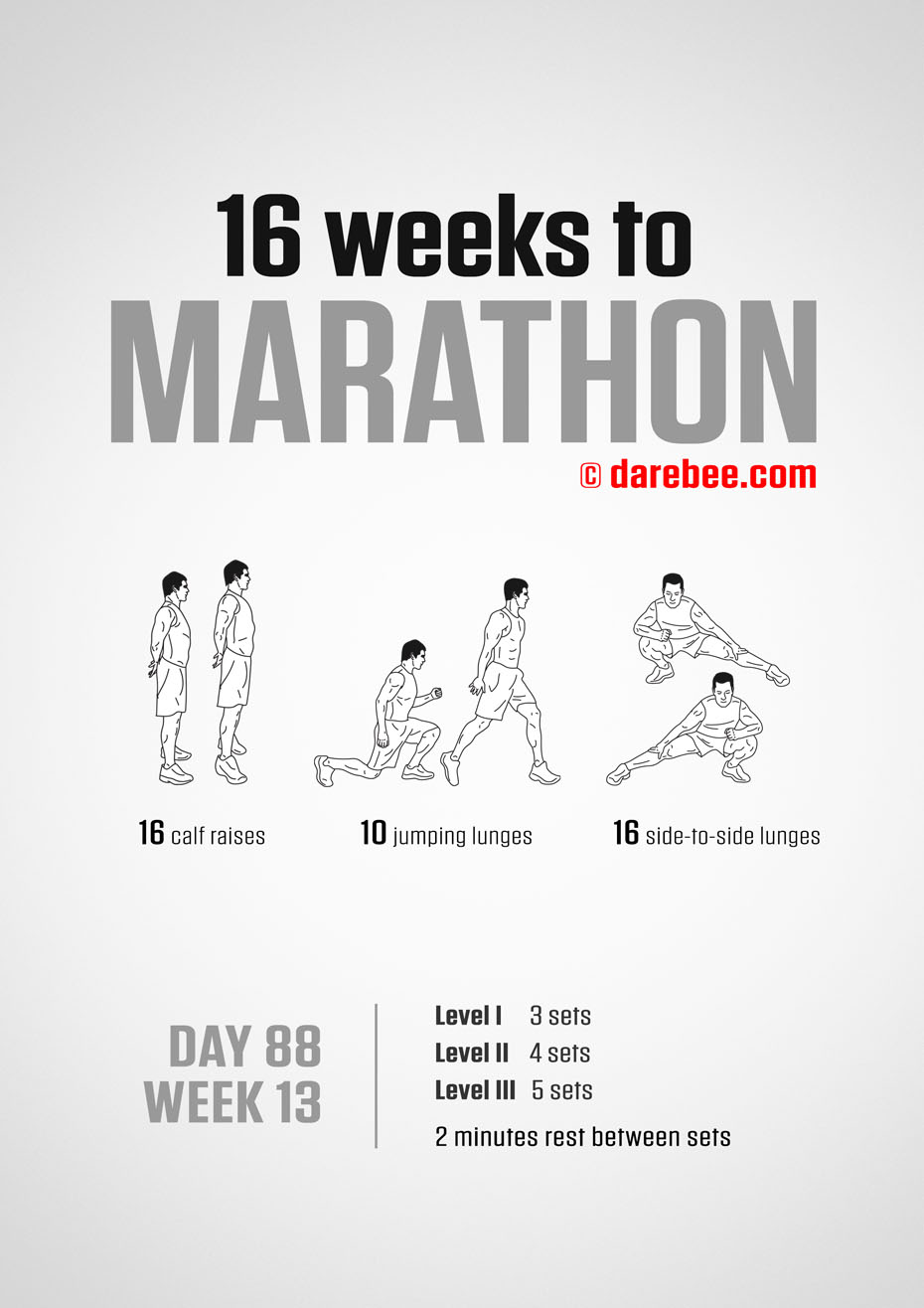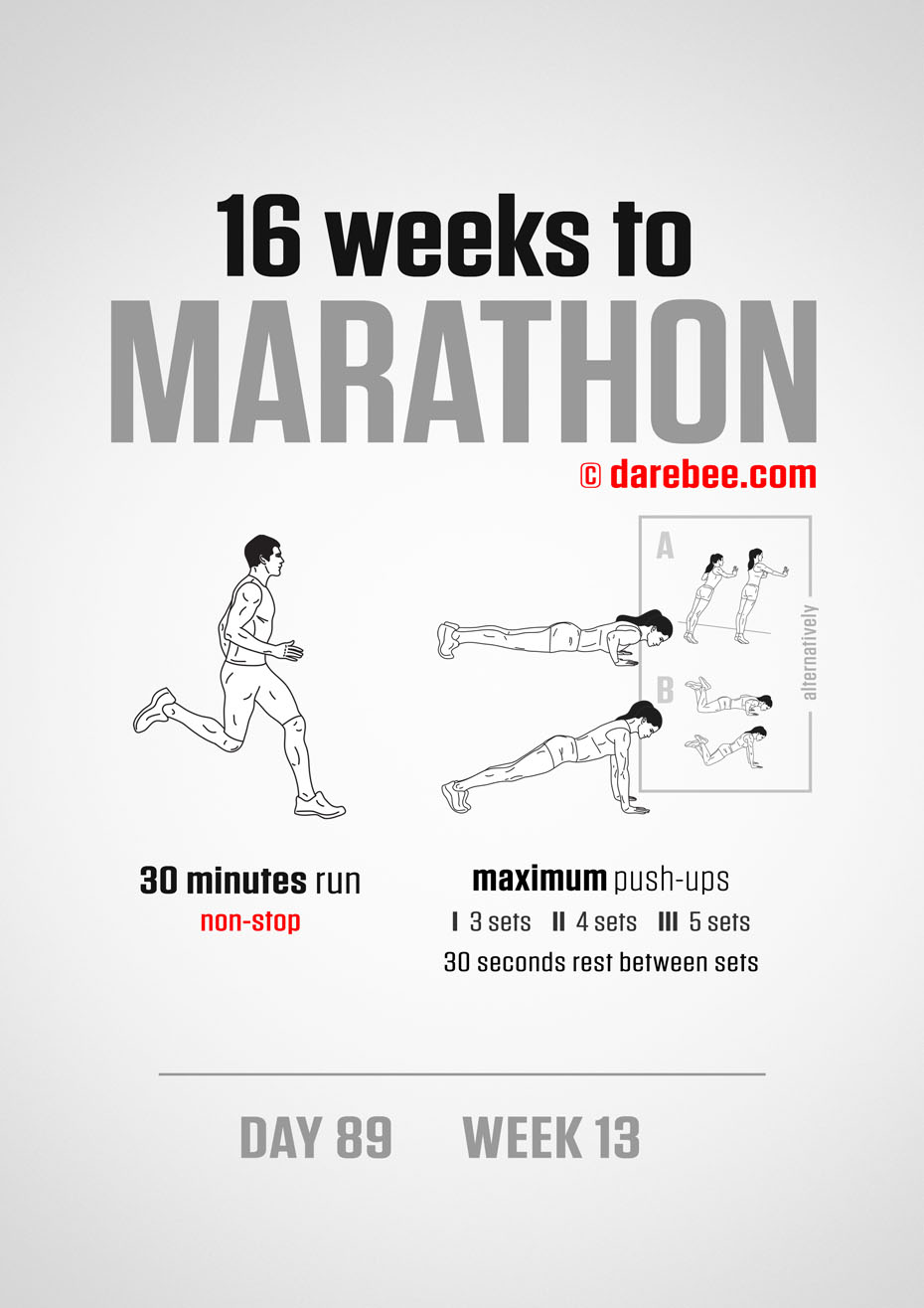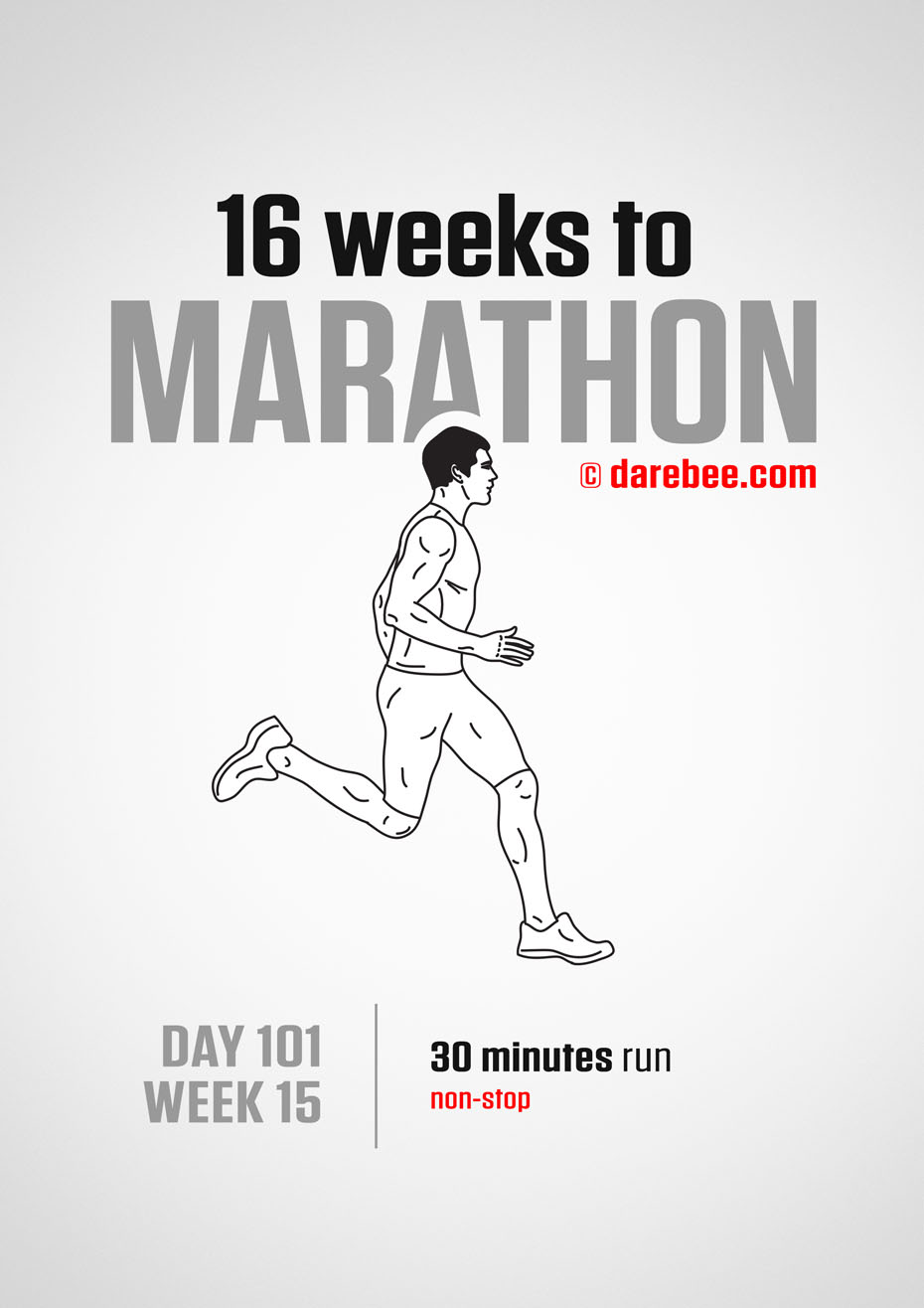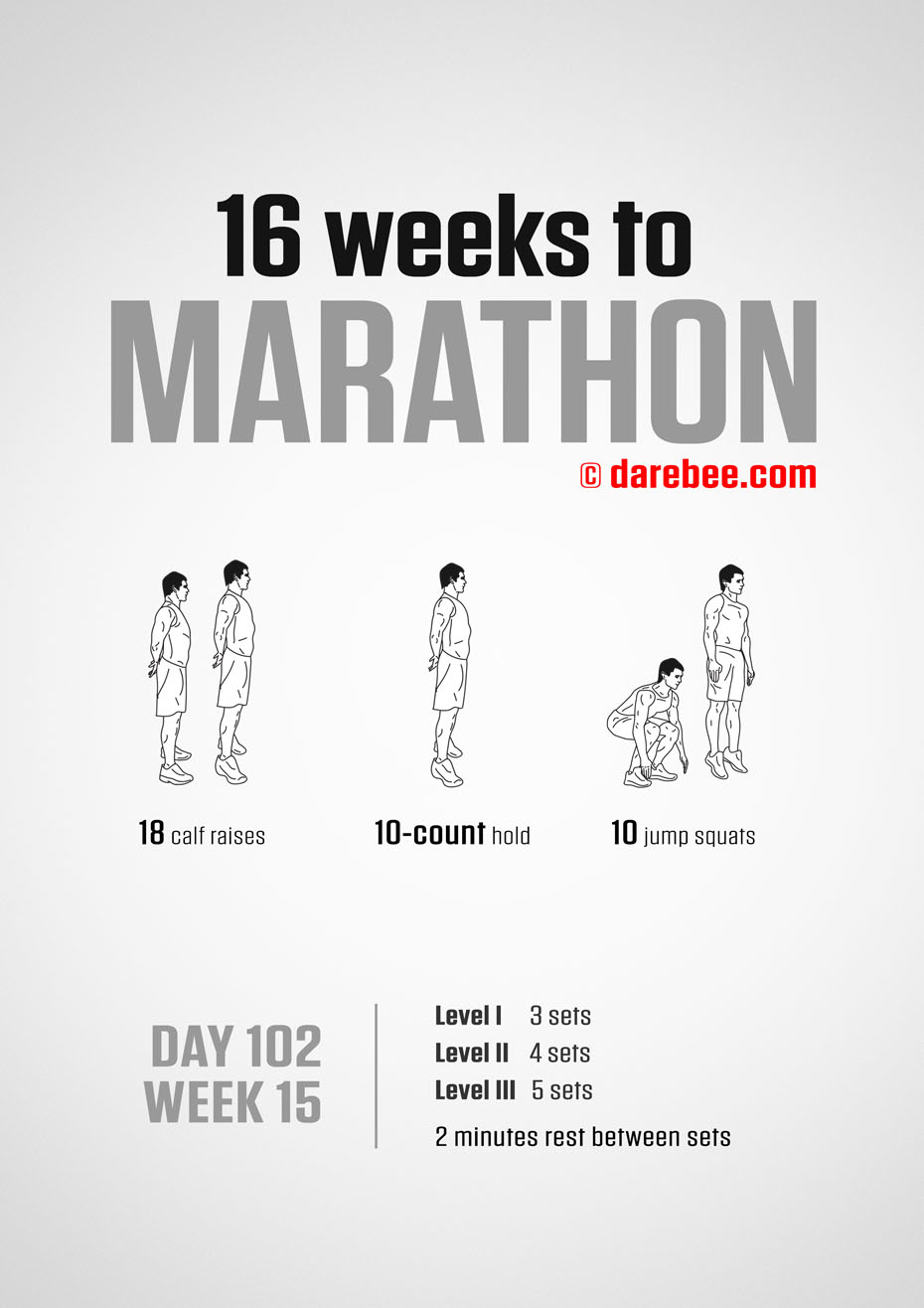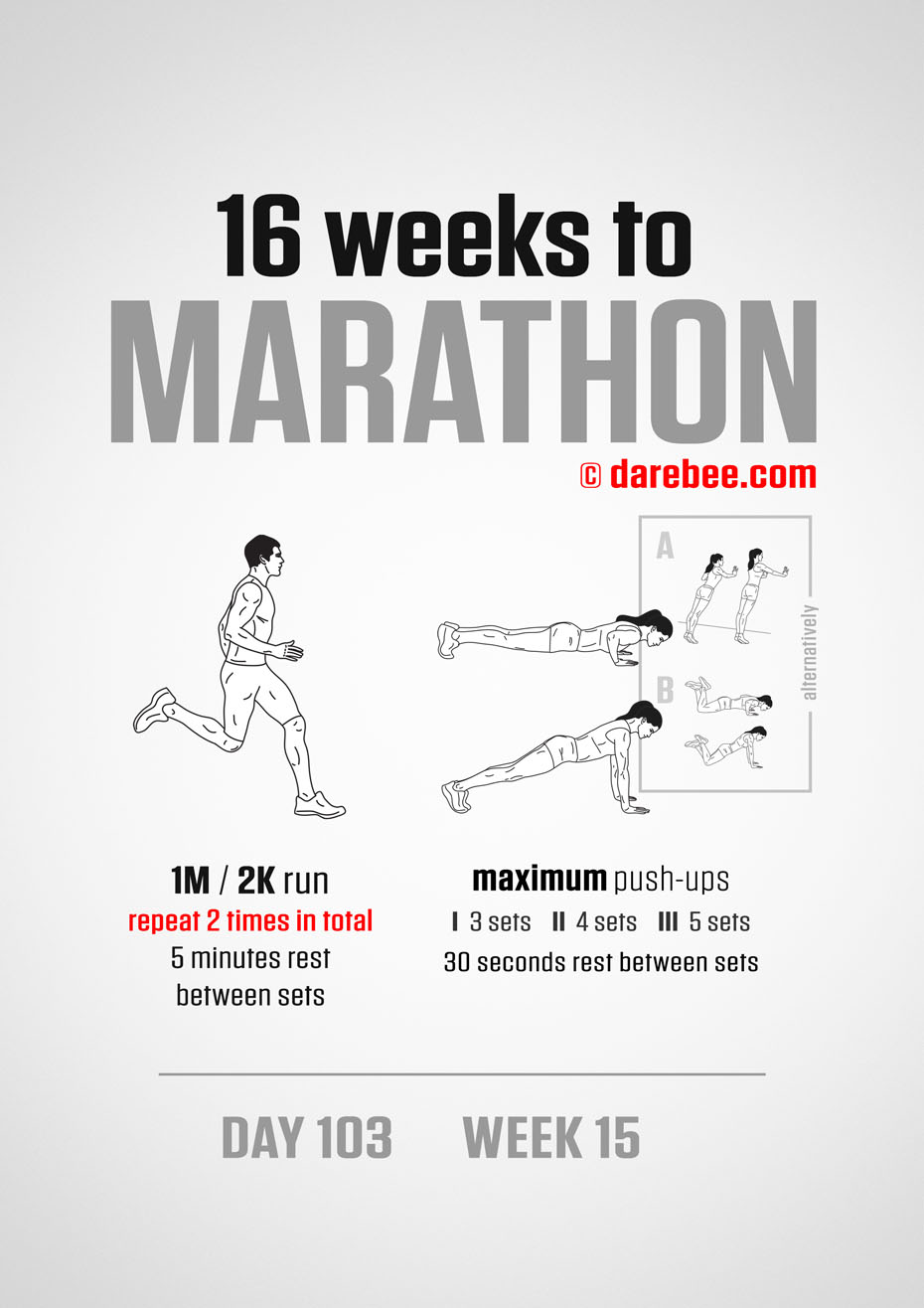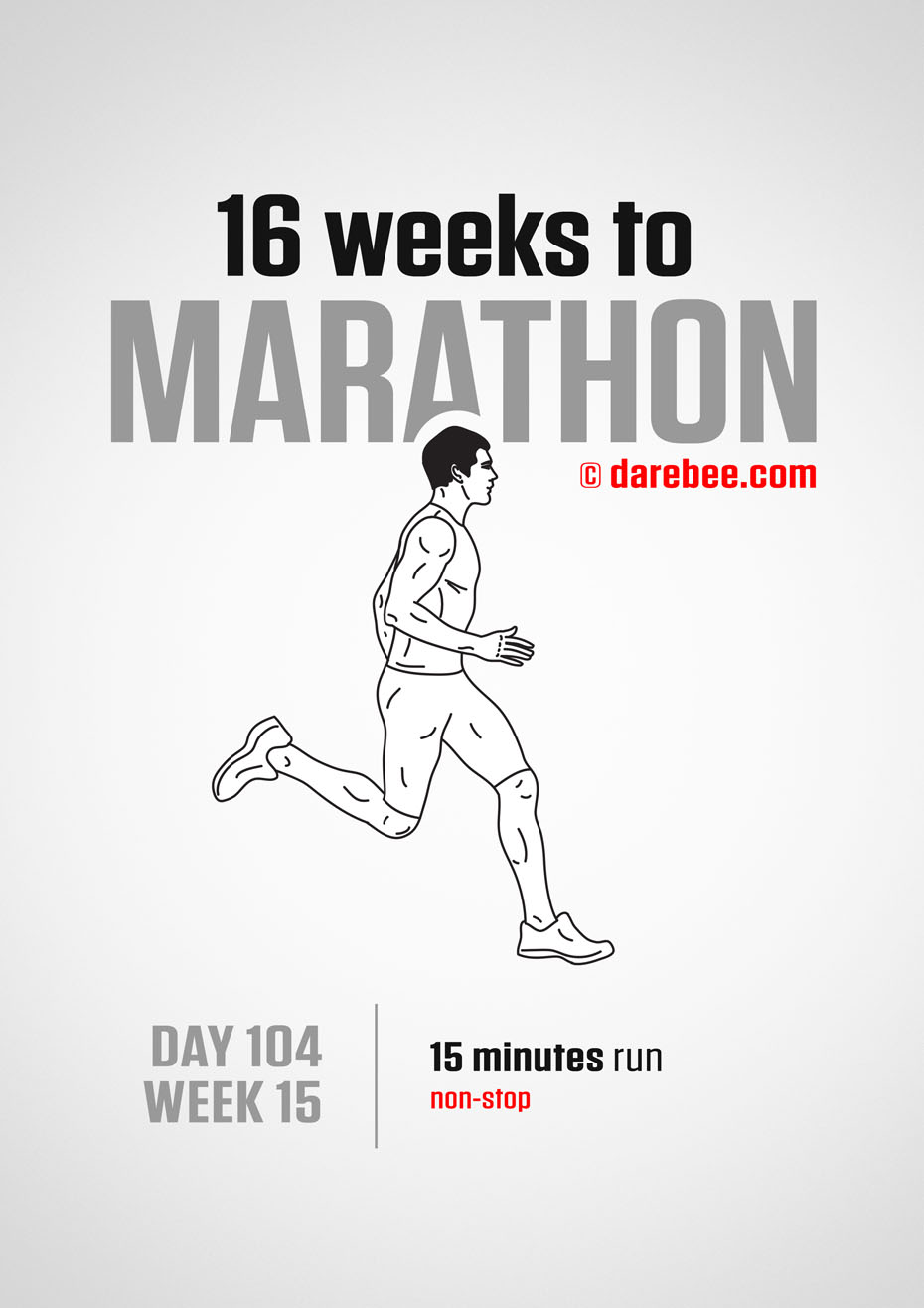
The Marathon Training is a 16-week program that takes you from a fifteen-minute jog to the start line of a full marathon, 26.2 miles / 42.2 kilometres. It combines running sessions with no-equipment bodyweight training, building your endurance, speed and strength side by side so that you arrive at race day with the legs, the lungs and the trunk to carry the distance. It is designed for anyone who wants to run a marathon or become able to run one, and it works just as well as a stand-alone conditioning program for anyone who simply wants to get fitter, leaner and stronger over four months.
The program runs on a 7-day cycle that follows the days of the week - start it on a Monday and the long sessions fall on weekends. Each week mixes easy jogs, brisker runs and a long Sunday session with three short floor and standing circuits for the core and the legs, plus a weekly push-up test to track your upper-body strength. The early weeks are gentle: short jogs with stops allowed, long walks on Sundays. Week by week the jogs join up, the walks turn into walk-and-jog sessions and then into long runs, and the pace work and interval days arrive once the base is there to support them. The final three weeks taper down so that you reach the start rested and ready.
By the end you will have run continuously for over two hours, covered 26 kilometres in a single outing, completed fast runs and interval sessions, and built a core and a pair of legs that hold their form when they are tired. That is what a marathon asks for, and it is what this program gives you - a day at a time, one card after another, from the first easy jog to the flag on Day 112.

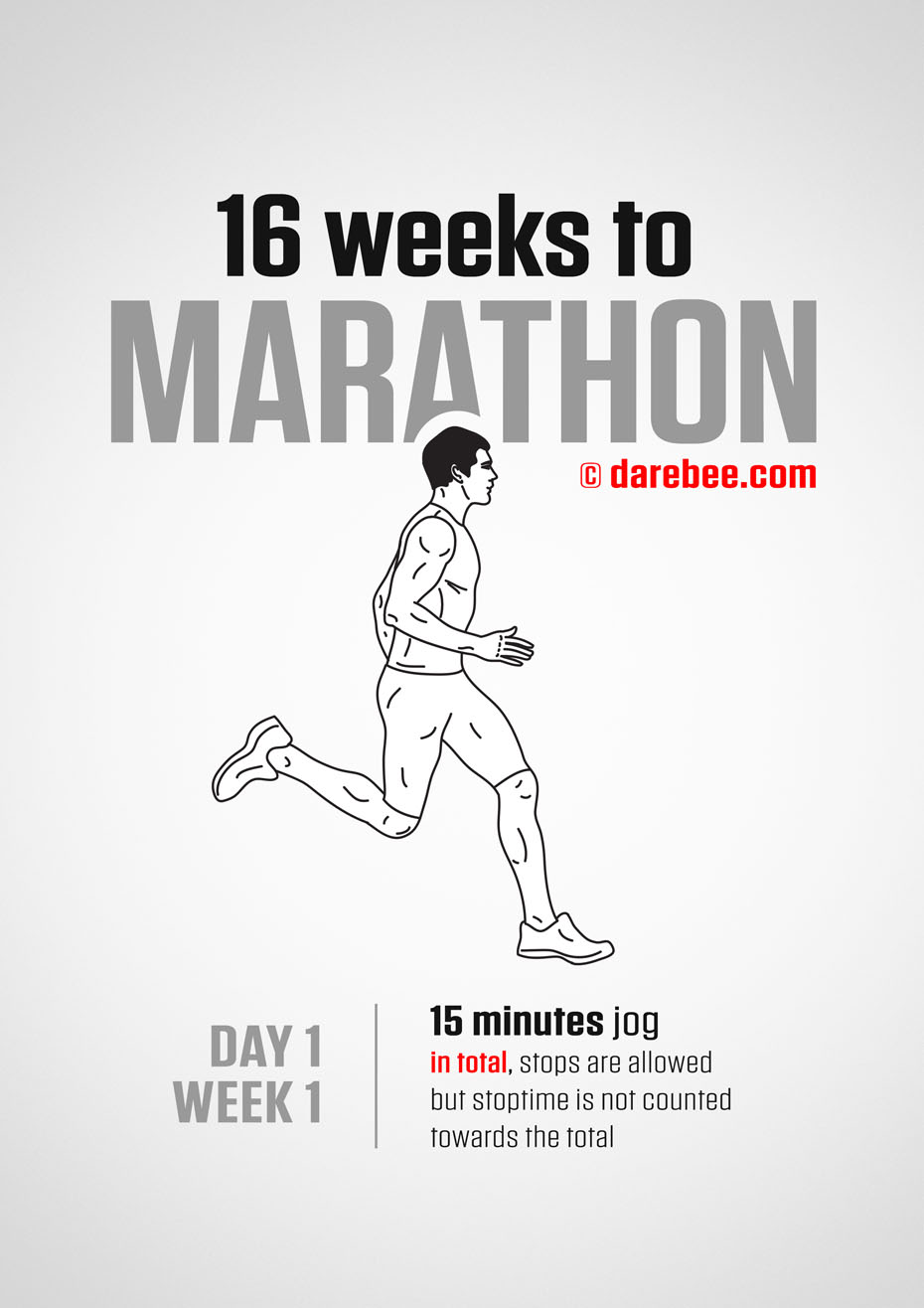
Sixteen weeks starts with fifteen minutes. Day 1 is a jog, and the card sets the rule that runs through the whole first week: the time is counted in total, stops are allowed, but the clock pauses while you stand still. Jog for two minutes, walk for one, jog again - however you split it, only the minutes spent jogging add up, and the session ends when they reach fifteen.
That rule is there so the first week is about time on your feet, not about proving anything. A jog is the slowest pace at which both feet still leave the ground - conversational, relaxed, nothing like a race. Breaking it up into pieces is not failure, it is the design: the program wants you to find out what fifteen minutes of easy movement feels like in your legs, your lungs and your shoes before it asks for anything continuous.
Run tall, land softly under your hips rather than reaching out in front, and keep your arms loose. If your breathing climbs to where you could not hold a conversation, slow down or walk until it settles, then pick the jog back up. Choose a route you can stop on without stress, and note how long the whole outing took compared to the fifteen minutes on the card - that gap will close over the coming weeks.
A marathon is built out of minutes like these fifteen - today you lay the first ones down.
Make it Harder: Not today - this is the gentlest day in the program on purpose, so jog it easy and save the ambition for Week 2.
Make it Easier: Split it any way you need: even fifteen separate one-minute jogs with walks in between count in full.

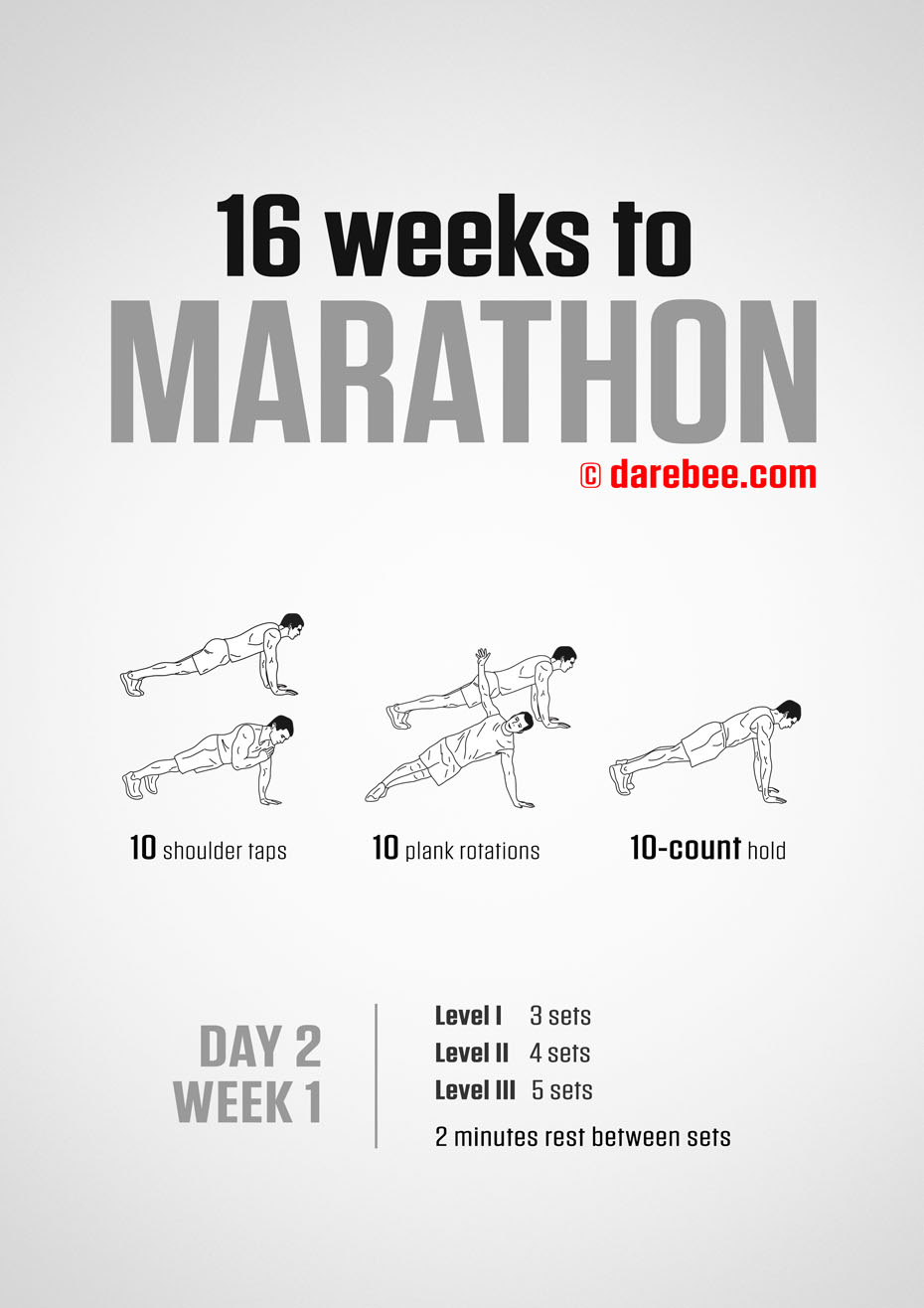
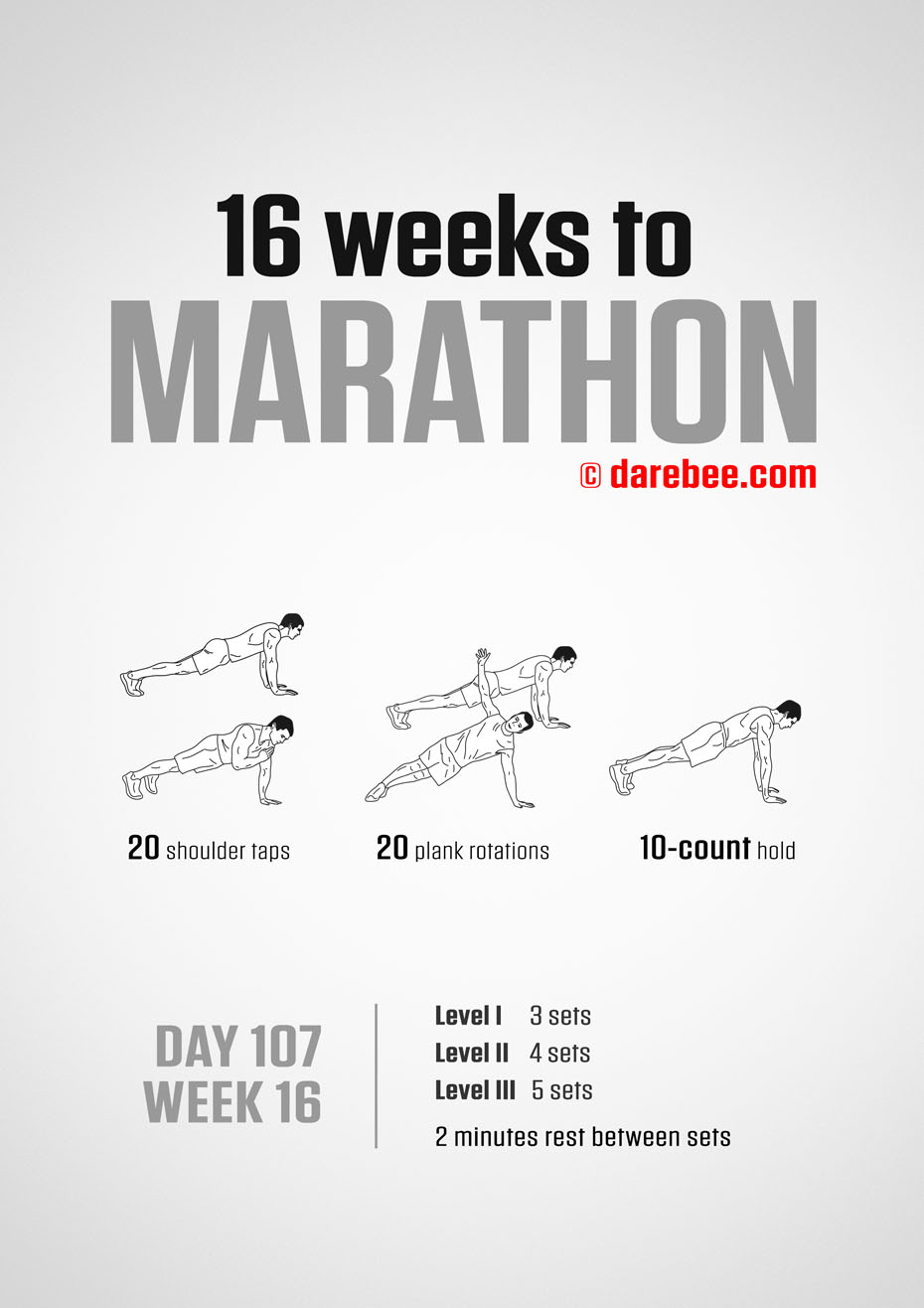
Your first bodyweight session is on the floor, and it is a circuit: 10 shoulder taps, 10 plank rotations and a 10-count hold, done one after another with no rest between exercises. Finishing all three once is one set; then you rest for 2 minutes and go again. The card offers three levels - Level I is 3 sets, Level II is 4, Level III is 5 - and you pick the one that matches how you feel today, not a label you think you should live up to. A rep is one completed movement; a count is one steady beat, roughly a second, used for holds.
Everything here is a plank in disguise. Shoulder taps start in a high plank on your hands and alternate lifting one hand to touch the opposite shoulder - 10 taps means 5 per side. Plank rotations lift one arm straight up toward the ceiling as the body turns into a side plank, then return and rotate to the other side. The hold is a straight high plank held still for ten counts. Runners need exactly this: a midsection that does not sag, twist or wobble when the legs get tired at mile twenty.
In every position, your body is a straight line from head to heels - hips neither sagging toward the floor nor pushed up into a tent. During shoulder taps, the trick is to keep the hips from swinging when a hand leaves the floor; spread your feet a little wider if they do. In rotations, stack your feet or stagger them, and open the chest fully to the side. In the hold, squeeze your glutes and push the floor away so your shoulders stay active.
Runners are made from the hips up as much as the knees down - this is where that part of the work begins.
Make it Harder: Pause for a two-count at the top of every plank rotation with the arm fully extended.
Make it Easier: Do the shoulder taps and the hold from your knees and keep the rotations as written.

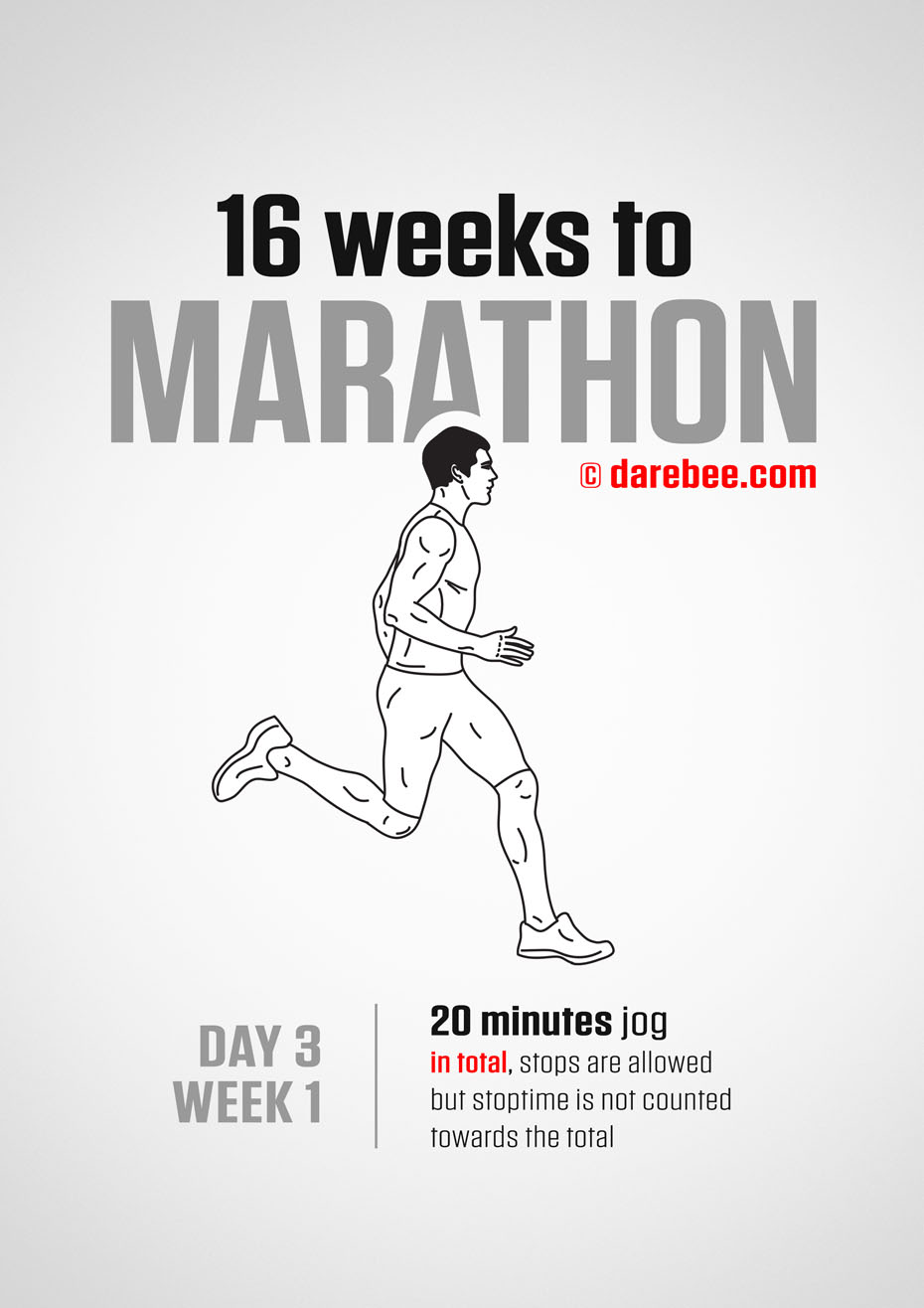
Day 3 adds five minutes to the jog: 20 minutes in total, with the same Week 1 rule - stops are allowed and only the time spent jogging counts. If Day 1 came in one piece, aim for the same here; if it came in pieces, aim for slightly longer pieces. The target is twenty minutes of jogging by the end of the outing, however the pauses fall.
Five minutes does not sound like much, but it is a third more than two days ago, and the program will keep adding in increments like this for the next three months. Small, regular steps are how distance gets built without the body objecting - the legs adapt to what they did last time plus a little, never to a leap. Yesterday's plank work is also why your torso may feel this jog differently: that is the midsection starting to hold you together on the move.
Keep the effort conversational, keep the steps short and quick rather than long and bounding, and keep your gaze ahead rather than down at your feet. If you stop, keep walking during the pause so the legs stay warm, then ease back into the jog rather than restarting at full speed. A watch or phone that pauses on stops makes the counting effortless.
Five more minutes than Day 1 - the distance between you and the marathon just got a little shorter.
Make it Harder: Harder is not what this week is for - if twenty minutes comes easily, take it as a sign the program is working, not a reason to push.
Make it Easier: Break the twenty into four fives with a walk between each and let them add up.

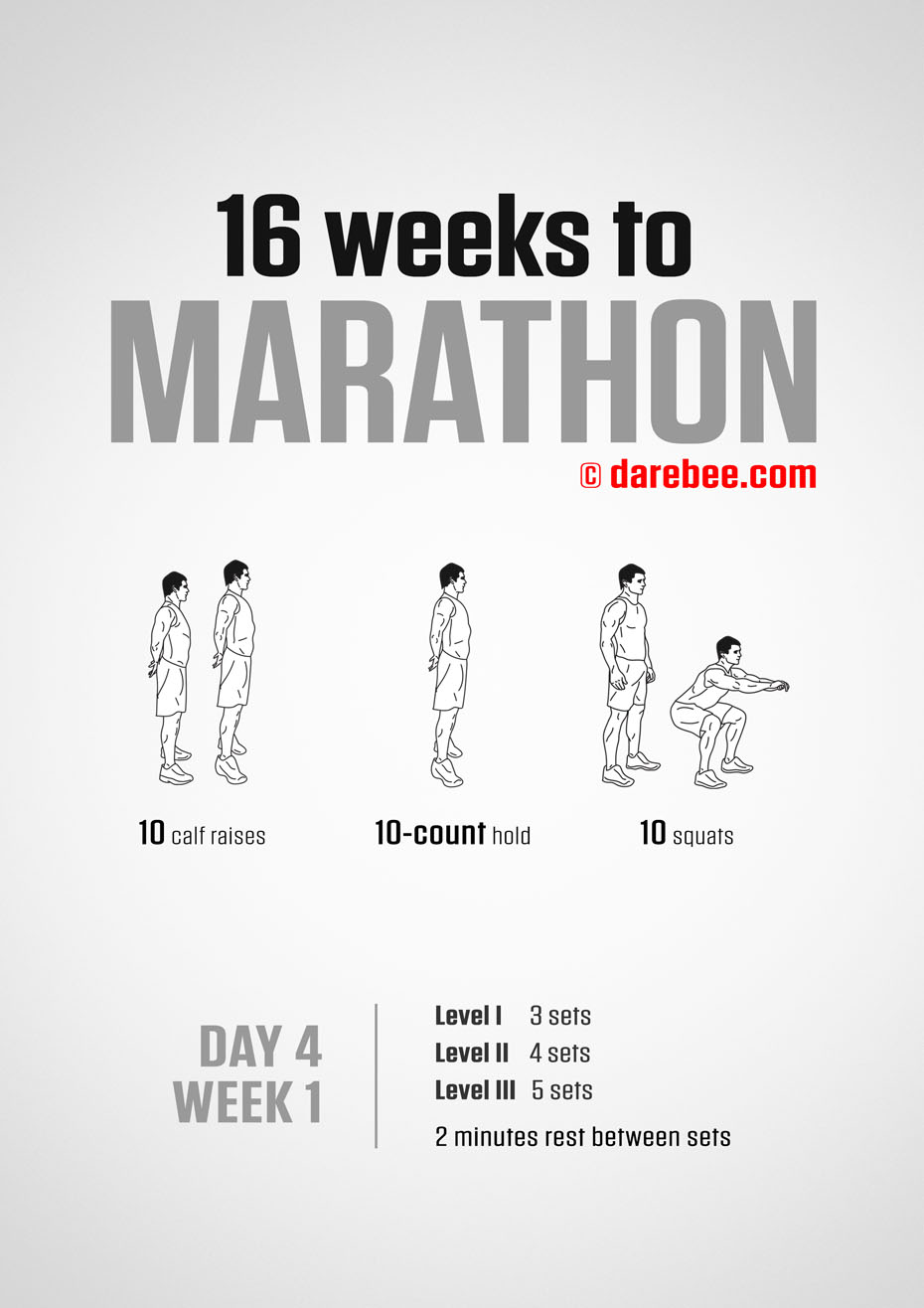
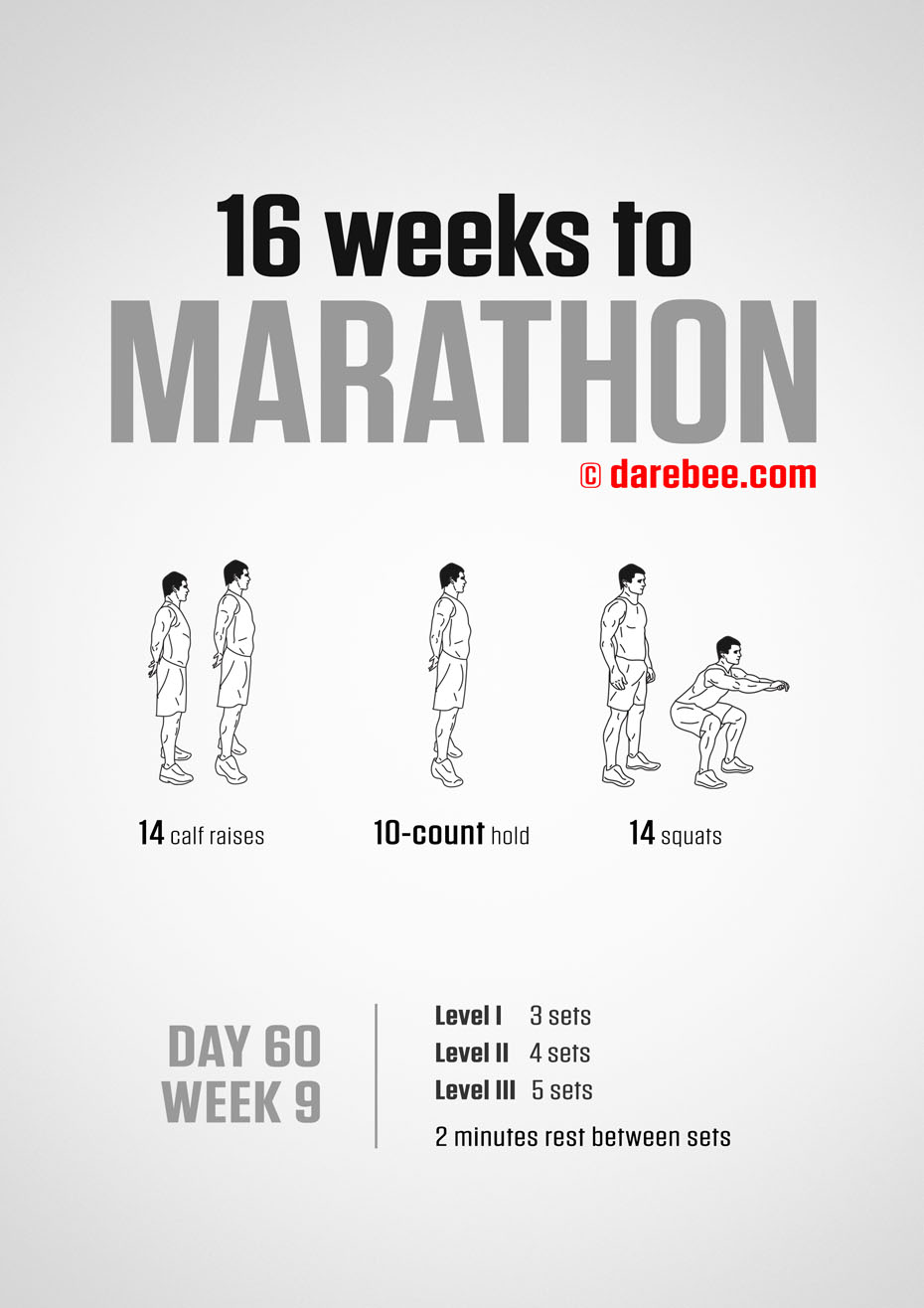
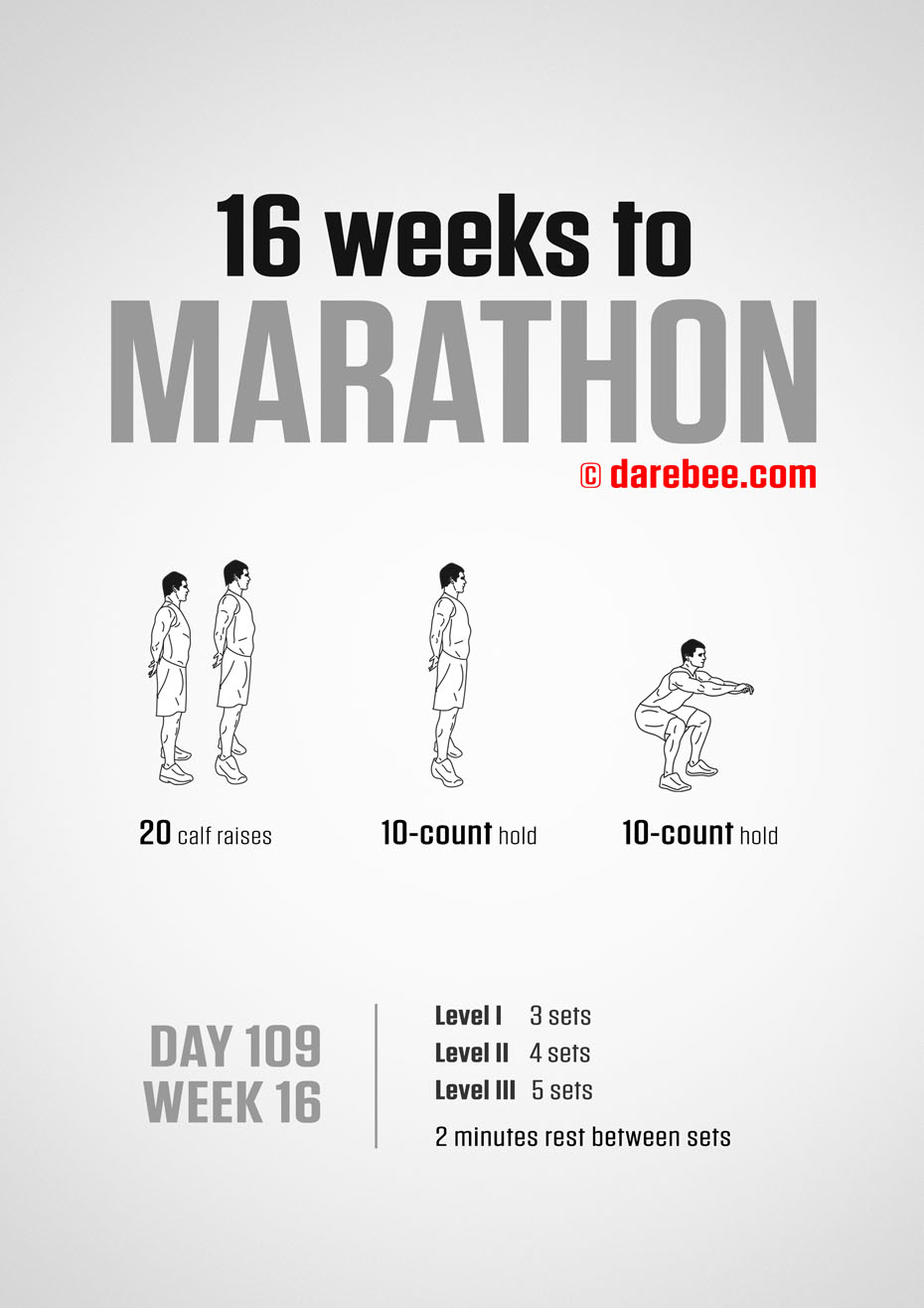
The leg session is a circuit of 10 calf raises, a 10-count hold and 10 squats - all three in sequence, then 2 minutes rest, then again for 3, 4 or 5 sets depending on the level you choose. The hold sits between the two moving exercises and, as the drawing shows, it is the top of the calf raise: standing on the balls of both feet, heels high, hands behind your back, held still for ten counts.
Calves and quads are the engine room of running, and this circuit gives them a simple, repeatable dose. Calf raises train the muscle that absorbs and returns energy on every single stride; the hold teaches that muscle to stay switched on rather than collapsing the moment it gets tired, which is precisely what happens to the calves late in a long run. Squats cover the quads, glutes and hips that carry you up every hill and down every descent. Done in sequence, the calves are already loaded when the squats begin.
Rise all the way onto the balls of your feet on each calf raise and lower slowly - do not let the heels drop with a thud. In the hold, keep your ankles steady and your weight over your big toes, not rolling outward. In the squat, sit back as if into a chair, keep your heels down and your knees tracking over your toes, and stop when your thighs are roughly parallel to the floor.
Every stride you will ever run begins at the calf and the quad - today they get their first lesson.
Make it Harder: Do the calf raises and the hold on one leg at a time, switching sides halfway through each.
Make it Easier: Hold the calf raise for a 5-count instead of 10 and keep the rest of the circuit as written.

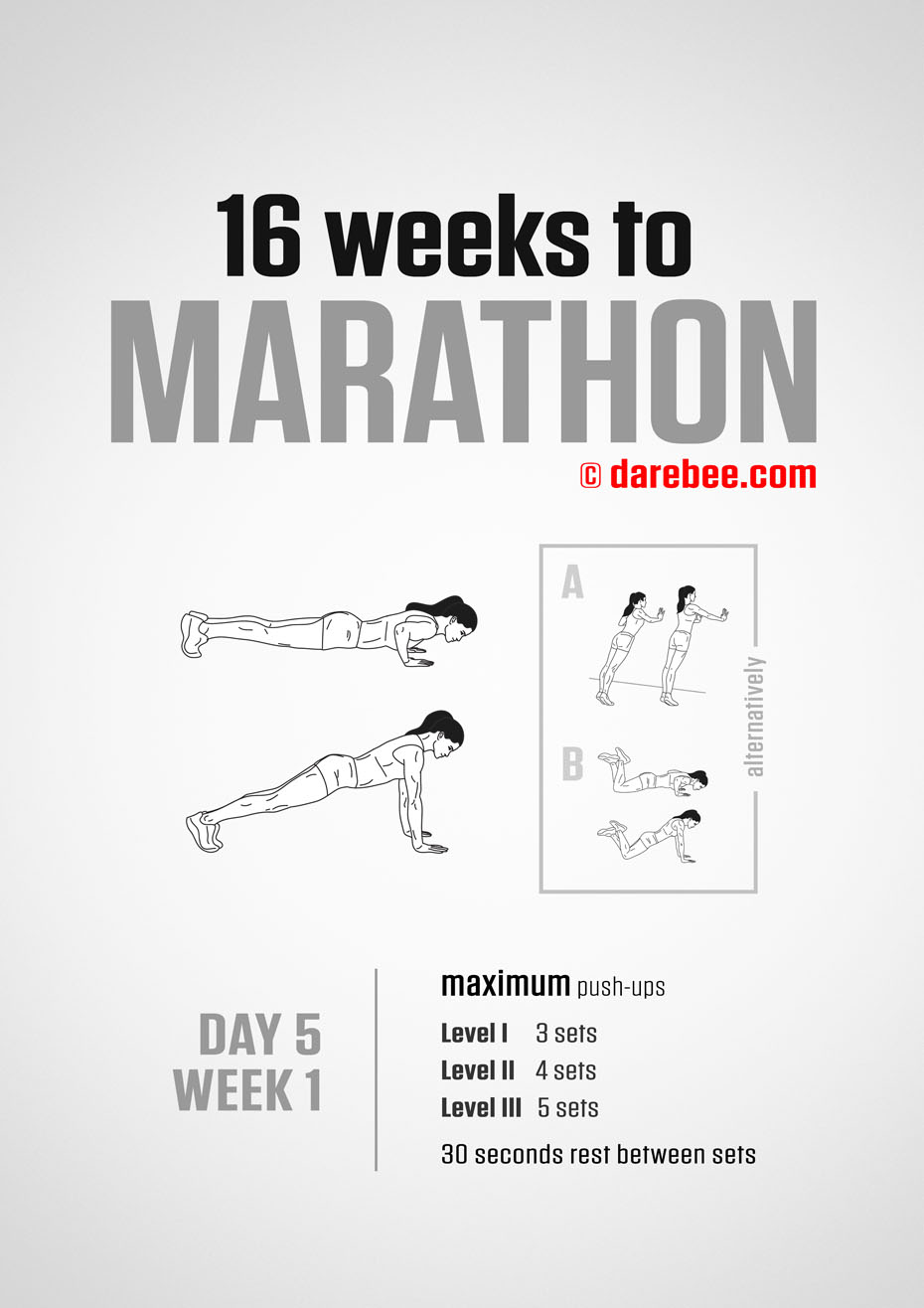
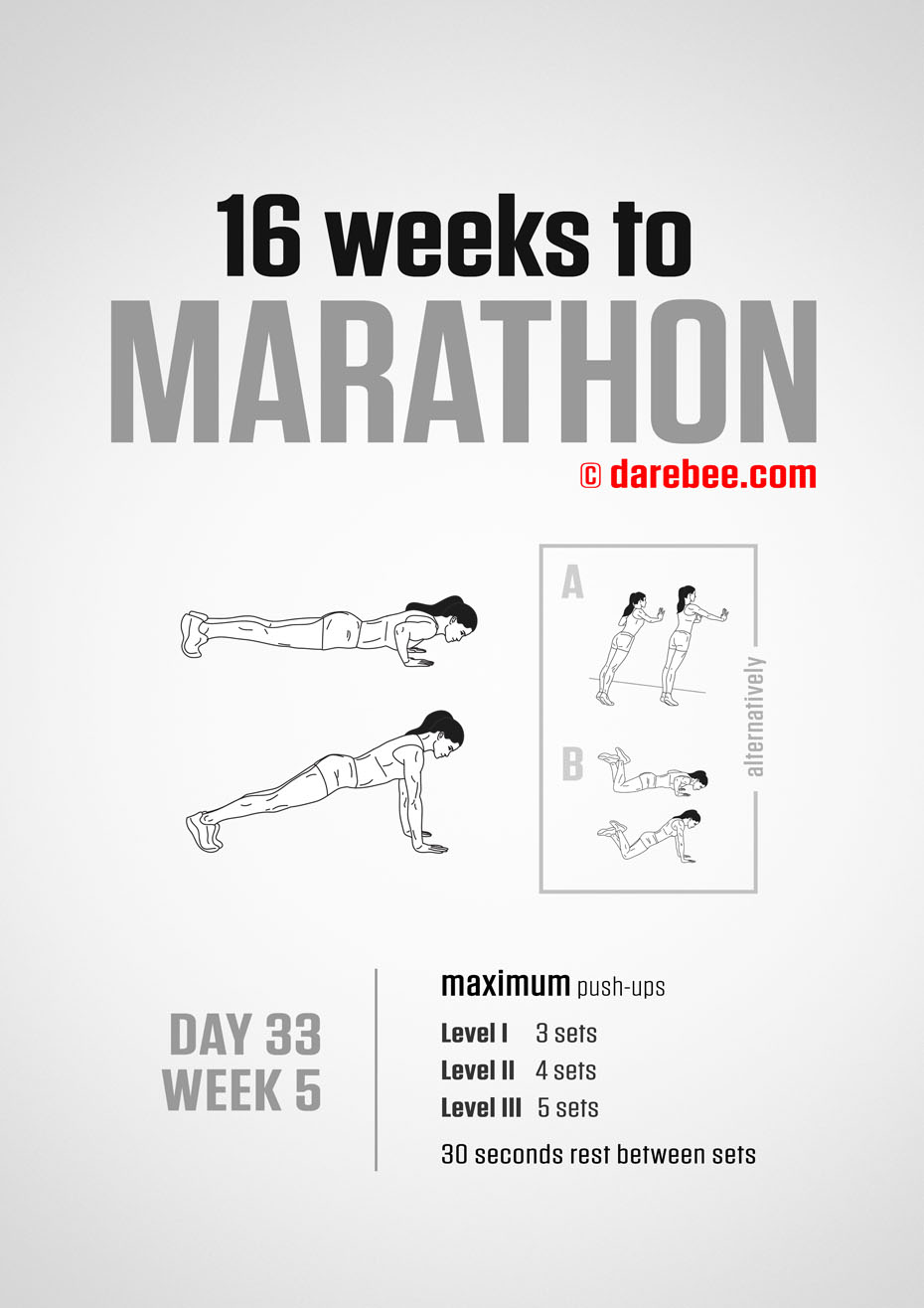
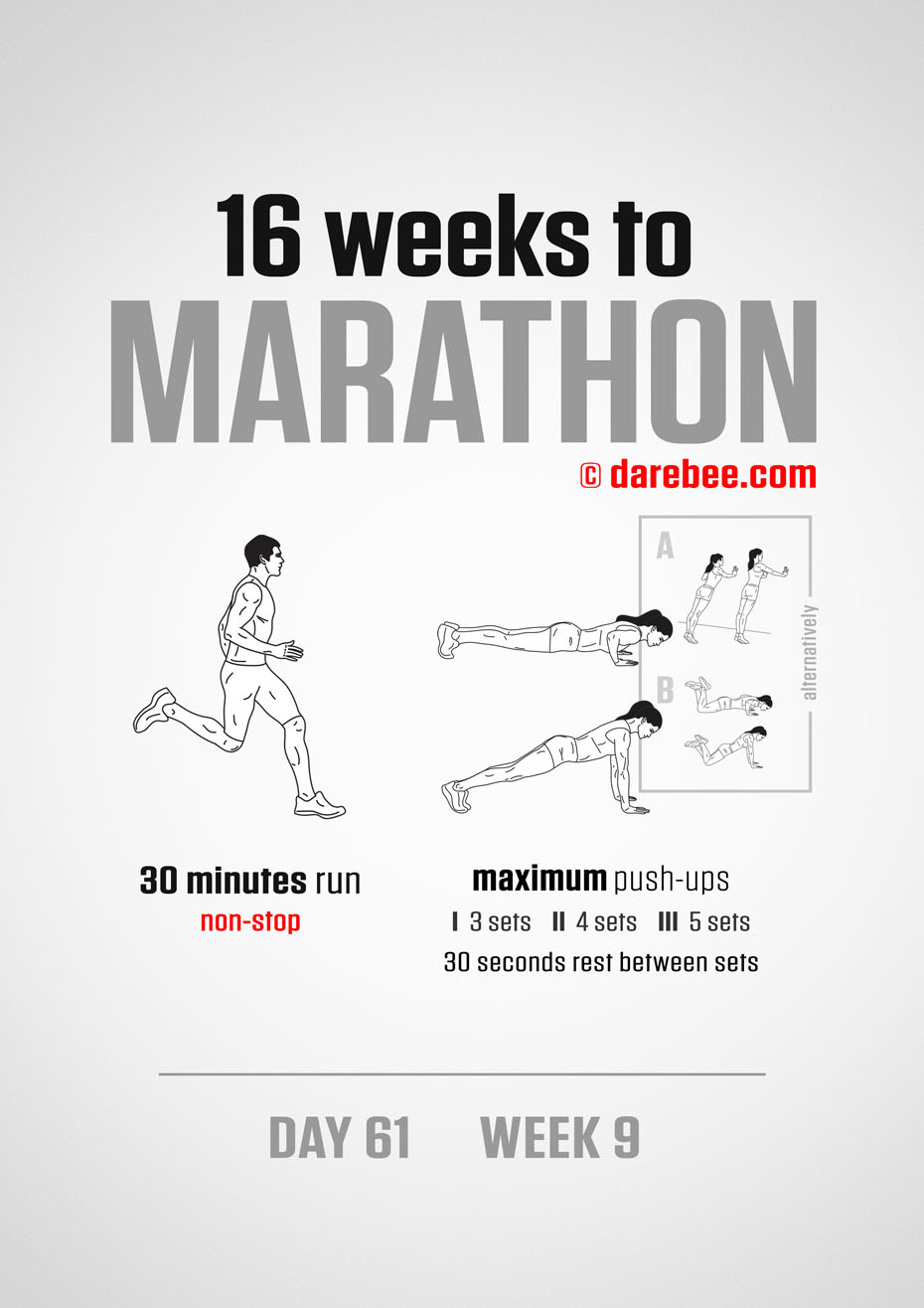
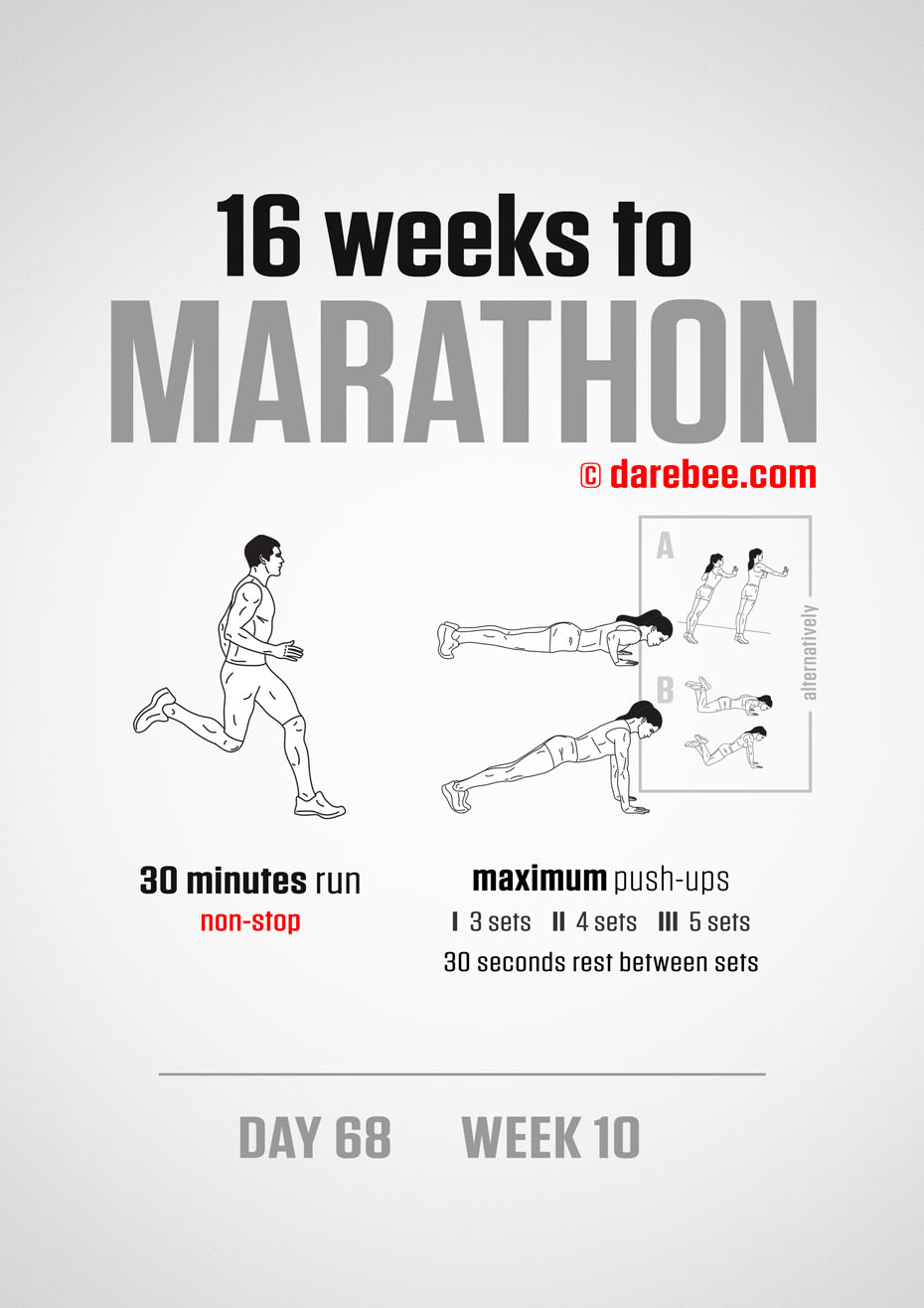
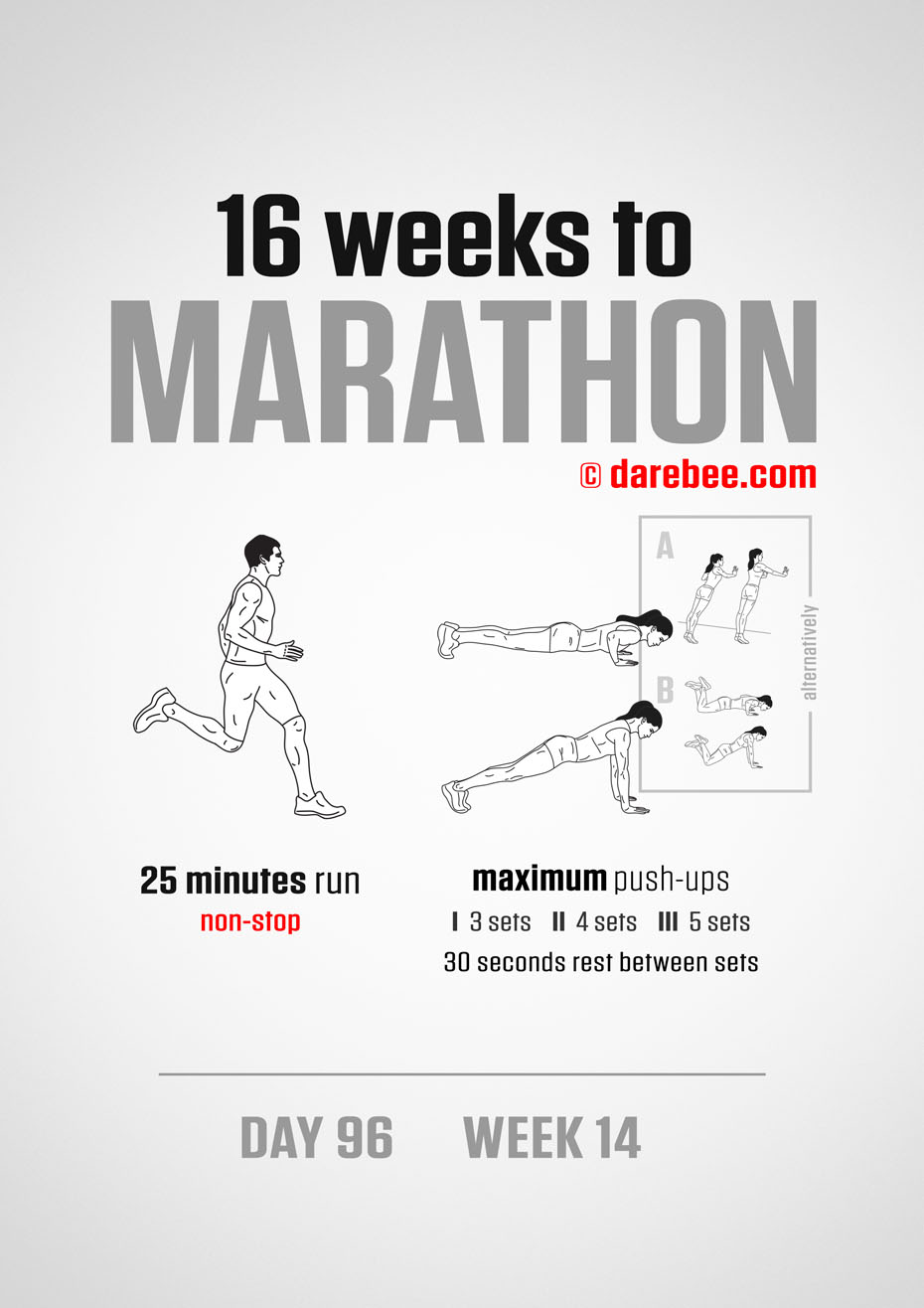
Day 5 is push-ups, and the instruction is one word: maximum. Do as many full push-ups as you can in one unbroken set, rest 30 seconds, and repeat - 3 sets for Level I, 4 for Level II, 5 for Level III. There is no target number, only your best on the day, and the number will be smaller on the last set than on the first. That is expected and exactly what the short rest is designed to produce.
The card carries an alternative box marked A and B: wall push-ups, done standing with your hands on a wall and your body angled toward it, or knee push-ups, done from the floor with the knees down and the body straight from knees to head. Pick whichever version lets you do a proper, full-range set - the program cares about the upper body getting worked to its limit, not about which version you used to get there. Push-ups keep the arms, chest and shoulders strong enough to hold good running posture for hours at a time.
Whatever the version, the standard is the same: hands slightly wider than your shoulders, elbows tucked at roughly 45 degrees rather than flared, chest traveling all the way down to just above the surface and all the way back up to straight arms. Stop the set when the next rep would be a half rep. Keep a count of your first-set number - this card returns every week, and that number is how you will see your progress.
No rep target, just your honest maximum - write it down, because this day comes back every week to ask again.
Make it Harder: Slow the lowering of every push-up to a three-count and keep the sets maximal.
Make it Easier: Use the wall version for every set and cut the rest between sets to whatever you need.

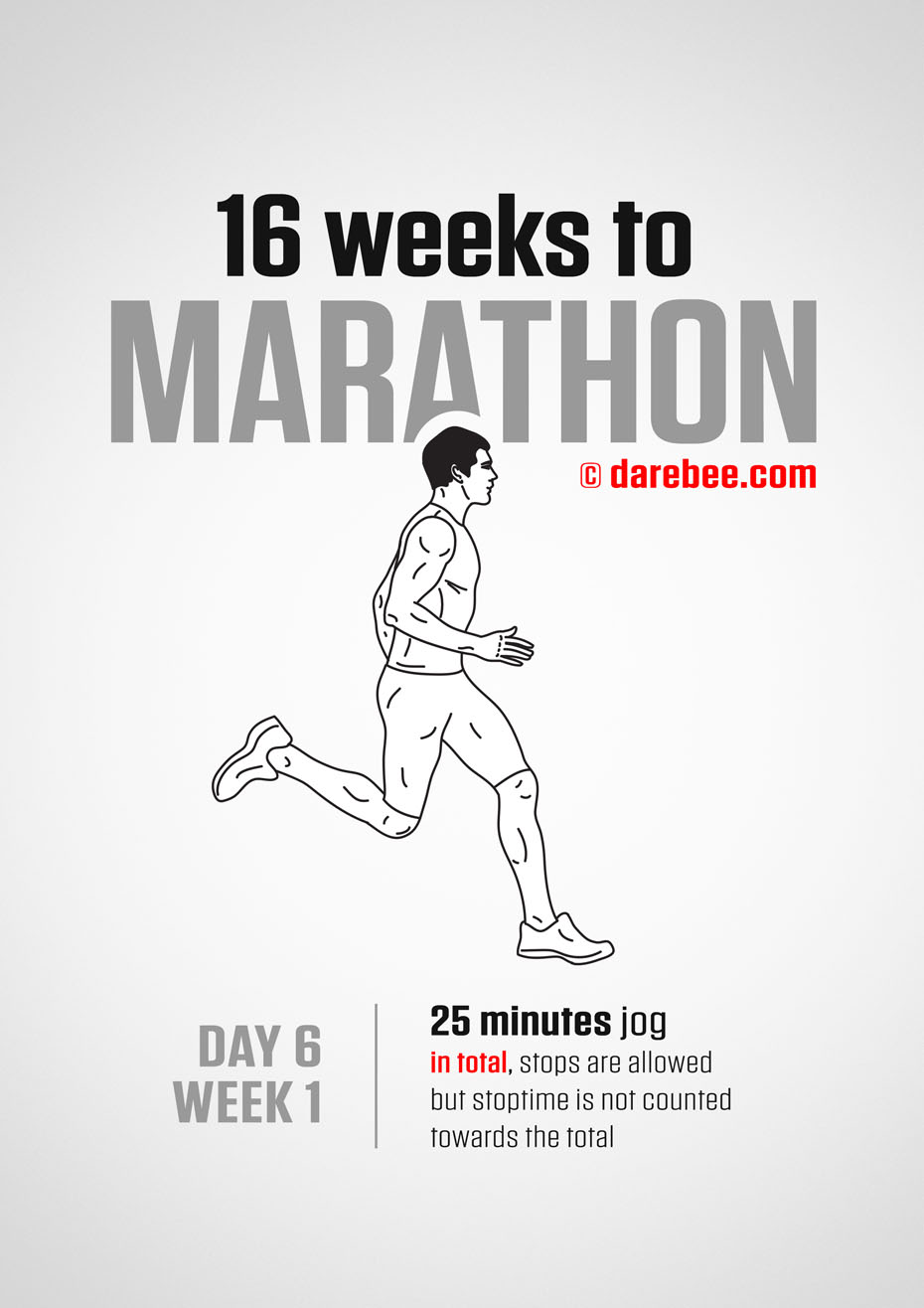
The last jog of Week 1: 25 minutes in total, stops allowed, with the jogging minutes added up as before. The card has grown by five minutes per session all week - 15, 20, now 25 - and this is the longest continuous effort the program has asked for so far. Spread it over whatever pattern of jogging and pausing gets you to the number.
Three jogs and three floor sessions into the program, the pieces are starting to talk to each other. The calves you raised on Day 4 are doing their job on every stride; the plank work is keeping your trunk quiet. Twenty-five minutes is also long enough that pacing starts to matter: a jog that feels too easy for the first five minutes is usually the right speed for the last five. Settle into it early and the end of the session looks after itself.
Start slower than feels necessary and let the pace find you. Keep the shoulders down and the hands relaxed, as if carrying something fragile. If you take pauses, make them brief - a minute of walking brings the breathing down without letting the legs cool - and resume at the same easy speed rather than trying to make up for lost time.
Week 1's longest jog, and the final warm-up before the program asks you to stop stopping.
Make it Harder: Leave it alone - the one thing this day needs from you is twenty-five easy minutes, not a faster version of them.
Make it Easier: Walk for a full minute after every four minutes of jogging and count only the jogging toward the total.

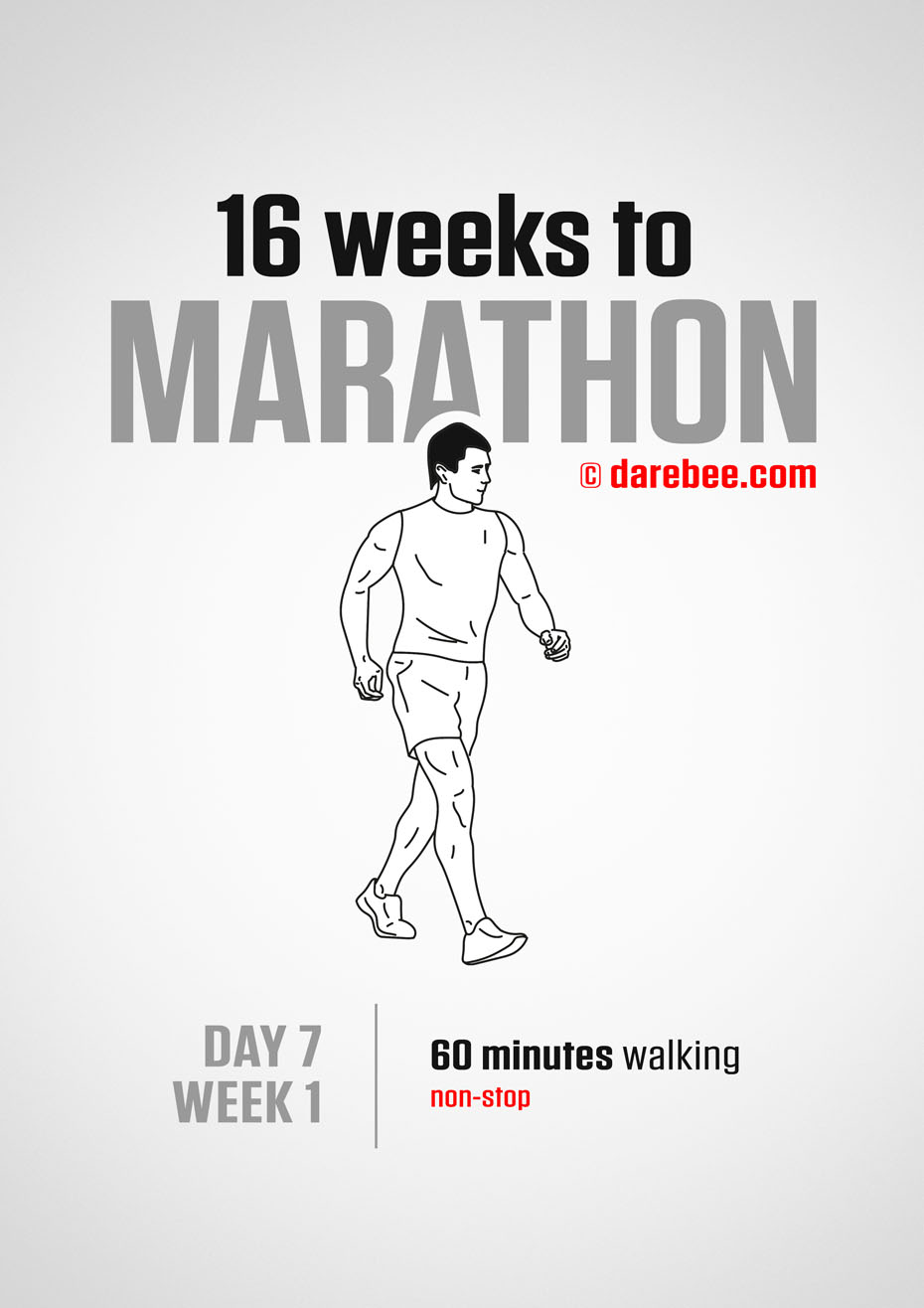
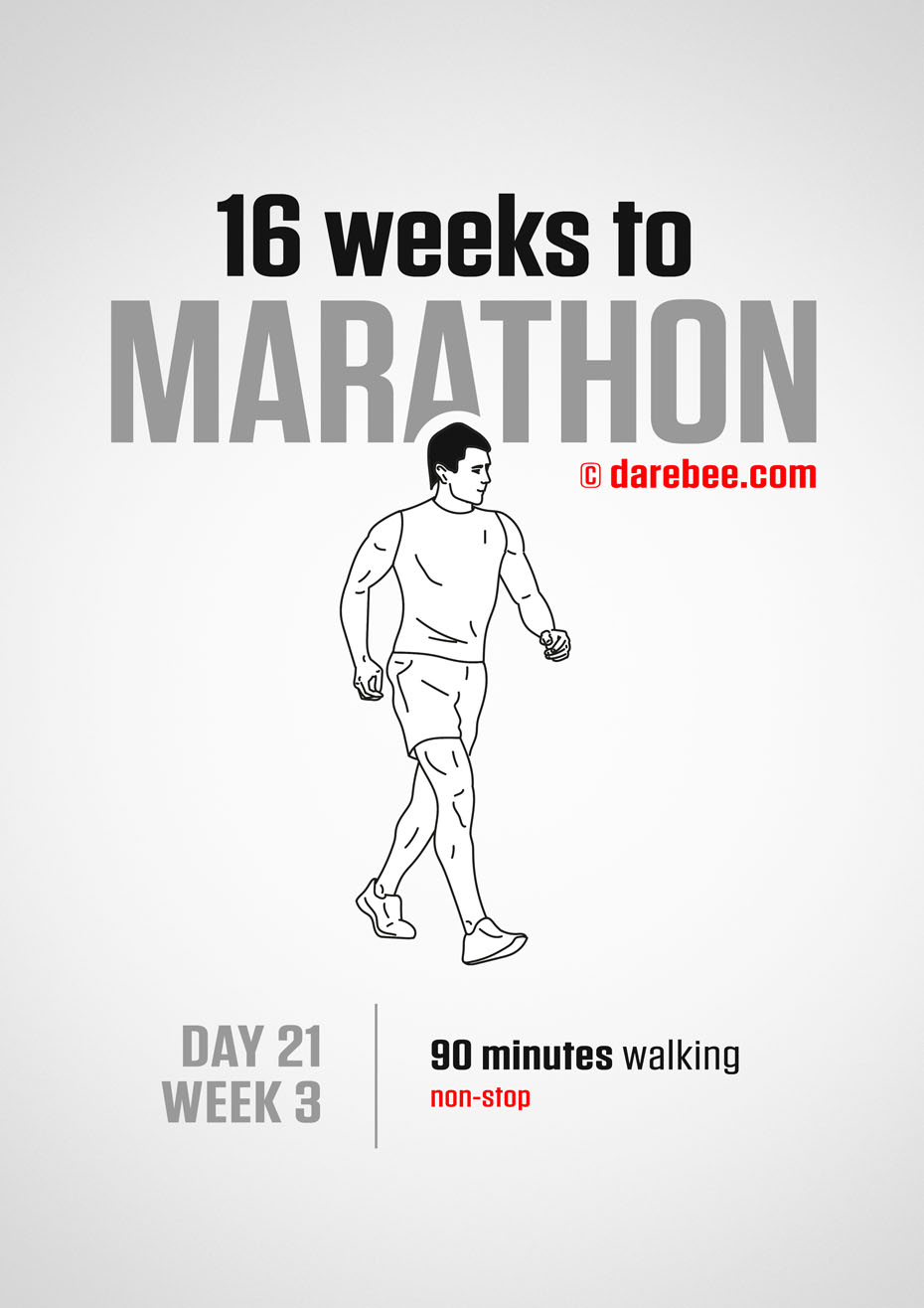
Week 1 closes with a walk: 60 minutes, non-stop. No jogging, no pace target, just an hour of continuous walking at whatever speed lets you talk the whole way. The only requirement is that you keep moving from the first minute to the last, which is a different kind of challenge from anything else this week - not intensity, but duration.
Long walks are how this program introduces the idea that a marathon is about time on your feet. The legs, feet and hips have to learn to carry you for hours, and walking teaches them that with almost no impact. Sixty minutes of walking also covers several kilometres of ground, which is a quiet preview of what the Sunday sessions will grow into: next week it is 75 minutes, the week after 90, and then the walks begin to turn into walk-and-jog days and finally into long runs. This hour is the foundation they all stand on.
Walk tall, swing the arms, and let the stride be natural rather than forced long. Wear the shoes you plan to run in so they start to fit your feet. Pick a route that loops or goes out and back so the second half brings you home, and take water if it is warm. Notice where you feel it - the hips, the feet, the lower back - because those are the places the program will keep an eye on.
Sixty minutes on your feet is where every long Sunday in this program starts - a marathon is a very long walk taken quickly.
Make it Harder: A walk does not need a harder version - it needs an unbroken hour, so keep it brisk, keep it relaxed and let the distance take care of itself.
Make it Easier: Walk at an easy stroll for the full hour - the time matters far more than the pace.

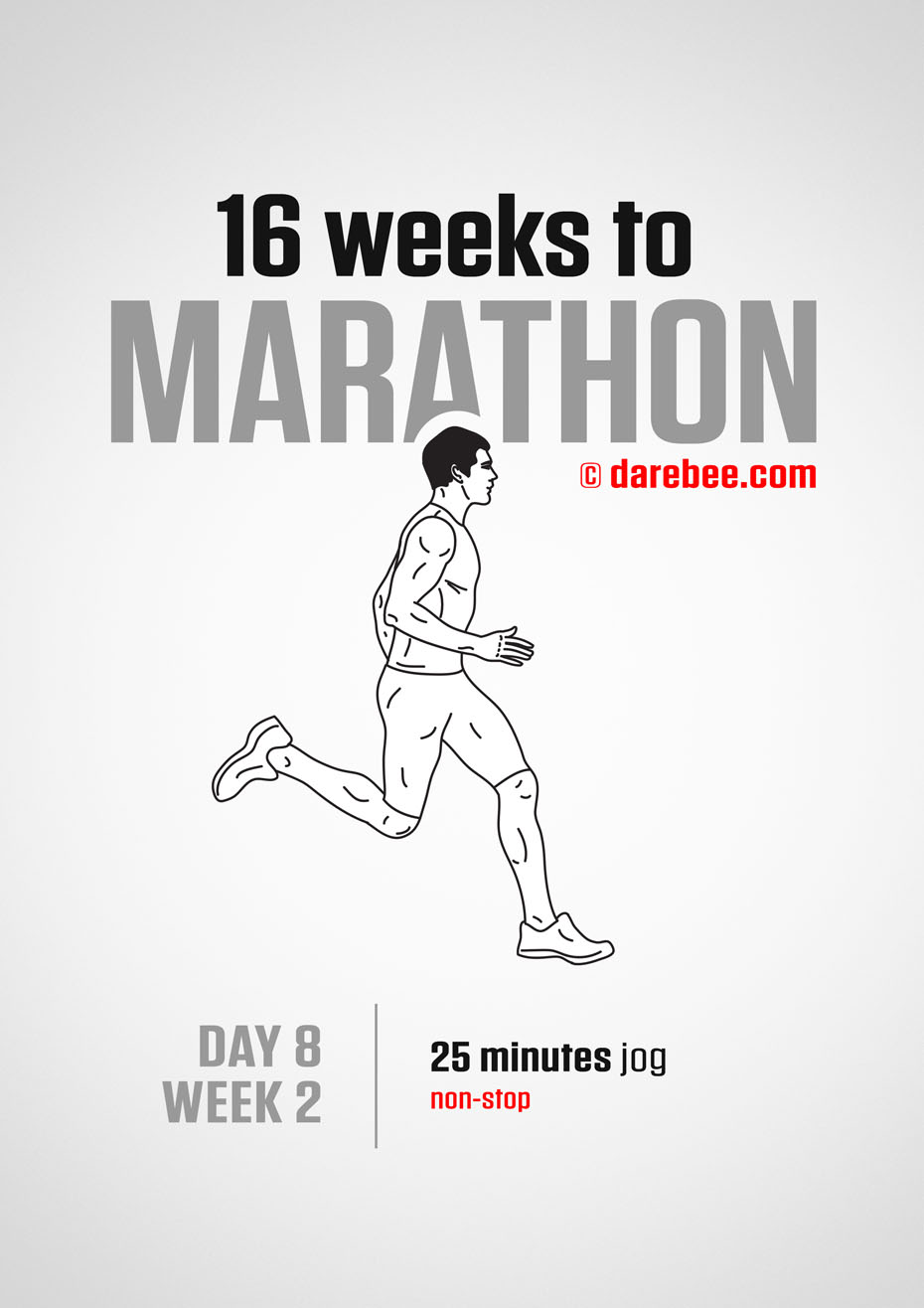
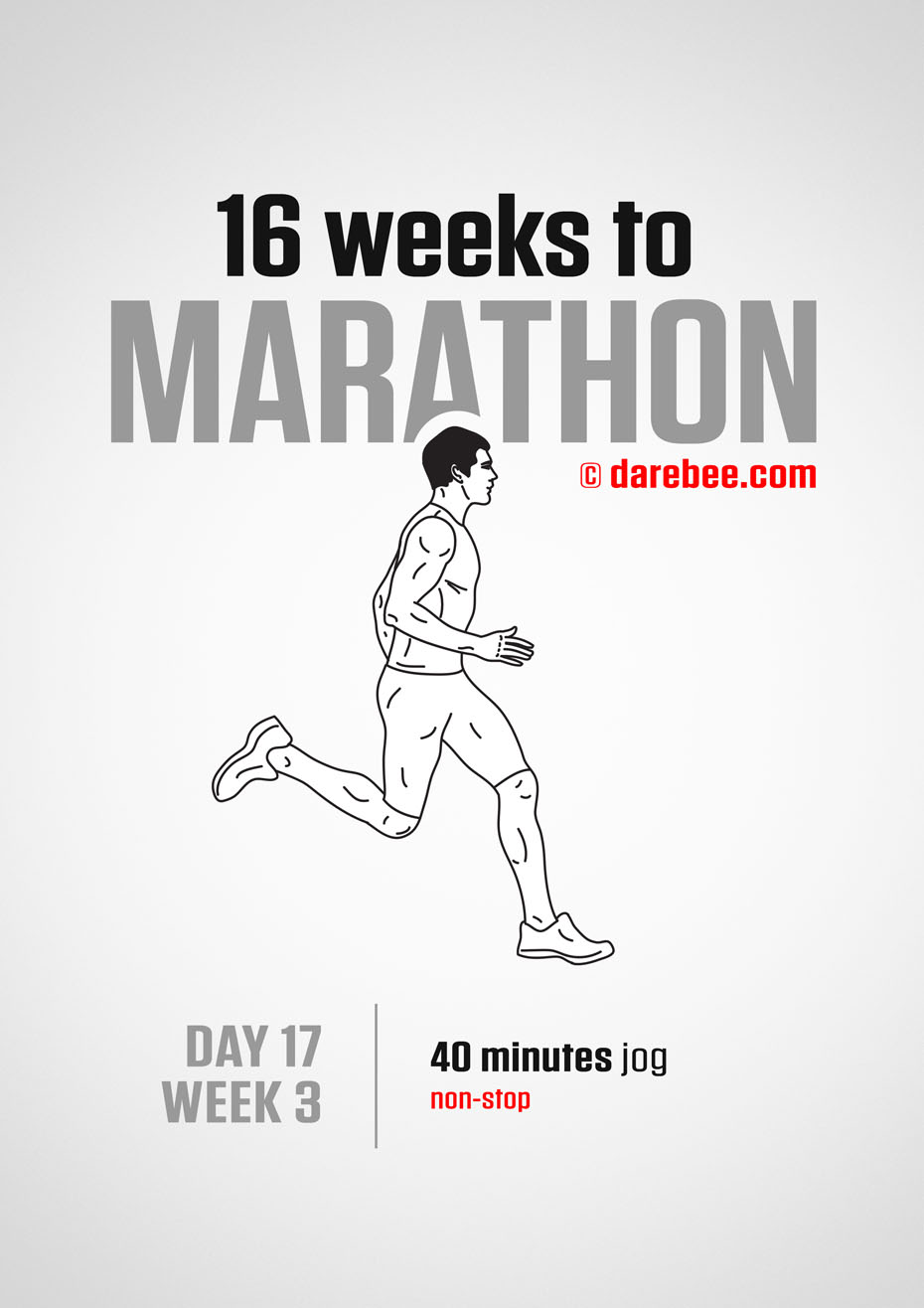
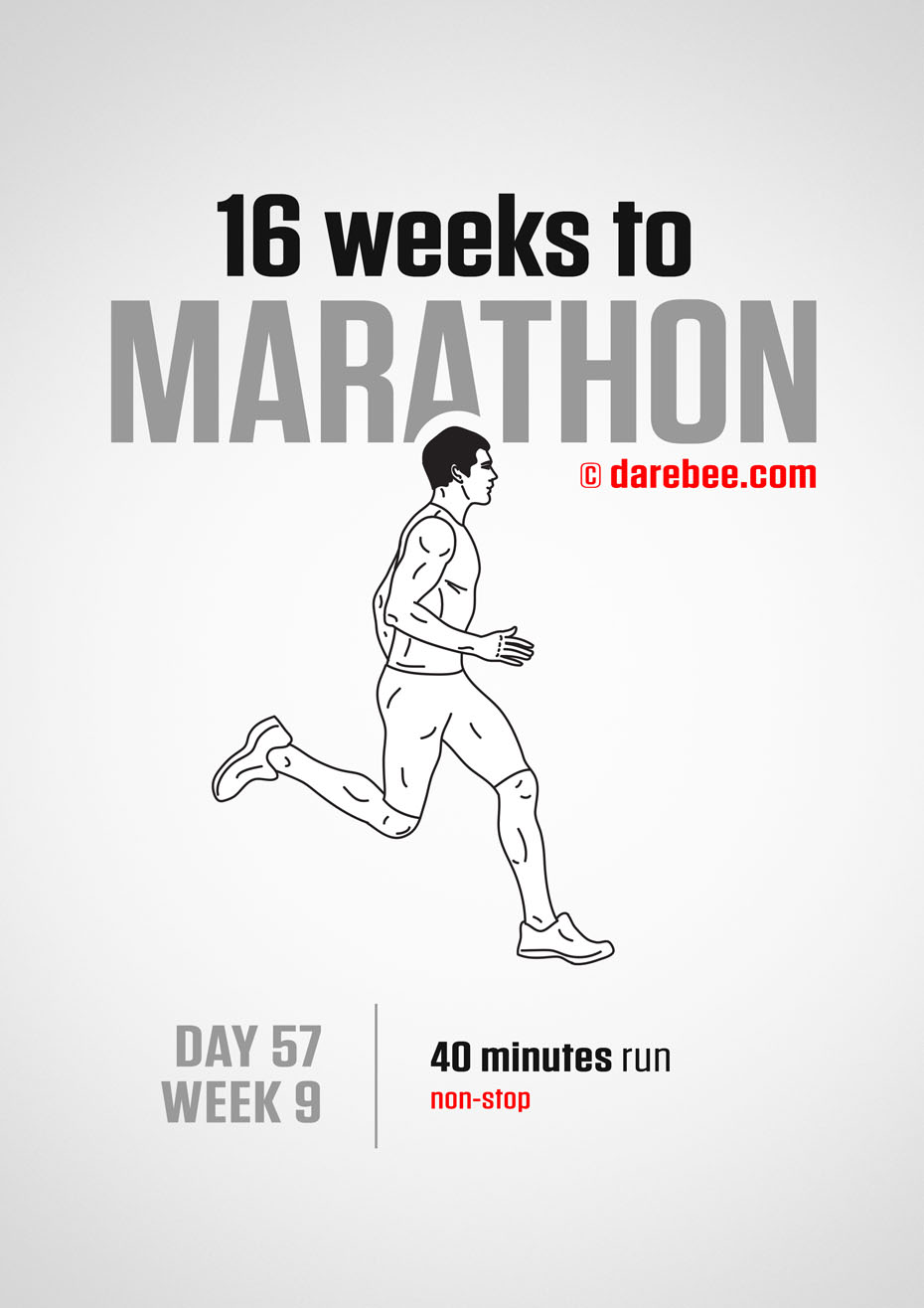
Week 2 changes one word and it changes everything: non-stop. Day 8 is a 25-minute jog, the same length as Day 6, but this time the clock does not pause and neither do you. From here until the end of the program, a run marked non-stop means exactly that - continuous movement for the full time, with slowing down always allowed and stopping not.
The jump from stop-allowed to non-stop is deliberately made on a duration you have already covered. You jogged 25 minutes two days ago, probably in pieces; today you join the pieces together. If you have to, slowing to the slowest jog imaginable is fine - the point is that the legs learn to keep cycling without the reset a stop provides. This is also the first time the program tests the pacing lesson from last week: start too fast and the back half will remind you.
Begin at a shuffle and build to a comfortable jog over the first three or four minutes. When the urge to stop arrives, shorten your stride and slow down instead - most of the time the urge passes within a minute. Breathe in a rhythm that matches your steps, keep your arms low and loose, and finish with a few minutes of walking to let the heart rate settle.
Same twenty-five minutes as Day 6, but this time in a single unbroken piece - that is the step from jogger to runner.
Make it Harder: Hold the same easy pace the whole way, then add a 5-minute walk at the end rather than sprinting the finish.
Make it Easier: Jog as slowly as you need to keep it continuous - a shuffle that never stops beats a quicker jog that does.

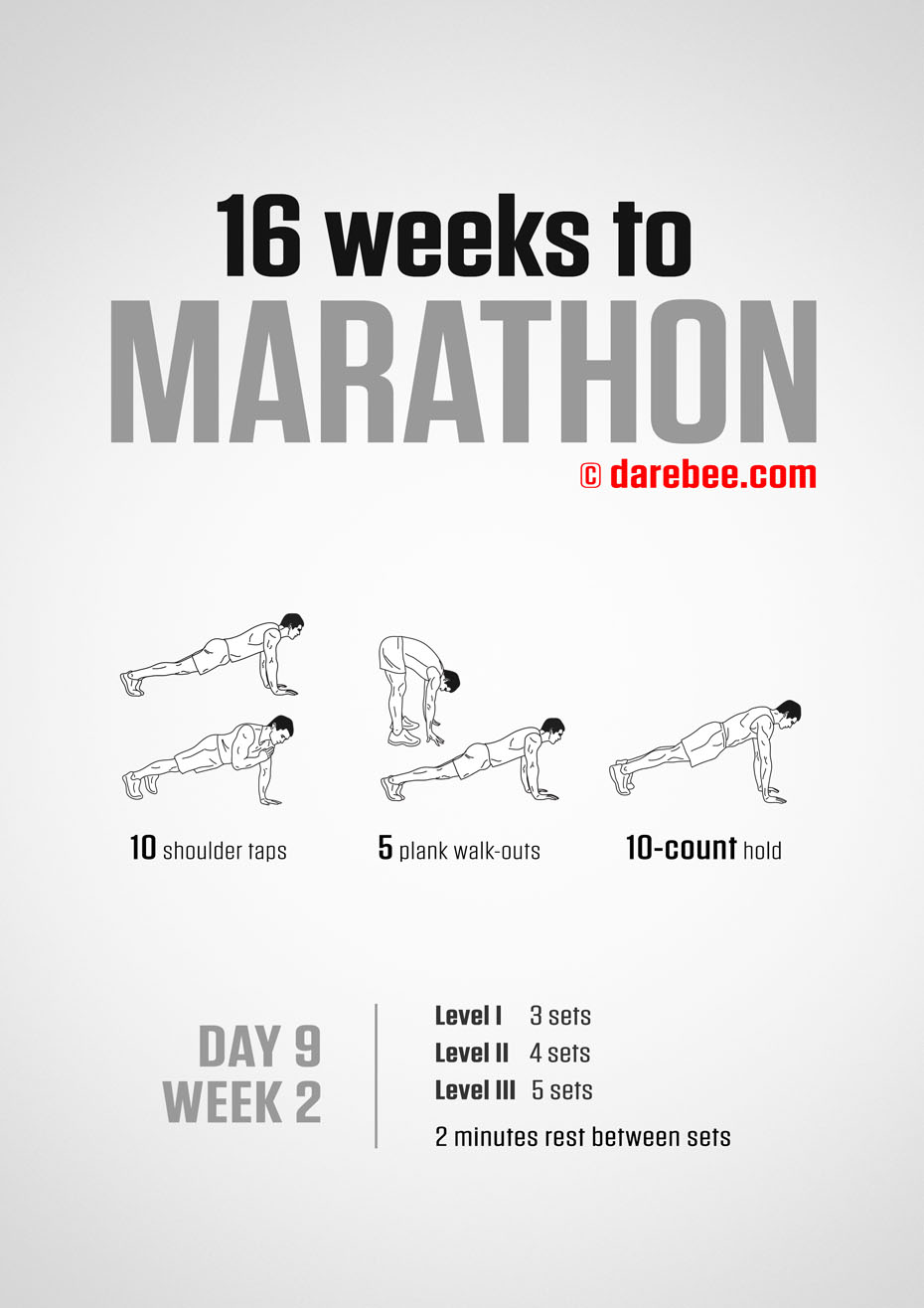
The plank circuit returns with one new exercise: 10 shoulder taps, 5 plank walk-outs and a 10-count hold, in sequence, 2 minutes rest, for 3, 4 or 5 sets by level. Plank walk-outs start standing: fold forward, place your hands on the floor, walk them out until you are in a full high plank, then walk them back and stand. One complete trip out and back is one rep, and five of them is a lot more work than the number suggests.
Walk-outs connect the standing and the floor halves of this program. Every step of the hands loads the shoulders and forces the trunk to hold the body rigid at a changing angle, which is a plank that never gets to settle. Sandwiched between shoulder taps and the hold, they make the whole circuit a study in keeping the torso still while everything else moves. Running asks the same: arms and legs swing, the middle stays firm.
Keep your legs as straight as your hamstrings allow during the fold and the walk; bend the knees if you need to, but do not let the hips sink when you reach the plank. Walk the hands out far enough that the shoulders sit directly over the wrists at the end. Shoulder tap and hold standards carry over from Day 2: straight line, quiet hips, active shoulders.
Five walk-outs that travel from standing to plank and back - the circuit just learned to get up off the floor.
Make it Harder: Add a shoulder tap on each side at the far end of every walk-out before walking back.
Make it Easier: Take the walk-outs down to 3 per set and keep the other two exercises as written.

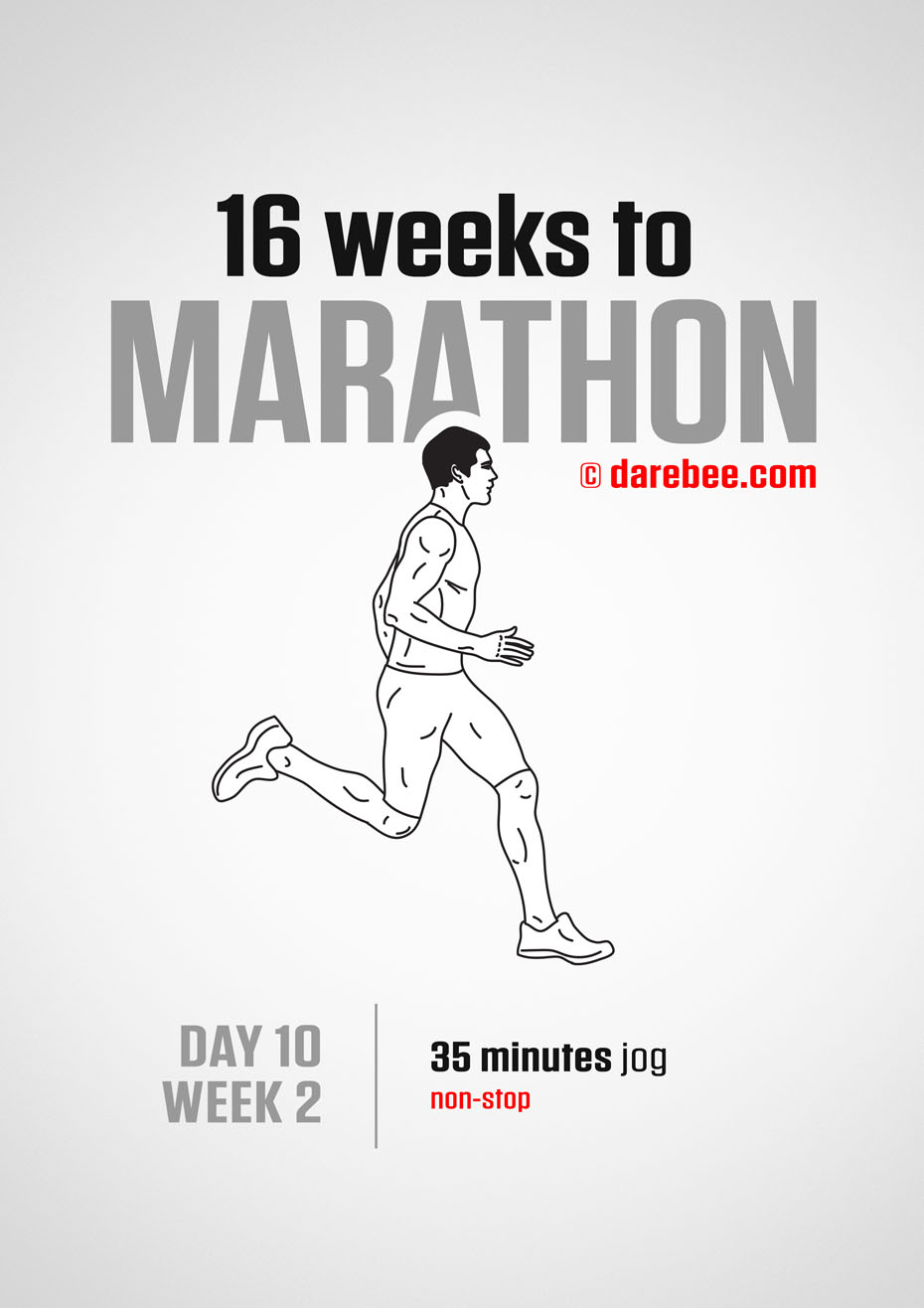
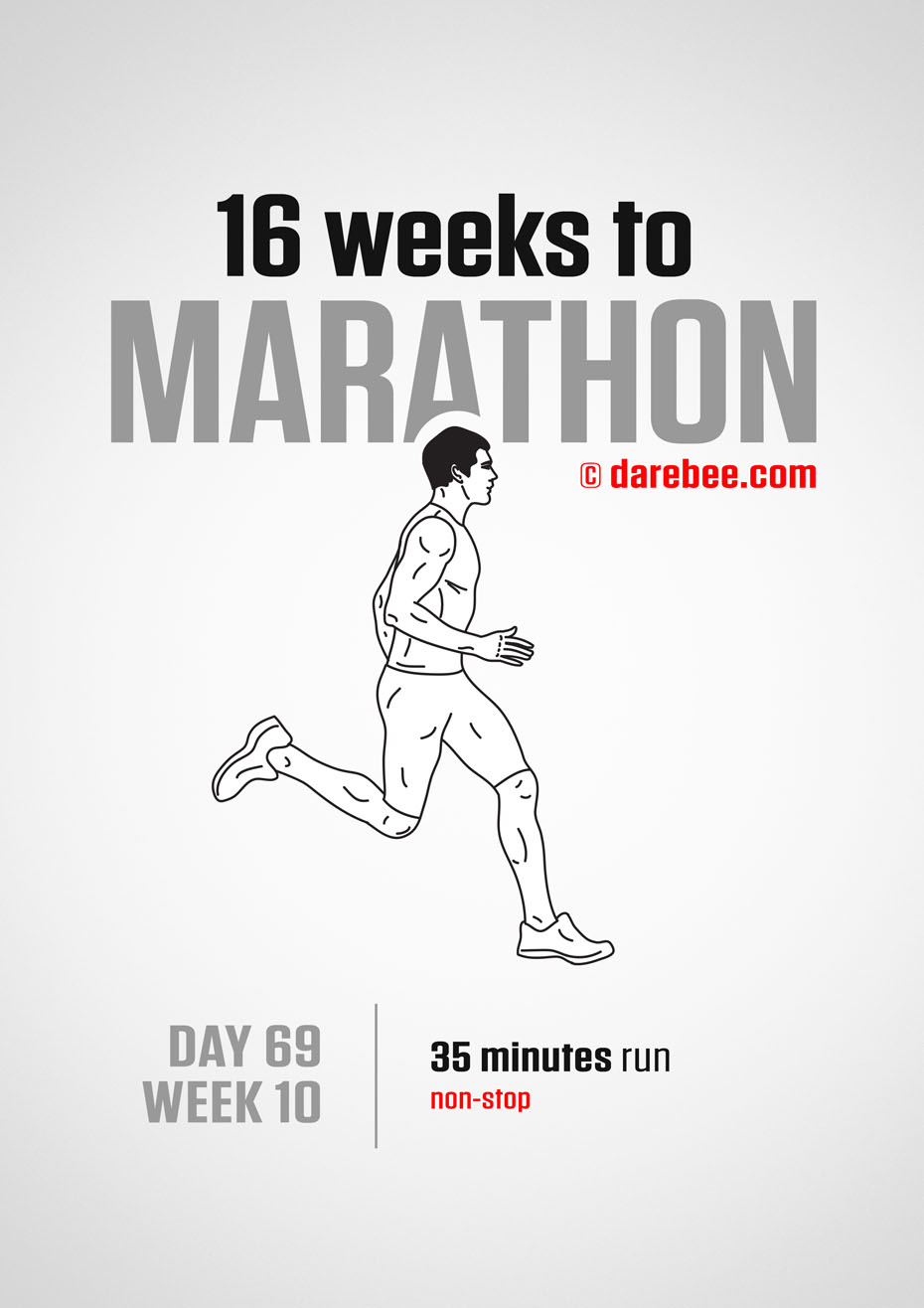
The jog jumps to 35 minutes non-stop, ten minutes longer than anything before it. This is the biggest single increase in the program so far, and it is placed mid-week on purpose: you are fresh from a rest day's worth of floor work and two days away from the next long effort. Run it all in one piece at a pace you could hold a conversation at.
Thirty-five minutes is where running begins to feel like a practice rather than an exercise. The first ten minutes are the warm-up you no longer have to think about, the middle is where the rhythm lives, and the last ten are where the program starts collecting its return - tired legs, still moving, still in good form. Those last minutes are the real training. Everything before them is the cost of getting there.
Pace by breath: if you cannot speak a full sentence, slow down. Keep the stride short and the cadence quick, and let the arms drive gently forward rather than across the body. Drink before you go out, and plan the route so that the final third is the easiest terrain - a flat finish makes the longest run of the week something to look forward to rather than dread.
Ten minutes longer than any jog so far, all in one piece - the week that stopped stopping is already reaching further.
Make it Harder: Keep the pace even and add a gentle pick-up over the final 3 minutes - faster, never flat-out.
Make it Easier: Run the first 25 minutes as planned and walk the final 10 briskly without stopping.

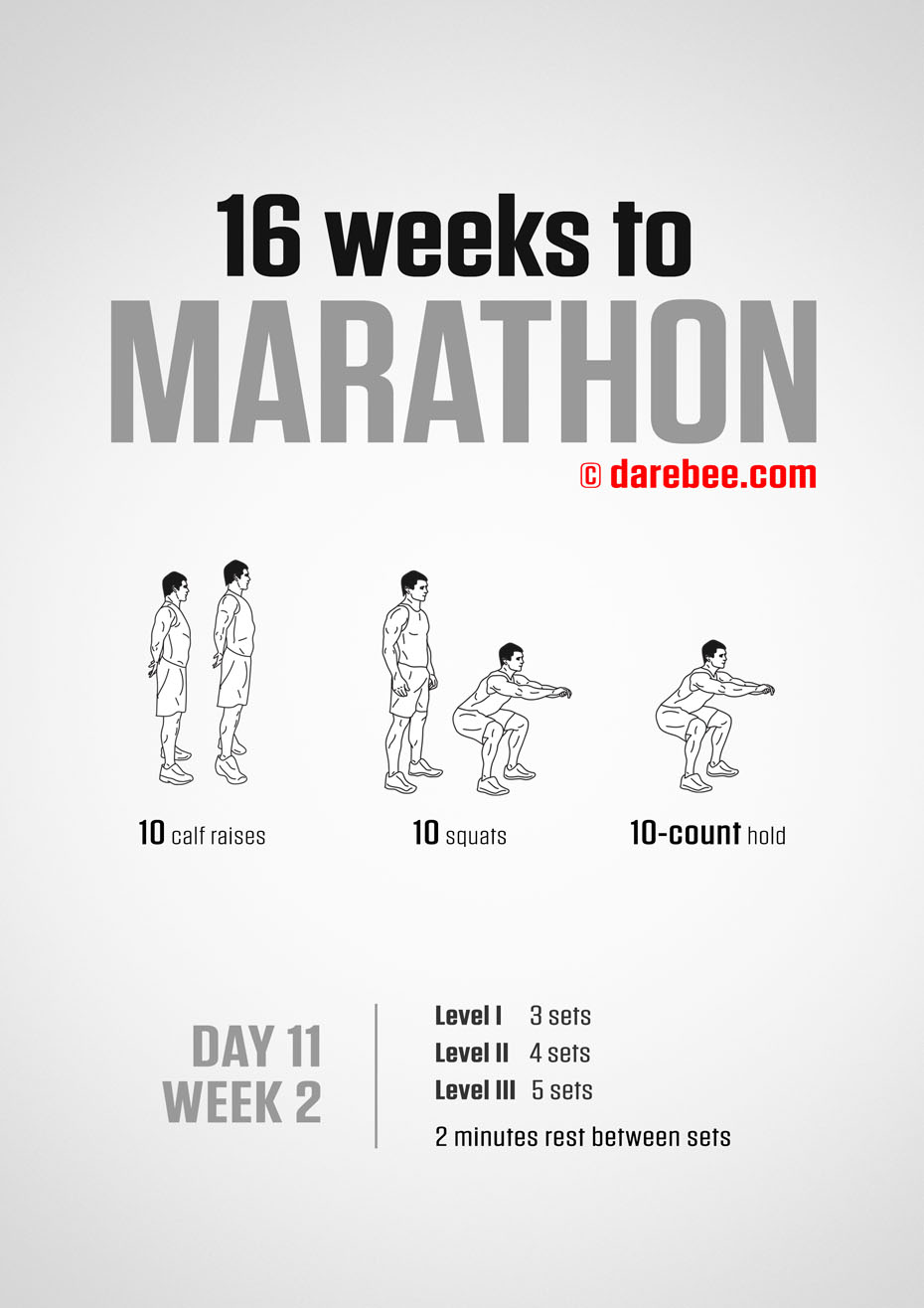
The leg circuit shuffles its order: 10 calf raises, 10 squats and a 10-count hold - and this time the hold is the squat, not the calf raise. The drawing shows it clearly: thighs near parallel, arms reaching forward, held still for ten counts. Three exercises in sequence, 2 minutes rest, 3 to 5 sets by level, and the hold now lands on already-tired quads.
Moving the hold from the calves to the squat changes what the circuit is for. A squat hold builds the endurance in the thighs that keeps your running form intact when the muscles are full of fatigue, which is the single most common way a long run falls apart. Doing it straight after the squats means the hold begins with the quads already working - ten counts under those conditions teaches more than thirty fresh.
Calf raises keep their full range, heel to toe. Squats keep their depth and their heel contact. In the hold, pick a depth you can keep for the entire ten counts without rising - thighs parallel is the target, a little higher is fine if it means you hold still. Keep the chest up and the weight in the heels, and breathe; a hold you hold your breath through is a hold you lose early.
Same three numbers as last week, but the hold moved from the calves to the thighs - the legs will notice the difference.
Make it Harder: Make the squat hold a 20-count while keeping the other numbers as they are.
Make it Easier: Do the hold with your back against a wall and keep the reps as written.

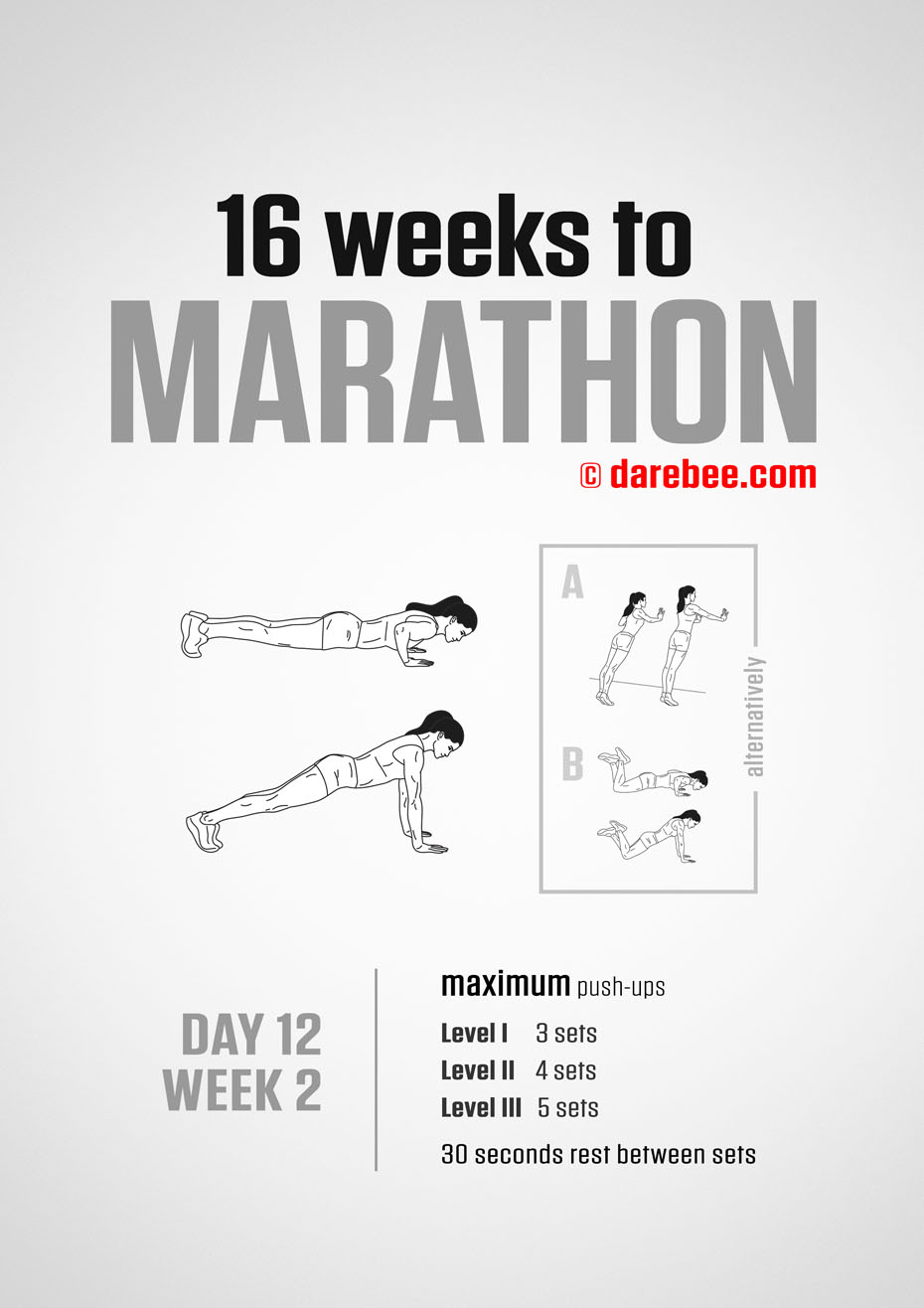
Push-up day again: maximum reps per set, 30 seconds rest, 3, 4 or 5 sets by level, with the wall and knee alternatives in the A/B box as always. Your first-set number from Day 5 is the one to look at - match it, beat it, or learn what a week of running did to it.
Testing the maximum every week is how this program tracks the upper body without any equipment. The number moves for two reasons: the chest and arms get stronger, and the trunk gets better at holding the plank position push-ups happen in - all that shoulder tap and walk-out work pays here. A higher number on the first set is strength; a smaller gap between the first set and the last is endurance, and the short rest is specifically measuring the second.
Same standard as last week - full range, elbows tucked, body straight - and the same honesty about where the set ends. If you are using the knee or wall version, stay on it for every set of the day rather than switching halfway; comparing numbers only works if the exercise is the same. Note both the first-set and last-set counts.
Second reading on the push-up scale - the number itself matters less than the direction it is moving.
Make it Harder: Start each set from the bottom position, chest hovering above the surface, so there is no free rep at the top.
Make it Easier: Rest a full 60 seconds between sets and keep each set maximal.

A 30-minute jog, non-stop. Shorter than Day 10, which is the point: the week's structure places the longest midweek effort in the middle and follows it with something slightly easier before the long Sunday session. Thirty continuous minutes is now familiar territory - run it relaxed and let it feel like consolidation, not a challenge.
Stepping down after a step up is part of how the body keeps absorbing the work. Day 10 stretched you to 35 minutes; today you run 30 with those minutes already in your legs, which should feel noticeably easier than 30 would have felt two weeks ago. That sense of a distance becoming ordinary is the feeling to chase across the whole program - the miles that once felt long becoming the miles you warm up with.
Run the first third slower than you think you need to. Keep your footfalls quiet - loud landings mean overstriding or tension - and check in on your shoulders every few minutes. If the legs feel heavy from the week's work, that is fine; heavy legs that keep moving are what the Sunday session is being built for.
Thirty minutes that two weeks ago would have been the longest run of your life - today it is the easy day.
Make it Harder: Run the final 10 minutes at a pace just quick enough that talking takes effort.
Make it Easier: Slow down to a walking break of one minute at the 15-minute mark and keep moving throughout.

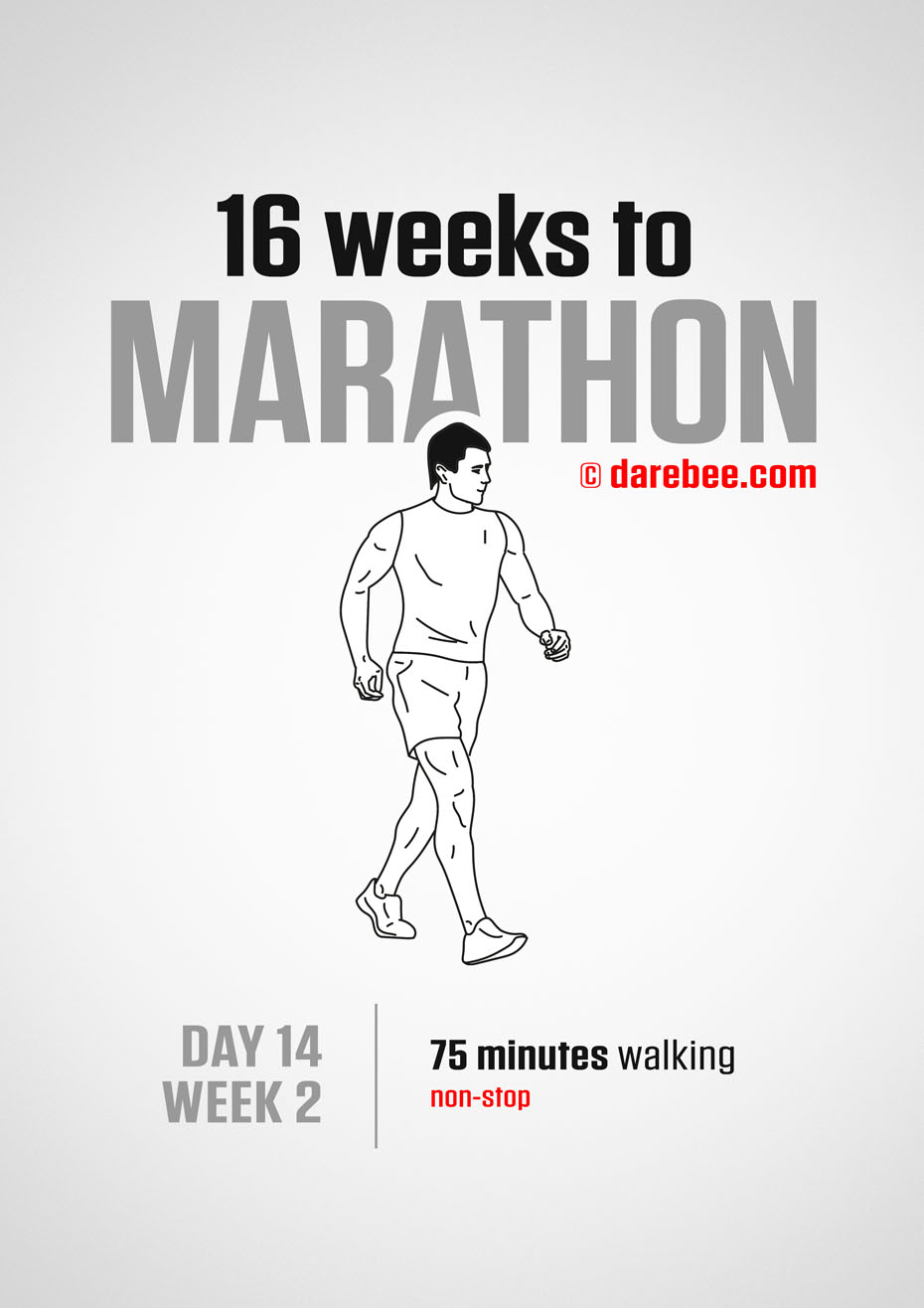
The Week 2 walk: 75 minutes, non-stop, fifteen minutes longer than last Sunday. Same rules - walk at a pace you can talk at, keep moving from start to finish, and let the clock do the work. An hour and a quarter on your feet is a real session, even at walking pace, and it is the longest the program has kept you out so far.
The Sunday walks are doing something no jog can: teaching the feet, ankles and hips to tolerate time. Running loads the body hard for a short while; walking loads it gently for a long while, and the marathon is going to ask for both. By the time these walks turn into walk-and-jog sessions and then into long runs, the support structure will already be used to being out for well over an hour. This walk is that structure being poured.
Walk briskly but easily, arms swinging, shoulders loose. Vary the terrain if you can - a little gentle gradient is good for the calves and the glutes. Take water, wear your running shoes, and plan a loop rather than an out-and-back if you prefer not to retrace. Pay attention to any hot spots on your feet: this is the week to find out where your shoes and socks need adjusting, long before a long run does it for you.
Seventy-five minutes of walking is a rehearsal for being out on the road for a long time - the body is learning the hours before it learns the pace.
Make it Harder: Walking days are about the clock, not the effort - the only upgrade worth making is keeping the pace steady from the first minute to the seventy-fifth.
Make it Easier: Ease the pace right down and let 75 unhurried minutes be the whole session.

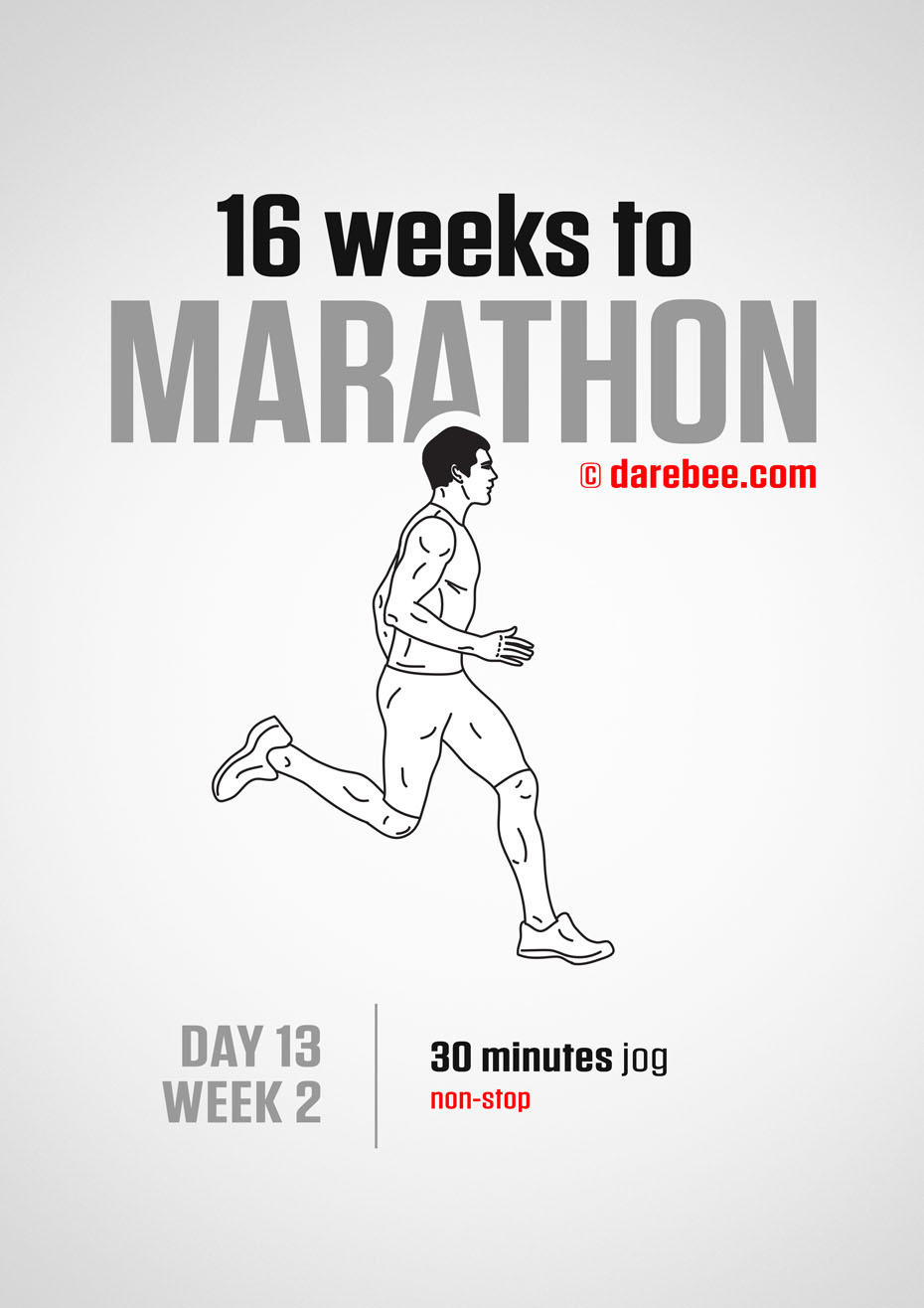
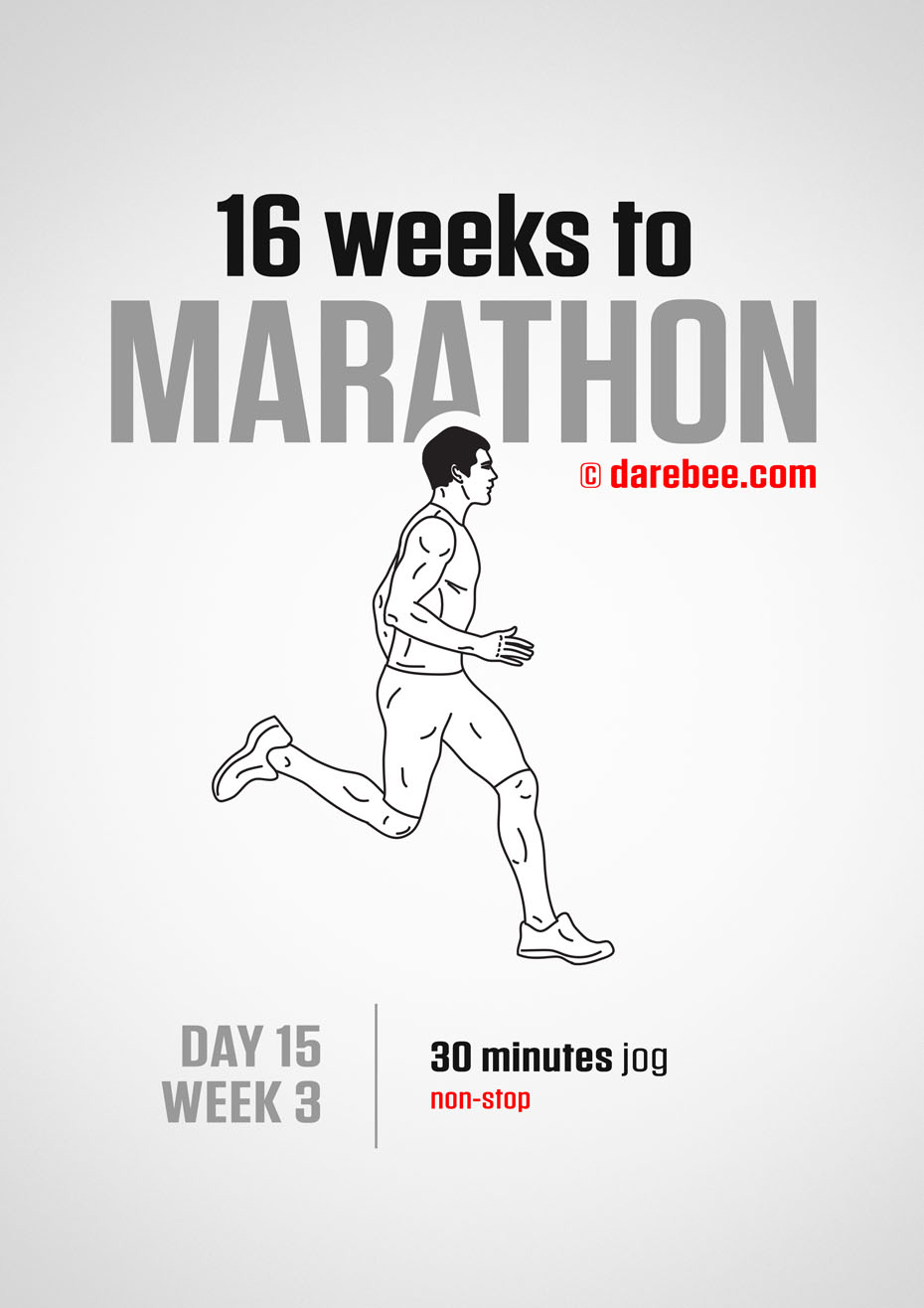
Week 3 opens with a 30-minute jog, non-stop - the same distance that closed the jogging part of last week, now serving as the starting point of a new one. The program builds in overlapping steps like this: the end of one week becomes the beginning of the next, so nothing ever arrives cold.
A repeated duration is not a repeated session. Your legs are two jogs, one long walk and three floor circuits further along than the last time you ran thirty minutes, and the point of running it again is to feel that difference rather than to add to it. Easy days are where running form gets practised without fatigue interfering - this is one of them, so spend it paying attention to how you move rather than how fast.
Settle into a rhythm within the first few minutes and hold it. Count steps for a minute at some point: somewhere around 170 to 180 per minute is the quick, light cadence that keeps impact low and stride short. If you are well under that, shorten the stride and pick up the feet a little quicker without speeding up the pace.
The first run of Week 3 is the last run of Week 2 - a familiar thirty minutes on legs that are a week stronger.
Make it Harder: Pick a gently rolling route and hold the same easy effort on the climbs as on the flat.
Make it Easier: Drop to a walk for 30 seconds whenever you need to and keep the jog going around it.

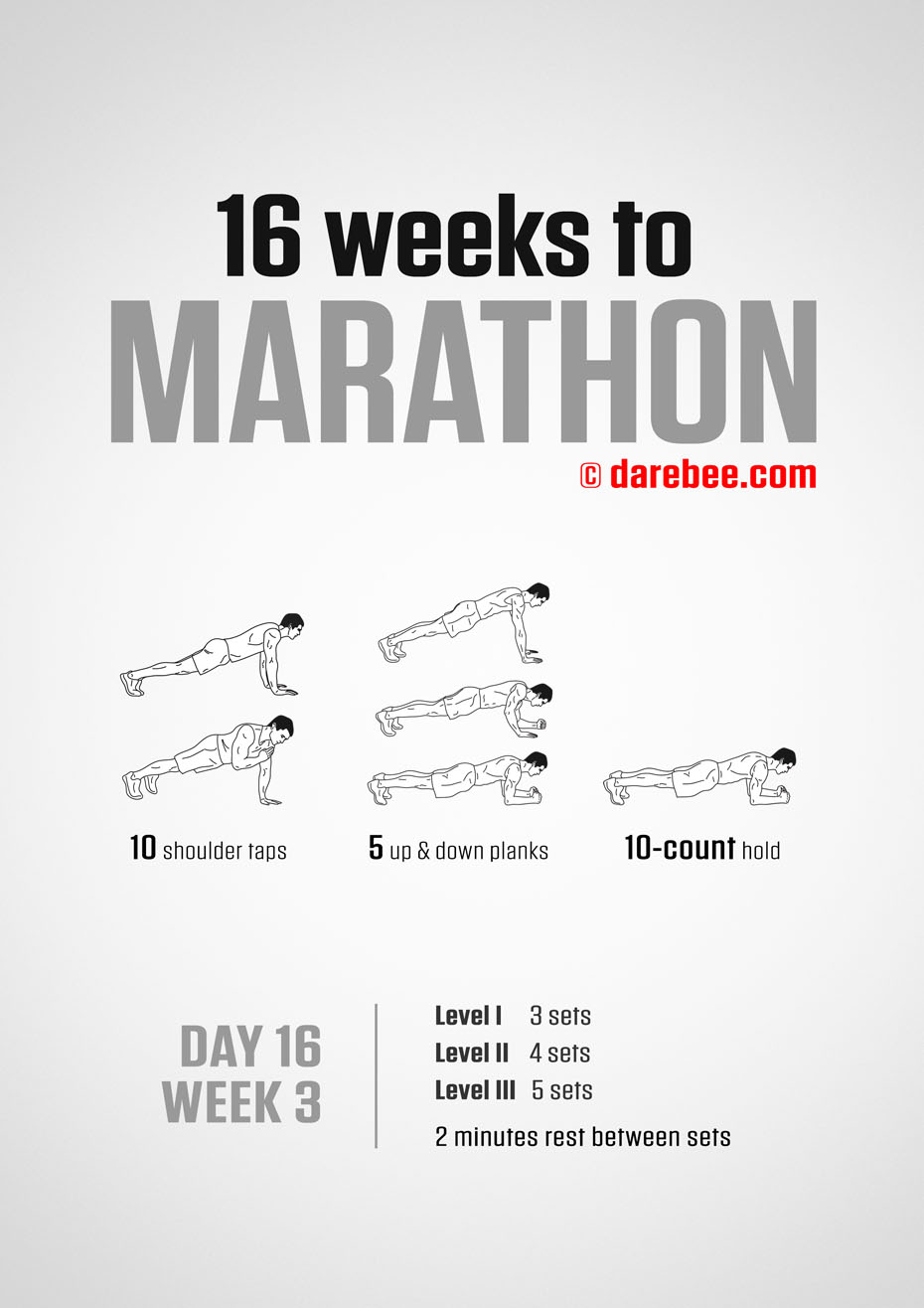
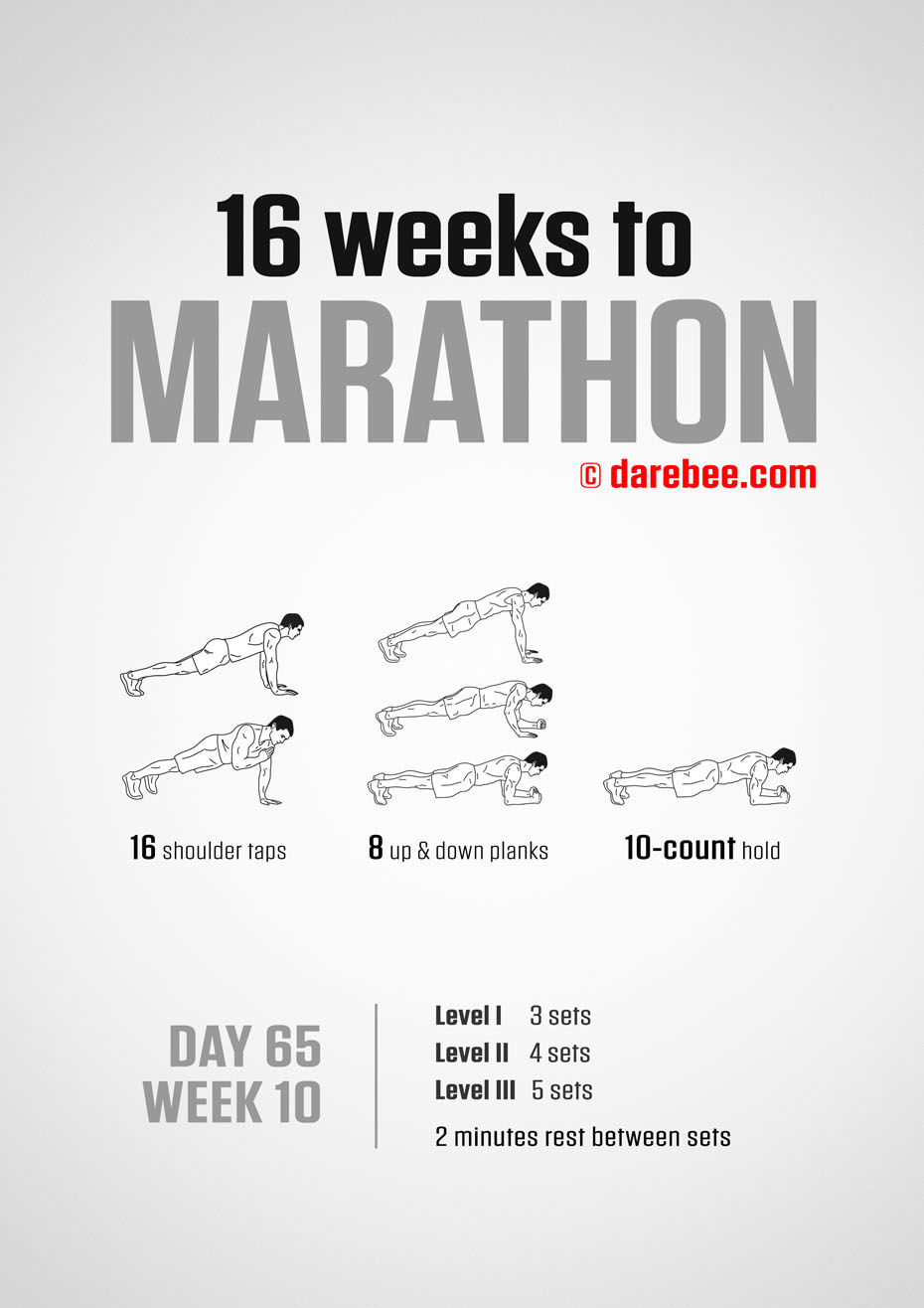
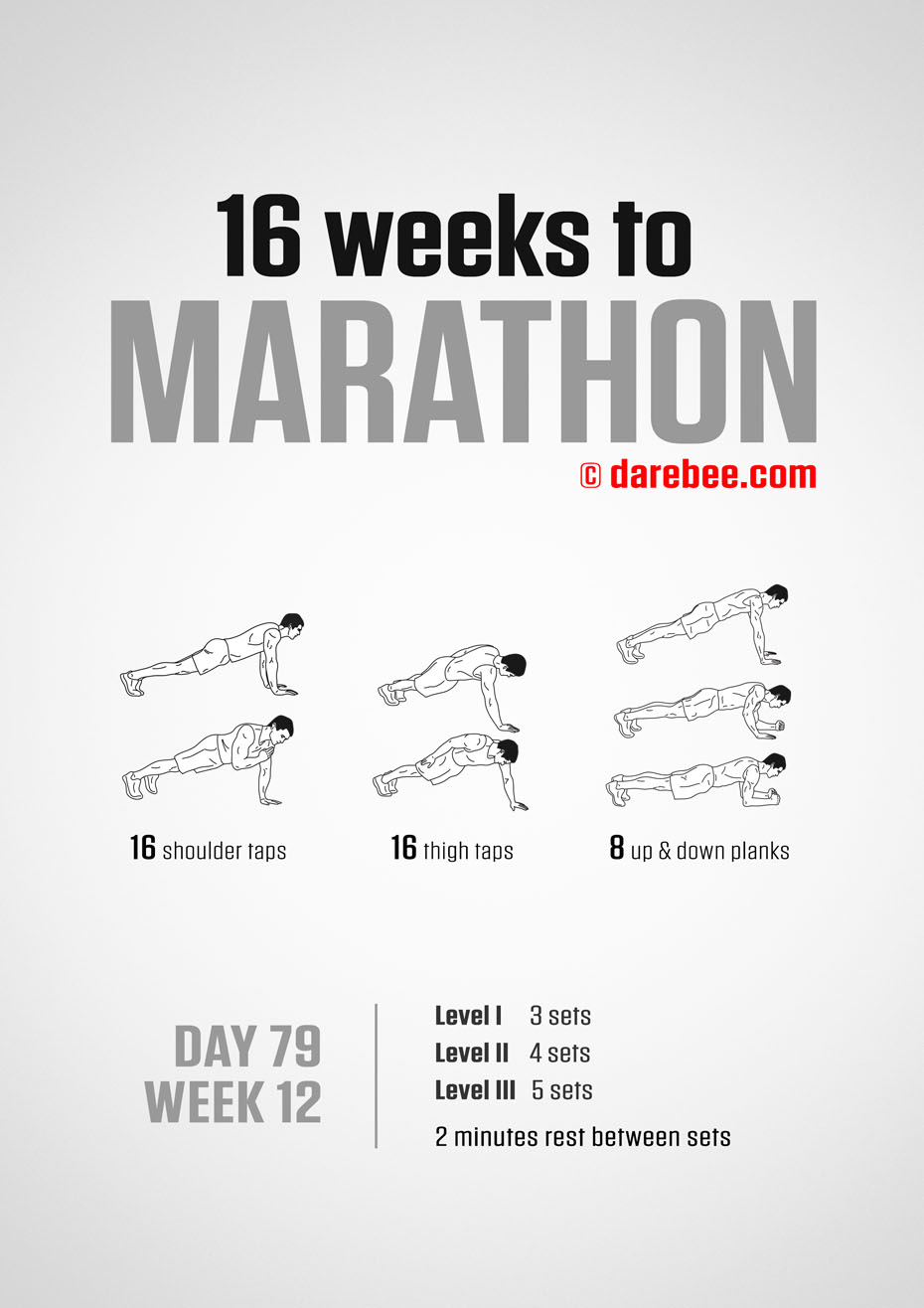
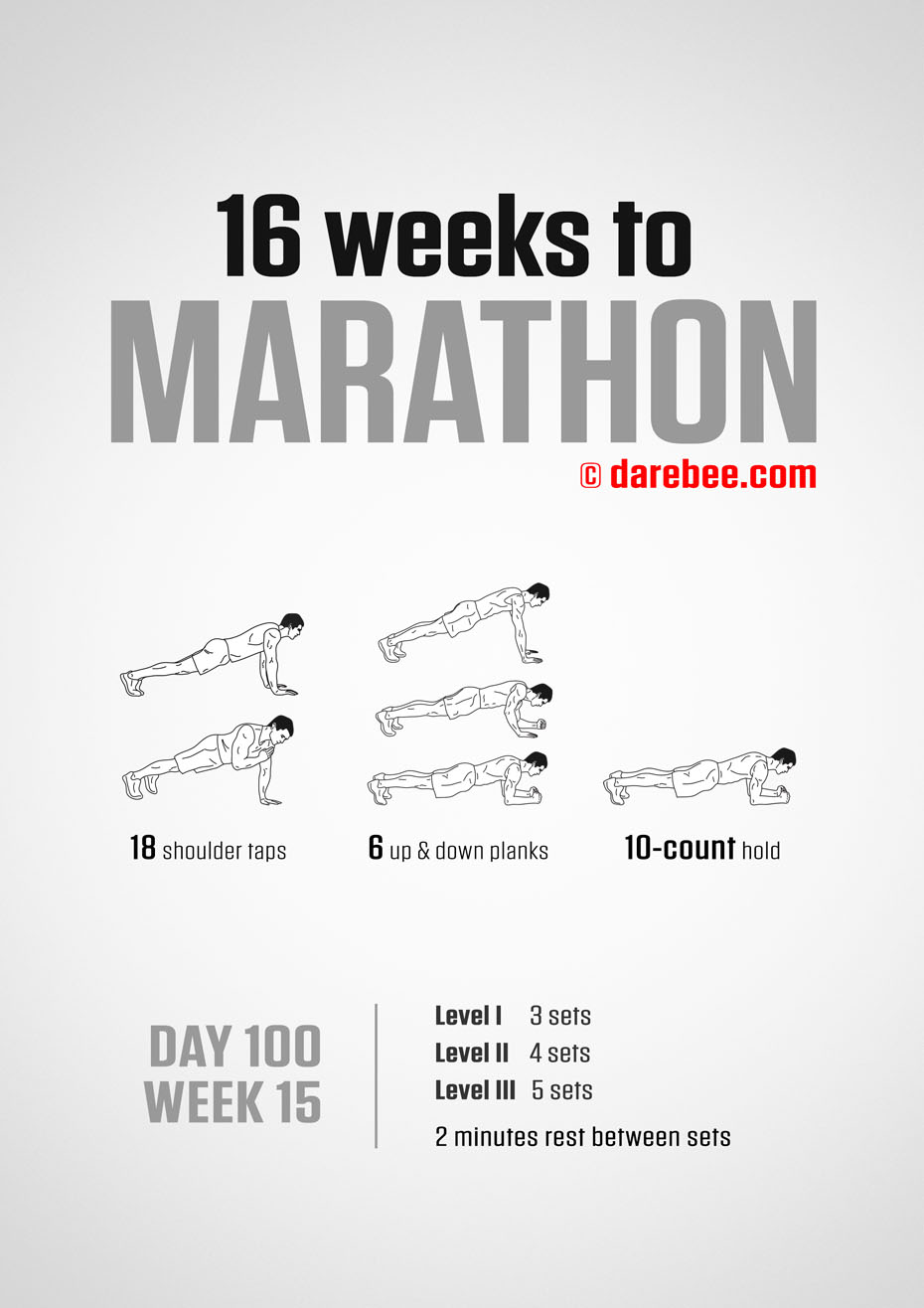
The plank circuit learns a new move: 10 shoulder taps, 5 up & down planks and a 10-count hold, in sequence, 2 minutes rest, 3 to 5 sets by level. Up & down planks start in a high plank on the hands and lower one forearm at a time to the floor into an elbow plank, then push back up one hand at a time. Down and up again is one rep. The hold today, as the drawing shows, is the elbow plank - forearms on the floor, body straight from head to heels.
Moving between high and low plank is a shoulder and trunk exercise disguised as a position change. Every transfer shifts the weight onto one arm for a moment, and the torso has to fight the twist that creates. Running has the same rotational leak - every stride tries to turn the hips, and the midsection has to say no. Following the up & downs with an elbow-plank hold means the final hold arrives on shoulders that have already been asked to do plenty.
Lead the up & downs with alternating arms: left down, right down, left up, right up, then switch which arm starts. Keep the hips as level as you can through every transfer; widening the feet makes it easier. In the elbow plank, stack shoulders over elbows, press the forearms into the floor and keep the glutes tight so the lower back does not sag.
Down to the elbows and back up, five times, and then an elbow plank on top - the shoulders earn their keep today.
Make it Harder: Hold the elbow plank for a 20-count and keep the up & downs at 5.
Make it Easier: Do the up & down planks from your knees and the hold from your knees as well.

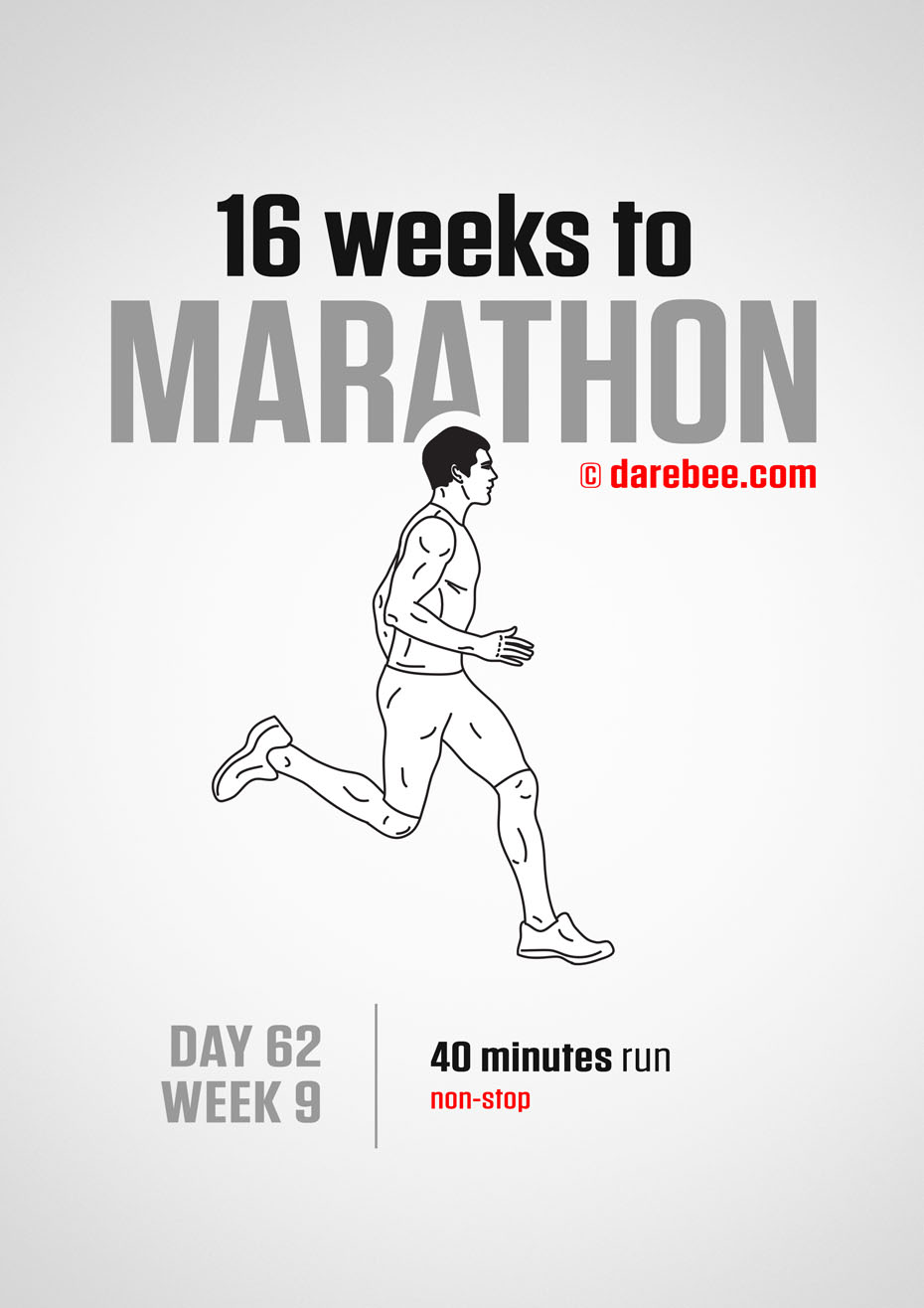
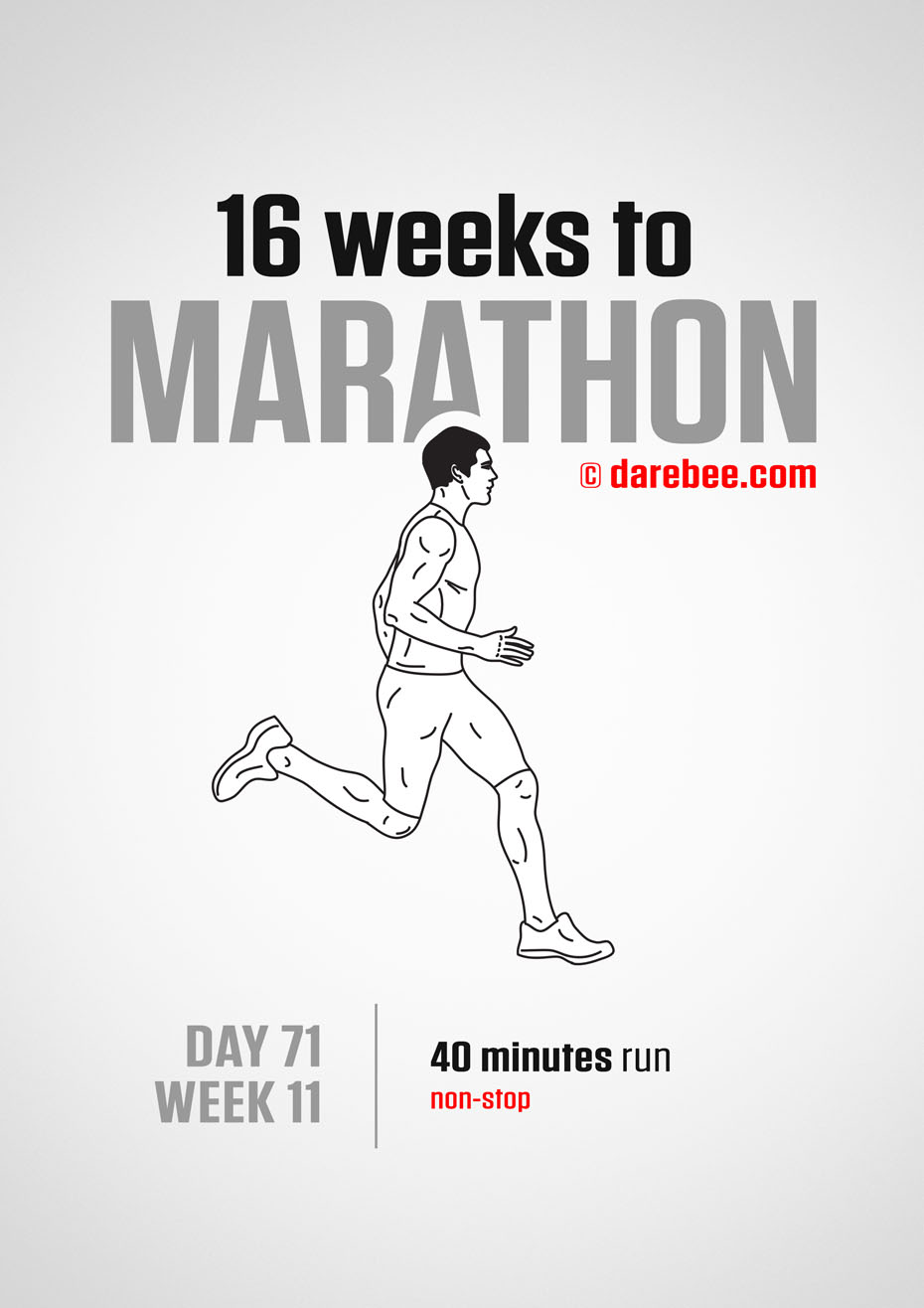
The midweek jog reaches 40 minutes, non-stop. That is five minutes further than Day 10 and the longest continuous run yet, and as with every midweek step in this program it is placed between two floor days so the legs have support on either side. Run it easy from start to finish.
Forty minutes is a threshold of sorts: long enough that the body starts using fat as well as the quick fuel in the muscles, long enough that how you hold yourself begins to matter more than how fast you go. Those are marathon skills - the race is won or lost by how efficiently you run when you are no longer fresh, and forty easy minutes is the first place that efficiency gets practised in earnest.
Go out as if the run were twice as long. Keep the breathing in step with the feet, keep the hands relaxed and the elbows bent at roughly ninety degrees. Hydrate before and after, and if the last ten minutes feel laboured, shorten the stride rather than pushing through with the same long one - a quick shuffle finishes far better than a tired lope.
Forty continuous minutes - the midweek run has quietly become what the Sunday walk was three weeks ago.
Make it Harder: Add one short pick-up of 30 seconds every ten minutes, then settle straight back to easy.
Make it Easier: Hold the easy pace for 35 minutes and walk the last 5 briskly.

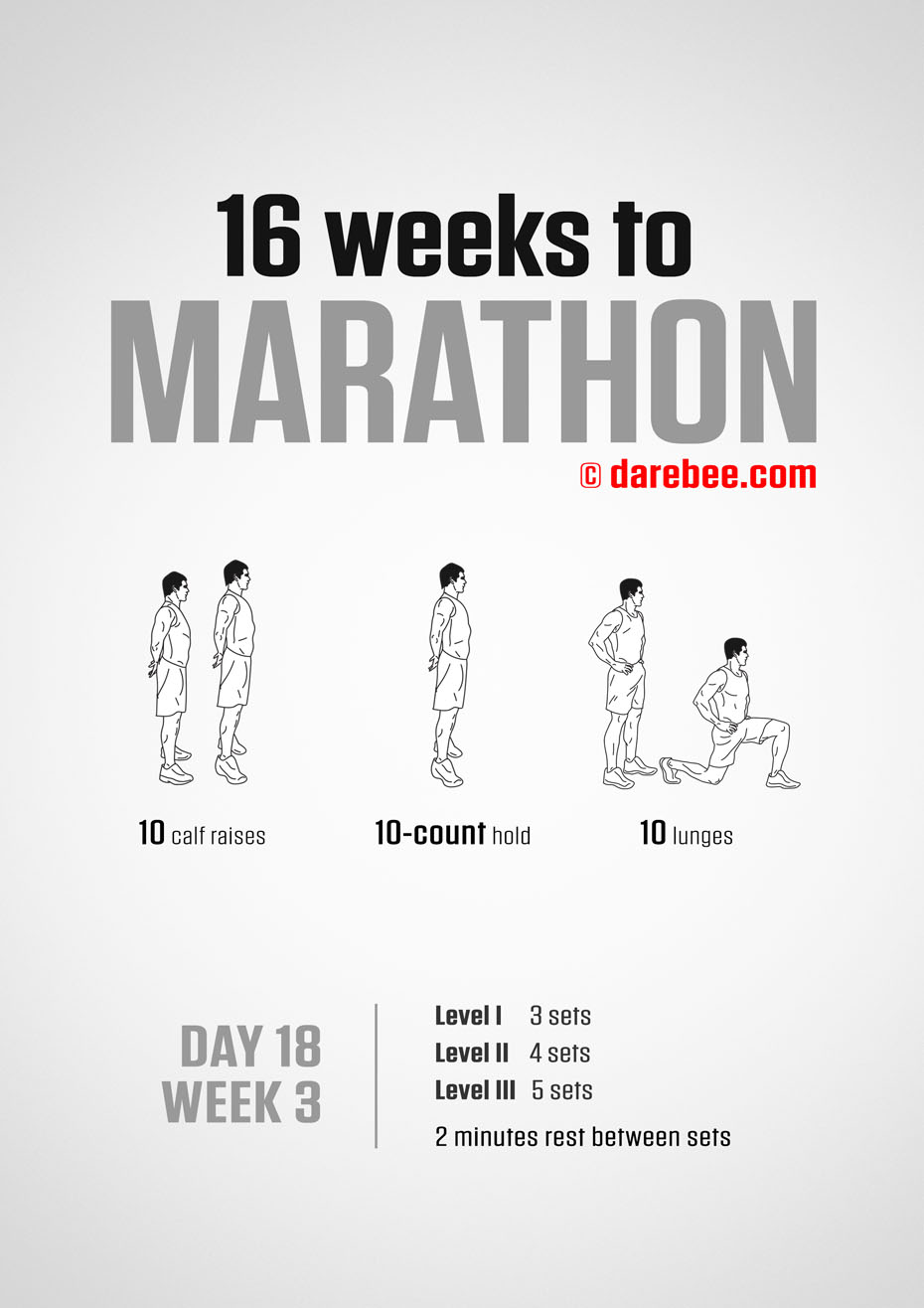
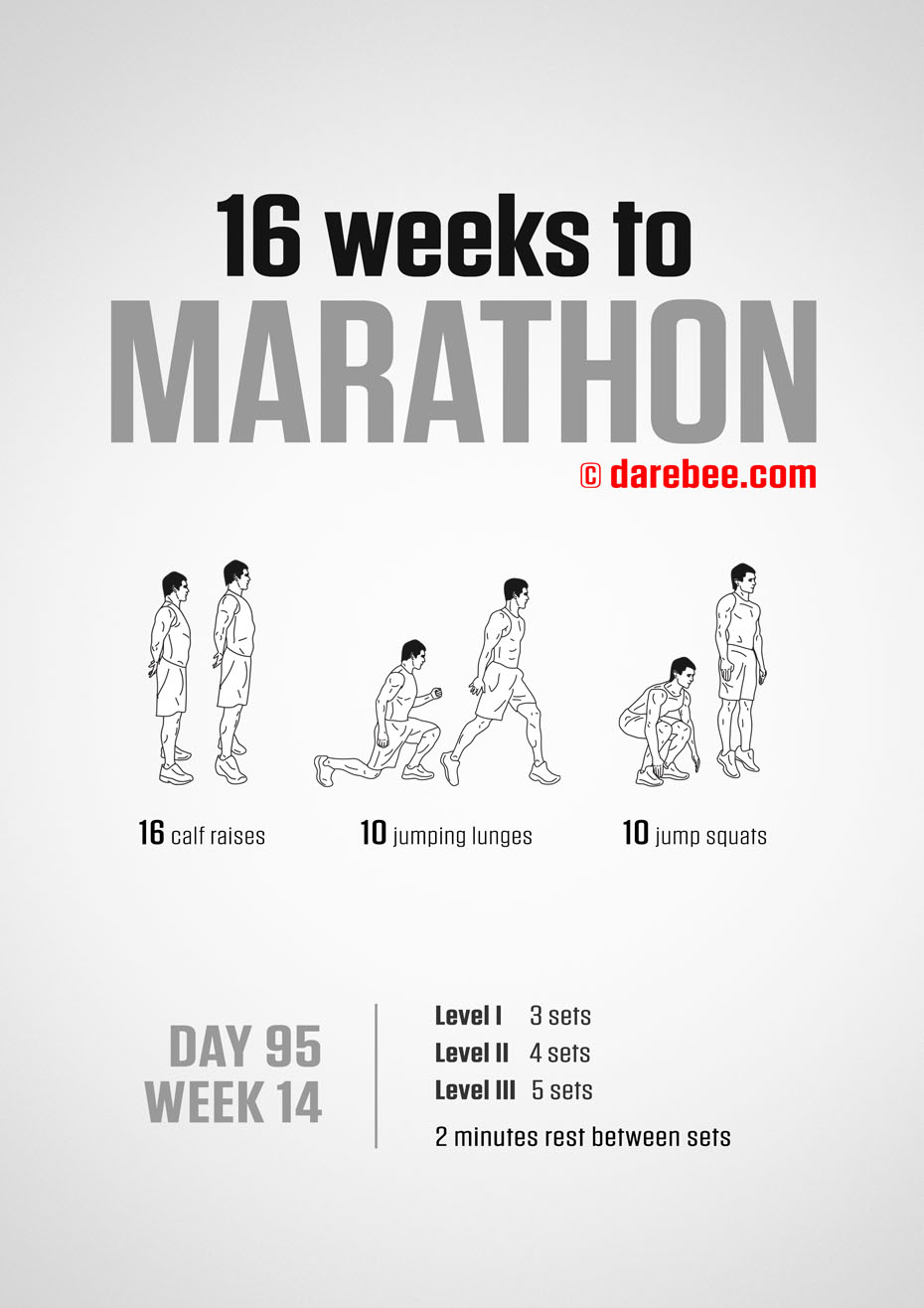
Lunges join the leg circuit: 10 calf raises, a 10-count hold and 10 lunges, in sequence, 2 minutes rest, 3 to 5 sets by level. The hold is back on the calves - on the balls of both feet, hands behind the back, ten steady counts. Lunges are forward, stepping one foot ahead and lowering the back knee toward the floor, then pushing back to standing - ten lunges means five per leg, alternating.
Lunges are the most running-specific exercise on any of these cards. One leg in front, one behind, the hips square and the torso upright - that is a single stride, frozen, with all the load going through the front leg. Calf raises and the calf hold prepare the lower leg for impact; lunges train the thigh and glute to handle that impact one side at a time, which is how every running step actually happens. The circuit goes from ankle to hip in three moves.
Step far enough forward that the front shin stays vertical as you lower, and drop the back knee straight down toward the floor rather than leaning the torso forward. Push back through the front heel. Calf raise and hold standards hold: full height, slow lowering, ankles steady throughout the ten counts.
One leg in front, one behind, everything loaded through the lead thigh - a lunge is a stride with the clock stopped.
Make it Harder: Lower into every lunge on a three-count and drive up at normal speed.
Make it Easier: Shorten the lunge step and lower only halfway, keeping the rest of the circuit as written.

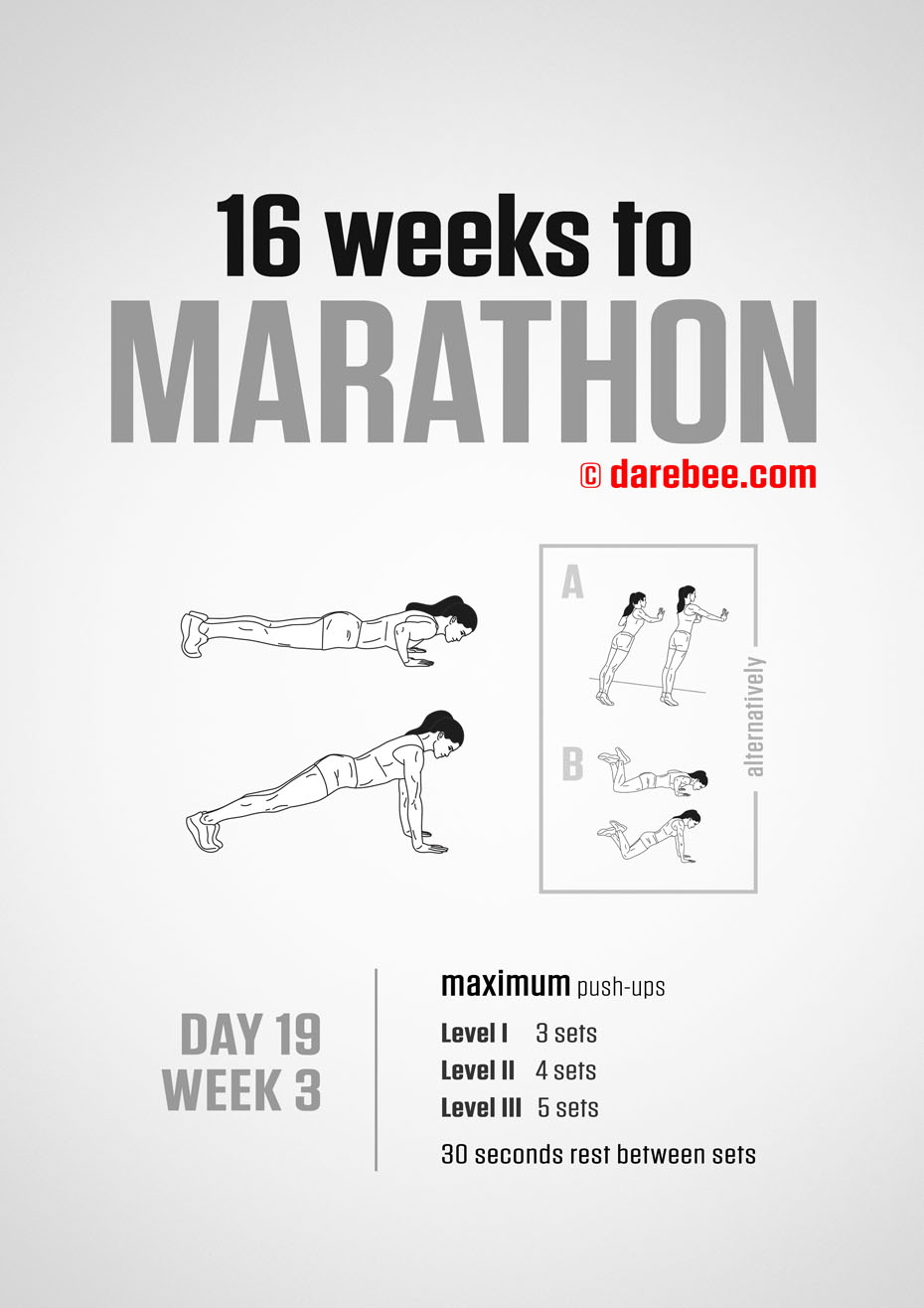
Maximum push-ups, third edition: as many as you can per set, 30 seconds rest, 3 to 5 sets by level, wall or knee alternatives available from the A/B box. Compare this week's first-set number with Day 5 and Day 12. Two data points are a line; three are a trend.
What makes this card work is that it never changes while you do. The same short rest, the same instruction, the same alternatives - and a different body arriving each Friday. By now the push-up position is familiar from a hundred shoulder taps and a dozen walk-outs, and the arms have been pressing your weight on the floor for three weeks. A max test is the program's way of making that invisible work count.
Form before numbers: no sagging hips, no half reps at the end of the set, no elbows flaring out to the sides. If your maximum on the last set drops to only a handful of reps, that is what maximal means - not every set has to be impressive, only honest. Record the numbers and move on.
Three Fridays of push-ups on the books - the scale has started to show a direction.
Make it Harder: Tap the opposite shoulder at the top of every push-up without letting the hips swing.
Make it Easier: Alternate between full push-ups and the knee version set by set so the total work stays high.

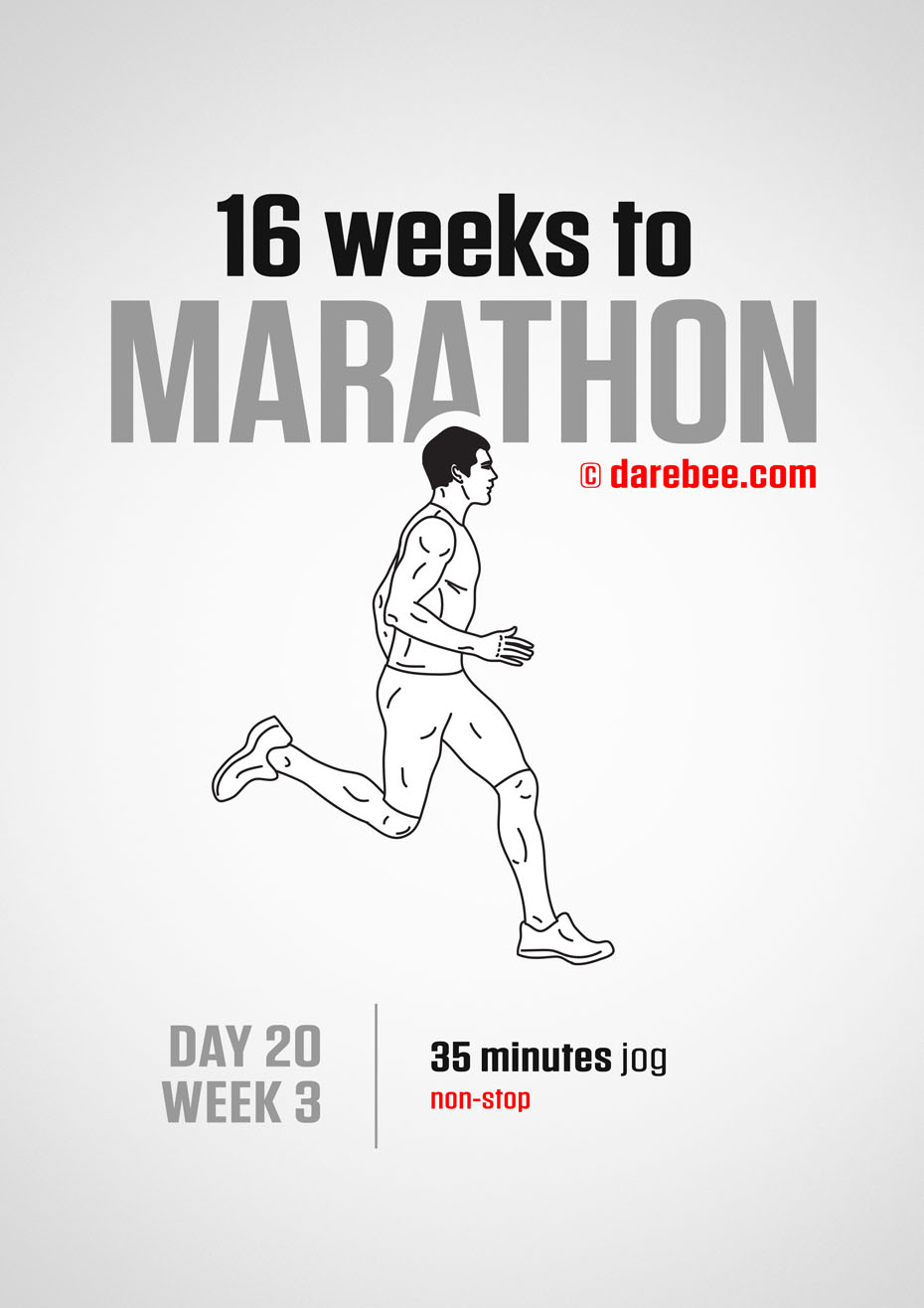
A 35-minute non-stop jog to step down from Wednesday's forty. Same pattern as last week: the biggest midweek run, then a slightly shorter one before the long Sunday session. Thirty-five minutes was the big new number ten days ago; today it is the one you back off to.
That shift is the program in miniature. Every increase becomes ordinary within a week or two, and the easy days are where you get to feel it. Run this one without looking at the watch more than you need to - let the body tell you the pace, and let the pace be whatever makes the conversation test easy. Tomorrow is a long walk, so there is nothing to save and nothing to prove.
Warm up into it over the first five minutes. Keep the cadence quick and the stride short; if the legs feel flat from the week, that is information rather than a problem. Finish with a couple of minutes of walking and a few calf and hip stretches while the muscles are warm.
Thirty-five minutes that used to be the mountain of the week - now it is the gentle slope before Sunday.
Make it Harder: Run it as a progression: the last 10 minutes slightly quicker than the first 25, still conversational.
Make it Easier: Take one 60-second walking break at halfway and keep everything else moving.

The last pure walk of the first block: 90 minutes, non-stop. An hour and a half on your feet, at a pace you could chat at, without sitting down or stopping. Next Sunday this session changes character, so this is the walking program's final and longest word.
Ninety minutes is roughly the length of time a first-time runner spends covering a half marathon at walking pace, and it is deliberately the last step before the Sunday sessions begin to include jogging. Everything the walks have been building - durable feet, patient hips, the habit of being out for a long time - gets its biggest single test here. If it feels long, good: long is the skill.
Walk with intent rather than strolling, and keep the arms moving. Eat something light an hour or two before and carry water. Change nothing about your shoes or socks from the last two walks unless something rubbed. Around the hour mark, do a quick check from the feet up - any stiffness in the hips or lower back is worth a few minutes of gentle stretching when you get home.
Ninety minutes walking, and the walks are done - from next week the Sundays start to run.
Make it Harder: Ninety unbroken minutes is the whole assignment - the only thing to add is consistency of pace, not speed.
Make it Easier: Slow to a stroll whenever the effort climbs and keep moving for the full hour and a half.

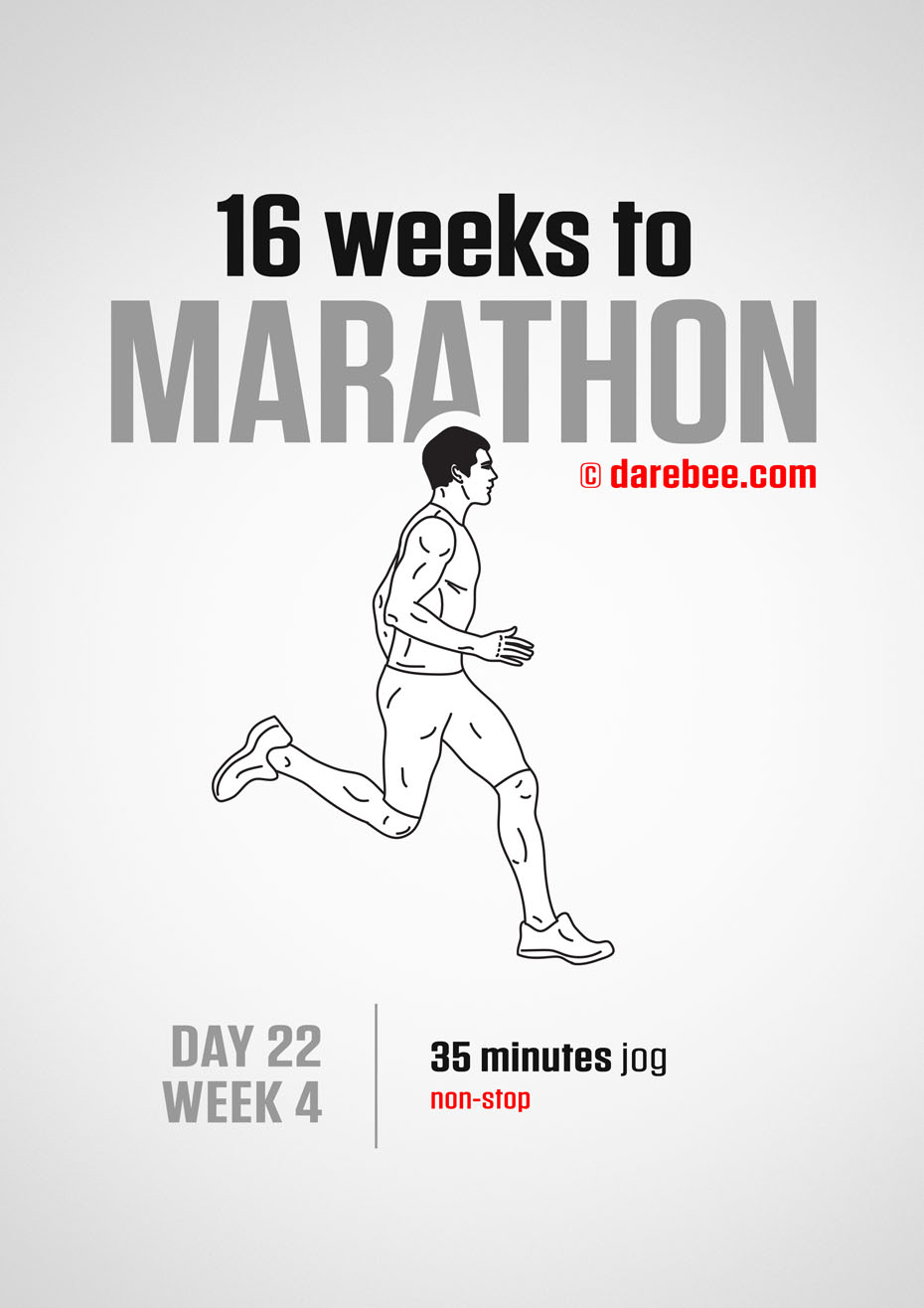
Week 4 starts with a 35-minute jog, non-stop. The midweek and Monday runs are now meeting in the middle: this is the duration you stepped down to on Friday, and it opens the week at the same easy effort. Familiar ground, fresh legs.
There is a rhythm to a training week now - an easy opener, a longer midweek push, a settle-down run, a long Sunday - and the Monday run is where you check in on yourself after the longest session. Ninety minutes of walking yesterday will be in the legs a little; if they feel dull for the first ten minutes, that is normal and it usually lifts. Run through it gently rather than around it.
Start at the slowest jog you can and let the legs decide when to open up. Keep your footfalls quiet and your shoulders low. This is a good day to leave the watch at home if you have one and run by feel - thirty-five minutes is long enough to know when it is over.
A thirty-five-minute Monday after a ninety-minute Sunday - the week is learning to carry itself.
Make it Harder: Finish with 5 minutes at a pace that makes talking hard, then walk it off for 3.
Make it Easier: Run 30 minutes and walk 5, keeping the whole session non-stop.

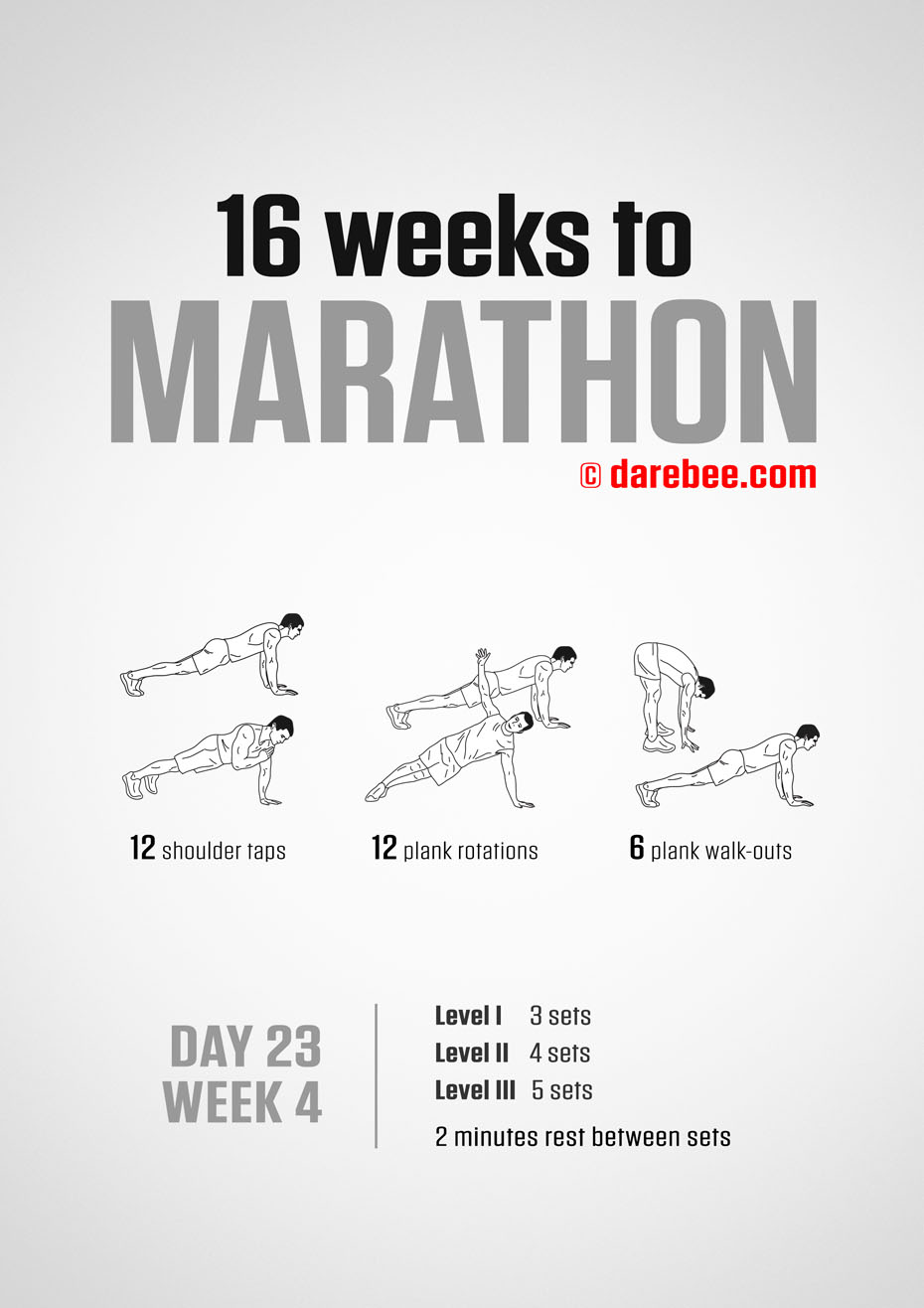
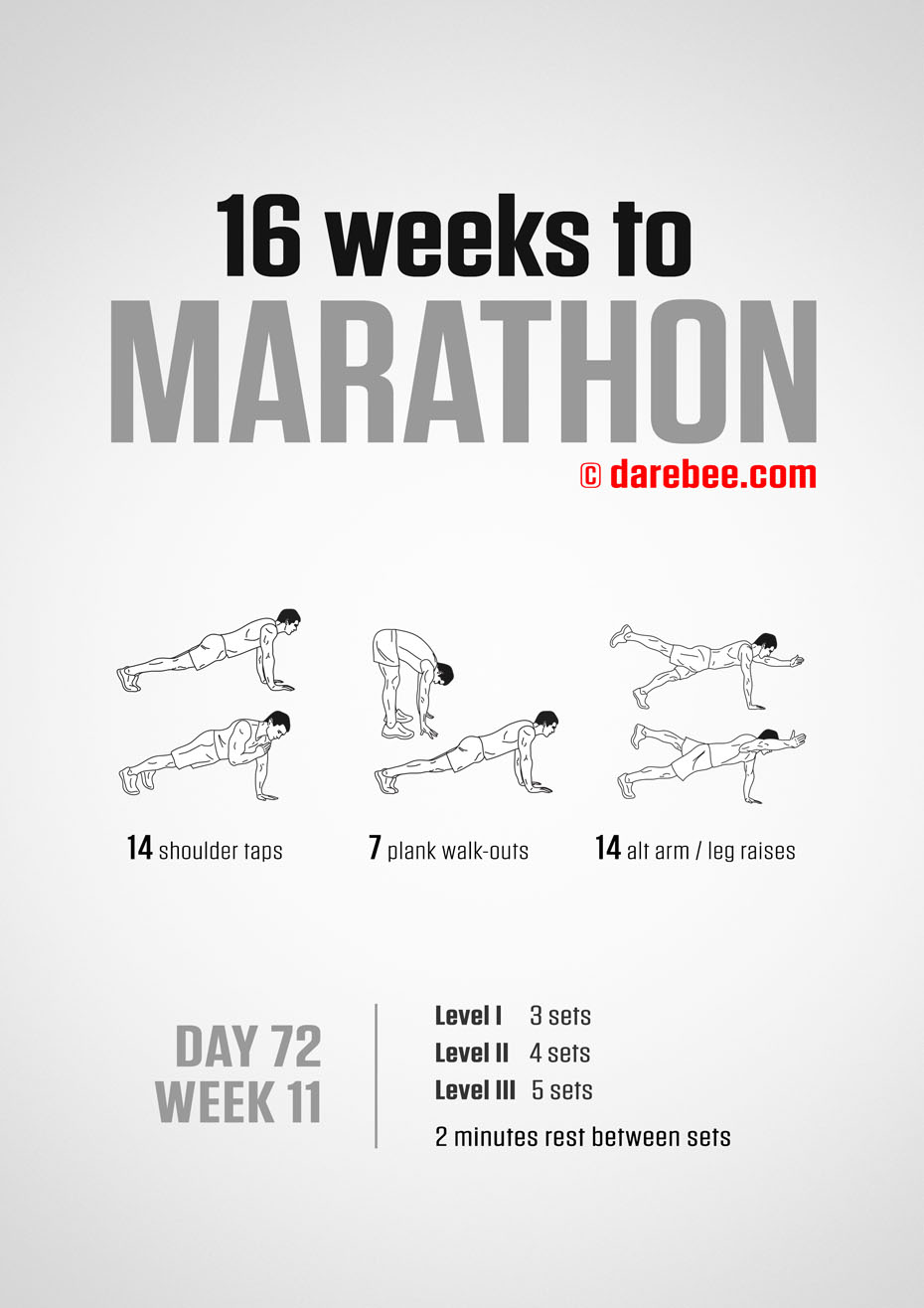
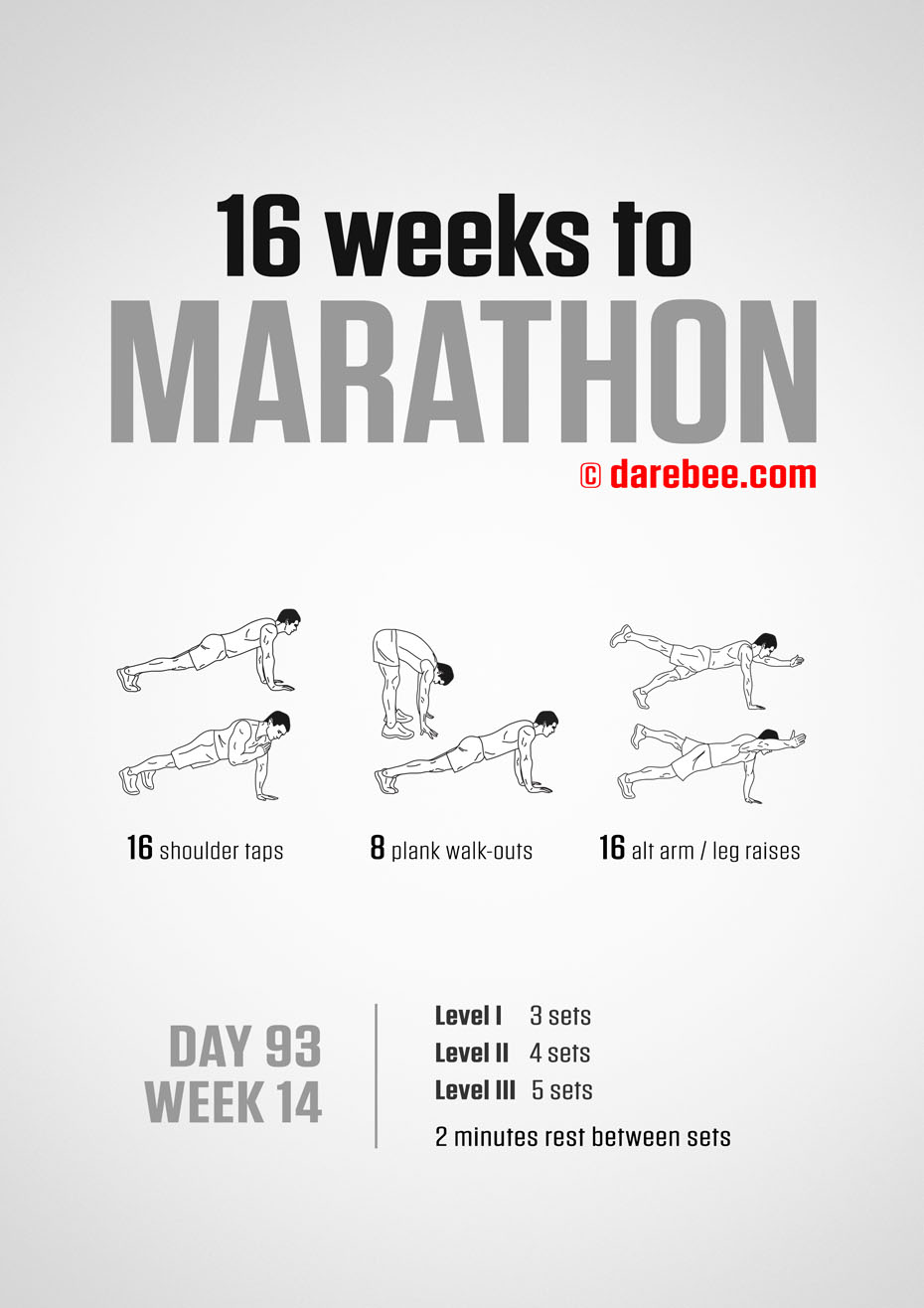
Week 4 turns the plank circuit up: 12 shoulder taps, 12 plank rotations and 6 plank walk-outs, in sequence, 2 minutes rest, 3 to 5 sets. Every number rose by a fifth and the hold is gone - three moving exercises in a row, with no stationary position to catch your breath in. It is the first card in the program without a hold.
Dropping the hold for a third moving exercise is a real increase even though the card looks no busier. Shoulder taps and rotations both demand a still torso while the arms move; walk-outs demand it while the whole body moves. Chaining them without a pause means the trunk never gets to simply hold - it has to stabilise through three different kinds of disturbance back to back, which is much closer to what running asks of it than any static plank.
Keep hips from swinging in the taps, open the chest fully in each rotation, and walk the hands out to a true plank on every walk-out. The temptation at 12 reps is to speed up and let the hips sway - resist it. Quality reps at a steady pace are the point; fast sloppy reps are a different exercise entirely.
Twelve, twelve and six, and the hold has left the building - the circuit now moves from start to finish.
Make it Harder: Hold the top of every plank rotation for a two-count before turning back to centre.
Make it Easier: Reduce the walk-outs to 4 and keep the taps and rotations at 12.

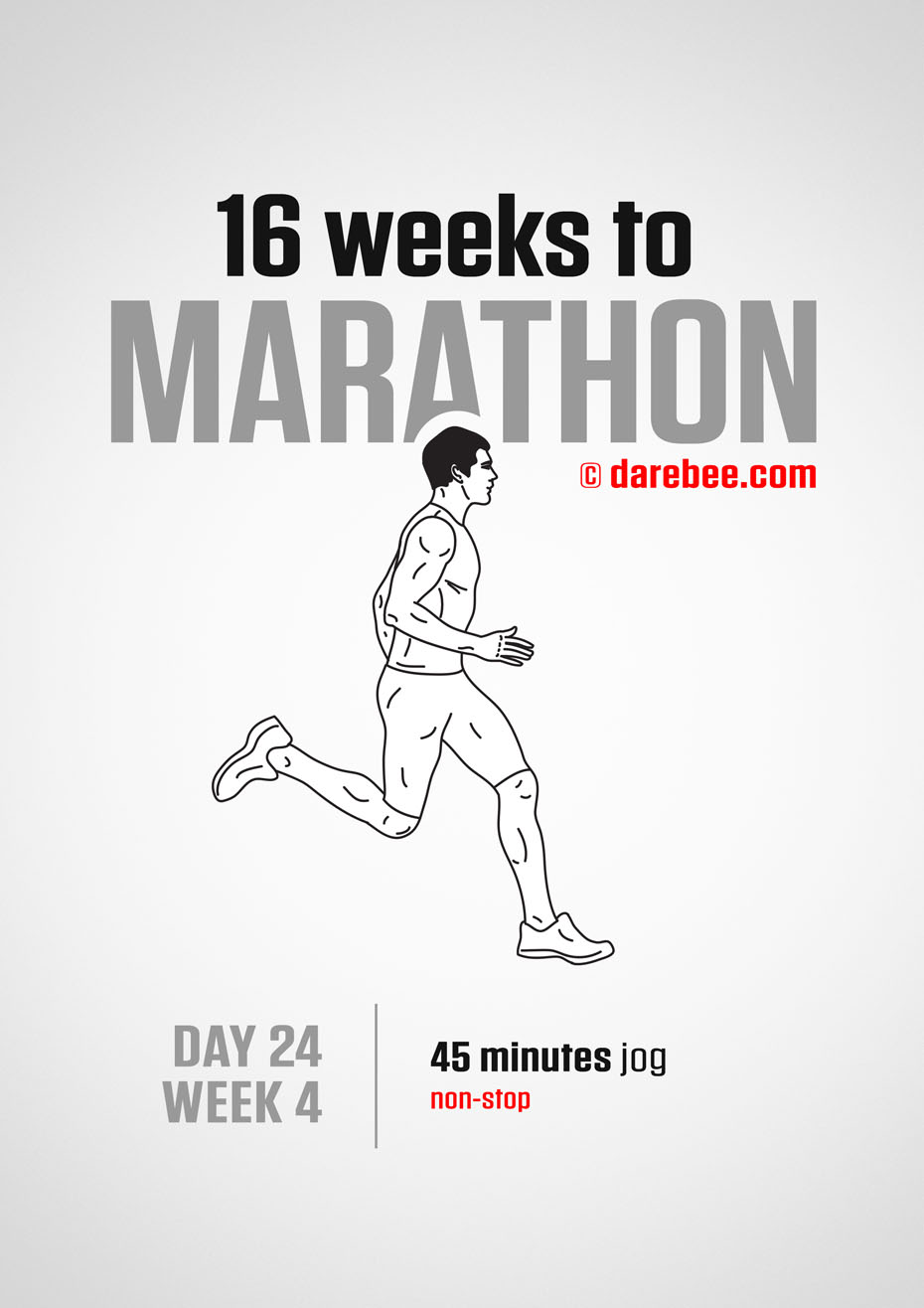
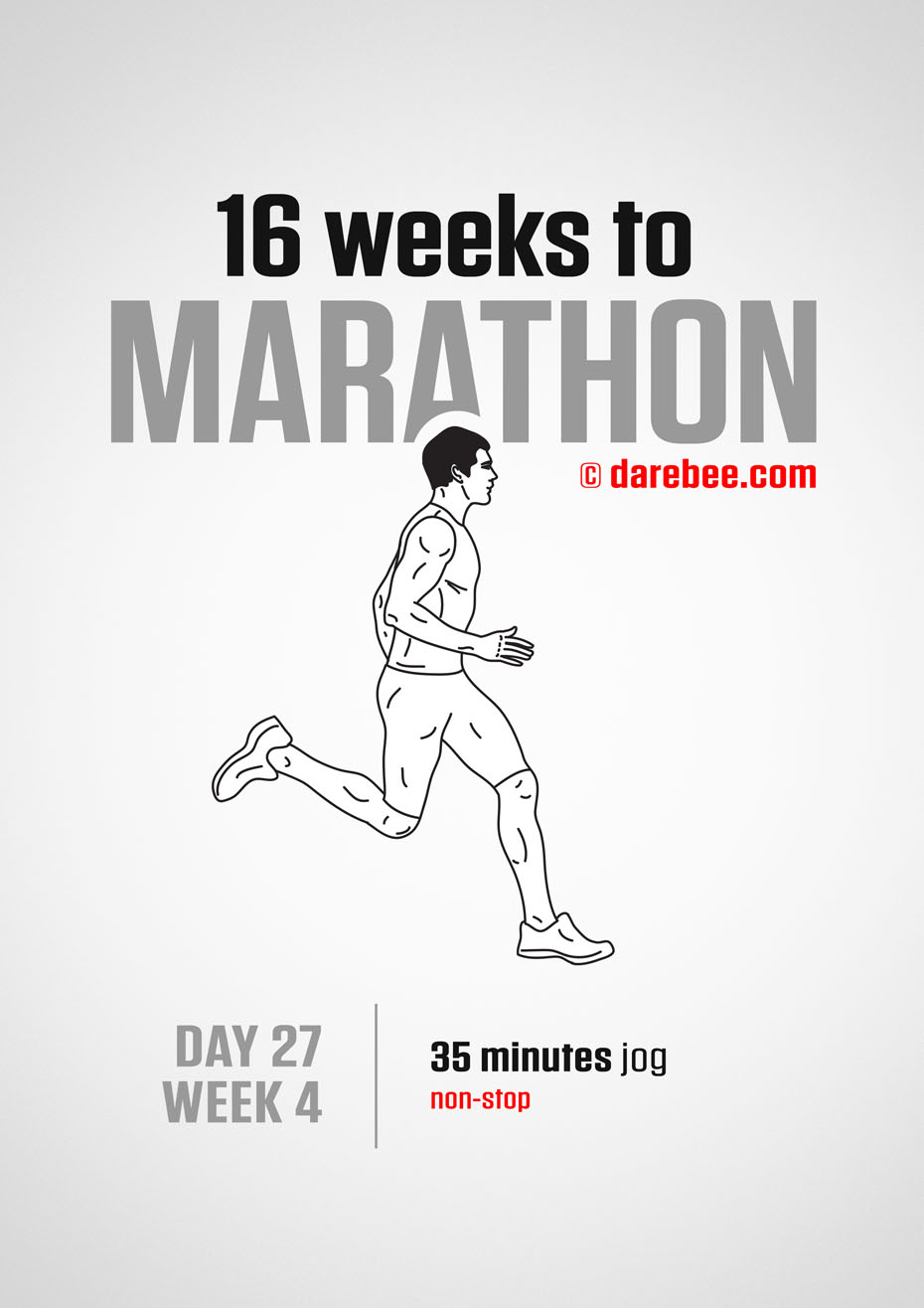
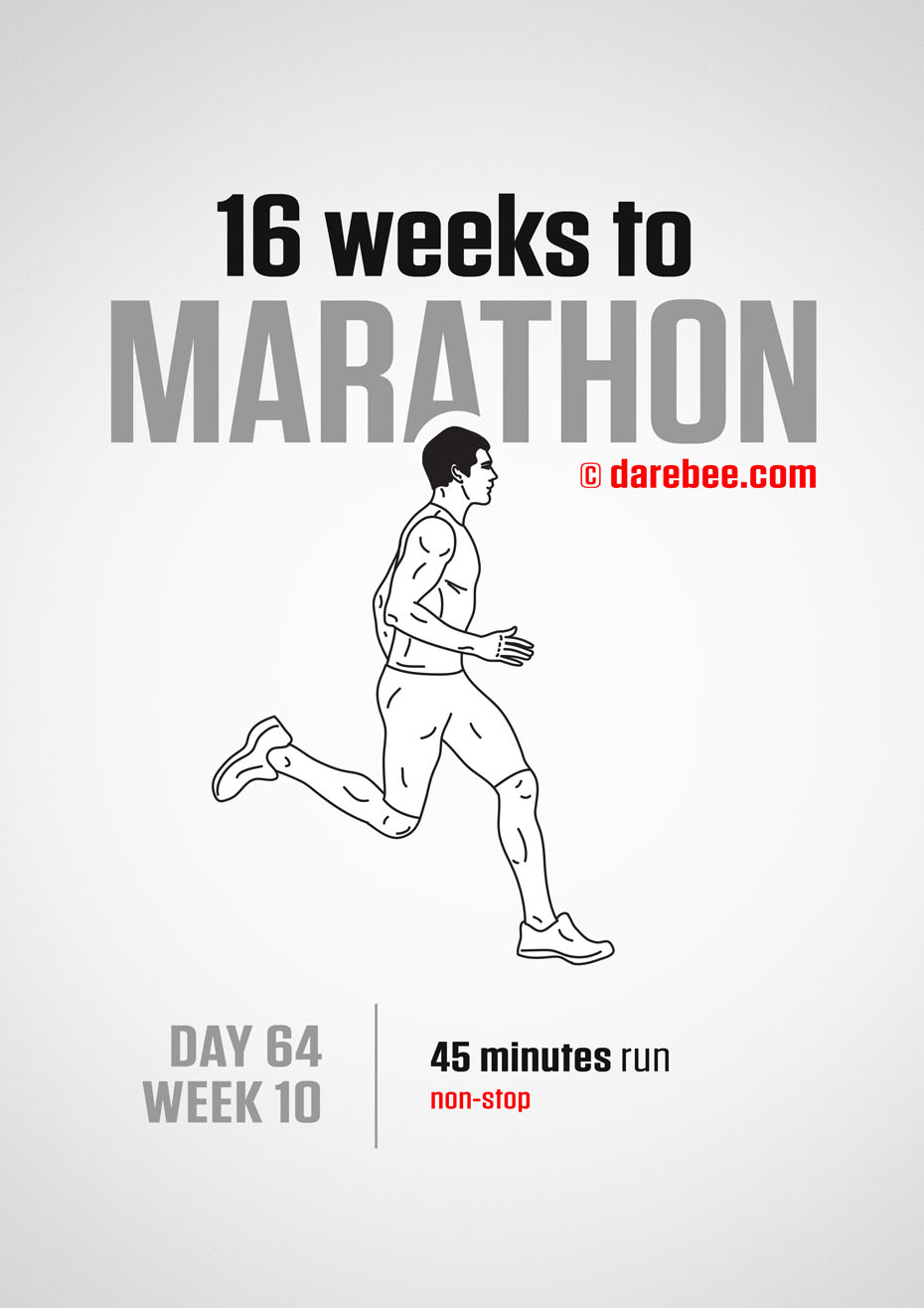
The midweek run reaches 45 minutes, non-stop - the first time the program's running sessions have passed the three-quarter-hour mark. Same easy effort as always; the only thing that grows is the time.
Forty-five minutes is long enough that the second half is a genuinely different run from the first. Form will want to drift: the shoulders climb, the stride lengthens, the landings get louder. Noticing that and correcting it is the real training this session offers. A marathon is two and a half to five hours of exactly this - keeping the same quiet, efficient movement long after the freshness has gone.
Check yourself every ten minutes: shoulders down, hands loose, cadence quick, landing under the hips. Drink before you go and take water along if it is warm. If the final ten minutes feel heavy, that is the part the program wants - shorten the stride and keep rolling rather than grinding through with a long one.
Forty-five minutes - the midweek run has now run past every walk the program started with.
Make it Harder: Add a steady 5-minute stretch at a moderate, still-conversational effort in the final third.
Make it Easier: Keep 40 minutes at a jog and walk the last 5 without stopping.

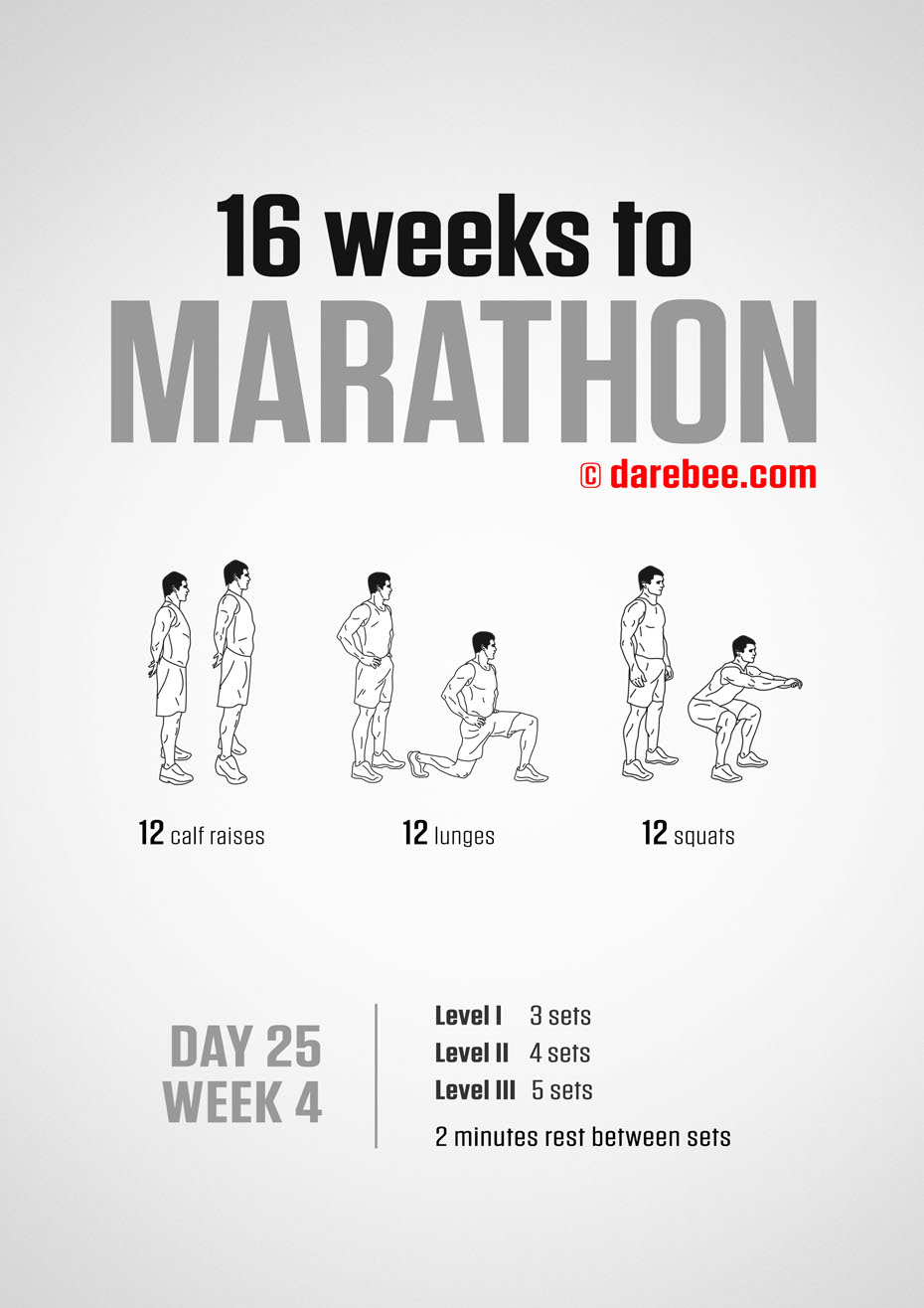
The leg circuit grows to 12 calf raises, 12 lunges and 12 squats, in sequence, 2 minutes rest, 3 to 5 sets by level. Like Tuesday, the hold has gone and a third moving exercise has taken its place: calves, then lunges, then squats, all at twelve. Thirty-six reps a set, the most leg work the program has asked for on a single card.
The order is the design. Calf raises wake up the lower leg; lunges load one thigh at a time; squats finish both legs together when they are already tired. Twelve lunges means six per leg, and by the time you reach the squats you will know which leg is stronger. Running is a single-leg sport that adds up to a two-leg effort - this circuit trains it in that sequence.
Full-range calf raises with a slow lower. Front shin vertical and back knee toward the floor in the lunges, alternating legs. Heels down and thighs to parallel in the squats, chest up throughout. At twelve reps, keep the tempo even from the first rep to the last rather than racing the early ones and slowing the late ones.
Thirty-six reps a set - three leg exercises, no holds, and the calves never quite stop working.
Make it Harder: Do the squats as a slow three-count on the way down and keep the lunges and calf raises as written.
Make it Easier: Take lunges and squats to 8 each and keep the calf raises at 12.

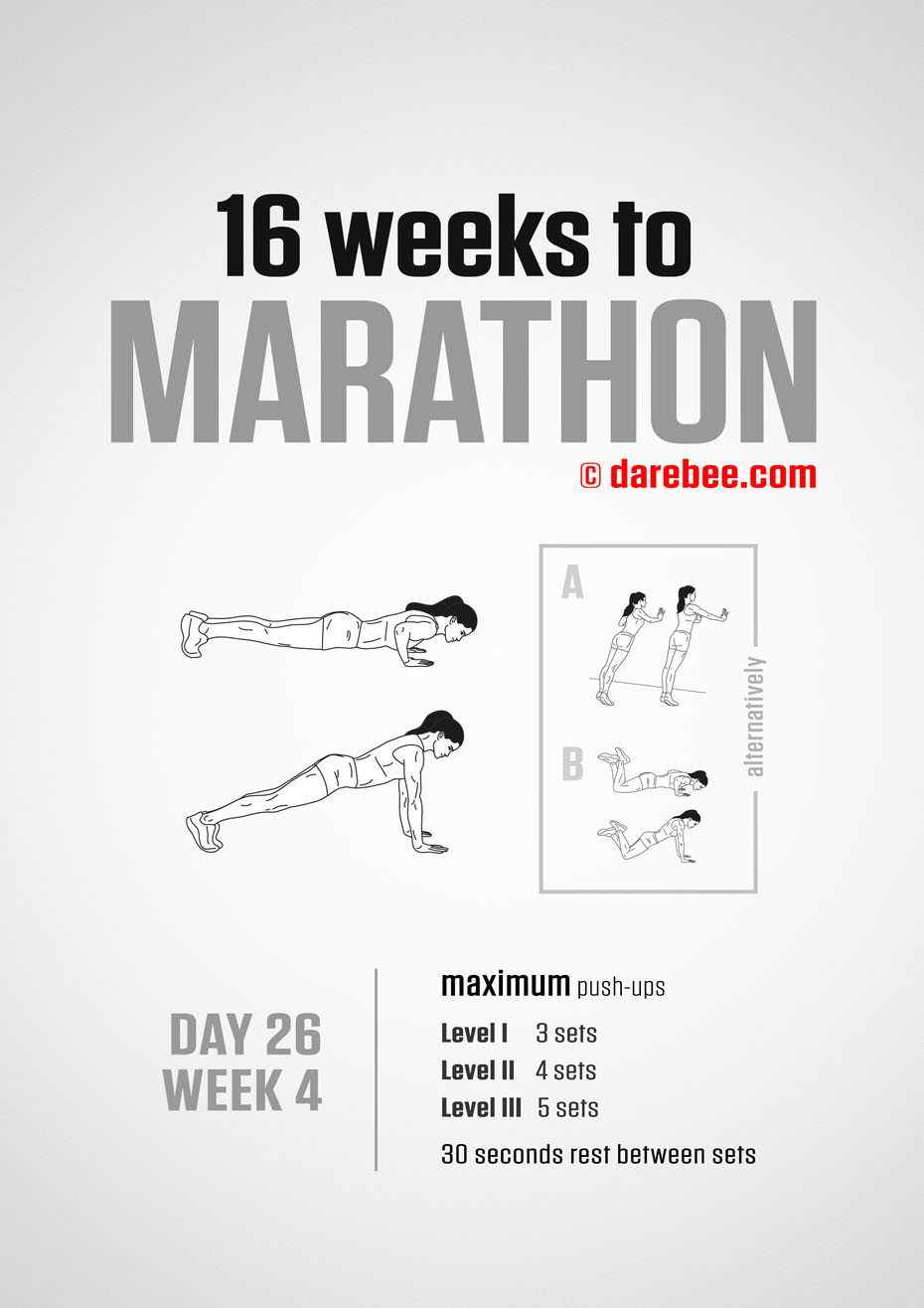
Push-up day, week four: maximum reps per set, 30 seconds rest, 3 to 5 sets by level, alternatives in the box. Four weeks of numbers now. If the first-set count has moved at all since Day 5, it is strength; if the last-set count has crept toward the first, it is endurance.
The push-up card does the same job as the weekly long run - it is a constant against which your change can be measured. By now there is nothing new to learn about the exercise, only something new to find out about yourself. Running has also had a quiet influence: a stronger, steadier trunk makes every push-up cheaper, and the walk-outs and up & downs have been pressing on the shoulders every Tuesday.
Same rules as ever - full range, elbows tucked, body in one line, set ends when the next rep would be incomplete. Keep the version consistent across every set and week to week if you can; if you have moved from the wall to the knees or from the knees to the floor, note it, because the numbers will reset and that reset is a milestone of its own.
Four weeks of maximum sets - whatever the numbers say, they are saying it about a different body than Day 5.
Make it Harder: Make every rep a slow two-count down and a fast press up.
Make it Easier: Perform the final set from the knees and keep the earlier sets as they were.

The step-down run settles at 35 minutes non-stop, bracketing the week's 45-minute push with the same easy duration you opened on. Monday, Saturday - the same number, the same relaxed effort, and tomorrow the Sunday session changes shape.
Easy runs are not filler. They are where the aerobic engine gets its mileage without the stress that would spoil the long session, and where form is practised when nothing is forcing it to break. Run this one with your attention on the details: posture, cadence, the position of your hands. Thirty-five minutes is long enough to rehearse a good habit several hundred times over.
Jog the first five minutes slowly, settle into a conversational pace, and keep it there. Breathe through the nose and mouth together, relax the jaw, and let the arms swing forward and back rather than across the chest. Finish walking and stretch the calves - they have a long day tomorrow.
Thirty-five easy minutes, and tomorrow the Sunday walks start to pick up their feet.
Make it Harder: Run the middle 15 minutes at a pace where you can still speak, but only in short sentences.
Make it Easier: Walk for a minute every 10 minutes and keep the session continuous.

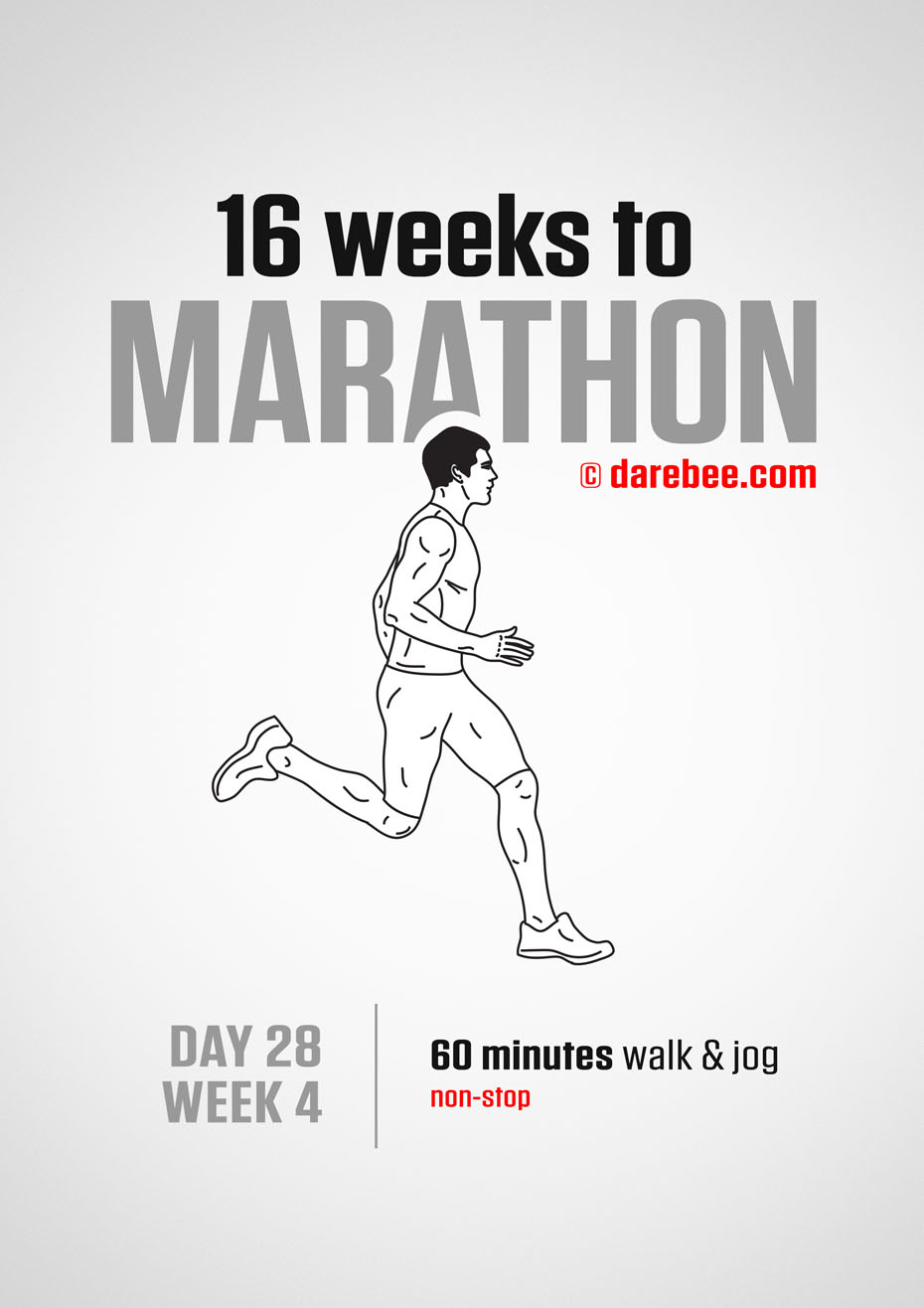
Four weeks in, the long Sunday session turns into something new: 60 minutes of walk & jog, non-stop. You decide the mix - jog as much of the hour as you want and walk the rest - but the hour stays continuous, and the drawing on the card has already made its choice about which half it expects to grow.
This is the bridge between the long walks and the long runs. The walk built the feet and hips; the jog is now being layered on top in whatever proportion you can sustain, and over the coming Sundays the jogging share will rise until the walk is an option rather than the default. Sixty minutes is shorter than last week's ninety because jogging minutes are worth more than walking ones - the program is exchanging time for intensity.
Start with a walk to warm up, then settle into a pattern: jog until the breathing climbs, walk until it comes back down, repeat. Keep the jog slow enough that the walking breaks get shorter rather than longer as the hour goes on. Take water, and note roughly how many minutes you jogged in total - that number is what next month is built on.
Sixty continuous minutes of walking and jogging - the long Sunday just stopped being a walk.
Make it Harder: Jog for 5 minutes and walk for 1, and keep that ratio honest for the whole hour.
Make it Easier: Walk most of the hour and jog whichever stretches feel easy - any jogging at all is progress on a walk.

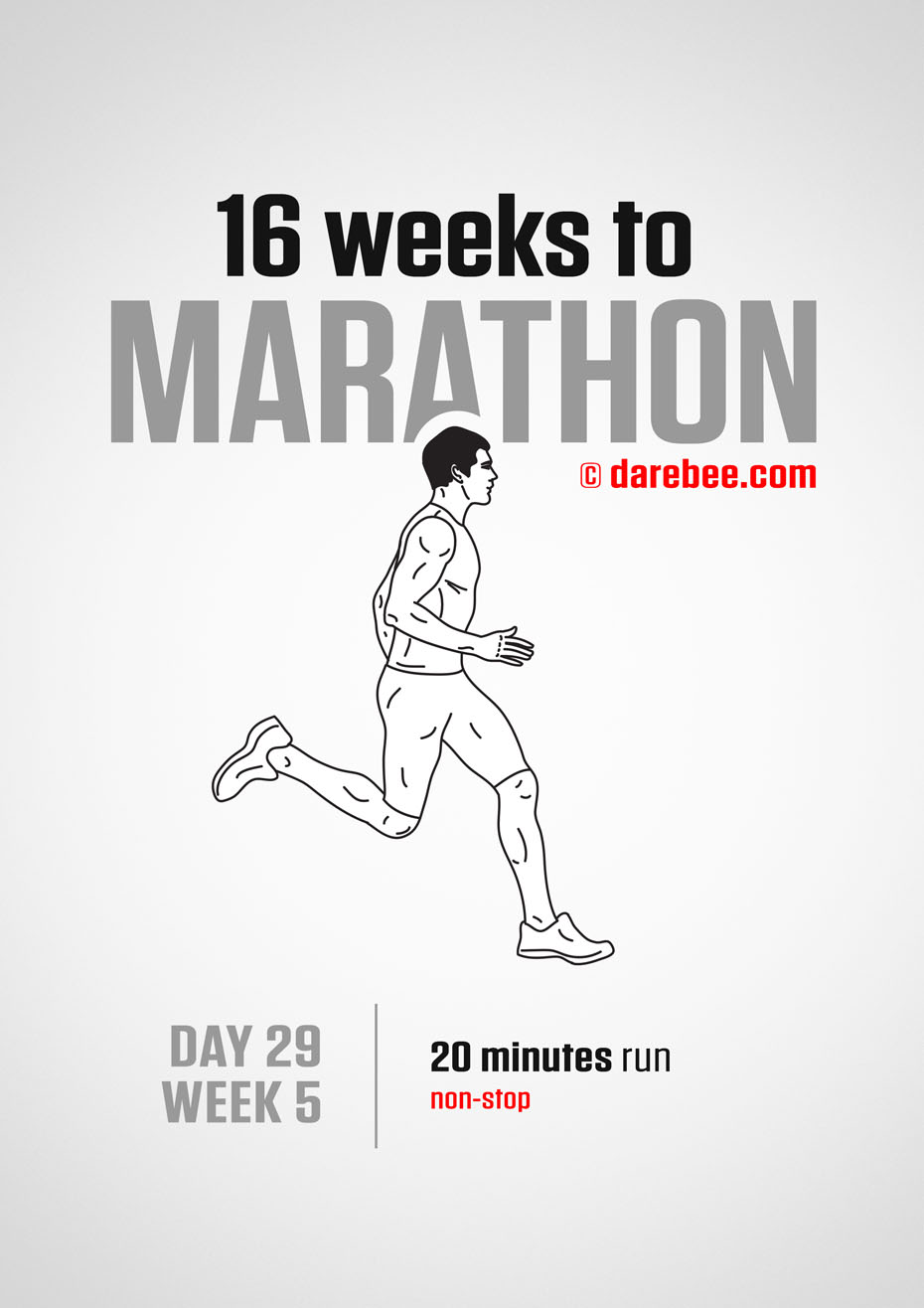
Week 5 changes the verb. The card says run, not jog: 20 minutes, non-stop, and the shortest session in almost a month. A run is a jog with intent - still comfortable, still something you could hold for a long time, but quicker, with a longer stride and a more purposeful arm swing. Twenty minutes is the length because the pace is the point.
After four weeks of easy jogging, the program now has a base to build speed on. Running faster for a short time teaches the legs a different rhythm, recruits muscle the jog never touches, and makes the easy pace feel easier by comparison - which is exactly what a marathon wants from you. The short duration keeps the session fresh rather than draining; you should finish wanting more, not needing a chair.
Warm up with a few minutes of jogging first, then settle into a pace where talking is possible but only in short sentences. Keep the cadence quick, lean slightly from the ankles rather than bending at the waist, and drive the elbows back. Cool down with a walk. If the pace felt like a jog, it was - push a little next time.
Twenty minutes, a little faster than anything before - the program has found a second gear.
Make it Harder: Run the middle 10 minutes at a pace that makes full sentences impossible and the outer 5s easy.
Make it Easier: Jog the 20 minutes instead and add 30 seconds of quicker running every 5 minutes.

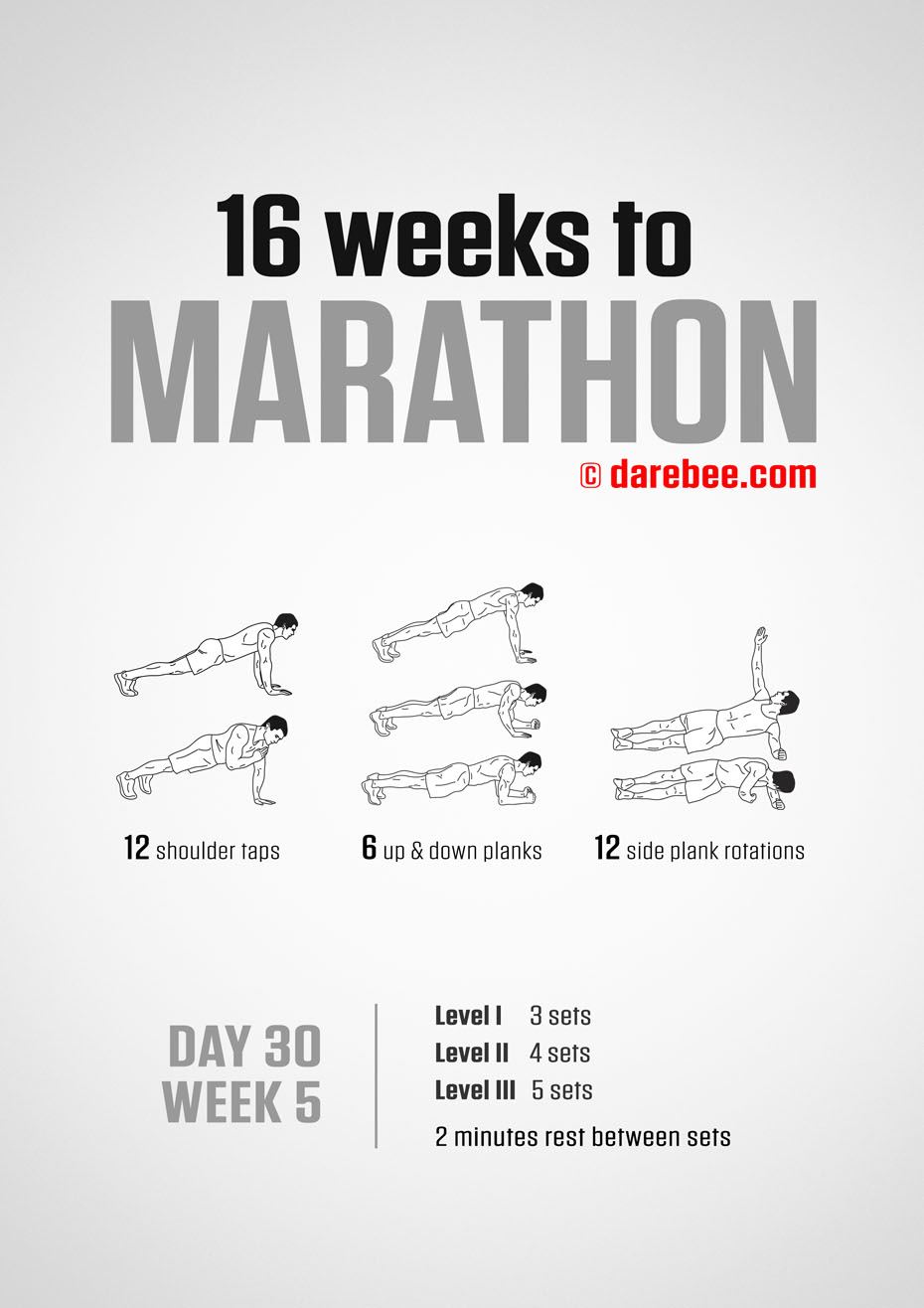
The plank circuit at Week 5: 12 shoulder taps, 6 up & down planks and 12 plank rotations, in sequence, 2 minutes rest, 3 to 5 sets by level. Three moving exercises and no hold, with the up & down planks now up to six. The card labels the rotations with the word side in front - same exercise as before, one arm reaching to the ceiling as the body opens into a side plank.
The combination is a full tour of plank stability: taps disturb it left and right, up & downs disturb it by changing the height, rotations disturb it by turning the whole body through ninety degrees. No position is held long enough to become comfortable. A trunk that can handle all three in sequence can handle the cumulative wobble of thousands of strides - that is the reason this circuit exists in a running program.
In the up & downs, alternate the leading arm and keep the hips from rocking. In the rotations, stack the feet or stagger them, open the chest to the side fully, and return through the high plank each time rather than cutting the corner. Taps stay quiet in the hips. Keep the same tempo for all twelve reps.
Taps, transfers and turns, twelve, six and twelve - every way a plank can be disturbed, in one circuit.
Make it Harder: Add a two-count hold in the low plank position on every up & down before pressing back up.
Make it Easier: Shoulder taps from the knees, the other two exercises as written.

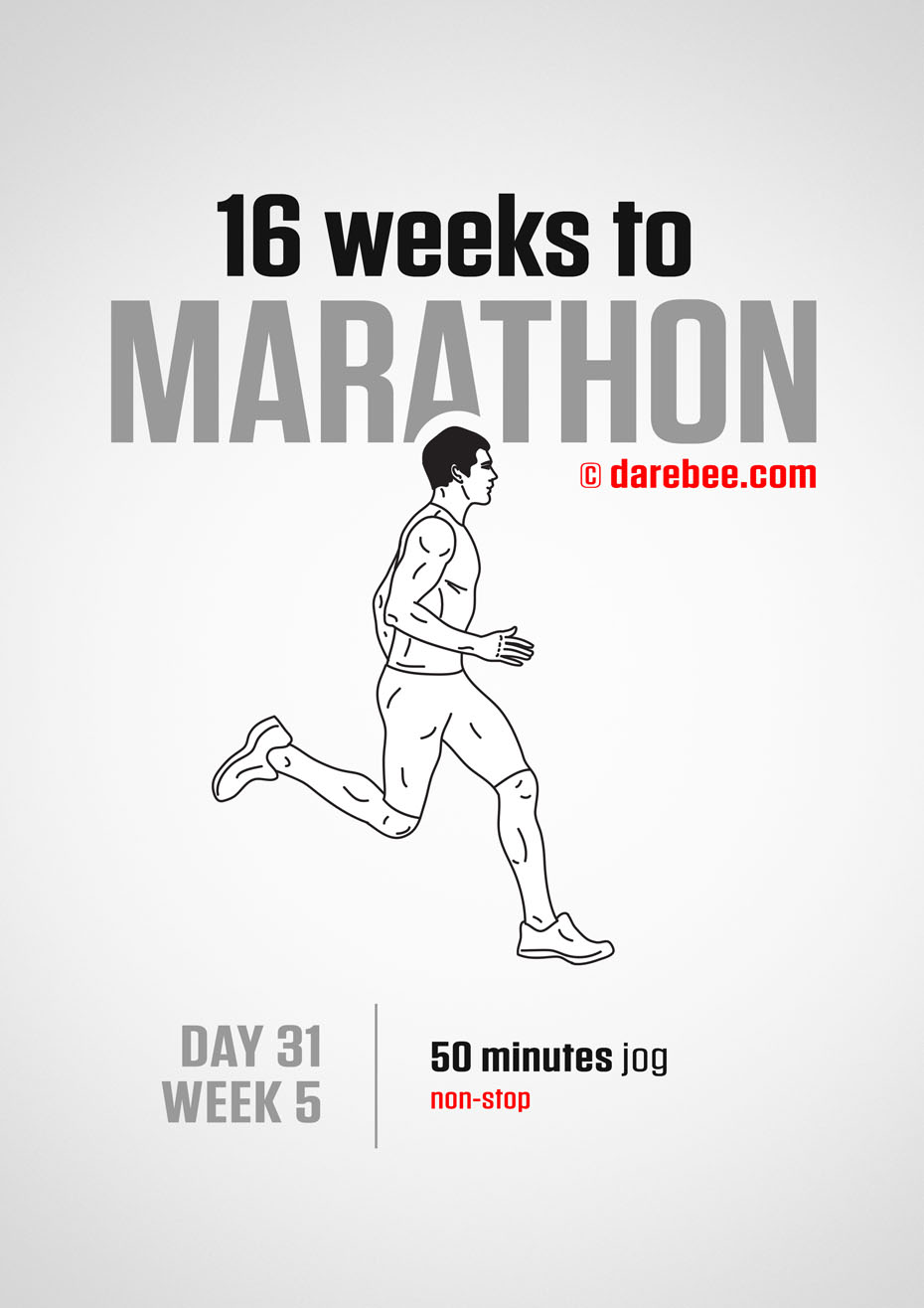
The midweek jog reaches 50 minutes non-stop - five minutes beyond last week and now just under an hour of continuous running. The card says jog, so the speed-work from Monday stays on Monday: this is easy, conversational, patient running from the first minute to the last.
Two kinds of running now live in the same week: the short, quicker run that builds the engine's top end, and the long, easy jog that builds its capacity. Neither replaces the other. Fifty minutes at a jog is where the endurance comes from, and keeping it genuinely easy is what lets Sunday's session absorb. The best runners in the world do most of their mileage slower than they race - the program is asking you to do the same.
Start slowly and stay slow. Eat something light a couple of hours before, drink, and carry water if it is warm. Check form every ten minutes - shoulders, hands, cadence, footstrike - and if the last fifteen minutes get heavy, shorten the stride and keep the feet quick rather than stretching for distance.
Fifty minutes of jogging - one more step and the midweek run will be an hour long.
Make it Harder: Run the last 10 minutes at a steady, moderate pace and settle back to a jog for the final 2.
Make it Easier: Keep it to 45 minutes of jogging and walk the remainder without stopping.

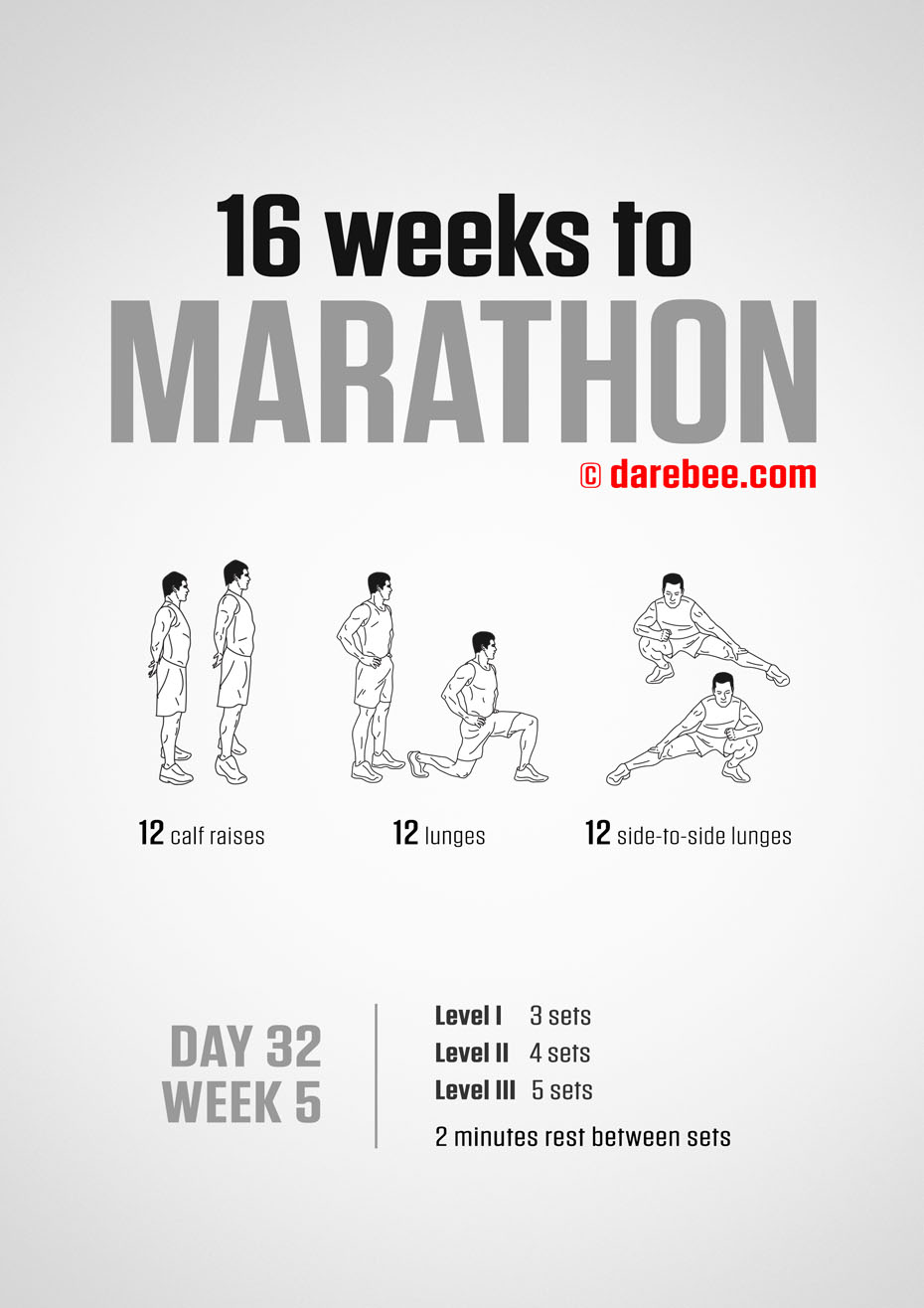
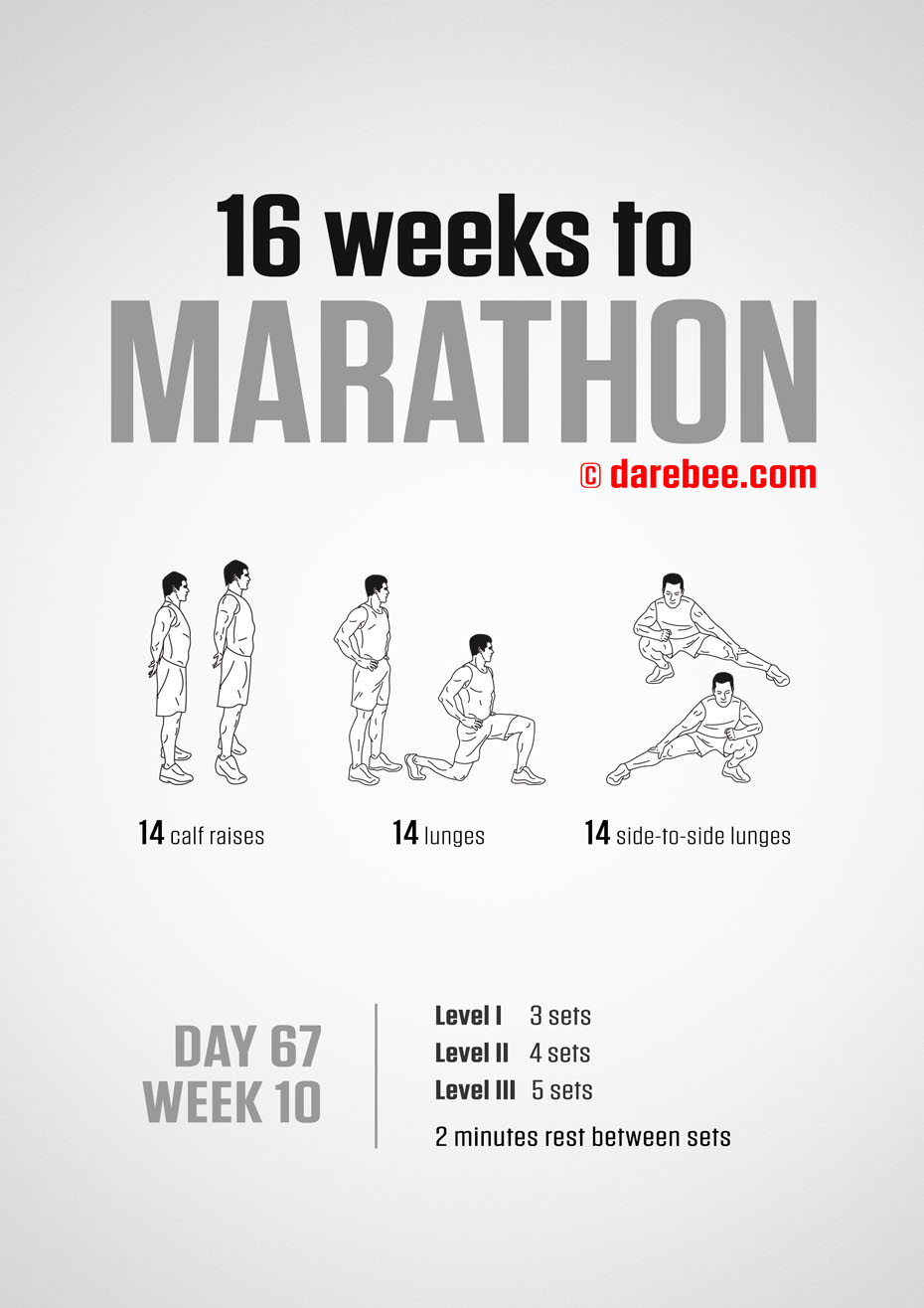
Side-to-side lunges arrive: 12 calf raises, 12 lunges and 12 side-to-side lunges, in sequence, 2 minutes rest, 3 to 5 sets by level. The new exercise is a deep lateral lunge - one leg bends and takes the weight while the other stays straight out to the side - and you shift from one side to the other without standing up in between. Twelve means six shifts to each side.
Forward lunges train the leg in the direction you run; side-to-side lunges train it in the direction you do not. The inner thighs, the outer hips and the glutes all work to move the body sideways and to stop it, and those are the muscles that keep the knees tracking straight and the pelvis level over thousands of forward strides. Strengthen them and the forward running gets cleaner. Calf raises open the circuit, as they have every week.
In the side-to-side lunge, keep both feet flat, point the toes forward and push the hips back as you shift, so the bent knee stays over the foot rather than folding inward. Stay low through the transition. Forward lunges keep the vertical front shin; calf raises keep their full range and slow lower.
The legs now lunge forward and sideways in the same circuit - running straight gets easier when the sides are strong.
Make it Harder: Hold the low position at the end of every side-to-side shift for a two-count before moving across.
Make it Easier: Stay higher in the side-to-side lunges - a half-depth shift trains the same pattern with less load.

Maximum push-ups, fifth week: as many as you can per set, 30 seconds rest, 3 to 5 sets by level, alternatives in the box. The card has not changed since Day 5 and will not change for the rest of the program. You are the variable.
The Friday push-ups sit between the week's longest jog and its first fast run, and that placement says something about what they are for. They are not about the arms for their own sake: they keep the upper body strong enough to carry good posture deep into a long effort, when tired shoulders start to round and the breathing gets cramped. Every Friday max is insurance against that.
Full range, elbows tucked, body straight, honest stopping point. If the first-set number has plateaued, do not force it - plateaus in a maximum test usually break after the next week or two of running. If you have not yet written the numbers down, start now.
Five Fridays of the same unchanging card - the only thing that is allowed to be different is you.
Make it Harder: Pause for a one-count with the chest just above the surface on every rep.
Make it Easier: Take the rest to 45 seconds and keep each set maximal.

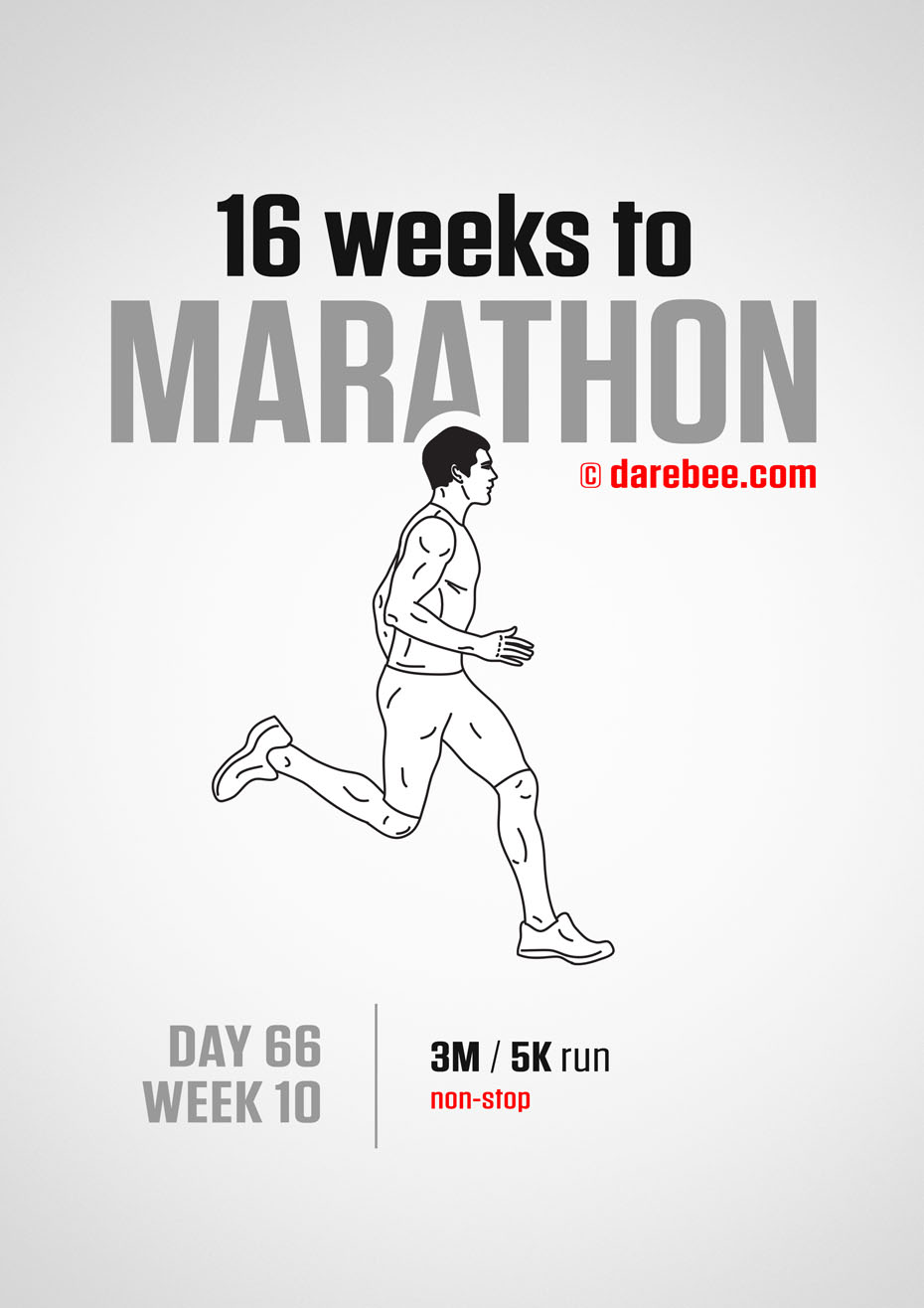
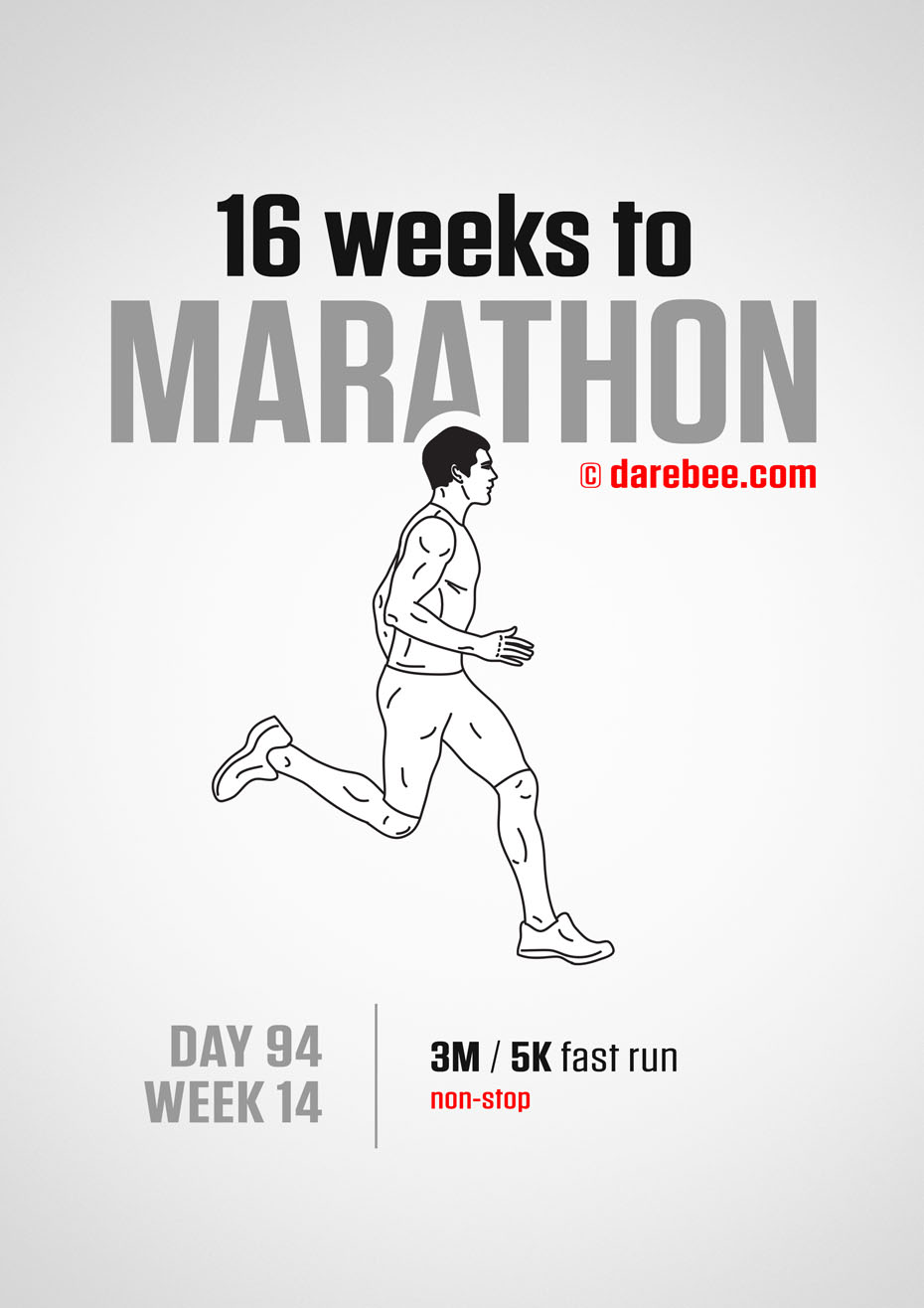
The first distance on a card: a 2 mile / 3 km fast run, non-stop. No time target, just the distance covered quickly - faster than Monday's run, faster than anything the program has asked for. Measure the route beforehand or use a tracking app, and note your time at the end.
Fast running this early in the plan is about two things. It teaches the body what a quicker pace costs, so that the marathon pace feels easy by contrast, and it gives you a number - the time for 2 miles - that you can compare against the fast runs that come later. A fast run is still controlled: hard enough that speaking is a few words at a time, not so hard that the form falls apart or the finish is a stagger.
Warm up with five to ten minutes of easy jogging before the fast part and cool down with the same after. Run tall, lean from the ankles, drive the arms, land under the hips. If the pace fades badly in the second mile, you started too fast - that is useful information and the next fast run is the place to use it.
Two miles, quick, and a time to write on the wall - the program has started keeping score.
Make it Harder: Run the second mile faster than the first - a negative split is the mark of a pace well judged.
Make it Easier: Make it fast but not frantic: run the distance at a pace you could hold for 4 miles, not 2.

The long Sunday stretches to 1 hour 40 minutes of walk & jog, non-stop - or, the card adds in red, run 10K. The two are the same session in different shapes: a hundred minutes on your feet with as much jogging as you can manage, or ten kilometres run continuously. Pick the one that fits where you are today and do it without stopping.
This is the first time the program offers a distance you would recognise from a race entry form, and it arrives as an option rather than a demand. The walk-and-jog version is the safer way to spend the same length of time and builds the same endurance; the 10K version is there for whoever has found the Sunday jogging share growing week on week. Both are building toward the same place: a half marathon option in three weeks.
Whichever version, start slower than you think you should and take water. Walk-and-joggers: keep the jogging pieces long and the walks short, and note the total minutes jogged. 10K runners: find a pace you could talk at and keep it for all ten kilometres - this is endurance, not a time trial. Eat something light before you go out and stretch the calves and hips when you get back.
A hundred minutes or ten kilometres - the first Sunday where the program lets you choose the door, and both lead to the same room.
Make it Harder: Run the 10K, and run the second 5K a touch quicker than the first.
Make it Easier: Walk & jog the time and keep the jog pieces short - five minutes on, two off - for the whole hundred.

Week 6 opens with a 25-minute run, non-stop - the quicker kind of running introduced on Day 29, now five minutes longer. Conversational in short sentences rather than paragraphs, quick feet, purposeful arms. The Monday run is becoming the week's speed session.
The run-then-jog structure is the program's way of building two things at once. Monday sharpens the pace, the midweek session lengthens the distance, and Saturday keeps the legs ticking over between them. Adding five minutes to the run is a bigger step than adding five to a jog, because faster minutes cost more - run it controlled and treat the final five as the real test.
Jog five minutes to warm up, then lift the pace. Keep the cadence high and the stride compact even as the speed rises - speed from turnover, not from reaching. If the breathing becomes ragged, ease off slightly rather than stopping. Finish with a walk and a few minutes of stretching for the calves and hamstrings.
Twenty-five minutes at the quicker pace - the second gear is getting its own mileage now.
Make it Harder: Run the last 5 minutes at a pace where only single words are possible.
Make it Easier: Alternate 4 minutes of running with 1 minute of jogging for the full 25.

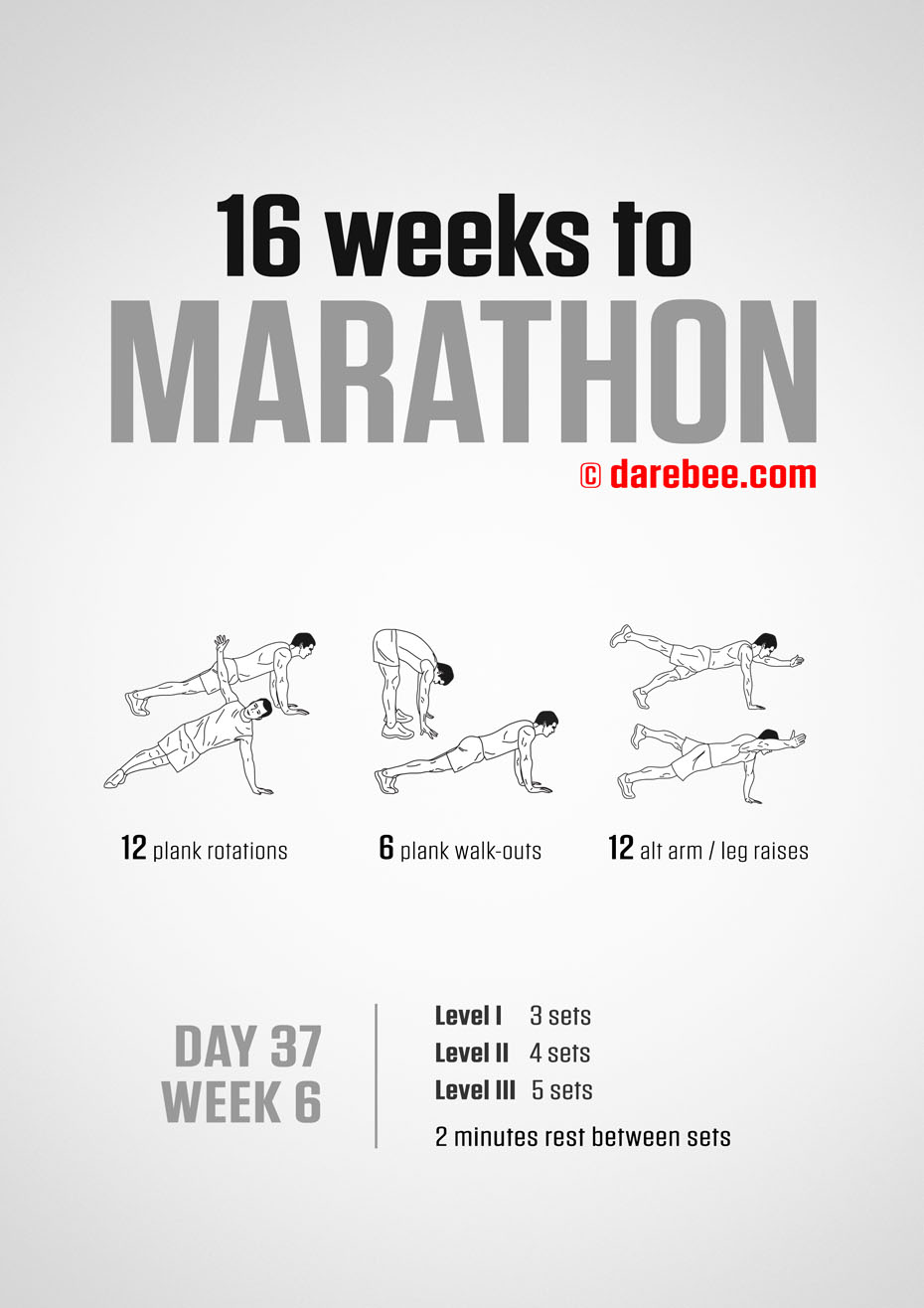
A new plank exercise takes over the Tuesday circuit: 12 plank rotations, 6 plank walk-outs and 12 alt arm / leg raises, in sequence, 2 minutes rest, 3 to 5 sets by level. Alt arm/leg raises are done from a high plank: lift one arm straight forward and the opposite leg straight back at the same time, hold the balance for a beat, return, and switch. Twelve means six on each diagonal.
The alternating raise is the hardest stability exercise on the plank cards because it removes two of the four points of contact at once. Everything the shoulder taps taught - keep the hips level when a hand leaves the floor - now applies with a foot gone too, and the diagonal load across the trunk is exactly the pattern running produces: opposite arm and leg driving forward together on every stride. Rotations and walk-outs set up the shoulders and trunk before the raises ask the question.
Reach long rather than high in the raises - arm out in line with the ear, leg out in line with the hip, hips flat, no arch in the lower back. If the balance goes, widen the supporting foot a little. Rotations and walk-outs keep their standards: chest open to the side, hands walked to a true plank.
Two limbs off the floor at once, opposite arm and leg, and the trunk finally gets asked the question running asks.
Make it Harder: Hold each arm/leg raise for a three-count at full extension before switching.
Make it Easier: Do the alt arm / leg raises from all fours with the knees down, keeping the rest as written.

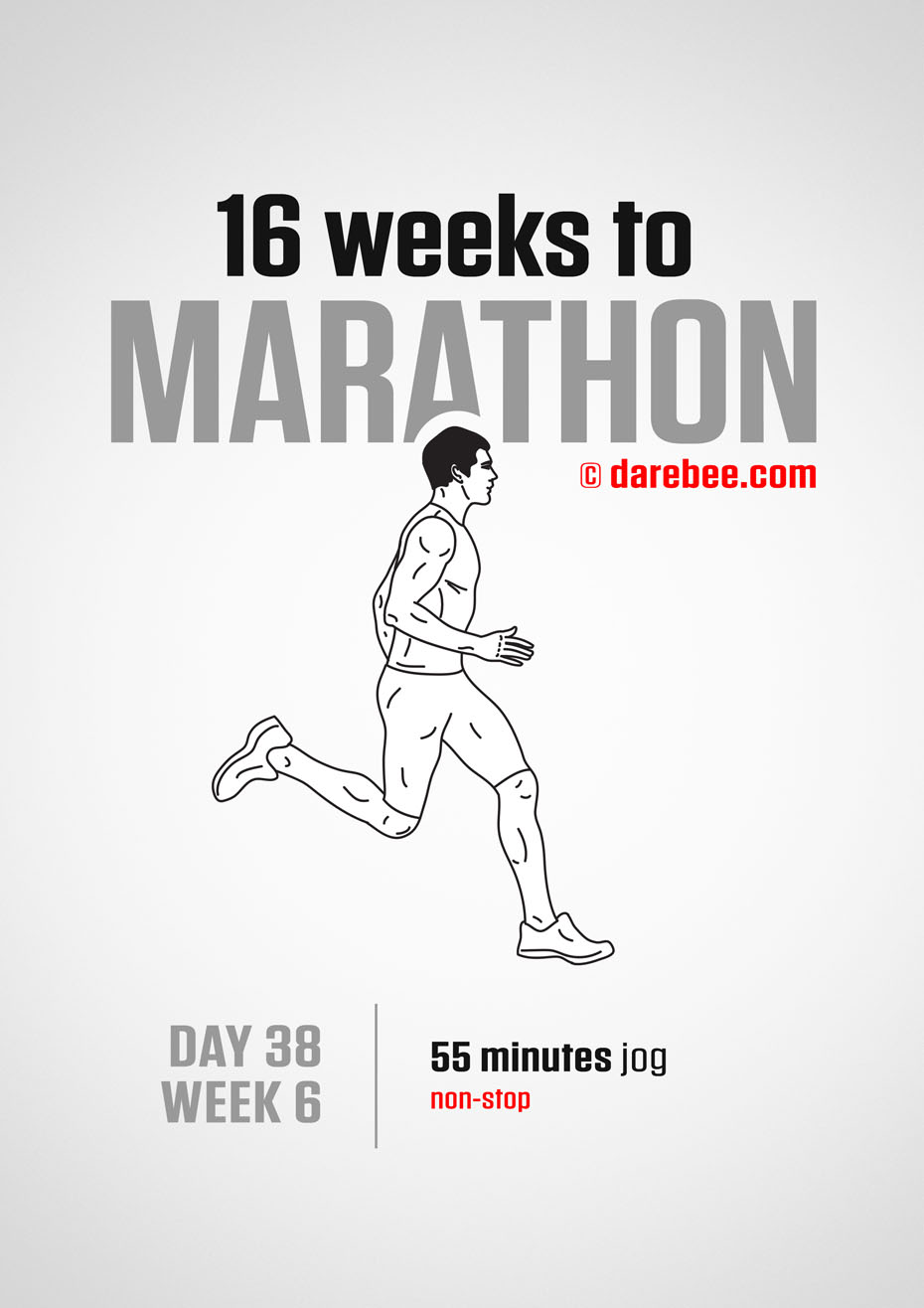
The midweek jog rises to 55 minutes non-stop. Easy pace throughout, the long-run rules in force: start slow, keep the stride short, drink, and let the final quarter be where the work lives. Next week this session becomes an hour.
Fifty-five easy minutes after a quicker Monday and a demanding Tuesday is a deliberate stack. The legs arrive a little tired, and jogging well on tired legs is the single most marathon-relevant skill the program can teach. Do not try to make the run feel fresh; let it feel like what it is, and keep the form honest while it does.
Slow start, even middle, steady end. Check posture every ten minutes and quieten the feet if the landings get loud. If the legs feel heavy for the first twenty minutes, keep going - that heaviness usually lifts around the half-hour mark and the run that follows is often the best part.
Fifty-five minutes at a jog, and the hour-long midweek run is now only a week away.
Make it Harder: Finish with 8 minutes at a moderate, short-sentence pace before jogging the last 2.
Make it Easier: Run 45 minutes at a jog and walk 10 briskly to complete the time.

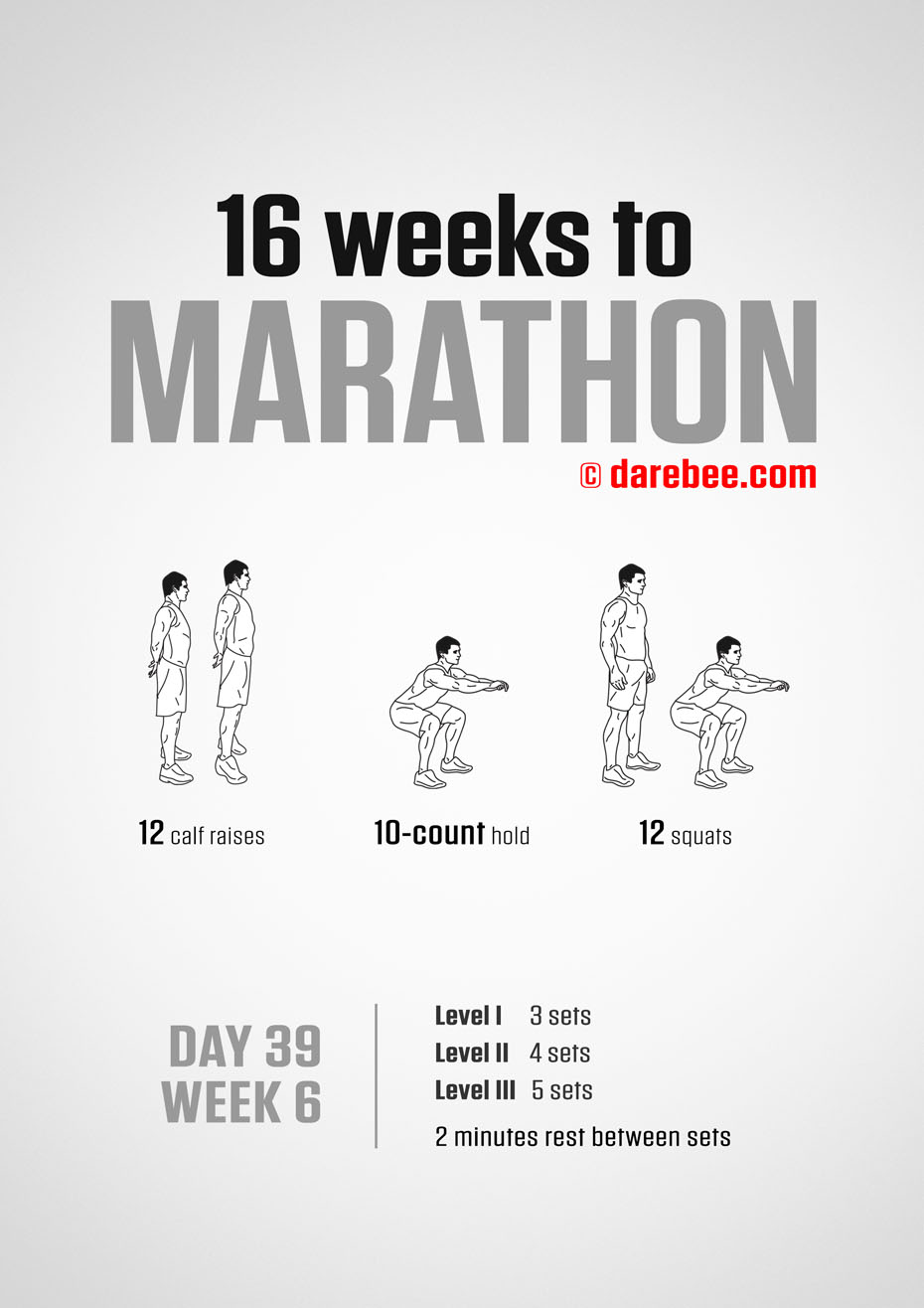
The leg circuit goes back to basics with bigger numbers: 12 calf raises, a 10-count hold and 12 squats, in sequence, 2 minutes rest, 3 to 5 sets. The hold is the squat hold - thighs near parallel, arms forward - and it sits before the squats this time rather than after them, so the reps arrive on already-loaded thighs.
Swapping the order of a hold and its exercise is a subtle change with a real effect. Squatting after a ten-count hold means the quads start the reps without any slack in them, which makes twelve squats feel like more. Calf raises keep their place at the front of the circuit, where they have been since Day 4 - the program never lets a leg day pass without paying the calves.
Calf raises: full height, slow lowering. Squat hold: pick a depth you can keep still for ten counts, chest up, weight in the heels, breathing steadily. Squats: to parallel, heels down, knees over the toes, same tempo from rep one to twelve.
Hold first, reps second - the squats show up to find the thighs already working.
Make it Harder: Stretch the squat hold to a 20-count and keep the squats at 12.
Make it Easier: Shorten the squat hold to a 5-count and keep the other two exercises as written.

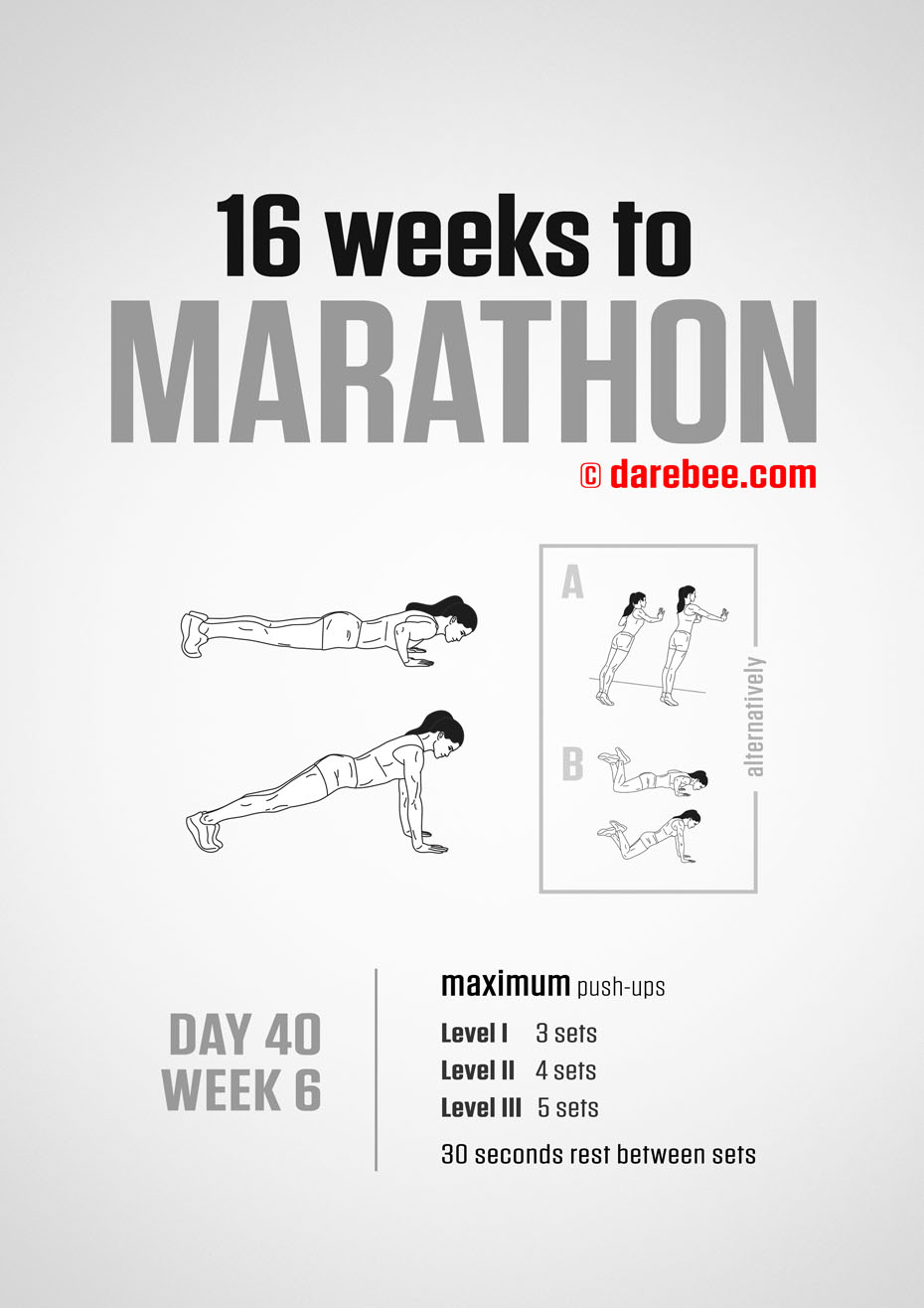
Push-ups, week six: maximum per set, 30 seconds rest, 3 to 5 sets by level, alternatives in the box. Six weeks of numbers. This is also the last time the push-ups get a card to themselves - from next week they share their Friday with a run.
Six weeks is long enough for the trend to be unmistakable one way or the other. If the numbers have climbed, the short rest is now doing its job of building endurance in the pressing muscles; if they have stalled, the running volume is probably the reason, and the cure is patience rather than extra sets. Either way, the habit of testing is what matters - a body that is measured regularly is a body that is paying attention.
Same standard every week: full range, elbows tucked, straight line, honest end. Note the first-set and last-set numbers. Next week the card changes shape but not rules - a 30-minute run comes first, and these sets follow it.
The last solo push-up day - from here the Friday card carries a run, and the press comes after it.
Make it Harder: Perform every set with the feet elevated on a step and keep the reps maximal.
Make it Easier: Split each set into two halves with a 10-second pause in the top position between them.

A 25-minute run, non-stop, in the Saturday slot. Same quicker pace as Monday, same duration. Two speed sessions in a week is new, and the second one arrives on legs that have done a 55-minute jog and a leg circuit since the first - so run it controlled and pay attention to how the pace feels rather than chasing the same number.
Doubling the faster running is how the program prepares the legs for the distance runs that begin next week. Speed makes the easy pace more economical - each stride gets a little more out of the same effort - and that economy is what turns an hour of jogging into the platform for an eight-mile run. Monday's run was the lesson; this is the repetition.
Warm up with an easy jog, then lift the pace to short-sentence effort. Keep the stride compact and the arms driving. If the pace is clearly slower than Monday for the same effort, that is Wednesday talking - accept it and finish cleanly. Cool down with a walk and stretch the calves.
The second quicker run of the week, on legs that know what the first one felt like.
Make it Harder: Beat Monday's middle 10 minutes - quicker through the centre of the run, the same at both ends.
Make it Easier: Alternate 3 minutes of running with 2 of jogging and keep the whole session continuous.

The Sunday session is 1 hour 45 minutes of walk & jog, non-stop - five minutes longer than Day 35, and this time without a distance option. One hundred and five minutes on the move, with the jog-to-walk ratio left to you. Whatever it was last Sunday, aim for slightly more jogging and slightly less walking today.
The absence of a 10K option on this card is a message: today is about time, not distance. The Sunday sessions have been alternating between offering you a race-length target and simply asking for hours, and the hours matter at least as much. Everything that happens in a marathon after the two-hour mark is a consequence of how well the body tolerates being out for a long time - and the only way to train that tolerance is to be out for a long time.
Eat two hours before, drink on the way, and start with a walk. Keep the jog pieces easy enough to repeat many times. If the walking breaks start getting longer rather than shorter, slow the jog rather than extending the walk. Note the total jogging minutes when you finish.
An hour and three quarters of continuous movement - no distance today, just hours, because hours are what a marathon is made of.
Make it Harder: Jog 10 minutes and walk 1, and keep that pattern going for the full session.
Make it Easier: Walk the first and last 15 minutes, and jog and walk the middle in whatever mix keeps you moving.

Week 7 opens with a 30-minute run, non-stop - the quicker pace, now half an hour long. Short-sentence effort, quick feet, arms driving. The Monday run has grown by five minutes a week since it first appeared, and thirty minutes of it is a proper session by any measure.
The program now trusts you with a half-hour of faster running because the easy mileage has earned it. Speed on a thin base breaks people; speed on six weeks of jogging and walking builds them. This run is also the one that makes the week's first distance run feel manageable - an 8-mile run on Sunday is far less daunting to legs that spent Monday running briskly for thirty minutes.
Five easy minutes to warm up, then lift. Hold the pace even rather than starting hard and fading; the last ten minutes should feel like the first ten at a slightly higher cost. Lean from the ankles, keep the hips tall, land under the body. Walk to cool down and stretch the hamstrings.
Thirty minutes at the quicker pace, and the Monday run has become a session worth naming.
Make it Harder: Make the final 10 minutes single-word effort - a pace where full sentences are off the table.
Make it Easier: Run 20 minutes at the quicker pace and jog the remaining 10.

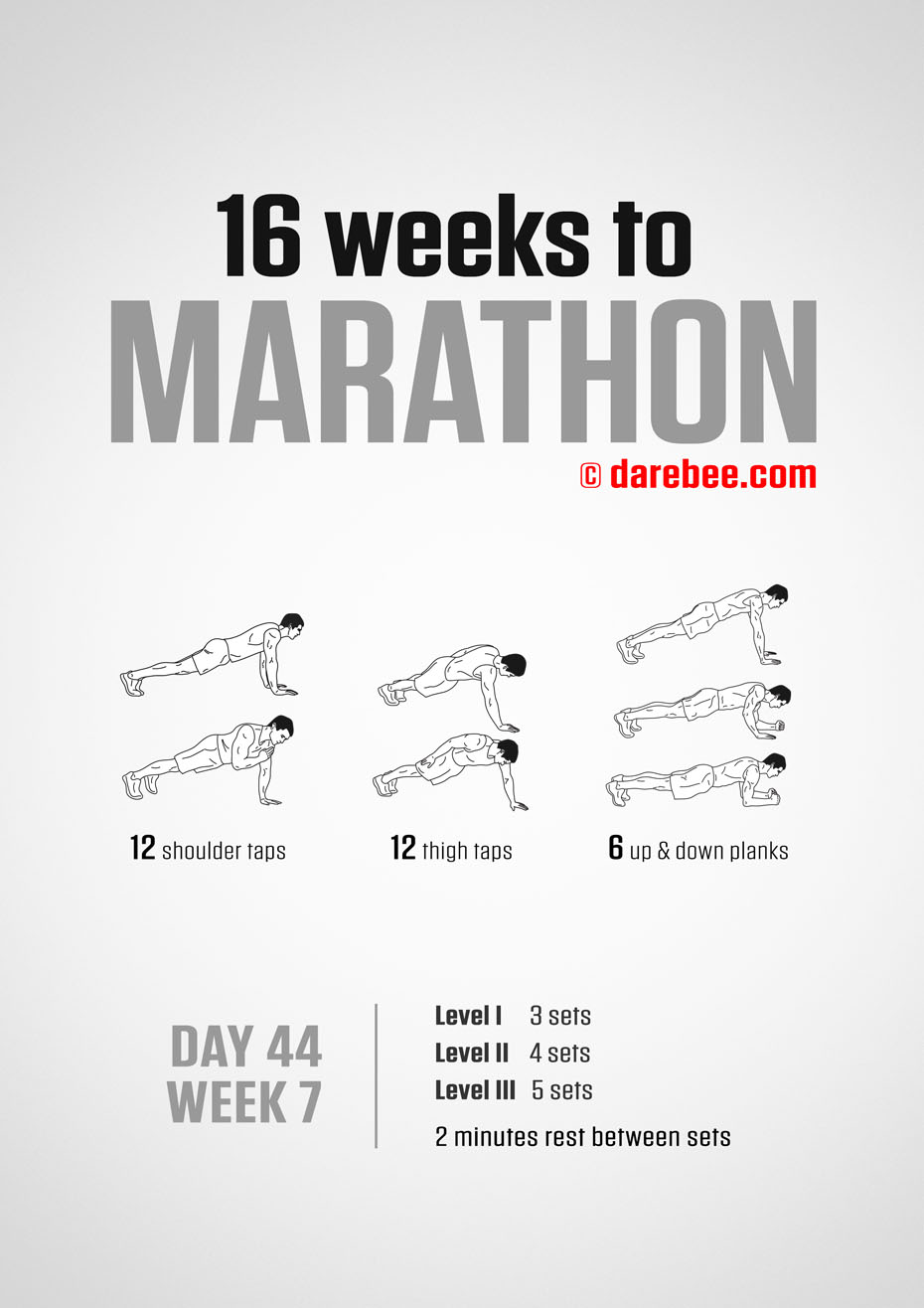
A new tap joins the circuit: 12 shoulder taps, 12 thigh taps and 6 up & down planks, in sequence, 2 minutes rest, 3 to 5 sets by level. Thigh taps are shoulder taps with a different destination - from a high plank, one hand comes off the floor and reaches back to touch the same-side thigh, then returns, alternating. Twelve taps is six per hand.
Reaching backward is a very different disturbance from reaching across. A shoulder tap pulls the hand inward and the body wants to rotate; a thigh tap pulls the hand toward the hip and the body wants to pike or sway. Doing both in the same circuit, then finishing with up & downs that change the plank height, gives the trunk three distinct problems to solve while the shoulders carry the load throughout. All of it transfers to the quiet midsection a long run depends on.
Keep the hips square and level through every tap in both exercises - if they swing, widen the feet. Reach the thigh tap to the hip rather than slapping the knee; a longer reach is more honest. Up & downs alternate the leading arm and keep the transfer smooth.
Taps to the shoulder, taps to the thigh, then the planks change height - three different ways to stay still.
Make it Harder: Double the time each arm spends alone: a shoulder tap and a thigh tap on the same side before switching hands.
Make it Easier: Do both tap exercises from the knees and keep the up & downs as written.

A 30-minute run, non-stop, in the middle of the week. Note the change: the midweek slot has been the long jog for six weeks, and today it is a thirty-minute run instead, because the long effort of this week is moving to Sunday as an 8-mile run. The week is reorganising itself around distance.
Two 30-minute runs in the first three days is a signal that the base has shifted. The jogs that once needed to be long to build endurance have been replaced for the moment by shorter, quicker runs that sharpen it, while the Sunday session takes over the job of going long. This is how a marathon build looks from the inside: the week stays the same length, the emphasis moves.
Same standard as Monday: warm up, lift to short-sentence effort, hold it even, cool down. Two quick runs in three days means the legs will be less fresh - run to effort, not to pace, and let the watch be a spectator.
The midweek slot traded its long jog for a thirty-minute run - the long stuff has found a new home on Sunday.
Make it Harder: Run it as three 10-minute blocks, each slightly quicker than the last, all still controlled.
Make it Easier: Keep the quicker pace for 15 minutes and jog the second 15 easily.

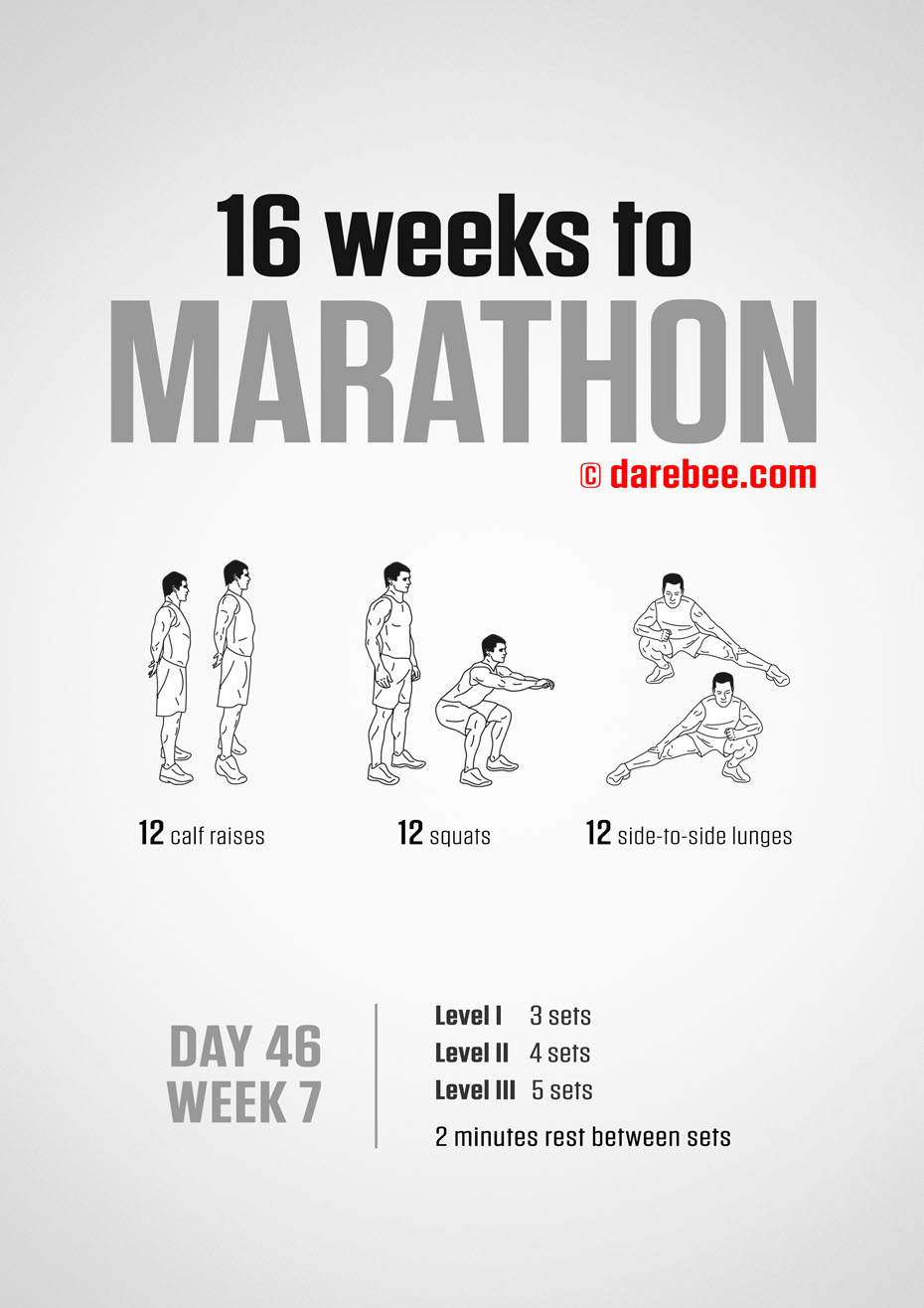
The leg circuit at Week 7: 12 calf raises, 12 squats and 12 side-to-side lunges, in sequence, 2 minutes rest, 3 to 5 sets by level. No hold, three moving exercises, and the lateral work from Day 32 returns - this time after squats rather than forward lunges, so the sideways shifts land on thighs that have just done twelve reps straight down.
The sequence here is vertical then lateral. Calf raises prepare the ankle, squats load both legs through the full range, and side-to-side lunges then ask the hips to control that loaded position while moving sideways through it. The sideways part matters more than it looks: running fatigue shows up first as knees drifting inward and hips dropping, and the inner-thigh and outer-hip strength this exercise builds is the direct antidote.
Feet flat and toes forward in the side-to-side lunges, hips pushed back, knee over the foot, staying low through the shift. Squats to parallel with the heels down. Calf raises at full range with the lowering slower than the lifting.
Straight down and then side to side - the legs cover both directions in thirty-six reps.
Make it Harder: Drop into a full squat at the end of every side-to-side shift before moving across.
Make it Easier: Take the side-to-side lunges to 8 and keep calf raises and squats at 12.

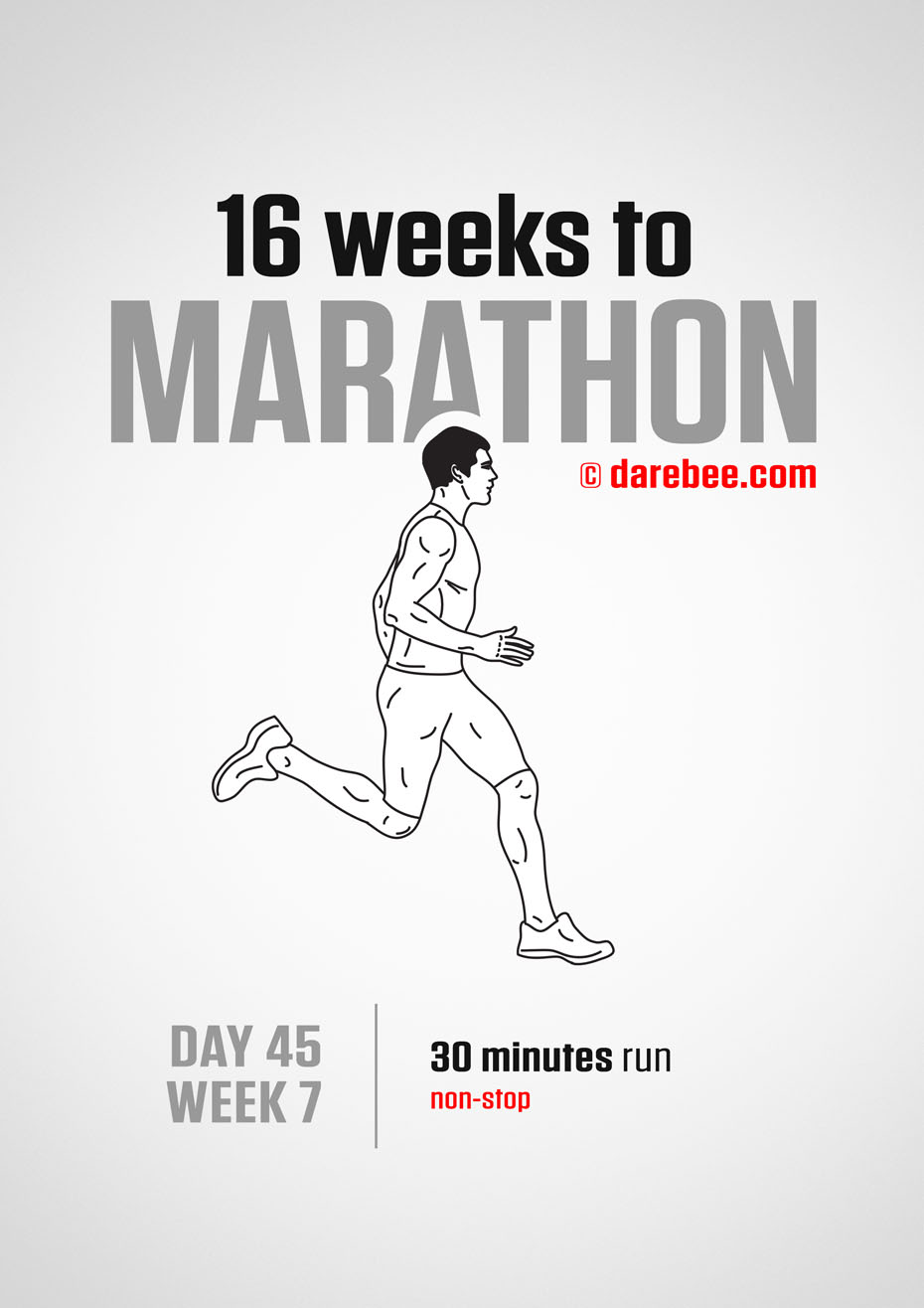
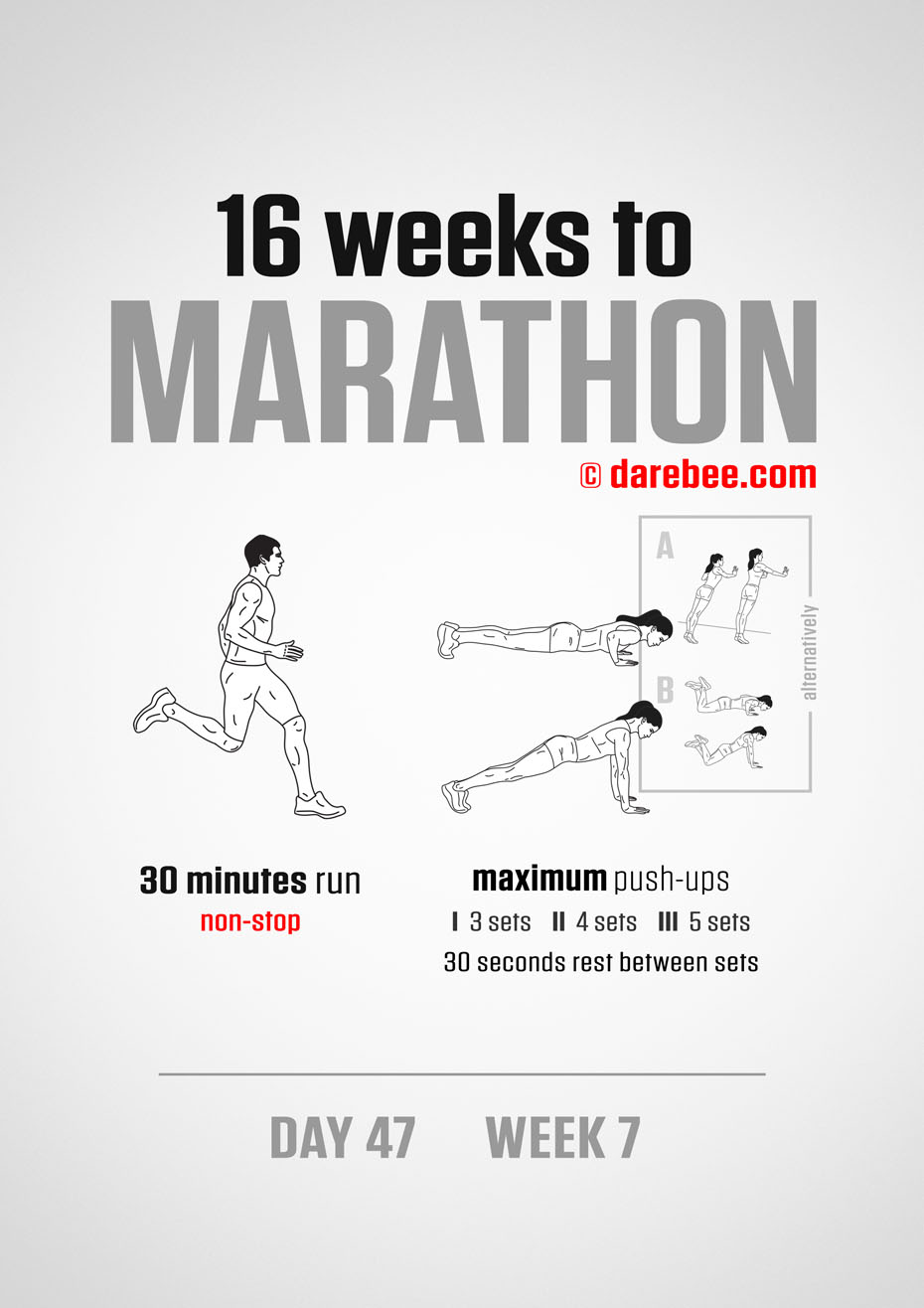
From here, the push-ups share a card with a run. Day 47 is a 30-minute run, non-stop, followed by maximum push-ups - 3 sets for Level I, 4 for Level II, 5 for Level III, with 30 seconds rest between sets and the wall or knee alternatives available as always. Run first, then press, in that order.
Pairing the max test with a run changes what the push-ups measure. Doing them after thirty minutes of quicker running means the trunk and shoulders have already spent half an hour holding running posture; the push-ups now test what is left rather than what is fresh. That is a more honest question for a marathon runner, and it is also why the numbers today may dip - note them, but compare them with the combo days that follow, not with the solo Fridays behind you.
Run as you have all week: short-sentence effort, even pace, quiet landings. Walk for a couple of minutes, then get straight into the push-ups before the body cools - full range, elbows tucked, honest end to each set, 30 seconds between them. Keep the same version (floor, knee or wall) across all sets.
A run and then a max test, on the same card - the push-ups now get asked on tired shoulders, which is the point.
Make it Harder: Cut the walk between the run and the first push-up set to 30 seconds.
Make it Easier: Rest a full 2 minutes after the run before starting the push-ups, then keep the 30-second rests between sets.

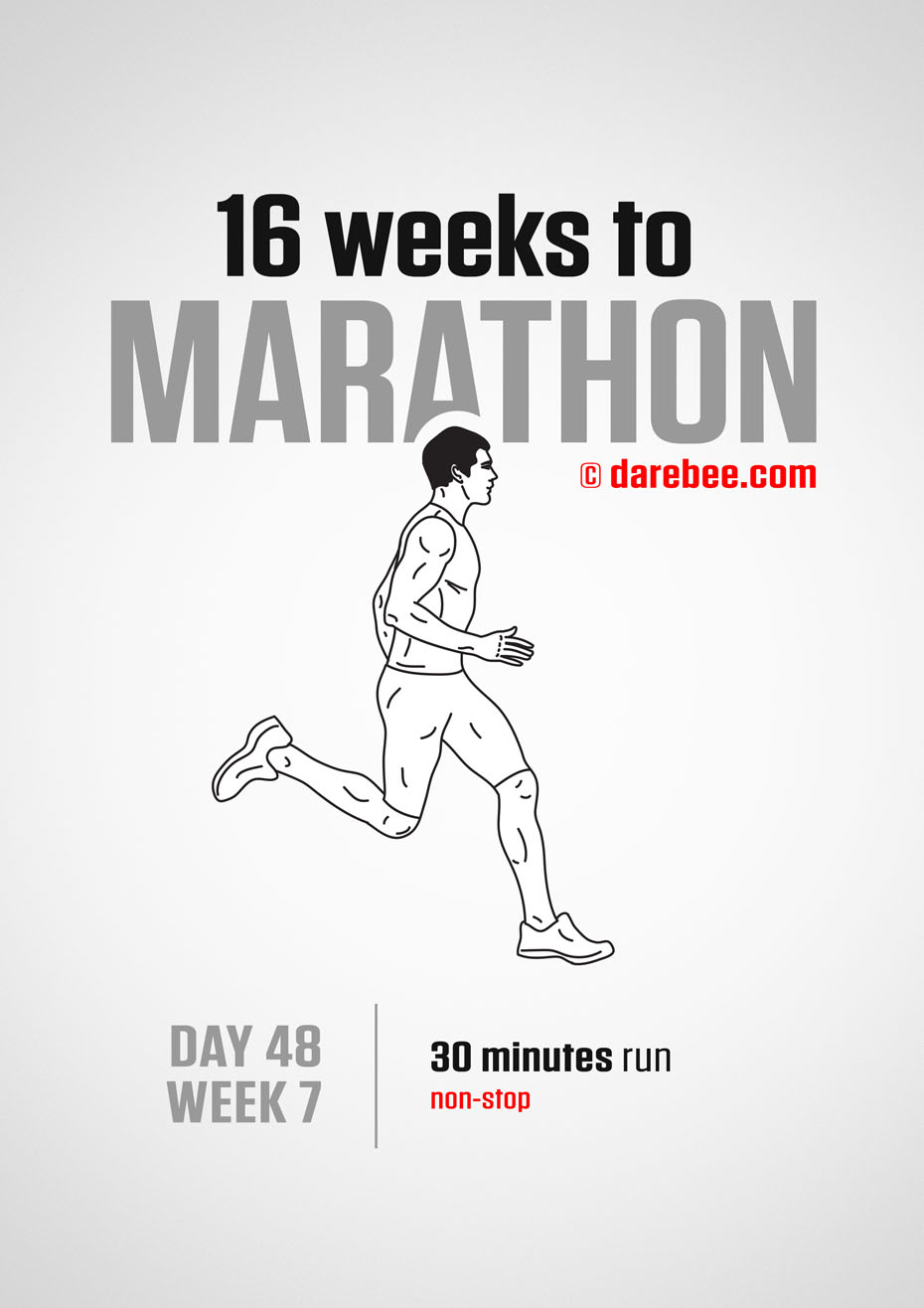
Another 30-minute run, non-stop, the day before the week's first long distance. Three runs at the quicker pace in a single week is the most speed the program has stacked so far, and this one comes the day after the combo card - run it controlled, with Sunday in mind.
The point of a run the day before a long one is not to add fitness; it is to keep the legs moving, loosen what the week has tightened, and rehearse the rhythm you will want tomorrow. The quicker pace is a formality here - if the effort says jog, jog. Arrive at Sunday rested enough to enjoy it, not so rested that the legs have forgotten what they are for.
Warm up well, hold a comfortable version of the faster pace, and cut it short if anything is complaining. Eat and drink well today; an 8-mile run tomorrow is fuelled the day before. Lay out the kit, plan the route and measure it.
The day before the first long distance is for moving, not proving - thirty easy-ish minutes and an early night.
Make it Harder: Run 20 minutes at the quicker pace and the last 10 as a jog, saving the rest for Sunday.
Make it Easier: Jog the whole 30 minutes and let the pace be whatever keeps tomorrow fresh.

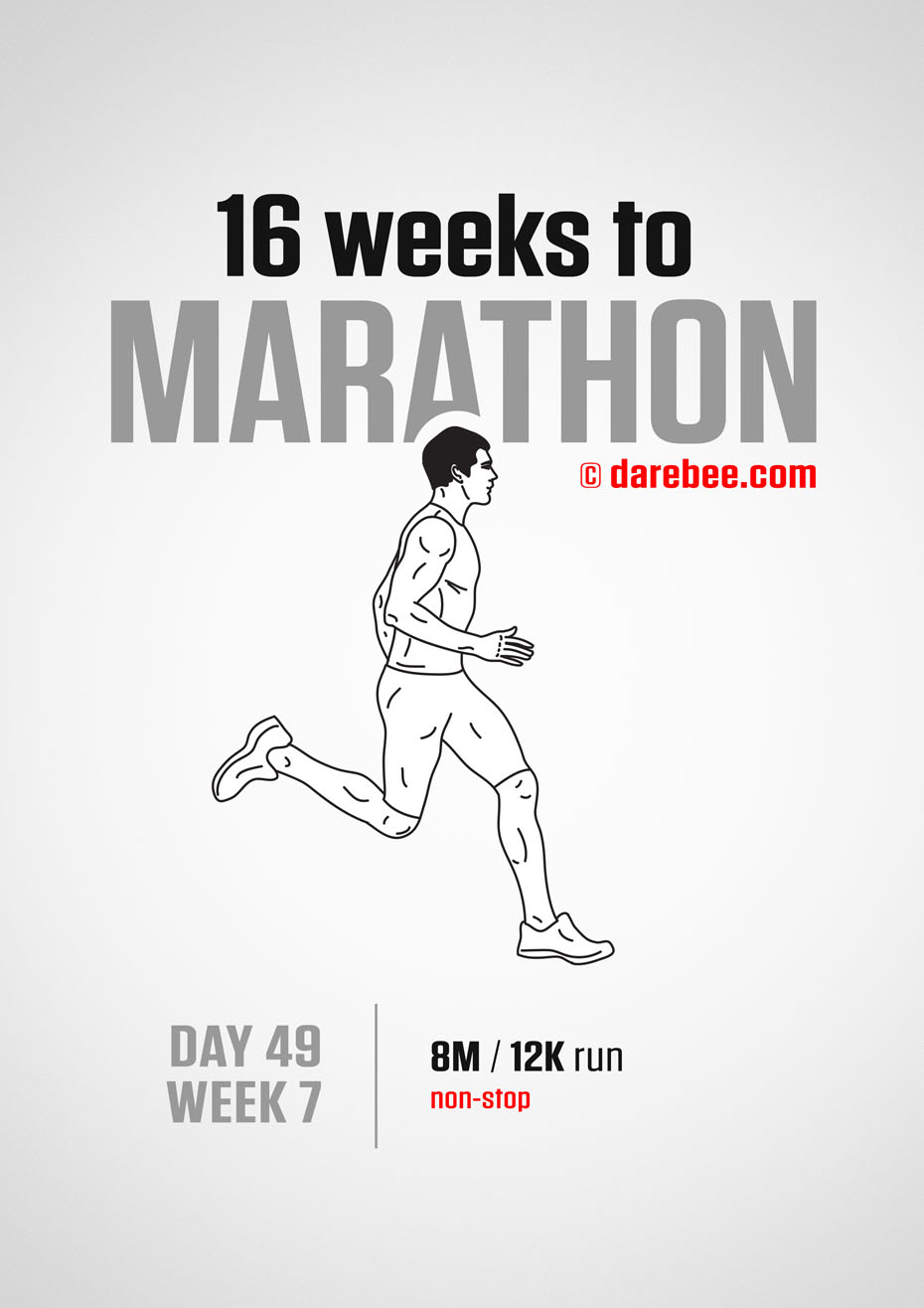
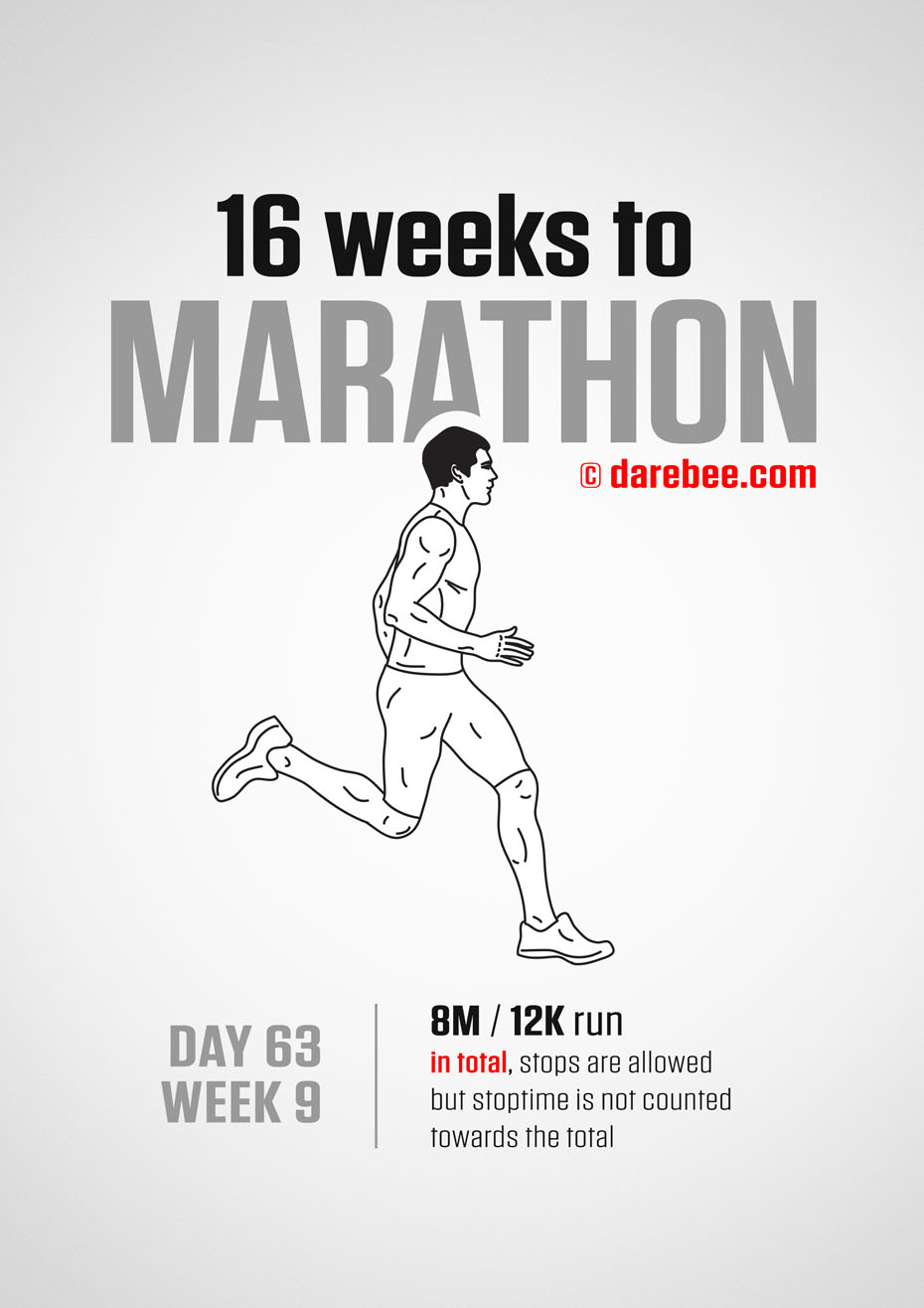
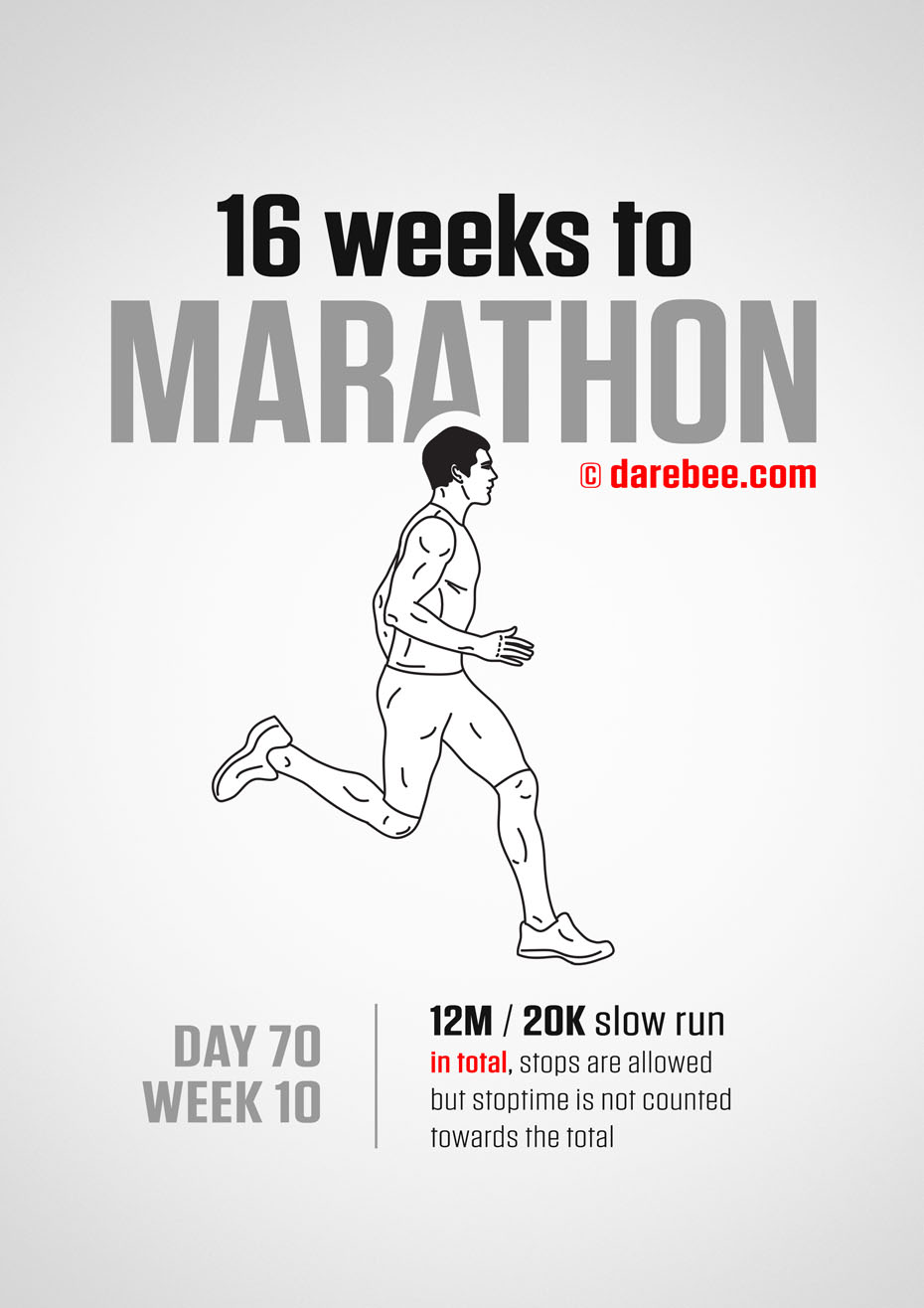
The program's first long distance: 8 miles / 12 km, run non-stop. Not a time, a distance - covered continuously at whatever pace lets you finish. After seven Sundays of walks and walk-and-jog sessions, this is the first one that asks for a run from start to finish, and it is the longest single run of the program so far by some way.
Twelve kilometres is roughly the distance covered by the jogging portions of recent Sunday sessions, now done without the walking glue between them. The walks and walk-jogs were preparing exactly this: the legs know how to be out for an hour and three quarters, and now they find out how to run for most of that. Everything from here builds on this distance - 12 km again in two weeks, 20 km in three, 22 km and 26 km after that.
Slow start, slower than feels right. Drink, and carry water or plan a fountain. Keep the stride short and the cadence quick, and check form every mile. If the pace drifts down in the last few kilometres, that is normal - keep it a run, however slow. Afterwards, walk for five minutes, eat within the hour, and take the time it took as your first long-run time.
Eight miles, twelve kilometres, run without a walk - the first long run in a program built to produce them.
Make it Harder: Hold an even pace the whole way and run the final kilometre a touch quicker than the rest.
Make it Easier: Run the distance as slowly as it takes and add a walking minute every 2 km if the run cannot stay continuous.

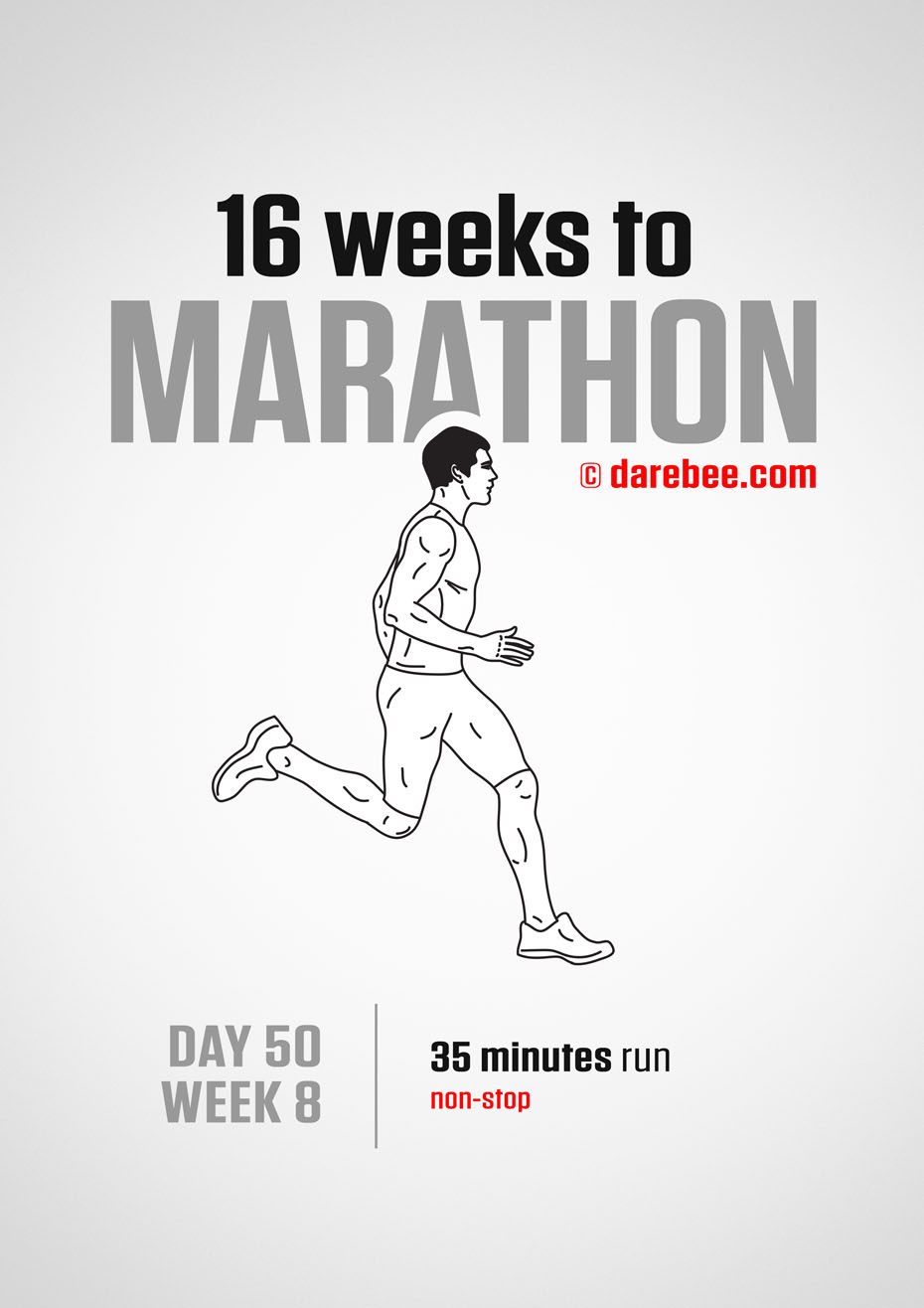
Week 8 opens with a 35-minute run, non-stop, the quicker pace grown by another five minutes. The Monday run has gone 20, 25, 30, 35 across four weeks, and this one arrives the day after your longest run yet - so the first ten minutes may feel like negotiation.
Running the day after a long run is one of the program's recurring lessons: the legs are tired, the run still gets done, and the pace is honest about both. Thirty-five minutes at short-sentence effort on post-long-run legs is a big ask; meet it by running to how you feel rather than how you ran last Monday. If the quicker pace is only marginally quicker than a jog today, the session has still done its job.
Warm up a little longer than usual - eight to ten minutes. Lift to a pace that feels brisk but sustainable, and hold it. Keep the shoulders down and the stride compact. If anything is sore rather than tired, cut the run short; soreness two days in a row is the signal to ease, tiredness is the signal to continue.
Thirty-five minutes the morning after eight miles - running on yesterday's legs is a skill the program wants you to have.
Make it Harder: Quicker for the last 10 than the first 25, and hold the form through the fatigue.
Make it Easier: Run 25 minutes at the quicker pace and jog 10, keeping it continuous.

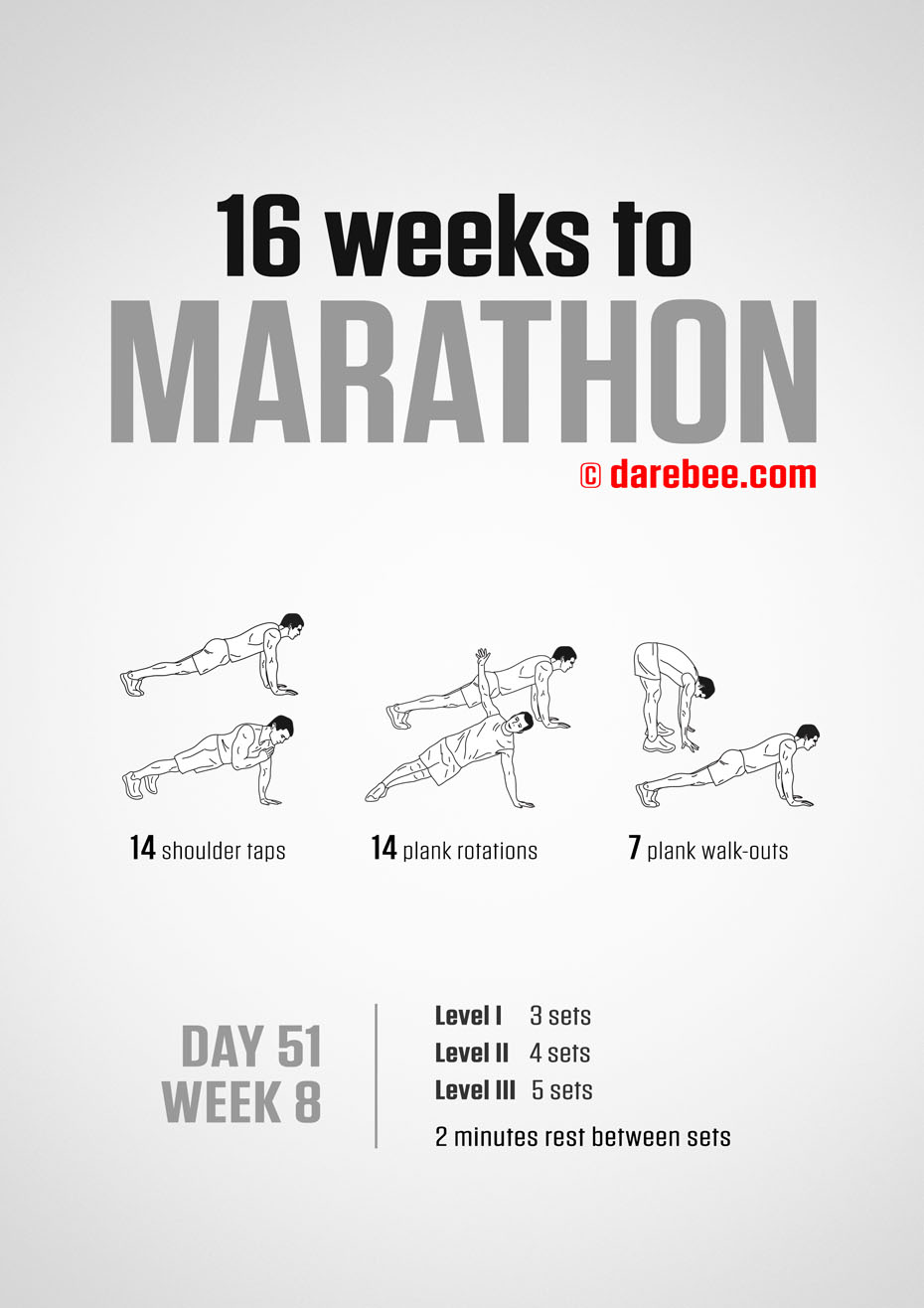
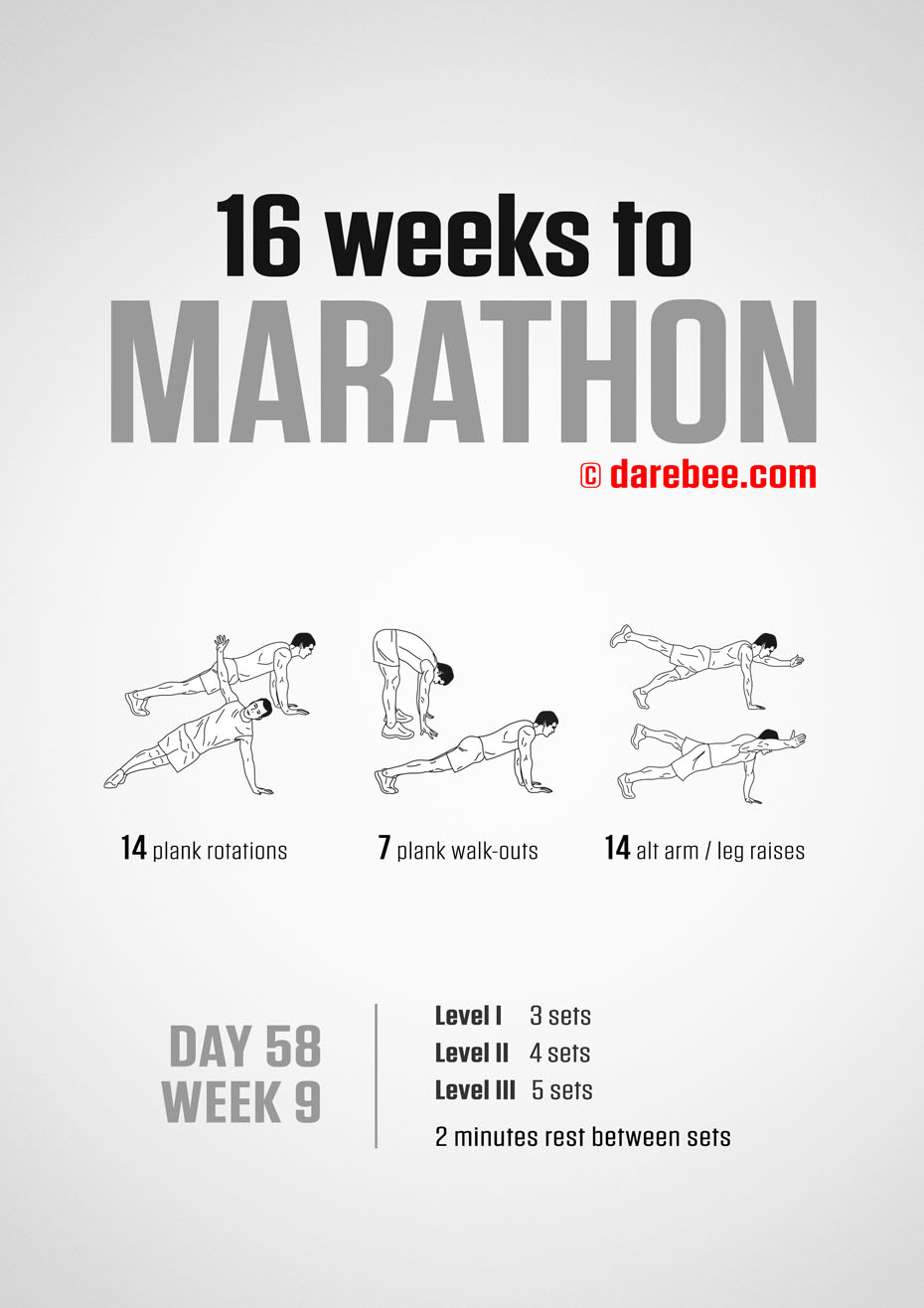
Week 8 raises the plank numbers: 14 shoulder taps, 14 plank rotations and 7 plank walk-outs, in sequence, 2 minutes rest, 3 to 5 sets by level. The same three exercises as Day 23, each up by a sixth. Twenty-eight taps and rotations plus seven trips out to plank and back per set.
This is the first rep increase since Week 4 on the plank cards, and it lands in the week the runs got longer too. The circuit is unchanged in design - rotational disturbance, whole-body movement, shoulder loading - but more of it, for longer, on a body that is carrying more running than ever. That is exactly how the trunk adapts: same demand, more volume, no shortcuts.
Keep the standards from Day 23 - quiet hips on taps, chest fully open on rotations, full plank at the end of every walk-out. Fourteen is enough reps that form slips around rep ten; slow down there rather than letting the hips sway through the last few.
Fourteen, fourteen and seven - the plank circuit grows for the first time in a month.
Make it Harder: Lift the opposite foot an inch off the floor during every shoulder tap.
Make it Easier: Take everything to Day 23 numbers - 12, 12 and 6 - and keep the sets as chosen.

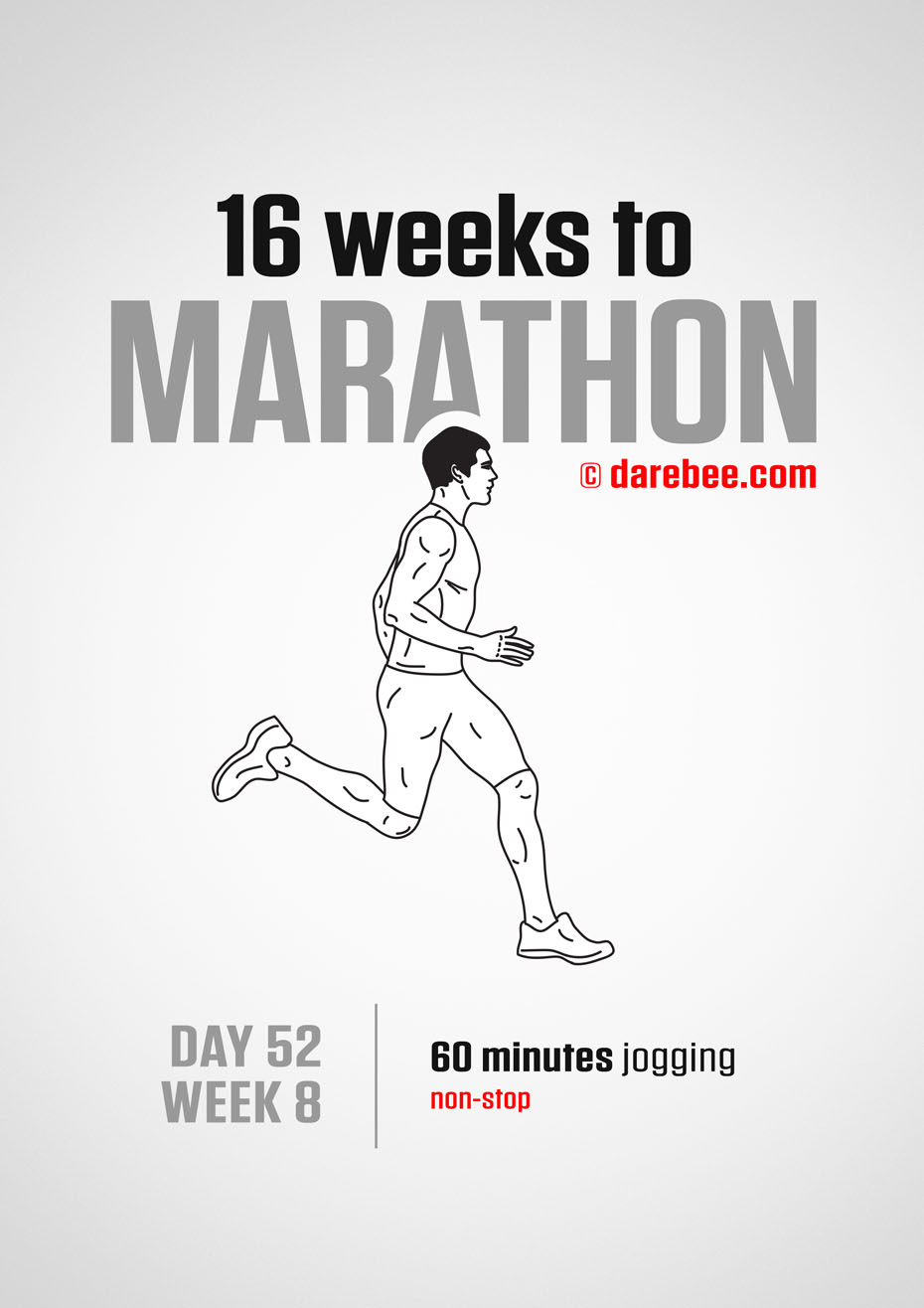
The midweek session returns to the long jog: 60 minutes of jogging, non-stop. An hour of easy, continuous running - the first time the midweek run has reached the full hour, and the first easy long effort since the week's structure changed.
Sixty easy minutes is the bread and butter of marathon training, and the program has been building toward it since the 15-minute jog on Day 1. Its job today is to add aerobic volume without the strain of pace, so that Sunday's two-hour session has something to stand on. Jog it at a pace where you could hold a full conversation, and resist any temptation to turn it into a run - the quicker work already has its days.
Eat two hours before, drink, start slow. Check posture every ten minutes - shoulders, hands, cadence, footstrike - and keep the stride short as the minutes accumulate. If the last fifteen feel heavy, that is the part the program is buying. Walk for five minutes afterwards and stretch the calves and hips.
A full hour of jogging - the midweek run has reached the duration everything else in the program was pointing at.
Make it Harder: Run the final 15 minutes at a steady, moderate pace and jog the last 3 to cool down.
Make it Easier: Jog 50 minutes and walk the remaining 10 without stopping.

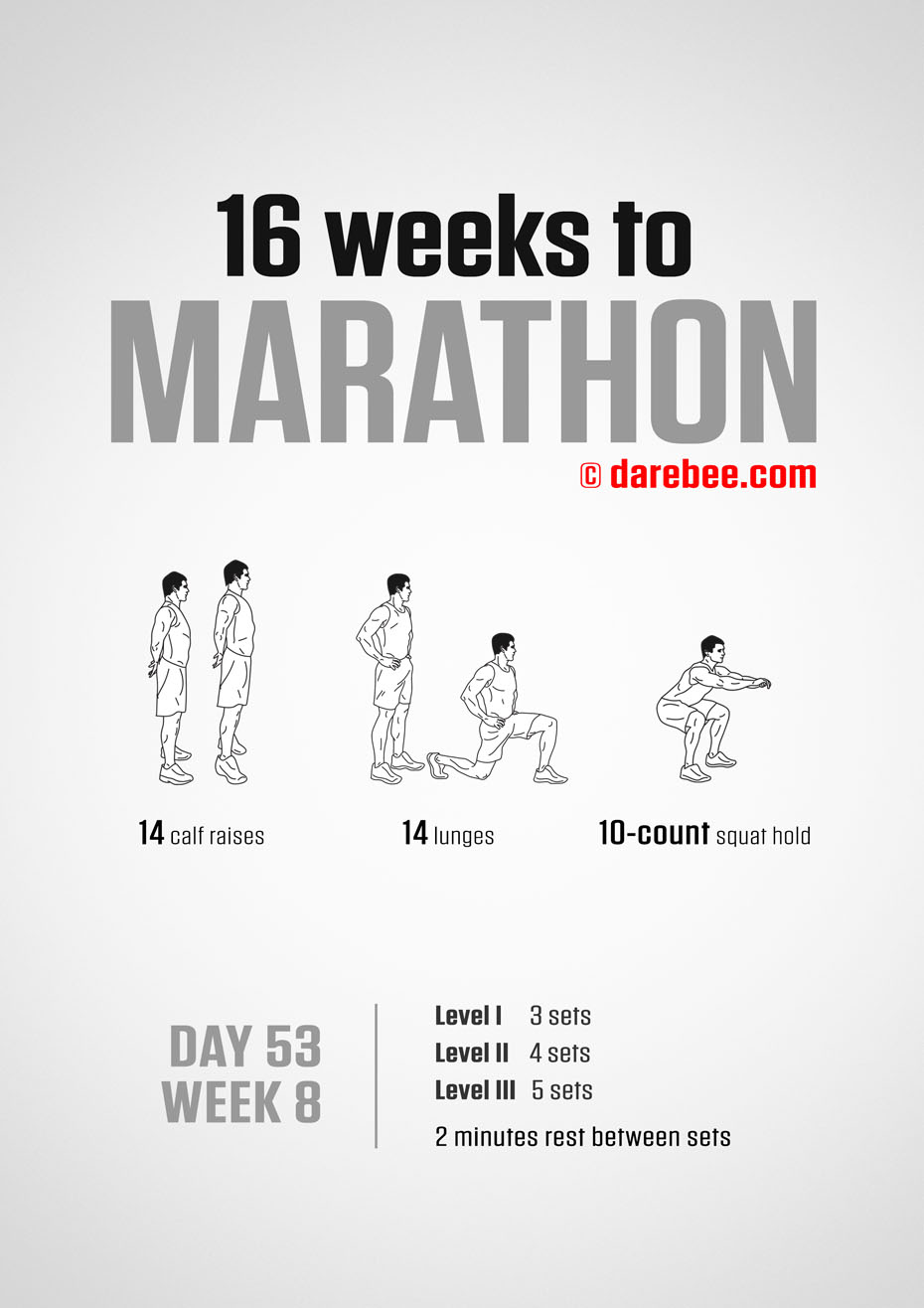
The leg circuit at Week 8: 14 calf raises, 14 lunges and a 10-count squat hold, in sequence, 2 minutes rest, 3 to 5 sets by level. The hold is labelled on the card this time, and it comes last: thighs near parallel, arms forward, held for ten counts after the lunges have already asked the quads for seven reps each leg.
Finishing with a hold rather than starting with one is the harder order. The quads arrive at the squat hold after fourteen lunges, and a ten-count that would be easy fresh becomes a real test of staying still when the muscle wants to shake. Calf raises at fourteen keep growing the lower leg's tolerance; lunges at fourteen keep building the single-leg strength running lives on.
Calf raises: full range, slow lowering. Lunges: vertical front shin, back knee toward the floor, alternating, seven per leg. Squat hold: find the depth you can defend for all ten counts, chest up, heels down, breathe. If the legs shake in the hold, that is effort, not failure - hold on.
Fourteen lunges and then a squat hold with nowhere to hide - the thighs earn the rest that follows.
Make it Harder: Turn the squat hold into a 20-count and keep the calf raises and lunges at 14.
Make it Easier: Take the lunges to 10 and keep the calf raises and the hold as written.

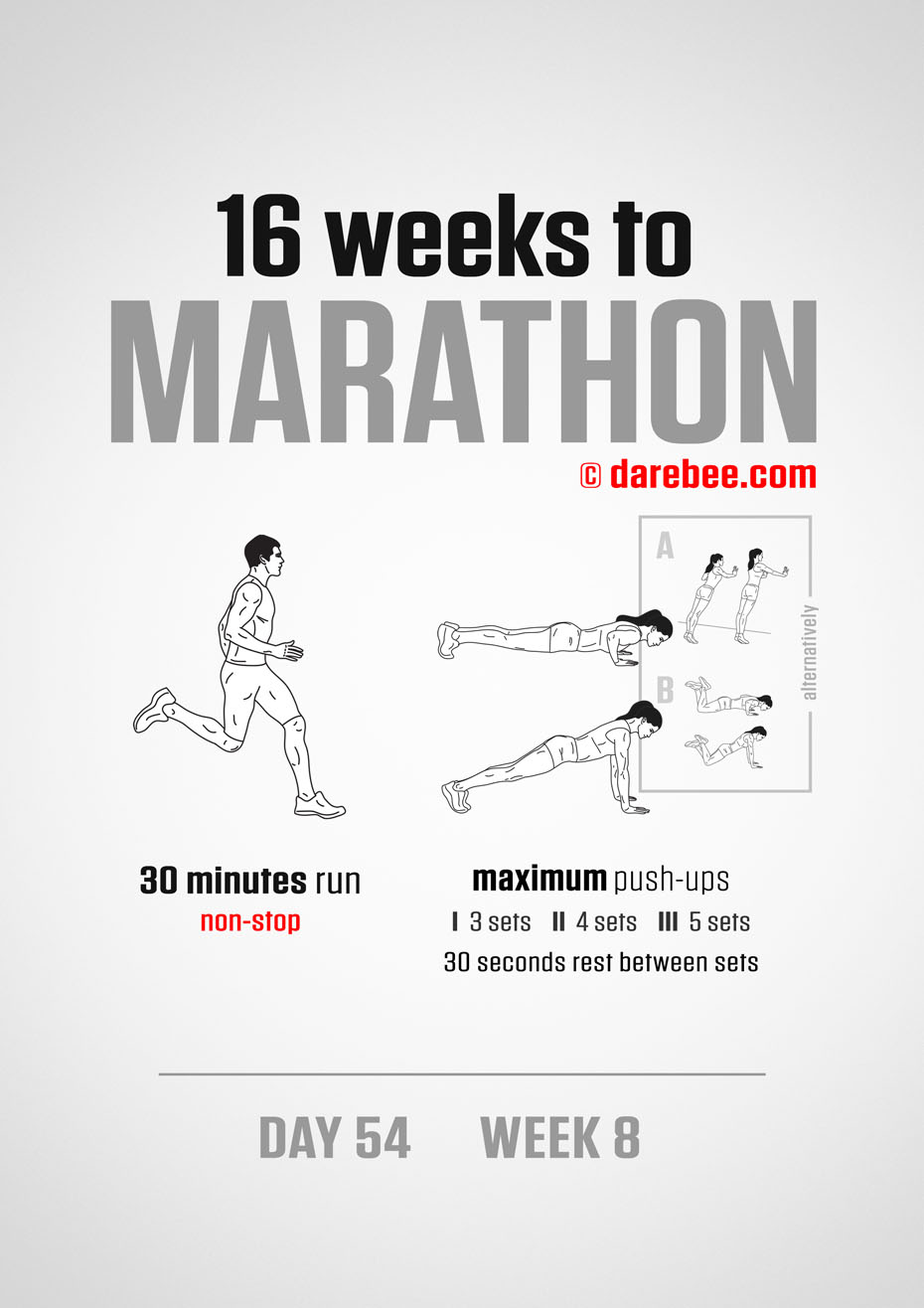
The combo card again: a 30-minute run, non-stop, followed by maximum push-ups - 3, 4 or 5 sets by level, 30 seconds rest between them, wall and knee alternatives in the box. Run first, press second.
Two weeks of the combined format now, so there is a first data point to compare against: last Friday's push-up numbers after a run. The test has quietly become a test of the whole body - the run taxes the legs and the trunk, the push-ups ask the shoulders what is left. As the run gets easier week by week, the push-up numbers should climb back toward where they sat on the solo Fridays, and that recovery is its own measure of fitness.
Run at short-sentence effort, even pace. Walk two minutes, then straight into the push-ups: full range, elbows tucked, honest stopping point, 30 seconds between sets, same version throughout. Note both halves of the session - run time and push-up counts.
Run, then press - the second week of asking the upper body to perform after the legs have had their say.
Make it Harder: Go straight from the run to the first push-up set with no walk between.
Make it Easier: Use the knee version for every push-up set after the run and keep the rest as written.

A 35-minute run, non-stop, the day before the biggest Sunday yet. The quicker pace at its Monday length, now on Saturday legs - three runs deep into the week and a combo card behind you. Run it controlled and think about tomorrow.
Saturday runs before a long Sunday have one job: keep the legs moving without taking anything from the long session. Thirty-five minutes at the faster pace is long enough to count, short enough to recover from overnight. If the effort is running ahead of the pace, back off - tomorrow is two hours or a half marathon, and either deserves fresh legs more than today deserves a fast time.
Warm up, run comfortably quick, cool down. Eat well today and drink through the afternoon; tomorrow is fuelled now. Decide which version of Sunday you are doing, measure the route if it is the half, and lay out the kit.
Thirty-five minutes the day before the longest Sunday so far - keep something in the tank and sleep on it.
Make it Harder: Run 25 minutes at the quicker pace and jog 10, leaving tomorrow untouched.
Make it Easier: Jog all 35 minutes easily and save every bit of speed for the week after.

The end of Week 8 is the program's halfway mark, and the card marks it: 2 hours of walk & jog, non-stop - or run a half marathon. Two ways to spend the same Sunday: a hundred and twenty continuous minutes with as much jogging as you can sustain, or 13.1 miles / 21.1 km run from start to finish. Both are the longest session yet in their own terms.
A half marathon option at the halfway point is no accident. Eight weeks ago the long day was a 60-minute walk; today it can be a half marathon, and the walk-and-jog version is the same session for anyone whose Sunday jogging share is still growing. Neither version is more correct than the other - the program wants two hours on your feet with as much running in them as you have, and it will ask for more in the second half.
Eat two hours before. Take water and something to eat on the way if you will be out beyond ninety minutes. Start slower than feels sensible. Walk-and-joggers: long jog pieces, short walks, note the minutes jogged. Half marathoners: conversational pace throughout, check form every mile, and if the last few kilometres slow down, keep them a run. Afterwards, eat within the hour and take the rest of the day.
Two hours or a half marathon, eight weeks after a sixty-minute walk - this is the halfway line, and it is a long way from the start.
Make it Harder: Run the half marathon, and run the second half of it a minute or two quicker than the first.
Make it Easier: Two hours of walk & jog with generous walking breaks - the time on your feet is the entire assignment.

Week 9 - the first of the second half - opens with a 40-minute run, non-stop. The Monday run has reached forty minutes at the quicker pace, and it comes the morning after either a two-hour session or a half marathon. The legs will have opinions. Run it to effort.
The second half of the program is where distance becomes the main event. The midweek sessions shift to intervals and longer runs, the Sundays climb toward 26 kilometres, and the Monday run is the steady thread through it all. Forty minutes at short-sentence effort is a serious session when it follows a long Sunday; treat it as the quicker run it is, but let the pace be whatever the effort produces today.
Warm up for a full ten minutes. Lift the pace only as far as the legs will go without straining, and hold it evenly. Tired legs tend to shorten the stride naturally - let them, and keep the cadence up. Cool down with a walk and stretch the calves and hips, which will have done the most work yesterday.
Forty minutes at the quicker pace to open the second half - the program has stopped being gentle with Mondays.
Make it Harder: Hold the final 10 minutes at a pace where speaking is reduced to single words.
Make it Easier: Run 30 minutes at the quicker pace and jog 10 to finish.

The plank circuit at Week 9: 14 plank rotations, 7 plank walk-outs and 14 alt arm / leg raises, in sequence, 2 minutes rest, 3 to 5 sets by level. The Day 37 combination - rotation, whole-body movement, diagonal balance - with every number raised. Fourteen raises is seven on each diagonal.
This is the most demanding of the plank cards to date, because the alt arm/leg raises are the hardest stability exercise on any of them and they now come at fourteen after the rotations and walk-outs have already worked the shoulders. Everything is about the trunk staying flat while the load shifts - on the running road that translates directly into hips that stay level when the legs are exhausted, which is what separates a strong finish from a slow fade.
In the raises, reach long rather than high, keep the lower back flat and the hips square, and widen the supporting foot if the balance wobbles. Rotations open the chest fully to the side; walk-outs reach a true plank before walking back. Slow the tempo in the last few reps of each exercise rather than letting form drift.
Fourteen diagonal balances after the rotations and walk-outs - the toughest plank card yet, in the first week of the second half.
Make it Harder: Hold every arm/leg raise for a three-count at full reach before switching diagonals.
Make it Easier: Alt arm / leg raises from all fours, and keep the other two exercises as written.

The first interval session: a 1 mile / 2 km fast run, non-stop, repeated 3 times in total. Three fast miles, each run continuously, with a recovery between them. The card does not specify the rest - take what you need to run the next one properly, walking or jogging easily until the breathing has settled.
Intervals are how the program builds speed it could not build in one piece. One fast mile is hard; three fast miles in a row would be a race; three fast miles with recovery between them is a session, and it teaches the legs to run quickly when they are already tired, which is what the last 10 km of a marathon is made of. Fast here means the effort of Day 34's 2-mile run, or a little quicker - a few words at a time, not a conversation.
Warm up with ten minutes of easy jogging and a few short pick-ups. Run the first mile controlled rather than flat out, so the third is still a fast mile and not a survival jog. Note each mile's time - the spread between them tells you how well you paced it. Cool down with ten minutes of easy jogging.
Three fast miles with recoveries between them - the program has started teaching speed in pieces.
Make it Harder: Run the three repeats with the same recovery each time, and make the third the fastest of the three.
Make it Easier: Run the repeats at a brisk rather than fast pace and take as long as you need between them.

The leg circuit at Week 9: 14 calf raises, a 10-count hold and 14 squats, in sequence, 2 minutes rest, 3 to 5 sets by level. The hold is the calf raise held at the top - on the balls of both feet, hands behind the back - and the squats follow it. Twenty-eight reps and a hold per set.
Calf raise, calf hold, squat: this is the Day 4 circuit at Week 9 numbers, and the difference is entirely in the legs doing it. Fourteen calf raises followed by ten counts on the toes is where the lower leg's endurance is built - the calf is the muscle that keeps the stride springy at 30 km, and it gets there through exactly this kind of repeated, unglamorous loading. Squats close the circuit with the quads and glutes.
Full-range calf raises with a slow lower. In the hold, ankles steady and weight over the big toes, not rolling out. Squats to parallel, heels down, chest up. At fourteen, keep the tempo steady for every rep rather than rushing the early ones.
The Day 4 circuit with Week 9 numbers - calves, calf hold, squats, and legs that have run a half marathon since.
Make it Harder: Single-leg the calf raises and the hold - seven reps and the full ten counts on each side.
Make it Easier: Cut the squats to 10 and keep the calf raises and the hold as written.

The combo card: a 30-minute run, non-stop, then maximum push-ups for 3, 4 or 5 sets by level, 30 seconds rest, wall or knee alternatives available. Three weeks of this format, and the push-up numbers after a run now have a trend of their own.
Week 9 is heavier than any before it - forty minutes on Monday, the toughest plank card, intervals on Wednesday - and the combo session sits at the end of that run. If the push-up counts dip, that is the week talking. If they hold or rise, the trunk and shoulders have adapted to doing their job on a body that has been asked for a lot. Either way, the numbers are worth writing down.
Short-sentence effort on the run, even pace throughout. Walk briefly, then into the sets - full range, elbows tucked, honest end, consistent version, 30 seconds between. Keep the run and the push-ups as one session; the rest between them is a transition, not a break.
Week 9's combo card at the end of the heaviest week so far - the push-ups report on the whole week, not just the run.
Make it Harder: Perform every push-up set as a slow three-count lower and a fast press.
Make it Easier: Rest 45 seconds between push-up sets and keep the run as written.

A 40-minute run, non-stop, on Saturday. The quicker pace, at the length Monday ran it, the day before a distance run. Five runs this week, two of them forty minutes long - the second half of the program is building volume in every direction at once.
Running forty minutes at a brisk pace the day before 12 km takes some judgement. The session counts - it is not a throwaway - but the distance tomorrow counts more. Run the first half properly and let the second half drift toward a jog if the legs ask for it. The goal of a Saturday run is to arrive on Sunday with legs that are loose, not legs that are spent.
Warm up well. Run comfortably quick, hold it as long as it feels sustainable, and jog the rest. Eat and drink well today; measure tomorrow's route and note where the water is.
Forty minutes on Saturday with twelve kilometres waiting on Sunday - a session to run well and leave early.
Make it Harder: Hold the quicker pace for the full 40 and run the last 5 minutes a shade faster.
Make it Easier: Twenty-five minutes at the quicker pace and 15 as a jog to finish.

The Sunday distance: 8 miles / 12 km, run in total - stops are allowed, and the stopped time does not count. The same distance as Day 49, with the first-week rule brought back: the distance must be covered, but the run can be broken if it needs to be. Two weeks ago this was non-stop; today the program wants the distance done, and it is relaxed about how.
The stop-allowed rule returns on the long runs from here, and it is a practical one. Long runs from now on get long enough that water stops, crossings and the occasional walk are part of the territory, and the program would rather you cover 12 km with two short pauses than cut it to 10 to keep it continuous. The distance is what trains you. Keep the stops short and purposeful and the running between them honest.
Start slower than you think. Drink at every opportunity and carry something to eat if you will be out beyond ninety minutes. Note the running time separately from the total outing. If this is the second 12 km on your watch, compare it with Day 49 - same distance, two weeks of work between them.
Twelve kilometres for the second time, with stops allowed and the distance non-negotiable - the long run has found its rhythm.
Make it Harder: Run it non-stop, as you did on Day 49, and aim for a quicker time.
Make it Easier: Take a walking minute every 2 km, keep the walking out of the running time and cover the full 12.

Week 10 opens with a 45-minute run, non-stop, the Monday run's longest version yet. Quicker pace, three quarters of an hour, the day after 12 km. The pattern of post-Sunday Mondays continues, and the number keeps climbing.
Forty-five minutes at short-sentence effort is now roughly what the long midweek jog was in Week 4 - at a faster pace. That is the clearest measure of how far the program has moved. Run it as what it is: a demanding session on legs that worked yesterday, which means effort first and pace second. Fast for today is whatever brisk feels like this morning.
Ten minutes of warm-up, then lift. Hold the effort steady and let the pace settle where it settles. Shoulders down, stride compact, cadence quick. If the final fifteen minutes turn into a jog, that is an honest forty-five, not a failed one.
Forty-five minutes at the quicker pace, the morning after twelve kilometres - the Monday run has caught up with the old midweek jog.
Make it Harder: Run the middle 25 minutes at a steady, moderate pace and keep the outer 10s controlled.
Make it Easier: Thirty minutes at the quicker pace and jog the final 15.

The plank circuit at Week 10: 16 shoulder taps, 8 up & down planks and a 10-count hold, in sequence, 2 minutes rest, 3 to 5 sets by level. The hold is the elbow plank, as the drawing shows - forearms on the floor, body straight - and it arrives after eight trips between high and low plank have already asked the shoulders for plenty.
The Day 16 circuit at nearly double the numbers. Sixteen taps and eight up & downs make it the most shoulder-heavy card so far, and finishing with an elbow plank hold means the last thing the trunk does is simply refuse to sag after the shoulders have been worked. That refusal is what keeps the torso upright in the final kilometres of a long run, when the arms get heavy and the posture wants to fold.
Quiet hips on the taps - widen the feet if they swing. Alternate the leading arm on the up & downs and keep the transfer controlled. In the elbow plank, stack the shoulders over the elbows, press the forearms down and keep the glutes tight for all ten counts.
Sixteen taps and eight up & downs before the elbow plank - the shoulders do the heavy lifting in a circuit meant for the middle.
Make it Harder: Extend the elbow plank to a 30-count and keep the other numbers as written.
Make it Easier: Up & down planks from the knees, and keep the taps and the hold as they are.

A midweek distance: 3 miles / 5 km, run non-stop. Not fast - the card says run, not fast run - so this is a steady, continuous five kilometres at the quicker pace, measured rather than timed. A 5K in the middle of the week is a reference distance: note your time and keep it.
Five kilometres at a steady run sits between the interval work and the long runs. It is long enough to require pacing and short enough to run with intent from start to finish, which makes it the best single test of how the quicker pace is developing. The program will ask for the same distance twice more, both times as a fast run, and this steady version is the reference those will be measured against.
Warm up with an easy jog, then run the 5 km at a pace you could hold for twice the distance. Keep the cadence high and the stride compact. If the last kilometre comes easily, that is the pace to hold next time; if it fades, start slower next time. Cool down with a walk.
Five kilometres, steady, with the time written down - the first of three 5Ks, and the one the other two will answer to.
Make it Harder: Run the 5 km as a negative split - second half quicker than the first.
Make it Easier: Run the distance at a jog and let the time take care of itself.

The leg circuit at Week 10: 14 calf raises, 14 lunges and 14 side-to-side lunges, in sequence, 2 minutes rest, 3 to 5 sets by level. The Day 32 combination - forward and lateral lunges after calf raises - with every number up. Forty-two reps a set, seven per leg on both lunge variations.
Forward then sideways is the program's preferred pairing for the legs because it covers both jobs the hips have in running: driving the stride and stopping it from drifting. Fourteen of each after fourteen calf raises puts the thighs and hips through a full set of demands in a row, and the total volume per set is now as high as any leg card the program has produced. Single-leg strength is the whole story here.
Forward lunges: vertical front shin, back knee to the floor, alternating. Side-to-side: feet flat, toes forward, hips back, low through the shift. Calf raises: full range, slow lower. At fourteen reps each, hold the tempo and stop the knees from folding inward in the last few reps of every exercise.
Forty-two reps of ankle, thigh and hip - forward, sideways and up onto the toes, on legs that ran 5K yesterday.
Make it Harder: Add a two-count pause at the bottom of every forward lunge and every side-to-side shift.
Make it Easier: Take both lunge variations to 10 and keep the calf raises at 14.

The combo card: a 30-minute run, non-stop, then maximum push-ups for 3, 4 or 5 sets by level, 30 seconds rest, wall and knee versions in the box. Run, then press, as has become the Friday routine.
Week 10 has stacked a 45-minute Monday, the most shoulder-heavy plank card, a 5K and a forty-two-rep leg circuit in front of this session, and the push-ups will tell you how the shoulders have coped with it. Four combo cards in, the after-run numbers should be settling into a pattern; whether they are rising, steady or dipping says more about the week than about the arms.
Run at short-sentence effort with an even pace. Brief walk, then into the sets: full range, elbows tucked, honest stopping point, 30 seconds between, same version throughout. Note both halves of the session.
Four combo Fridays in, and the after-run push-up count is now a record of how each week has gone.
Make it Harder: Sink to a slow two-count at the bottom of every push-up before pressing up.
Make it Easier: Wall push-ups for the final two sets and keep the earlier sets as written.

A 35-minute run, non-stop, on Saturday, before a Sunday that takes the long run to 20 km. The quicker pace, a comfortable length, and the single most important instruction of the day is to finish it with plenty left.
Saturday runs before long Sundays are about rhythm and readiness. Thirty-five minutes at a controlled quicker pace keeps the legs used to moving without making a dent in tomorrow's energy. Run it by feel, and if feel says jog, jog - the program has no interest in a fast Saturday that costs a slow Sunday.
Warm up, run comfortably, cool down. Eat well today, drink through the afternoon, and prepare tomorrow's route, water and food. Twenty kilometres is long enough to need all three planned in advance.
Thirty-five controlled minutes, and then everything else today is preparation for the first twenty kilometres.
Make it Harder: Twenty-five minutes at the quicker pace, 10 as a relaxed jog, and Sunday stays whole.
Make it Easier: Jog the full 35 minutes and let the pace be whatever tomorrow needs it to be.

The long run grows to 12 miles / 20 km, slow run, in total - stops allowed, stopped time not counted. Twenty kilometres is further than anything before it, and the card asks for it to be slow: easy pace, conversational breathing, the distance as the whole aim. This is a session measured in hours.
Twenty kilometres is where marathon training starts to feel like marathon training. The legs go through the same phases they will on race day - fresh, settled, tired, determined - and the slow pace is what lets them experience all four without breaking down. Stops are allowed because the distance is now long enough that water, a walk through a tricky crossing or a minute's pause to reset the form are sensible, not cheating. What matters is that the 20 km gets covered.
Eat a proper meal two to three hours before. Carry water and something to eat, and use both before you feel you need them. Start slower than the half marathon pace from Day 56. Check form every 2 km and shorten the stride when the legs get heavy. Note the running time and the total outing separately. Afterwards: walk, eat, rest, and keep the evening quiet.
Twenty kilometres, slow and in total - the first long run that gives a real preview of what race day will feel like.
Make it Harder: Keep the stops to water only and run the final 2 km at a steady rather than slow pace.
Make it Easier: A minute's walk every 2 km, with the walking kept outside the running time.

Week 11 opens with a 40-minute run, non-stop, the day after twenty kilometres. The Monday run steps back from last week's 45 to a more forgiving 40, which is the program acknowledging what yesterday cost. Quicker pace by intent, honest pace by necessity.
This is the biggest Monday-after in the program so far. Twenty kilometres leaves the legs heavy for a day or two, and forty minutes at brisk effort on top of that is real training for the specific skill of running on fatigue. Do not chase last Monday's pace - chase the same effort and accept whatever speed it produces. If the run turns into a jog for stretches, it has still done its work.
A long warm-up, at least ten minutes of easy jogging. Lift to brisk effort only when the legs agree. Keep the stride short and the cadence high; tired legs run best in small steps. Cool down thoroughly and stretch the calves, hamstrings and hips.
Forty minutes the day after twenty kilometres - the shortest-feeling distance of the week is going to be this one.
Make it Harder: Ten minutes at the end where sentences are impossible - then a long, slow cool-down.
Make it Easier: Twenty minutes at the quicker pace and 20 as a jog, keeping it continuous.

The plank circuit at Week 11: 14 shoulder taps, 7 plank walk-outs and 14 alt arm / leg raises, in sequence, 2 minutes rest, 3 to 5 sets by level. A new combination - taps, walk-outs and the diagonal balance - that takes the hardest stability exercise and pairs it with the two that load the shoulders most. Fourteen raises is seven per diagonal.
Shoulder taps and walk-outs both fatigue the arms; the alt arm/leg raises then demand balance on one arm and one leg with the supporting shoulder already tired. That sequencing is deliberate. The trunk has to hold the body flat when its supports are weakest - which is a direct rehearsal of what happens to running posture in the last hour of a marathon, when the arms are heavy, the hips want to drop and the only thing keeping everything in line is the midsection.
Quiet hips on the taps. Full plank at the end of every walk-out. Long reach in the raises, lower back flat, hips square, supporting foot wider if needed. Slow the tempo on the last reps of each exercise rather than letting the form degrade.
Tired shoulders, then a diagonal balance on one of them - the plank circuit is now testing stability where it is weakest.
Make it Harder: Two-count holds on every arm/leg raise, plus a shoulder tap at the far end of every walk-out.
Make it Easier: From all fours for the alt arm / leg raises, and bend the knees on the walk-outs.

The interval session returns with its rest specified: a 1 mile / 2 km fast run, repeated 3 times in total, with 5 minutes rest between sets. Three fast miles, five minutes of walking or easy jogging between them. This is the same workout as Day 59 with the recovery pinned down.
Five minutes is a generous recovery, and it is meant to be. The program wants each mile run fast - properly fast, a few words at a time - rather than three moderate miles that blur together. Long recoveries let the legs reload so the third repeat can be as quick as the first, and running fast three times in a session teaches the body to produce speed on demand. Compare the three times with Day 59's.
Warm up with ten minutes of jogging and a few pick-ups. Run the first repeat controlled, the second the same, and the third with everything left. Walk the first two minutes of each rest and jog the rest if you like. Cool down for ten minutes of easy jogging. Note the three times and the spread between them.
Five minutes of rest between three fast miles - long enough that every repeat can be a real one.
Make it Harder: Shorten the rests to 3 minutes and keep all three repeats at the same fast pace.
Make it Easier: Brisk rather than fast on the repeats, and take the full 5 minutes every time.

Power squats arrive: 14 calf raises, a 10-count hold and 10 power squats, in sequence, 2 minutes rest, 3 to 5 sets by level. The hold is the squat hold, thighs near parallel and arms forward. Power squats, as the drawing shows, are squats that finish with a jump: drop into the squat, then drive up hard enough that the feet leave the floor, land softly and go straight into the next.
This is the first jumping exercise in the program, and it arrives eleven weeks in because the legs have now earned it. A jump squat is running's power stroke isolated - the quads and glutes producing force against the ground and the calves absorbing the landing - and ten of them after a squat hold trains exactly the explosive strength that makes a stride feel springy rather than flat. The number is ten rather than fourteen because each rep costs more than a standard squat.
Calf raises: full range, slow lower. Squat hold: defensible depth, chest up, breathe. Power squats: sit back into a full squat, jump from the heels, land toe-to-heel with soft knees, and let the landing become the next squat. If the jumps get lower as the set goes on, that is fine; if the landings get loud, slow down.
The first jump in the program, ten times, after a hold - the legs have graduated to power.
Make it Harder: Hold the bottom position of every power squat for a two-count before jumping.
Make it Easier: Replace the jump with a fast rise onto the toes and keep the reps at 10.

The combo card: a 30-minute run, non-stop, then maximum push-ups for 3, 4 or 5 sets by level, 30 seconds rest, wall and knee versions available. Five Fridays of this format now; the after-run numbers have a history.
Week 11 has delivered intervals and the first jump squats in front of this card, so the run will feel those in the legs and the push-ups will feel the week in the shoulders. The combination never changes - thirty minutes, then as many as you can - which is why it stays useful: it is one fixed point in a program that is moving fast now, and the numbers it produces are only ever about you.
Run at short-sentence effort, even pace, clean finish. Brief walk, then the sets - full range, elbows tucked, honest end, 30 seconds between, same version throughout. Record run time and push-up counts side by side.
Five combo Fridays - the one card that does not change, in the middle of the weeks that change most.
Make it Harder: Do the push-ups with the hands set narrower than the shoulders for every set.
Make it Easier: Take the final set from the knees and keep the earlier sets as they were.

A 30-minute run, non-stop, on Saturday, before the longest run of the program so far tomorrow. Quicker pace, moderate length, and the Saturday rule in force: finish with the legs loose and the tank full.
Thirty minutes is shorter than recent Saturdays, and it should be - tomorrow is 22 km. The purpose of today is to keep the week's rhythm, shake out the power squats and intervals, and rehearse an easy cadence. Any speed you leave out today goes straight into tomorrow's last few kilometres.
Warm up, run comfortably, cool down, and keep it short if the legs ask. Eat and drink well through the day, plan the route, the water and the food for tomorrow, and get an early night.
Thirty easy-quick minutes, and then the day belongs to getting ready for twenty-two kilometres.
Make it Harder: Twenty minutes at the quicker pace, 10 as a jog, and leave it there.
Make it Easier: Jog the full 30 minutes and let tomorrow have all the effort.

The long run reaches 14 miles / 22 km, slow run, in total - stops allowed, stopped time not counted. Two kilometres beyond last Sunday, and beyond a half marathon for the first time. Slow is the instruction and the strategy: this is the longest you have ever run, and the pace that gets it done is the pace that keeps the breathing conversational.
Passing the half marathon mark on a training run matters psychologically as much as physically. The body learns that 21 km is not a ceiling, the mind learns that the distance keeps yielding to patience, and both carry that knowledge into the 26 km run two weeks from now and the marathon after that. Stops are allowed because water, food and the occasional walk are part of running this far; keep them short and the running between them steady.
Full meal two to three hours before, water and food carried and used early, slowest sensible start. Check form every 2 km. When the legs get heavy around 15 km, shorten the stride, keep the cadence and let the pace go where it goes - it stays a run. Record running time and total time, then walk, eat, rest.
Twenty-two kilometres, beyond a half marathon for the first time - the distance keeps giving way to patience.
Make it Harder: Limit the stops to water and run the final 3 km at a steady pace rather than slow.
Make it Easier: Walk a minute every 2 km and keep the walking outside the running time.

Week 12 opens with a 35-minute run, non-stop, the day after 22 km. The Monday run steps back again - 45, 40, now 35 - as the Sundays climb, and that trade is the program protecting your legs while it keeps them honest. Brisk by intent, whatever pace that produces.
A shorter Monday is not a lighter week. This week carries a fast 5K, a 30-minute run and a fast 22 km, and the 35 minutes today is the first step of a week that asks for speed in three places. Run it to effort. If the legs are heavy from yesterday, they are meant to be; the run is there to move the stiffness out, not to set a pace.
Ten minutes of easy warm-up, then lift only as far as the legs allow. Short stride, quick cadence, shoulders down. Cool down with a walk and stretch everything that worked yesterday - calves, hamstrings, hips, lower back.
The morning after twenty-two kilometres gets thirty-five minutes - a shorter Monday in a week that is going to ask for speed.
Make it Harder: Finish the last 10 minutes at a pace where only single words come out.
Make it Easier: Jog for 15 minutes before lifting the pace for the final 20.

The plank circuit at Week 12: 16 shoulder taps, 16 thigh taps and 8 up & down planks, in sequence, 2 minutes rest, 3 to 5 sets by level. The Day 44 combination - taps to the shoulder, taps to the thigh, planks changing height - with every number up by a third.
Thirty-two taps per set before the up & downs makes this the longest continuous stretch of single-arm plank work on any card so far. Every tap is a brief moment on three points of contact, and the alternation between reaching across and reaching back keeps the trunk guessing about which way it is about to be pulled. By the time the up & downs arrive, the shoulders have done sixteen small presses each - and then they do eight more, bigger.
Hips square through every tap, feet wider if they swing. Reach the thigh taps to the hip rather than the knee. Alternate the leading arm on the up & downs and keep the transfers smooth. Slow down in the last few reps of each exercise rather than speeding up to finish.
Thirty-two taps and eight height changes - the shoulders pay for the trunk's stillness, sixteen times each side.
Make it Harder: Float the opposite foot off the floor during every shoulder tap and thigh tap.
Make it Easier: Do the taps from the knees and the up & downs from the knees too.

A 3 mile / 5 km fast run, non-stop. The 5K returns, and this time the card says fast - quicker than Day 66's steady version, the effort of the mile repeats stretched over three times the distance. Measure the route, run it hard but even, and compare the time with Day 66.
Fast 5K in Week 12 is where the speed work gets tested as a single continuous effort. The mile repeats built the ability to run quickly; this is the first time the program asks for that speed to be sustained for fifteen to thirty minutes without a rest. It is a race-effort run - a few words at a time, form holding, the finish a controlled push rather than a collapse - and the time it produces is the clearest marker yet of how much faster you have become.
Warm up with ten minutes of easy jogging and three or four short pick-ups. Start the 5K at a pace you believe you can hold, not one you hope to; the first kilometre sets the whole run. Drive the arms, keep the cadence high, land under the body. Cool down for ten minutes. Note the time.
Five kilometres, fast, against the steady time from two weeks ago - the program wants to see what the speed work bought.
Make it Harder: Negative-split the 5 km and make the final kilometre the fastest of the five.
Make it Easier: Run the first 2 km fast, then settle to a steady pace for the remaining 3 and finish it non-stop.

The leg circuit at Week 12: 16 calf raises, a 10-count hold and 10 power squats, in sequence, 2 minutes rest, 3 to 5 sets by level. The hold is the squat hold. The Day 74 circuit with two more calf raises; the power squats stay at ten because jumping is costly and ten is the program's ceiling for it.
Calf raises have climbed from ten to sixteen over twelve weeks, which is the slowest and steadiest progression on any card - and the most important one for a marathon. The calf hold is gone from this version and the squat hold has taken its place, so the thighs arrive at the jumps already loaded. Power squats after a hold is the program's way of asking for explosive strength when the muscle is tired - which is when a race needs it.
Full range on the calf raises, slow lower, sixteen times. Defensible depth in the squat hold, chest up, breathing steady. Power squats: full squat, jump from the heels, soft landing, straight into the next. Keep the landings quiet; loud landings mean the calves are tired, and the fix is to slow the rhythm, not to stop the jumps.
Sixteen calf raises, a squat hold and ten jumps - the legs have never been asked for this much in one circuit.
Make it Harder: Hold the squat hold for a 20-count before the power squats.
Make it Easier: Swap the power squats for 14 standard squats and keep the calf raises and the hold as written.

The combo card: a 30-minute run, non-stop, then maximum push-ups for 3, 4 or 5 sets by level, 30 seconds rest, wall and knee versions available. Run, then press. Six Fridays of this format.
This combo lands between a fast 5K and a fast 22 km, in the most speed-heavy week of the program, and the run half of it is a chance to run easily for once - brisk by the card, but the quickest runs of the week are already behind and ahead. The push-ups ask the usual question of the shoulders. The answer, six weeks into the format, is a trend line you can read.
Run at comfortable short-sentence effort. Short walk, then the sets - full range, elbows tucked, honest end, 30 seconds between, same version throughout. Note the numbers.
The combo card in the program's fastest week - a brisk run that is almost a rest, then a max test that never is.
Make it Harder: Go straight into the first push-up set from the run with no walk between, and keep the rests at 30 seconds.
Make it Easier: Rest 60 seconds between push-up sets and keep the run as written.

A 25-minute run, non-stop, on Saturday - the shortest run in weeks, placed the day before a fast 22 km. Quicker pace in name, relaxed in practice. Today is a shake-out.
Twenty-five minutes is exactly as long as the program thinks the legs should move before a hard long run: enough to keep the rhythm, not enough to take anything from tomorrow. Run it easy-quick, enjoy the short version of a session, and put the rest of the day into eating, drinking and resting. Tomorrow is the fastest long run in the program.
Warm up, run comfortably, cool down. Hydrate all day. Plan the route with water in mind and decide on a pace for tomorrow - quicker than Day 77's slow 22 km, slower than anything you would call a race.
Twenty-five minutes on Saturday - the program has left the calendar almost empty so tomorrow can fill it.
Make it Harder: Twenty-five quick minutes, all of them at pace, and not a minute longer.
Make it Easier: Jog the 25 minutes at the easiest pace you own.

A 14 mile / 22 km fast run, in total. The same distance as last Sunday with a different instruction: fast instead of slow, meaning steady, purposeful, marathon-effort running rather than a conversational jog. The in-total rule still applies - stops for water or a reset are allowed and the stopped time does not count - but the running between them is meant to have pace in it.
This is the closest thing to a race rehearsal the program contains. Twenty-two kilometres at a pace that costs something teaches the body what sustained effort over hours feels like - the fuel, the form, the mental arithmetic of the second half - and the time it produces is the best available guide to a realistic marathon pace. Fast here is relative to last Sunday's slow run, not to the 5K: a pace you could hold for a long time while only managing short sentences.
Eat properly beforehand, carry water and food, use both early. Start at the pace you planned, not faster, and hold it; check the split every 2 km. Shorten the stride when the legs get heavy and keep the cadence high. Record the running time and compare it with Day 77. Afterwards: walk, eat within the hour, rest the rest of the day.
Twenty-two kilometres with pace in it - the nearest thing to a dress rehearsal the next four weeks will offer.
Make it Harder: Run it non-stop, water on the move, and make the second 11 km quicker than the first.
Make it Easier: Run the first 11 km at last Sunday's slow pace and lift only for the second half.

Week 13 opens with a 30-minute run, non-stop, the day after a fast 22 km. The Monday run has now stepped down to thirty minutes, and every one of them will be felt. Brisk effort, honest pace, no heroics.
Yesterday was the hardest session of the program so far, and today exists to move the legs through the stiffness rather than around it. Thirty minutes is long enough to be a run and short enough to finish before the fatigue turns into form breakdown. This week holds the first 26 km run, so the Monday's job is recovery that still counts as training.
A long, slow warm-up - ten minutes at least. Lift only to whatever brisk means on these legs. Short stride, quick feet, shoulders down. Cool down and stretch the calves and hamstrings properly; they carried the pace yesterday.
Thirty minutes the morning after the fast twenty-two - a run that counts because it happens, not because of its pace.
Make it Harder: Run the final 8 minutes at a steady pace and jog the last 2.
Make it Easier: Jog 15 minutes before running the remaining 15 at whatever brisk feels like.

The plank circuit at Week 13: 16 shoulder taps, 16 plank rotations and a 10-count hold, in sequence, 2 minutes rest, 3 to 5 sets by level. The Day 2 circuit, sixteen reps where there were ten, with the hold a high plank on the hands as on the first day. A direct comparison across twelve weeks.
Returning to the opening circuit at higher numbers is the program showing you your own progress. Sixteen taps and sixteen rotations will feel like a lot, and they are - but the ten-count hold that follows them should feel like nothing compared to how it felt on Day 2, because the trunk that holds it has been trained by every walk-out, up & down and diagonal raise since. Notice that difference - it is the whole reason for Tuesdays.
Quiet hips on taps. Full chest rotation, returning through the high plank each time. Straight line in the hold, glutes tight, shoulders active. Sixteen is enough that the last four reps of each exercise are where the form matters most - slow them down.
The Day 2 circuit at sixteen - the same three exercises, and a trunk that is twelve weeks stronger.
Make it Harder: Hold each plank rotation at the top for a two-count and the final hold for 20.
Make it Easier: Reduce the taps and rotations to 12 each and keep the hold as written.

The mile repeats for the third time: a 1 mile / 2 km fast run, repeated 3 times in total, with 5 minutes rest between sets. The same session as Day 73, two weeks and a fast 22 km later. Three fast miles, generous rest, and three times to compare with the previous two sessions.
This is the last interval session before the taper, and the speed it builds is what the program has been sharpening since the first fast 2-mile run in Week 5. Run the repeats fast and even - the third as quick as the first - and treat the rest periods as genuine recovery. The numbers today are the peak of the speed work; after this, the program protects what it has built rather than adding to it.
Ten minutes of jogging and a few pick-ups to warm up. First repeat controlled, second the same, third with whatever is left. Walk the first two minutes of each rest, jog the remainder. Ten minutes of easy jogging to cool down. Record the three times and the spread between them.
Three fast miles for the last time - the speed work peaks here, and everything after it is about keeping what it built.
Make it Harder: Cut the rests to 3 minutes and aim for the tightest spread between the three repeats you have managed.
Make it Easier: Run two fast repeats instead of three and take the full 5 minutes between them.

Split lunges join the leg circuit: 16 calf raises, 10 split lunges and 16 side-to-side lunges, in sequence, 2 minutes rest, 3 to 5 sets by level. Split lunges are jumping lunges: drop into a lunge, jump, switch the legs in the air, and land in the lunge on the other side. Ten means five per side, and the reps stay low because, like power squats, each one costs far more than its standard version.
The second jumping exercise in the program arrives a week before the taper, and it brings running's single-leg power into the circuit. A split lunge is a stride with a jump in it - one leg driving up, the other reaching forward, the landing absorbed on a bent knee - and it trains exactly the strength that keeps the stride long and springy when the legs would rather shuffle. Side-to-side lunges at sixteen bring the lateral control in after the jumps have loaded the hips.
Calf raises: full range, slow lower. Split lunges: lunge with the front shin vertical, jump from both feet, switch, land softly into the same depth, and stay balanced between reps. Side-to-side: feet flat, toes forward, hips back, low through the shift. If the split lunge landings get loud, slow the rhythm.
Jumping lunges, ten of them, between calf raises and lateral lunges - the legs have every direction and now power in two of them.
Make it Harder: Pause in the bottom position of every split lunge for a two-count before jumping.
Make it Easier: Replace the split lunges with 10 standard alternating lunges and keep the rest as written.

The combo card: a 30-minute run, non-stop, then maximum push-ups for 3, 4 or 5 sets by level, 30 seconds rest, wall and knee versions available. Run, then press. Seven Fridays of this format.
Week 13 has already delivered the last interval session and the first split lunges, and on Sunday it delivers the longest run of the program. The combo card sits between those as a steady, known quantity - a brisk half hour and an honest max test. The push-up numbers after seven combo weeks are a story; read it, and do not try to rewrite it today.
Run at short-sentence effort, even pace. Brief walk, then the sets: full range, elbows tucked, honest end, 30 seconds between, consistent version. Record the numbers.
Seven combo cards, and the push-ups are a trend line by now - add a point and move on.
Make it Harder: Elevate the feet on a step for every push-up set.
Make it Easier: Knee push-ups for the final two sets and keep the rest as written.

A 20-minute run, non-stop, on Saturday. The shortest run in the program since Day 29, and it sits the day before 26 km for good reason. A quick, light shake-out and nothing more.
Twenty minutes keeps the legs ticking without spending anything. The program has taken the Saturday run down in steps - 40, 35, 30, 25, now 20 - as the Sundays have grown, and today's number is as low as it will go before the long runs end. Run it easy-quick, enjoy that it is short, and make the rest of the day about tomorrow.
Warm up, run comfortably, cool down. Eat carbohydrates through the day and drink steadily. Plan the 26 km route with water and food along it, decide on a slow pace, lay out the kit and get an early night.
Twenty minutes, the shortest Saturday in the program - a sketch of a run before the biggest one.
Make it Harder: Keep the quicker pace for all 20 and resist the urge to add a single minute.
Make it Easier: Jog the full 20 minutes at an easy shuffle.

The longest run of the program: 16 miles / 26 km, in total - stops allowed, stopped time not counted. Twenty-six kilometres, just under two thirds of the marathon distance, run at an easy pace with whatever pauses the distance requires. This is the summit of the training; from here the program descends toward race day.
Twenty-six kilometres is the point where the body has learned everything training can teach it about distance - the rest is rest, tapering and trust. Running it slowly and completely matters more than running it quickly. Stops are allowed because over two and a half hours of running, water, food and a brief walk are part of how the distance is covered; what matters is that the full 26 km is behind you by the end of the day.
A full meal two to three hours before. Carry water and food and use both from the start, not from the point of need. Begin at the slowest pace you have run a long run at. Check form every 2 km; shorten the stride when the legs get heavy and keep the cadence. Record the running time. Then walk, eat within the hour, elevate the legs, and give the day to recovery.
Twenty-six kilometres - the longest run of the program, and the last time it asks you to go further than before.
Make it Harder: Run it non-stop with water on the move, and keep the pace even from first kilometre to last.
Make it Easier: Break it with a walking minute every 2 km, keep the walking out of the running time, and cover every one of the 26.

Week 14 begins the taper with a 25-minute run, non-stop, the day after 26 km. The Monday run has stepped down to twenty-five minutes, and it will feel like more. Brisk in intent; whatever the legs allow in practice.
The taper is the part of marathon training that feels wrong and is right. Over the next three weeks the distances fall, the speed work stops, and the body finishes absorbing the work of the previous thirteen. Today is the first day of that: a short run to move the stiffness through, not a session to prove anything. If it feels like a jog, it is exactly the run the program wants.
Long warm-up, gentle lift, short stride, quick feet, thorough cool-down. Stretch the calves, hamstrings and hips. Eat and sleep well this week; the taper works when the rest is as deliberate as the running was.
Twenty-five minutes the morning after twenty-six kilometres - the taper has started, and it starts with stiff legs and a short run.
Make it Harder: Run the final 5 minutes at a steady pace and jog the last 2.
Make it Easier: Jog the whole 25 minutes at whatever pace the legs allow.

The plank circuit at Week 14: 16 shoulder taps, 8 plank walk-outs and 16 alt arm / leg raises, in sequence, 2 minutes rest, 3 to 5 sets by level. The Day 72 combination at its highest numbers - sixteen diagonal balances, eight per side, after sixteen taps and eight walk-outs.
The floor work does not taper the way the running does, and this card is the proof: sixteen alt arm/leg raises is the most the program has asked for in a single set. The trunk keeps training through the taper because it recovers quickly and because a strong midsection is what the marathon will lean on in its last hour. The shoulders will be tired from the taps and walk-outs by the time the raises arrive; that is the design.
Quiet hips, full walk-outs, long reaches. Lower back flat and hips square in the raises; widen the supporting foot if needed. Slow the tempo in the final reps of each exercise. Sixteen raises deserves patience.
Sixteen diagonal balances on tired shoulders - the trunk keeps training while the running starts to rest.
Make it Harder: Three-count holds at full reach on every one of the sixteen raises.
Make it Easier: Do the raises from all fours and reduce the walk-outs to 6.

A 3 mile / 5 km fast run, non-stop - the last 5K in the program and the last fast run of any kind. Measure the route, run it hard and even, and set it beside Day 80's time. This is where the speed built over thirteen weeks gets its final reading.
A fast 5K in the first taper week is deliberate: the legs are rested enough from the reduced volume to produce a true time, and short enough a run to recover from quickly. After today the program asks for nothing faster than a steady run. Whatever time this produces is the one to carry into race day as a marker of how far the quicker pace has come since the first 2-mile run in Week 5.
Ten minutes of easy jogging and a few pick-ups to warm up. Start at a pace you can hold, not one you hope for. Arms driving, cadence high, landing under the body. Cool down for ten minutes and stretch. Record the time.
The last fast run of the program - five kilometres, and a final number for the speed work to be proud of.
Make it Harder: Run the final kilometre as the fastest of the five and the second half quicker than the first.
Make it Easier: Fast for the first 2 km, steady for the remaining 3, and non-stop throughout.

The leg circuit at Week 14: 16 calf raises, 10 power squats and 10 split lunges, in sequence, 2 minutes rest, 3 to 5 sets by level. Both jumping exercises on one card for the first time - twenty jumps per set - after the calves have been raised sixteen times.
This is the most powerful leg card in the program. Power squats train the two-legged drive, split lunges the single-leg version, and running them back to back after calf raises gives the legs a full rehearsal of the explosive side of the stride. It arrives in the taper because jumps are short, sharp and fast to recover from - the legs get a reminder of their power without the fatigue of a long circuit.
Calf raises: full range, slow lower. Power squats: full depth, jump from the heels, soft landing, straight into the next. Split lunges: vertical front shin, jump, switch, land softly at the same depth. Quiet landings throughout; if they get loud, slow the rhythm rather than shortening the range.
Twenty jumps a set after sixteen calf raises - the legs get a final reminder of how much power they have built.
Make it Harder: Sink into a two-count pause at the bottom of every jump, both exercises, before leaving the floor.
Make it Easier: Replace both jumping exercises with 14 standard squats and 14 alternating lunges.

The combo card, shortened: a 25-minute run, non-stop, then maximum push-ups for 3, 4 or 5 sets by level, 30 seconds rest, wall and knee versions available. The run has dropped by five minutes for the taper; the push-ups have not changed at all.
Eight combo Fridays. The run is shorter now because the taper applies to running volume, and the push-ups are unchanged because the upper body does not need to taper - it needs to keep its strength for the race. This week's numbers, on rested legs and after a shorter run, may be the best of the combo series. Enjoy them if they are.
Run at short-sentence effort, even pace. Short walk, then the sets - full range, elbows tucked, honest end, 30 seconds between, consistent version. Record the numbers.
A shorter run and the same old max test - the taper reaches the combo card, and the push-ups stay exactly as demanding.
Make it Harder: Do every push-up with a two-count hold at the bottom.
Make it Easier: Take the rest between push-up sets to 60 seconds.

A 15-minute run, non-stop, on Saturday. The shortest run since Day 1, and it has the same function as every recent Saturday: keep the legs moving before a long run, spend nothing. Tomorrow is 10 km.
Fifteen minutes at a brisk pace is a reminder, not a workout. The program is deliberately taking the volume down step by step so that the fitness built over thirteen weeks can settle into the legs. Short runs like this keep the rhythm and the habit alive while everything else rests. Run it light, run it quick, and be done.
Five minutes of warm-up within the fifteen, a comfortable brisk middle, an easy last few minutes. Eat and drink well. Plan tomorrow's route - 10 km is short enough now to feel like a relief.
Fifteen minutes, the length of the program's first jog - now it is the warm-up before a Sunday that barely counts as long.
Make it Harder: Stay at the quicker pace for all 15 minutes and no more.
Make it Easier: Jog all 15 minutes easily.

The Sunday run drops to 6 miles / 10 km, in total. The distance is just over a third of last Sunday's, and the in-total rule is kept so you can stop for water or a reset without it counting. Run it easy and notice how short it feels.
This is the taper's first real long-run reduction, and the feeling it produces - that 10 km is nothing - is exactly what the program is after. A week ago 10 km would have been the warm-up of a 26 km run; today it is the whole session. The legs are recovering, the aerobic fitness is holding, and a relaxed 10 km keeps the long-run habit alive without touching the reserves that race day will draw on.
Eat lightly before, carry water, start easy and stay easy. Check form every 2 km out of habit. Finish feeling fresh - if you feel you could run it again, the taper is working. Walk, eat, rest.
Ten kilometres the week after twenty-six - a distance that used to be a warm-up, and now is the day.
Make it Harder: Run it non-stop at a steady rather than easy pace and finish the last kilometre a little quicker.
Make it Easier: Jog it slowly with a walking minute every 2 km and keep the walking outside the running time.

Week 15 opens with a 20-minute run, non-stop. The second taper week, and the Monday run is down to twenty minutes - brisk, short and over before the legs have finished waking up.
Two weeks from race day, every run is about maintenance. Twenty minutes at the quicker pace keeps the legs acquainted with speed without costing any of the recovery they are banking. Resist the feeling that this is too little; the marathon is run on the fitness you built in Weeks 1 to 13, and it is protected by the restraint of Weeks 14 to 16.
Warm up for five minutes, run brisk and relaxed for ten, ease off for five. Cool down with a walk and a stretch. Sleep well, eat well, and keep the week's stress as low as its mileage.
Twenty brisk minutes two weeks from race day - the program is down to keeping the engine warm.
Make it Harder: Steady pace for the middle 10 minutes, easy for the outer 5s.
Make it Easier: Jog the whole 20 minutes.

The plank circuit at Week 15: 18 shoulder taps, 6 up & down planks and a 10-count hold, in sequence, 2 minutes rest, 3 to 5 sets by level. The hold is the elbow plank. Eighteen taps is the highest tap count yet; the up & downs have eased to six, so the card trades some shoulder load for more trunk time.
Day 100 arrives with a circuit that is recognisably the Day 16 one - taps, height changes, elbow plank - with twelve weeks of strength in it. The trunk work has not tapered, and this card shows why: eighteen taps, nine per side, is the longest run of single-arm plank work on any card so far, and the elbow plank that closes it has to be held with the shoulders already spent. A race day finish is exactly this - holding the middle together when the arms are done.
Quiet hips through all eighteen taps, feet wider if needed. Alternate the leading arm on the up & downs. Shoulders over elbows in the hold, forearms pressing down, glutes tight. Slow the final reps rather than letting form go.
Day 100 - eighteen taps, six height changes and an elbow plank, and the middle of the body is still the program's main concern.
Make it Harder: Take the elbow plank to a 30-count and the up & downs to 8.
Make it Easier: Take the taps to 12, do the up & downs from the knees, and keep the hold.

A 30-minute run, non-stop, in the middle of Week 15. Longer than Monday's twenty, still short by the standards of a month ago, and still brisk. This is the longest run of the week apart from Sunday's hour.
Thirty minutes in the taper is not about adding anything; it is about keeping the body fluent in the rhythm of running for half an hour at a time, which is the rhythm the marathon will ask for, over and over. Run it even and relaxed and use it to rehearse the things that matter on race day - posture, breathing, cadence, the habit of checking in with yourself every few minutes.
Warm up, lift to a comfortable brisk pace, hold it, cool down. Practise drinking on the move if you will be carrying water in the race. Keep the shoulders down and the hands soft. Finish with a stretch.
Thirty brisk minutes in the second taper week - a rehearsal of rhythm, not a test of anything.
Make it Harder: Close with 10 minutes at a steady, short-sentence pace.
Make it Easier: Jog 10 minutes and run 20, keeping the session continuous.

The leg circuit at Week 15: 18 calf raises, a 10-count hold and 10 power squats, in sequence, 2 minutes rest, 3 to 5 sets by level. The hold is the calf raise at the top - balls of the feet, hands behind the back - and the power squats follow. Calf raises have reached eighteen.
Eighteen calf raises followed by a calf hold is the heaviest dose the program gives its most important muscle, and it comes ten days before the race on purpose. The calves are what keep the stride elastic through the last 10 km, and the taper gives them a final, focused loading that they will recover from fully by race day. Power squats at ten close the circuit with a last reminder of explosive strength.
Calf raises: full range, slow lower, all eighteen. Hold: ankles steady, weight over the big toes, ten steady counts. Power squats: full squat, jump from the heels, soft landing, continuous rhythm. Keep the landings quiet.
Eighteen calf raises and a calf hold, ten days from the start line - the muscle that carries the last hour gets its final lesson.
Make it Harder: Stand on one leg for the calf raises and the hold, nine reps and the full hold per side, then switch.
Make it Easier: Trade the power squats for 14 standard squats and keep the calf work as written.

The final combo card changes its running half: a 1 mile / 2 km run, repeated 2 times in total, with 5 minutes rest between sets - then maximum push-ups for 3, 4 or 5 sets by level, 30 seconds rest, wall and knee versions available. Two brisk miles with a rest between them, then the usual max test.
The mile repeats are back in a gentler form - two rather than three, run rather than fast run - as a last touch of leg speed before the race. The push-ups are exactly as they have been since Day 5, because the program's last upper-body test is the same as its first: how many, honestly. This is the ninth and final combo card and the last push-up day of the program. Compare the numbers with Day 5 when you are done.
Warm up with easy jogging. Run the two miles brisk and even with five minutes of walking or easy jogging between them. Cool down briefly, then the push-ups: full range, elbows tucked, honest end, 30 seconds between, consistent version. Write down the final numbers.
Two brisk miles and then the last max test of the program - the push-up scale gives its final reading.
Make it Harder: Make the second mile quicker than the first and keep the push-up rests at 30 seconds.
Make it Easier: Run the two miles at a jog and take 60 seconds between push-up sets.

A 15-minute run, non-stop, on Saturday. The shortest run in the program for the second Saturday running, placed the day before the last hour-long run. Brisk, short, and mostly an excuse to get outside.
Fifteen minutes keeps the legs honest without touching the reserves. The program is eight days from race day and every session now is about arriving rested, sharp and confident. Run it light and relaxed, note how easy fifteen minutes has become since Day 1, and spend the rest of the day preparing for tomorrow's hour.
Five minutes easy, five brisk, five easy. Cool down with a walk. Eat and drink well; tomorrow is the last run of any real length before the race.
Fifteen brisk minutes eight days out - the run is small, and the fitness it sits on is not.
Make it Harder: Run the middle 5 minutes at a steady pace, no faster.
Make it Easier: Jog the full 15 minutes.

The last long run: 60 minutes, non-stop. An hour of continuous running at an easy pace, a week before the marathon. Not a test, not a time trial - a final reminder of what an hour on the move feels like, so the legs carry that memory into race week.
Sixty minutes the Sunday before the race is the taper's last piece. It is long enough to keep the aerobic system primed and short enough to be fully recovered from in a day or two. Run it at the pace you intend to run the marathon, or slower, and use it to rehearse the race morning routine: what you eat, when you drink, how you warm up, what you wear. Anything you learn today you can still change before Sunday.
Eat as you plan to on race morning. Start easy, hold an even pace, drink on the move. Check form every ten minutes. Finish feeling that you could have gone on - that is the feeling to remember next week at the 30 km mark. Walk, eat, rest.
An hour, easy, a week before the start - the last long run is a rehearsal, and it should end with plenty left.
Make it Harder: Run the hour at your planned marathon pace and practise drinking on the move every 15 minutes.
Make it Easier: Jog the hour slower than marathon pace and take a walking minute every 15 if it helps.

Race week begins with a 20-minute jog, non-stop. The card says jog, not run, for the first time in ten weeks - easy, conversational, short. The hard work is over and the program is now simply keeping you loose.
Every run this week is a jog because speed has nothing left to add and plenty to take away. Twenty easy minutes keeps the legs feeling like runner's legs without using any of what they have stored. The temptation in race week is to do something to feel ready; the program's answer is to do very little, and to do it gently.
Jog at the easiest pace you have, keep the stride short, enjoy the lack of pressure. Cool down with a walk. Sleep, eat well, drink steadily and keep the week calm.
Twenty easy minutes to open race week - the program has gone back to jogging, because jogging is all that is left to do.
Make it Harder: Keep it an honest jog for the full 20 and finish wanting more.
Make it Easier: Add a walking minute in the middle if the legs want it, and jog the rest.

The final plank circuit: 20 shoulder taps, 20 plank rotations and a 10-count hold, in sequence, 2 minutes rest, 3 to 5 sets by level. The Day 2 circuit one last time, at double the reps, with the hold a high plank on the hands as it was on the first day.
Twenty taps and twenty rotations is the highest count on any plank card, and the program saves it for race week because the trunk is the one part of the body that benefits from a final sharpening five days out. It is also the last time you will do this circuit with the marathon ahead of you - the same three exercises that opened the program on Day 2, at twice the volume, with fifteen weeks of training in between.
Quiet hips through all twenty taps. Full chest opening on every rotation, returning through the high plank. Straight line in the hold, glutes tight, shoulders active. Keep the tempo steady and the last five reps of each exercise as clean as the first.
Twenty taps and twenty rotations - the first circuit of the program, doubled, as its last floor session for the trunk.
Make it Harder: Hold the final plank for a 20-count and pause at the top of every rotation.
Make it Easier: Take both exercises to 14 and keep the hold as written.

A 30-minute jog, non-stop, on the Wednesday of race week. Easy, conversational, the longest run of the week at a pace that costs nothing. Four days to go.
Thirty easy minutes is the last run of any length before the marathon, and its entire purpose is to keep the body feeling fluent. Run it at a pace well below marathon effort and let the legs enjoy the lightness of a taper that is nearly complete. This is the run to finish thinking the race is going to feel good.
Jog easy from start to finish, shorten the stride, quiet feet, loose shoulders. Practise the race-morning breakfast if you have not yet. Cool down, stretch, and rest.
Thirty easy minutes with four days to go - the last run with any length in it, and the lightest.
Make it Harder: Jog the 30 minutes and add nothing - the race will be grateful for the restraint.
Make it Easier: Jog 20 minutes and walk 10, keeping it continuous.

The final leg circuit: 20 calf raises, a 10-count hold and a 10-count hold, in sequence, 2 minutes rest, 3 to 5 sets by level. Two holds and one rep exercise - the first hold is the calf raise at the top, balls of the feet and hands behind the back; the second is the squat hold, thighs near parallel and arms forward. The drawings tell them apart.
The last leg card is almost entirely static on purpose. Twenty calf raises is the highest count the calves have been asked for, and the two holds that follow them give the calves and the quads a final, low-impact reminder of how to stay switched on under fatigue - which is the skill the last 10 km of a marathon demands above all others. No jumps, no lunges: nothing here should leave the legs tired on Sunday.
Calf raises: full range, slow lower, all twenty. Calf hold: ankles steady, weight over the big toes. Squat hold: defensible depth, chest up, heels down, breathing steady. Keep both holds still for the full ten counts.
Twenty calf raises and two holds, three days before the start - the legs get their last instruction, and it is to stay strong and still.
Make it Harder: One leg at a time for the calf raises and the calf hold - ten reps and a full hold each side.
Make it Easier: Take the calf raises to 14 and keep both holds as written.

A 15-minute walk, non-stop. Two days before the marathon, the program puts running away entirely and asks for a quarter of an hour on foot. Walk it easy, breathe, and let the legs feel the ground without any load on them.
The walks are back, and they close the program the way they opened it. Fifteen minutes of walking keeps the blood moving through legs that are being held in reserve, and it gives the day a shape without a run in it. This is also a good moment to check the kit, confirm the race logistics and make the plan for the morning - pace, fuel, drink - so that nothing has to be decided on the day.
Walk at a relaxed pace in the shoes you will race in. Keep the stride natural. Spend the rest of the day off your feet as much as possible, eat carbohydrates, drink steadily and go to bed early.
Fifteen minutes walking with two days to go - the legs are on the shelf, and the plan for Sunday is the only thing left to work on.
Make it Harder: A walk two days before a marathon is not to be improved on - stroll it, plan the race, and sit down.
Make it Easier: Walk it slowly and stop early if you would rather be sitting.

A 20-minute walk, non-stop, the day before the race. Twenty easy minutes on foot, no running, no effort, just enough movement to keep the legs from stiffening while everything else in you rests.
The last card before race day is a walk because there is nothing left to train. Sixteen weeks of jogging, running, walking, planks and leg circuits are in the legs; the only thing today can do is keep them loose and keep you calm. Walk somewhere pleasant, think about the morning, and trust the work. Tomorrow's race is already run in every sense except the last one.
Walk at a gentle pace in the race shoes. Lay out everything for the morning - number, kit, food, drink - before the evening. Eat a familiar carbohydrate-heavy dinner, drink steadily, stop drinking late enough to sleep, and set two alarms.
Twenty minutes walking the day before the marathon - the program is finished, and the rest is up to the morning.
Make it Harder: The day before a marathon does not have a harder setting - walk it, eat well and get to bed.
Make it Easier: Walk as little as you like - even ten slow minutes will do the job.

Race day. The card carries no workout, only a flag and two words: good luck. Sixteen weeks ago this program began with a fifteen-minute jog that allowed stops; today it ends with 26.2 miles, 42.2 kilometres, that will not. Everything you need for them is already in your legs.
Run the race the way the long runs taught you: start slower than feels right, settle into the pace you rehearsed on Day 84 and Day 105, drink and eat early and often, and check your form every few kilometres as you have for months. The first half should feel easy; the second half is where the plank circuits, the calf raises and the 26 km Sunday come to collect. When the legs get heavy around 30 km, shorten the stride, keep the cadence, and remember that you have run on tired legs every Monday since Week 7.
Breakfast as rehearsed, two to three hours before. Warm up with a few minutes of easy jogging and a stretch. Line up where your planned pace belongs, not further forward. Walk through the water stations if it helps you drink properly. Finish, keep walking, eat, and take the week that follows as the rest you have earned.
Sixteen weeks to marathon, and the sixteenth week ends here - good luck, and enjoy every step of what you built.
Make it Harder: A marathon does not need a harder version on the day - run the plan, and let the course do the rest.
Make it Easier: Run it at whatever pace gets you to the finish - walking through stations, slowing when needed, finishing anyway.