Program by DAREBEE

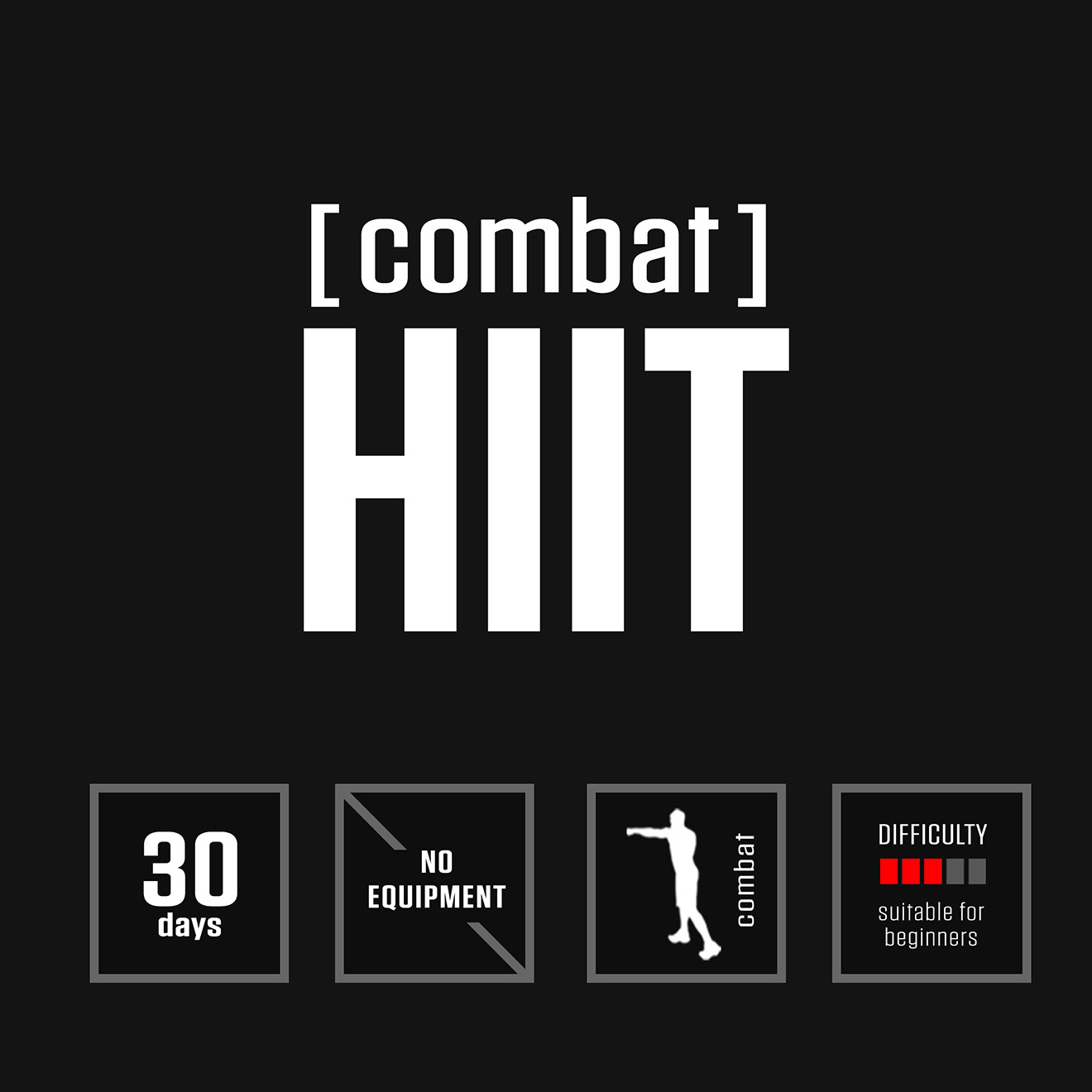
Combat HIIT is a 30-day, no-equipment program that takes high intensity interval training and gives it a fight to win. Every day is built from timed intervals of combat techniques - kicks, punches, strikes and the strength work that powers them - performed in rounds with one minute of rest in between. Each day comes in three levels, from 3-5 rounds on the heaviest sessions to 5-15 on the technique days, and each day has its own follow-along video recorded at all three levels of difficulty, so you can train in real time at exactly the pace that fits you. Sessions run 10-30 minutes at the highest level, and no martial arts experience is required.

The month runs on a rotation of day types, each with a job to do. Practice days drill techniques and combinations at speed. Power HIIT days splice push-up variants between punch intervals so your hands learn to work on tired arms. Ab Work arrives every fourth day and does its core training combat-style - sit-up punches, sitting elbow strikes, flutter kicks. Speed Work days chase pure hand and foot velocity, and the three Super HIIT days are the volume peaks, with six-interval rounds that bookend the program on Days 11 and 30. There are no rest days: recovery lives inside the timer, in the minute between every round, and the level system is your intensity dial.

Across the month the techniques learn to talk to each other. Single kicks and punches become side-to-side versions, then two-move pairings, then doubles thrown off a single chamber, and finally the four-strike chains of the closing week. Day 30 repeats Day 11's structure with every kick block doubled, so the finish line is also a measuring tape - you get to feel exactly how much faster, sharper and fitter four weeks have made you. Ideal for martial artists chasing speed and endurance, and just as good for anyone who simply likes throwing kicks and punches and wants to get leaner and stronger doing it.

Program Index - click the days to navigate


COMBAT HIIT by DAREBEE

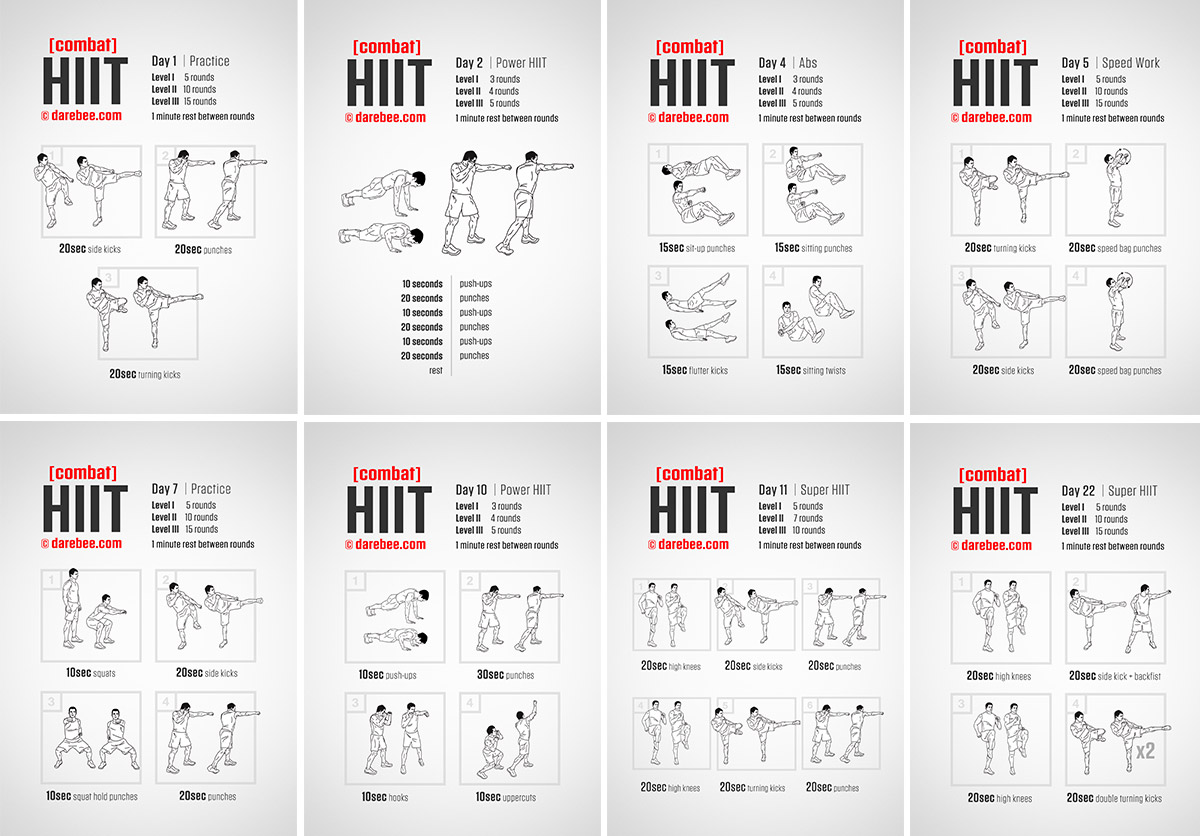
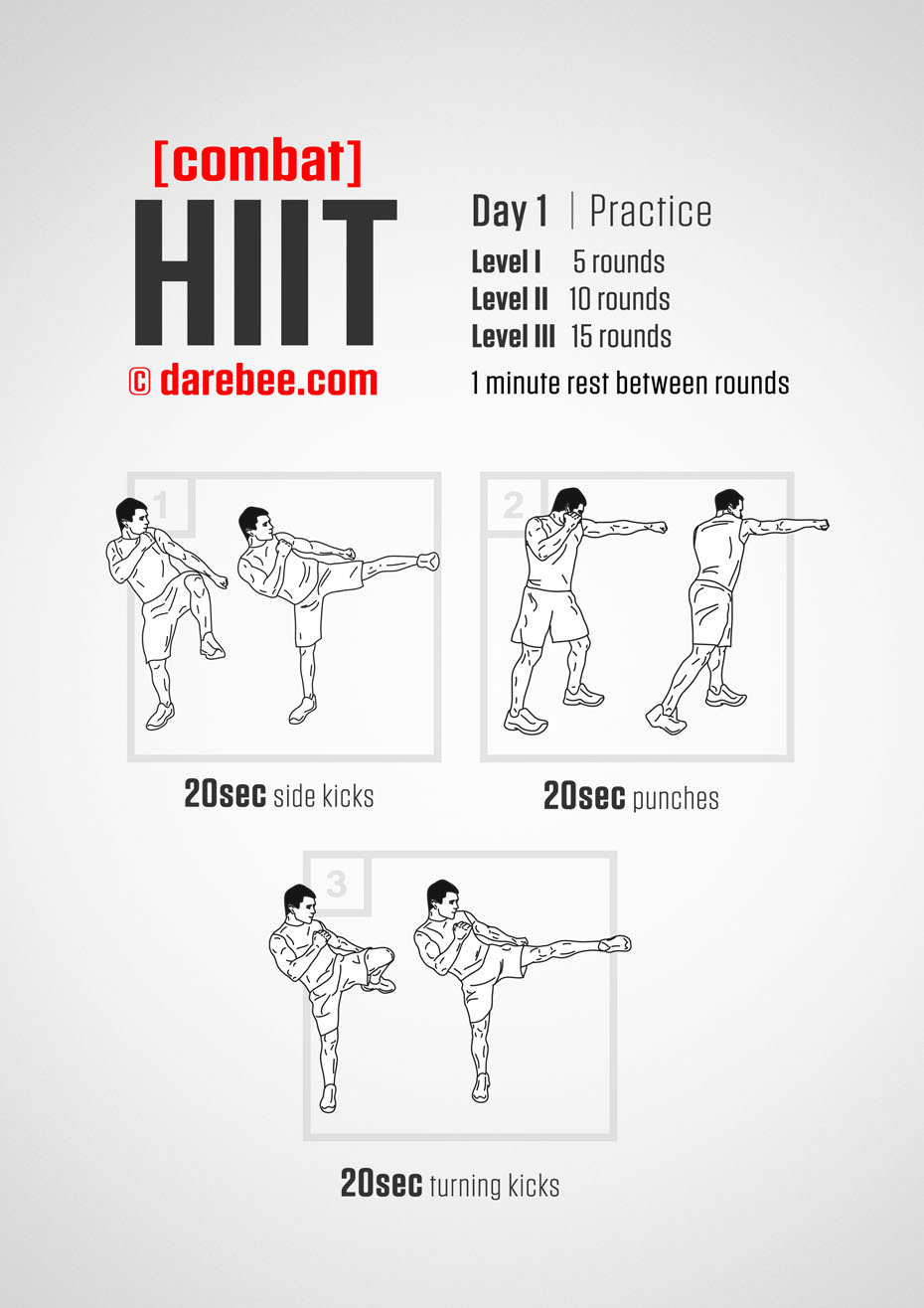
Combat HIIT opens with its three cornerstones. Day 1 is a Practice session: 20 seconds of side kicks, 20 seconds of punches and 20 seconds of turning kicks make one round, followed by a full minute of rest, repeated for 5, 10 or 15 rounds depending on your level. Three techniques, one minute to recover, and the whole month ahead built on exactly this rhythm.

These three moves were chosen because between them they teach everything the program will keep asking for. The side kick trains the chamber - knee up, foot loaded - and the balance to deliver force sideways off one leg. Punches teach rotation: power that starts at the hips and arrives at the fist. The turning kick adds the pivot, swinging the hip over the standing foot to whip the leg through an arc. Twenty seconds per technique is long enough to find a groove and short enough that every rep can be thrown with speed.

Chamber the side kick properly - knee to chest, then drive the heel out and pull it back the same way. Throw punches from a guard, rotating the shoulder and hip behind each one, and snap the fist back as fast as it went out. On turning kicks, pivot fully on the ball of the standing foot so the hips open and the kick travels level. Alternate sides throughout and keep the non-working hand up - the guard is part of every technique here.

Three moves, one minute of rest and twenty-nine days to go - consider the opening bell rung.

Make it Harder: Kick above waist height on every single rep - full chamber, full extension, no exceptions.

Make it Easier: Start at Level I and keep the kicks at knee height while you learn the pivot.

Program Index - click the days to navigate


COMBAT HIIT by DAREBEE

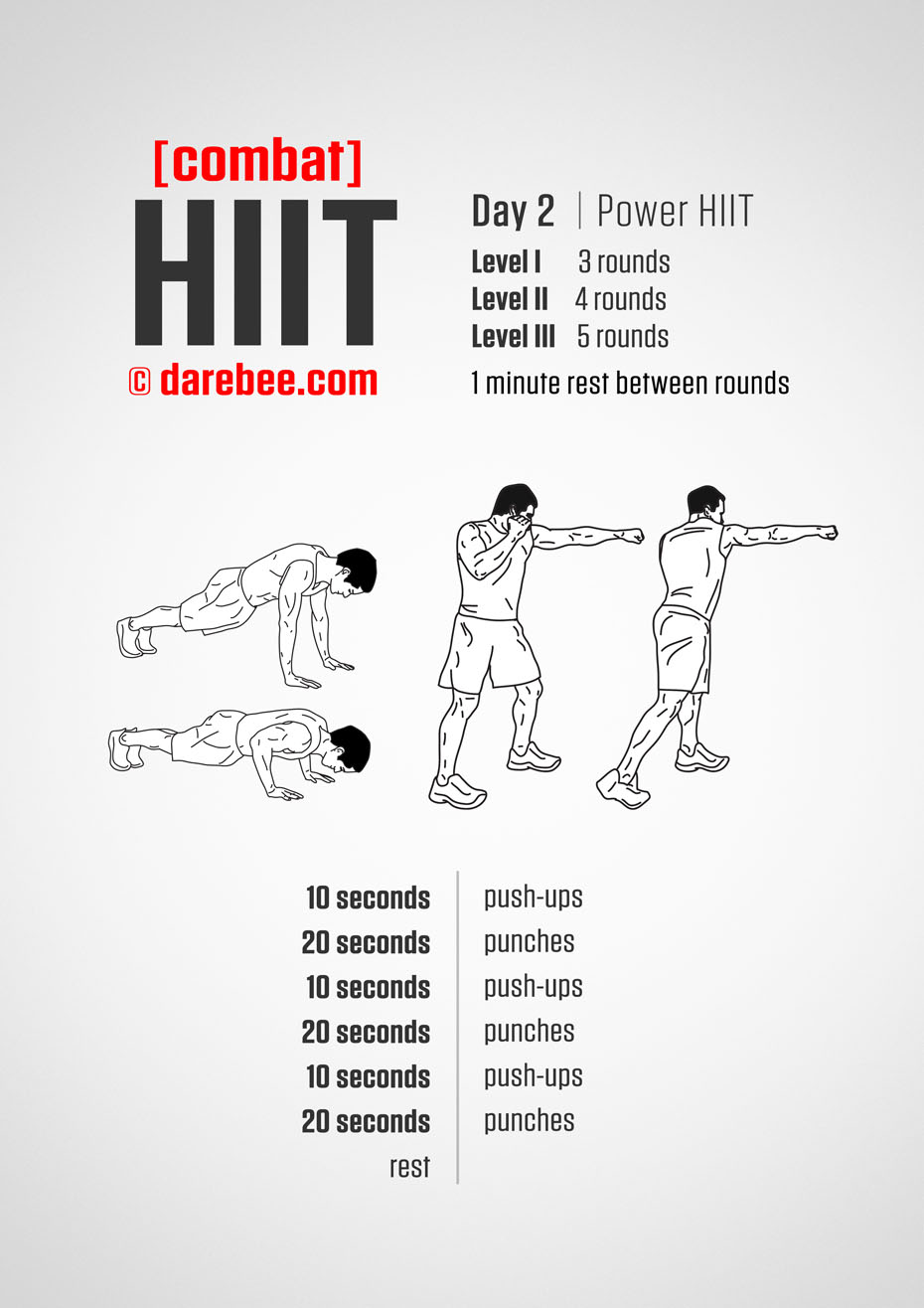
Day 2 introduces the program's other engine: strength. This is a Power HIIT session - 10 seconds of push-ups straight into 20 seconds of punches, alternated three times before the minute of rest, for 3, 4 or 5 rounds by level. The round count drops from yesterday because the intensity per round climbs: there is no coasting through a 10-second push-up burst.

The pairing is the whole point. Push-ups pre-fatigue the chest, shoulders and triceps - the exact muscles a punch relies on - and then the punches arrive on arms that would rather not. That is deliberate: fights and hard training sessions are won on tired arms, and the fastest way to build punch endurance is to practice punching in exactly that state. Ten-second push-up windows also force quality over quantity: there is only time for a handful of reps, so every one of them can be full.

Take the push-ups through their whole range - chest low, elbows tracking back, core braced in one line. When you rise for the punch intervals, resist what fatigue wants: keep the guard at cheek height, extend every punch fully and snap it back, and let the hips do the rotating even as the shoulders burn. If the punches start pawing at the air instead of firing, slow them slightly and make them honest again.

A punch begins where a push-up ends - today your arms learn that lesson from both directions.

Make it Harder: Treat every 10-second push-up window as a sprint - as many full-range reps as honest form allows.

Make it Easier: Do the push-ups from your knees and keep the punch intervals as written.

Program Index - click the days to navigate


COMBAT HIIT by DAREBEE

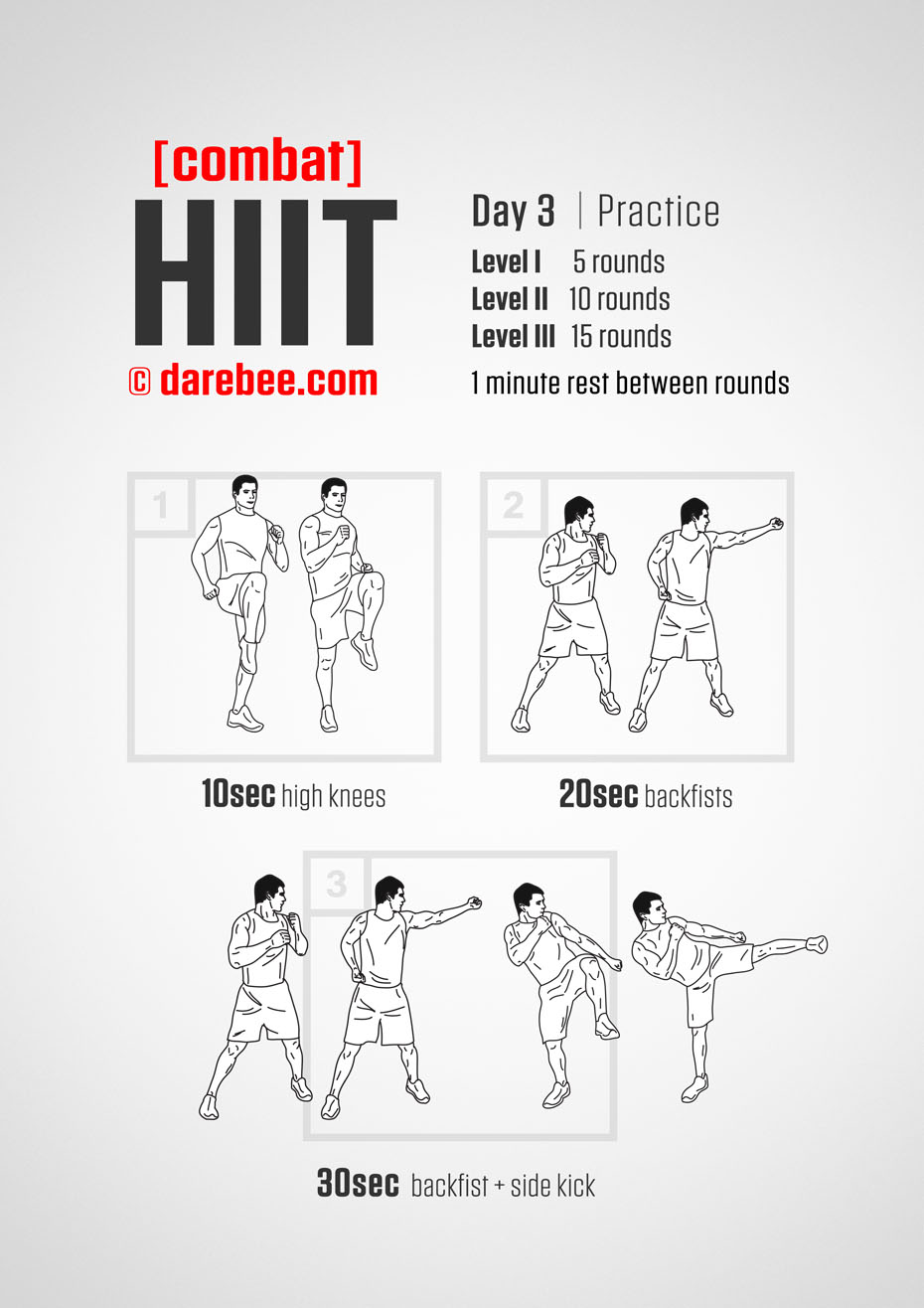
Day 3 is a ladder. The intervals climb - 10 seconds of high knees, 20 seconds of backfists, 30 seconds of backfist + side kick - and so does the complexity, from a simple sprint-in-place to a strike to a two-move combination. One round is a minute of work, then a minute of rest, at 5, 10 or 15 rounds.

The design gives each interval exactly the time its job needs. Ten seconds of high knees is an ignition switch - just enough to spike the heart rate before the technical work. The backfist is the fastest strike in the toolbox, a whip straight from the guard where the wrist leads and the arm follows, and 20 seconds lets you find its rhythm. The combination gets the longest interval because chaining hand to foot takes more time per rep: backfist fires, and as it retracts, the same-side hip is already chambering the side kick behind it.

Run the high knees tall, knees to hip height, staying light on the balls of the feet. Snap the backfist out and back rather than swinging it - the return is as fast as the strike. In the combination, let the backfist do double duty: it scores and it covers the kick's wind-up, so there should be no pause between the two. Alternate sides so both hips and both hands get the ladder's full length.

Ten, twenty, thirty - the ladder only goes up, and so does everything this program will ask of you.

Make it Harder: Throw the combination from both stances, switching your lead every round.

Make it Easier: March the high knees instead of running them and take the combination at a learning pace.

Program Index - click the days to navigate


COMBAT HIIT by DAREBEE

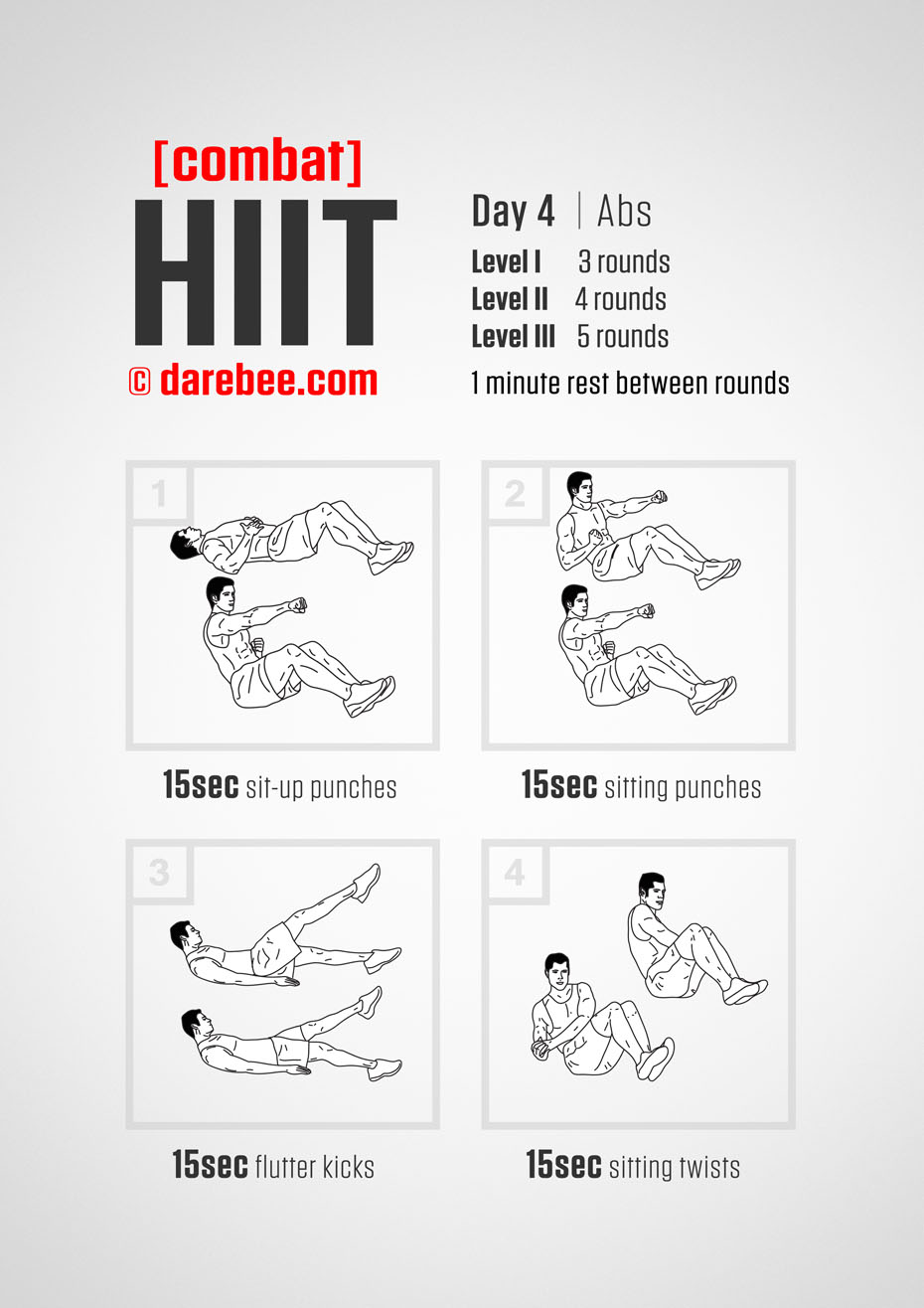
Every fourth day in Combat HIIT belongs to your core, and this is the first one. Four stations of 15 seconds each - sit-up punches, sitting punches, flutter kicks, sitting twists - make up a round, with the usual minute of rest and 3, 4 or 5 rounds by level. All of it happens on the floor, and most of it happens with your fists.

This is core training the combat way. Punching from a sit-up or a lean-back position forces the abs to do two jobs at once - hold an unstable torso steady and rotate it to power the strike - which is precisely what they do in every standing punch you have thrown so far. Flutter kicks bring in the lower abs and hip flexors, the muscles behind every knee and kick, and the sitting twists close the round with pure rotation, side to side, the transverse work that ties the whole midsection together.

On sit-up punches, come all the way up and land the punch at the top before lowering with control. For sitting punches, lean back until the abs switch on, keep the spine long rather than rounded, and punch without letting the torso collapse. Flutter kicks stay small and fast with the lower back pressed into the floor. In the twists, lead with the shoulder, not the elbow, and let the head follow the turn.

Four stations, sixty seconds of work, and a set of abs that just found out they are part of the fight too.

Make it Harder: Punch with intent at every station - full extension and snap, as if the target were real.

Make it Easier: Keep your hands on your chest for the sit-up station and add the punches when you are ready.

Program Index - click the days to navigate


COMBAT HIIT by DAREBEE

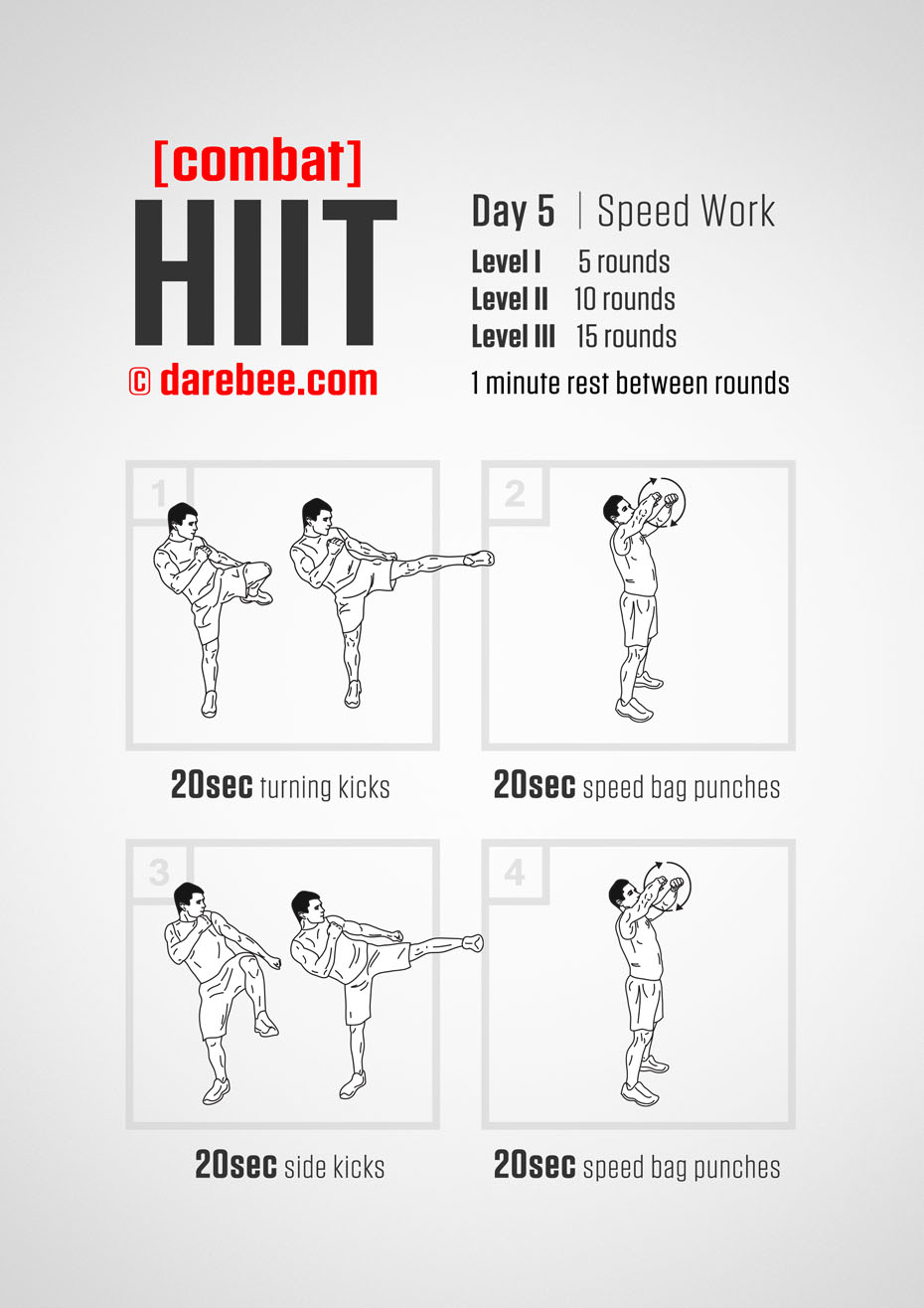
Day 5 is the program's first dedicated Speed Work session: 20 seconds each of turning kicks, speed bag punches, side kicks and speed bag punches again, then the minute of rest, at 5, 10 or 15 rounds. The speed bag punches need no bag - fists up at eye level, forearms rotating around each other in small, fast circles, exactly as if a bag were there.

The alternating design is what keeps everything fast. Kicks and rotation work share almost no muscles, so the legs recover while the shoulders spin and the shoulders recover while the hips kick - which means every interval can be attacked at full speed instead of survived. The rotation itself is a classic boxing endurance drill: keeping the arms up and circling for 20 seconds builds the shoulder stamina that keeps a guard high late in a round, and trains the hands to move fast without tensing up.

Keep the rotation small, continuous and close - elbows up, fists circling each other at forehead height, no winding down mid-interval. On the kicks, snap rather than push: chamber, fire, re-chamber, and let the count climb. A useful habit from day one of speed training: count your kicks per interval, because that number is how you will measure this program working.

Speed is a skill, not a gift - today is its first formal lesson.

Make it Harder: Reverse the direction of the rotation halfway through each speed bag interval without slowing down.

Make it Easier: Kick to waist height and slow the rotation - continuous beats fast today.

Program Index - click the days to navigate


COMBAT HIIT by DAREBEE

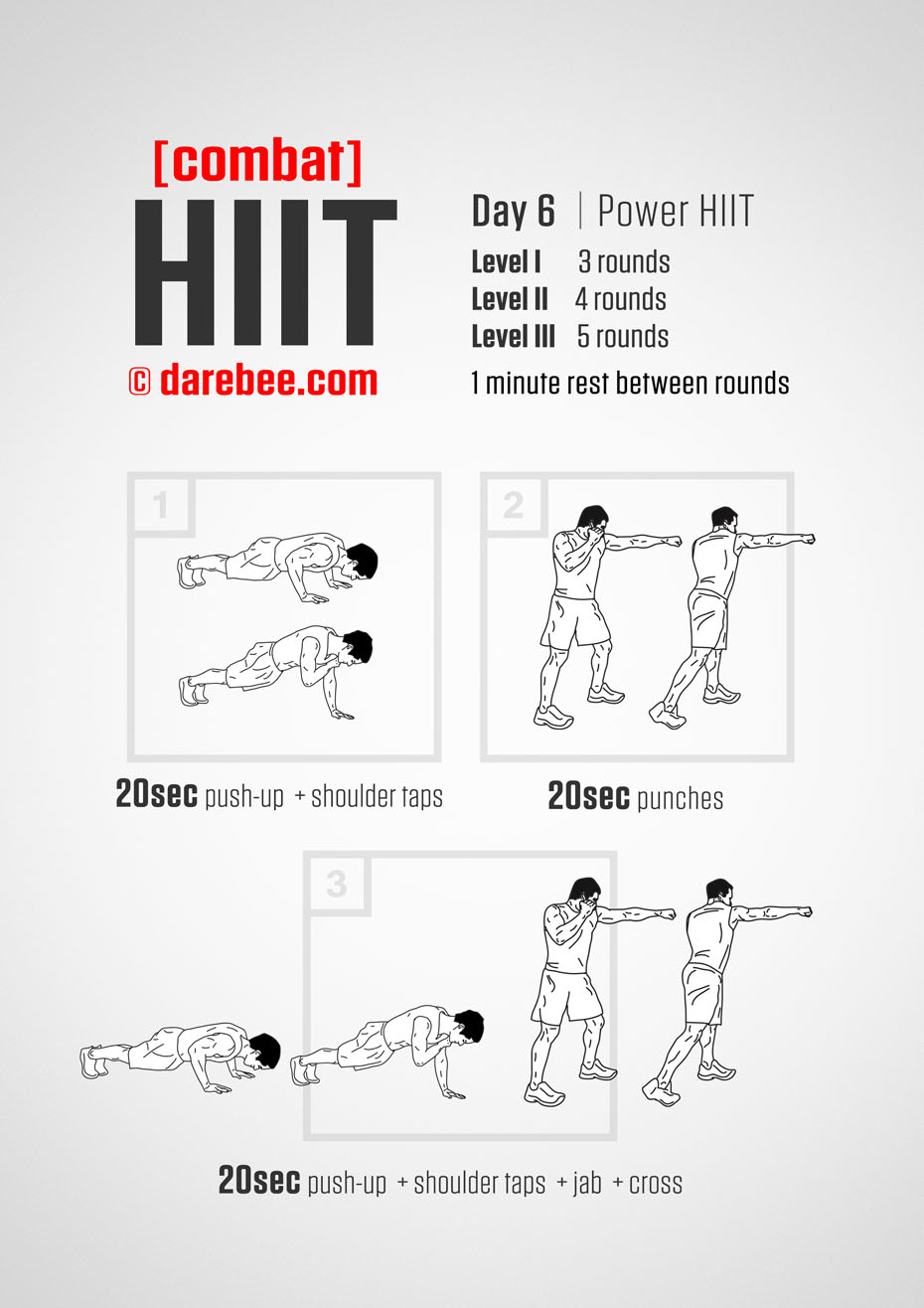
Day 6 upgrades the Power HIIT formula. Three 20-second blocks: push-up + shoulder taps, punches, and then the full sequence - push-up + shoulder taps + jab + cross - at 3, 4 or 5 rounds. The floor and the fight are no longer separate places: the final block has you striking the moment you are up.

The shoulder tap is the clever addition. After each push-up, tapping one shoulder with the opposite hand in plank means three points of contact instead of four, and the core has to fight rotation to keep the hips level - which is the same anti-rotation strength that keeps a punch straight. The third block then adds the most combat-relevant skill on the card: getting off the floor fast and being ready to strike immediately. Push-up, tap, rise, jab, cross, back down - a complete story in one interval.

Widen the feet slightly in plank to steady the taps, and tap without letting the hips sway or dip. On the standing punches, set the feet before firing - explode up from the floor, but land organised, then let the jab and cross turn from the hips. Keep the transition smooth rather than frantic: the fastest way up is the one that does not require a balance correction at the top.

Floor to fists in one breath - that transition is this program's signature move, and today it makes its debut.

Make it Harder: Tap both shoulders twice after every push-up before moving on.

Make it Easier: Skip the shoulder taps and keep the push-up + jab + cross sequence.

Program Index - click the days to navigate


COMBAT HIIT by DAREBEE

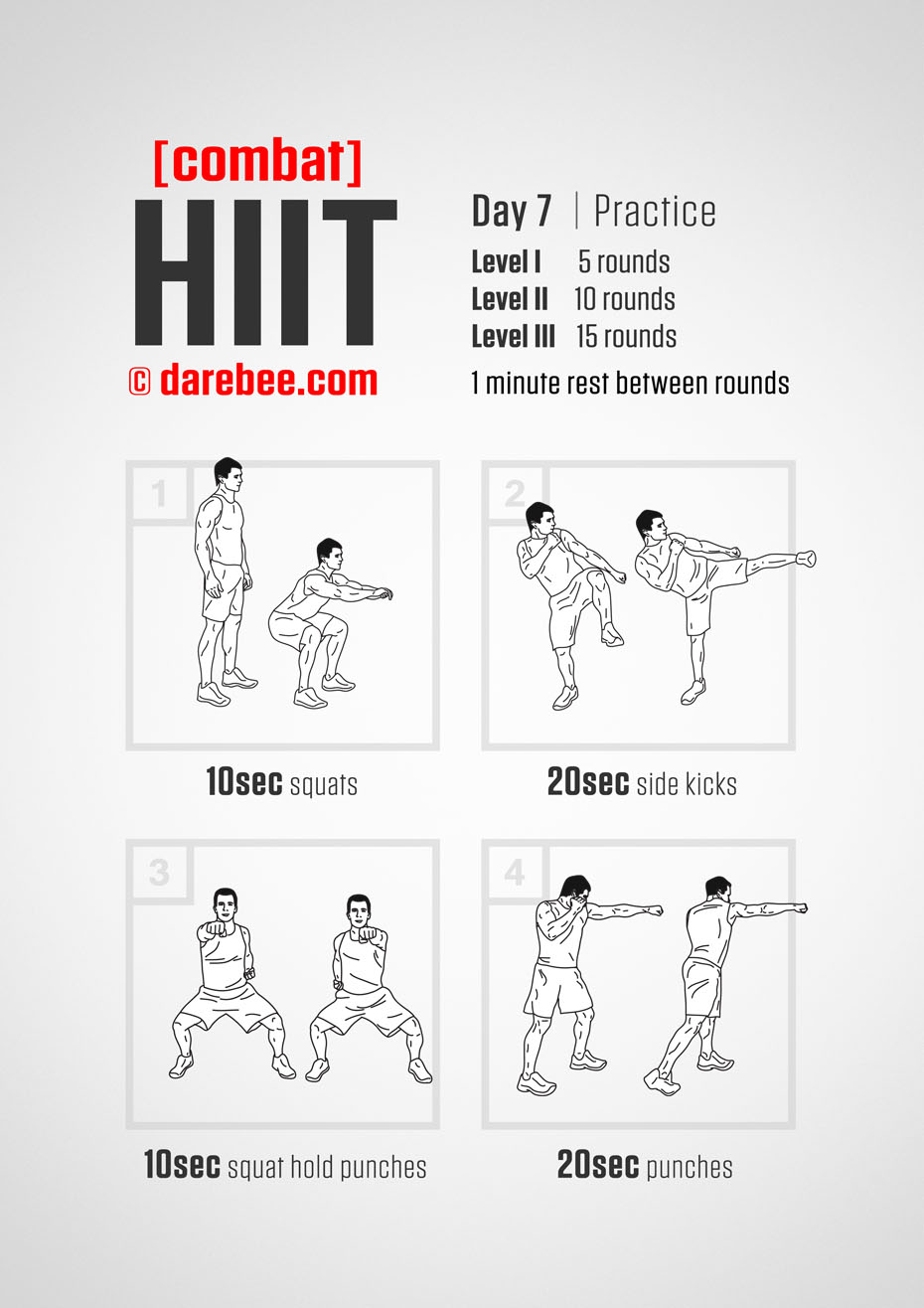
Day 7 puts your legs and hands in the same room. The Practice structure runs 10 seconds of squats, 20 seconds of side kicks, 10 seconds of squat hold punches and 20 seconds of punches, for 5, 10 or 15 rounds. Half the round happens below parallel, and the other half is powered by what you built there.

Squats and kicks are the same muscles doing different jobs, which is why they lead into each other here. The squat loads the quads, glutes and hips; the side kick spends that strength one leg at a time. Then comes the interesting part: punching from a held squat. The legs work isometrically while the torso rotates and strikes, teaching the single most important power lesson in striking - punches are thrown with the legs, and the arms just deliver the mail.

Squat to parallel with the weight in your heels and the chest up. In the squat hold, find a depth you can defend for the full 10 seconds and stay there - thighs burning, guard up, punches turning from the hips even though the legs cannot move. When you rise for the standing punches, notice how much easier rotation feels with the legs free again: that contrast is the lesson.

Ten seconds in a squat with your fists flying - the shortest interval on the card and somehow the longest.

Make it Harder: Sink the squat hold deeper and refuse to rise even a centimetre until the interval ends.

Make it Easier: Take the squat hold a few inches higher - a position you can punch from beats one you abandon.

Program Index - click the days to navigate


COMBAT HIIT by DAREBEE

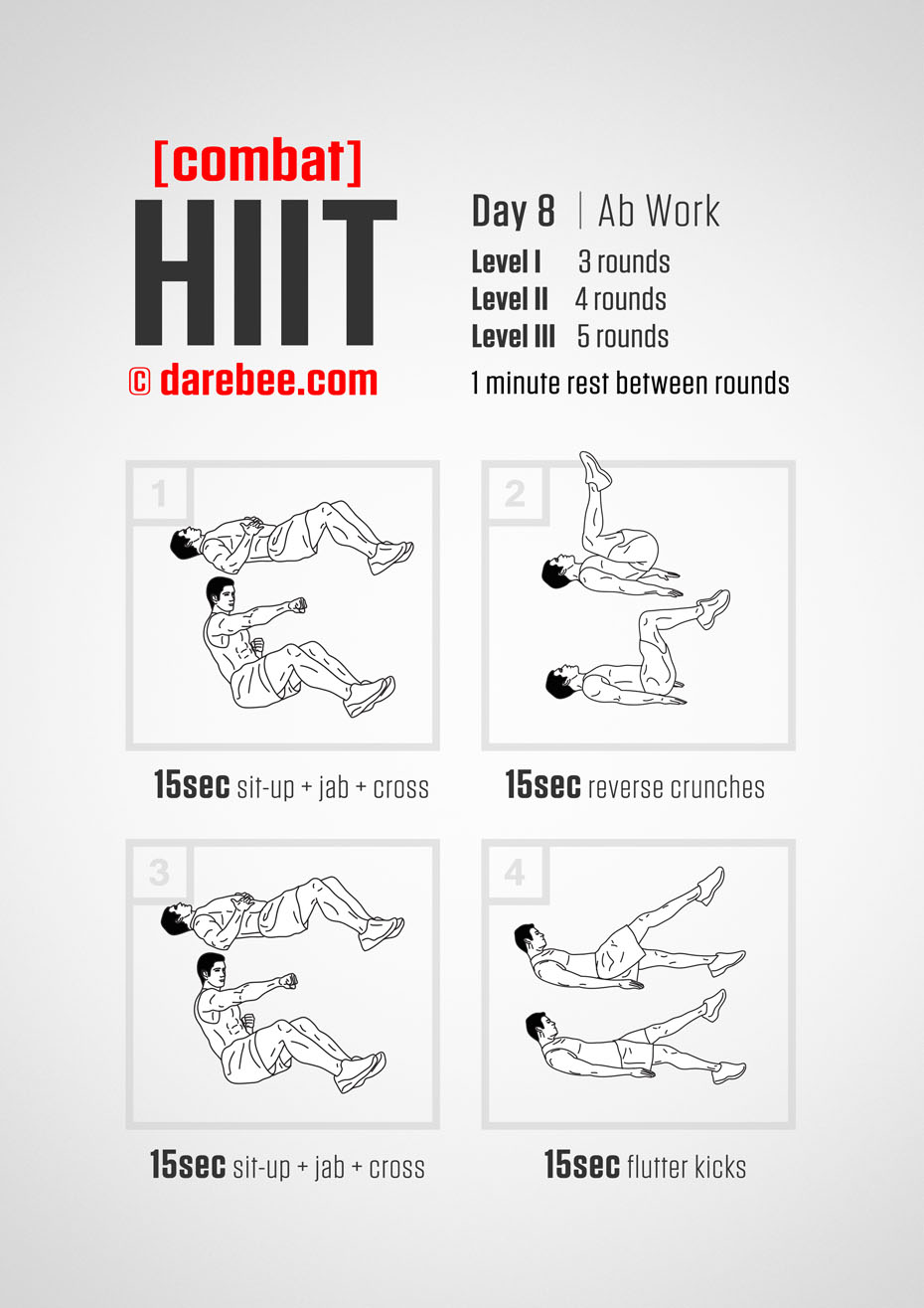
Day 8 is Ab Work with a boxing accent. Four 15-second stations: sit-up + jab + cross, reverse crunches, sit-up + jab + cross again, and flutter kicks, at 3, 4 or 5 rounds. The sit-up station appears twice because it is the day's main event - a full sit-up crowned with a two-punch combination at the top.

Punching twice at the top of every sit-up means the trunk rotates both ways before it lowers - jab turns the torso one direction, cross turns it back - so each rep trains flexion and rotation in a single package. The reverse crunches between those stations flip the equation: instead of the ribs curling toward the hips, the hips curl toward the ribs, hitting the lower abs and giving the hip flexors a break from pulling you upright. Flutter kicks then finish the round on endurance.

Land both punches fully before you lower - a complete jab and a complete cross, guard returning between them, no half-hearted paws on the way down. On reverse crunches, roll the hips off the floor with the abs and lower them with control rather than dropping. Flutter kicks stay low and quick, lower back pressed into the floor for the entire 15 seconds.

Two punches per sit-up, every sit-up - your abs are officially learning combinations.

Make it Harder: Pause for two counts at the top of every sit-up while you throw the punches.

Make it Easier: Throw a single punch per sit-up and alternate which hand leads.

Program Index - click the days to navigate


COMBAT HIIT by DAREBEE

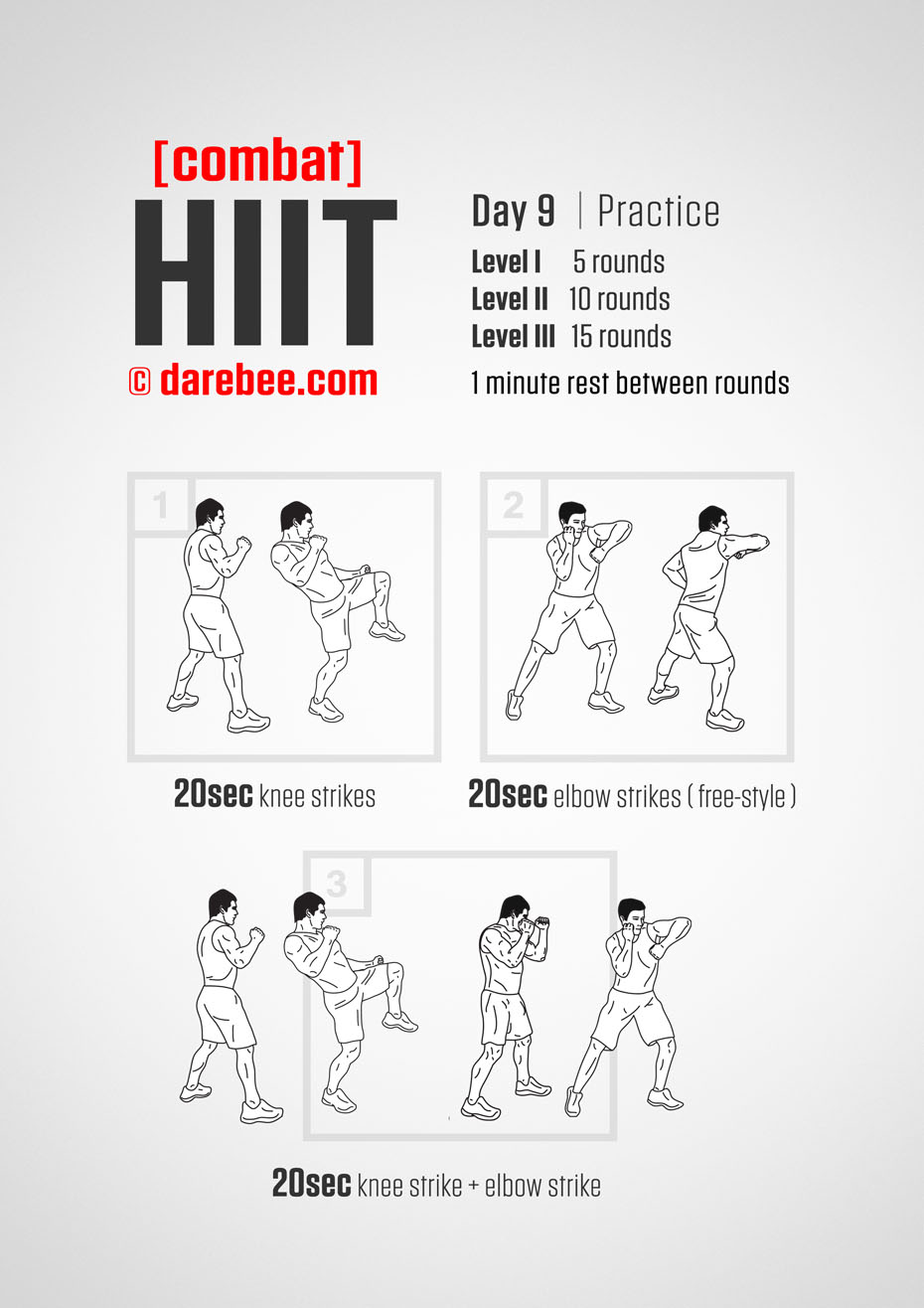
Day 9 closes the distance. This Practice session is built entirely from infighting weapons: 20 seconds of knee strikes, 20 seconds of elbow strikes thrown free-style, and 20 seconds of the knee strike + elbow strike combination, at 5, 10 or 15 rounds.

Everything so far has worked at punching and kicking range - knees and elbows are what happens when that range disappears. The knee strike drives upward through an imaginary target, powered by the hips, with the hands pulling down to meet it. The elbows are free-style on purpose: horizontal, upward or downward, your choice per rep, because elbow versatility matters more than any single angle. The combination then teaches close-range rhythm - knee rises, foot plants, elbow follows through the space the knee just made.

Drive each knee up and through, rising tall on the standing leg, and snap the hands down as the knee comes up - that opposition is where the power lives. Keep the elbows short and hard: the strike travels a hand-span, not an arm's length, with the body weight turning behind it. Alternate sides on everything, and keep the free-style elbows genuinely varied rather than settling into one comfortable angle.

Punches and kicks argue at range - today you learned what the conversation sounds like up close.

Make it Harder: Rise onto the ball of the standing foot with every knee strike for extra drive through the target.

Make it Easier: Bring the knees to hip height only and keep the elbows short, relaxed and precise.

Program Index - click the days to navigate


COMBAT HIIT by DAREBEE

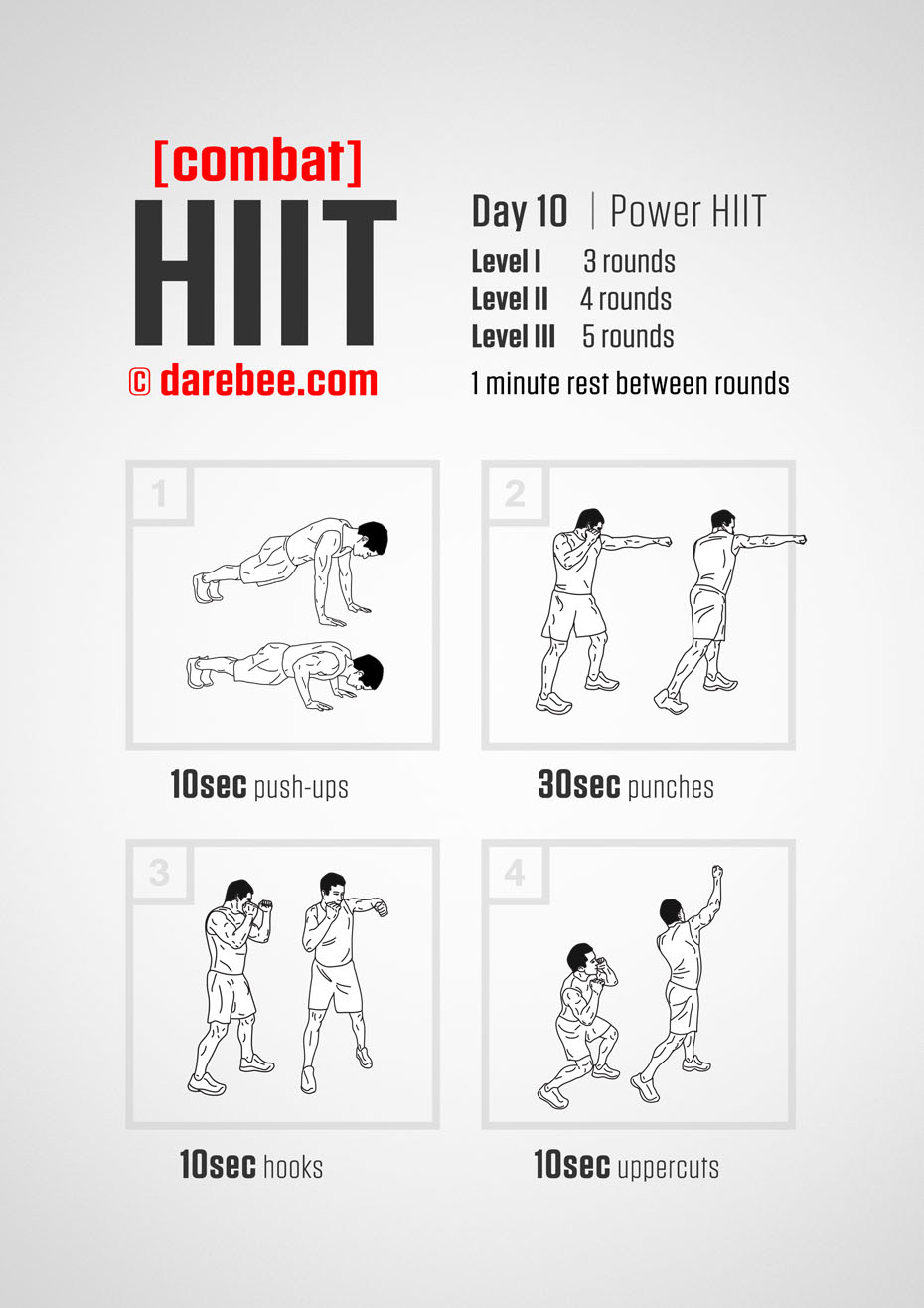
Day 10 hands you the rest of the boxing arsenal. The Power HIIT structure runs 10 seconds of push-ups, a long 30-second block of punches, then 10 seconds of hooks and 10 seconds of uppercuts, at 3, 4 or 5 rounds. Straight punches have been here since Day 1 - the curved ones arrive today.

The 30-second punch block is the endurance centrepiece, half a minute of continuous straight punching on arms the push-ups just emptied. Then come the new angles in short, sharp doses: the hook travels horizontally, elbow up, whole body pivoting behind it, and the uppercut rises from the legs in a short vertical arc. Ten seconds each is an introduction, not an exam - enough time to feel how differently power moves when the punch curves.

Keep the 30 seconds honest: pick an output you can hold to the buzzer and hold it, full extension on every straight punch. For hooks, keep the elbow at shoulder height and pivot the same-side foot so the hip turns with the arm. Uppercuts start with a slight dip of the legs and drive up short - the fist should finish at chin height, not launch toward the ceiling. Guard stays glued to the cheek on whichever hand is not working.

Straight, hooked and rising - as of today, your punches come in every direction.

Make it Harder: Throw the entire 30-second punch block at an output you can barely carry to the buzzer.

Make it Easier: Take the 30-second block at a steady conversational pace - constant motion, no stopping.

Program Index - click the days to navigate


COMBAT HIIT by DAREBEE

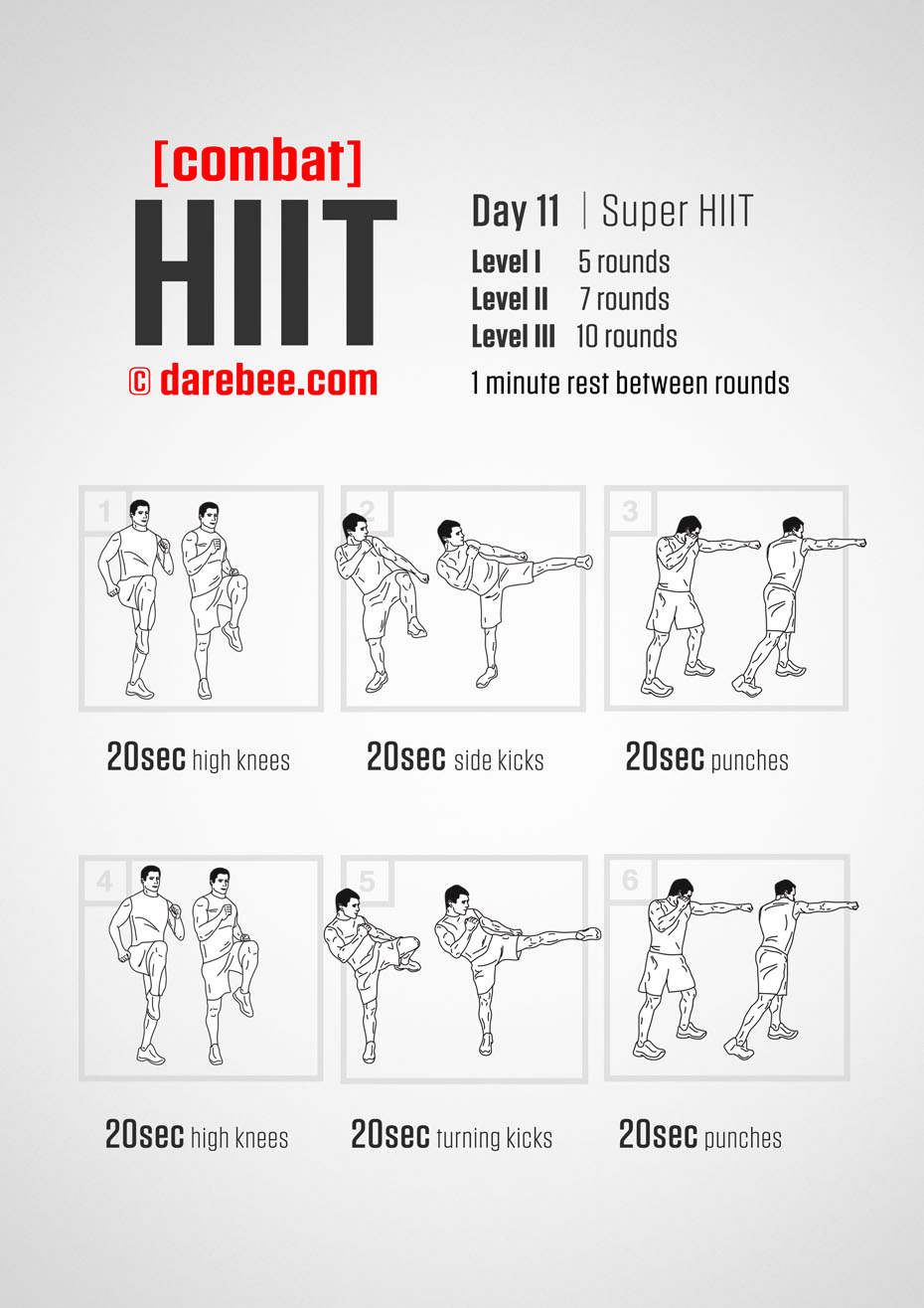
Day 11 is the program's first Super HIIT - the round doubles in size. Six 20-second intervals run back to back: high knees, side kicks, punches, high knees, turning kicks, punches. Two full minutes of work per round, one minute of rest, at 5, 7 or 10 rounds. Remember how this one feels: Day 30 uses this exact structure with the difficulty turned up.

The design mimics a fight round. Cardio bursts of high knees are stitched between technique blocks, so the kicks and punches always arrive on an elevated heart rate - the way they would in a real round, where nobody hands you fresh legs before a combination. Six intervals also introduce the pacing problem: a two-minute round cannot be sprinted from the front, so you learn to distribute effort across the whole distance and still have punches left for interval six.

Pace deliberately: the first high knees interval should feel almost easy, because interval five - turning kicks on tired hips - is where the round is actually won. Keep every technique at Day 1 standards no matter what the clock says: full chambers on the kicks, full rotation on the punches, knees at hip height on the runs. If form is dissolving in the second minute, that is your signal to slow the early intervals, not to shorten the late ones.

Two-minute rounds have arrived - and they left a note saying they will be back on Day 30.

Make it Harder: Treat the sixth interval of every round as an all-out sprint - empty the tank on the final punches.

Make it Easier: Drop one level and bank a clean, strong finish on every round.

Program Index - click the days to navigate


COMBAT HIIT by DAREBEE

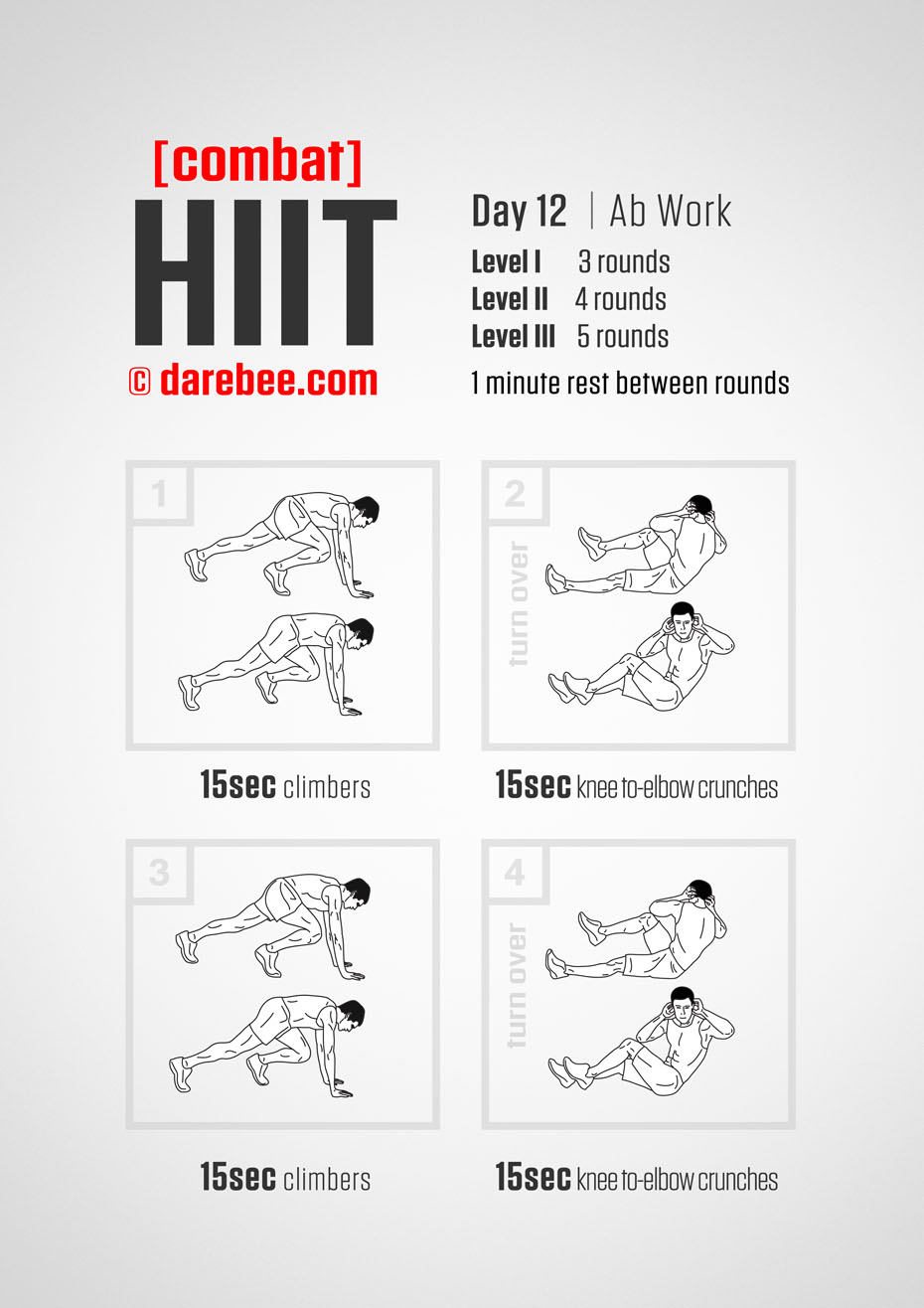
Day 12 is Ab Work with a flip built in. Four 15-second stations alternate between face-down and face-up: climbers, knee to-elbow crunches, climbers again, knee to-elbow crunches again - with a turn over between each, at 3, 4 or 5 rounds. The transitions are printed right on the card, because they are part of the workout.

Climbers are a moving plank: shoulders stacked over wrists while the legs sprint, which trains the core to stay rigid under fast, uneven loading. The crunches answer from the other side - knee and elbow drawn together over the midline, adding rotation to flexion. And the flips between them do quiet work of their own: changing position every 15 seconds under a running clock keeps the transitions athletic and denies the abs any moment where nothing is happening.

In the climbers, keep the hips low and level - the legs sprint, the torso does not bounce - and drive the knees all the way toward the chest. On the crunches, bring knee and elbow to meet in the middle rather than hauling the neck forward, and alternate sides evenly. Flip over briskly but land organised: the next interval starts whether you are ready or not.

Face down, face up, face down again - your core works every angle it has today.

Make it Harder: Sprint the climbers - as fast as your feet can cycle while the hips stay quiet.

Make it Easier: Take an extra breath at every turn over - the flip can wait two seconds, the work cannot.

Program Index - click the days to navigate


COMBAT HIIT by DAREBEE

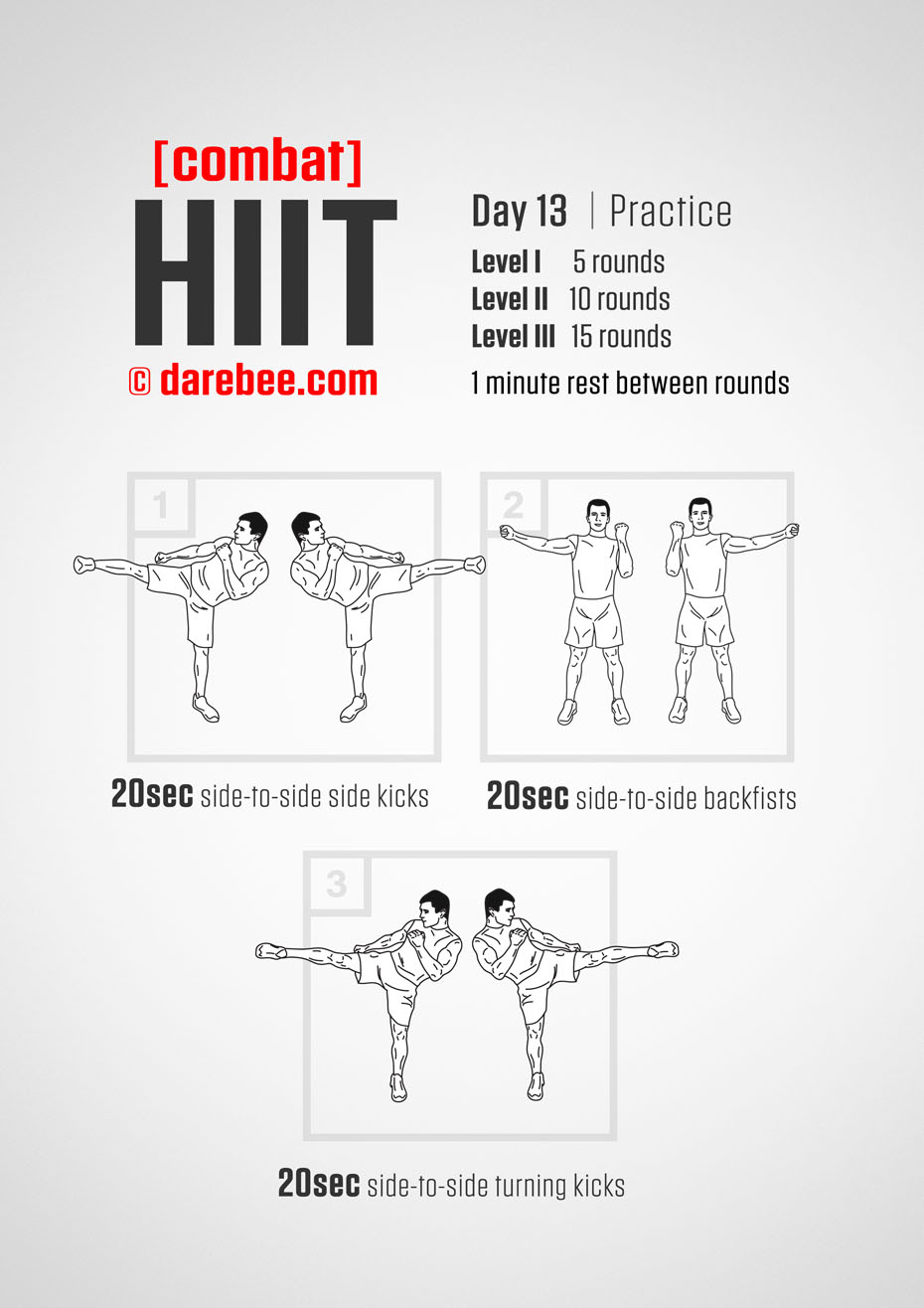
Day 13 outlaws favourites. Every exercise in this Practice session alternates sides on every rep: 20 seconds of side-to-side side kicks, 20 seconds of side-to-side backfists, 20 seconds of side-to-side turning kicks, at 5, 10 or 15 rounds. Left, right, left, right - the pattern is the point.

Until now you could quietly lead with your stronger side. The side-to-side format ends that: each rep starts from a full reset, weight shifting across the body, balance re-found, technique fired from the other hip. That reset costs more than repeating one side ever does - the stabilisers work double, the co-ordination demand doubles, and your weaker side gets exactly as many reps as your stronger one, which is how the gap between them closes.

Return fully to your guard and centre between sides - no drifting halfway and firing early. Match the heights: if the right leg kicks at hip height, the left owes the same, because today your weaker side sets the standard and your stronger side keeps it honest. On the backfists, let the whole body turn side to side so the strike whips out of the rotation rather than just the arm swinging.

Your weaker side just found out it has been enrolled in this program all along.

Make it Harder: Hold the chamber for one count before every kick - both sides, no wobbles.

Make it Easier: Rest your fingertips on a chair back for the kicking intervals while your balance catches up.

Program Index - click the days to navigate


COMBAT HIIT by DAREBEE

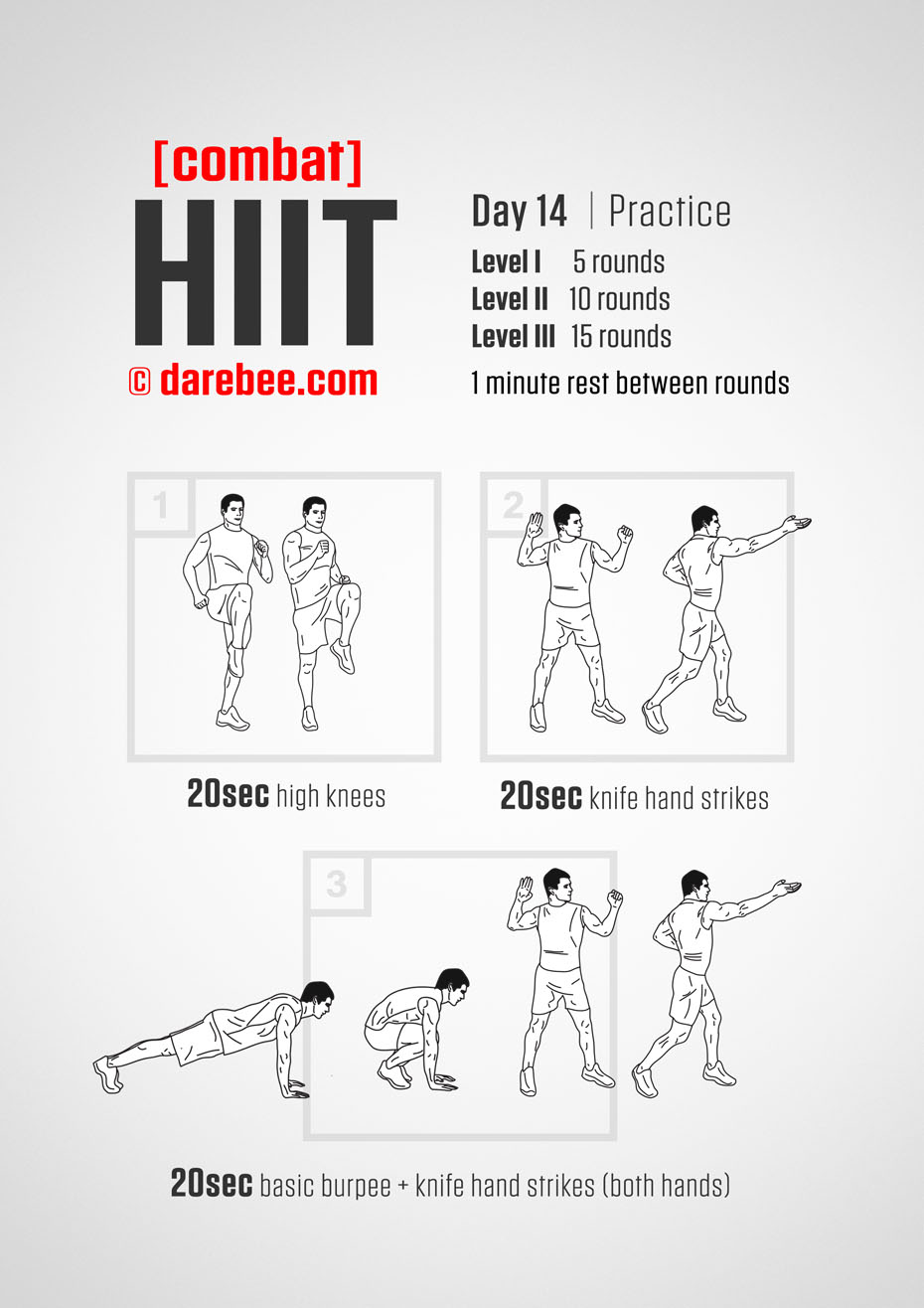
Day 14 opens your hands. This Practice session runs 20 seconds of high knees, 20 seconds of knife hand strikes and 20 seconds of basic burpee + knife hand strikes with both hands, at 5, 10 or 15 rounds. The knife hand is the classic open-hand chop - fingers together, striking with the blade edge of the hand.

Open-hand strikes teach something fists cannot: relaxation. A knife hand only works if the arm stays loose until the moment of contact, which makes it a speed lesson disguised as a technique - tension is slow, and this strike punishes tension. The finale then bolts it onto the program's favourite transition: drop through a basic burpee, snap the feet back in, rise, and deliver a chop with each hand before the next rep. Floor to strike, again and again, on a climbing heart rate.

Keep the fingers together and the thumb tucked, and strike with the fleshy edge of the hand, hips rotating behind it just like a punch. In the burpee, there is no push-up required - plank out, snap in, stand - but the standing matters: rise balanced, strike with the right hand, strike with the left, and only then go back down. Speed comes from smooth, not from rushing the floor work.

Two weeks in, and your hands now strike open or closed - the toolbox keeps growing.

Make it Harder: Add a jump at the top of every burpee before the strikes.

Make it Easier: Step the feet out and back in the burpee instead of jumping them.

Program Index - click the days to navigate


COMBAT HIIT by DAREBEE

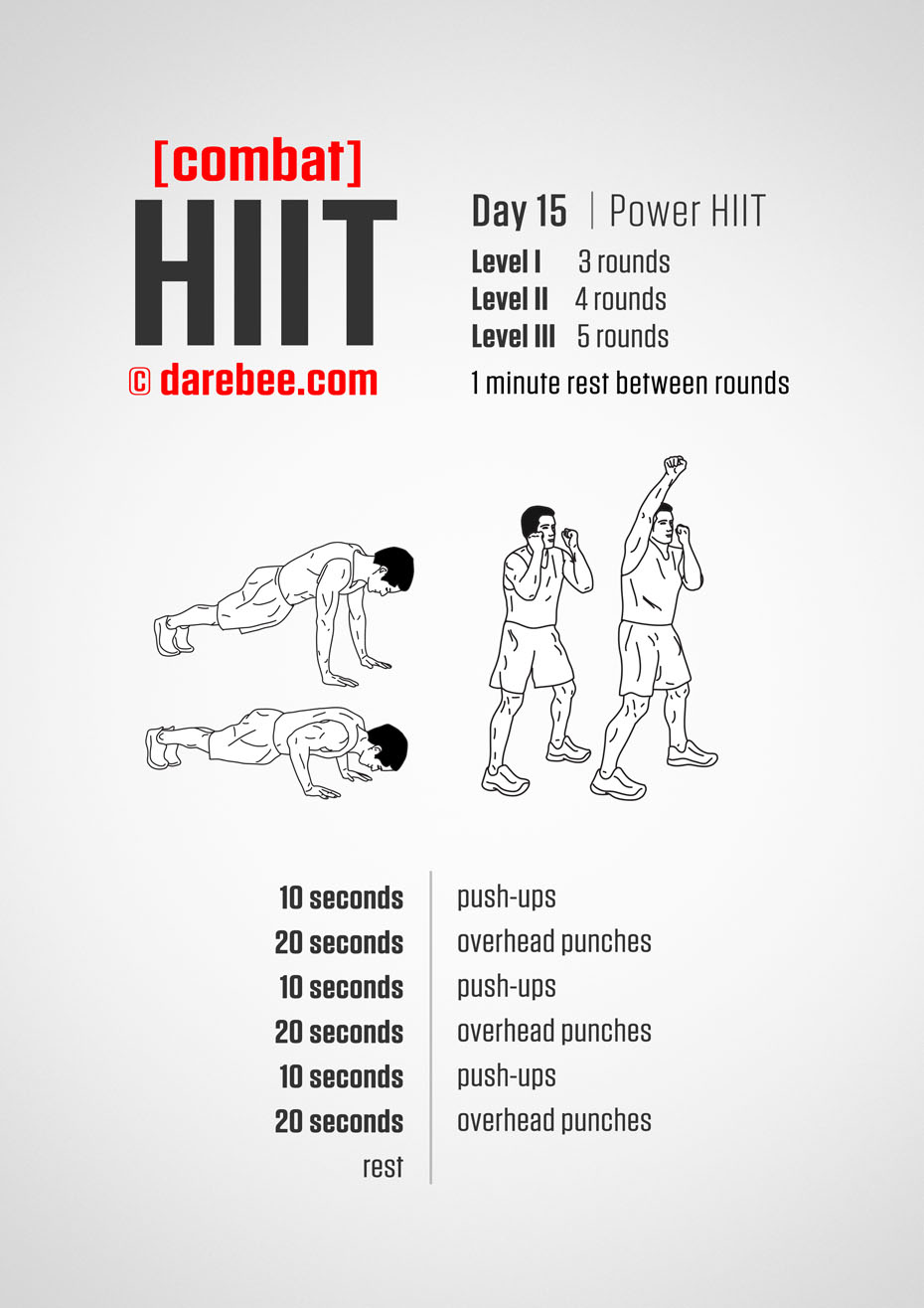
Day 15 points the punches at the ceiling. The Power HIIT structure is Day 2's exact skeleton - 10 seconds of push-ups into 20 seconds of punching, three times per round, 3, 4 or 5 rounds - but the payload has changed: overhead punches, thrown straight up to full extension, alternating arms.

Punching vertically is a different tax than punching forward. The deltoids carry the arm's whole weight through every rep, the ribs and core have to stay stacked so the lower back does not arch, and there is no hip rotation to hide behind - just shoulders, working. Sandwiched between push-up bursts, the session becomes a complete shoulder day in disguise: horizontal pressing on the floor, vertical punching off it, and no interval where the shoulders are off the clock.

Drive each punch to a full lockout overhead - fist directly above the shoulder - and pull it back down fast, keeping the ribs down and the abs braced so the reach comes from the arm, not from leaning back. Alternate arms in a steady rhythm. The push-ups keep their full range even in the final block: by round three the shoulders will be negotiating, and the depth of your push-up is where you win that negotiation.

Same skeleton as Day 2, brand new direction - progress in this program sometimes just means aiming higher.

Make it Harder: Add a one-count pause at the bottom of every push-up before pressing up.

Make it Easier: Hold a plank through the push-up intervals and save your shoulders for the punches.

Program Index - click the days to navigate


COMBAT HIIT by DAREBEE

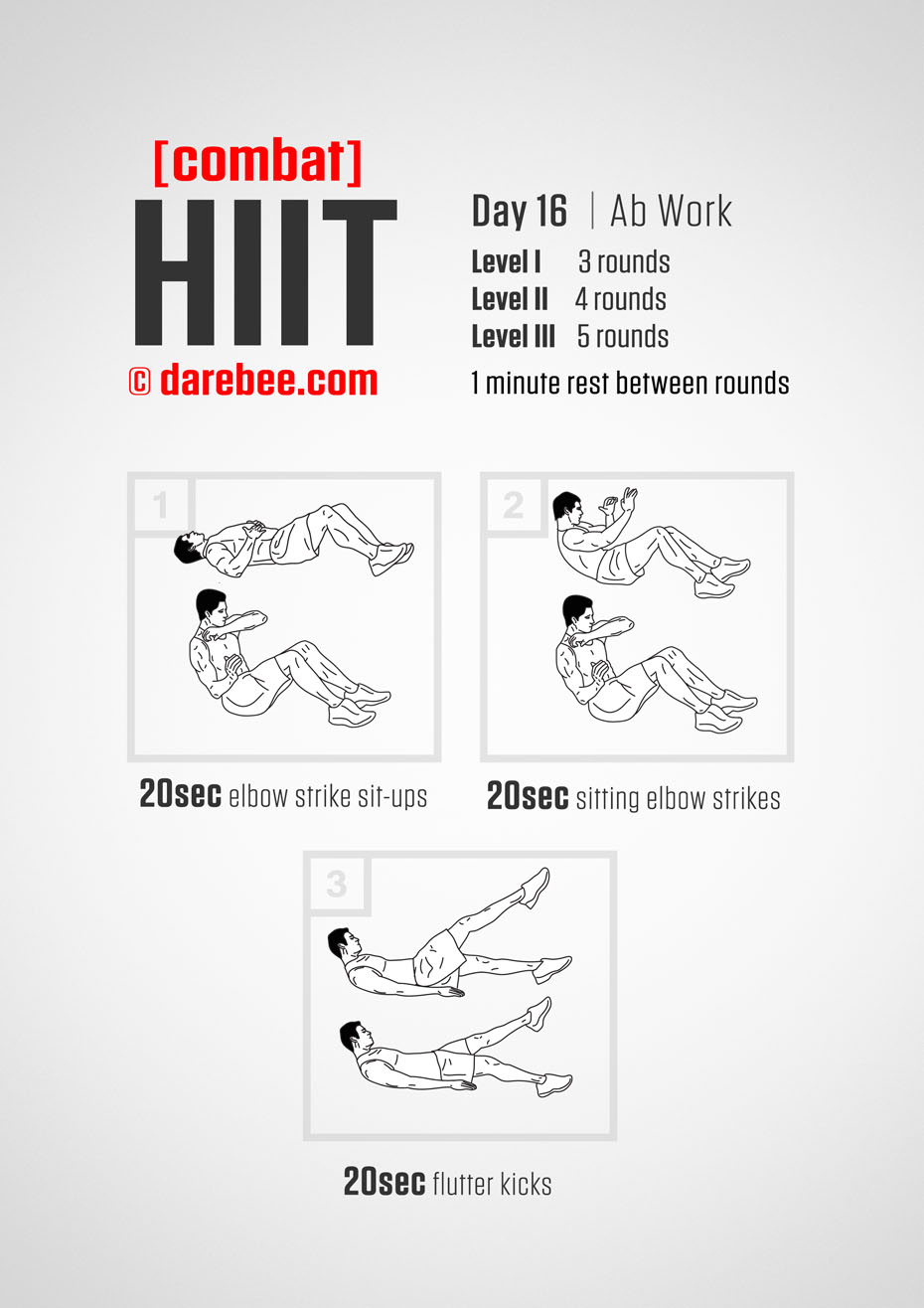
Day 16 brings the elbows down to the floor. Three 20-second stations - elbow strike sit-ups, sitting elbow strikes, flutter kicks - at 3, 4 or 5 rounds. Notice the quiet progression: the ab intervals have grown from 15 seconds to 20, a third more time under tension at every station.

The elbow strike sit-up marries Day 9's close-range weapon to trunk flexion: rise through a full sit-up and throw a horizontal elbow across the body at the top, alternating sides, so every rep ends in rotation. The sitting version then strips out the up-and-down and keeps only the hard parts - the lean-back hold and the turning strike - which makes it an isometric for the abs and a rotation drill for the obliques at the same time. Flutter kicks close the round with the lower abs, as they have on every core day so far.

Come all the way up before the elbow fires, and make it a strike - short, sharp, body turning behind it - rather than a vague wave. In the sitting elbow strikes, find a lean-back angle you can hold for the full 20 seconds with a long spine, and rotate through the ribs, not just the arms. Flutter kicks stay low, fast and continuous, lower back welded to the floor.

Twenty-second stations and elbows in the sit-ups - the core days are growing up alongside you.

Make it Harder: Sit an inch lower in the lean-back during the sitting elbow strikes and stay there.

Make it Easier: Rise to crunch height instead of a full sit-up and keep the elbow strikes as written.

Program Index - click the days to navigate


COMBAT HIIT by DAREBEE

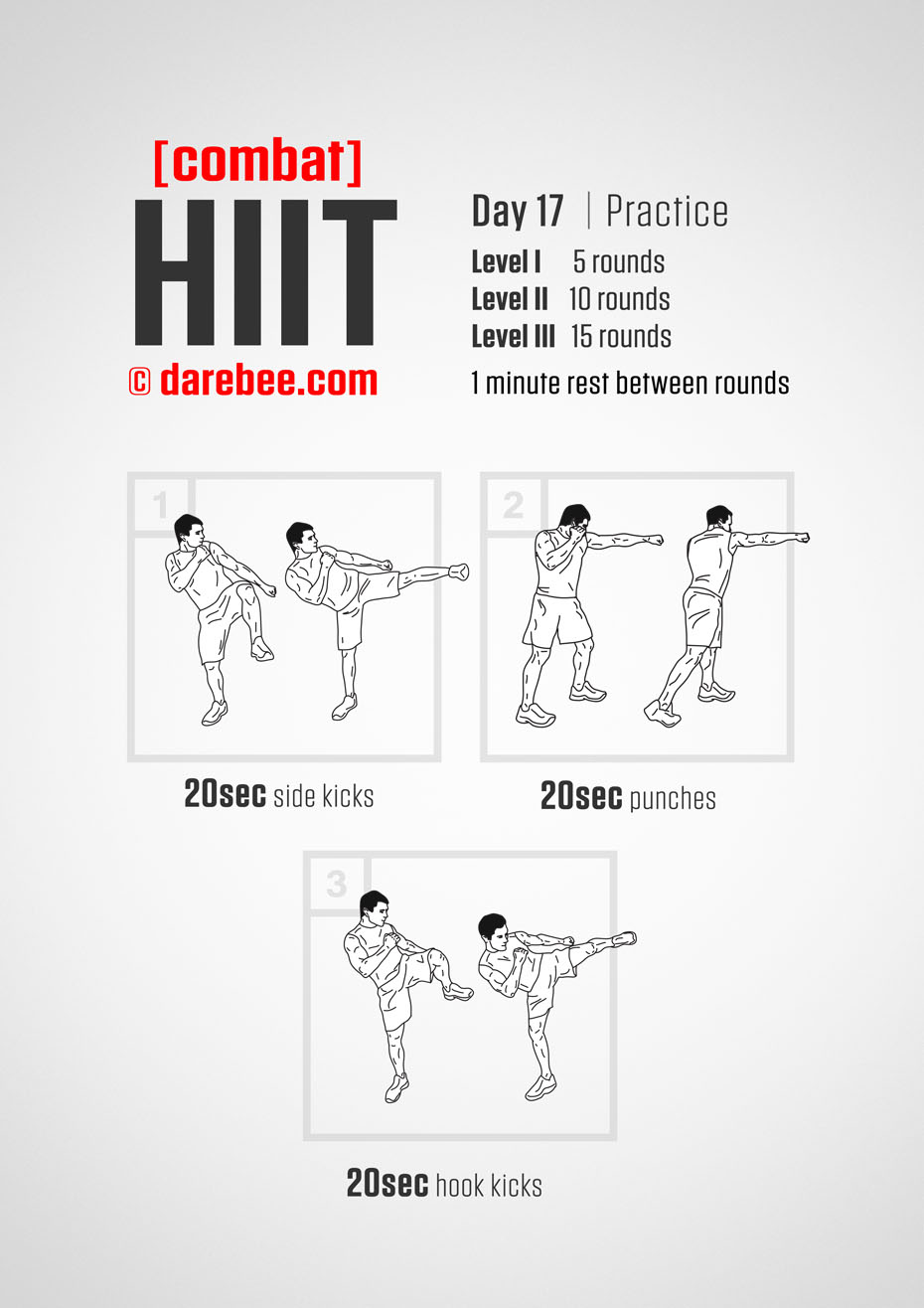
Day 17 saves its news for the third interval. This Practice session runs 20 seconds of side kicks and 20 seconds of punches - both old friends - and then 20 seconds of hook kicks, the most technical kick in the program, at 5, 10 or 15 rounds.

The hook kick is the side kick's mirror-image cousin, and the card sequences them together on purpose. Both start from the same chamber, but where the side kick drives the heel straight out, the hook kick extends past the target line and then whips the heel back across it - a long arc that demands hip control through the entire path, not just at the moment of impact. Bracketing it with familiar techniques means all of today's learning budget goes to one place.

Chamber exactly as you would for a side kick, extend the leg slightly past where a side kick would land, then hook the heel across in a controlled sweep and ride the leg back to chamber before setting it down. Height is negotiable, control is not: a smooth hook kick at hip height is worth ten wild ones at head height. Keep the punches and side kicks at full quality - they are today's proof that the old skills hold while a new one moves in.

Every kick so far has travelled outward - the hook kick is the first one that comes back for more.

Make it Harder: Take the hook kicks to head height - if your hips allow it and the control comes with them.

Make it Easier: Slow the hook kicks right down to technique speed and keep the other two intervals live.

Program Index - click the days to navigate


COMBAT HIIT by DAREBEE

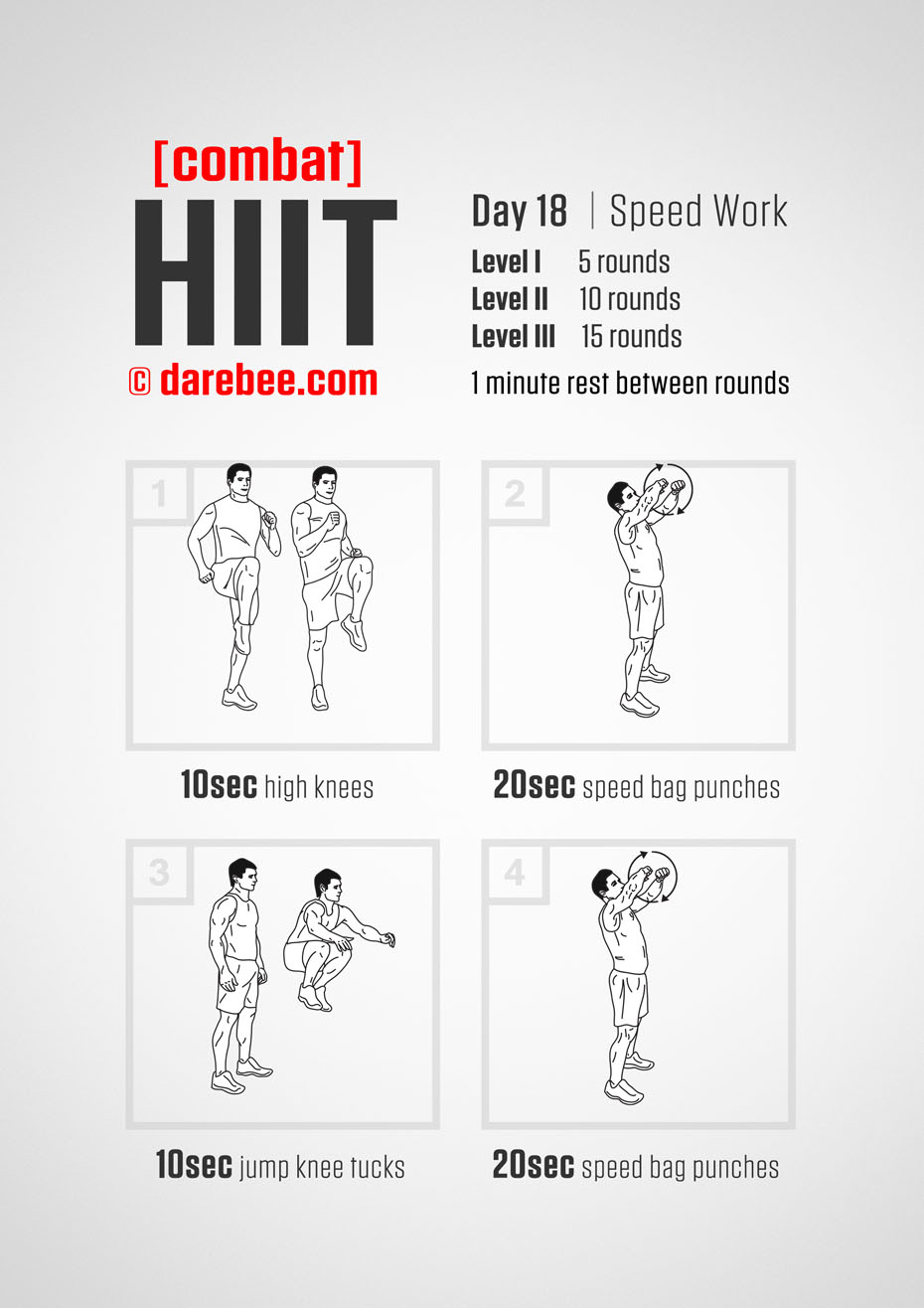
Day 18 adds flight. The Speed Work structure runs 10 seconds of high knees, 20 seconds of speed bag punches, 10 seconds of jump knee tucks and 20 seconds of speed bag punches again, at 5, 10 or 15 rounds. The jump knee tuck is the only genuinely airborne exercise in the whole program, and it shows up here for a reason.

That reason is what it does to your heart rate. Ten seconds of maximal jumping - knees driven to the chest mid-air - spikes the pulse harder than anything else on these cards, and the very next interval demands fast, precise hands. That is the drill: hand speed on a redlined engine. The high knees at the top of the round are the gentler version of the same idea, a warm spike before the full one, with speed bag rotation absorbing both.

Land every jump softly - toes first, knees bending to swallow the impact - and drive the knees up toward the chest rather than kicking the heels back. Reset in a breath and go again; ten seconds only fits a handful of jumps, so make each one count. In the speed bag intervals, the test is posture under fatigue: elbows high, fists circling at forehead height, even while your lungs lobby for lower arms.

Ten seconds of flying, twenty seconds of fast hands - speed work just discovered altitude.

Make it Harder: Tuck the knees higher on every jump - aim them at your chest, not your waist.

Make it Easier: Swap the jump knee tucks for fast bodyweight squats and keep everything else as written.

Program Index - click the days to navigate


COMBAT HIIT by DAREBEE

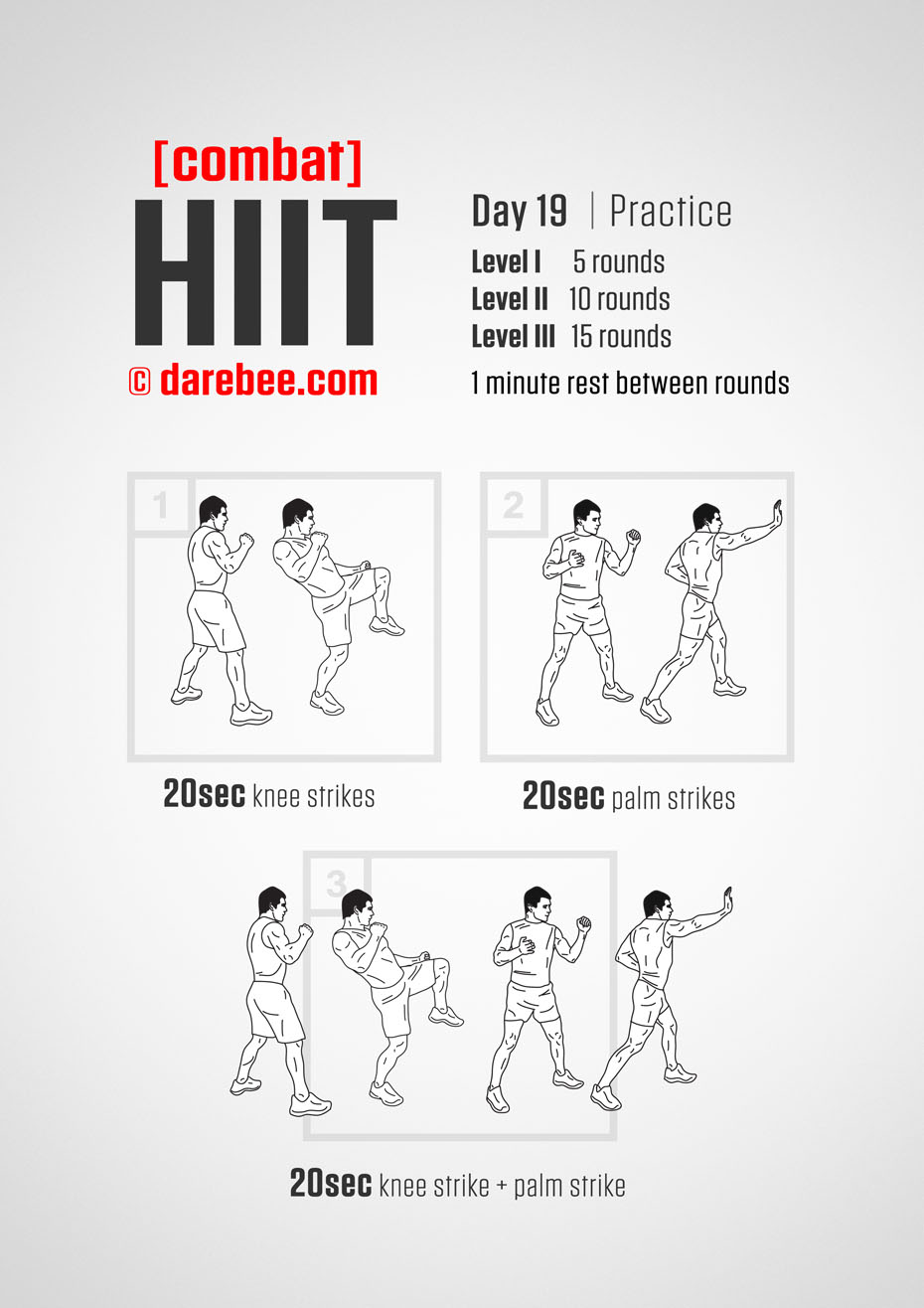
Day 19 runs Day 9's blueprint with a new weapon. The Practice format is the same trio shape - 20 seconds of knee strikes, 20 seconds of palm strikes, 20 seconds of the knee strike + palm strike combination - at 5, 10 or 15 rounds. Elbows out, palms in.

The palm strike is the pragmatist of the striking family: all the power of a straight punch delivered through the heel of the hand, with the wrist stacked safely behind it. It rewards exactly the same mechanics you have been drilling - rotation from the hips, extension, snap back - which is why it slots so cleanly into the knee strike pairing. The combination flows on a natural rhythm: the knee rises and plants forward, and the palm strike fires off the step it just created.

Pull the fingers back, lead with the heel of the palm, and drive it straight out with the same hip turn as a punch - this is not a push, it is a strike that happens to be open. Knee strikes keep their Day 9 standard: hips driving up and through, hands snapping down, tall on the standing leg. In the combination, let the knee's forward momentum load the palm strike so the two moves share one wave of power.

Same close-range grammar as Day 9, new vocabulary - your infighting now speaks two dialects.

Make it Harder: Exhale sharply on every strike - breath timing is power timing, and today is the day to wire it in.

Make it Easier: Shadow the strikes at half reach until the knee-to-palm rhythm feels smooth, then extend.

Program Index - click the days to navigate


COMBAT HIIT by DAREBEE

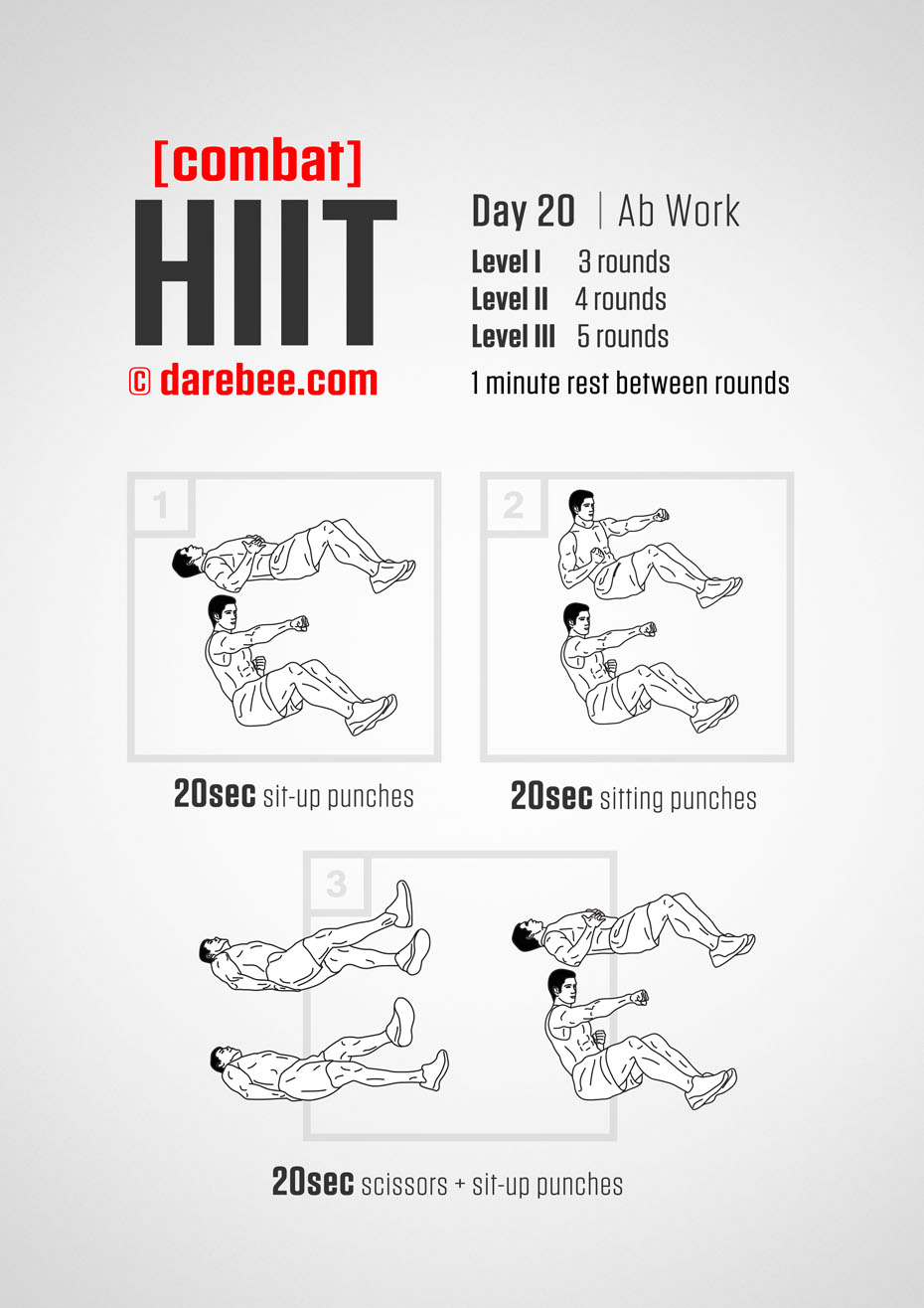
Day 20 hands the core a hybrid. Three 20-second stations: sit-up punches and sitting punches - Day 4's opening pair, now a third longer - and a new finisher that alternates scissors with sit-up punches inside a single interval, at 3, 4 or 5 rounds.

The hybrid is the interesting one. Scissors work the lower abs and hip flexors with the legs long and crossing; sit-up punches work trunk flexion and rotation up top. Alternating between them within one 20-second window means the entire abdominal wall trades the workload back and forth with no seam in between - the legs rest while the trunk punches, the trunk rests while the legs scissor, and the abs as a whole never do.

Keep the scissors low and straight-legged, crossing at the ankles just above the floor, with the lower back pressed down. When you transition to the sit-up punches, do it without parking - flow from legs to trunk and back in one continuous piece of work. The familiar stations keep their standards: full rise and full punches on the sit-ups, long spine and honest lean on the sitting punches.

Scissors below, punches above, and not a single second where your abs are off duty.

Make it Harder: Keep the heels hovering off the floor for the entire final interval - through the punches too.

Make it Easier: Bend the knees slightly during the scissors and shorten the leg lever.

Program Index - click the days to navigate


COMBAT HIIT by DAREBEE

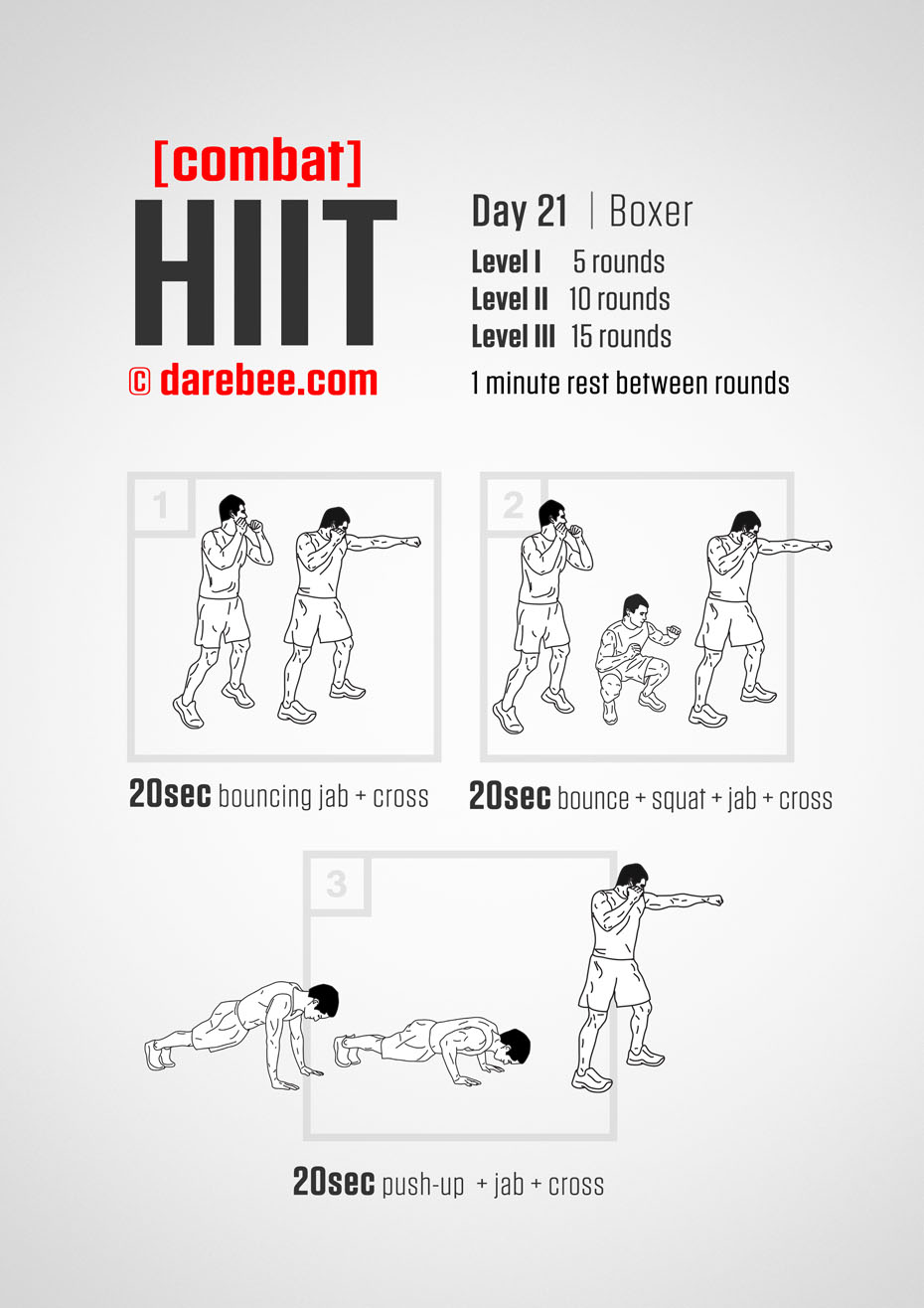
Day 21 belongs to the sweet science. The Boxer session runs three 20-second blocks - bouncing jab + cross, bounce + squat + jab + cross, push-up + jab + cross - at 5, 10 or 15 rounds, and every one of them is built around the same idea: punching off a moving base.

The bounce is the ingredient the program has been saving. Staying live on the balls of the feet between combinations is how boxers keep their punches connected to their footwork, and the first block drills exactly that rhythm - bounce, bounce, jab-cross, bounce. The second block adds a level change: drop into a squat as if slipping under a hook, then rise firing. The third block takes the base away entirely and makes you rebuild it - down for a push-up, up to the feet, jab-cross before the stance has time to go stale.

Keep the bounce small and springy - centimetres, not hops - and never let it stop while you are standing. In the squat block, drop under the imaginary punch with the back straight and the eyes forward, and let the rise power the jab. On the push-up block, get up quickly but land in your stance before the hands fire: a punch thrown off crossed feet teaches the wrong lesson. Turn every cross fully from the hip.

Twenty days of striking, and today it all learns to move to a boxer's beat.

Make it Harder: Keep the feet live for the entire round - the bounce resumes the instant you are up from every push-up.

Make it Easier: Take the bounce out and throw every combination from a planted stance.

Program Index - click the days to navigate


COMBAT HIIT by DAREBEE

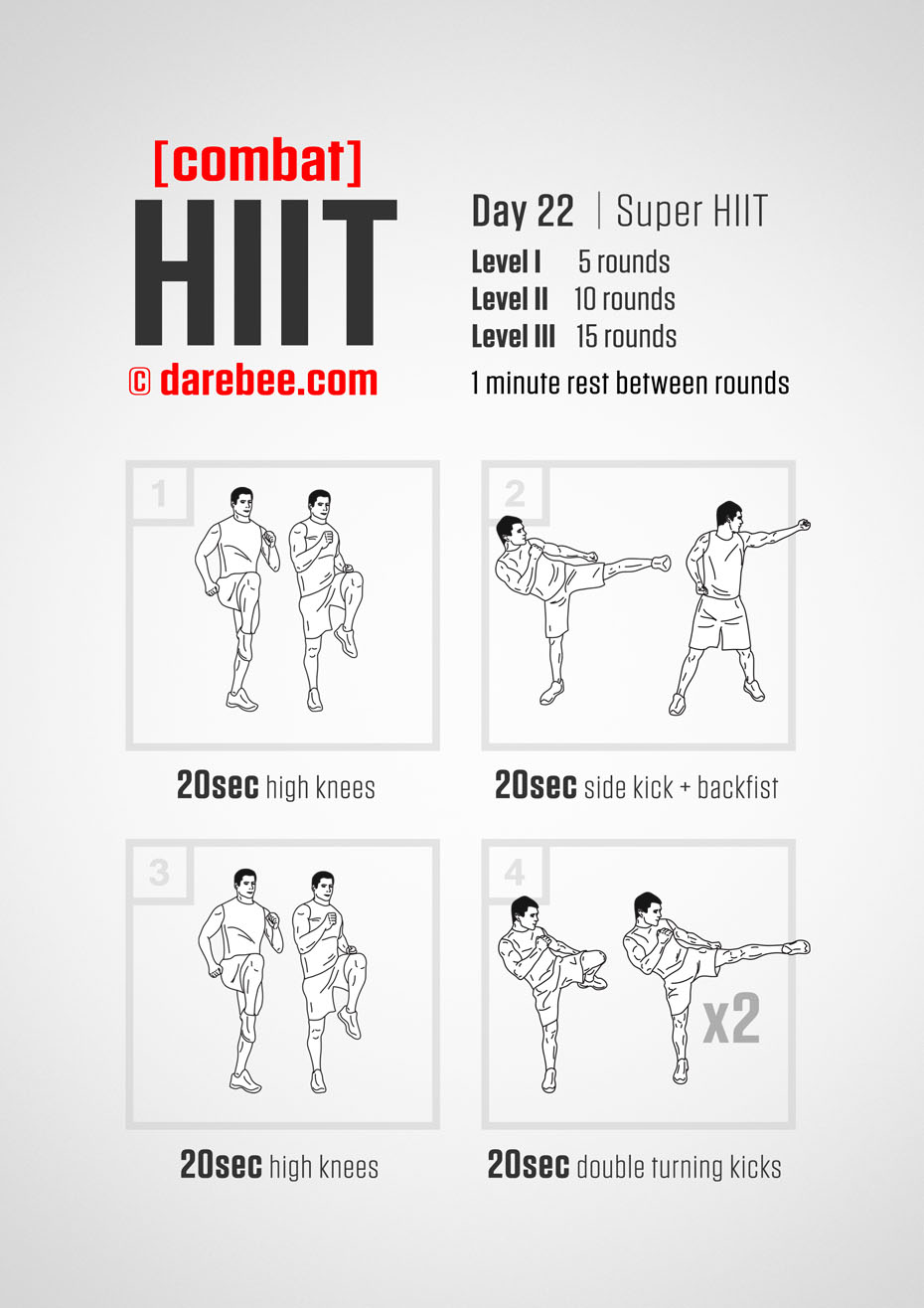
Day 22 is a Super HIIT with a first: doubles. Four 20-second intervals - high knees, side kick + backfist, high knees, double turning kicks - at 5, 10 or 15 rounds. The x2 on the card means two kicks thrown in succession before the foot resets: kick, re-chamber in the air, kick again, then land.

Doubling a kick without setting the foot down changes everything about it. The standing leg holds balance twice as long, the kicking hip has to reload from the chamber instead of from the ground, and the second kick exposes any laziness in the first - if the chamber collapses after kick one, kick two has nothing to fire from. The side kick + backfist block pairs foot and fist the other way around from Day 3, and the high knees intervals between are working recovery: legs moving, heart rate held, breath resetting.

On the doubles, make the second kick match the first - same height, same snap - by re-chambering fully between them; a strong kick followed by a leg wave is a single, not a double. In the side kick + backfist, land the kick, plant, and let the backfist whip out of the landing rotation. Use the high knees deliberately: hip-height knees, quick feet, and lungs refilling for the next technical block.

Two kicks, one landing - the doubles have arrived, and Day 30 is taking notes.

Make it Harder: Turn the doubles into triples - three turning kicks per chamber before the foot touches down.

Make it Easier: Set the foot down briefly between the two turning kicks and keep both at full quality.

Program Index - click the days to navigate


COMBAT HIIT by DAREBEE

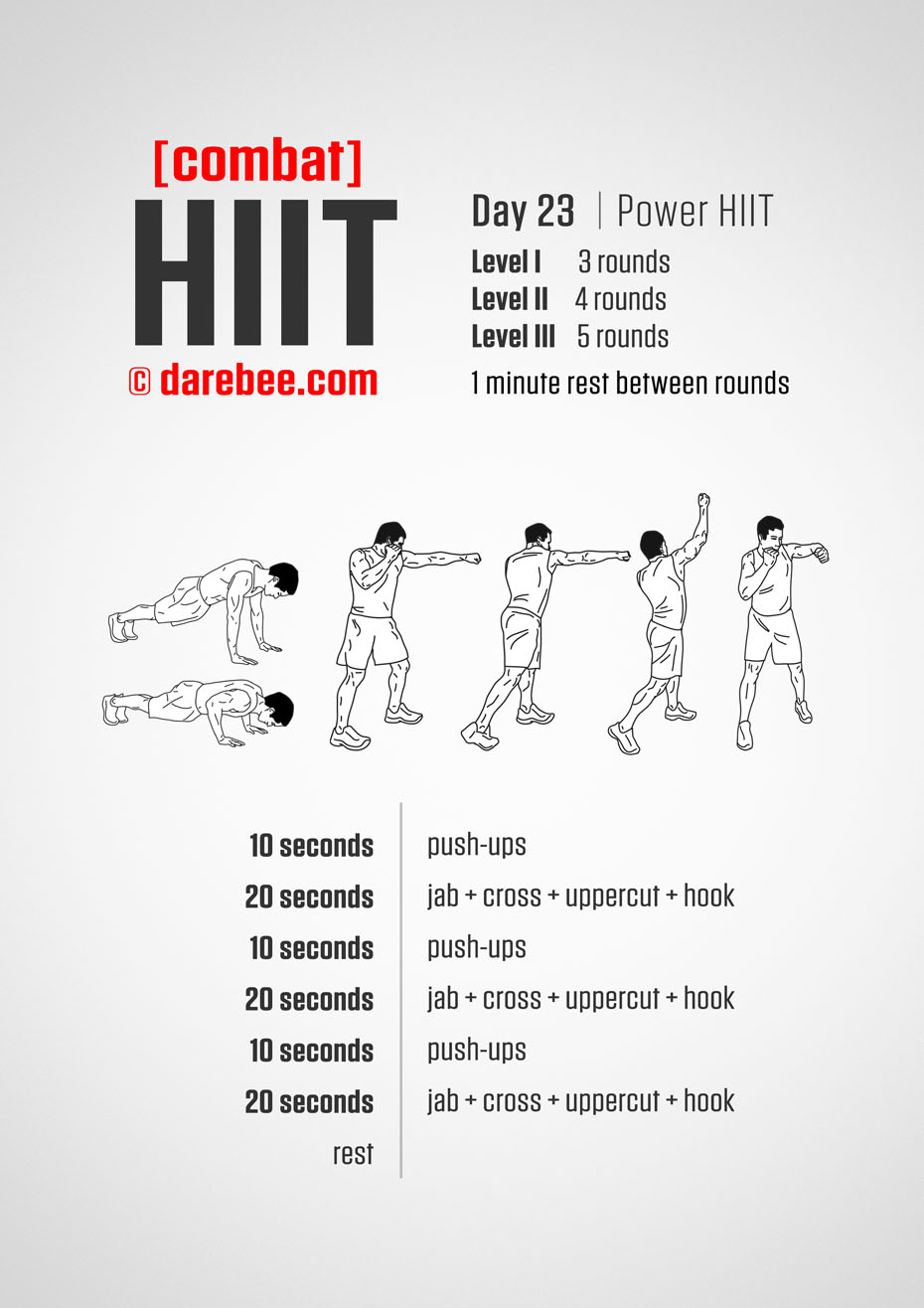
Day 23 assembles the full sentence. The Power HIIT structure - 10 seconds of push-ups into 20 seconds of punching, three times per round at 3, 4 or 5 rounds - now carries the longest hand combination in the program: jab + cross + uppercut + hook, on repeat, for every punching block.

Every piece of this chain was installed separately: the jab and cross from Day 1's punches, the uppercut and hook from Day 10's introductions. Today they run in sequence, and the sequence is the skill - four punches through four different angles, straight, straight, rising, curving, each one flowing out of the rotation the previous one created. The push-up bursts in between guarantee the chains are thrown on heavy arms, because a combination you can only throw fresh is a combination you do not own.

Keep the four punches distinct: full jab, full cross, a genuine dip-and-rise on the uppercut, and a horizontal hook with the elbow up - no blurring the last two into one circular smear. Reset the guard after every hook before the next jab leaves. The push-ups hold their depth to the final block; the chain deserves arms that earned their fatigue honestly.

Jab, cross, uppercut, hook - four punches, one breath, and no passengers anywhere in the chain.

Make it Harder: Switch stance every round and run the entire chain off your other lead.

Make it Easier: Trim the chain to jab + cross + hook until the rhythm settles, then restore the uppercut.

Program Index - click the days to navigate


COMBAT HIIT by DAREBEE

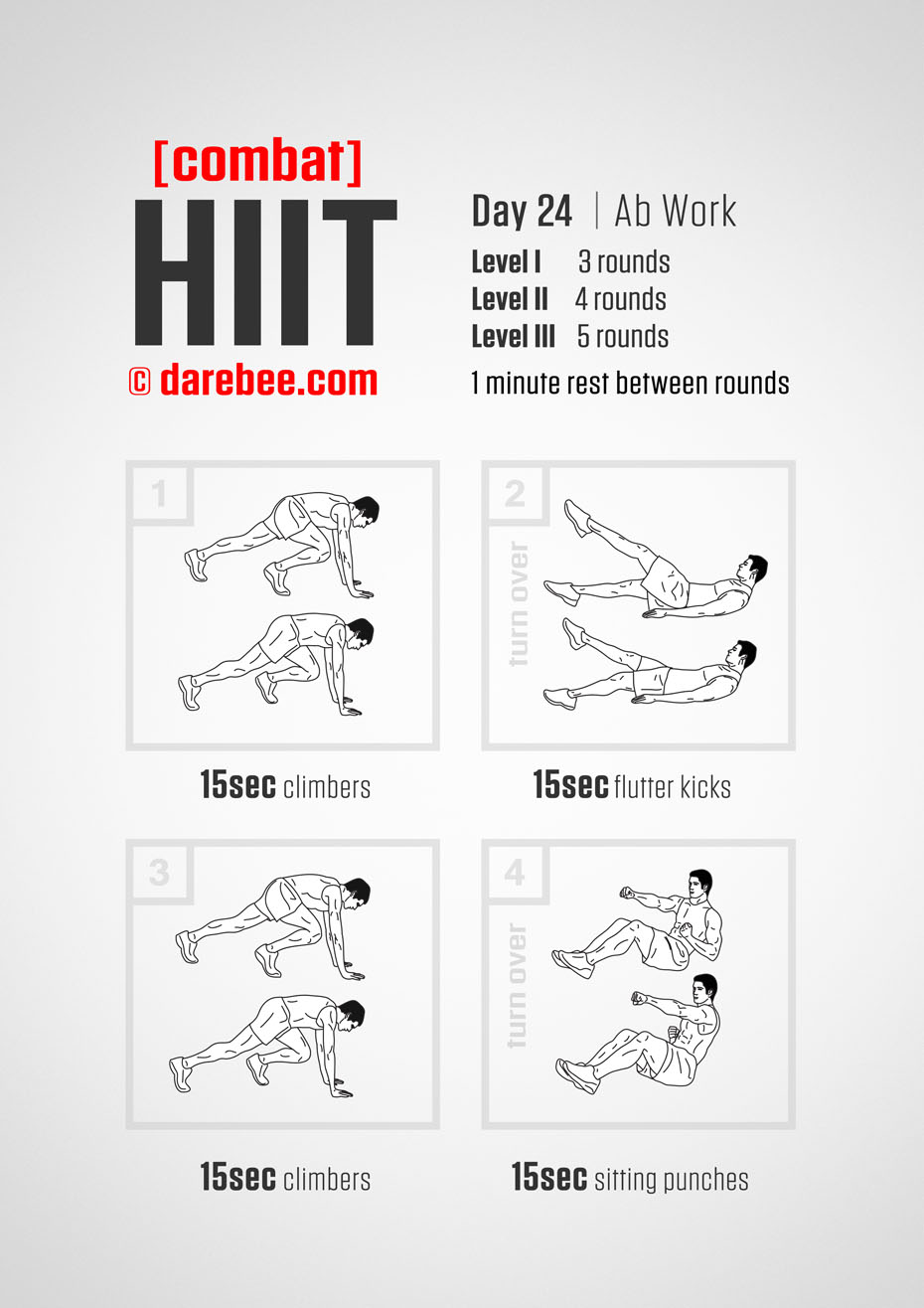
Day 24 doubles the flips. Four 15-second stations alternate face-down and face-up work - climbers, flutter kicks, climbers, sitting punches - with a turn over between each, at 3, 4 or 5 rounds. Day 12 introduced this format; today it returns with fresh cargo in the face-up slots.

The climbers bookend the round for a reason: they are the station that keeps the heart rate tall, so the ab work in between happens breathless - flutter kicks and sitting punches performed the way a fighter's core actually operates, mid-effort rather than fresh. The two face-up stations split the territory neatly: flutters take the lower abs with the legs long, sitting punches take the trunk with the fists working, and the flips stitch it all into one continuous, scrambling round.

Climber standards hold from Day 12 - hips low and level, knees driving to the chest, shoulders stacked over the wrists. Flip fast but arrive organised: the clock does not wait for you to arrange yourself. Flutter kicks stay small and relentless; sitting punches keep the long spine and land every punch with a turn of the ribs, even at the end of the round when the turning is the hard part.

Down, up, down, up - fifteen seconds at a time, your core learns to fight from every position it owns.

Make it Harder: Sprint the second climber block flat out - it is the last one, spend everything.

Make it Easier: Slow the climbers to a controlled march and keep the face-up stations at full effort.

Program Index - click the days to navigate


COMBAT HIIT by DAREBEE

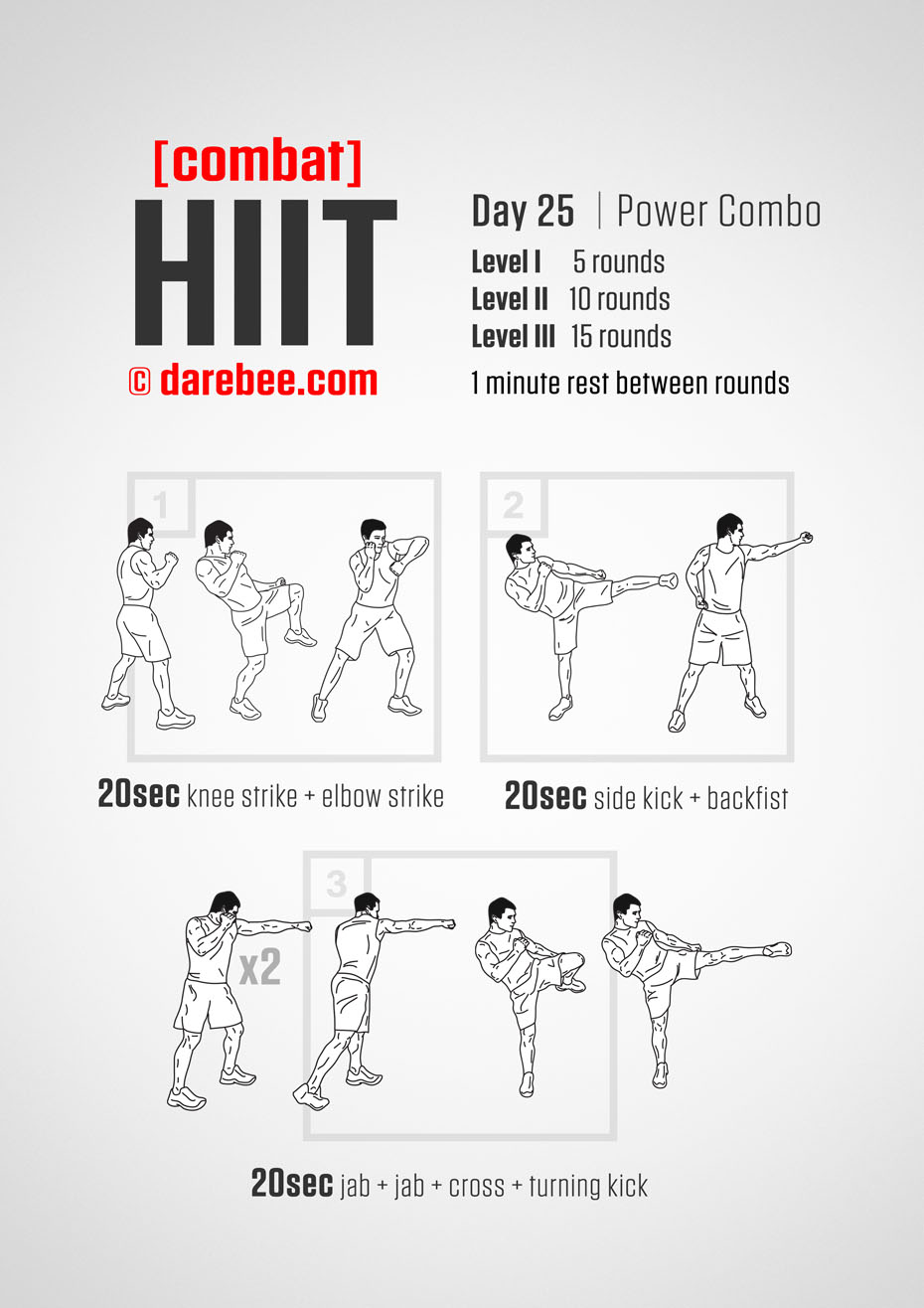
Day 25 is the Power Combo - the day the program's techniques speak in full sentences. Three 20-second blocks: knee strike + elbow strike, side kick + backfist, and the longest chain on any card this month - jab + jab + cross + turning kick, the double jab marked x2. Levels run 5, 10 or 15 rounds.

Every block is a reunion. The knee + elbow pairing comes from Day 9, the kick + backfist from Day 22, and the finale chains the oldest skills in the program into something new: two jabs to find the range, a cross to commit, and a turning kick arriving as the cross retracts. The double jab is a real boxing habit - the first jab asks the question, the second confirms the answer - and the kick at the end only lands cleanly if the three punches before it kept the body organised.

Flow is the standard today. In the finale, the turning kick should leave as the cross comes back - no pause, no reset, one continuous wave from fists to foot. Keep both jabs honest, full extensions rather than flicks. The first two blocks hold their original standards: knees driving up with the hands pulling down, side kicks landing into the rotation that whips the backfist out.

Everything you have drilled for twenty-four days just learned to talk in complete sentences.

Make it Harder: Compress the four-strike chain until it takes under three seconds - then hold that speed for the interval.

Make it Easier: Break the chain in the middle - jab, jab, breathe, cross + kick - until the pieces reconnect on their own.

Program Index - click the days to navigate


COMBAT HIIT by DAREBEE

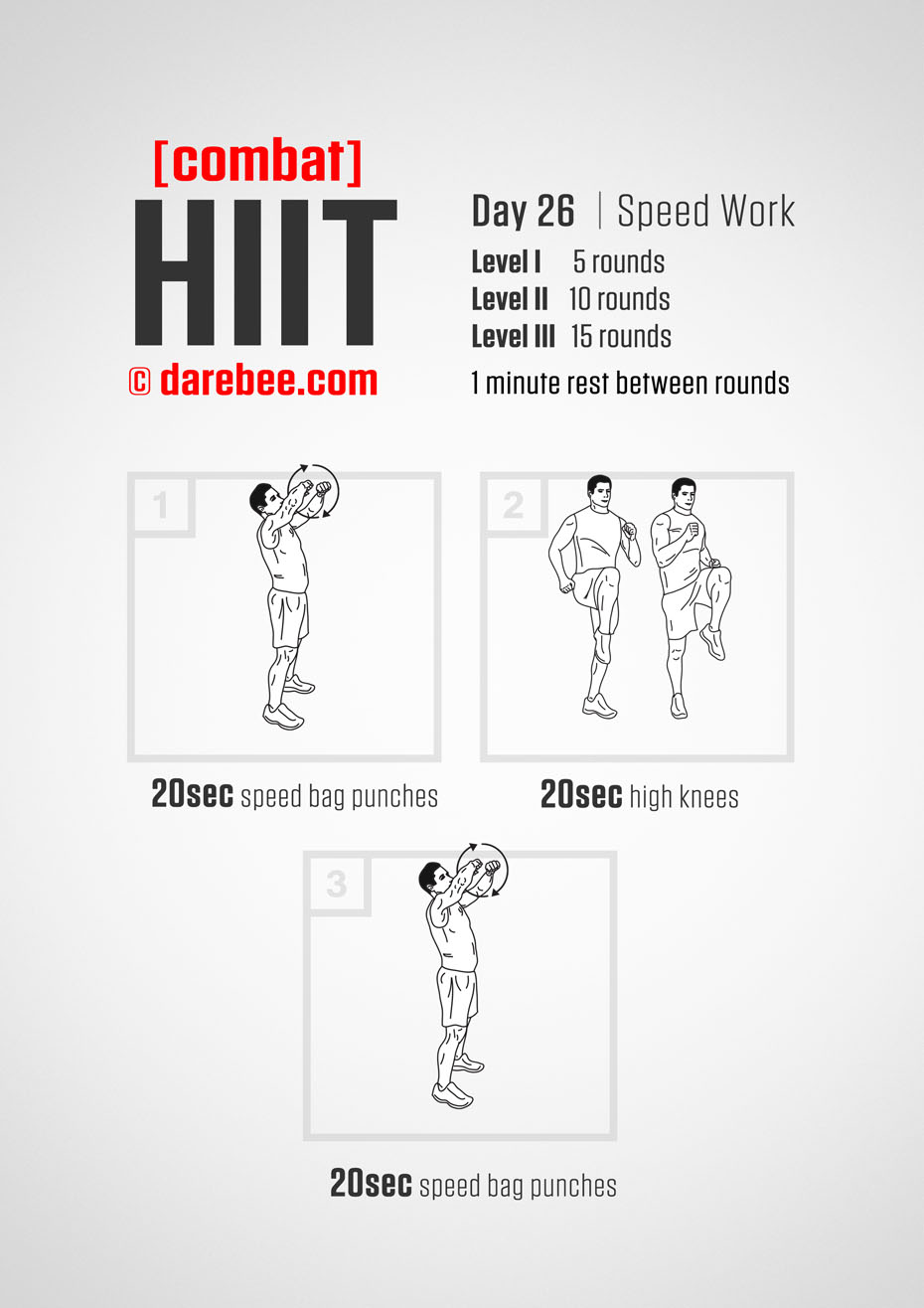
Day 26 is the last Speed Work session and the simplest card in the program: 20 seconds of speed bag punches, 20 seconds of high knees, 20 seconds of speed bag punches, at 5, 10 or 15 rounds. Two rotation blocks with a leg interval between them - and a built-in test.

The test is the comparison. Block one is your rotation speed fresh; block three is your rotation speed after the high knees have taxed the lungs. Three speed days ago that gap would have been wide - narrowing it is precisely what Days 5 and 18 were building toward, because a fighter's hand speed only matters if it survives their heart rate. The simplicity of the card is the point: nothing to think about, nowhere to hide, just hands and their honest velocity.

Rotation standards for the final time: fists at forehead height, elbows up, circles small and continuous for every one of the 20 seconds. Run the high knees properly - hip height, fast turnover - because a soft middle interval makes the third block an easier test than you deserve. When the arms beg to drop in block three, that is the exact moment the session was designed for.

First block against third block - the month of speed work lives in the space between those two numbers.

Make it Harder: Count your rotations in the first block and refuse to come in under that number in the third.

Make it Easier: Lower the fists to chest height for the rotations and keep them turning without pause.

Program Index - click the days to navigate


COMBAT HIIT by DAREBEE

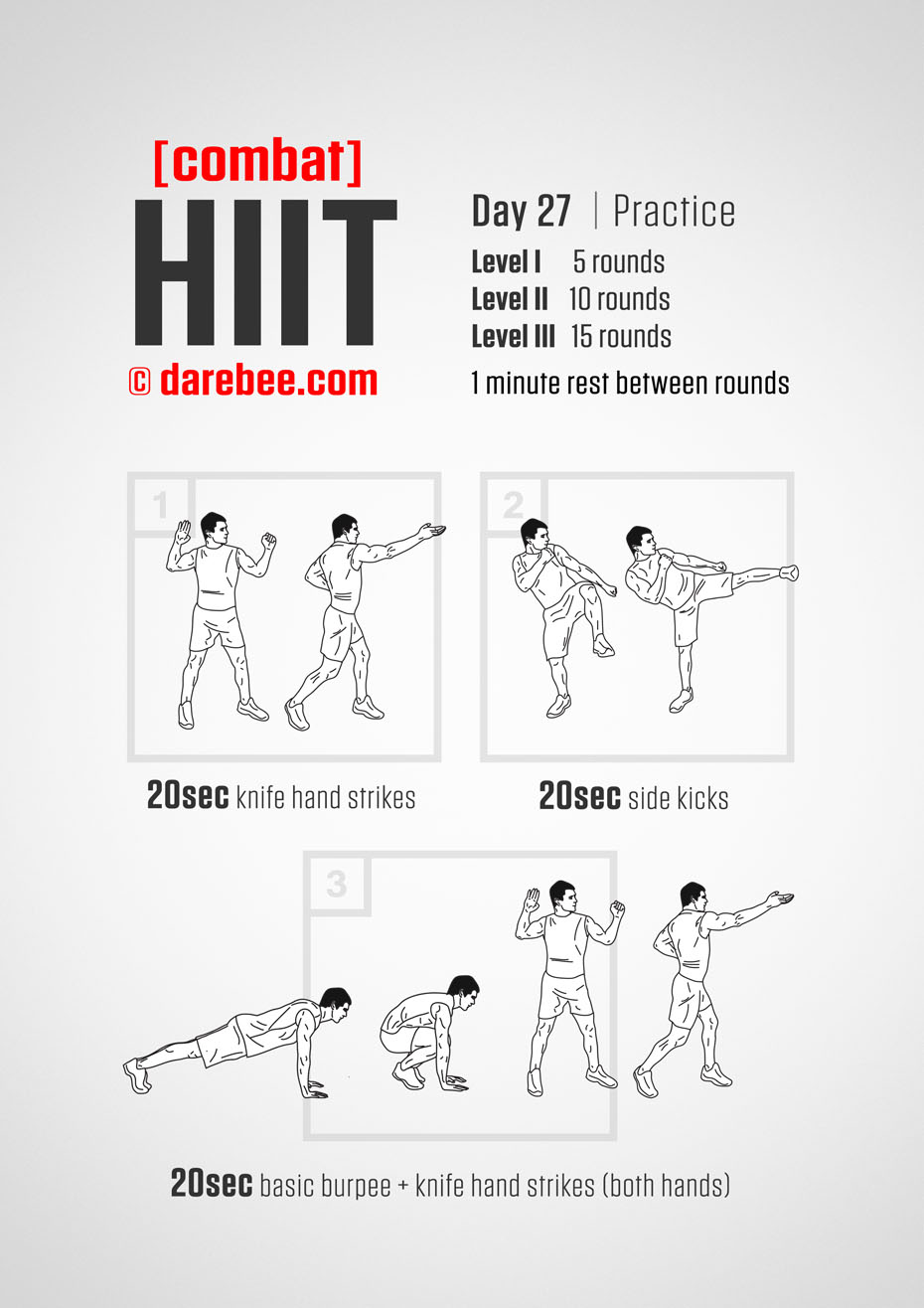
Day 27 is the final Practice session - the last technique check of the program. Three 20-second blocks: knife hand strikes, side kicks, and the basic burpee + knife hand strikes with both hands, at 5, 10 or 15 rounds. Day 14's open-hand work returns, this time keeping company with the program's most-travelled kick.

This is a measuring day disguised as a workout. The burpee-to-strike transition felt clumsy for most people on Day 14 - two weeks later, the floor should release you faster, the stance should assemble itself, and the chops should arrive relaxed instead of rushed. The side kicks in the middle are the program's oldest technique getting its final formal appearance: same chamber, same heel drive it asked of you on Day 1, now thrown by a different athlete.

Keep the knife hands loose until impact - blade of the hand, fingers together, hips turning behind every chop. Side kicks at full standard: chamber to the chest, drive, re-chamber, set down. In the finale, snap through the burpee and rise straight into your stance, right chop, left chop, down again - and notice how much shorter the gap between floor and strike has become since the first time you tried it.

The last Practice day does not teach anything new - it just shows you how much the old things have changed.

Make it Harder: Kill the pause entirely - the first chop leaves the moment you are upright, not a beat after.

Make it Easier: Trade the burpee for a deep squat and keep both strikes at the top of every rep.

Program Index - click the days to navigate


COMBAT HIIT by DAREBEE

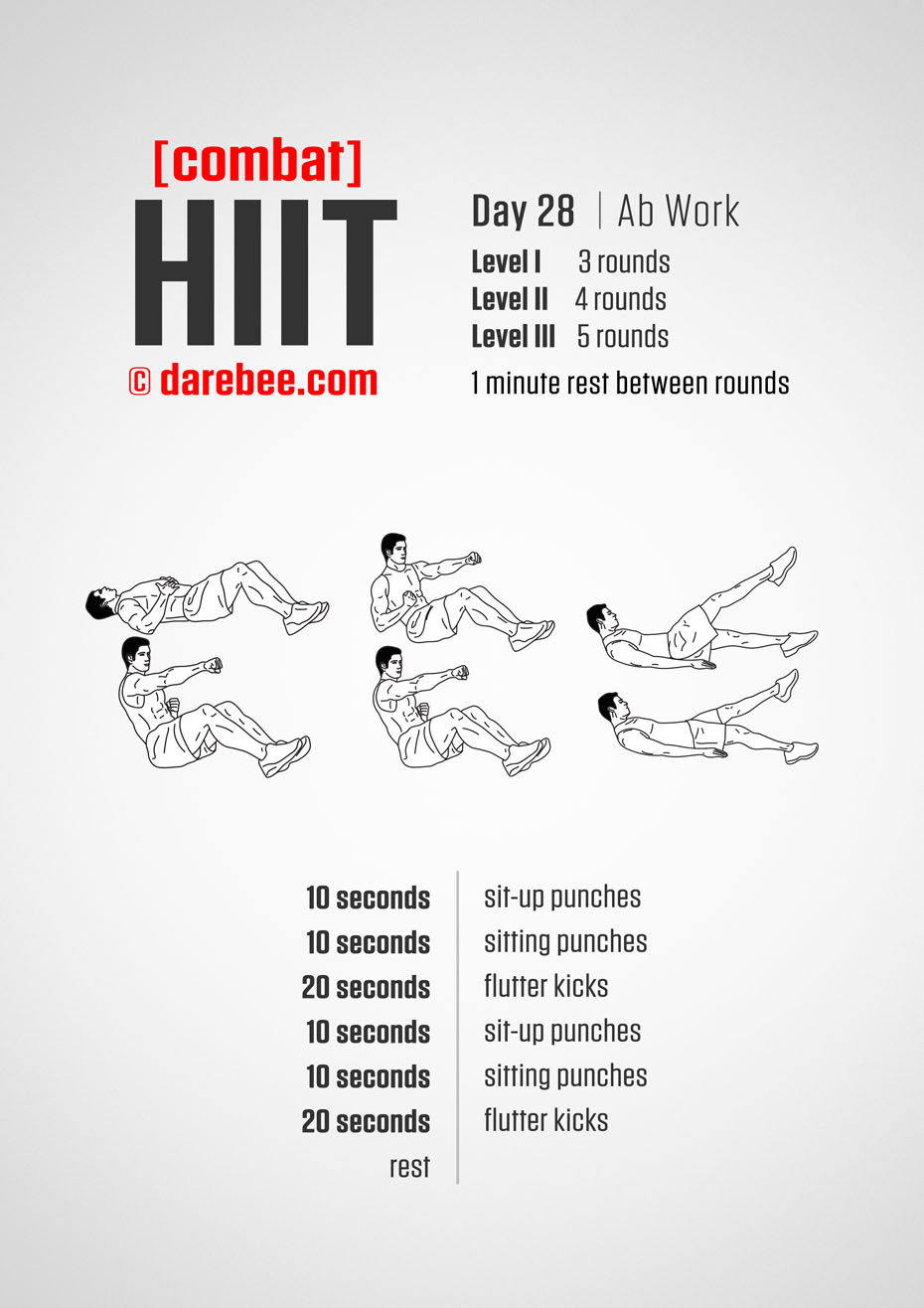
Day 28 is the final core session, and it moves in bursts. The round runs 10 seconds of sit-up punches, 10 seconds of sitting punches, 20 seconds of flutter kicks - then repeats that trio immediately before the rest arrives, at 3, 4 or 5 rounds. Six blocks, eighty seconds, everything an old friend.

Ten-second intervals change the arithmetic. There is no pacing a 10-second block - it is over before any strategy applies - so both punch stations become pure sprints, full output from the first rep. The 20-second flutter kicks are the endurance counterweight, twice the length arriving exactly when the trunk has just emptied itself twice. Every exercise here debuted on Day 4 or Day 20; today's exam sets familiar questions and simply demands faster answers.

Transitions decide this session: 10 seconds disappears fast, so move between positions without a single wasted beat. Sit-up punches at full rise and full extension, sitting punches with the long spine, flutters low and pressed-back-down - the standards do not soften because the clock got shorter. When the second flutter block burns, remember it is the last 20 seconds of core work in the program, and act accordingly.

Four Ab Work days, four weeks, and a midsection that punches back - the core curriculum closes here.

Make it Harder: Keep the shoulders off the floor from the first sit-up punch to the final flutter kick.

Make it Easier: Rest the heels on the floor for the sitting punches and keep everything else honest.

Program Index - click the days to navigate


COMBAT HIIT by DAREBEE

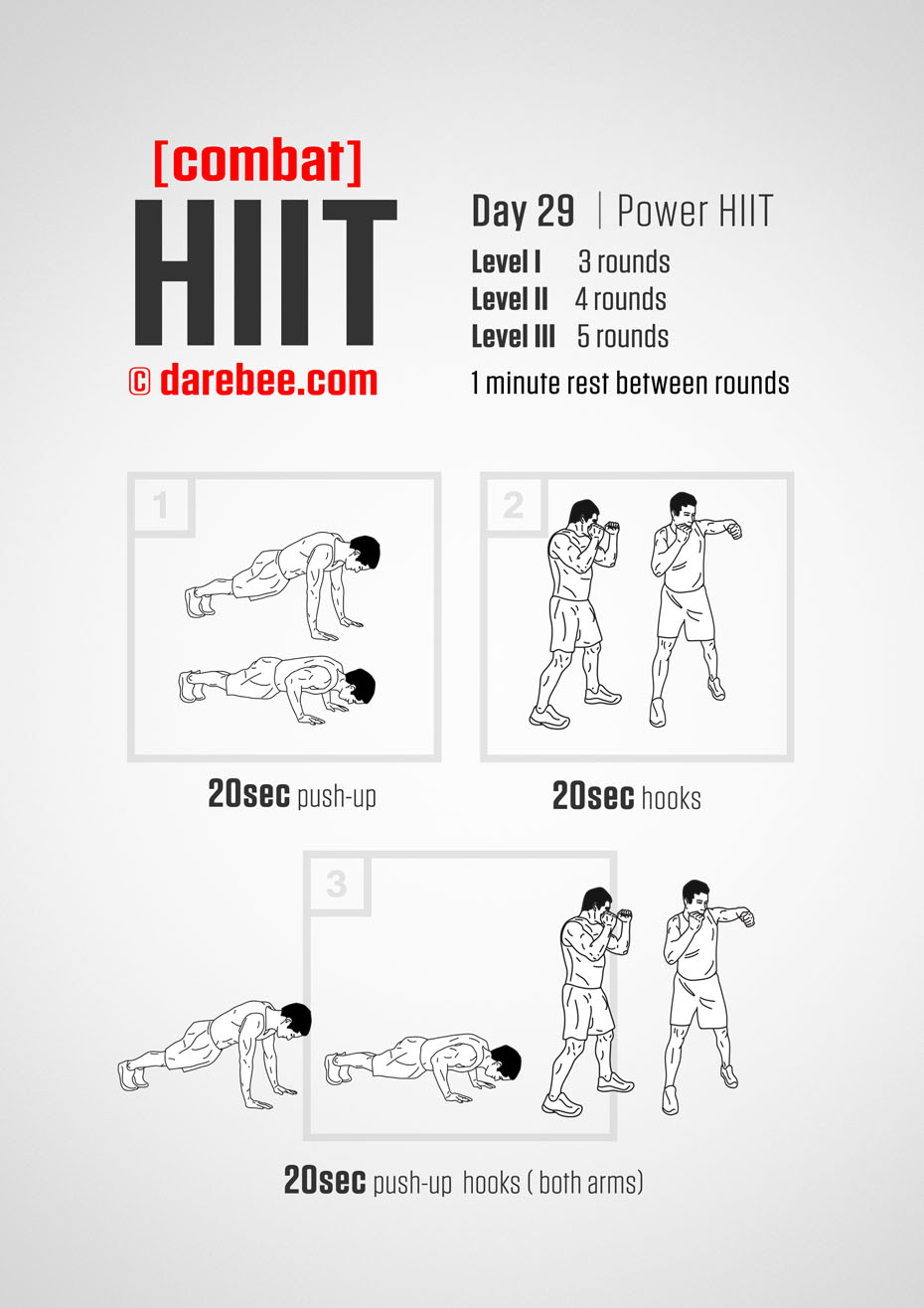
Day 29 is the last Power HIIT, and it closes a circle that opened on Day 2. Three 20-second blocks: push-ups, hooks, and then the fusion - push-up hooks, where you press up from the floor, rise to your stance and throw a hook with each arm before going back down. Levels run 3, 4 or 5 rounds.

Four weeks ago push-ups and punches shared a round but took turns. Today they become one exercise. The push-up hook is the program's floor-to-strike transition in its final form: the press-up flows into the stand, the stand flows into the pivot, and the two hooks land off legs that just finished pushing the floor away. The middle block of standing hooks is there as the reference - crisp, planted, Day 10's angles at full quality - so the hybrid block has a standard to be measured against.

Full-depth push-ups in block one, all the way to the final rep. Standing hooks with the elbow at shoulder height and the same-side foot pivoting - power from the turn, not the arm. In the hybrid, rise smoothly, set the feet, left hook, right hook, and return to the floor under control: the goal is a seamless loop, not a scramble. Smooth is what four weeks of this transition were for.

Push-up and punch walked in separately on Day 2 - they leave the program as a single movement.

Make it Harder: Sneak a jab + cross in before the hooks on every rise - four strikes per trip off the floor.

Make it Easier: Spend the hybrid block on push-ups alone and let block two carry all the hooks.

Program Index - click the days to navigate


COMBAT HIIT by DAREBEE

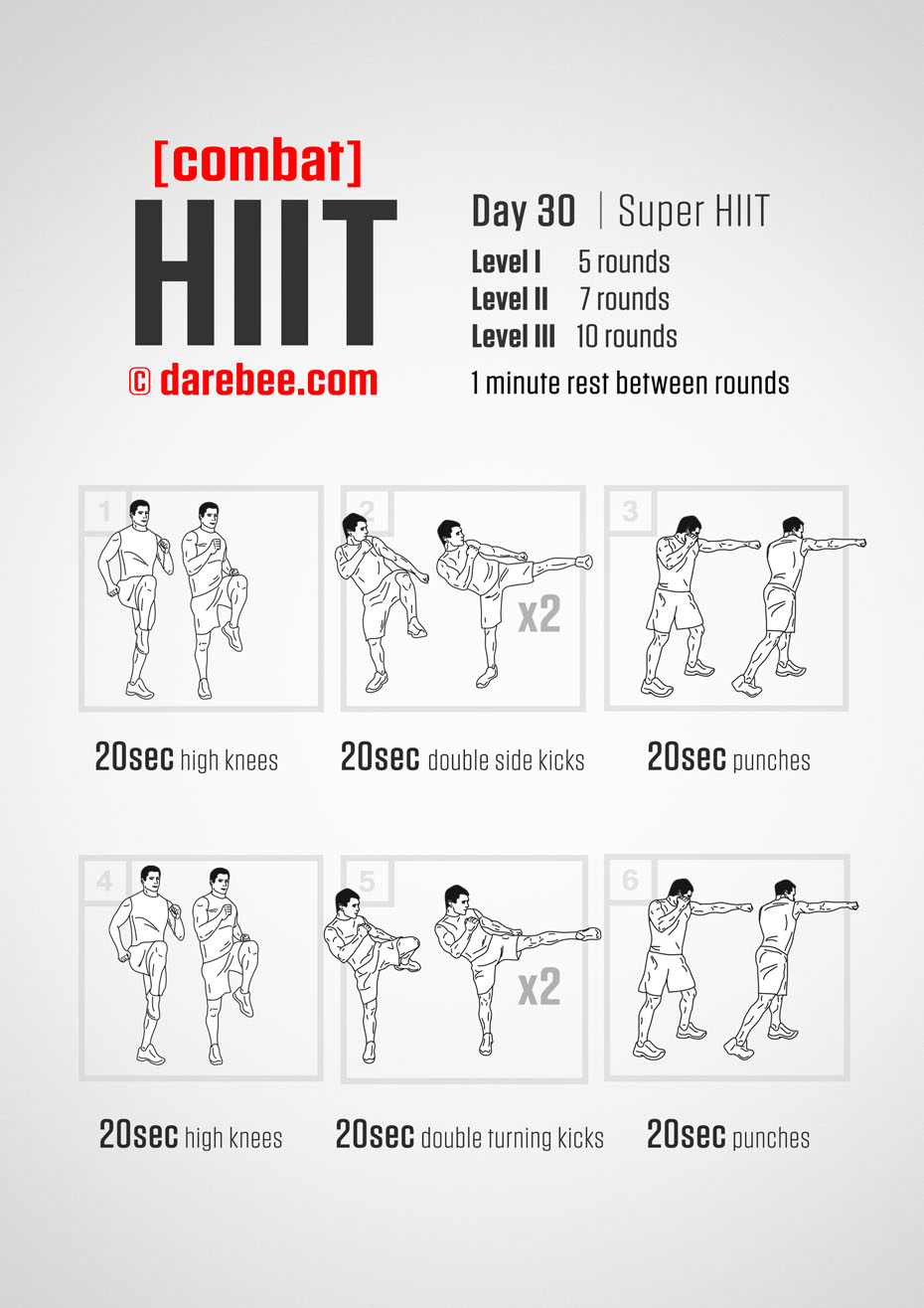
Day 30 is the graduation exam, and you have already sat the mock. This Super HIIT runs Day 11's exact six-interval structure - high knees, side kicks, punches, high knees, turning kicks, punches, 20 seconds each, at 5, 7 or 10 rounds - with one change: both kick blocks are now doubles. Two side kicks per chamber, two turning kicks per chamber, foot down only after the second one lands.

The upgrade is the whole message. On Day 11 you paced two-minute rounds built from singles; today the same rounds demand the balance, hip endurance and re-chambering skill that Days 22 and 25 installed - proof, written into the card itself, that the program moved you somewhere. The pacing lesson still applies: six intervals, the doubles buried in slots two and five, and the final punches waiting to find out whether you spent the round or invested it.

Hold the doubles to the Day 22 standard - full re-chamber between kicks, second kick matching the first for height and snap. Keep the high knees at hip height and use them to breathe. And throw the last 20 seconds of punches of the entire program the way you threw the first ones on Day 1: guard up, hips turning, every rep meant. Then go find out what your Day 11 self would make of you.

Day 11 asked the question - Day 30 answers it, in doubles.

Make it Harder: Take on Level III today even if you have lived at Level II all month - this is the day it was saved for.

Make it Easier: Drop to single kicks wherever the doubles break your balance - finishing all six intervals outranks everything.

Program Index - click the days to navigate

DONE
Done it
5
done since August 2026

Darebee buzzes like a bee just like my wife of 1000 years, oh I love her like a cat! but I have to give darebee 1000 stars because even with my rattly joints I can move like a belly dancer in the… Darebee buzzes like a bee just like my wife of 1000 years, oh I love her like a cat! but I have to give darebee 1000 stars because even with my rattly joints I can move like a belly dancer in the 1920's Yahooo!

Joe, 99, from South North Carolina

Started this website when my basketball coach recommended it to me. I love it because it's easy to use and free. This website also definitely works because I have seen numerous improvements. Thank… Started this website when my basketball coach recommended it to me. I love it because it's easy to use and free. This website also definitely works because I have seen numerous improvements. Thank you DAREBEE!

Big Drew, 14, from USA

Excellent work you guys doing here. No words of thanks are enough to express what I feel for you. My journey in training began through you, and even now, whenever I stop and return, you are the… Excellent work you guys doing here. No words of thanks are enough to express what I feel for you. My journey in training began through you, and even now, whenever I stop and return, you are the first people who come to mind.

OB, 38, from Jordan