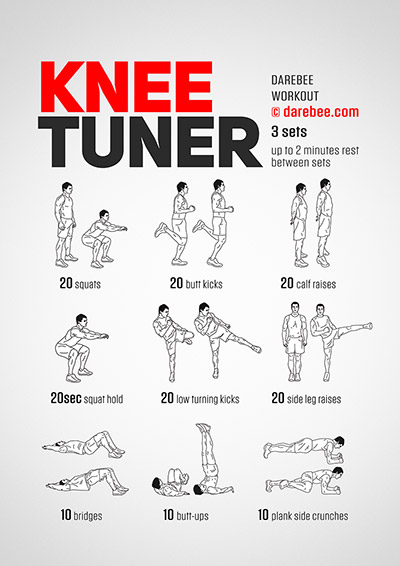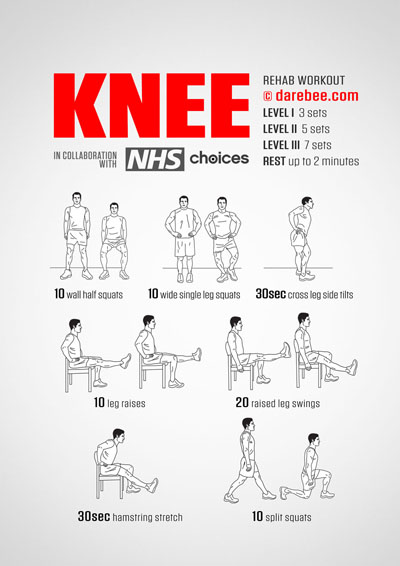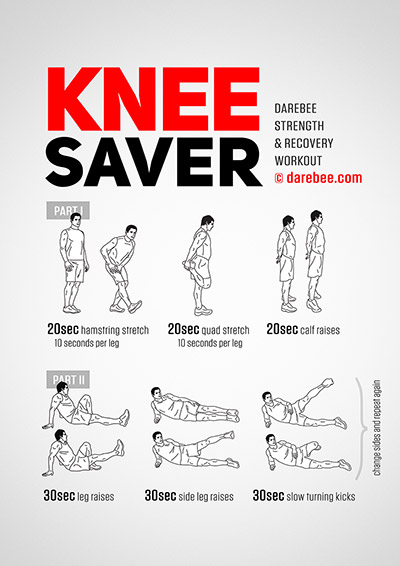
The knee looks simple next to the shoulder - a hinge between thigh bone and shin bone, with the kneecap gliding in front - and its injury statistics prove the look deceiving: it is one of the most frequently hurt joints in the body, because it carries every step, absorbs every landing, and twists in sports it was only ever designed to hinge through. Knee trouble comes in three broad kinds - sprains and strains of its ligaments and supporting tissue, the gradual wear of the cartilage cushioning the bone contact, and the serious internal injuries that need a professional's eyes - and the rule that governs all three is the same one the shoulder guide runs on: a persistent or serious knee gets diagnosed by a doctor or physiotherapist, while everything below prepares that visit, explains the recovery principles, and maps DAREBEE's knee-friendly work into them.
When To See Someone, And How Fast
Straight to urgent care: a knee that gave way with a felt or heard pop and swelled within hours (the classic signature of a cruciate ligament tear); a knee that cannot bear weight; visible deformity; a joint locked and unable to straighten; or a hot, swollen, feverish knee. Prompt regular appointment: pain persisting past a week or two of sensible easing, recurrent swelling, a knee that repeatedly buckles or catches, or grinding pain that is changing how you walk. The cruciate ligaments deserve their own line because they are the injury everyone fears: the ACL and PCL cross inside the joint itself, they tear in the pivoting sports - football, skiing, basketball - and they are specialist territory, though not automatically surgical territory: in the landmark randomized trial of young active adults with ACL tears, structured rehabilitation with the option of later surgery produced outcomes comparable to early reconstruction, with roughly half the rehab-first group never needing the operation.[1] The decision belongs to the specialist and the athlete together - and either way, the muscles around the knee do the heavy lifting of recovery, which is where training comes in.
The Recovery Principles
For the ordinary tier - the tweaks, mild sprains and grumbling knees of training life - modern soft-tissue care has moved past the old prescription of ice, rest and waiting. The current shape: protect briefly (a few days of relative rest, easing off what provokes pain - ice and compression are fine for early comfort and swelling), then reload progressively, because joints and their tissues heal along the lines of the gentle stress applied to them, and the knee that moves early within comfort recovers range and confidence that the fully rested knee has to rebuild later. Gentle motion first - lying leg slides, easy extensions, comfortable-range cycling - then strengthening, then the return ramp with the usual 10-20% patience. Pain is the dosing instrument throughout: mild, settling-by-tomorrow discomfort is acceptable working territory; sharp pain, swelling that returns, or a knee less trusting than yesterday mean the dose was too big.
Strength Is The Knee's Best Medicine
The knee is stabilized by four muscle groups - quads, hamstrings, calves and the hip stabilizers around the pelvis - and strengthening them is not just rehabilitation but treatment and prevention in one, with unusually strong evidence behind it. For the wear-and-tear knee, the Cochrane review of exercise for knee osteoarthritis found strength and aerobic work reducing pain and improving function on the order of proper medical treatments[2] - the worn knee's counterintuitive prescription is more movement, well dosed, not less. For prevention and re-injury protection, the pooled trials put strength training's injury reduction at 68% across 26,610 participants,[3] and the mechanical logic is simple: strong muscles absorb the forces that would otherwise arrive at the joint's passive structures. The hip stabilizers earn special mention - a knee that caves inward on landings and squats is usually reporting weak hips above it, not weakness of its own - and every kilogram of the squat-lunge-bridge-calf-raise family is load the ligaments and cartilage no longer carry alone.
Workouts for the Knees
Common Mistakes
- Resting completely until all pain is gone. The immobilized knee stiffens and weakens while it waits. Brief protection, then progressive reloading, is the modern method.
- Ignoring the pop-and-swell signature. Sudden swelling within hours of an injury is the cruciate ligaments asking for a professional. That appointment is not optional.
- Assuming a torn ACL means automatic surgery. The trial evidence says rehab-first with surgery as a preserved option matches early reconstruction for many - a specialist conversation, not a foregone conclusion.
- Rehabbing the knee and ignoring the hips. The inward-caving knee is a hip-strength complaint filed at the wrong address. The four muscle groups travel together.
- Sprinting the return ramp. The healed-feeling knee and the robust knee are separated by weeks of progressive loading. The ramp rules exist for exactly this joint.
What To Expect
Expect ordinary knee recoveries to run in the two-to-six-week range with strength work compressing the timeline and total rest stretching it; expect the serious tier to run on the specialist's schedule, in months, with the daily strengthening homework being the part that actually determines the outcome. Confidence returns behind capacity - the knee usually can before it trusts - and controlled, progressive loading is what closes that gap, one honest session at a time. Stairs and slopes report progress before flat ground does. And expect the durable finish the evidence keeps pointing at: the knee that comes back through the four muscle groups, hips included, is better defended than it was before the injury - the strength that rehabilitated it is the same strength that, kept up, makes the sequel far less likely.
The Goal: Route The Serious, Reload The Rest, Strengthen Forever
Recover a knee by tier: pop-swell-lock-buckle and can't-bear-weight go to professionals promptly (with ACL decisions made jointly with a specialist, surgery being an option rather than an automatic); the ordinary tier gets brief protection, early comfortable motion, then progressive strengthening of the four groups that stabilize the joint - quads, hamstrings, calves and the hips above - dosed by the settling-by-tomorrow pain rule. The Cochrane-grade evidence makes strength the worn knee's medicine and the pooled trials make it every knee's armor: the rehabilitation program, continued, is the prevention program.
Summary
The knee is a heavily loaded hinge injured three ways - sprains and strains, cartilage wear, and the serious internal tier. Route by red flag: pop-plus-rapid-swelling (the cruciate signature), inability to bear weight, locking, deformity or a hot swollen joint go to urgent care; persistent pain, recurrent swelling or buckling get a prompt appointment - and an ACL tear is a specialist conversation, not automatic surgery, since the randomized trial found rehab-first with optional later reconstruction matching early surgery, with about half never needing the operation. Ordinary-tier recovery: protect briefly (ice and compression for comfort), then reload progressively - gentle motion, then strengthening, then the 10-20% return ramp - dosed by mild-and-settling versus sharp-or-swelling pain. Strength is the treatment: the four stabilizing groups (quads, hamstrings, calves, hip stabilizers - weak hips being the usual culprit behind inward-caving knees) reduce joint load directly, exercise improves pain and function in knee osteoarthritis at Cochrane-review grade, and strength training cuts injuries 68% in the pooled trials. The program that rehabilitates the knee, continued, is the program that protects it.
Research
- 1. Frobell RB, Roos EM, Roos HP, Ranstam J, Lohmander LS. A randomized trial of treatment for acute anterior cruciate ligament tears. N Engl J Med. 2010 Jul 22;363(4):331-342. doi: 10.1056/NEJMoa0907797.
- 2. Fransen M, McConnell S, Harmer AR, Van der Esch M, Simic M, Bennell KL. Exercise for osteoarthritis of the knee. Cochrane Database Syst Rev. 2015 Jan 9;1:CD004376. doi: 10.1002/14651858.CD004376.pub3.
- 3. Lauersen JB, Bertelsen DM, Andersen LB. The effectiveness of exercise interventions to prevent sports injuries: a systematic review and meta-analysis of randomised controlled trials. Br J Sports Med. 2014 Jun;48(11):871-877. doi: 10.1136/bjsports-2013-092538.