
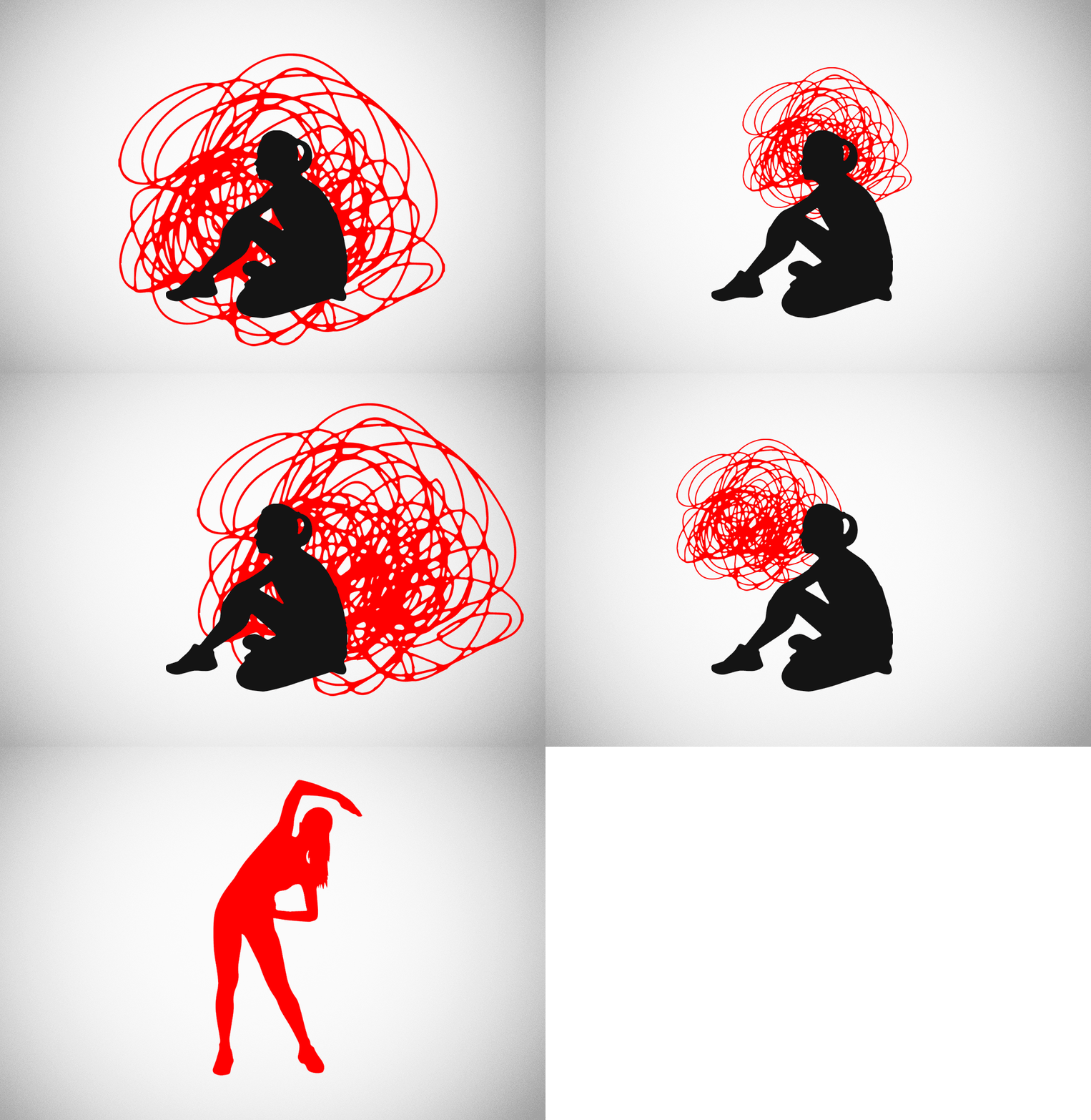
Let’s start with a truism: if you don’t feel some anxiety, an enhanced sense of uncertainty about the future or, even, a little bit of depression in this early part of the 21st century the chances are that you’re not quite human.
The external world is beyond our control. But that doesn’t have to mean control is beyond us. First, however, let’s establish what exactly “control” is and why we need to have it in the first instance. The American Psychological Association considers that “perceived behavioral control”, the extent to which a person believes a behavior is under his or her active control, is part of a larger construct called “theory of planned behavior”.
Because planned behavior takes place within socially accepted norms, it affords us a sense of confidence in our decisions and security in our actions. This, in turn, allows us to exercise better self-care when we are in need[1] and, more generally, experience reduced stress and anxiety which benefits our overall health and wellbeing.
There are many studies that conclusively link stress with a reduction in physical and mental wellbeing.[2] These show that the neurochemical effects of stress on the body affect its physiology. The body’s affected physiology in turns affects our moods, and mental balance.[3]
So, control, within the APA definition, is behavior we feel confident about because we think that it is first, appropriate to the situation we are in and second, it fills us with confidence that it will lead to the outcomes we expect. When we know what to do in any given situation and feel our actions give us the outcomes we want, we feel that we have control over the world.
The external world, of course, rarely bends to our will. It will always throw some curve in our life. In order for our sense of control to not be shattered we need to engage in adaptive behavior that allows us to change our plans and adjust our expectations without feeling the sky is falling. This ability is called resilience. Resilience is a trait that manifests itself in adaptive behavior that allows us to cope with the unexpected.[4]
A lot of what we covered here are mental states we experience. These mental states are expressed in the body through the release of hormones[5] such as cortisol (the stress hormone), adrenaline (to raise heart rate and body temperature), growth hormone (that reduces insulin and increases metabolism). These hormones and the neurotransmitters that attend them, change the physiological responses of the body and affect how it deals with external stressors such as cold and heat and internal ones such as pain and hunger.
The Body And Mind Are Integrated
What we know today of the body/mind connection is that the two are an inseparable whole.[6] For instance, what goes on in the gut microbiome, affects mental health, the way we feel and the way our body responds to food, medicine and exercise.
There are studies that show that exercise helps relieve both anxiety[7] and depression[8], especially amongst young people. The same 2020 study[8] also showed that even daily chores performed by adolescents help stave off depression by contributing to the overall volume of daily activity. Physical activity is also key to dealing with mid-life depression in adults.[9]
While doing workouts and signing-up for exercise classes is always good, it is always better when the activity you engage in is persistent and sustainable. To achieve that you need to follow some simple rules:
- Engage in exercise that makes you feel good. There is no point working yourself rugged or going for the “no-pain, no-gain” approach if you’re going to be too sore to repeat it the next day or too tired to do your work. Exercise has to fit seamlessly into your day, helping you decompress, get healthier and feel stronger without draining you.
- Add additional activity. An hour’s exercise a day is not going to undo the harm done by the rest of the day. Find time to take a walk. Do household chores to music, walk up stairs instead of taking the lift, in good weather find reasons to be outside.
- Find ways to do mini-workouts throughout the day.
- Hang around people who ‘get you’. You need social support to maintain this. If you can’t integrate your fitness activities with your social life you will need to find ways to get the support you need so you don’t feel isolated and alone.
Set Up Small Wins Each Day
One of the most common pitfalls of people who want to get fitter, want to help their body and mind work better together and want to experience the sense of freedom that comes with being liberated from a constant sense of anxiety, is to try and do too much, too soon.
The British Cycling Team broke from its average performance to win 16 gold medals in two Olympiads and seven Tour de France in eight years thanks to Sir Dave Brailsford’s belief in making consistent incremental gains.
In broad terms, marginal gains theory, borrowed from the world of business, suggests that if we break down the areas of our performance, physical or psychological and we then aim to improve just one per cent in each area, when we put them back together the overall improvement will be significant. That’s because in terms of physical and psychological performance the whole is always greater than the sum of its parts.
So, for instance, you may want to give up smoking or drinking but quitting at a stroke is way too difficult. It requires significant lifestyle change and this change has both physical and mental components which make it difficult for it to stick, simply because the change is too great. It is far easier to, let’s say stick to a rule that simply reduces your cigarette consumption or alcohol intake a little. This, over time, allows you to continue to make incremental gains by further small steps that limit consumption until, one day, you can stop smoking or drinking and barely notice because you won’t miss it.
You can do the same with anxiety. Removing every stressor is usually not possible and, even if it were, it would be counterproductive. The change would be too big to make and too tiring to withstand for long. You can, however, implement small strategies like starting the day with breathing techniques that help our body and mind find a better point of balance. Or, intentionally exercise kindness as a means of improving the neurochemical balance in your body and brain and feeling better about yourself.
Pick an exercise from the bodyweight exercise map and just work out a little to give yourself a feel of control over your body and mind. Add a social component to your physical activity, either by exercising with a partner or a friend, or simply sharing your journey with people you know and like, online, as part of keeping yourself honest and inspiring others.
Experiment any way you want. What you mustn’t do is be inert and do nothing about it. Then the world will appear bleak and without hope and you will find that even moderate difficulties present you with the feeling that they are insurmountable.
Create your own personal coping strategy however and you will have the means to navigate even the most serious of problems without your brain shutting down or your stress levels getting out of control. That, in itself, will help make you stronger in your mind and healthier in your body.
References
- Pourmand, G., Doshmangir, L., Ahmadi, A. et al. An application of the theory of planned behavior to self-care in patients with hypertension. BMC Public Health 20, 1290 (2020).
- Yaribeygi H, Panahi Y, Sahraei H, Johnston TP, Sahebkar A. The impact of stress on body function: A review. EXCLI J. 2017;16:1057-1072. Published 2017 Jul 21. doi:10.17179/excli2017-480
- von Känel R. ACUTE MENTAL STRESS AND HEMOSTASIS: WHEN PHYSIOLOGY BECOMES VASCULAR HARM. Thromb Res. 2015;135(Suppl 1):S52-S55. doi:10.1016/S0049-3848(15)50444-1
- Parker, S.L., Jimmieson, N.L., Walsh, A.J., & Loakes, J.L. (2015). Trait Resilience Fosters Adaptive Coping When Control Opportunities are High: Implications for the Motivating Potential of Active Work. Journal of Business and Psychology, 30, 583-604.
- Ranabir S, Reetu K. Stress and hormones. Indian J Endocrinol Metab. 2011;15(1):18-22. doi:10.4103/2230-8210.77573.
- Brower V. Mind-body research moves towards the mainstream. EMBO Rep. 2006;7(4):358-361. doi:10.1038/sj.embor.7400671
- Anderson E, Shivakumar G. Effects of exercise and physical activity on anxiety. Front Psychiatry. 2013;4:27. Published 2013 Apr 23. doi:10.3389/fpsyt.2013.00027
- Aaron Kandola, Gemma Lewis, David P J Osborn, Brendon Stubbs, Joseph F Hayes, Depressive symptoms and objectively measured physical activity and sedentary behaviour throughout adolescence: a prospective cohort study, The Lancet Psychiatry, Volume 7, Issue 3, 2020,Pages 262-271,ISSN 2215-0366.
- Suterwala AM, Rethorst CD, Carmody TJ, et al. Affect Following First Exercise Session as a Predictor of Treatment Response in Depression. J Clin Psychiatry. 2016;77(8):1036-1042. doi:10.4088/JCP.15m10104