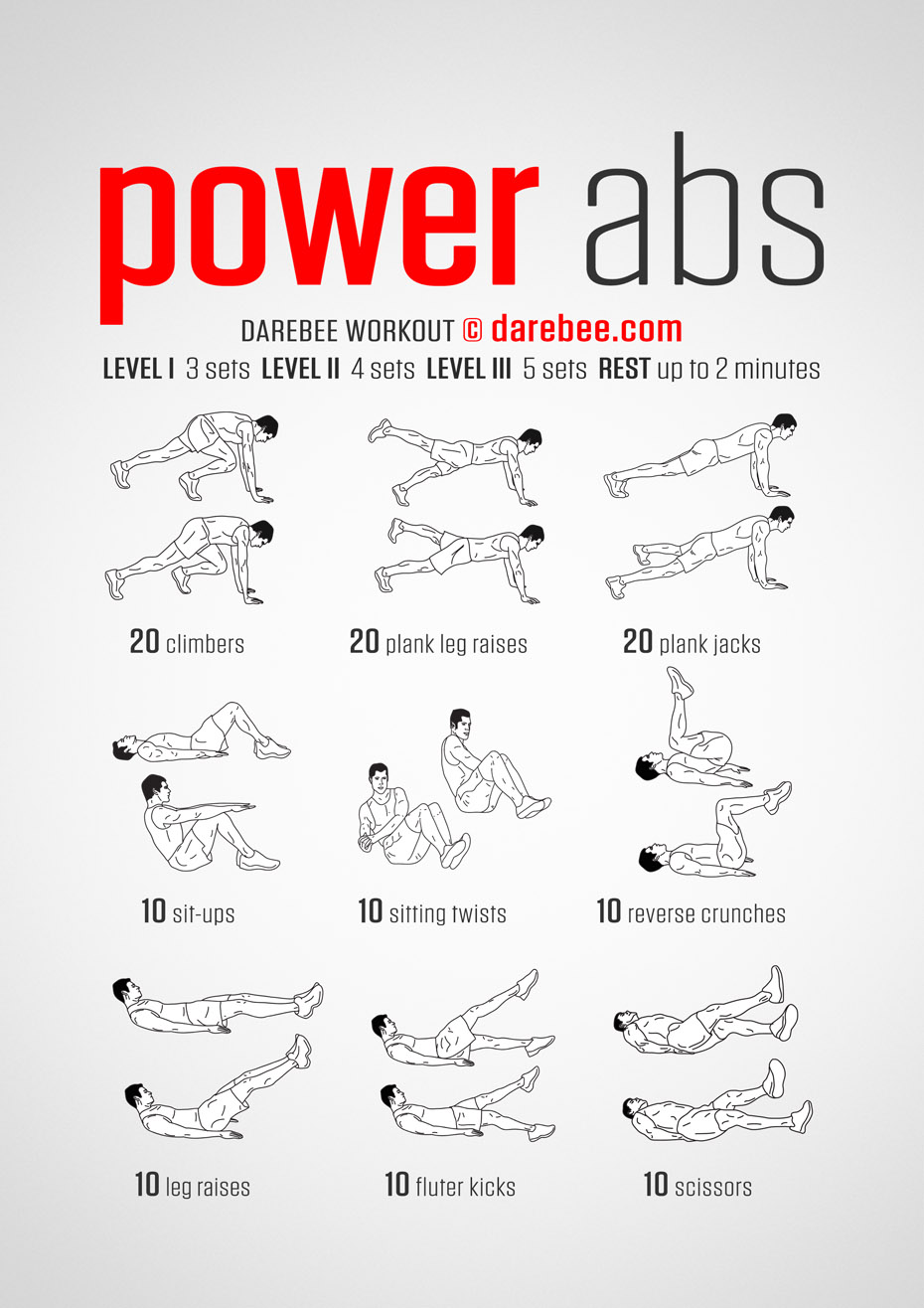
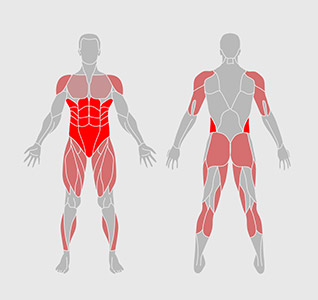


Power Abs works through every major plane and function of the abdominal complex in a single session, without repeating itself. Climbers, plank crunches, and plank rotations cover the core from a high-load horizontal position; sit-ups, sitting twists, and reverse crunches shift the work to the floor and target flexion, rotation, and hip flexor compression in sequence; leg raises, flutter kicks, and scissors close with sustained lower-ab and hip flexor endurance under continuous tension.
The first row is the most demanding on the stabilizers - the core has to brace against extension while the limbs move dynamically in three different patterns. Plank rotations in particular rotate the entire body from a push-up position, requiring the obliques to both generate and control rotation simultaneously. The second row transitions to supine work where the rectus abdominis does the primary lifting: sit-ups for full flexion range, sitting twists for rotational power, reverse crunches for posterior pelvic tilt and lower-ab recruitment. The third row is an endurance sequence - 30 total reps of continuous lower-ab and hip flexor work with no positional reset between exercises. Flutter kicks and scissors particularly accumulate fatigue through constant tension rather than discrete contraction and release, which is a different physiological stress than the row above it.
On reverse crunches, the movement should originate from the pelvis tilting posteriorly, not from the legs swinging - if momentum is doing the work, slow it down. On scissors, the range of motion matters: crossing the legs past each other and holding the feet just above the floor places far more demand on the lower abs than a wide, lazy scissor that never comes close to the ground.
The core is not one muscle. This workout treats it like the system it actually is.
Make it harder: Perform climbers at sprint pace, add a weight plate held at the chest during sit-ups, and keep all floor exercises elevated at a low leg height throughout each exercise.
Make it easier: Perform plank crunches and rotations from the knees, bend the knees during leg raises and flutter kicks to reduce the hip flexor lever arm, and take brief rests between each exercise rather than flowing continuously through each row.