
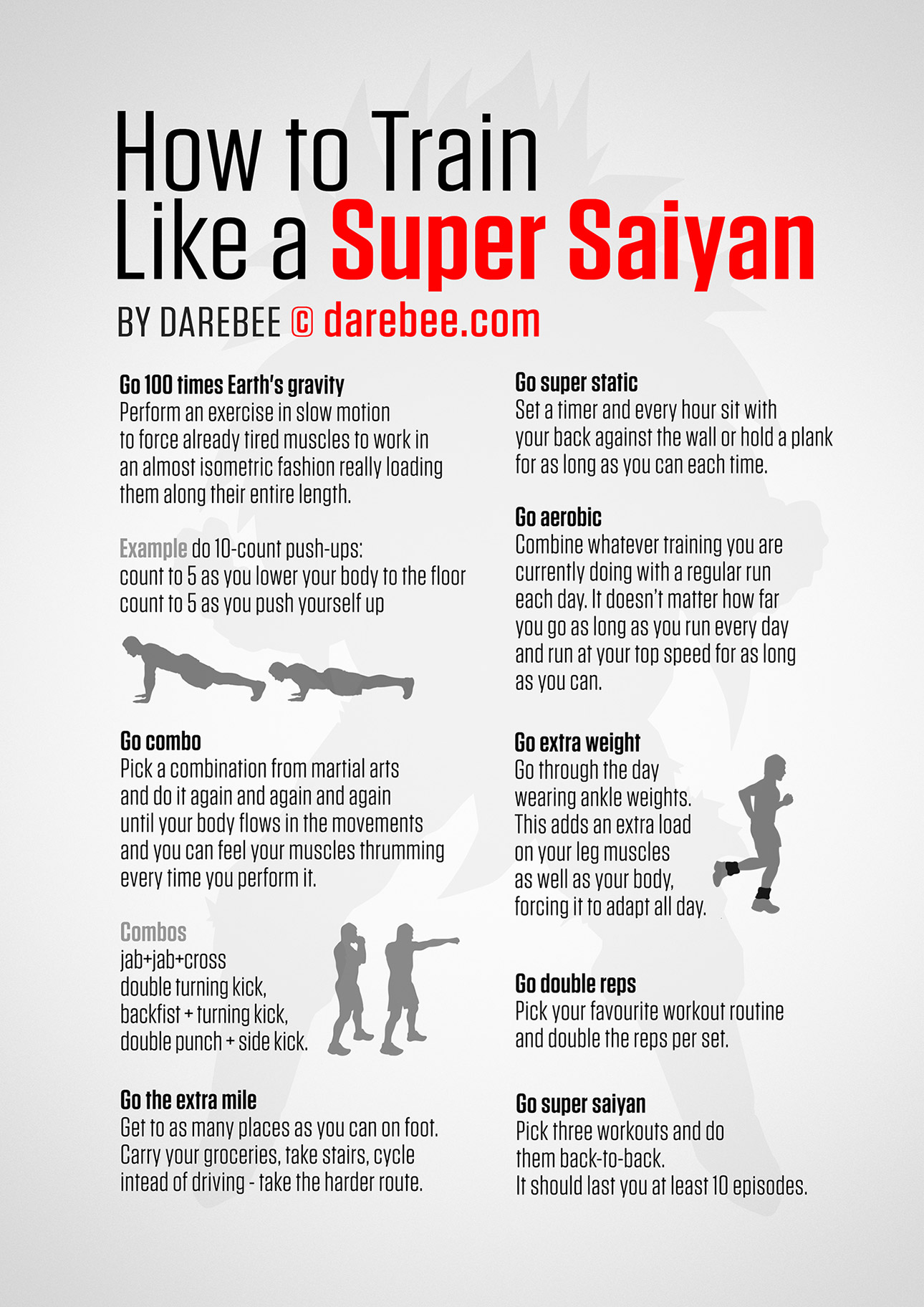
There is training, and then there is Saiyan training. The core idea is sound and it is exactly how adaptation works: the moment something becomes comfortable, it has stopped being a demand, and you raise the bar. Power levels go up because you keep giving your body a reason to raise them.
There is even a number on it. A meta-analysis of 34 training groups found a graded relationship between weekly training volume and muscle growth, with each additional weekly set associated with roughly 0.37% more gain.[1] More demand, more response - up to what you can recover from, which is the part of the Saiyan method the anime skips because Goku has a healing tank and you do not.
The One Rule, Slightly Amended
Raise your standards the moment you can - yes. Double everything every time you succeed - no, and this is where the training arc gets you injured.
Jumps in load are what hurt people. In a year-long study of 874 novice runners, of whom 202 were injured, those increasing their weekly distance by more than 30% over a two-week period were more prone to distance-related injuries than those increasing by under 10%.[2] Doubling is a 100% jump. Do it repeatedly and the limiting factor stops being your willpower and becomes your tendons.
The amended rule: when it gets easy, make it meaningfully harder - and make it harder next week too. Steady escalation beats heroic escalation, because you are still training in month six.
Go 100 Times Earth's Gravity
Slow the movement down. Push-ups performed as slowly as you can control, chest to the floor, keep the working muscles under tension far longer than normal reps do, and it is a legitimate way to make a movement harder without adding load.
One adjustment: not every set to total failure. A meta-analysis of 15 studies comparing training to failure with stopping short found only a trivial advantage for going all the way, with evidence of a non-linear relationship - sets need to be close to hard, not annihilating.[3] Leaving a rep or two in reserve on most sets costs you almost nothing and lets you train again tomorrow.
Go Double Reps
Take your usual routine and add to it - but add, do not double. Ten percent more this week, ten percent more the week after, and inside three months you have far more than doubled anything.
Keep the 10,000 push-up thing as mythology. Very high rep counts of an easy movement train endurance rather than strength; when a movement gets easy, the better answer is a harder variation, not another hundred reps.
Go The Extra Mile
Nothing to fix here - this is the best item on the list. Walk instead of riding, carry the shopping, take the stairs, choose the harder route whenever you notice one. It costs no training time and accumulates all day.
Go Aerobic
Add running, yes. Run every day at your top speed for as long as you can, no.
Maximal running every day is how you accumulate injuries rather than fitness, and hard efforts need fresh legs to be worth doing. Run most days at a conversational pace and go genuinely hard once or twice a week. Hills are excellent and the guide is right about them - they build strength and are easier on you than flat-out sprinting on tired legs.
Go Combo
Also sound. Repeating a martial arts combination until it flows is skill practice, and skill improves with repetition in a way that strength does not. Pick a combination, drill it, and let it become automatic.
Go Super Saiyan
Three workouts back-to-back, each emphasizing something different, is a legitimate occasional challenge - a training-arc day rather than a weekly fixture.
The best sentence in the whole mythology is the true one: strength comes as a response to a need, not a desire. That is precisely right, and it is why the day after a session like this should be light.
Go Super Static
Hourly wall sits and planks spread through a day is a good idea with one change: not to maximum every time. Holding to failure once an hour means every hold after the second is worse than the last, and you spend the day accumulating fatigue rather than training.
Set a target you can hit each hour and keep hitting it. Raise it next week.
Go Extra Weight
This is the one to change outright. Wearing ankle weights through a normal day is the least effective and most disruptive item on the list.
Weight added out at the extremities is disproportionately costly: researchers measuring the energy cost of running with added mass found that adding a given mass to the limbs cost significantly more than adding it at the centre of mass, and the effect became more pronounced the further out the load was placed.[4] That is why it feels like it is working - and it is also why it alters how you walk, for hours, on repeat.
Goku's weighted clothing is closer to a weighted vest, which is the version to copy: load near your centre of mass, worn for a defined session rather than all day, and taken off before your gait starts adapting around it.
The Part The Anime Skips
Every Saiyan training arc includes recovery, and it is never the interesting bit. It is also where the adaptation happens.
A systematic review and meta-analysis found that acute sleep loss negatively affects next-day exercise performance, with the effect depending on exercise type and the pattern of sleep loss.[5] Less sleep means less capacity in the session, which means less demand applied, which means less response. Sleeping properly is not the soft option. It is the multiplier.
Common Mistakes
- Doubling instead of adding. Large jumps in load are the clearest injury signal in the research. Escalate steadily.
- Every set to failure. The advantage over stopping short is trivial, and the recovery cost is not.
- Maximal running daily. Hard efforts need fresh legs. Most days should be easy.
- Ankle weights all day. Distal load changes your mechanics. Use a vest for a defined session instead.
- Treating rest as weakness. Sleep is where the power level actually goes up.
What To Expect
Expect the amended Saiyan method to feel less dramatic than the anime and work considerably better: ten percent weekly compounds past doubling inside a quarter, with tendons intact and the training arc still running in month six. The occasional triple-session day will deliver its story-worthy soreness and its light day after, exactly as designed. And somewhere along the steady escalation comes the genuinely Saiyan moment - the workout that once flattened you, repeated as a warm-up - which is the power level going up the only way it ever does: as a response to a need, patiently applied.
The Goal: Escalate Like A Saiyan, Recover Like A Human
Keep the Saiyan principle - comfort means the demand expired, so raise the bar - and run it at human settings: add 10% instead of doubling, train close to hard instead of to annihilation, run mostly easy with hard days fresh, wear the weight as a vest for a session rather than ankle weights for a life, save the triple-workout for training-arc days, and sleep like it multiplies everything, because it does.
Summary
The Saiyan principle is correct - when something becomes easy it has stopped being a demand, and training volume and results are related in a graded way. The execution needs amending. Escalate steadily rather than doubling, since jumps above about 30% in two weeks were associated with more injuries in novice runners. Train close to hard rather than to failure on every set, because the advantage of going all the way is trivial and the recovery cost is not. Slow tempo work, stair-climbing, drilling combinations and occasional triple-workout days all earn their place. Run mostly easy and hard occasionally rather than flat out daily. Swap all-day ankle weights for a weighted vest during a defined session, because load out at the limbs costs more energy and changes how you move. And sleep, because sleep loss reduces next-day performance and therefore everything downstream of it.
Suggested Programs
Research
- 1. Schoenfeld BJ, Ogborn D, Krieger JW. Dose-response relationship between weekly resistance training volume and increases in muscle mass: a systematic review and meta-analysis. J Sports Sci. 2017 Jun;35(11):1073-1082. doi: 10.1080/02640414.2016.1210197.
- 2. Nielsen RØ, Parner ET, Nohr EA, Sørensen H, Lind M, Rasmussen S. Excessive progression in weekly running distance and risk of running-related injuries: an association which varies according to type of injury. J Orthop Sports Phys Ther. 2014 Oct;44(10):739-747. doi: 10.2519/jospt.2014.5164.
- 3. Refalo MC, Helms ER, Trexler ET, Hamilton DL, Fyfe JJ. Influence of resistance training proximity-to-failure on skeletal muscle hypertrophy: a systematic review with meta-analysis. Sports Med. 2023 Mar;53(3):649-665. doi: 10.1007/s40279-022-01784-y.
- 4. Myers MJ, Steudel K. Effect of Limb Mass and its Distribution on the Energetic Cost of Running. J Exp Biol. 1985 May;116:363-373. doi: 10.1242/jeb.116.1.363.
- 5. Craven J, McCartney D, Desbrow B, Sabapathy S, Bellinger P, Roberts L, Irwin C. Effects of acute sleep loss on physical performance: a systematic and meta-analytical review. Sports Med. 2022 Nov;52(11):2669-2690. doi: 10.1007/s40279-022-01706-y.