
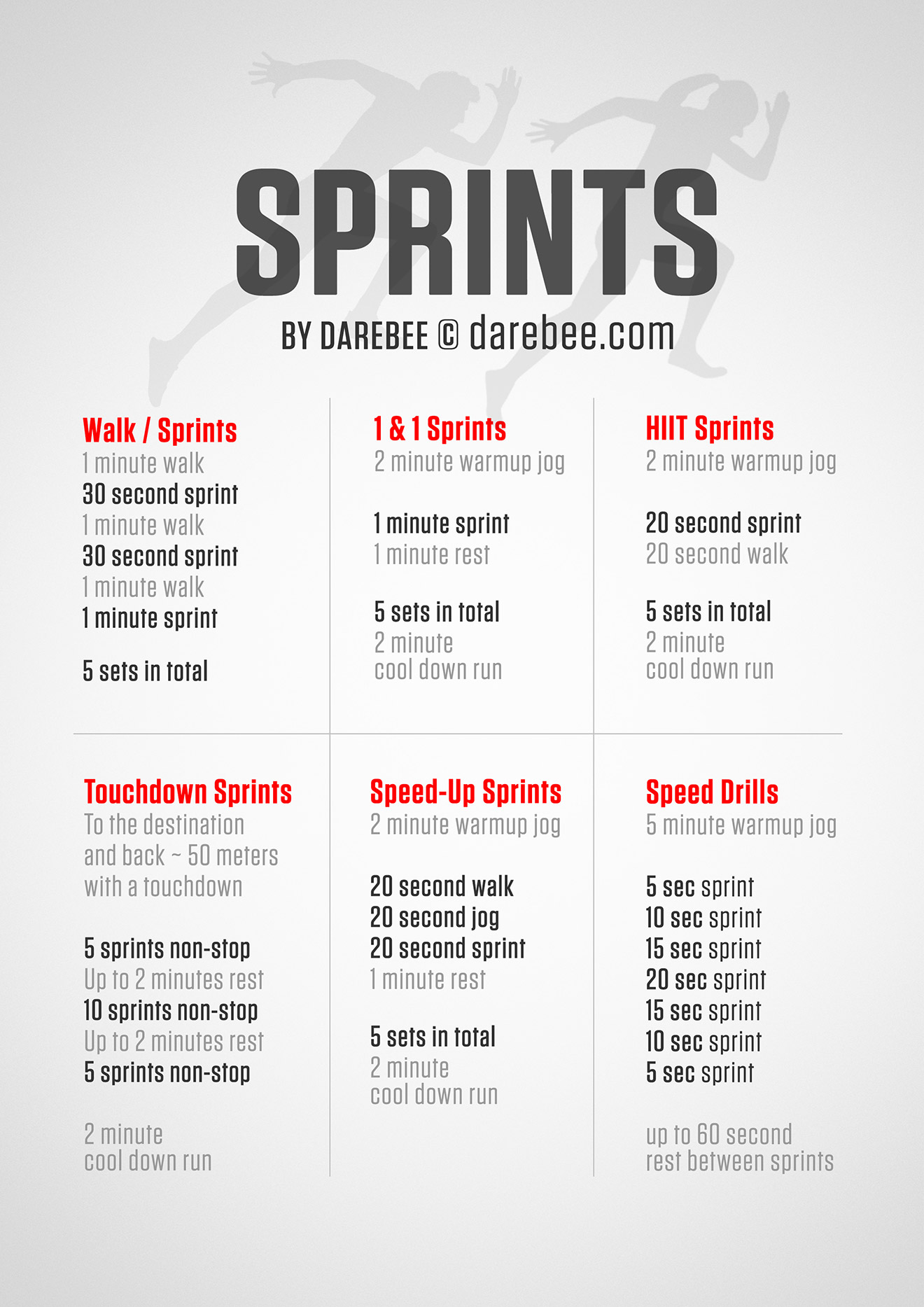
Sprinting is the most concentrated training running offers: seconds of true effort that build speed, power and a surprising amount of cardiovascular engine, in exchange for the strictest rules in the sport. The exchange rate has been measured. In a 12-week trial, sedentary men doing sprint interval training - three sessions a week of just three 20-second all-out efforts inside a 10-minute session - improved their aerobic capacity by about 19%, matched the improvements in insulin sensitivity and muscle energy machinery of a group doing 45-minute steady rides, and did it on one-fifth of the training volume: 30 minutes a week against 150.[1] Minutes of honest sprinting buy what hours of moderate work buy. The rules below are the price.
What Sprinting Builds, And Why It Needs Rules
Top running speed is not about moving your legs faster. When researchers compared runners across a range of top speeds, the faster athletes were not swinging their limbs more quickly - they were hitting the ground harder, applying greater support forces during shorter contact times.[2] Sprinting is therefore force training at full expression: maximal recruitment of muscle by the nervous system, the true speed end of the CNS guide's dial, delivered through the glutes, hamstrings and calves.
The same fact explains the risk profile. During the last part of each stride's swing phase, the hamstrings lengthen at high speed while working hard to brake the leg - the single most demanding thing most people ever ask of that muscle group, and the moment where sprint injuries concentrate. Hamstring strains are the most common injury in running-based sports, and the protection is specific: in a meta-analysis pooling 8,459 athletes, teams using the Nordic hamstring exercise - a slow, lowering-focused hamstring movement - cut hamstring injuries roughly in half, a 51% reduction.[3] Strength work protects sprinters the way it protects all athletes - the broader meta-analysis puts strength training's overall injury reduction at 68%[4] - but for sprinting, hamstring-specific strength is the load-bearing wall.
The Warm-Up Is Not Optional Here
Warming up improves performance in 79% of measured outcomes across the warm-up literature,[5] and muscle temperature climbs at roughly 0.1°C per minute of activity[6] - facts that matter everywhere and are non-negotiable at maximal speeds, because cold muscle tolerates high-velocity lengthening poorly and the hamstring mechanism above is exactly that. The sprint warm-up, exactly:
- Five minutes of easy jogging or brisk walking.
- Two to three minutes of dynamic work: leg swings front and side, walking lunges, high knees, butt kicks.
- Three or four build-ups: runs of 60 to 80 meters starting easy and rising through roughly 70%, 80%, then 90% of full speed, with a walk back between. Build-ups are the bridge between warm and ready - the actual movement, rehearsed at rising intensity.
- Total: about ten minutes. Interrupted for more than ten minutes afterward? Repeat the build-ups. Muscle temperature falls at close to the rate it climbed.
The Session
The starter template: 6 to 8 sprints of 10 to 15 seconds at a smooth, tall 90% of maximum, with 2 to 3 minutes of walking recovery between each, once or twice a week, on days your legs are fresh. Every element is deliberate:
- 90%, not 100. Smooth-fast at near-maximal effort trains speed and power at a fraction of the injury exposure of ragged all-out efforts. True 100% sprints are an occasional test earned after weeks of the 90% version, never the default.
- Full recovery, every rep. Sprints are quality work: the goal of each rep is speed, and speed needs a fresh nervous system and reloaded muscle fuel. Walk the whole recovery. If you are still panting, the rest is not over. A sprint session done right feels almost leisurely between efforts - the 20-second efforts in the trial above were separated by minutes of easy spinning for exactly this reason.
- Stop while fresh. The session ends when speed drops or form frays, not when you are destroyed. The last rep should look like the first; six sharp sprints beat ten deteriorating ones on every quality this training exists to build.
- Forgiving ground. Grass, track or firm trail over concrete. Flat and unobstructed - at speed, you have no attention to spare for potholes.
- Hills first. Uphill sprints on a moderate slope are the safest entry: the incline cuts impact and top-end velocity - trimming exactly the high-speed hamstring exposure where the risk lives - while making the glutes and legs work harder. Start with hills for the first month; graduate to flat ground when the 90% efforts feel controlled.
No Ground To Sprint On
The format survives indoors: sprint-in-place with maximal high knees, fast stair repeats, or all-out 15-to-20-second intervals of burpees or fast bodyweight movements through the change-any-exercise guide - the trial evidence above was built on stationary 20-second all-out efforts, not open ground. Short, maximal, fully recovered: that structure is the ingredient, wherever it runs.
Who Should Wait, And For What
Sprinting is a graduate course with prerequisites. First: several weeks of comfortable continuous running - the become-a-runner guide's thirty-minute target is sprinting's starting line, because sprint mechanics sit on top of ordinary running mechanics. Second: hamstring and glute strength work already in the week - bridges, good mornings, and slow Nordic-style lowering, the movements behind that 51% figure. Third: for anyone managing heart conditions, blood pressure issues or recent injuries, maximal effort work is a clear-it-with-your-doctor category; all-out sprinting produces the highest acute demands in running. None of these prerequisites expires - sprints reward the wait, and the wait is measured in weeks, not years.
Common Mistakes
- Sprinting cold or nearly cold. High-speed lengthening on cold hamstrings is the injury mechanism, requested directly. Ten minutes of warm-up and build-ups, every time.
- Racing the recovery. Short rests turn a speed session into a conditioning slog: efforts get slower, form gets ragged, and the quality this format exists for disappears. Walk, recover fully, sprint fresh.
- Living at 100%. The margin between 90 and 100 contains most of the injuries and little additional benefit. Smooth and tall at 90 is the workout.
- Grinding out junk reps. The first slow rep is the session's natural end. Everything after it trains fatigue, not speed.
- Sprinting on tired legs. Sprint days follow easy days and precede them. This is the one running format that meaningfully taxes the nervous system, and it needs the freshness it spends.
- Skipping the base. Sprints sharpen an engine that continuous running builds first. Order matters.
What To Expect
Expect the first sessions to be humbling in an unfamiliar way - not breathless but coordinationally: moving at genuine speed is a skill, and most adults have not used it in years. The first weeks bring hamstring and glute soreness of the ordinary kind (the soreness guide's territory), sharp improvement in how "fast" feels, and - because the trial data says so - engine gains arriving within six to twelve weeks from minutes of weekly work. Strides at every slower pace start feeling easier, since a raised top speed makes every submaximal speed a smaller fraction of maximum. And there is the part no study measures: moving flat-out is one of the few physical experiences most adults have completely lost, and getting it back is worth the walk-backs by itself.
The Goal: Six Sharp Sprints, Fully Recovered, Twice A Week
The whole discipline compresses into one session done right: ten minutes of warm-up ending in build-ups, six to eight efforts of 10 to 15 seconds at a smooth 90%, two to three minutes of walking between, ending while everything still feels sharp - on a hill for the first month, on fresh legs always, with hamstring strength work standing guard in the rest of the week. Run that session once or twice weekly and the measured returns follow: aerobic capacity comparable to five times the training volume, a raised top speed that discounts every other pace, and the power end of running restored to a body that had filed it away.
Summary
Sprinting buys engine, speed and power at the sport's best exchange rate - in trial conditions, three weekly 10-minute sessions containing 3x20 seconds of all-out work improved aerobic capacity ~19% and matched 45-minute endurance sessions on one-fifth the volume - and charges for it in rules. Speed itself comes from ground force, not leg turnover, which makes sprinting maximal force training and puts the hamstrings at risk during each stride's high-speed lengthening: Nordic-style lowering strength cuts hamstring injuries by 51% across 8,459 athletes, and general strength work cuts sports injuries 68%. The session: ten minutes of warm-up ending in 70-80-90% build-ups (warm-ups improve performance in 79% of measured outcomes; muscle warms at ~0.1°C per minute and cools as fast), then 6-8 sprints of 10-15 seconds at a smooth 90% with 2-3 minutes of full walking recovery, stopped while form is sharp, on forgiving ground - hills for the first month, since incline trims exactly the high-speed exposure where risk lives. Prerequisites: thirty continuous minutes of running, hamstring strength in the week, medical clearance where health history asks. Indoors, the format survives as all-out 15-20-second bodyweight intervals. Fast, fresh, finished early.
Suggested Workouts
Research
- 1. Gillen JB, Martin BJ, MacInnis MJ, Skelly LE, Tarnopolsky MA, Gibala MJ. Twelve Weeks of Sprint Interval Training Improves Indices of Cardiometabolic Health Similar to Traditional Endurance Training despite a Five-Fold Lower Exercise Volume and Time Commitment. PLoS One. 2016 Apr 26;11(4):e0154075. doi: 10.1371/journal.pone.0154075.
- 2. Weyand PG, Sternlight DB, Bellizzi MJ, Wright S. Faster top running speeds are achieved with greater ground forces not more rapid leg movements. J Appl Physiol. 2000 Nov;89(5):1991-1999. doi: 10.1152/jappl.2000.89.5.1991.
- 3. van Dyk N, Behan FP, Whiteley R. Including the Nordic hamstring exercise in injury prevention programmes halves the rate of hamstring injuries: a systematic review and meta-analysis of 8459 athletes. Br J Sports Med. 2019 Nov;53(21):1362-1370. doi: 10.1136/bjsports-2018-100045.
- 4. Lauersen JB, Bertelsen DM, Andersen LB. The effectiveness of exercise interventions to prevent sports injuries: a systematic review and meta-analysis of randomised controlled trials. Br J Sports Med. 2014 Jun;48(11):871-877. doi: 10.1136/bjsports-2013-092538.
- 5. Fradkin AJ, Zazryn TR, Smoliga JM. Effects of warming-up on physical performance: a systematic review with meta-analysis. J Strength Cond Res. 2010 Jan;24(1):140-148. doi: 10.1519/JSC.0b013e3181c643a0.
- 6. Kapnia AK, Dallas CN, Gerodimos V, Flouris AD. Impact of Warm-Up on Muscle Temperature and Athletic Performance. Res Q Exerc Sport. 2023 Jun;94(2):460-465. doi: 10.1080/02701367.2021.2007212.