The best thing most runners can do about their form is almost nothing. Running technique is largely self-optimizing: with practice, your body converges on the movement pattern that costs it the least energy, and a review of the running-economy research concluded that runners tend to self-select the technique that is most economical for their own build - and that imposed, wholesale changes to a runner's natural style frequently make economy worse before they make anything better.[1] Your stride is not a flaw to be corrected. It is a solution your body has already computed. The useful work is smaller and more specific: one measured adjustment for runners with knee complaints, a handful of cues that keep the self-optimization on track, and the patience to let mileage do the rest.

Why Your Stride Already Fits You

Every body solves running differently because every body is different: limb lengths, tendon stiffness, muscle fiber mix and joint geometry all set the terms, and the movement that is cheapest for one runner is expensive for another. This is why elite marathoners visibly differ from each other, and why copying any particular runner's style - however fast they are - transplants a solution computed for a different machine. The self-optimization is also ongoing: as you accumulate kilometers, your economy improves without any conscious technique work, because the refinement happens below awareness, stride by stride. Beginners waiting to fix their form before running more have it backwards. Running more is the form work.

The One Adjustment With Measurements Behind It

Cadence - how many steps you take per minute - is the exception, and only for a specific audience. When researchers had runners increase their step rate while holding speed constant, taking steps 5 to 10% quicker and therefore shorter, the mechanical load absorbed at the knee and hip dropped substantially, with the 10% increase reducing energy absorbed at the knee measurably per step.[2] Shorter, quicker steps mean your foot lands closer under your body, which trims overstriding - the reaching, heel-first landing far ahead of the hips that loads the knee hardest.

The operational version: count your steps for 30 seconds on an easy run and double it. If you land somewhere in the typical recreational range and your knees complain, raise the number by 5% - not the internet's magic 180, just your own number plus a nudge - using a metronome app or a playlist at the target tempo for a few minutes per run until it settles. If your knees are happy, skip all of it. This is a tool for a problem, not an upgrade for everyone.

Footstrike

Heel, midfoot or forefoot landing is the most argued and least important variable. Most recreational runners land heel-first; most elite marathon fields contain every style; and switching styles mainly relocates load - heel striking loads the knee more, forefoot striking shifts work to the calf and Achilles - rather than removing it. Deliberate conversion to forefoot running is a common source of calf and Achilles injuries in runners whose tendons never asked for the job. Land however you land. If injuries force a change, make it gradually, over months, with the calf strength to fund it.

Cues That Help, Cues That Hurt

The cues worth keeping are the ones that restore what fatigue steals:

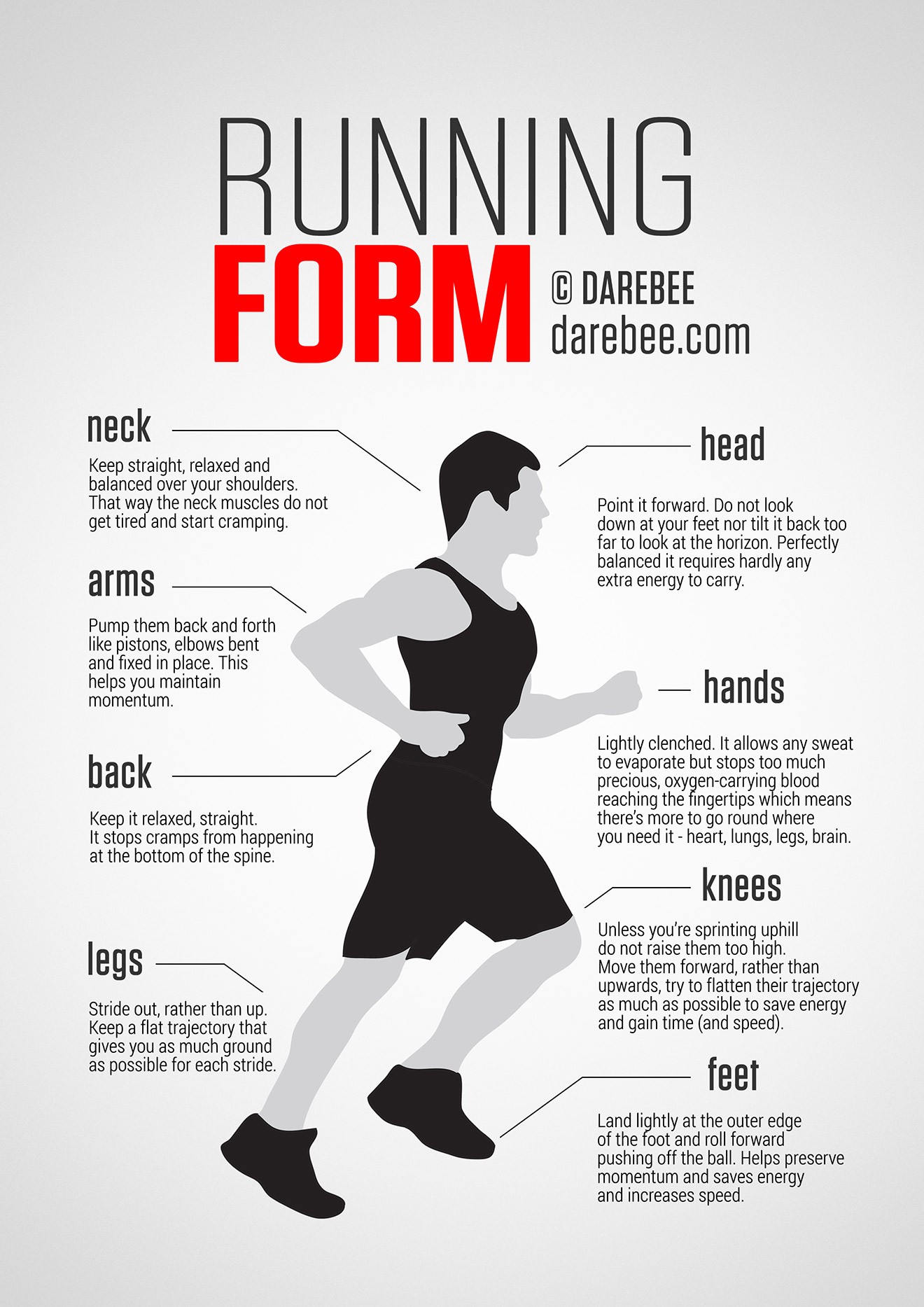
  • Run tall. Imagine a string from the crown of your head. Fatigue folds runners forward at the waist; height keeps the hips under you and the stride free.
  • Relax the shoulders and hands. Shoulders creep toward ears as effort rises, and tension there is pure waste. Loose jaw, soft hands - a crisp you could hold without crushing.
  • Look ahead, not down. The head weighs around 5 kg (11 lb), and where it points, posture follows.
  • Let the arms swing naturally. Arm swing counterbalances leg drive on its own. Elbows near 90 degrees, hands passing hip height - and no cue needed beyond not interfering.

The cues to discard are the prescriptive ones: forcing a forefoot landing, pulling the toes up, bounding for "stride length," or holding any position rigidly. Anything that makes running feel like an exam is costing energy on top of attention - and at speed, the research says the power comes from the ground anyway: faster running comes from applying greater force during ground contact, not from quicker leg turnover,[3] which strength work builds and posture tricks do not.

Shoes Belong To This Conversation

Footwear shapes form more than cues do, and the evidence points the same direction as everything above: toward your own preferences. The comfort-filter research holds that runners who choose shoes that feel comfortable to them tend to stay closer to their preferred movement path and show lower injury rates than runners assigned shoes by foot-type category.[4] Comfortable, fitting, replaced when dead - the same verdict as the become-a-runner guide, arrived at through form.

Common Mistakes

  • Overhauling a stride that produces no pain. Self-optimized beats redesigned. Save the project.
  • Copying an elite's style. Their form is the solution to their body. Yours is already solving yours.
  • Forcing a forefoot landing. The classic self-inflicted calf injury. Land as you land.
  • Chasing 180 steps per minute as a universal number. The evidence supports your cadence plus 5-10%, for knee complaints, not a magic constant for everyone.
  • Form-checking every run. Cues are for occasional refreshes, mid-run, when fatigue slumps you - not a permanent exam.

What To Expect

Expect your form to improve without being worked on - economy rises with mileage as the self-optimization compounds, and runs at a given pace get cheaper over months. A cadence nudge, if you need one, feels strange for two or three weeks and then becomes invisible. The tall-and-relaxed cues will rescue the late stages of long runs more than the early ones, because their job is repairing what fatigue dismantles. And the deepest change is subtraction: running stops being a posture test and returns to being running, which is the state in which all the real refinement happens anyway.

The Goal: Interfere Only Where It Pays

Running form manages itself better than instruction manages it: the body self-selects economical technique and refines it with every kilometer, so the working rules are few - run tall and loose, let the arms swing, land however you land, choose shoes by comfort, and reserve the one measured intervention, a 5-10% cadence nudge, for knees that complain. Everything else is mileage doing what mileage does.

Summary

Running technique is self-optimizing - the economy research finds runners converge on the cheapest technique for their own build, and imposed style overhauls frequently worsen economy - so the default is to leave a pain-free stride alone and let mileage refine it. The one adjustment with measurements behind it is cadence: raising step rate 5-10% at constant speed lands the foot closer under the body and substantially cuts the load absorbed at knee and hip, which makes it the tool for runners with knee complaints, applied as your-own-number-plus-5%, never a universal 180. Footstrike style mostly relocates load rather than removing it, and forced forefoot conversions injure calves that never volunteered. Keep the anti-fatigue cues - tall, loose shoulders, eyes ahead, natural arm swing - discard the prescriptive ones, remember that speed comes from ground force rather than leg turnover, and buy shoes by the comfort filter. Interfere only where it pays.

Suggested Challenges

30 days of running challenge intro
From walking to running challenge intro
Walk and run challenge intro

Research

0 people liked this article

I really like this website. It doesn't make me overthink what to workout. I would just do one or two of these workouts, walk for 45 minutes and stretch. It makes me feel good.

Anonymous

I've always wanted to workout but never knew where to start. Darebee has helped me find fun but challenging workouts, and I've worked out more now than I have in my whole life. I feel so much… I've always wanted to workout but never knew where to start. Darebee has helped me find fun but challenging workouts, and I've worked out more now than I have in my whole life. I feel so much healthier and stronger. I'm so grateful to everyone who makes these workouts.

Anonymous

Awesome effort you put into making quality workouts/plans/programs and that you still continually update and add new ones. Grateful for your promise in keeping this site accessible and free for… Awesome effort you put into making quality workouts/plans/programs and that you still continually update and add new ones. Grateful for your promise in keeping this site accessible and free for people of all fitness levels & goals around the world. Found Darebee some time years ago and used to just save the workouts and then forget about them somewhere in my documents & to do later lists 😅 but coming back to the site this year I loved the organised/simple layout & navigation of the site with full workout video at bottom to see proper form and notes to make things easier or harder depending on your fitness/energy aswell as an extensive exercise library with joint friendly alternatives. I found it much easier to track/check off completed workouts & days on program/plan on dashboard, was more likely to remember & do it + advanced filter made it quick to find a doable workout. As a tiny way to support this site I made account and use the site exclusively for exercises now, will look to donate when I can 🙏🏽 and would recommend it to all I talk to regarding fitness. Thank you Darebee team for the great job you've all done here and keep up the good work. Blessings to you all.

T.T, 28, from AUS