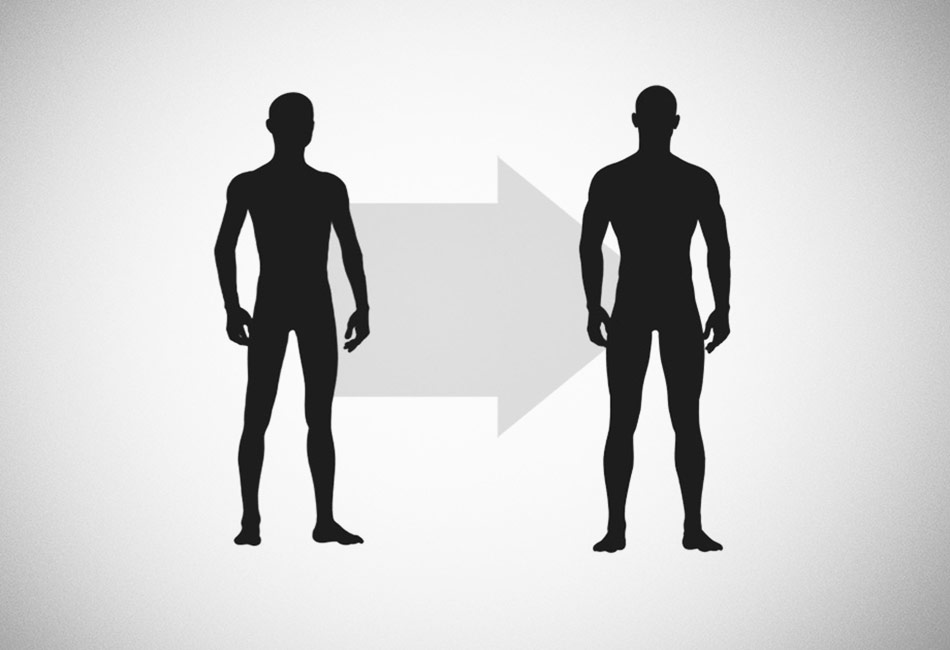
The only time your body changes and gets leaner or bigger is when it has to. The body is a bio-machine designed to adjust and optimize itself for survival so every single thing you do influences that change. If the conditions dictate it, it will get stronger, bigger and more durable simply because it makes it easier for it to cope with the load. For your body it’s all about conserving energy - it’s easier for you to move stones, pull yourself up cliffs and chop down trees if you have the arms for it.
Of course, these days very few people need to do that on a daily basis so in order to look the part we imitate those conditions. With regular training and out of your normal range, load you will let your body know that it has to change to fit the bill. It’s just way too taxing for it to remain the same if your daily routine demands it to be stronger. That’s the logic behind the entire process. Now that you know how it works, you can make it work for you.
Training for muscle mass
If you want strength and the muscles that come with it you have limitless options. After all, it’s all about simulating the lifestyle of a mountain man. You can use your own bodyweight, free-weights or specialized equipment at the gym if you can afford it.
It really comes down to what you have access to. Any way you choose to train will get you results provided you put in the time and you keep on challenging your body.
Option 1: Bodyweight training
Bodyweight training works several muscle groups all at once, it doesn’t require any equipment and can be done anywhere, anytime. You harness the gravity of the earth and your own weight and make them work against one another. It’s harder for a beginner because there is no way you can adjust the load, you weigh as much as you weigh, but on the other hand it never stops challenging you.
Bodyweight training is adaptive - you don’t need to progressively increase the weight, your body does it for you. The stronger you get, the heavier you body becomes. It’s an adaptive way to train and it gives you a high quality muscle system that is trained to work in unison.
The best bodyweight exercises for strength are:
pull-ups: work your back and biceps;
push-ups: work your chest and triceps;
lunges: work your quads and calves;
squats: work your glutes and quads.
How to: Put together your own routine by making a list of strength oriented exercises and perform them every day 10-12 reps each in a set. Increase the number of reps and/or sets the moment it gets easier. Alternatively pick a few strength oriented workouts from our collection and rotate them every week. Go to workouts’ page. Select “strength / tone” option to get workouts more suitable for muscle building and muscle definition.
No matter what you do eventually the same routine becomes less and less effective - if your body can deal with the load it no longer needs to change. That’s why variety is key here. Increase the number of reps or sets, perform an exercise slower or add wrist and ankle weights or any other equipment. The more variety you have in your training, the better. You want to keep your body guessing and you want to keep it challenged at every turn - that’s when you benefit the most.
What to expect: Due to its adaptive nature you can’t get as huge as a mountain. Bodyweight training will give you an athletic, strong body, big arms and legs, wide chest and back but it will not give you body-builder sized muscles.
Option 2: Gym equipment training
Using gym equipment isolates a muscle group and places it under individual stress that forces it to change faster. It’s fairly monotonous training that doesn’t need much imagination, the moment you can do something you raise the resistance weight on the machine. Most gym equipment normally has a little sticker on the side that tells you how to use it and what muscles it will work. It’s pretty straightforward.
How to: Pick several stations, usually between five and seven, and move from one to another. Set the weight resistance for each to a manageable load. Don’t set it too high and don’t set it too low, either, you should be able to do at least 10 repetitions before you can’t repeat it anymore. Perform at least 3 sets of 8-12 reps at each station and move on to the next one until you have visited them all.
What to expect: Gym equipment training will give you size and strength but it is in size that you will see the best results.
Option 3: Free-weight training
Free-weights work similar to the gym equipment, they also hyperload a specific part of your body but they also engage other supporting muscle groups e.g., when you do bench curls your core, back and calves are also engaged. It’s a comfortable middle ground between the machines and bodyweight training because it gives you the best of both. Having at least a pair of dumbbells at home is often a good move simply because you can add it to your bodyweight routines and get that bit of extra size that bodyweight training on its own is reluctant to give you.
Lifting light weights: Light weights create bulkier muscles because they flush them with blood, get them pumped up and increase their mass. If you want to have bigger muscles, faster, repetitively lifting light weights will do it for you: lift within a very comfortable range in weight and number of reps (for example, if you can curl a 15kg dumbbell ten times you may want to try just 8kg or 10kg at the most and double the number of curls you do.) You rinse and repeat until you can’t any more.
Lifting heavy weights: Heavy weights are transformational. They put your body under stress because they are at the very limit of what you can lift. By repeatedly making your muscles lift heavy weights you are forcing them to shred and remake themselves. While there will be a small increase in bulk with heavy weights you get a large increase in strength. Muscles become denser, the tendons where they attach to the bone, thicker and stronger.
How to: Pick several exercises and do each one 3 times, 8-10 repetitions each set with a 60 second rest in between sets. If you’re training for size go for lighter dumbbells and lift to muscle failure. If you want to see quick gains in strength pick the ones you can just barely lift.
What to expect: Free weights will give you size and strength. Using them does not give results as fast as using stationary gym equipment but you end up with better synced muscles.
Option 4: Go Combo
Free weights and bodyweight training can be combined - as a matter of fact they go very well together and give you better and faster results especially if your goal is muscle building.
A set of dumbbells will complement any of the visual workouts we have here.
Cardio or no Cardio
If your body needs to endure and carry you for miles and miles (running) it’ll shed everything unnecessary - fat and muscle, alike. If you run long distance you can’t have large muscles, it’s unsustainable. If you are training for size any running you do has to be limited to short distance (to 2 miles / 3 kilometers) and sprints.
You may not realize it but you might be doing endurance walking already if you cover long distances during your normal day. Review your daily routine outside your workout regimen if you are training for size and make sure you are not.
Full body or muscle targeted training
It’s really a matter of preference how you train, whether you prefer to train legs one day, arms and chest another and abs the next. Muscle-targeted training is especially handy when you are training at the gym and with all the choices of equipment that’s usually available you want to hit as many machines as possible in one day without spending four hours there. You can spread your training throughout the week letting one muscle group work while the others recover and then rotate.
You can also work full body and go from a hard session to an easy recovery session and back. That way you can train your entire body as a whole and develop better quality muscle. Since bodyweight training often already targets several muscle groups all at once it usually makes sense to do full body workouts each time and recover on the fly as you go from one exercise to the next. Doing full body workouts also gives you flexibility in your training - if you miss a day your entire schedule is not screwed up.
These are two different ways to train and it largely depends on which you prefer more and the type of training you are doing. Even with bodyweight training you can mix it up and focus on something in particular like your arms and back from time to time.