
Our legs are enormously strong, they are longer than our arms and we use them from the moment we learn how to walk. Kicking however is not easy and there are several reasons for that. In order to do it correctly it requires a great deal of balance and precision. Because the muscles we are using are large, it also requires endurance and kicking can become really tiring, really quickly, unless of course we have trained for it.
That means that like everything else that has to do with physical performance there is a definite skill to kicking well and technique as well as physical conditioning, become important factors.
Given how difficult it is to kick well the primary question must be why do it at all? After all our bodies have adapted fantastically well to fighting in a forward stance, using our two arms and balancing perfectly well on both of our sturdy legs. Why compromise this intuitive mechanism for combat in order to deliver a little more muscle power?
There are several good reasons which we need to keep in mind:
Power. Although we are Apex Predators on our planet, without our technology we are inherently weak. We have muscle-to-mass ratio. Our muscles are acquired rather than inherited. We have no large teeth or claws. What we are really well adapted for is running continuously over very long distances and this is where our legs actually come in as weapons. The reasoning goes that if we can correctly harness their muscle power we suddenly have two very potent weapons to bring into play, if need be.
Reach. Because we are generally weak and vulnerable, close quarter combat does not suit us very well. Our legs are longer than our arms, they can reach a target we are striking without having to get too close to it physically and put ourselves in harm’s way.
Strength. Square a man and a woman against each other and the man has a distinct advantage. Men are not only physically larger than women but they also have much greater upper body strength which gives them an advantage in grappling and punching. But that gender difference becomes a lot less noticeable when we get to lower body strength. There a woman can be as strong as a man, almost, which is why kicking is also a great gender equalizer.
Mobility. It sounds counterintuitive to say that by raising one leg to kick and standing on only one leg you gain mobility but that is actually what can happen. An unarmed combat situation is a highly fluid one where steps being taken are dead time and can also telegraph your intent, making a move obvious and destroying the element of surprise in an attack. By kicking and using the momentum of the kick to also take a step as the foot lands a skilled fighter can gain ground much faster and can either move away from or towards an opponent with minimal downtime.
Kicks and Martial Arts
Kicks, of course, have become synonymous with martial arts but they have been with unarmed combat throughout the ages. They were used by ancient warriors fighting with edged weapons on the battlefield as a means of distracting an opponent or, at times, as a weapon of last resort. And even the brutal (and illegal) bare knuckle street fighting of the past had a “boots and fists” rule, which also was the only rule it seemed to have.
In martial arts kicking has reached an art form. By turning the body itself into a weapon, different styles have contributed different types of kicks, each with its own advantages and disadvantages when it comes to performing them. Some kicks use long, circular motions, others are more direct and others still are a mix of the two. Kicks can be performed statically, from a standing still position. They can be performed while in motion, alone or as part of a two or three kick combination.
While they appear to be different in essence their foundation is the same. Biomechanics and physics dictate that realistically there are only so many ways we can kick and still deliver effective power on a target.
Types of Kicks
Before we mention the six primary types of kicks it’s worth remembering that a kick can be delivered either from the front or the back leg. The difference is in speed of delivery vs power and this is where physics comes in. A front leg kick reaches the target you’re attacking faster but utilizes less of the body’s weight to do so. A kick delivered from the back leg will take longer to reach the target and travel a longer distance to do so but will gain more power in the process and utilize more of the body’s weight, making it a harder kick.
There is no ‘wrong’ or ‘right’ in the choices you make when you kick. The choice each time depends upon your ability, the particular martial art you are trained in and, obviously, what is required by the situation.
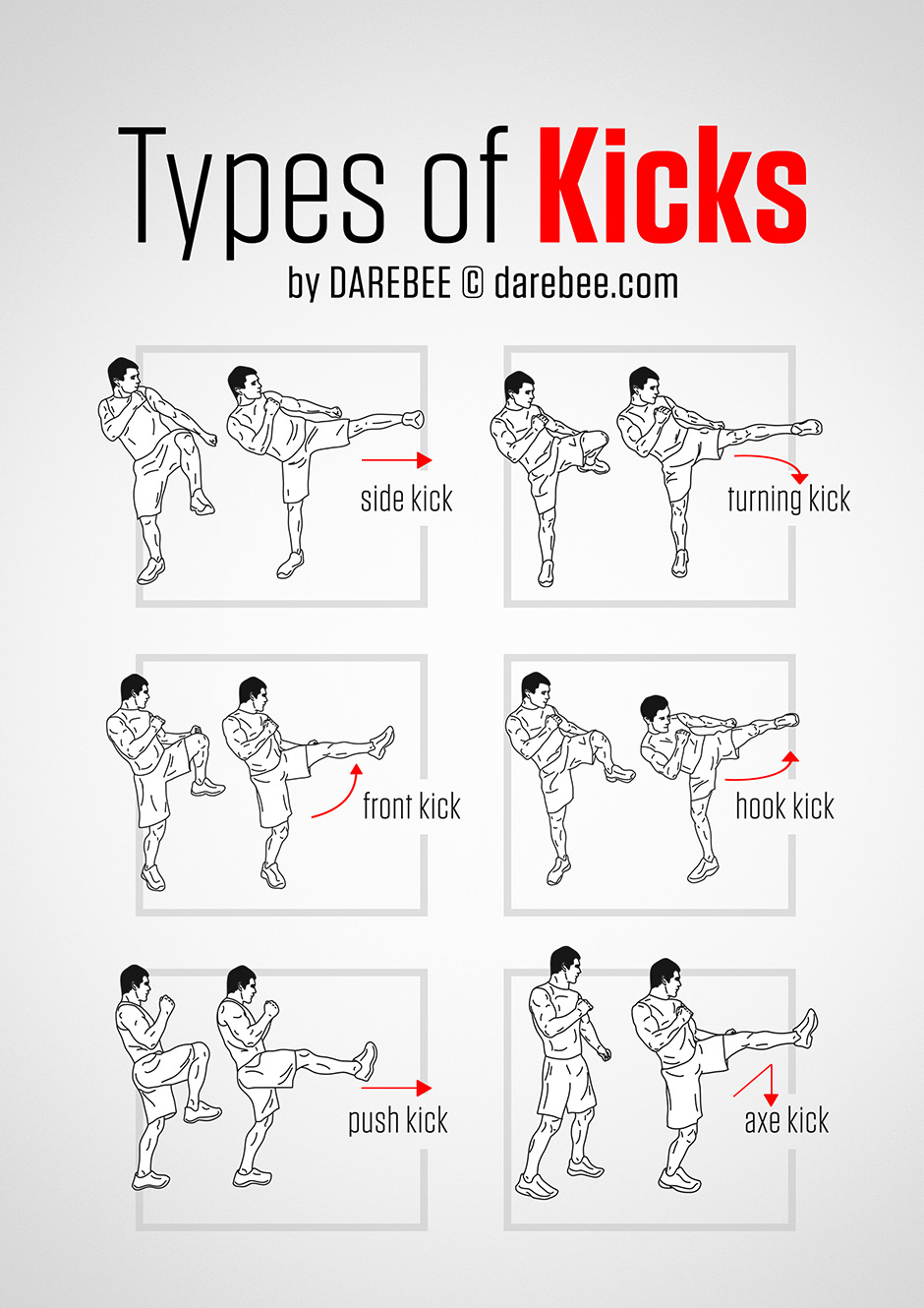
Although we will look at six fundamental types of kicks, essentially there are only two types of basic kicks they all spring from: Push kicks and arc kicks.
Push kicks, as the name suggests, utilize the strong leg muscles, bunching them up like a spring and then releasing them in a straight line, to the target. Push kicks have an immediate, powerful effect and are hard to block against. They are fast kicks that generate a lot of power which even if blocked, creates an impact so they can never be ignored. Because they are fast and travel the shortest distance to a target they are also hard to evade.
Arc kicks, as the name suggests, take the leg through a curved trajectory that is necessary for power to be developed. Arc kicks are great for fighting in unorthodox positions (i.e. not facing forward), dealing with multiple opponents at once (when the traditional coiling and uncoiling action of a push kick takes too much time to execute more than a couple of times) or for generating power that is disproportionate in size to the strength of the muscles involved (proving that even physically smaller or weaker opponents can generate powerful kicks).
If you watch a Van Damme film or have ever seen Joe Lewis fight, you’ll see that they are both primary proponents of push kicks. Bruce Lee, Jackie Chan and Jet Li on the other hand use mostly arc kicks. Modern cinema will use arc kicks or jumping push kicks because they are visually more pleasing plus they are a little harder to execute correctly which is why they are more prevalent in popular culture. From a purely practical point of view push kicks tend to be more effective in most unarmed combat situations.
Starting Point
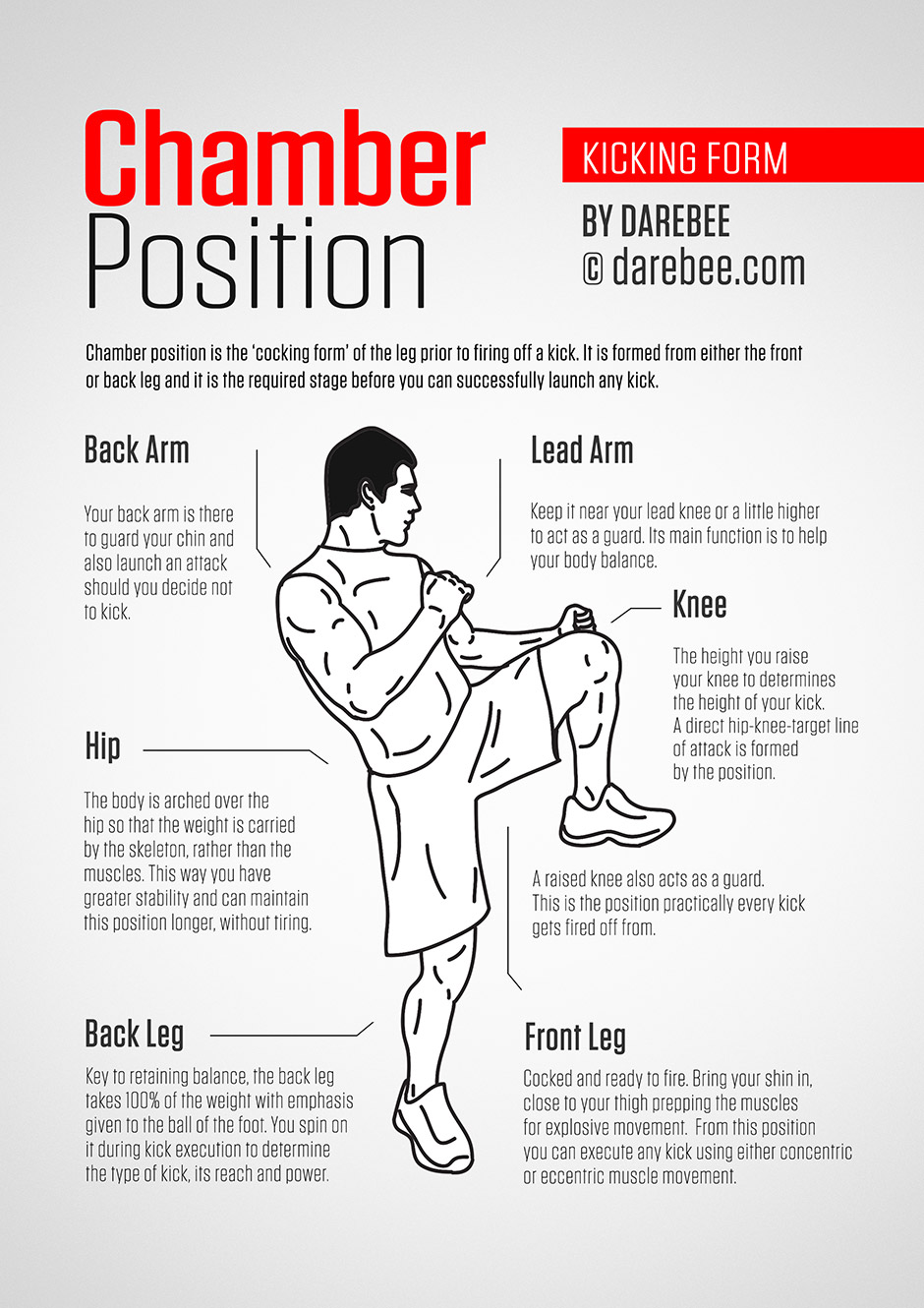
There are two important things to keep in mind when executing kicks. First every kick that requires muscles to coil and spring starts from the same initial position, called “chamber position”. Whether the kick starts from the front leg or the back, the chamber position is the same and it brings up the leg in the cocked position, the other leg, acting as the support and balance.
Second, the height of a kick is determined by how high the knee is raised. A lot of arc kicks also require the chamber position to be formed prior to execution as they utilize some of the same muscle groups as a push type kick.
Side Kick
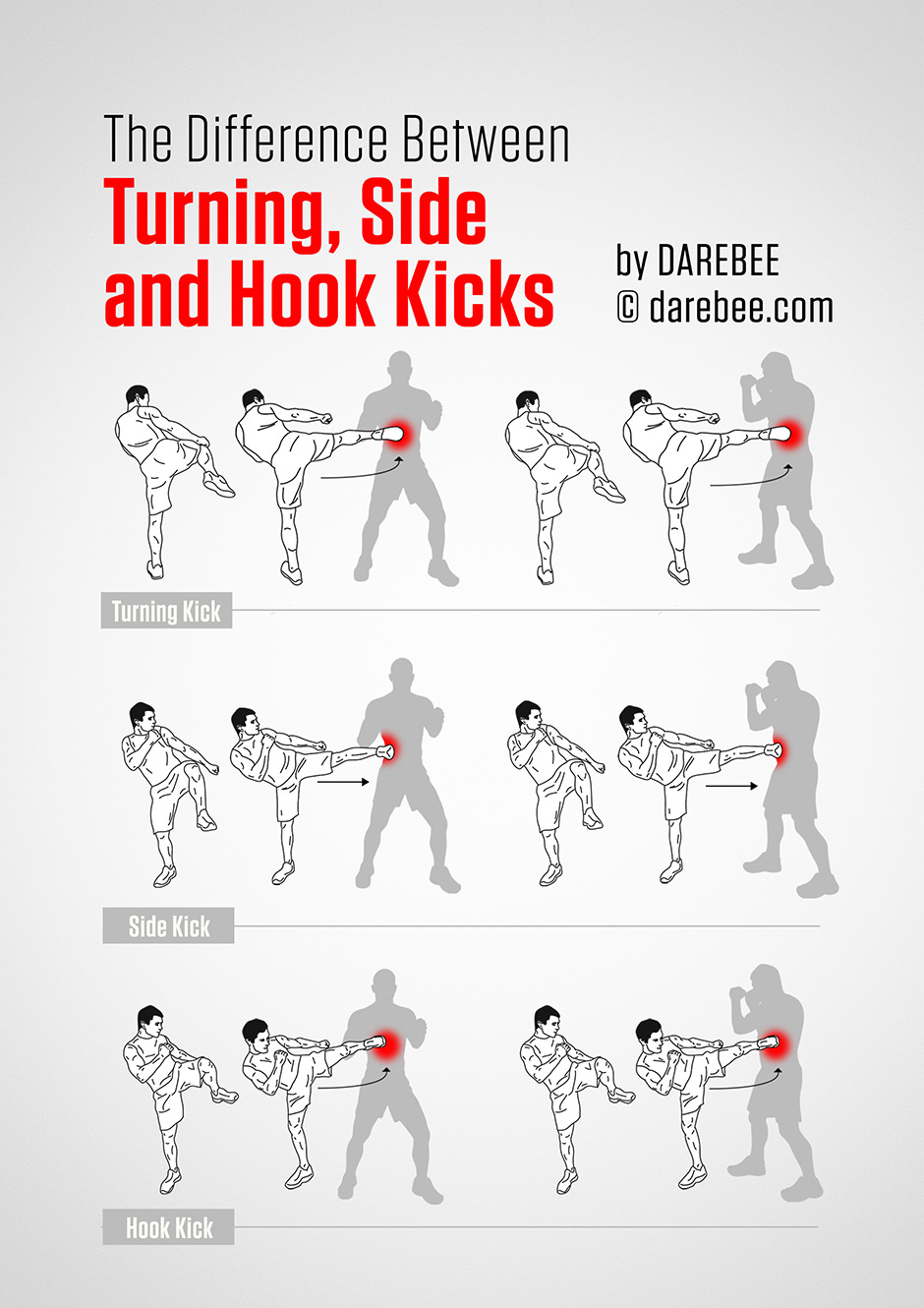
Easily one of the fastest and most powerful push kicks you can perform, a side kick can be thrown from either the back or the front leg, used as a checking kick or an attacking one.
Gets its power from: quads (for a fast checking kick with minimal body movement), quads, glutes and obliques (for a side kick where the supporting leg, spins on the ball of the foot to bring the whole body to bear).
Great for: Checking an opponent’s attack. Launching a quick attack. Launching a powerful, deep attack (when launched from the back leg with maximum bodyweight behind it).
Striking area: Usually the edge of the foot (called footsword), or occasionally, the flat of the foot.
Turning Kick
Also known as roundhouse kick. It can be a defensive or attacking technique and can be thrown by the front or back leg. It is an arc kick that performs the leg equivalent of a slap, although a very powerful one.
Gets its power from: Quads (for a front leg kick), quads, glutes and lower back muscles for a kick that utilizes the whole body weight to maximize impact.
Great for: Probing an opponent’s guard for weaknesses. It can be used as an attacking kick and it is perfect for setting up an opponent for multiple strikes with the same leg, often at different heights.
Striking area: The instep or top of the foot. The ball of the foot (if you bend your toes back and shape your foot to a 90 degree angle). The shin (a favored Muay Thai kick).
Hook Kick
This is a kick that uses the eccentric motion of the muscles to deliver an unexpected blow that comes in from the blind side (usually). This is usually a kick that’s used to attack, rather than defend.
Gets its power from: Quads (for a front leg kick), quads, glutes, lower back muscles and front hip flexors for a kick that utilizes the whole body weight to maximize impact.
Great for: Delivering a kick on an opponent’s blind side.
Striking area: The heel or the flat of the foot (for a kick aimed at just delivering sparring points).
Front Kick
The most straightforward of push kicks. It uses the leg’s basic mechanical movement to deliver a powerful blow in the shortest line possible, between two targets.
Gets its power from: Quads (primarily), glutes, front hip flexors and lower abs. The hip muscles and glutes if it is executed from a back leg position.
Great for: Delivering a kick in the shortest possible time, when fighting in a forward facing position.
Striking area: The ball of the foot.
Push Kick
Although from a biomechanical action point of view a side kick, front kick and back kick are all push kicks, there is a kick that specifically coils the body’s primary muscle groups to utilize the force generated and push through a defense or push an opponent away. The push kick generates the maximum amount of power possible from the coiling of the body’s muscles and throwing of a kick in a forward facing position.
Gets its power from: Quads, glutes, abs, hip flexors and lower back muscles.
Great for: Pushing an opponent away, breaking through an opponent’s guard, kicking down a door (the action is identical).
Striking area: The flat of the foot.
Axe Kick
An axe kick is an arc king in the sense that the leg undergoes a trajectory in order to generate the power it needs and strike a target. In keeping with the purpose of arc kicks, it can generate a disproportionate amount of power for the muscle groups it uses.
Gets its power from: Front hip flexors, pelvic muscle and lower abs.
Great for: Striking a target with a vertical top-down motion.
Striking area: The heel of the foot.
Kick Combinations
Kick combinations are designed to get round the seeming impossibility of delivering successive kicks without compromising one’s balance. They are usually delivered in an alternative-legs style so that the body is repositioned after each kick to deliver a new one with the other leg and this minimizes downtime between kicks and does not require extra steps to be taken between kicks.
Different kicks can also be delivered with the same leg, though usually, when that happens mobility and power are sacrificed.
When it comes to fighting kicks are the great equalizer. By using strong muscle groups in the body to attack a target they make up for deficits in strength and reach. A weaker fighter, for example, can overcome a much larger, stronger opponent, by delivering strong kicks at vulnerable areas.
As such kicks are not only the great equalizer allowing, say a woman, to beat a stronger larger man in fighting but also help reduce risk by increasing the safe distance from which you can strike at a target.
How to warm up before doing kicks
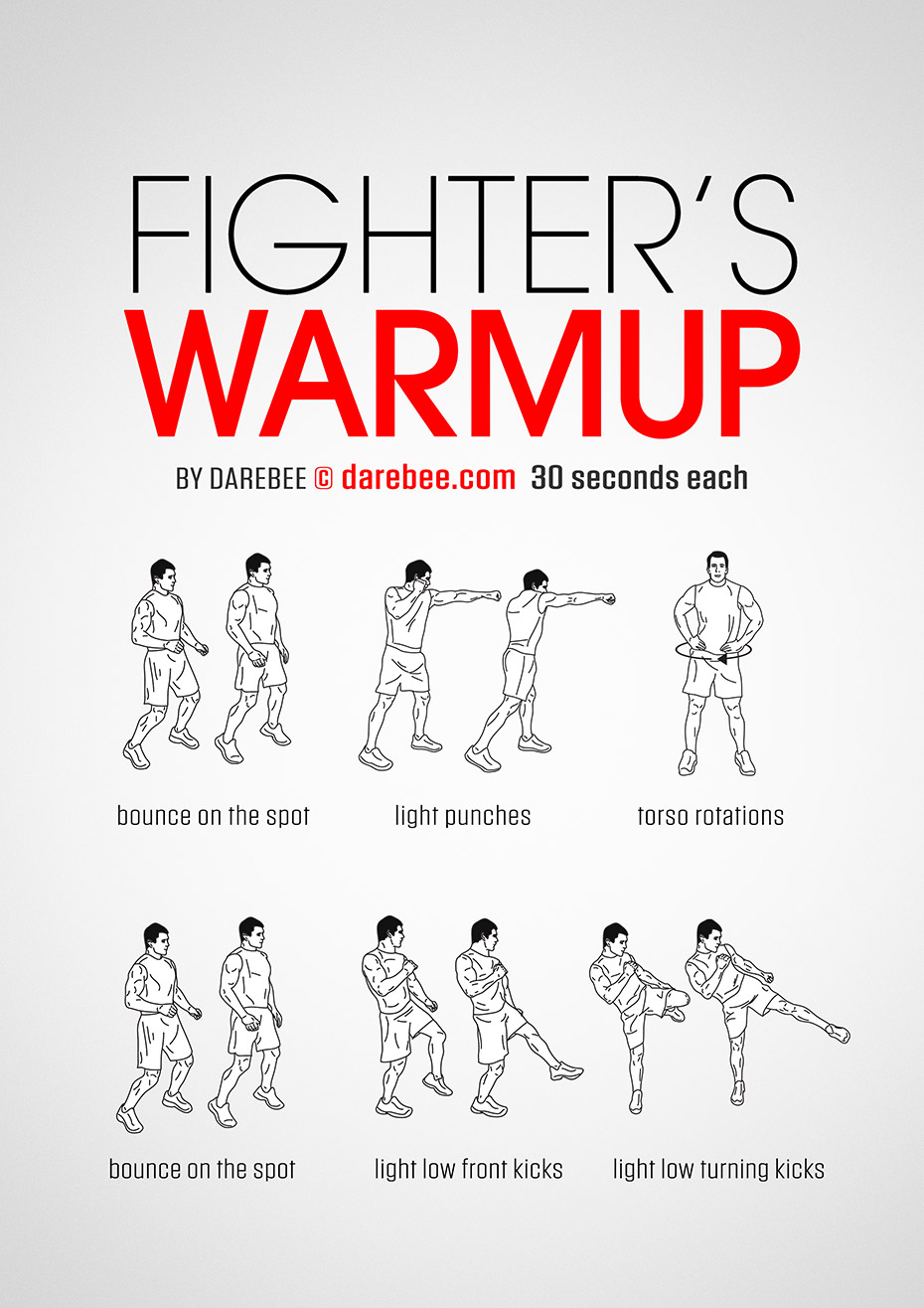
Kicks use large muscle groups in fast, explosive movements. Unless you have warmed up beforehand engaging in this kind of activity significantly increases the risks of a sports injury. There are two effective ways of warming up for kicks and both are necessary: First, raising the temperature of the muscle groups by raising the overall temperature of the body. This requires a little light running, jogging on the spot, skipping rope, doing push-ups. Second, raising the temperature of specific muscle groups by increasing the blood flow to them. This requires executing a technique in a powered-down mode, so you are kicking lightly, using the technique to get the muscles you will be using, warmed up and ready.
Getting your kicks right
Power and elegance in execution, in kicks, require good technique. Here are all the elements that make great kicks happen:
- Good balance
- Flexibility
- Tendon strength
- Explosiveness
- Great technique
Good balance requires strong muscles in the supporting muscle groups, not just the ones you use when you perform a kick. A side kick, for instance, puts as much emphasis on the strength and stability of your standing leg as it does on the power of the muscles that execute the kick. Bodyweight exercises, slow kicking techniques, and isometric exercises help develop a lot of the muscle groups you need.
Flexibility is needed to increase speed and free the range of motion of the muscles. There are many different flexibility workouts you can implement here. Flexibility is always a post-workout exercise and some workouts you do should be all flexibility, ones.
Tendon strength exercises are incorporated in many bodyweight workouts. Tendon strength works the front and side hip flexors that are required for the fast execution of kicks. Infinity circles and leg swings help develop the tendons you need and also strengthen the supporting muscle groups.
Explosiveness is developed through anaerobic HIIT training and by pushing the muscles past their limit with exercises to failure.
Powerful Combos
It is always relatively easy to learn to perform a single kick. It takes an understanding of the technique and the power it generates and the development of good balance in order to execute it. Kicks, however really begin to make you feel awesome when you can perform a combination of them in the blink of an eye. That takes a little more practice and it requires an understanding of what goes together and why.
You can't for example, easily use one push-type kick after another. Because push-type kicks coil the muscles and explode in a more or less linear motion, they take some time to get into the starting position so a succession of such type of kicks is hard because it is slow. So one side kick performed after another is self-defeating, just as it is self defeating to perform one front kick after another. The target you're hoping to hit has either moved away in the time between the kicks or, worse, has struck back.
Combinations, therefore, tend to have a very distinctive rhythm of form that looks a little like this: push-type kick + arc-type kick + arc-type or push-type kick or, inverting this: arc-type kick + push-type kick + push-type or arc-type kick. The reason two push-type kicks can be performed together in quick succession at the end of a combination when they shouldn't at its beginning lies in the mechanics of combining kicks. Beyond the fact that a combination of kicks, performed well is great to see, there is a practical reason we do this: it allows us to strike a moving target, using our legs but without taking unnecessary steps which would signal what we do and make it easy to counter or evade and which would also slow us down.
So, an attack combination might look like: side kick + turning kick + turning kick or side kick. After a combination of kicks starts the way it finishes depends on where a target and how fast it is moving to avoid being struck. In the example above, if the target is not moving very fast to get away the combination can finish with a turning kick because the target is within range from the previous strike. If the target is trying to get away however (eg. an opponent back-pedaling) a turning kick is likely to end up short whereas a side kick gives extra reach and can still strike it.
That also suggests how you learn to choose which kick to use in the first instance and when you should sacrifice good balance and mobility and deliver successive kicks from the same leg, without putting your foot down in between. Basically the choice of opening kick is governed by the distance to the target and whether it is moving away as it is struck, or remaining relatively stationary and within steady reach. Facing someone determined to fight with you, for instance, means you don't have to chase them so the kicks will be arc type (unless you want to push them further away from you). If the target is not moving away you can use successive kicks thrown from the same leg (double and triple kicks) and these can even be of the same type and they can be thrown at the same height or varying heights, depending on the situation.
Someone who is moving aggressively towards you, requires a push-type kick to act as a checking kick, quickly followed up by an arc-type kick (as they're not moving away and you do not have to make up for distance).
Putting kick combinations together is a skill and the best way to get better at it is to visualize a sparring scenario and simply drill again and again in a particular combination, until you are proficient. You can then begin on the next one.
Heavy Bag or Empty Air?
The question of whether you should be practicing kicks on a heavy bag or on empty air is the same one that's asked in boxing about bag work and shadow boxing. Both are needed. Each one does something different. Heavy bag work allows you to develop focus and power and also get a feel for the positive feedback which comes from an impact when a strong kick connects. Practicing without a target allows you to develop balance, coordination and speed.
If you're serious about becoming a kicking sensation then you definitely need both. If you're using kicks as part of your fitness training practicing without a bag is good enough. It always comes down to aims and goals which then govern choice. Regardless what you choose you should always aim to enjoy learning to kick well and just have fun.
Whether you learn to kick because you’re doing a martial art or are simply using kicks as a way to spice up your fitness training, the results are the same: greater muscle control, enhanced ability and range of movement in your body and a sense that you have shaped yourself to be an instrument of your will. A real living weapon.