
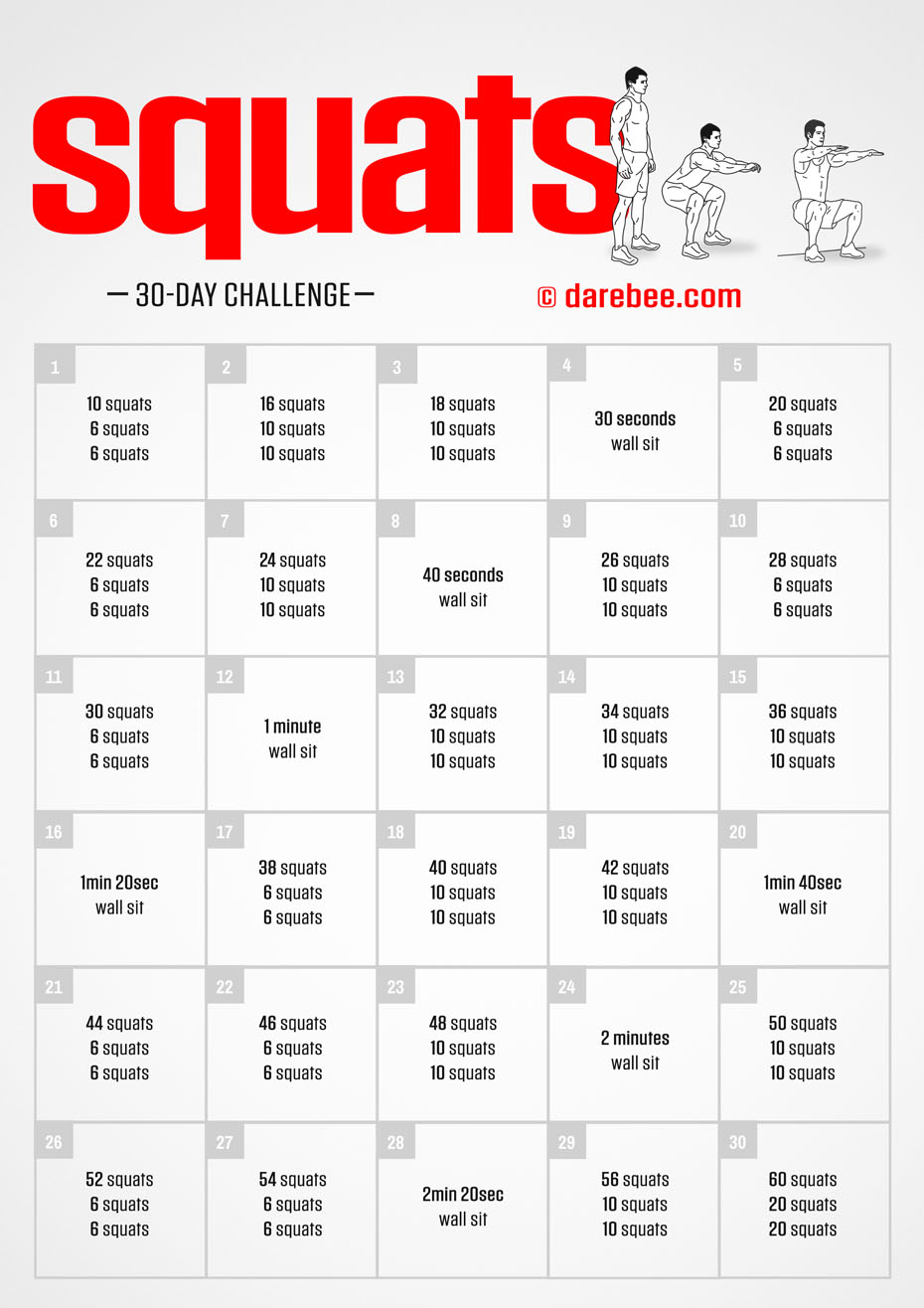
Tap a day on the poster to check it off — your progress is saved on this device.


Three sets of squats a day for a month, with a wall sit every fourth day. The squat works your quads, glutes and hamstrings with your core holding you upright, and it takes your hips, knees and ankles through their full range, which is why it is the most useful lower body exercise there is.
The first set carries the whole progression. It runs 10, 16, 18, 20, 22, 24 and upward to 60 on day 30. Sets two and three alternate between 6 and 10 in a pattern that has no relationship to the first number - some days it is 6 and 6, some days 10 and 10, and it switches without warning. They are there for accumulated volume rather than as targets. Chase the first set and take what the other two give you. Day 30 breaks the pattern by jumping to 20 and 20.
Wall sit days fall on days 4, 8, 12, 16, 20, 24 and 28, climbing from 30 seconds to 2 minutes 20. They are not a joint break - a wall sit loads your knees isometrically and is arguably harder on them than squatting is. What they give you is a break from the movement pattern: the same muscles working with nothing moving, which is a genuinely different demand.
It needs standing room and a clear stretch of wall on the wall sit days. No equipment, no impact and no noise. The difficulty rating is 3 and the last week earns it - 52 to 60 reps in a first set is a lot of squatting in one go.
How to do the exercises
Two exercises run through this challenge: squats and the wall sit.
- Squats: stand with your feet shoulder-width apart and your toes turned slightly out. Push your hips back and bend your knees until your thighs are near parallel with the floor, keeping your chest up, your weight through your heels and your knees tracking out over your toes rather than caving in. Drive back up through your heels and squeeze your glutes at the top. Depth is the first thing to go when the numbers climb, so shorten the set rather than the range - thirty proper squats beat sixty half ones. Take up to two minutes of rest between sets, which is what the descending structure is built around.
- Wall Sit: stand with your back flat against a wall and walk your feet out about half a metre. Slide down until your thighs are parallel with the floor and your knees are bent at a right angle, with your knees directly above your ankles rather than out past your toes. Keep your whole back against the wall and your weight through your heels. Arms folded or hanging at your sides. Breathe steadily - the instinct in a long hold is to hold your breath and it makes the burn worse. Resting your hands on your thighs takes a noticeable amount of load off and is a fair adjustment rather than cheating. A squat hold away from the wall is the alternative if no clear wall is available.
Adjust Difficulty
Make it easier: Reduce the depth on both exercises - sitting higher in a wall sit takes a large share of the load off and a shallower squat does the same. Squat down to a chair and tap it before rising, which gives you a depth target and something to catch you. Split the first set into two blocks with a short rest. Take longer between sets. Repeating a day's numbers rather than climbing is a reasonable adjustment. On wall sit days, split the time into two halves.
Make it harder: Slow every rep to a 3-count on the way down and pause at the bottom. Cut the rest to 30 seconds. Hold a bag of books against your chest, which is the simplest way to load a challenge that is otherwise all volume. On wall sit days, sit lower than parallel, hold your arms straight out in front of you or lift your heels so you are on the balls of your feet. Doing all three sets back to back with no rest turns the first set target into a much harder proposition.
What to expect
The first week is comfortable and mostly about establishing the habit. Expect quad and glute soreness after the first couple of days if daily squatting is new, settling within a week as your body adapts to the frequency.
The wall sit days will feel like a break in week one and will not by week four, when 2 minutes 20 on legs that squatted 48 reps two days earlier is a serious hold. Around day 17 the first set passes 38 and the day stops being quick.
Watch your knees across the month. General muscle soreness is expected and normal. Pain at a specific point in the knee, particularly on the wall sit days, means reduce the depth rather than push through - sitting higher costs nothing and protects the rest of the month.
By week three you will notice your hips and ankles feeling looser, which is one of the more useful side effects of squatting every day. The last week is 52, 54, 56 and 60 rep first sets plus a 2 minute 20 wall sit. What you get is stronger legs and glutes, better movement in your hips and knees and around 1,800 squats behind you.