
Tap a day on the poster to check it off — your progress is saved on this device.


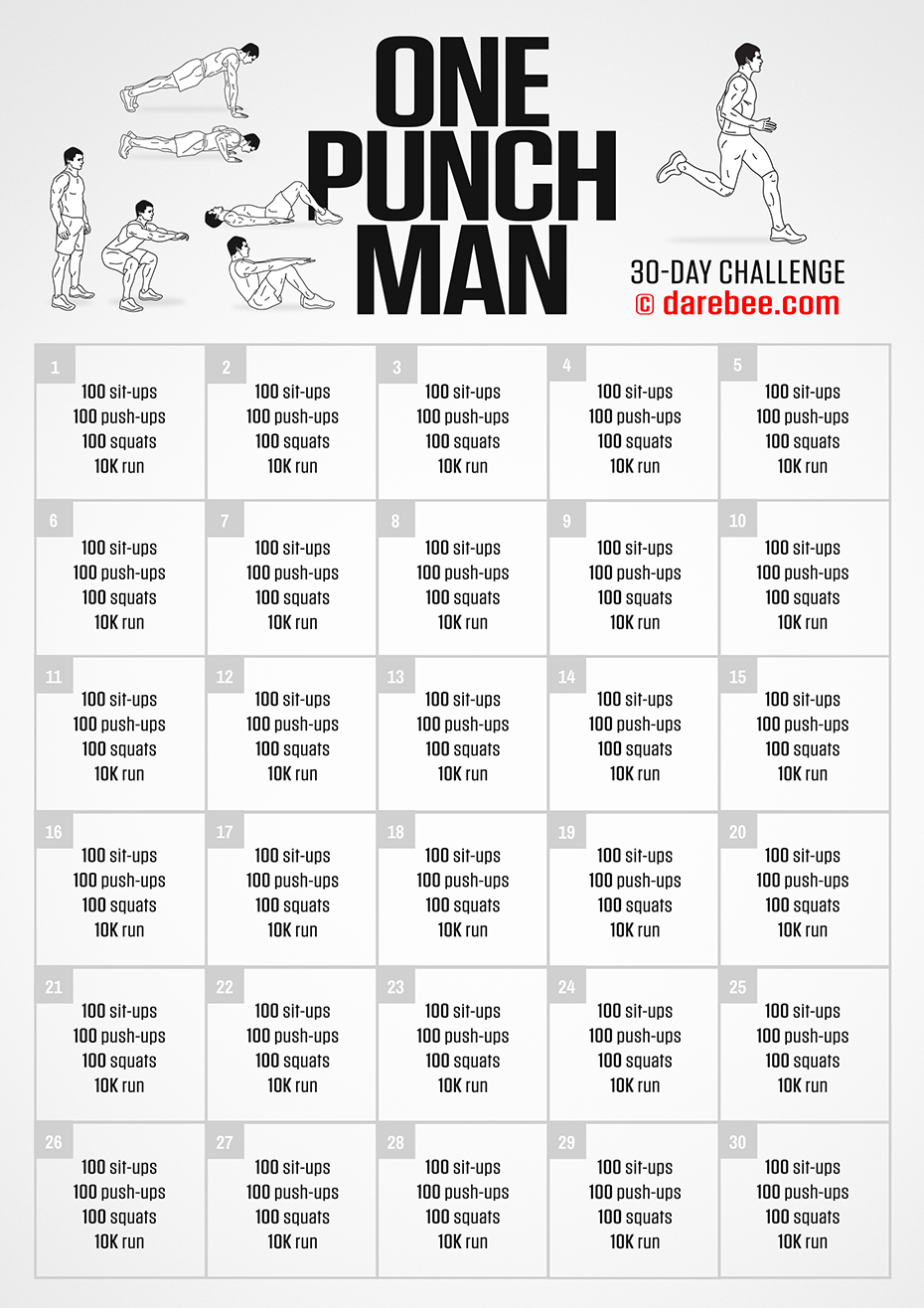
The most famous training routine in anime, taken at face value. One hundred sit-ups, one hundred push-ups, one hundred squats and a 10K run. Every day. For thirty days. No equipment beyond a pair of running shoes and nowhere to hide - the whole thing is four numbers and the will to keep meeting them.
Nothing on the calendar changes because nothing needs to. This is the hardest challenge on the site and the difficulty comes entirely from the repetition: 3,000 sit-ups, 3,000 push-ups, 3,000 squats and 300 kilometres across a month with no rest days built in. Be clear-eyed about that before you start. This is a serious volume of work for anyone who is not already training daily, and going in cold is how people end up injured in week one rather than legendary in week four. Scaling it is not failing it.
How to do the exercises
Four things run through this challenge, done every single day.
- Sit-Ups: lie on your back with your knees bent and feet flat, arms crossed over your chest. Curl up until your torso is upright, keeping your chin off your chest and your neck relaxed, then lower under control. Do not pull on your head or throw yourself up with momentum. Crunches are the swap if your back or neck complains at this volume.
- Push-Ups: hold a straight line from heels to head, lower until your elbows bend to about 90 degrees and press back up. Knee push-ups and incline push-ups with your hands raised both count and both belong in the mix once fatigue starts changing your form.
- Squats: feet shoulder-width apart, hips back, down until your thighs are near parallel, up through your heels with a squeeze at the top. Keep your knees tracking over your toes - at a hundred reps a day, form drift is what causes problems rather than the reps themselves.
- 10K Run: ten kilometres, however you get there. Outside, on a treadmill, or split across two runs in a day. If you are not already a runner, this is the part that needs building rather than attempting whole from day one.
None of the reps have to be done in one go. Splitting 100 into sets, or spreading them across the day, gets you to the same total with considerably better form and far less risk.
Adjust Difficulty
Make it easier: Scale the whole thing to your starting point and build toward the full version. Half the reps and a 5K is still a serious daily session and a far better plan than three days at full volume followed by a fortnight off injured. Walk part or all of the 10K - the difference between walking, jogging and running matters less than covering the distance. Break every rep count into small sets across the day. Use knee push-ups and crunches freely. Take a rest day when your body asks for one; the calendar does not include them and it should for most people.
Make it harder: There is not much room above this, but if you want it: do each set of 100 unbroken, add the push-up variations that suit your weak points, run the 10K at pace rather than steady, or add the 100 pull-ups the source material implies but the poster does not. Doing the whole session in one continuous block rather than spread across the day is the honest hard version.
What to expect
Week one will hurt everywhere. That is expected and it settles. What does not settle on its own is joint and tendon pain, particularly in knees, elbows and shins, and that is the signal to scale rather than push - tendons adapt on a much slower clock than muscles do, and this challenge loads them daily with no recovery built in. Watch your shins especially if the 10K is new to you. Eat and sleep accordingly; at this volume, recovery is part of the training rather than an optional extra. What you get if you complete it is significant strength endurance and cardiovascular fitness, and a month of evidence that you can decide to do something difficult every day and then do it.