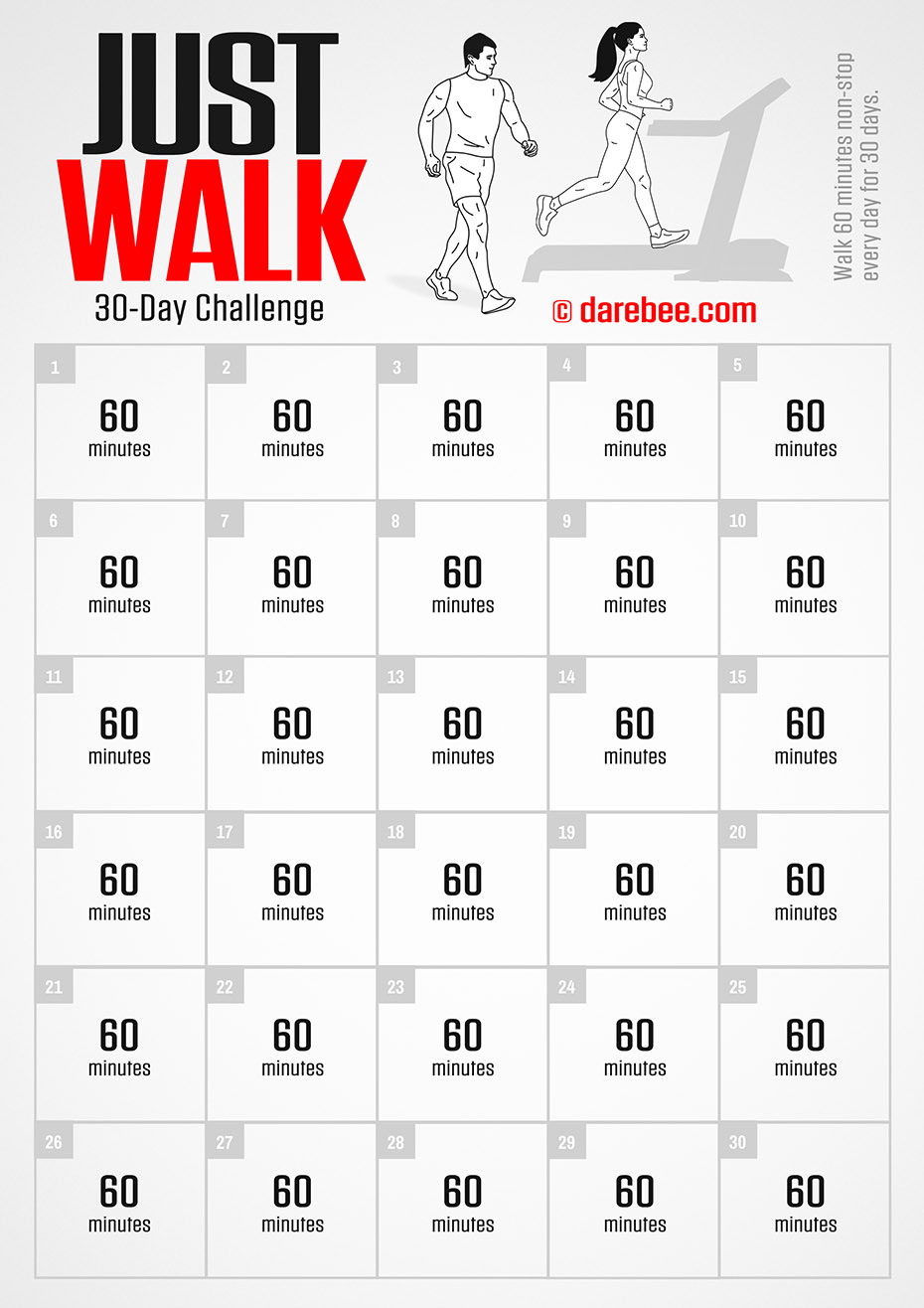
Tap a day on the poster to check it off — your progress is saved on this device.


We were born to walk. It lowers body fat, improves cardiovascular fitness, helps aerobic performance, clears your head and gives you back a sense of control over your own body. Just Walk asks for 60 minutes of it every day for thirty days. No equipment, no technique to learn and nothing to book. The only real requirement is an hour and a pair of shoes you trust.
The number never changes and there are no rest days, which is where the difficulty sits. The other detail that matters: this hour is non-stop. Unlike a step count that you accumulate across a day, this is one continuous walk, and continuous is what makes it different. Your body settles into a steady aerobic effort somewhere in the first ten minutes and stays there, which is the state that does the work. Thirty of those hours across a month adds up to something a scattered version of the same time never quite reaches.
How to do it
One activity runs through this challenge: walking, for a continuous hour.
Walk at a pace you can hold for the full sixty minutes - brisk enough that you are aware you are working but not so hard that talking becomes difficult. Land through your whole foot, keep your shoulders relaxed and let your arms swing naturally rather than pumping them. Stand tall instead of leaning forward and look ahead rather than down at your feet. Outside is the obvious choice, but a treadmill counts entirely and so does walking laps of a shopping centre, a corridor or a car park if the weather or the hour makes outdoors impractical. Where you walk is not the variable. The unbroken hour is.
If you want more on pace, form and what walking actually does for body composition, the Guide to Walking for Fat Loss and The Difference Between Walking, Jogging and Running both go deeper than a challenge page can.
Adjust Difficulty
Make it easier: Start at 30 minutes and add five minutes every few days until you reach the hour. An unbroken sixty minutes is a real ask if you are not used to it and building toward it beats abandoning the challenge in week one. Split the hour into two thirty-minute walks if a single block will not fit your day - you lose some of the continuous benefit and keep most of the rest. Slow the pace right down. A relaxed hour still counts and is far better than a brisk twenty minutes followed by three days off. A treadmill removes weather, darkness and safety from the equation entirely.
Make it harder: Pick up the pace until you are walking at the edge of comfortable conversation. Find hills, or set an incline on the treadmill - gradient changes the effort more than speed does and is easier on your joints than going faster. Carry a loaded backpack, starting light at around 5kg. Add intervals: three minutes brisk, two minutes easy, repeated for the hour. Or extend the walk to 90 minutes on the days when you have the time, which is where walking starts producing the kind of endurance that transfers to everything else.
What to expect
The first week is where you find out whether your shoes are up to it. Sore feet, tight calves and complaining shins in the early days almost always come down to footwear, so wear something with support you trust and replace anything worn flat. Fitting a full hour into a day takes planning and most people find that anchoring it to a fixed time - first thing, at lunch, straight after work - is the difference between a streak that holds and one that collapses in week two. Somewhere in the second week the hour stops feeling long. By the end of the month expect better cardiovascular fitness, easier breathing on stairs and hills, and steadier energy through the day. The mental side is the part people underestimate. An hour of walking every day for a month is an hour of thinking time, and most people finish this challenge more attached to that than to the fitness.