Tap a day on the poster to check it off — your progress is saved on this device.


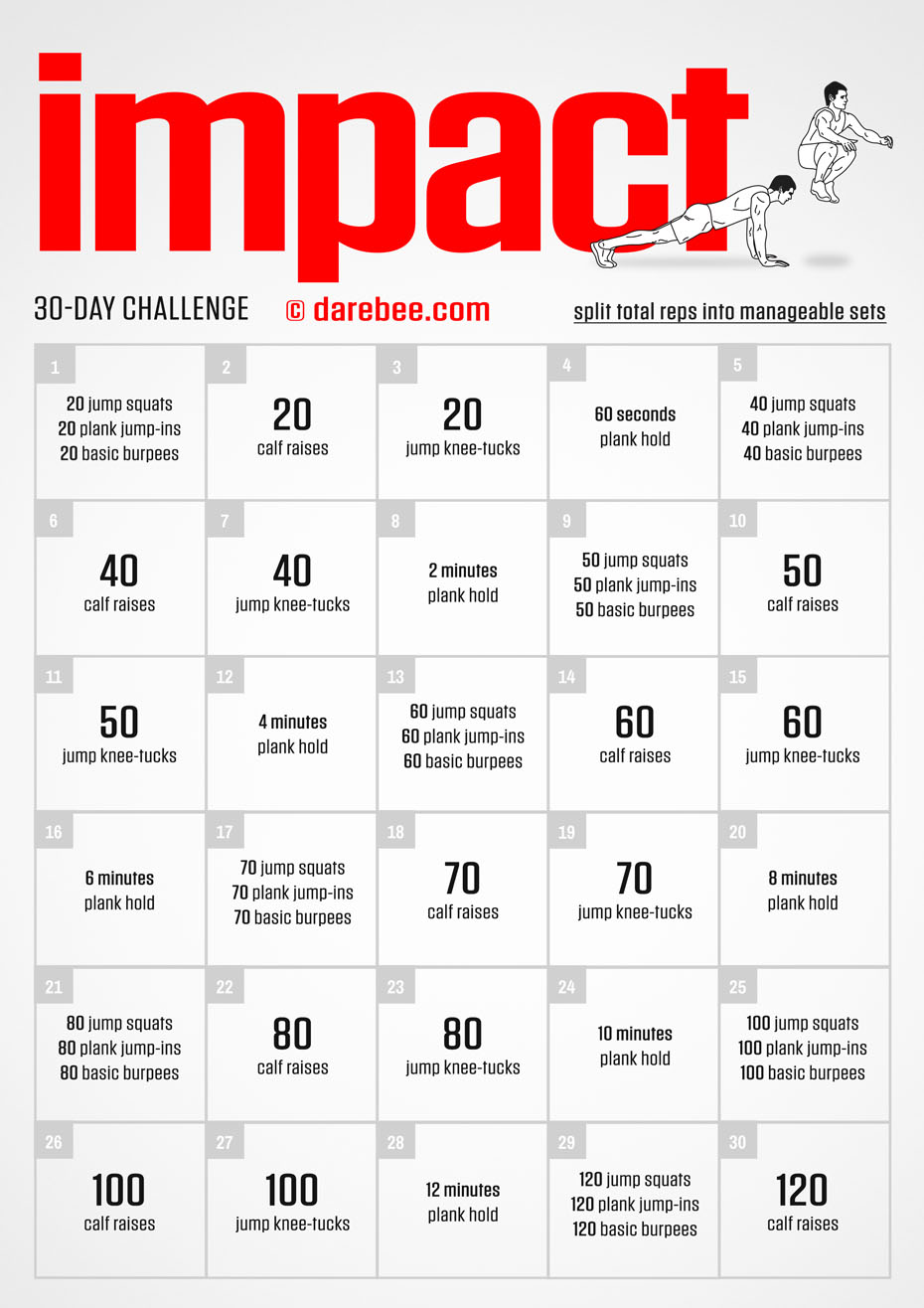
Impact is a month of jumping. Jump squats, plank jump-ins, burpees and jump knee-tucks all leave the ground, and calf raises and plank holds are threaded between them to work the tissue that absorbs the landings. It is the highest-impact challenge we have and the name is a description rather than a slogan.
The calendar runs a four-day cycle that repeats seven and a half times: a triple day with all three jumping exercises, a calf raise day, a jump knee-tuck day and a plank hold day. The triple days are the load and the three single-exercise days let different things recover while you keep going. The numbers climb together in steps of 10 or 20, while the plank holds climb in minutes from 60 seconds on day 4 to 12 minutes on day 28.
The difficulty rating is 5 and both ends of the challenge earn it. Day 29 is 360 reps across three jumping exercises, which is a long hard session however you split it. Day 28 is a twelve-minute plank, which almost nobody holds unbroken and which is meant to be broken into pieces.
Before you start, be honest about the impact. Three hundred and sixty landings in a day is a lot for shins, knees and Achilles tendons, and this challenge will find any weakness there. Everything has a low-impact substitute below and using them is a sensible decision rather than a failure. It needs a body-length of floor and no equipment.
How to do the exercises
Five exercises run through this challenge: jump squats, plank jump-ins, burpees, calf raises and the plank hold. On any day with a rep count, the number is a total and splitting it into sets is expected.
- Jump Squats: squat down with your chest up and your weight through your heels, then drive up and jump. Land soft, absorb through your knees and hips and go straight into the next squat. The landing is where this exercise is won or lost - a stiff-legged landing repeated a hundred times is what makes knees ache.
- Plank Jump-Ins: from a plank with your hands under your shoulders, jump both feet forward toward your hands, then jump them back out to the plank. That is one rep. Keep your hips from piking up as your feet come in and land the feet lightly rather than stamping.
- Burpees: squat down, hands to the floor, feet back into a plank, feet back in and jump up with your arms overhead. That is one rep. The poster shows the version with the jump and no push-up. Keep your back flat in the plank and land soft. Step burpees remove the impact at both ends.
- Jump Knee-Tucks: from standing, jump straight up and pull both knees toward your chest, then land soft with your knees bent and go again. Height matters less than a soft landing. These are the highest-impact exercise on the poster.
- Calf Raises: rise onto your toes as high as you can, pause at the top and lower with control until your heels touch the floor. The lowering is where most of the work happens, so take it slower than the rise. These days are not filler - strong calves and Achilles tendons are exactly what absorbs the jumping on the other three days.
- Plank Hold: on straight arms with your hands under your shoulders, body in one line from heels to head. Squeeze your glutes and brace your core. Come down and reset when your hips sag rather than holding a broken position. The elbow version works too if your wrists have taken a beating from the plank jump-ins.
Adjust Difficulty
Make it easier: Replace the jumping. Ordinary squats for jump squats, plank step-ins for plank jump-ins, step burpees for burpees and fast squats for jump knee-tucks. That version of the challenge keeps every number and removes all the impact, and it is a genuinely good month of training. Beyond that, split the totals into as many sets as you need and spread them across the day. On plank days, break the time into blocks and close the gaps over the month - a twelve-minute plank in four pieces is a good result. Reduce the number on any day where your shins or knees are complaining.
Make it harder: Do the triple days as one continuous circuit rather than three separate blocks. Cut the rest between sets. Jump higher and pull the knees closer to your chest on the tucks. Do the plank days unbroken. Adding the push-up to every burpee turns the triple days into a full-body session rather than a lower-body one.
What to expect
The first week is manageable and the triple day on day 1 will still leave you breathing hard, since 60 reps of jumping is a real session. Expect your calves and quads to be sore from day 2 and expect the soreness to sit in your shins if your landings are heavy. That is the signal to soften them rather than to push on.
By the second week the triple days reach 150 to 180 reps and take proper time. The plank holds pass four minutes and become the hardest day of the cycle for most people. Around week three the jumping starts to feel more elastic - you use less effort for the same height, which is the adaptation this kind of training produces. The last week is 300 reps on day 25, a twelve-minute plank on day 28 and 360 reps on day 29.
Watch your joints throughout. Dull general soreness is normal. A specific ache in one shin, one knee or one Achilles that builds day on day is not, and the substitutions above exist for exactly that. What you get is real explosive power, stronger tendons and the conditioning to keep producing hard efforts for a long time. What you risk if you ignore the warning signs is a month off, so take the low-impact route whenever you need it.