
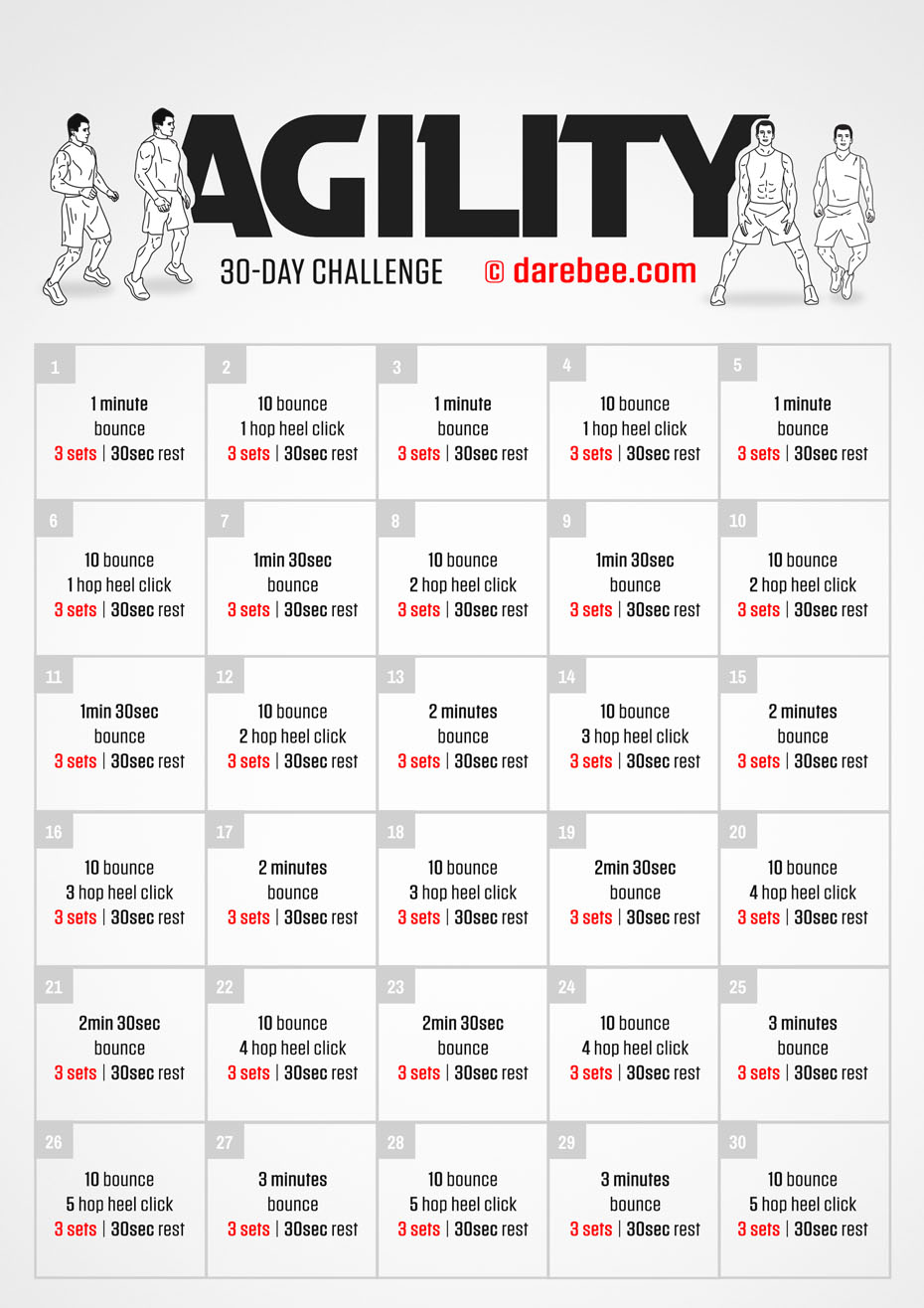
Tap a day on the poster to check it off — your progress is saved on this device.


Agility is the ability to move quickly and easily, and the apparent effortlessness of it comes from tendons, muscles and ligaments working in balance. When that balance is there the body feels almost weightless - you can change direction on a whim, stop and start without effort and jump, run and kick with a smoothness that hides the work behind it. This challenge is thirty days of building that: fascial fitness, lower leg tendon strength, coordination and a share of core work. No equipment and standing room only.
Two day types alternate and they progress in opposite directions. Bounce days climb in time, from 1 minute to 3, across 3 sets with 30 seconds of rest. Hop heel click days hold the bounces at 10 and climb the heel clicks instead, from 1 to 5. One builds endurance in the springy tissues of your lower legs, the other builds the explosive coordination to use them. Both are needed and neither works alone.
How to do the exercises
Two exercises run through this challenge: bounces and hop heel clicks.
- Bounces: stay light on the balls of your feet and bounce continuously in place, keeping your knees soft and your heels barely touching down. This is a small, springy movement rather than a jump - the aim is elastic recoil through your ankles and calves rather than height. Stay relaxed through your shoulders and let the rhythm do the work.
- Hop Heel Clicks: after the bounces, jump up and click your heels together in the air before landing soft with your knees bent. On the days asking for more than one, the clicks come one after another with bounces in between to reset. Land quietly - the noise you make is a good measure of how well you are absorbing force.
Adjust Difficulty
Make it easier: Bounce lower and softer - height adds nothing here and costs you in landing force. Break the time into smaller blocks with extra breathers, particularly on the 3-minute days. On heel click days, do a small hop without the click while you build the coordination, then add the click when the timing feels natural. Take longer than 30 seconds between sets. If your calves or Achilles complain rather than just tire, stop and take a lighter day.
Make it harder: Bounce faster and lighter so your feet spend as little time on the floor as possible - that is where the elastic quality is trained. Add a fourth set. On heel click days, chain the clicks together with a single bounce between them rather than several. Cutting the rest to 15 seconds turns the later weeks into genuine conditioning as well as agility work.
What to expect
Your calves and Achilles do most of the work here and they will let you know in the first week. That soreness settles, but tendon tissue adapts on a slower clock than muscle does, so if anything feels sharp rather than tired, back off - our Training Smart: Tendons, Ligaments and Fascia guide covers why that distinction matters. Expect the heel clicks to be a coordination problem before they are a strength one; most people miss the click entirely for the first few attempts and then it clicks, so to speak. By day 30 you will be bouncing for three minutes and stringing five heel clicks together, and what you notice is the quality rather than the numbers - quieter landings, faster feet and a body that feels lighter than it did on day 1.